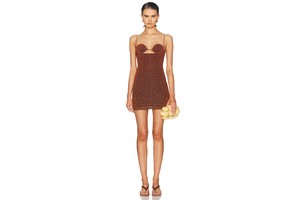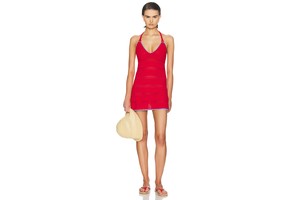
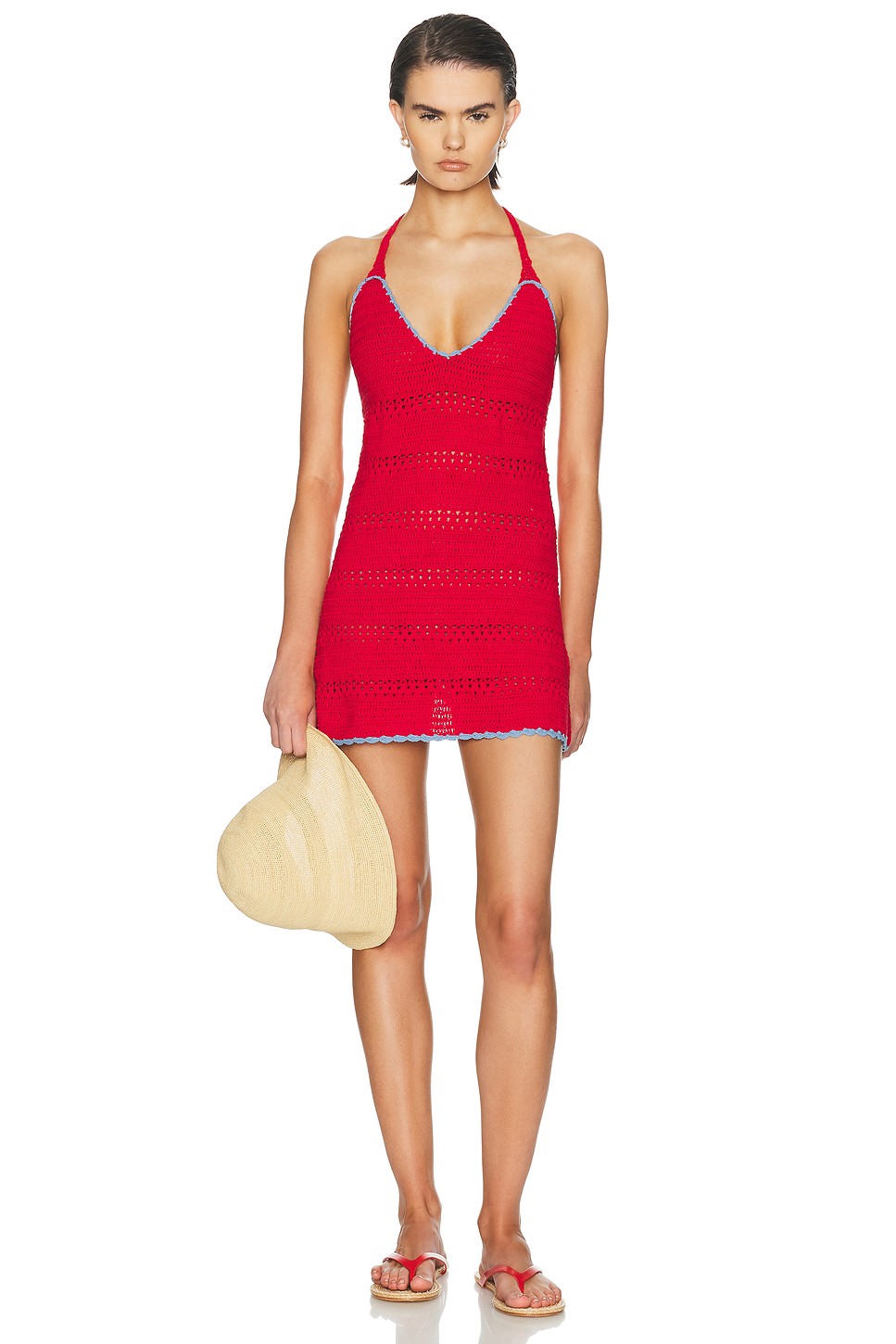
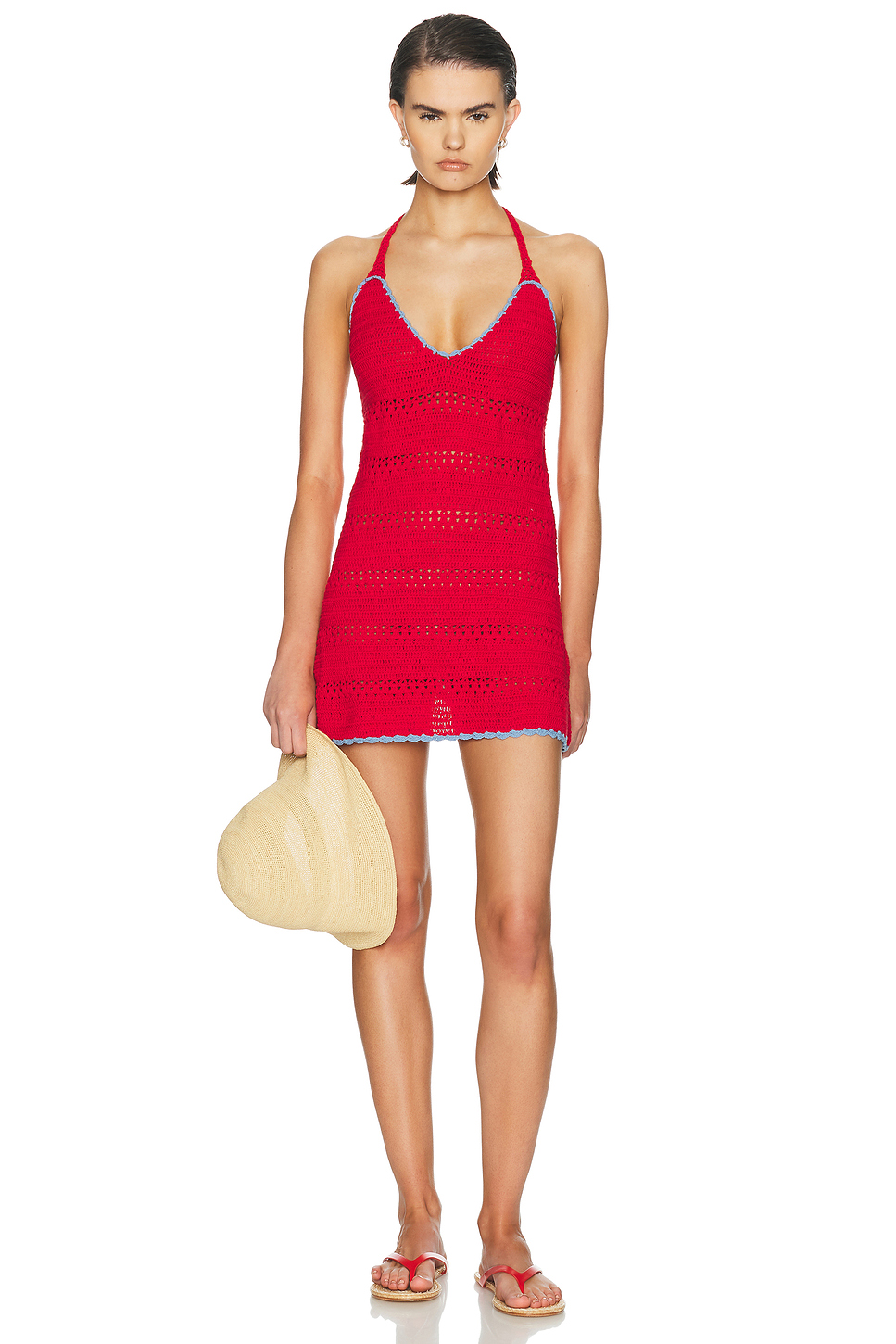
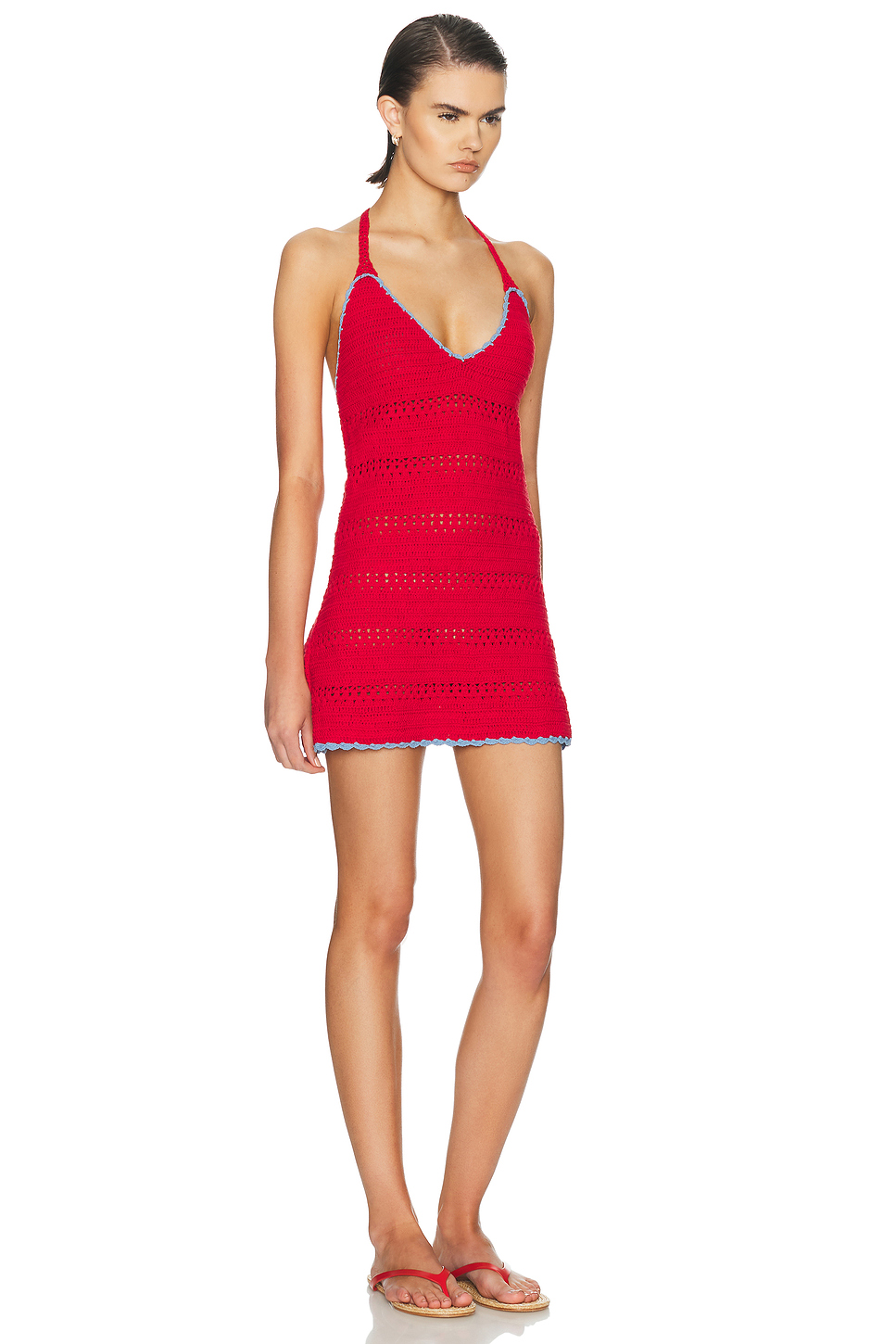
A mini dress listed in 100% cotton, hand wash, unlined, in a mid-weight crochet knit with a self-tie halterneck, made in Indonesia, ranked eleventh in the retailer's dress list, at 280 dollars. There are no reviews and no fit votes, so there is no score to quote. This is the first crochet encountered here, and comparing it with the rest of the openwork family met over several batches reveals why it sits at the extreme end. The sales category also does something genuinely useful, which has not been true of many of these labels. There is also a gap in the care instruction that this construction makes unusually easy to see. The reference is the Cora Mini Dress by ELCE in Siren. Dongguan Bafinasa Garments Co., Ltd. develops comparable cotton crochet dresses on OEM and ODM terms, from yarn sourcing and crochet development to retail or FBA ready packing. We publish this as a development reference and build your own version of it, and we do not supply the branded original or reproduce anyone else's label.
Key Features
- 100% cotton as stated, with hand wash as stated
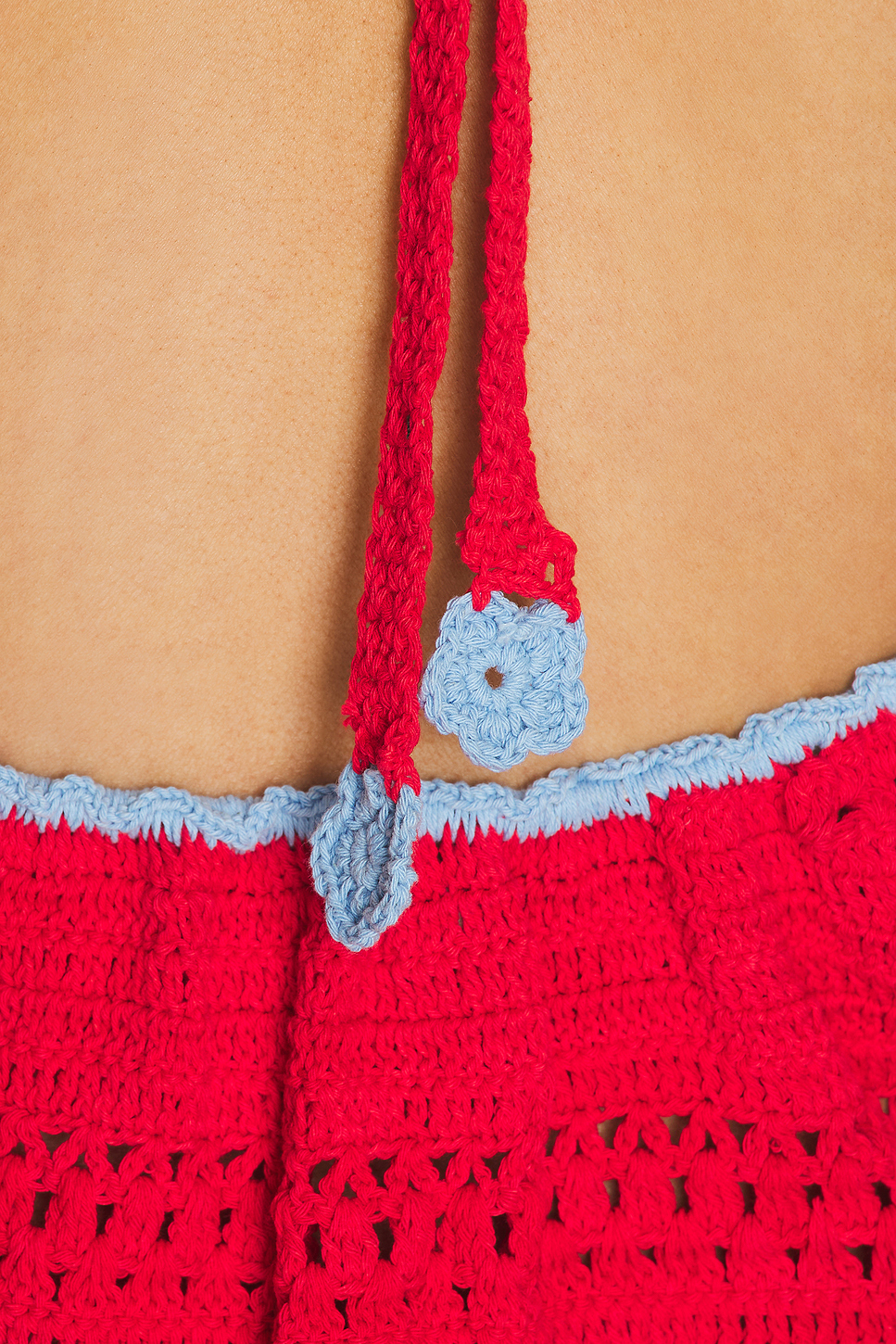
- Mid-weight crochet knit as stated, the first crochet in this series. See the note below
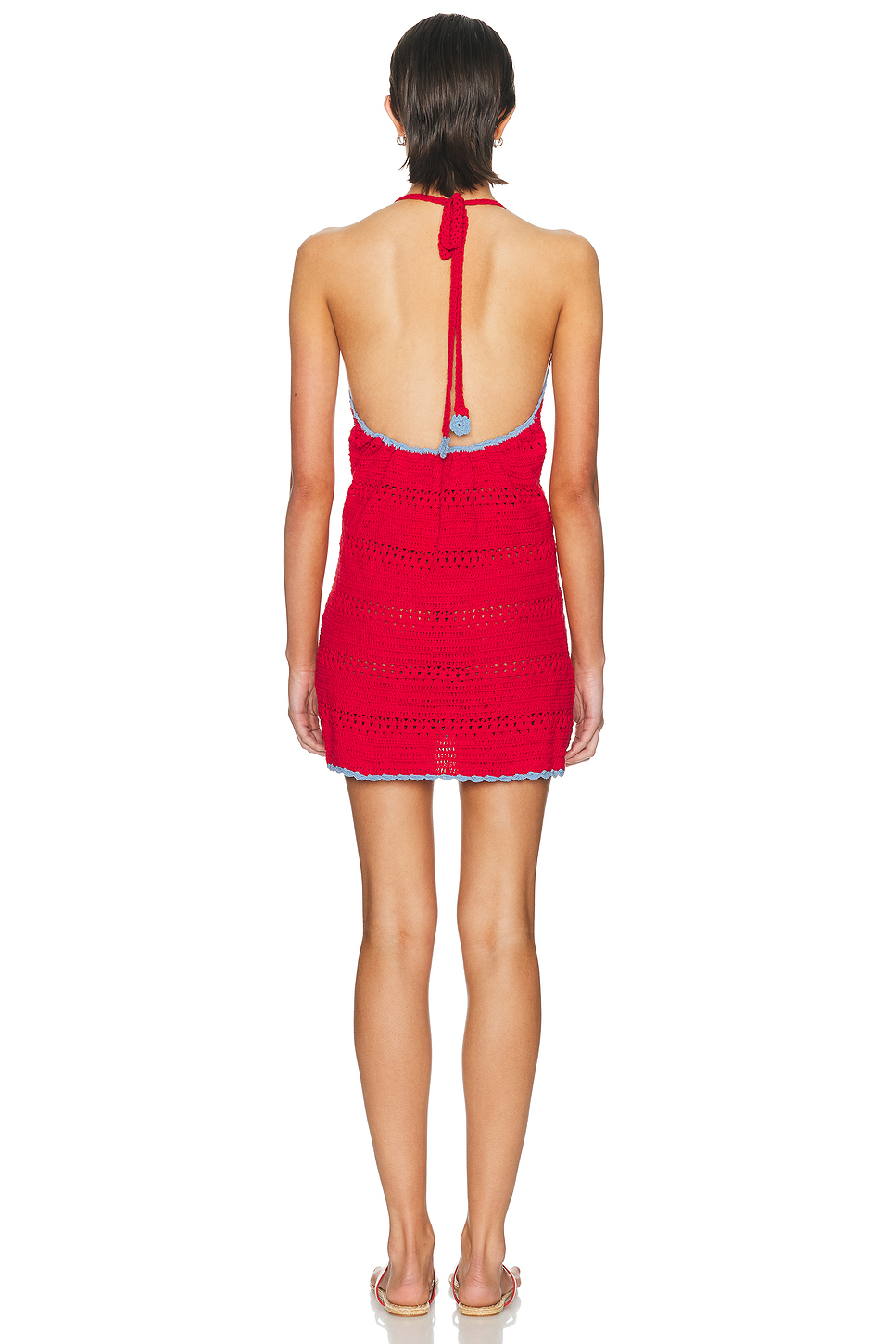
- Self-tie halterneck as stated, which along with the construction explains the bust figure. See the note below
- Unlined as stated, which for this particular construction is normal rather than neglectful
- Mid-weight is stated, and that single word carries more here than anywhere else. See the note below
- Made in Indonesia as stated
- Siren, a strong red, which is toward the safer end for what worries people here
- Measurements published for one size, including bust 25 in. See the note below
Customisable Options
- Fabric: cotton crochet to the reference, with yarn count, hook size and stitch pattern specified rather than only the name
- Weight: midweight to the reference, offered across a range since that decides openness
- Halterneck: self-tie to the reference, with tie length and hardware stated rather than left to be discovered
- Care: hand wash to the reference, plus drying instructions, since this is the part most at risk. See the note below
- Length from mini to knee, stitch pattern openness, size set, colour development, private label and care labelling
Specifications
| Style | Cotton crochet halter mini dress |
| Reference | ELCE, Cora Mini Dress, style ELCF-WD2, manufacturer style CORA, colour Siren |
| Composition | 100% cotton as stated |
| Fabric | Mid-weight crochet knit as stated. See the note below, since this is the first crochet here |
| Lining | Unlined as stated. See the note below |
| Care | Hand wash as stated. See the note below, since there is a second half to this which is missing |
| Neck | Self-tie halterneck as stated |
| Sizes Published | XS, S, M and L |
| Measurements Published | S: bust 25 in, waist 26 in, hip 34 in, length 30.5 in. See the note below |
| Chart Note | The bust sits about eight inches under the model while waist and hip sit at or near. See the note below |
| Coverage | Only size S has figures. XS, M and L are blank |
| Model | 178 cm, bust 84 cm, waist 62 cm, hips 89 cm, wearing size S |
| Production | Made in Indonesia as stated |
| Reference Retail | 280 USD, quoted to show the price band this sits in, not as our price |
| Customer Reviews | None on the reference listing, so we quote no score |
| Best Seller Badge | Rank 11 in the retailer's dress list |
| Categories | Filed by the retailer under sweater dresses and mini dresses. See the note below, since the first is unusual |
| Occasion | Summer, holidays, beach, warm weather, evenings |
| MOQ | 100 pcs per style per colourway, mixed sizes and colourways accepted |
| Sampling | 7-10 days after tech pack or reference sample confirmation |
| Bulk Lead Time | 20-30 days after sample approval and deposit |
| Service | OEM / ODM / private label, cotton yarn sourcing, crochet development, retail or FBA ready packing |
Size Chart
| Size | Bust | Waist | Hips | Length | Source | ||||||||||||
|---|---|---|---|---|---|---|---|---|---|---|---|---|---|---|---|---|---|
| S | 25 | in | 26 | in | 34 | in | 30.5 | in / | 77 | cm | As published | ||||||
| XS | 31 | in / | 79 | cm | 24 | in / | 61 | cm | 34 | in / | 86 | cm | 78 | cm / | 30.7 | in | Our proposal |
| S | 33 | in / | 84 | cm | 26 | in / | 66 | cm | 36 | in / | 91 | cm | 80 | cm / | 31.5 | in | Our proposal |
| M | 35 | in / | 89 | cm | 28 | in / | 71 | cm | 38 | in / | 97 | cm | 82 | cm / | 32.3 | in | Our proposal |
| L | 37 | in / | 94 | cm | 30 | in / | 76 | cm | 40 | in / | 102 | cm | 84 | cm / | 33.1 | in | Our proposal |
The published size S gives bust 25 in, waist 26 in, hip 34 in and length 30.5 in against a model at roughly 33, 24 and 35. The bust sits about eight inches under her, and two things on this page between them account for that fully.
Occasions and Styling
Suits summer, holidays, the beach, warm weather and evenings. Crochet ventilates better than any woven cloth since the openings are structural, which makes it comfortable in heat and worth knowing about before deciding what goes underneath.
Production and Quality Control
There are no reviews and no fit votes on this listing, so we quote no score. This is the first crochet encountered here, and comparing it against the rest of the openwork family reveals why it sits at the extreme end. The sales category also turns out to be genuinely useful, which is not something often said about these labels.
Crochet, and where it sits at the end of the openwork family, and that is the first thing. This series has met openwork repeatedly across several batches, and listing them makes this one's position clear. First came three French words meaning openwork, where it was established that this is the one case where sheerness is definitional rather than incidental. Then the same thing under its English name, which prompted the observation that a customer knowing one name will not recognise the other, so someone who would have avoided the first could buy the second. Then the same work combined with another open structure. Then mesh. Now this, crochet. The important difference is not degree but kind. With embroidery there is cloth, and then holes are introduced into it: something was removed from something that was already there. Crochet has no ground cloth at all. It is built loop into loop, so the openings are not absences in a surface, they are the structure, and there is no anywhere that was ever solid. Several consequences follow and they are worth being precise about because they differ from every other openwork met. Where an embroidered hole has an edge stitched to keep it from fraying, a crochet loop is held only by the next loop passing through it, so there is considerably less holding it. Where a snag in embroidered openwork stays roughly where it happened, a snag in crochet can travel, since each loop depends on its neighbour and pulling one draws on the next along its row. And where a woven or embroidered cloth finally tears locally, this can lose integrity along a whole row, the direction depending on how it was worked. So this construction is the most demanding member of the family on the question of damage being reversible, and this series has maintained throughout that the essential point about these failures is not that they are disappointing but that they cannot be undone. There is a second consequence specific to it which nothing else in the family shares, and it concerns shape rather than damage. Loops arranged this way are not held in a stable geometry by anything, so this kind of cloth does not merely stretch, it grows, particularly when wet and carrying its own weight, and it does not return on its own afterwards. That is the practical thing anyone owning this needs to know, and it is entirely separate from how it is washed. That said, this page supplies the word which keeps all of that proportionate, which is mid-weight. This series established recently that weight words do more work than construction names, since one tells you how much material there is and the other only how things are arranged, and this instance demonstrates it better than the pair it was derived from did. Crochet at its most open is little more than thread, and everything described above applies in full. Crochet described as mid-weight is denser and uses heavier yarn, which does not eliminate any of those tendencies but changes substantially how likely they are to bite. So this single adjective tells a customer more about what she is buying than either of the other two words do, and this page gave it.
Ranked eleventh among sweater dresses, and the label finally earns its keep, and that is the second thing. This is filed under sweater dresses and mini dresses. Now, this series has been sceptical of these labels throughout, having found repeatedly that the same input does not reliably produce the same category, most sharply when two identically named garments from unrelated makers landed in different categories. So the working conclusion has been that a category is worth reading for what it reveals incidentally and worth distrusting for what it asserts. Recently that position was complicated by discovering a silhouette category which actually resolved a conflict in some measurements, and there was a note at the time that such labels could be informative when they happened to be correct without being reliable generally. Sweater fits the same description, and it is worth saying why it is doing so much work here. Sweater says this is knit rather than woven, which immediately accounts for a set of things this series would otherwise have to reason about separately. Knit constructions are built from loops which open under load and recover when load is removed, and this series has noted many times that knit is the commonest explanation encountered for a garment whose measurements sit below the body it fits, and the one permitting the largest shortfall. It also explains why this shape does not need elastane to fit close, since there is none stated here, and it explains why nothing here needs lining to hold its shape. Thirdly, and less obviously, it warns a customer about what damage looks like, since snags rather than tears are what happens. So one category word, used correctly, has replaced four separate lines of inference. That is worth contrasting with an instance in this very same batch, where a garment at forty one inches was filed as mini alongside others at thirty two and a half inches called the same thing, and where comparison with garments at fifty four and a half and fifty five inches produced a set of labels mutually impossible to arrange by length. What separates them is straightforward and worth keeping hold of. A category describing construction is a claim about the garment, and can be right or wrong and checked against what else is said. A length category is a claim about how the garment looked on one particular body, and it carries no information about any other. This series has now found construction and silhouette labels useful several times, and length labels useless almost every time.
Hand wash without the second half, and eighty inches of negative ease explained twice over, and that is the third thing. Start with the instruction, which is hand wash. This is proportionate as far as it goes, since cotton is the most washable fibre examined here, being stronger wet than dry and immune to felting, while crochet is toward the least robust thing you can build from it, for the reasons set out above, so hand wash is a reasonable meeting point between those two. The problem is where it stops, and this series has made this point before in connection with a different garment carrying a condition rather than a method, where it was noted that hand wash restricts the mechanical force which causes damage. What it does not address is what happens next, and for this construction what happens next is most of the risk. Because loops held only by their neighbours will grow under their own weight when wet, hanging this to dry is close to the worst available option, since the weight of the water pulls every loop downward while it dries and it will set longer than it began. The correct advice is to dry it flat, on a towel, reshaping it while damp, which is a sentence costing about ten words and is nowhere here. So the instruction given is adequate for washing and silent about the part where things go wrong, and this series has found that shape of omission repeatedly: knowing to keep water away is not the same as knowing which part needs care. Now the measurements, which are answered more completely than almost anything examined here. The published bust is twenty five inches against a model at roughly thirty three, so about eight inches below her body, which is among the largest shortfalls met anywhere in this series. Two things then apply. First there is the procedure used every time this shape appears, which is to ask whether the garment is strapless, halter or sleeveless, since each removes or weakens the landmarks a bust measurement depends on, and this is a halter, so it engages immediately. Then there is the catalogue of mechanisms, and here two of them are present at once rather than the usual one. Halter ties drawn at the neck belong in the family where nothing needs to stretch and the circumference is set each time it is worn. And crochet is knit, whose loops open. Either alone makes eight inches difficult to explain, and together they account for it, so this is the second instance in recent batches where two mechanisms stack, which is worth recording since until lately every case resolved to a single one. It matters practically because if anybody assumed one mechanism was doing all the work they would overestimate what each contributes. Taken with there being no elastane at all here, nothing has been quietly added to do this quietly, so what you see described is genuinely what is doing it. Every bulk shipment gets a measurement report against your approved chart.
Optional upgrades include adding drying instructions to the care label, since hand wash is adequate for washing and silent about the part where things go wrong and that sentence costs ten words, specifying yarn count, stitch pattern and openness rather than only saying crochet, since openness decides both how it drapes and how it survives, offering heavier and lighter versions given that this one word decides most of the questions here, publishing measurements for XS, M and L, since one out of four has been the rule throughout, stating tie length and what it is at the neck rather than leaving it to be discovered, confirming what the fit relies on by naming the construction rather than expecting knit to be inferred from the sales category, colour development, private label, hangtag and care labelling.
Pre-production sample approval, in-line inspection during cutting and sewing, and a final AQL inspection before packing, with measurement reports and photos shared before shipment.
Send us your tech pack, a photo or a reference garment and we will quote within 24 hours. Contact bafinasa@bafinasa.com or WhatsApp +86 13827222469.