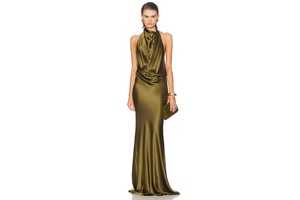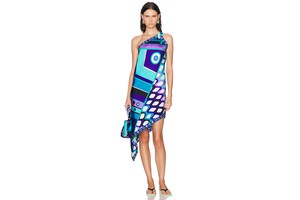
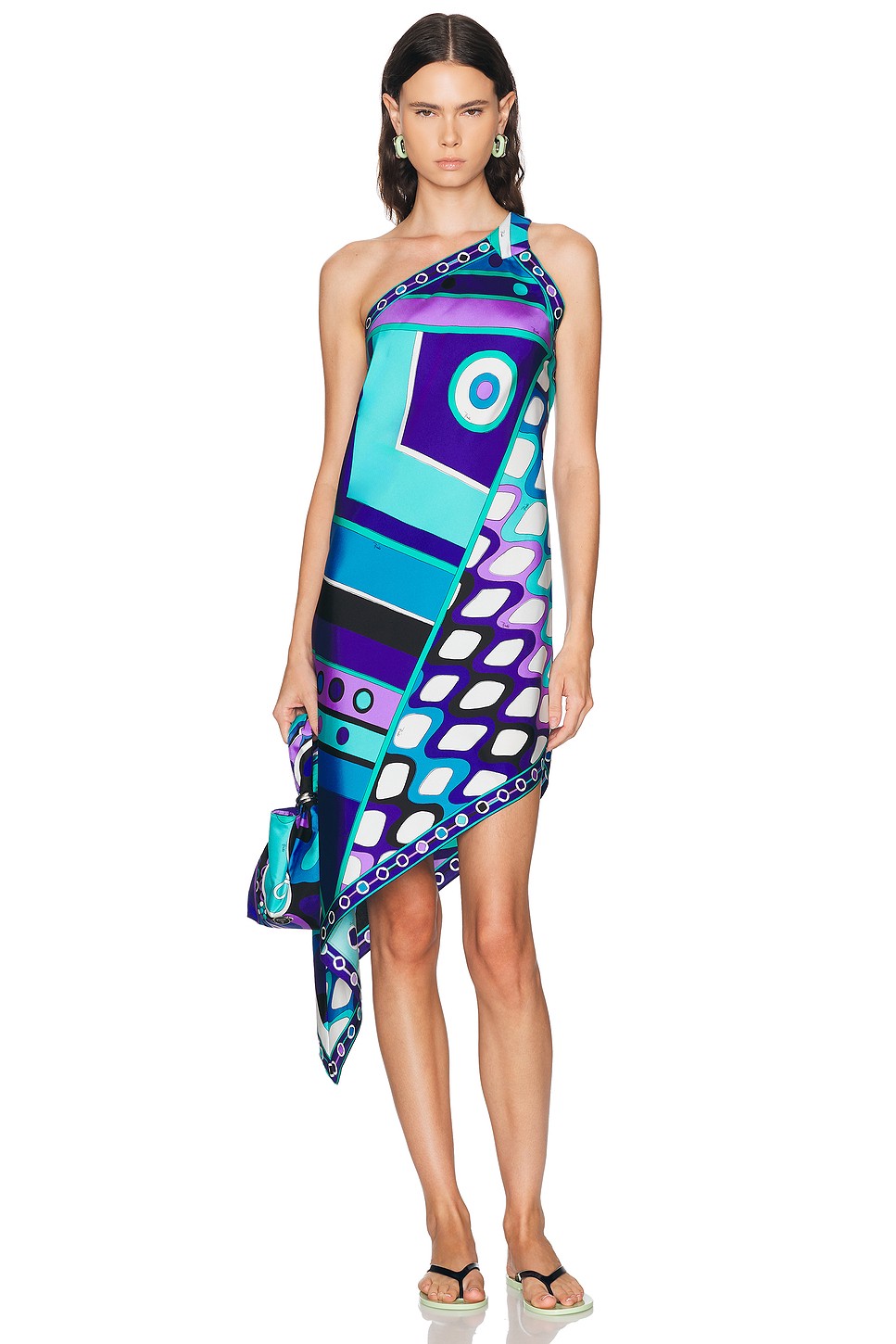
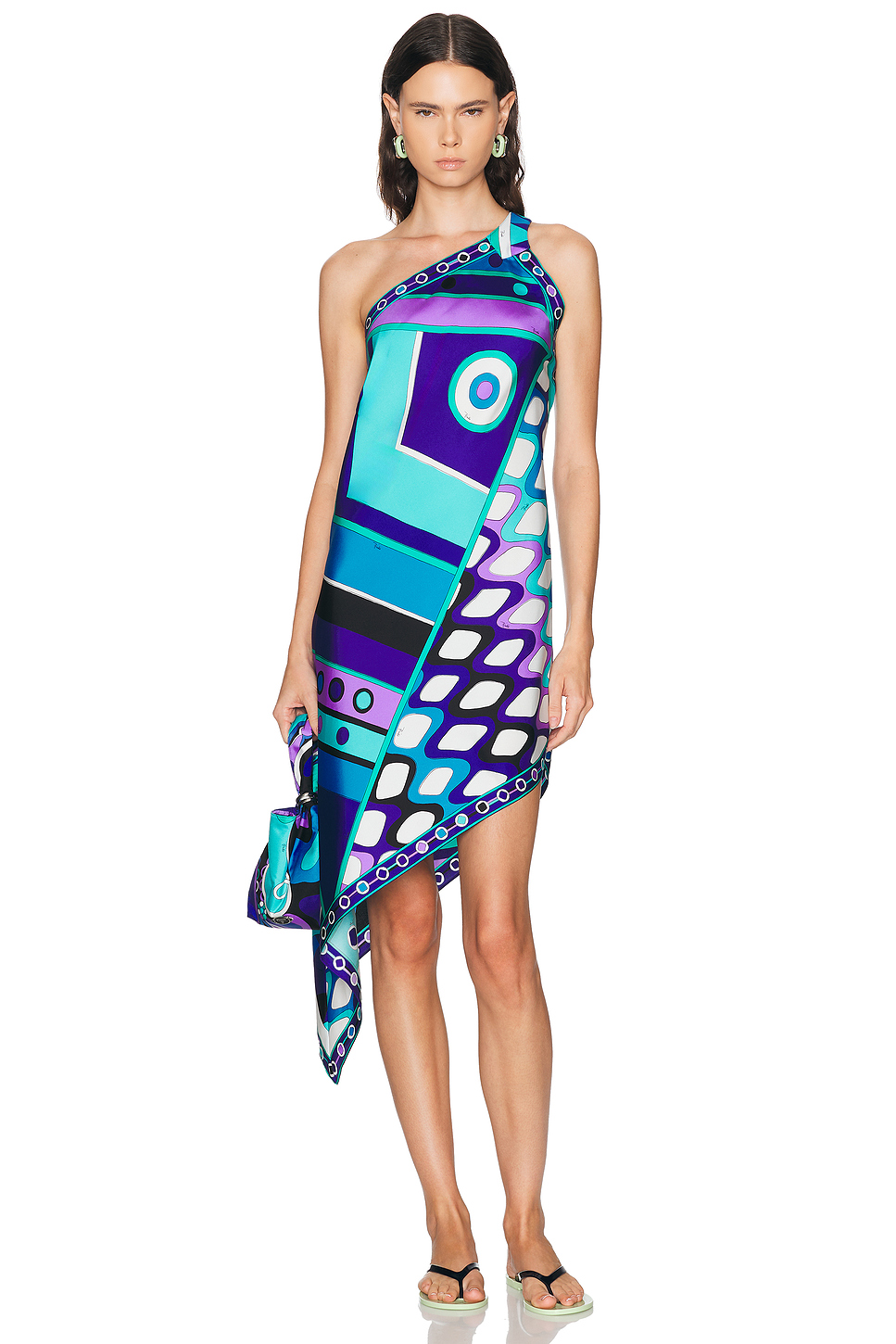
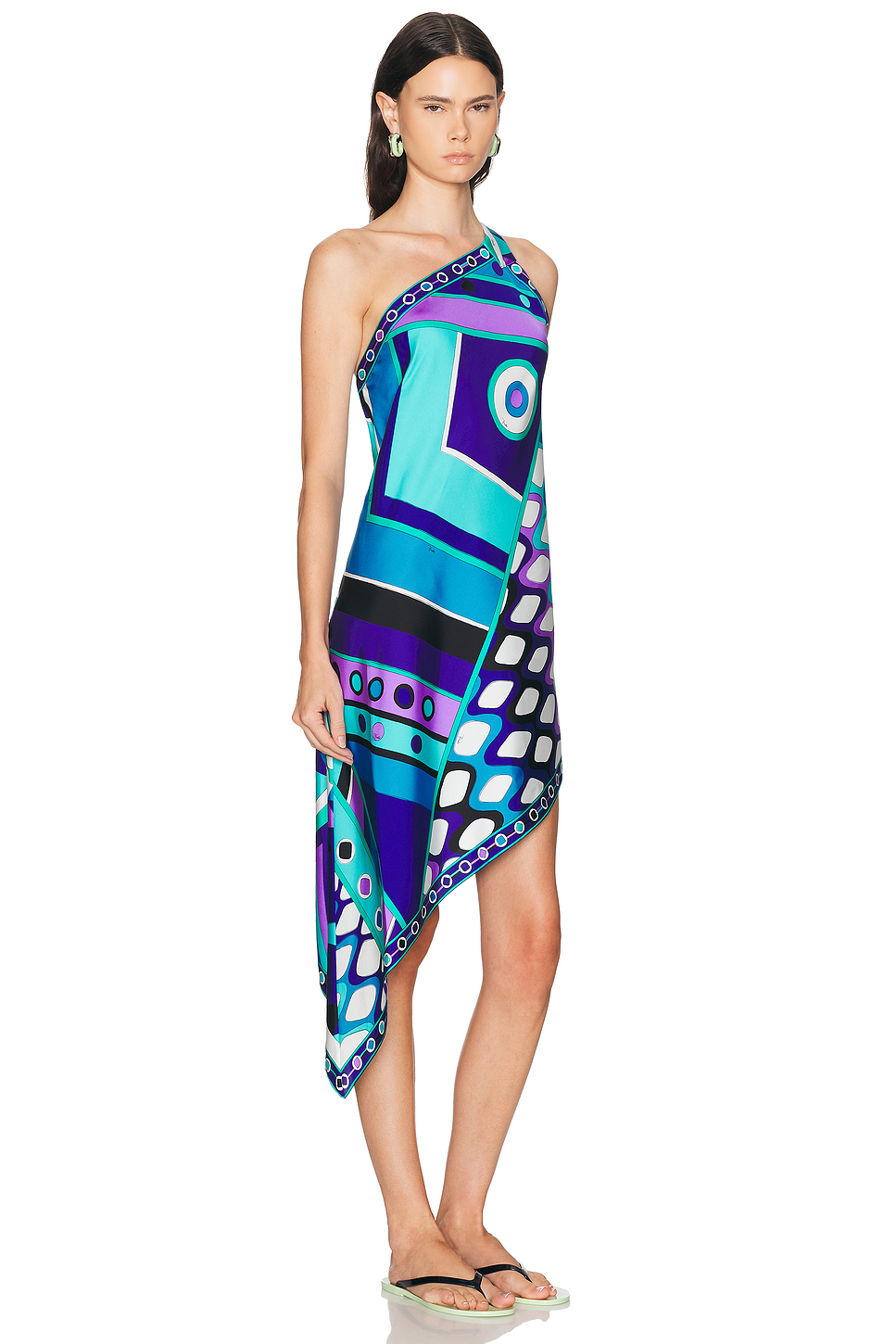
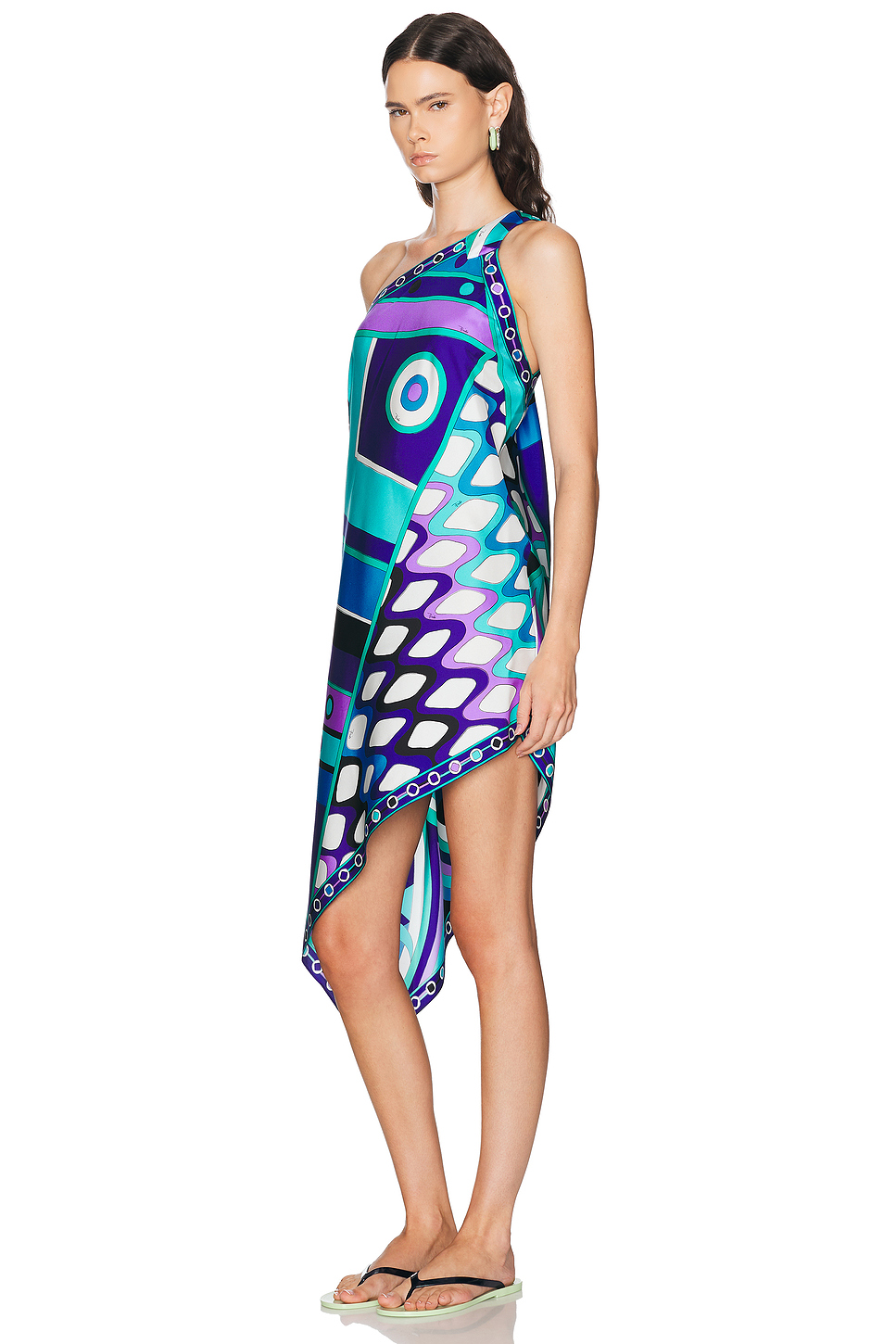
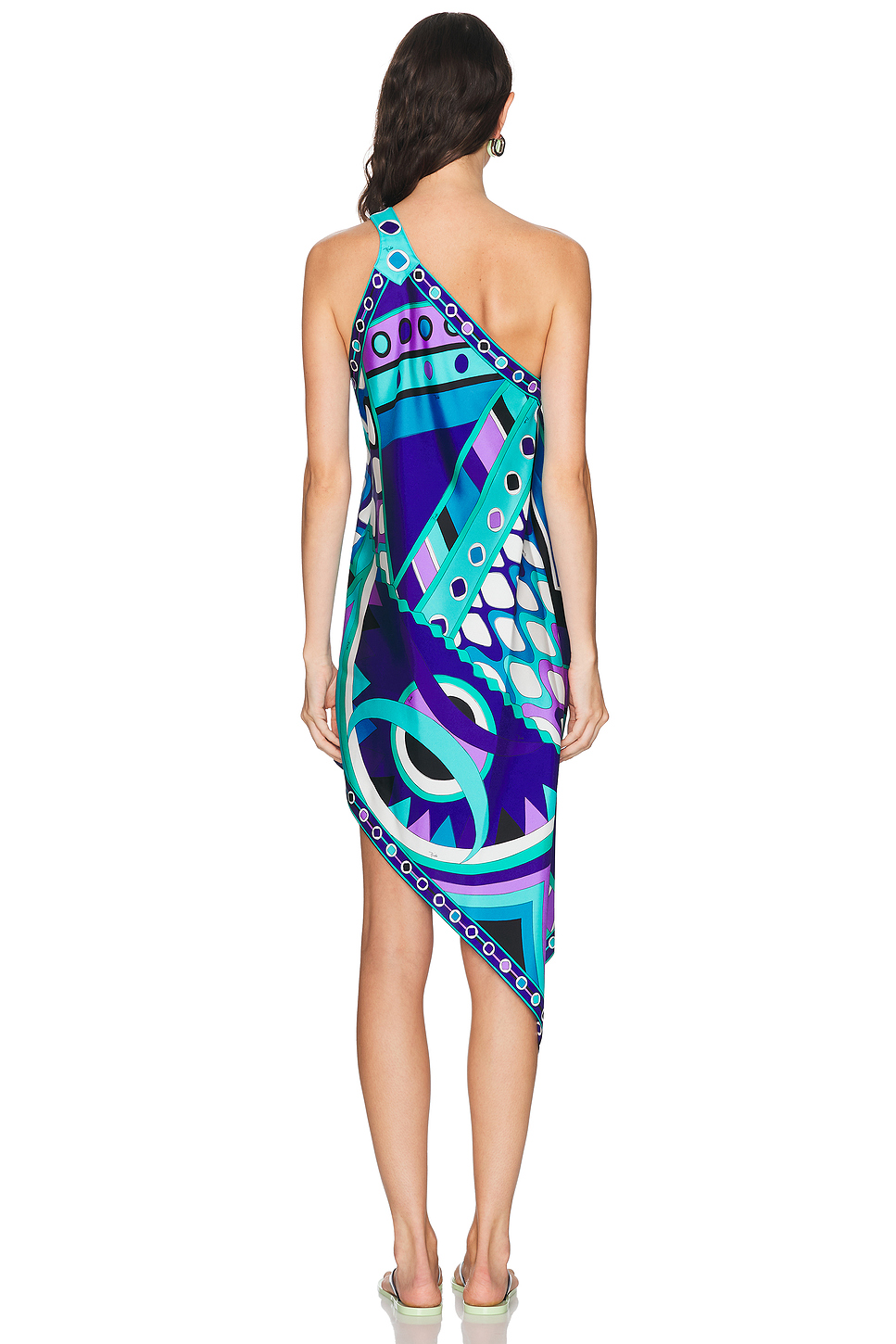
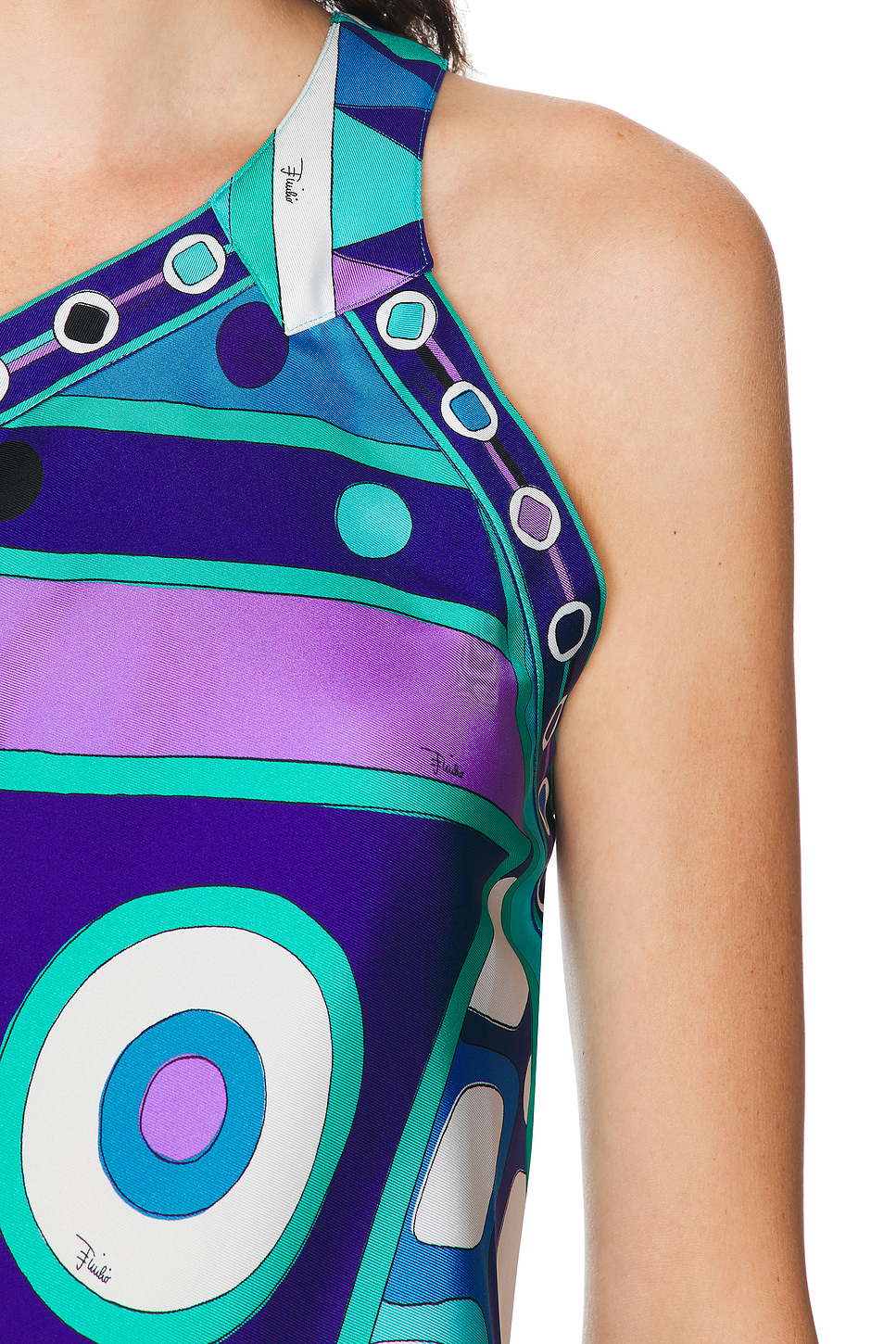
A dress listed in 100% silk, dry clean only, unlined, in a lightweight silk twill, with a pull on construction and an asymmetric hem, made in Italy, ranked twenty ninth in the retailer's one shoulder dress list, at 1,293 dollars. There are no reviews and no fit votes, so there is no score to quote. One of the most ordinary words on this page turns out to explain the entire size chart, which is not something this series has been able to say before. The length category also disagrees with the length figure more sharply than anything previously encountered, and looking at why produces the most useful thing that can be said about length categories. The reference is the Silk Twill Asymmetric Dress by Pucci in Turquoise Blue. Dongguan Bafinasa Garments Co., Ltd. develops comparable silk dresses on OEM and ODM terms, from fabric sourcing and print placement to retail or FBA ready packing. We publish this as a development reference and build your own version of it, and we do not supply the branded original or reproduce anyone else's label.
Key Features
- 100% silk as stated, and dry clean only as stated, which silk requires
- Pull on construction as stated, and this explains the whole chart. See the note below
- Lightweight silk twill as stated, and lightweight is the word doing the work here. See the note below
- Asymmetric hem as stated
- Unlined as stated, which combined with the above makes opacity the thing to work out rather than assume
- Made in Italy as stated
- Sizes from M to XXL, four consecutive sizes toward the larger end
- Measurements published for one size, including length 41 in. See the note below
Customisable Options
- Fabric: silk twill to the reference, with weight in momme rather than only the word lightweight
- Construction: pull on to the reference, and we would compute and state the ease needed rather than inheriting it
- Hem: asymmetric to the reference, with the shortest and longest points given as figures
- Print: placement print developed for an asymmetric hem, since a printed asymmetric needs more than rescale
- Weight options since that single word decides most of the questions here, size set from XS where wanted, colour development, private label and care labelling
Specifications
| Style | Silk twill asymmetric dress |
| Reference | Pucci, Silk Twill Asymmetric Dress, style EMIF-WD107, manufacturer style 6HRG57-6H851, colour Turquoise Blue |
| Composition | 100% silk as stated |
| Fabric | Lightweight silk twill as stated. See the note below |
| Construction | Pull on as stated. See the note below, since this accounts for the whole size chart |
| Hem | Asymmetric hem as stated |
| Lining | Unlined as stated |
| Care | Dry clean only as stated, which is correct for silk |
| Sizes Published | M, L, XL and XXL, four consecutive sizes beginning at M |
| Measurements Published | M: bust 36 in, waist 40 in, hips 42 in, length 41 in. See the note below |
| Chart Note | The waist and hips sit well above the bust relative to the model, and one stated word explains why. See the note below |
| Coverage | Only size M has figures. L, XL and XXL are blank |
| Model | 182 cm, bust 86 cm, waist 58 cm, hips 91 cm, wearing size M |
| Production | Made in Italy as stated |
| Reference Retail | 1,293 USD, quoted to show the price band this sits in, not as our price |
| Customer Reviews | None on the reference listing, so we quote no score |
| Best Seller Badge | Rank 29 in the retailer's one shoulder dress list |
| Categories | Filed by the retailer under mini dresses and one shoulder dresses. See the note below on the first of those |
| Occasion | Occasions, parties, evenings, resort and warm weather events |
| MOQ | 100 pcs per style per colourway, mixed sizes and colourways accepted |
| Sampling | 7-10 days after tech pack or reference sample confirmation |
| Bulk Lead Time | 20-30 days after sample approval and deposit |
| Service | OEM / ODM / private label, silk twill sourcing, asymmetric patterning, retail or FBA ready packing |
Size Chart
| Size | Bust | Waist | Hips | Length | Source | ||||||||||||
|---|---|---|---|---|---|---|---|---|---|---|---|---|---|---|---|---|---|
| M | 36 | in | 40 | in | 42 | in | 41 | in / | 104 | cm | As published | ||||||
| M | 35 | in / | 89 | cm | 28 | in / | 71 | cm | 38 | in / | 97 | cm | 104 | cm / | 40.9 | in | Our proposal |
| L | 37 | in / | 94 | cm | 30 | in / | 76 | cm | 40 | in / | 102 | cm | 106 | cm / | 41.7 | in | Our proposal |
| XL | 39 | in / | 99 | cm | 32 | in / | 81 | cm | 42 | in / | 107 | cm | 108 | cm / | 42.5 | in | Our proposal |
| XXL | 41 | in / | 104 | cm | 34 | in / | 86 | cm | 44 | in / | 112 | cm | 110 | cm / | 43.3 | in | Our proposal |
The published size M gives bust 36 in, waist 40 in, hips 42 in and length 41 in against a model at roughly 34, 23 and 36. Waist and hips sit far further above her than the bust does, and one word on the page accounts for that completely.
Occasions and Styling
Suits occasions, parties, evenings and resort or warm weather events. Silk twill drapes and moves well in heat, though this one is lightweight and unlined, so what sits underneath is a decision rather than an afterthought.
Production and Quality Control
There are no reviews and no fit votes on this listing, so we quote no score. One ordinary word on this page explains the whole size chart, which this series has not previously managed, and the length category disagrees with the length figure more sharply than anything yet, which turns out to be the useful part.
Pull on, and it explains every number in the chart, and that is the first thing. The published size M gives bust thirty six, waist forty and hips forty two against a model at roughly thirty four, twenty three and thirty six. Taken without anything else, that combination is difficult to read: there is about two inches of ease at the bust, which is ordinary, but then around seventeen at the waist and six at the hips, and ease of that size in two places and not the third does not describe any silhouette anyone would draw. The page explains it with two words that look like nothing at all, which is that the garment is pull on. Pull on means there is no opening anywhere, no zip and no placket and no buttons, so this cannot be stepped into or opened and closed around the body. It has to pass over whichever part of the body is widest, which for most people is the shoulders or the hips, and everything between that point and where it finally sits has to be at least as large as that widest point. So the waist and hip figures here are not describing what the garment looks like when worn. They are describing what had to be built into it so that it could be got on in the first place. That distinction matters because it changes what the numbers mean, and it is a different direction of travel from everything else this catalog has been assembled for. This series has spent considerable time cataloguing the mechanisms that let a garment fit a body smaller than its own measurements, and built up five of them across many examinations: knit because loops open, elastane high enough to compress rather than merely recover, bias cutting though only along one direction, shirring where gathered elastic draws cloth in, and closure adjusted rather than stretched. Every one of those makes measurements smaller than the body believable. This is the first examined here that does the reverse, making measurements larger than the silhouette believable, and it belongs to the same family in that the fastening method is what both are about. A fastening you adjust lets the garment be made smaller, since the closing is done by hand. No fastening at all forces the garment to be made larger, since the body has to travel through it. So the general lesson worth carrying forward is that the method of getting into a garment appears in its numbers, and the numbers are unreadable if nobody says how it goes on. There is a second consequence that follows directly and is worth stating because it affects buying. Take the waist away from this design and it would not be a slightly neater garment of the same shape, because the waist is carrying functions that have nothing to do with shape. So the choice here is between that ease and an opening, and this page picked the ease.
Forty one inches and called mini, and working through that settles the length categories for good, and that is the second thing. The published length is forty one inches, which is about 104 centimetres, and the retailer files this under mini dresses. This series has tracked the length categories almost since it began, having recorded initially that the line between midi and maxi appeared to sit somewhere below about forty eight inches, and has accumulated evidence ever since that it does not resolve cleanly. The evidence here is sharper than anything before it. Two garments examined recently sat at fifty four and a half inches filed as maxi and at fifty five inches filed as midi, so the shorter of those two carries the longer category and half an inch separates a decision running in the opposite direction. Then this one at forty one inches is filed as mini, alongside other garments examined here at thirty two and a half and thirty four inches and called the same thing. So the word mini is being applied to garments whose lengths differ by about nine inches, and the whole set does not arrange itself in order: something at forty one is called mini, something at fifty four and a half is called maxi, and something at fifty five is called midi. There is no consistent dividing line anywhere in that, and it is time to stop treating these words as though there might be one. Now, what is actually going on is not mysterious, and stating it gives a customer something better than scepticism. The model on this listing is one hundred and eighty two centimetres, which is tall. Forty one inches on somebody that tall falls well above the knee, so on her it genuinely is short, and the category is describing her rather than the garment. On somebody considerably shorter the same dress falls differently and the same word becomes misleading. So these categories do not describe how long a garment is. They describe how long it looks on whoever modelled it, and the listing happens to tell you how tall that was. This is worth dwelling on because it converts a complaint into something actionable, and this series would rather give somebody something to do than merely warn them. The number is what matters, and it is printed right there. Comparing forty one inches against your own height tells you where this falls on you, which no category word can do, and comparing it against the model height tells you what the word was based on. This series has argued before that these words are worth reading for what they reveal incidentally and worth distrusting for what they assert, and this page supplies the mechanism behind that: they are a claim about a photograph, not about cloth.
Lightweight, and why that word is carrying most of this page, and that is the third thing. This is stated as a lightweight silk twill, and there is a rule established very recently which applies here with unusual cleanliness, so it is worth setting out alongside what it predicts. Comparing two similar poplin garments against each other recently settled that a weave name does not reassure and a weight does, and the reason was stated then: a weave name tells you how yarns are arranged, and a weight tells you how much material is there, and quantity is what most of these questions turn on. That pair was cotton and this is silk, and the rule generalises without difficulty since it was never about cotton. Silk is well known to this series: it spots permanently where water sits and dries, it loses brightness under ultraviolet light, and it is generally the most demanding fibre examined here. Twill itself is worth one sentence, since it is only the second time it has appeared. Twill is built so that the crossing points fall on a diagonal rather than in line, which produces that diagonal surface texture, and the practical consequences are that it drapes more readily than a plain weave and creases less visibly. Neither of those touches the real question here, which is the one word before it. Lightweight means there is not much material, and there is no lining here, so there is nothing behind it either. This series has tied unlined to opacity repeatedly, recently noting that the combination matters most when several things push the same direction at once, and that is exactly the arrangement: an unusual rather than dark colour, a fabric word saying little material per area, and no second layer. Reading those together rather than separately gives a clearer answer than any of them does alone, which is the whole point of assembling them. Compare that with a garment examined in this same batch where buyers were able to say what the outcome actually was, having worn it: variously described as completely see through, too sheer to be worn practically, and needing another lining. This page gives no figures on opacity and no reviews to supply any, but it gives the word that would let you predict the same outcome, and that is the difference this series has insisted on throughout. All that said, one large omission sits beside it. Only one size out of four is measured, and while the sizes here run toward the larger end rather than beginning at the smallest, four consecutive larger sizes is a range somebody chose deliberately. Publishing the other three would cost nothing against the page this already is. Every bulk shipment gets a measurement report against your approved chart.
Optional upgrades include stating how the garment goes on, since here that single fact explains every other number and the chart is unreadable without it, giving the ease needed for step in or pull on versions as two separate specifications rather than one inherited either way, publishing measurements for L, XL and XXL, since one out of four remains the rule rather than the exception, specifying weight rather than only lightweight, since that one word is doing most of the useful work on this page and every question here turns on how much material there is, giving shortest and longest hem points as figures rather than letting asymmetric be read from a photograph, offering XS and S for these four larger sizes where required, extending at both ends rather than one, developing print placement for an asymmetric hem rather than rescaling, keeping dry clean only since silk requires it, colour development tested per shade given what happens when this is combined with linen or jersey alternatives, private label, hangtag and care labelling.
Pre-production sample approval, in-line inspection during cutting and sewing, and a final AQL inspection before packing, with measurement reports and photos shared before shipment.
Send us your tech pack, a photo or a reference garment and we will quote within 24 hours. Contact bafinasa@bafinasa.com or WhatsApp +86 13827222469.