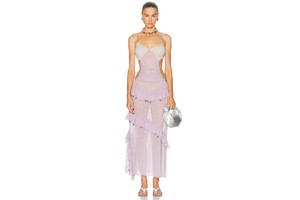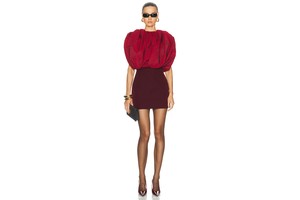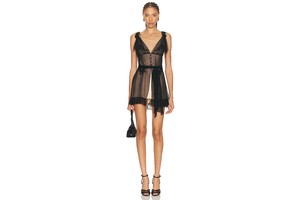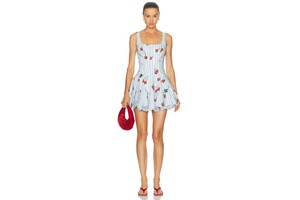
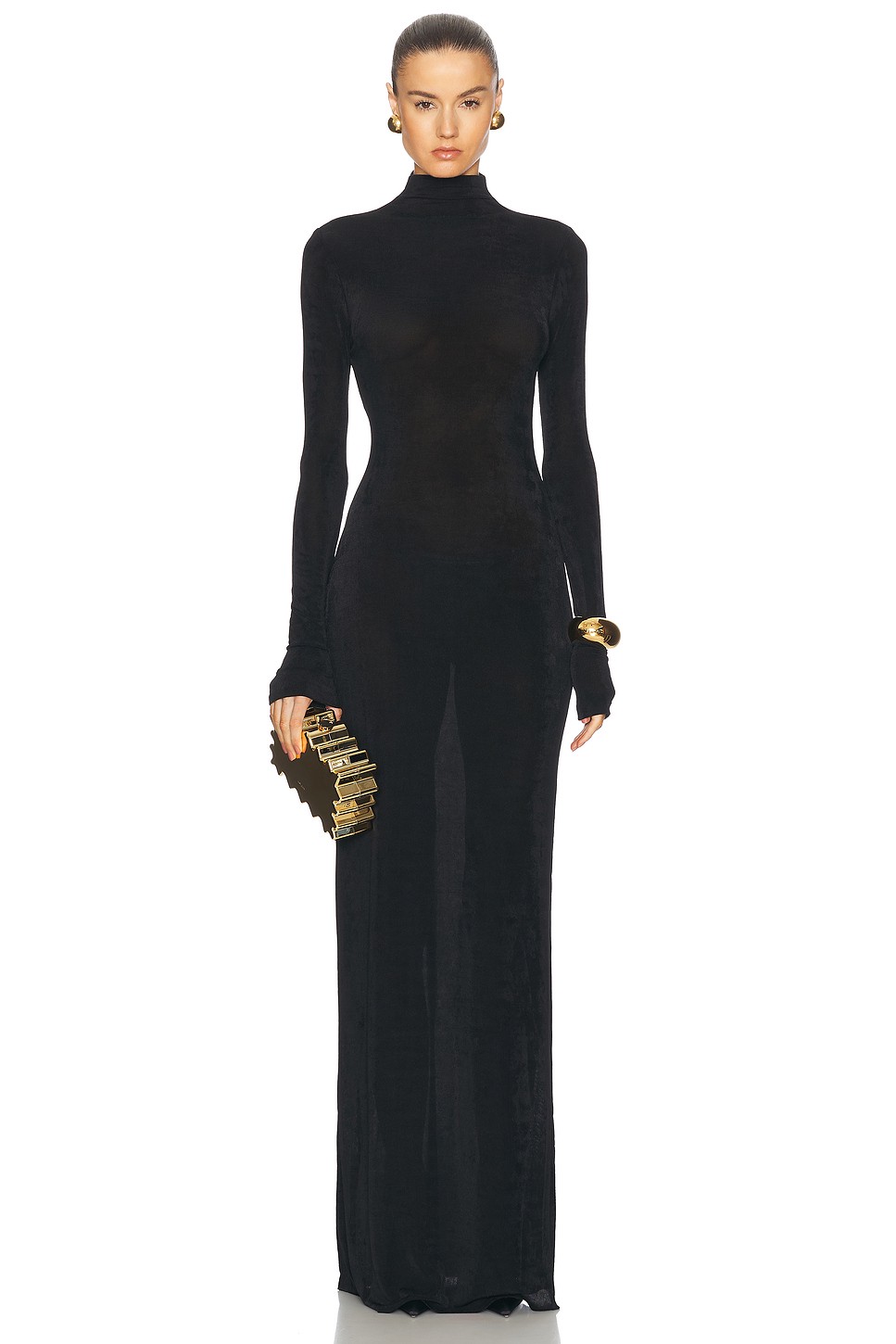
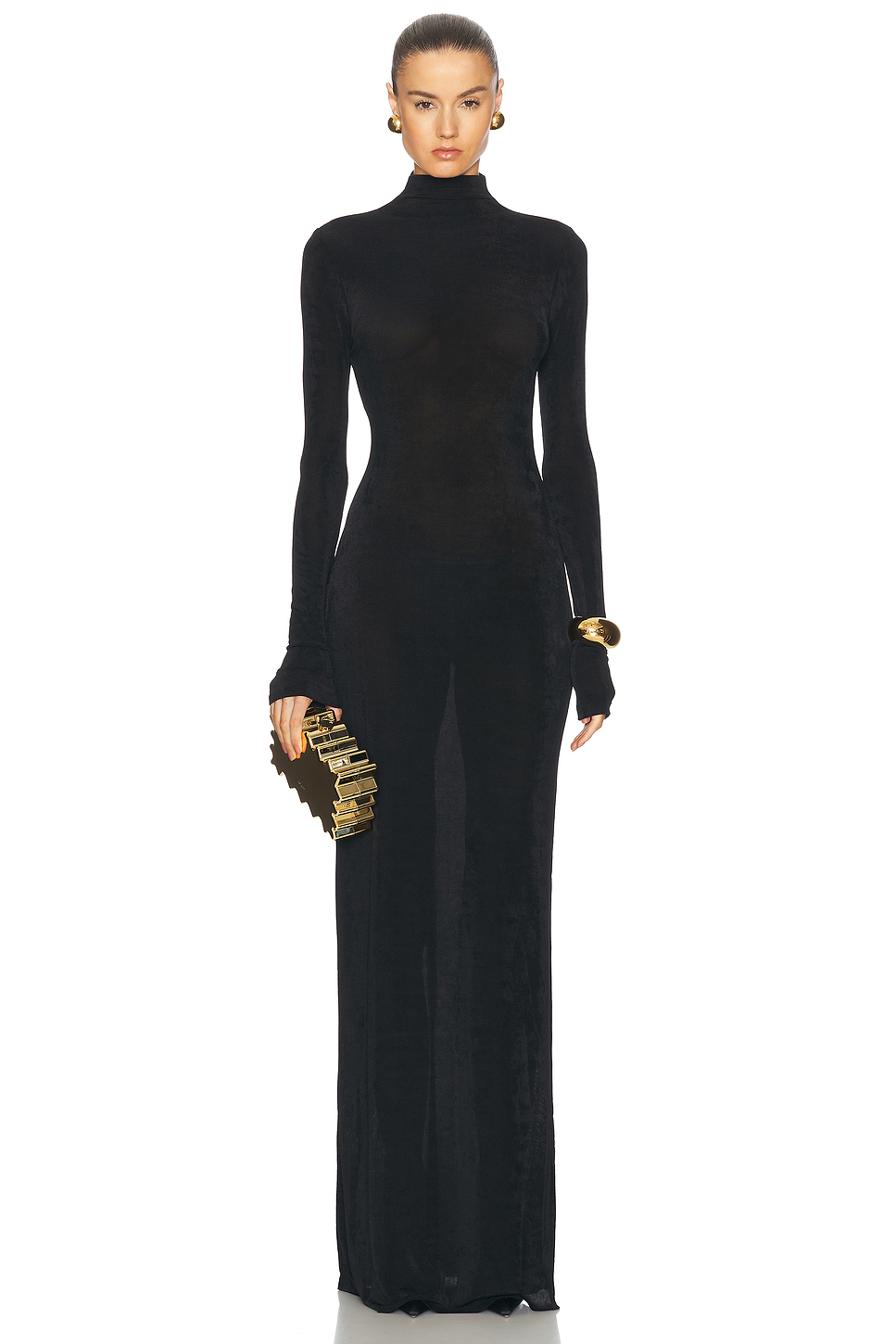
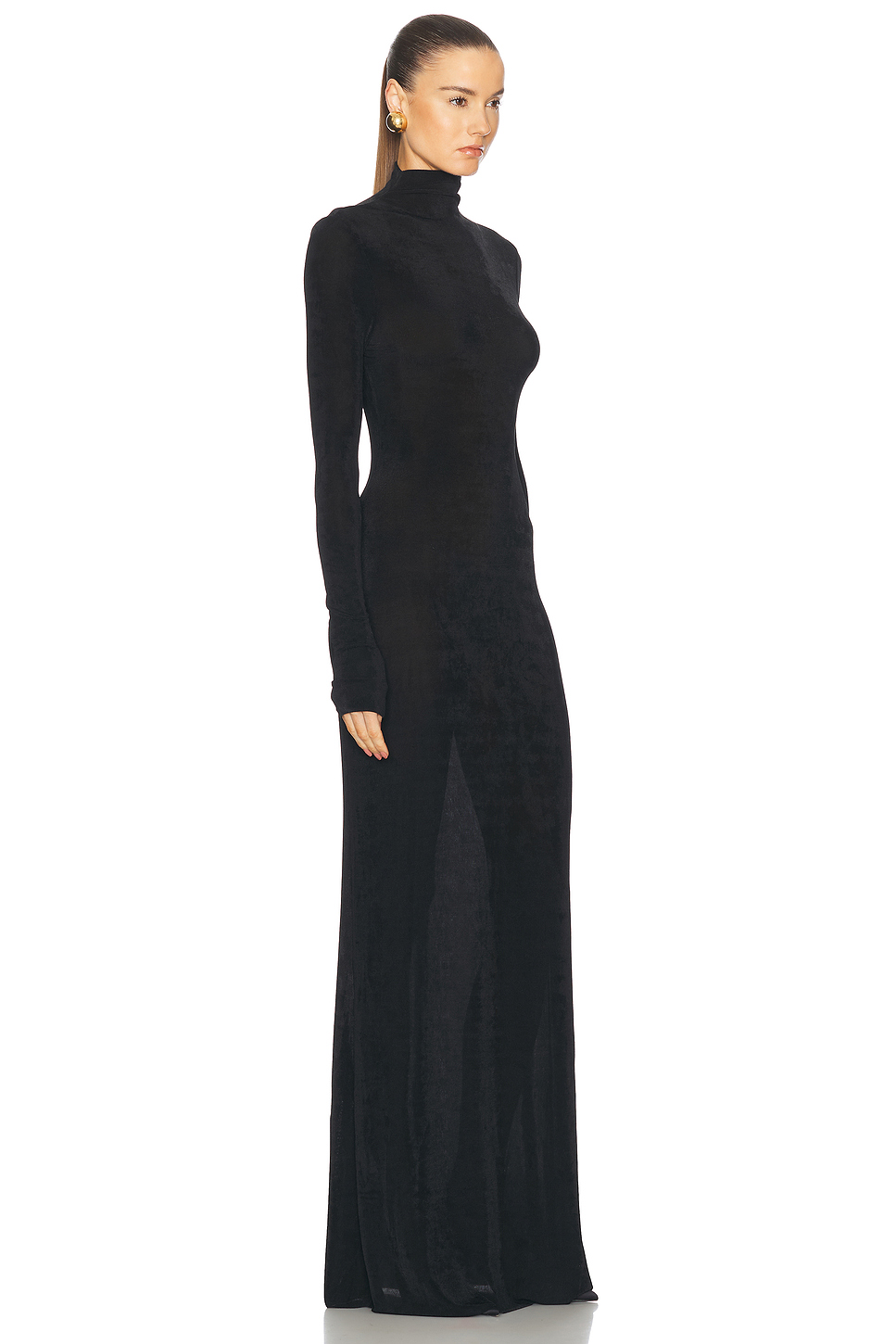
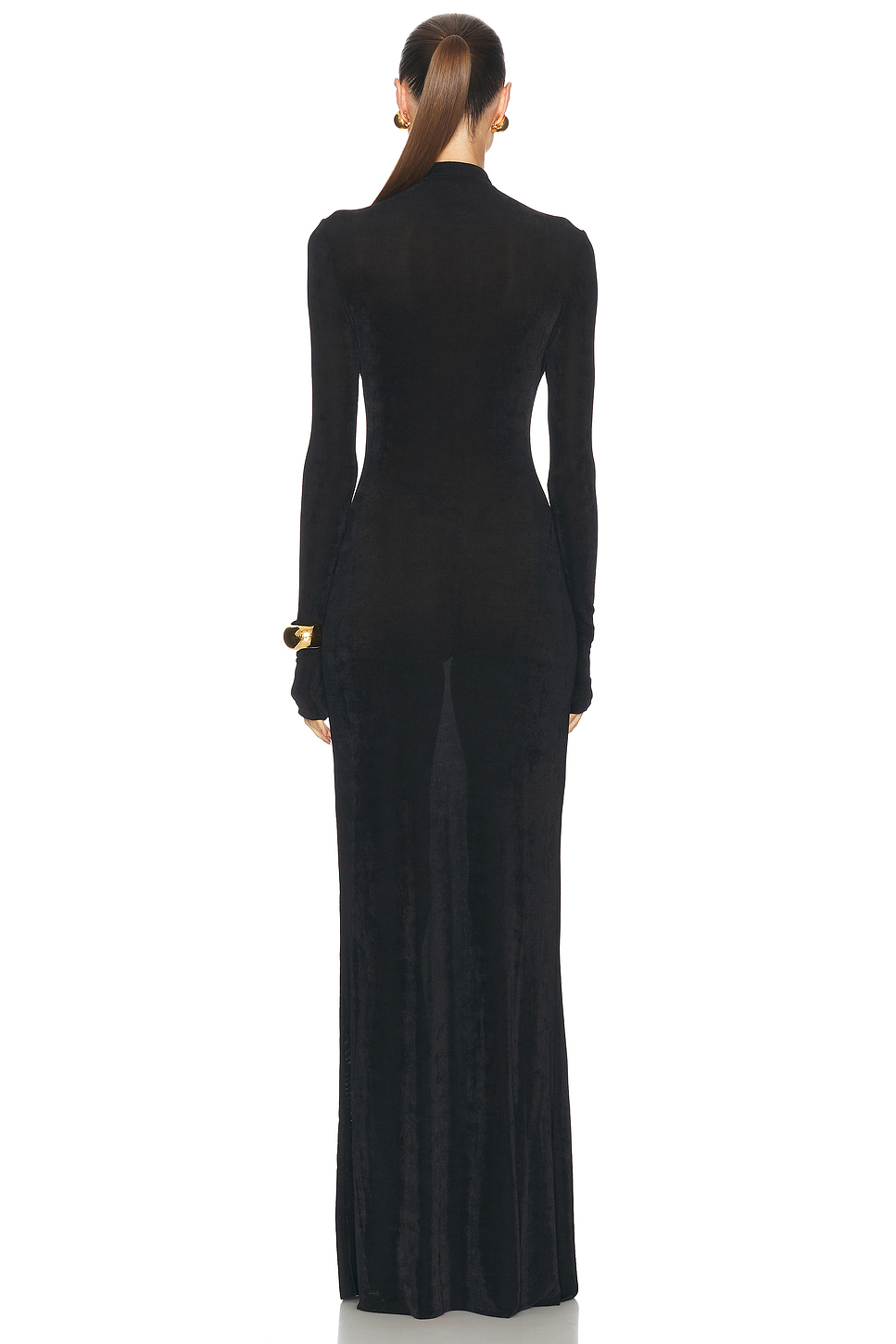
A maxi dress listed in 94% polyester and 6% elastane, hand wash, unlined, with a pull on construction, in a Roma jersey, with long sleeves, made in China, ranked twentieth in the retailer's long sleeve dress list, at 298 dollars, together with a plainly stated sentence that it is made of semi-sheer fabric through which undergarments will be visible. There are no reviews and no fit votes, so there is no score to quote. Two things here matter a great deal. The first is that this page states sheerness with a calibration rather than as a switch, which nobody else has done. The second is that it breaks a rule this series established literally one batch ago, and the rule needed correcting rather than defending. The reference is the Kim Maxi Dress by SEROYA in Black. Dongguan Bafinasa Garments Co., Ltd. develops comparable knit maxi dresses on OEM and ODM terms, from fabric selection and opacity testing to retail or FBA ready packing. We publish this as a development reference and build your own version of it, and we do not supply the branded original or reproduce anyone else's label.
Key Features
- 94% polyester and 6% elastane as stated, hand wash as stated
- Pull on construction as stated, and this is where a recently established rule needs correcting. See the note below
- Stated plainly as semi-sheer with undergarments visible, and the wording differs importantly from earlier versions. See the note below
- This is said of a black garment, which runs against something buyer reviews appeared to confirm recently. See the note below
- Roma jersey as stated, and the fabric name points the other way from the sheerness sentence. See the note below
- Unlined as stated
- Long sleeves, with sleeve length published at 28 in, which is unusual and welcome
- Measurements published for size S, including length 61 in
Customisable Options
- Fabric: Roma jersey to the reference, offered at several weights since opacity for a given colour is decided by quantity
- Opacity: we would test and state the result per colourway rather than reusing one sentence across several
- Opacity by colour: developed and measured rather than assumed from fibre and cloth name alone
- Stretch: we would measure and publish recovery rather than rely on the stated percentage for how an opening behaves
- Length from midi to floor, size set, colour development, private label and care labelling
Specifications
| Style | Sheer knit pull on maxi dress |
| Reference | SEROYA, Kim Maxi Dress, style SOYA-WD181, manufacturer style 4467-17, colour Black |
| Composition | 94% polyester, 6% elastane as stated |
| Fabric | Roma jersey as stated. See the note below |
| Opacity | Stated as semi-sheer fabric with undergarments visible, on the listing itself. See the note below |
| Construction | Pull on as stated. See the note below, since this corrects a rule established very recently |
| Lining | Unlined as stated |
| Care | Hand wash as stated |
| Sleeve | Long sleeves as stated, with sleeve length published |
| Sizes Published | XS, S, M, L and XL, five consecutive sizes |
| Measurements Published | S: bust 31 in, waist 24 in, hips 32 in, length 61 in, sleeve 28 in. See the note below |
| Chart Note | The waist matches the model exactly while bust and hips sit below her, despite the garment having no opening. See the note below |
| Coverage | Only size S has figures. XS, M, L and XL are blank |
| Model | 179 cm, bust 34, waist 24, hips 34 |
| Production | Made in China as stated |
| Reference Retail | 298 USD, quoted to show the price band this sits in, not as our price |
| Customer Reviews | None on the reference listing, so we quote no score |
| Best Seller Badge | Rank 20 in the retailer's long sleeve dress list |
| Categories | Filed by the retailer under black dresses and long sleeve dresses. See the note below, since neither is a length |
| Occasion | Evenings, occasions, layering, resort and warm weather |
| MOQ | 100 pcs per style per colourway, mixed sizes and colourways accepted |
| Sampling | 7-10 days after tech pack or reference sample confirmation |
| Bulk Lead Time | 20-30 days after sample approval and deposit |
| Service | OEM / ODM / private label, knit sourcing, opacity testing, retail or FBA ready packing |
Size Chart
| Size | Bust | Waist | Hips | Length | Source | ||||||||||||
|---|---|---|---|---|---|---|---|---|---|---|---|---|---|---|---|---|---|
| S | 31 | in | 24 | in | 32 | in | 61 | in / | 155 | cm | As published | ||||||
| XS | 31 | in / | 79 | cm | 24 | in / | 61 | cm | 34 | in / | 86 | cm | 155 | cm / | 61 | in | Our proposal |
| S | 33 | in / | 84 | cm | 26 | in / | 66 | cm | 36 | in / | 91 | cm | 157 | cm / | 61.8 | in | Our proposal |
| M | 35 | in / | 89 | cm | 28 | in / | 71 | cm | 38 | in / | 97 | cm | 159 | cm / | 62.6 | in | Our proposal |
| L | 37 | in / | 94 | cm | 30 | in / | 76 | cm | 40 | in / | 102 | cm | 161 | cm / | 63.4 | in | Our proposal |
| XL | 39 | in / | 99 | cm | 32 | in / | 81 | cm | 42 | in / | 107 | cm | 163 | cm / | 64.2 | in | Our proposal |
The published size S gives bust 31 in, waist 24 in, hips 32 in, length 61 in and sleeve 28 in against a model at roughly 34, 24 and 34. Bust and hips sit below her while the waist matches exactly, and given that this garment has no opening at all, that required explaining rather than assuming.
Occasions and Styling
Suits evenings, occasions, layering and resort or warm weather. Long sleeves with a flowing length carry themselves well, and what is worn underneath is part of the look rather than hidden from it, since the listing says so itself.
Production and Quality Control
There are no reviews and no fit votes on this listing, so we quote no score. This page states sheerness as a calibration rather than a switch, which nothing else here has done. It also breaks a rule established one batch ago, and the rule needed correcting rather than defending, which is worth doing in public rather than quietly.
A rule this series wrote one batch ago, and why it needs qualifying now, and that is the first thing. Recently a garment without any opening whatsoever was examined, and its size chart showed substantially more ease at waist and hip than at the bust, which made little sense as a shape. This series worked out why: with no opening, a garment cannot be stepped into or closed around the body, so it has to pass over the widest point, and everything between there and where it finally rests has to be at least as large as that point. So those larger numbers were not describing shape, they were describing what had to be built in for the wearer to get it on at all. That was presented as a general rule, and this garment shows it was not one. Here is pull on stated plainly, no opening anywhere, and the published measurements are bust thirty one, waist twenty four, hips thirty two, against a model at approximately thirty four, twenty four, thirty four. So the waist matches exactly and bust and hips sit below her. Nothing here has been made larger to accommodate getting it on, and there is no extra ease anywhere for it to travel through. The rule as stated is therefore wrong, and the correction is worth making precisely because it is simple. What was missed was that the rule was derived from one garment in a non-stretch woven silk, and it was generalised without checking what happened when the cloth itself gives. This is knit, it carries six per cent elastane, and it is stretchy in a way that silk twill is not. So the qualifying condition is this: an opening-less garment needs extra ease only when the cloth cannot itself stretch enough to pass the widest point. Where it can, that need disappears entirely, since the stretch does the work that extra cloth would otherwise do. Stated generally, the true rule is that a garment with no opening must be able to pass the widest part of the body, by whatever means are available, and both adding ease and adding stretch are ways of arranging that. Which one was chosen then shows up in the numbers in opposite directions, and that is why two pull on garments here have produced measurements going opposite ways. It is worth being clear about the limits of what six per cent contributes. This series has established that below roughly five per cent elastane behaves mostly as a recovery additive and toward one fifth genuinely compresses, and confirmed twelve per cent doing real compression work recently from buyer reviews. Six per cent sits just above the lower bound, so it will help something pass over hips and it will recover reasonably afterwards, and it will not meaningfully hold anyone in. That is exactly what these numbers show: enough help to get past the widest point, not enough to shape anything.
Semi-sheer rather than sheer, and it being said of a black garment, and that is the second thing. This page carries a sentence stating the garment is made of semi-sheer fabric and that undergarments will be visible through it. This series has been tracking these sentences since early on, having found the identical wording recurring verbatim across unrelated makers, which was one of several pieces of evidence leading to the conclusion that much here is applied rather than written. Two things differ about this instance. First, the wording is not the one that recurred, so this is separately authored rather than copied. Second, and considerably more useful, it carries calibration. Every previous version drew a line: either something is described as sheer or nothing is said about it at all. This says semi-sheer, which is a degree rather than a state. That distinction has real content, because binary statements resolve the question of whether to be careful without resolving how careful, and how careful determines what somebody can wear underneath. It is the single most informative sentence of its kind encountered here precisely because of that one word. Now, it is stated of a black garment, and that deserves being set beside something said recently, because it complicates a conclusion rather than simply confirming it. Buyer reviews on another garment recently included one comparing two colourways directly, reporting that the black version was elegant while the white was see through. This series took that as confirmation of something maintained throughout, which is that pale shades are harder than dark because darker cloth absorbs more light rather than transmitting it. That confirmation stands, because it was a comparison between two versions of one garment, and nothing here changes it. What this page says is something different and narrower: dark does not mean safe. Read together they give the correct and more careful position, which is that colour operates as a tendency rather than a guarantee, and can be overridden entirely by what the cloth actually is. This instance shows how far that override can go, since this is knit in polyester with elastane, and there is no lining, so there is nothing behind it but air. There is a further tension on this page worth noting rather than resolving, because it is honest to leave it visible. Roma jersey normally refers to a double knit built thick and stable, generally chosen precisely because it does not read sheer. So the cloth name and the sheerness sentence point in opposite directions, and nobody can tell from the page which dominates, or whether this is simply a light version of that construction. Set against that, three other things all point the same way, since there is no lining, there is a stated sheer warning, and this is one flat layer. This series has maintained repeatedly that reasoning comes from several facts pointing together rather than from any single one, and reading them that way rather than picking one gives a clearer answer than any does alone.
Two categories, neither of them a length, and what that gets right, and that is the third thing. This is filed under black dresses and long sleeve dresses. Both are true, both are checkable, and neither has anything to do with length. That absence is worth noting, because this series has spent a great deal of space establishing that length categories carry almost no reliable information, having found sets of lengths and labels which no consistent threshold could arrange. Here, at sixty one inches, which is long enough to be near the top of everything examined, nothing claims a length at all, because both available slots have been used on attributes which are genuinely properties of the garment. Colour is a property of the cloth. Sleeve presence is a property of the object. Both are claims which can be checked against what else is stated, and both check out, since long sleeves is corroborated here by an actual sleeve measurement being published at twenty eight inches. That last detail deserves particular notice, because it is only the second instance in this series of sleeve length appearing as a number, and it is the first where it lines up completely with what the category claims. So there is something mildly encouraging to record: this page declines to assert something it cannot support, and it supplies numbers for the assertions it does make. Set that against a garment examined in this same batch where the same retailer filed something under a construction category which turned out to be correct and checkable, and another recently where a length label made a claim which half an inch of cloth contradicted, and a pattern emerges which is more useful than blanket scepticism. These listings are honest about what they can see and silent about what they cannot, which is close to the reverse of what sheer omission usually produces. There is one remaining thing, and it connects back rather neatly. The model proportions here read one hundred and seventy nine centimetres with bust thirty four, waist twenty four, hips thirty four. Those are identical, down to the units being given for height while none are given for the other three, to the model quoted on another garment examined very recently from a different maker at a different price. This is now the second striking recurrence of exactly this kind found here, following identical product names across makers, and it belongs with the accumulating evidence about what sets these pages. It is recorded rather than concluded from, since a single coincidence remains possible however striking. Every bulk shipment gets a measurement report against your approved chart.
Optional upgrades include publishing measurements for XS, M, L and XL, since one of five consecutive sizes repeats the pattern found throughout, stating opacity per colourway rather than reusing one sentence across several, since colour is a tendency and this page shows how far one can be overridden, calibrating opacity rather than only declaring it, since this page demonstrates how much more useful a degree is than a state, offering this in heavier and lighter versions rather than one weight, since for a given colour and construction that single variable decides the whole question, naming stretch and recovery rather than leaving six per cent to be interpreted, keeping the sleeve measurement since it corroborated the category claim, extending the size range at both ends if demand supports it, length options rather than sixty one inches alone, colour development, private label, hangtag and care labelling.
Pre-production sample approval, in-line inspection during cutting and sewing, and a final AQL inspection before packing, with measurement reports and photos shared before shipment.
Send us your tech pack, a photo or a reference garment and we will quote within 24 hours. Contact bafinasa@bafinasa.com or WhatsApp +86 13827222469.