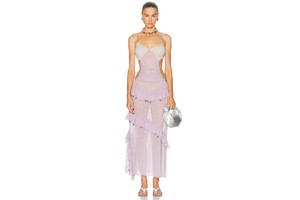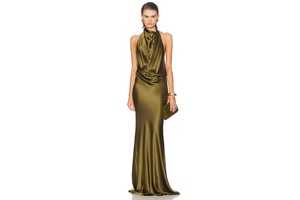
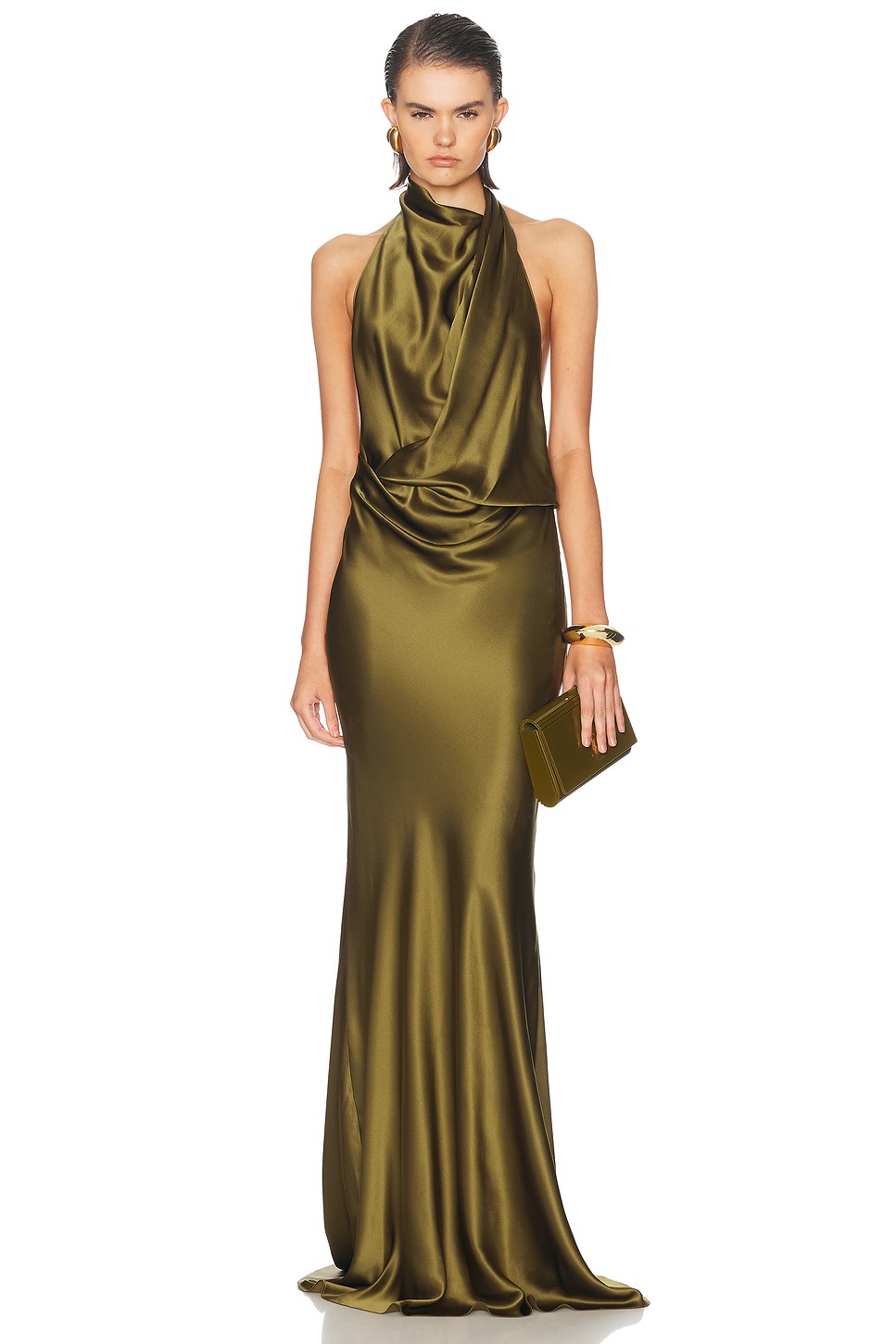
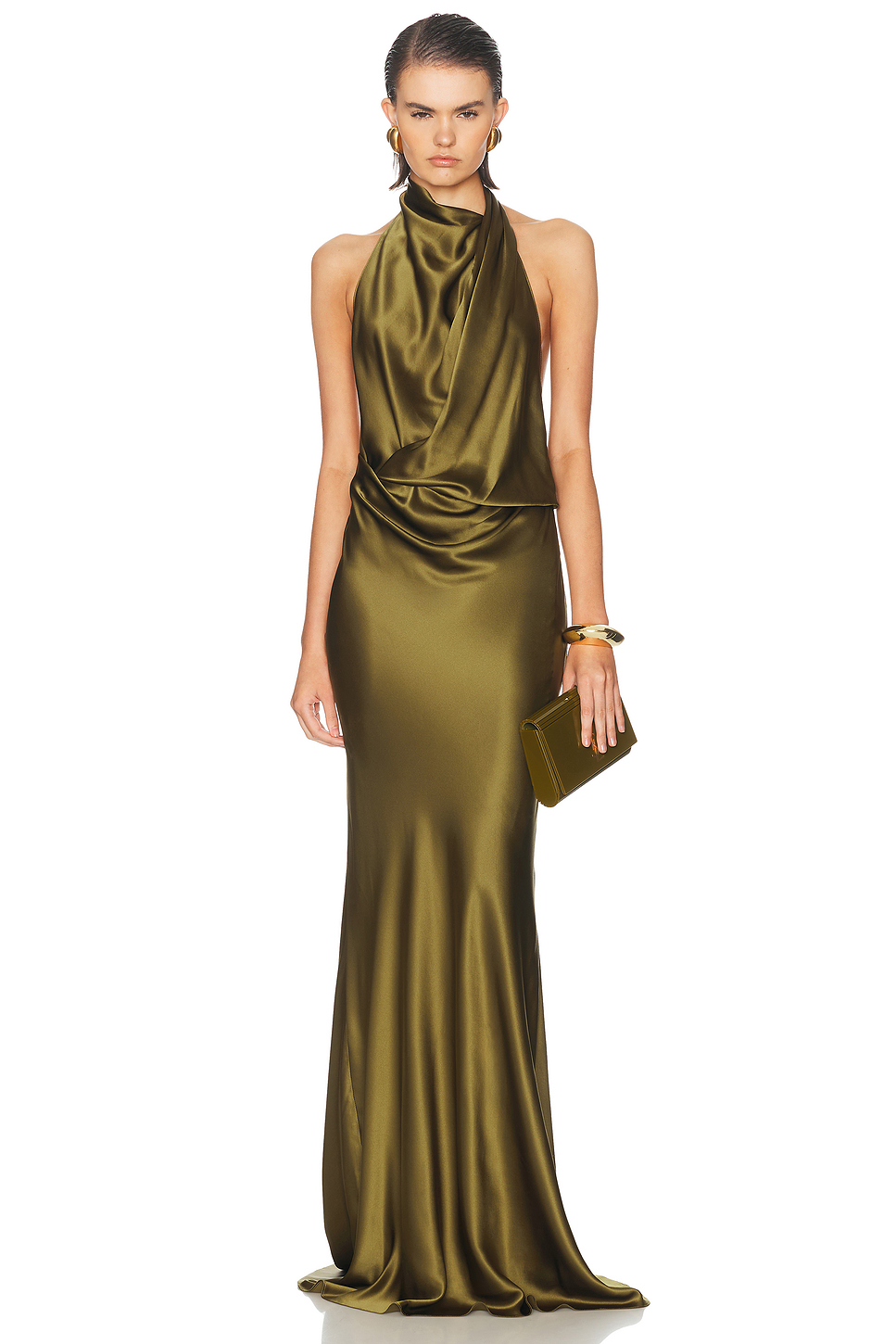
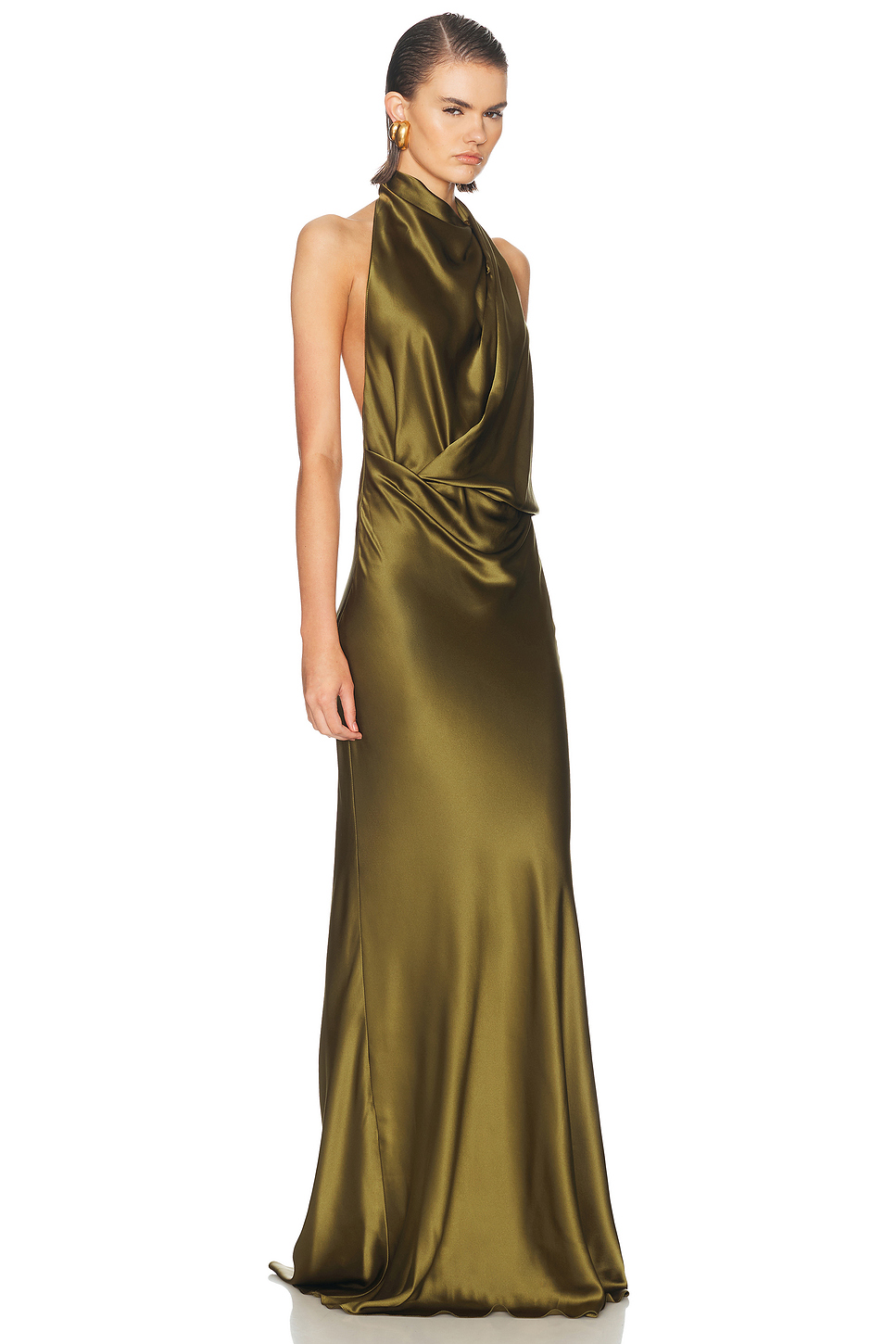
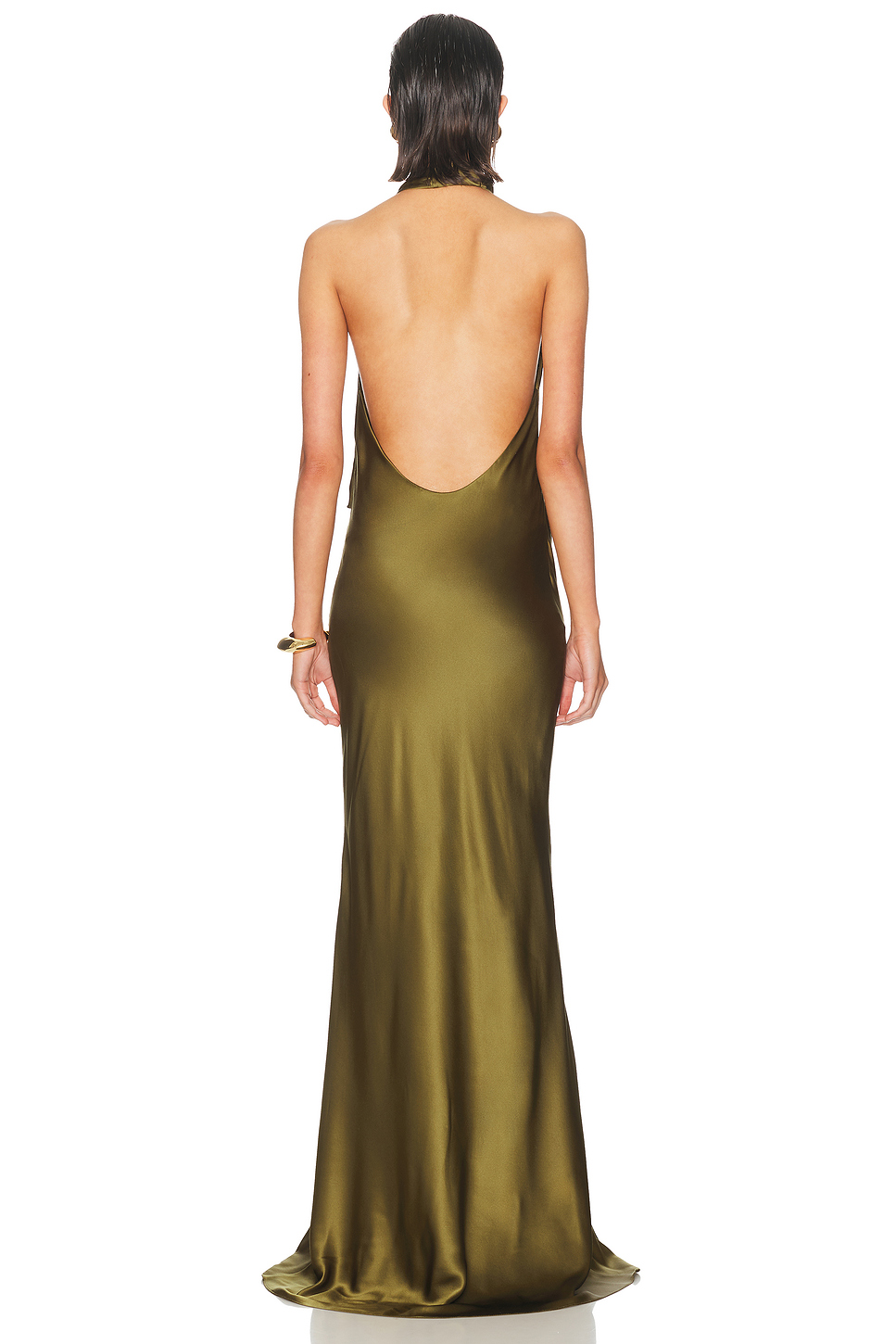
A gown listed with fabric and lining both in 100% silk, professional clean, fully lined, described as pull on with a button closure at the back, in a midweight charmeuse with a bias cut and a backless design, made in China, at 1,300 dollars. There are no reviews and no fit votes, so there is no score to quote. At sixty eight inches this is the longest garment examined here, long enough to have left the length system altogether, which is the most useful thing said about length categories in this series. Pull on alongside a button closure looks like a contradiction and resolving it improves a rule used many times recently. The reference is the Halter Drape Bias Gown by The Sei in Olive. Dongguan Bafinasa Garments Co., Ltd. develops comparable silk gowns on OEM and ODM terms, from fabric selection and bias cutting to retail or FBA ready packing. We publish this as a development reference and build your own version of it, and we do not supply the branded original or reproduce anyone else's label.
Key Features
- Fabric and lining both 100% silk, stated in a single combined field rather than two. See the note below
- Length 68 in, the longest garment examined anywhere in this series. See the note below
- Bias cut as stated, and together with the construction this accounts for the numbers. See the note below
- Pull on alongside a button closure at the back, which looks contradictory and is not. See the note below
- Midweight charmeuse as stated, with no second fibre anywhere needing to be balanced
- Fully lined as stated, and the lining is the same fibre as the shell
- Professional clean as stated, and silk alone is sufficient reason for it
- Backless design as stated
- Sizes 0 through 8, five even numbered sizes
Customisable Options
- Fabric: silk charmeuse to the reference, offered in several weights since that carries most of the questions here
- Cut: true bias to the reference, and we would confirm by weight rather than inherit the method
- Lining: silk to the reference, matched to the shell rather than substituted
- Closure: we would reconcile how it goes on with where an opening stops rather than inheriting conflicting words
- Length offered short rather than one figure given how extreme sixty eight inches is, size set, colour development, private label and care labelling
Specifications
| Style | Silk halter draped bias gown |
| Reference | The Sei, Halter Drape Bias Gown, style TSEX-WD156, manufacturer style TS9171B, colour Olive |
| Fabric and Lining | 100% silk, in a single field as stated. See the note below |
| Second Fibre | None stated anywhere |
| Fabric | Midweight charmeuse as stated. See the note below |
| Cut | Bias as stated. See the note below, since this explains the measurements |
| Construction | Pull on as stated, alongside a button closure at the back. See the note below |
| Design | Backless design as stated |
| Lining Coverage | Fully lined as stated |
| Care | Professional clean as stated. See the note below |
| Sizes Published | 0, 2, 4, 6 and 8, five even numbered sizes |
| Measurements Published | 2: bust 28 in, waist 28 in, hips 38 in, length 68 in. See the note below |
| Chart Note | The bust sits below the model while waist and hips sit above. See the note below |
| Coverage | Only size 2 has figures. Sizes 0, 4, 6 and 8 are blank |
| Model | 178 cm, bust 84 cm, waist 62 cm, hips 89 cm, wearing size 2 |
| Production | Made in China as stated |
| Reference Retail | 1,300 USD, quoted to show the price band this sits in, not as our price |
| Customer Reviews | None on the reference listing, so we quote no score |
| Best Seller Badge | None. The listing carries no rank |
| Categories | Filed by the retailer under gowns and halter dresses. See the note below, since neither is a length |
| Occasion | Black tie, formal events, weddings, occasions |
| MOQ | 100 pcs per style per colourway, mixed sizes and colourways accepted |
| Sampling | 7-10 days after tech pack or reference sample confirmation |
| Bulk Lead Time | 20-30 days after sample approval and deposit |
| Service | OEM / ODM / private label, silk sourcing, bias cut development, retail or FBA ready packing |
Size Chart
| Size | Bust | Waist | Hips | Length | Source | ||||||||||||
|---|---|---|---|---|---|---|---|---|---|---|---|---|---|---|---|---|---|
| 2 | 28 | in | 28 | in | 38 | in | 68 | in / | 173 | cm | As published | ||||||
| 0 | 31 | in / | 79 | cm | 24 | in / | 61 | cm | 34 | in / | 86 | cm | 173 | cm / | 68.1 | in | Our proposal |
| 2 | 33 | in / | 84 | cm | 26 | in / | 66 | cm | 36 | in / | 91 | cm | 175 | cm / | 68.9 | in | Our proposal |
| 4 | 35 | in / | 89 | cm | 28 | in / | 71 | cm | 38 | in / | 97 | cm | 177 | cm / | 69.7 | in | Our proposal |
| 6 | 37 | in / | 94 | cm | 30 | in / | 76 | cm | 40 | in / | 102 | cm | 179 | cm / | 70.5 | in | Our proposal |
The published size 2 gives bust 28 in, waist 28 in, hips 38 in and length 68 in against a model at roughly 33, 24 and 35. The bust sits about five inches below her while waist and hips sit well above, and there are two stated reasons for that working together.
Occasions and Styling
Suits black tie, formal events, weddings and occasions. Bias cut charmeuse follows the body rather than imposing a shape, and at sixty eight inches this is a full length piece where what is underfoot matters, so height relative to hem is worth settling before ordering.
Production and Quality Control
There are no reviews and no fit votes on this listing, so we quote no score. At sixty eight inches this is the longest garment encountered here, and it is long enough to have stepped outside the length system altogether, which clarifies that system better than anything else has. Pull on stated alongside a button closure appears contradictory, and resolving the appearance improves a rule used several times recently.
Sixty eight inches, and leaving the length system entirely, and that is the first thing. The published length is sixty eight inches, about one hundred and seventy three centimetres, which is the longest figure encountered anywhere in this series, exceeding even another examined recently at sixty three. The model is one hundred and seventy eight centimetres, so this cloth covers about ninety seven per cent of her height, meaning it reaches close to the floor on somebody tall enough that most things fall well short of it. Now, this series has spent considerable space establishing that the length categories carry almost no reliable information, having found sets of lengths and labels which no consistent threshold could arrange, most sharply a pair differing by half an inch whose labels ran the wrong way, and having concluded that what those words describe is how a garment looked on whoever modelled it rather than anything about cloth. This garment supplies the cleanest possible account of why, and it does something slightly different from simply being another case. It is no longer filed by length at all. This is recorded under gowns and under halter, and neither word is a length. Everything recently examined sat inside the sequence in some way, whether sensibly or not, being called mini, midi or maxi, and here the retailer has stopped trying to place it there. Read alongside everything else and this is the system admitting something: once a garment gets this long, placement by length stops being informative, so another kind of word gets used instead. That is the strongest available evidence that those words were never measurements. They were rough impressions of photographs, and impressions stop working at the edges, so at the edges people reach for something else. It is also worth saying what this asks of anybody specifying garments, since that is actionable rather than merely critical. A hundred and seventy three centimetres is a great deal of cloth, and if somebody is average height rather than close to this model, they will be walking on several inches of it. This page does publish the figure, which deserves credit since many do not, and comparing sixty eight inches against your own height resolves immediately whether this is wearable, which no category word could do. Offering this same design at two or three lengths would extend it considerably beyond tall buyers, and unlike adding sizes that mostly means altering one pattern dimension. Finally there is the care instruction, and it is the easiest to justify among recent batches. Both stated layers are silk, with no second fibre anywhere needing balancing, and this series has described silk repeatedly: it marks permanently wherever water sits and dries, so marks appear where water was rather than where anything was spilled, and it loses brightness under ultraviolet light. That alone is sufficient, and the interest here is rather that nothing else competes, since a lining in the same fibre means one problem treated once rather than two.
Pull on plus buttons, and a binary becoming a scale, and that is the second thing. The page states both that this is pull on and that there is a button closure at the back, and those read as flatly incompatible. Pull on means there is no opening, so it cannot be stepped into or opened around the body, whereas a button closure means there plainly is one. This series would once have treated that as an error. It is worth asking instead what would make both true, because an assumption has been operating quietly in everything written about this recently. This series established recently that a garment with no opening must be able to pass the widest part of the body, since it has to be got over whatever is broadest, and then immediately had to qualify that having derived it from one non-stretch woven garment, noting that where the cloth itself stretches the need disappears because the stretch does the work extra cloth would otherwise do. Both times, with and without stretch, an opening was treated as a binary: either there is one, or there is not. This garment shows that it is a scale, which is the correction worth carrying forward. A button closure at the neck opens enough for the head to pass, and then it stops. Everything below that stopping point still has no opening at all. So what governs how a garment goes on is not whether there is a fastening but where an opening ends, since below that point the body still has to be got through, and below it the cloth still has to be big enough or stretchy enough to allow that. That reading immediately explains these numbers, and there is no longer anything confusing about them. The bust sits about five inches below the model, which is exactly where the halter and the neck opening and the bias can be put to work. Waist and hips sit well above her, at twenty eight and thirty eight against twenty four and thirty five, and that is not a shape anybody would draw either, since there is generous ease at two points and none at the third. It is simply the cost of everything below the last button having to travel over the hips. So the two apparent contradictions on this page resolve into one explanation, and the general lesson now reads this way: negative ease appears where a garment has some means of dealing with it, and positive ease appears where it has none, and reading where each belongs tells you which part of a garment is doing structural work.
Bias and charmeuse together, and a better way of stating layers, and that is the third thing. This is stated as bias cut, which is one of the mechanisms catalogued in this series, though one which has always carried a qualification. Cutting on the bias means cutting at an angle across rather than along the grain threads, and because cloth distorts most readily along that diagonal, a garment so cut clings and follows rather than hanging from its own structure. That is why it appears so often on garments of this shape. The qualification this series has always attached is that it grants that behaviour in one direction and not uniformly, so it is not interchangeable with stretch, and it does not let one size serve several bodies the way elastane does. Here it is working alongside several other things at once, which is worth setting out because this series has recently been finding mechanisms stacking more often. There is bias itself. There is the halter, whose ties are adjusted each time it is worn, belonging in the family where nothing needs to stretch because circumference is set by hand. There is charmeuse, worth one sentence since it is the first time it has appeared: it is built with long floats across the surface, giving the characteristic lustrous face and heavy fluid drape, and those same floats are the most exposed part of any weave, being raised and free along most of their length, so they are what anything abrading meets first. Nothing here is stretch, since there is no second fibre at all, which makes this a clean instance of the family of mechanisms relying on geometry rather than material. This series noted recently that there appear to be two independent sources of negative ease which stack rather than substituting for one another, and everything above belongs to the geometric side. There is one further thing worth noticing, which is a small piece of corroboration for something argued repeatedly. Rather than being recorded as either a shell or a lining alone, this page states a single combined field naming both together, which is one of several wordings this series has assembled for splitting a garment into layers. It is considerably less common than the single unexplained word alone, which has now appeared well into double figures here with the second layer never once following. Every bulk shipment gets a measurement report against your approved chart.
Optional upgrades include offering this at two or three lengths rather than one, since one hundred and seventy three centimetres suits tall buyers almost exclusively and this requires one pattern dimension rather than a new design, reconciling the two closure statements into one sentence saying where an opening stops rather than using two words which appear to conflict, publishing measurements for sizes 0, 4, 6 and 8, since one of five repeats throughout, stating charmeuse weight rather than only midweight, since that decides both how it drapes and how exposed those floats are, confirming bias rather than merely stating it since the two are frequently claimed and less often delivered, keeping silk for both layers since having one treatment rather than two is genuinely simpler here, extending the size range past size 8 if demand supports it, offering lining alternatives where silk is not wanted, keeping the combined fabric and lining field rather than splitting it, since stating both in one place has repeatedly proved to be the cleanest way these pages handle layers, colour development, private label, hangtag and care labelling.
Pre-production sample approval, in-line inspection during cutting and sewing, and a final AQL inspection before packing, with measurement reports and photos shared before shipment.
Send us your tech pack, a photo or a reference garment and we will quote within 24 hours. Contact bafinasa@bafinasa.com or WhatsApp +86 13827222469.