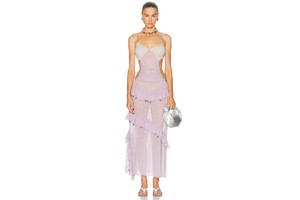
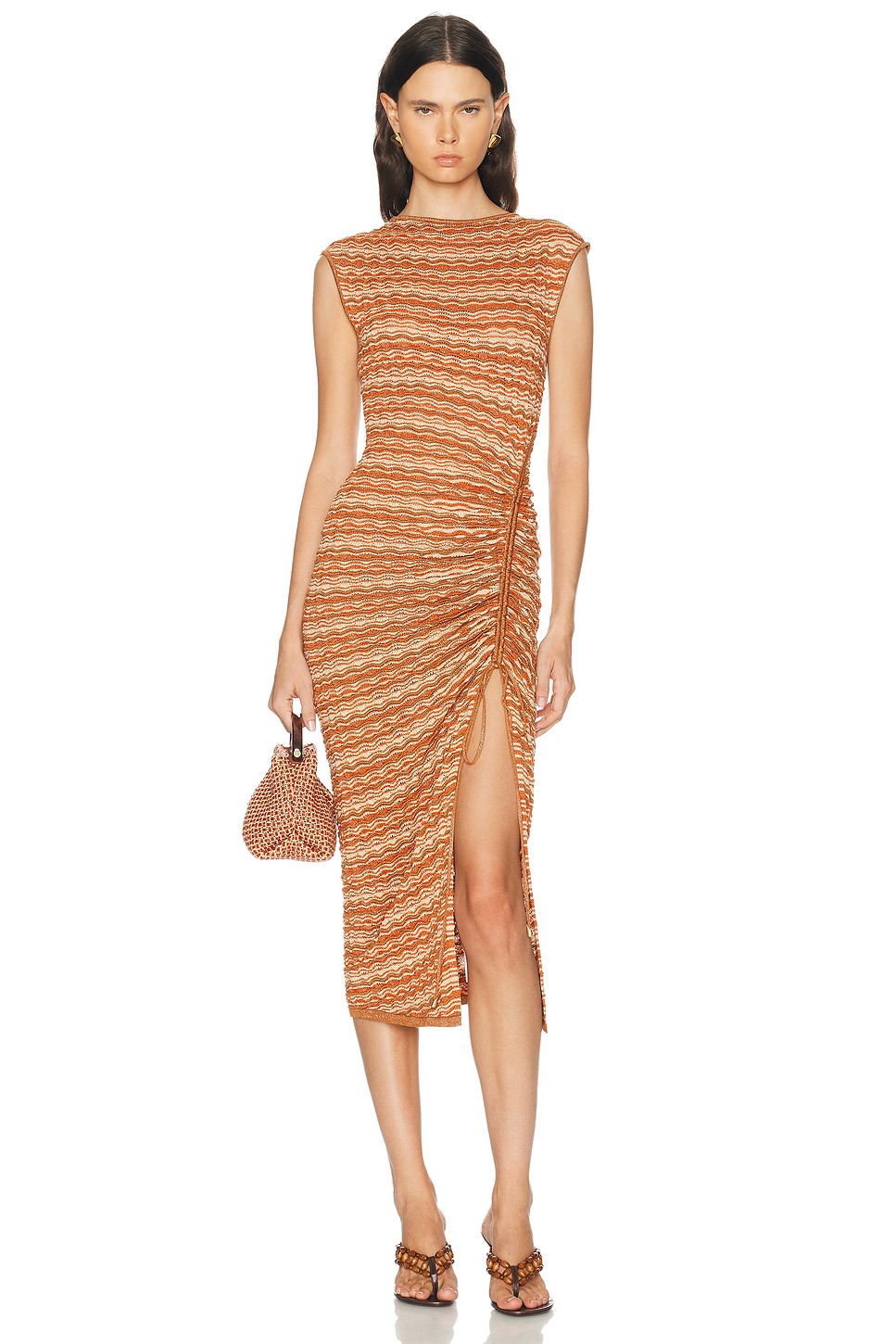
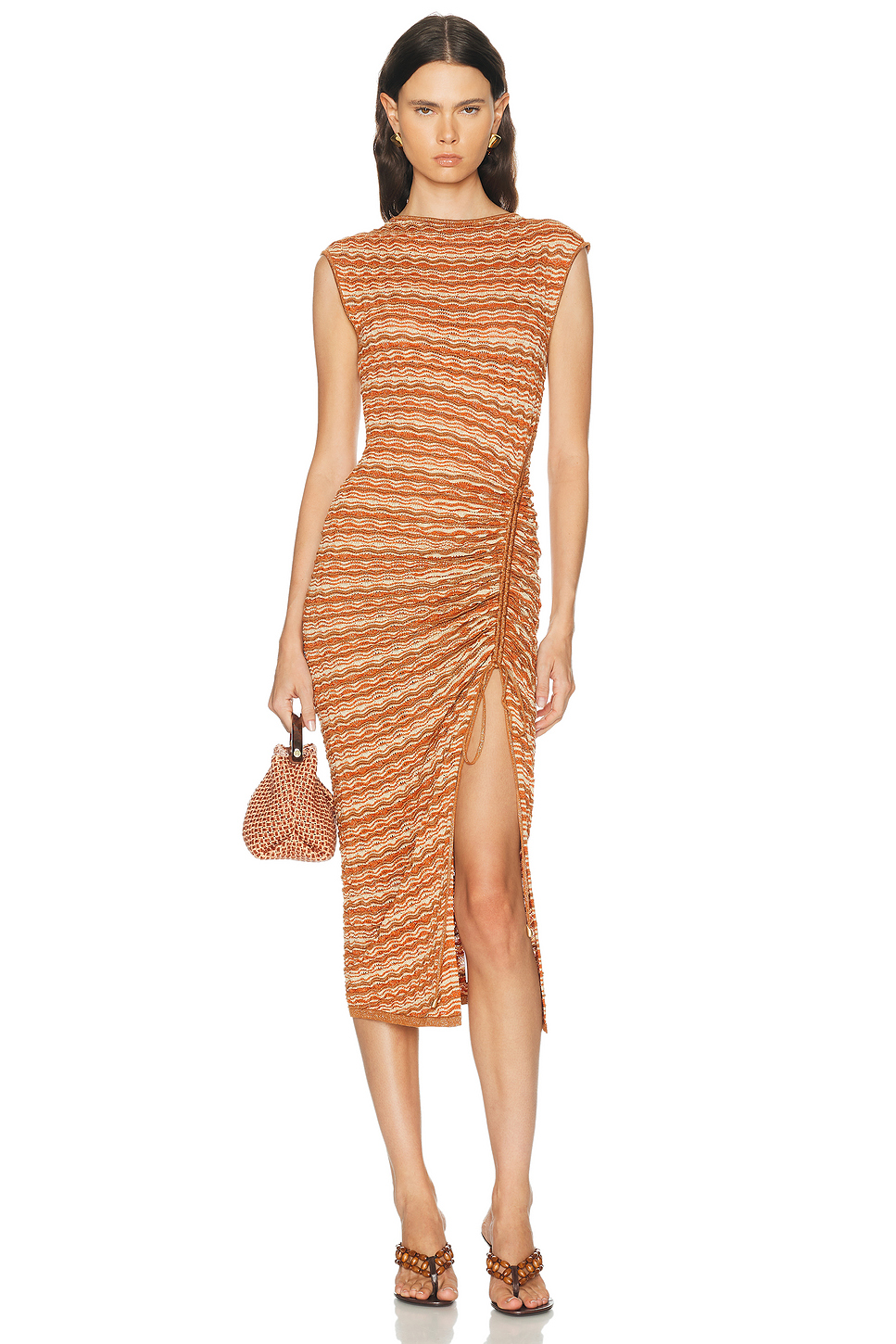
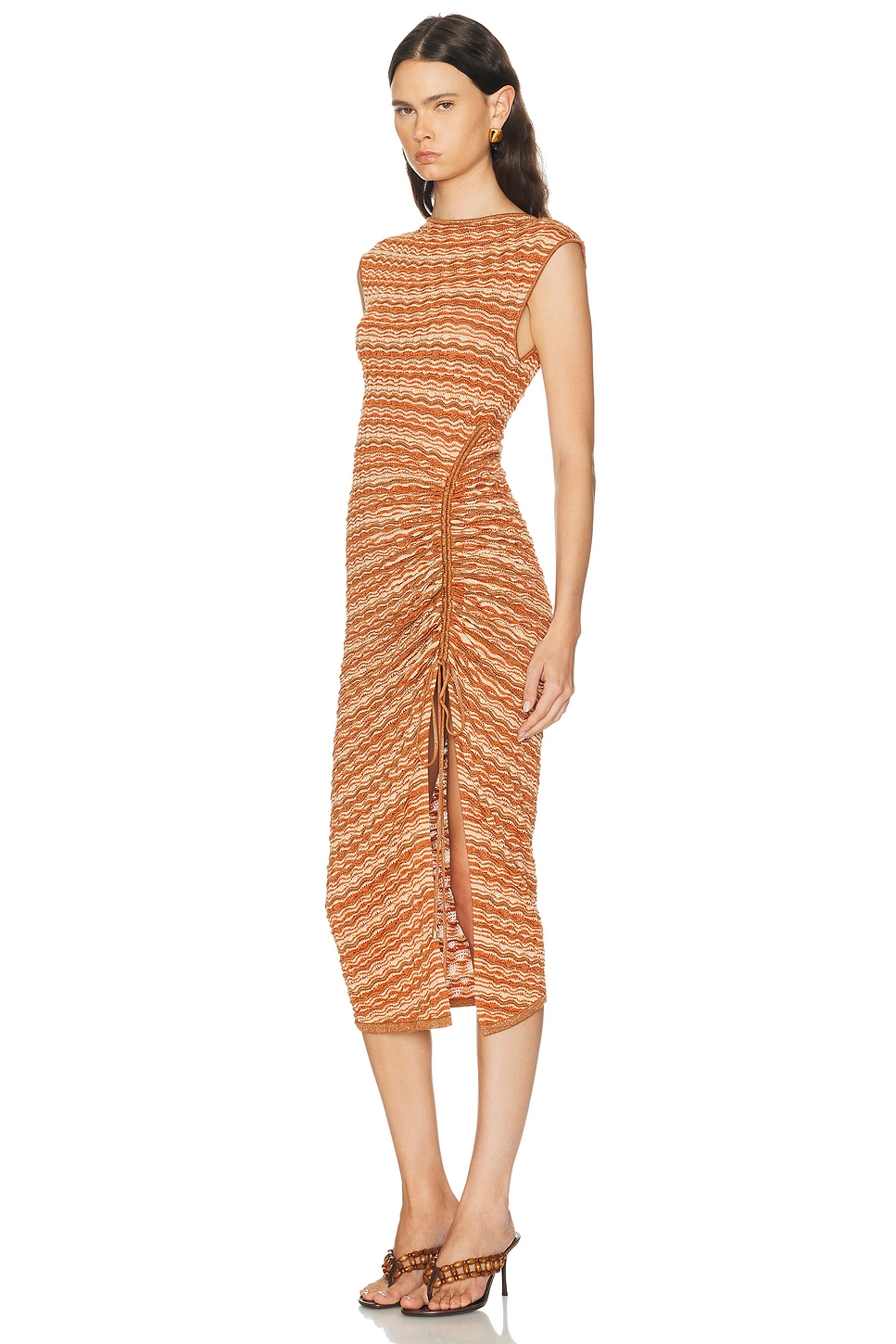
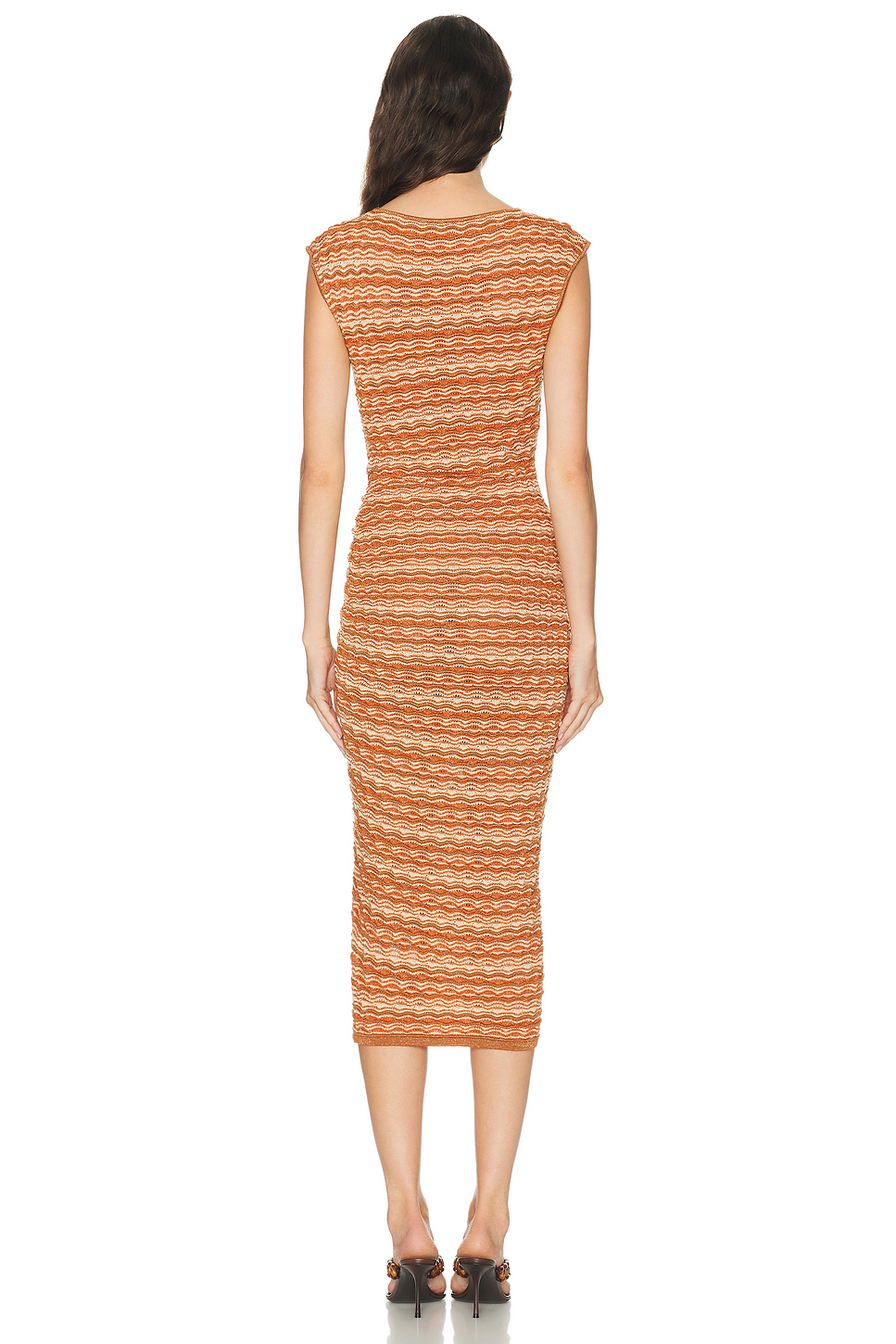
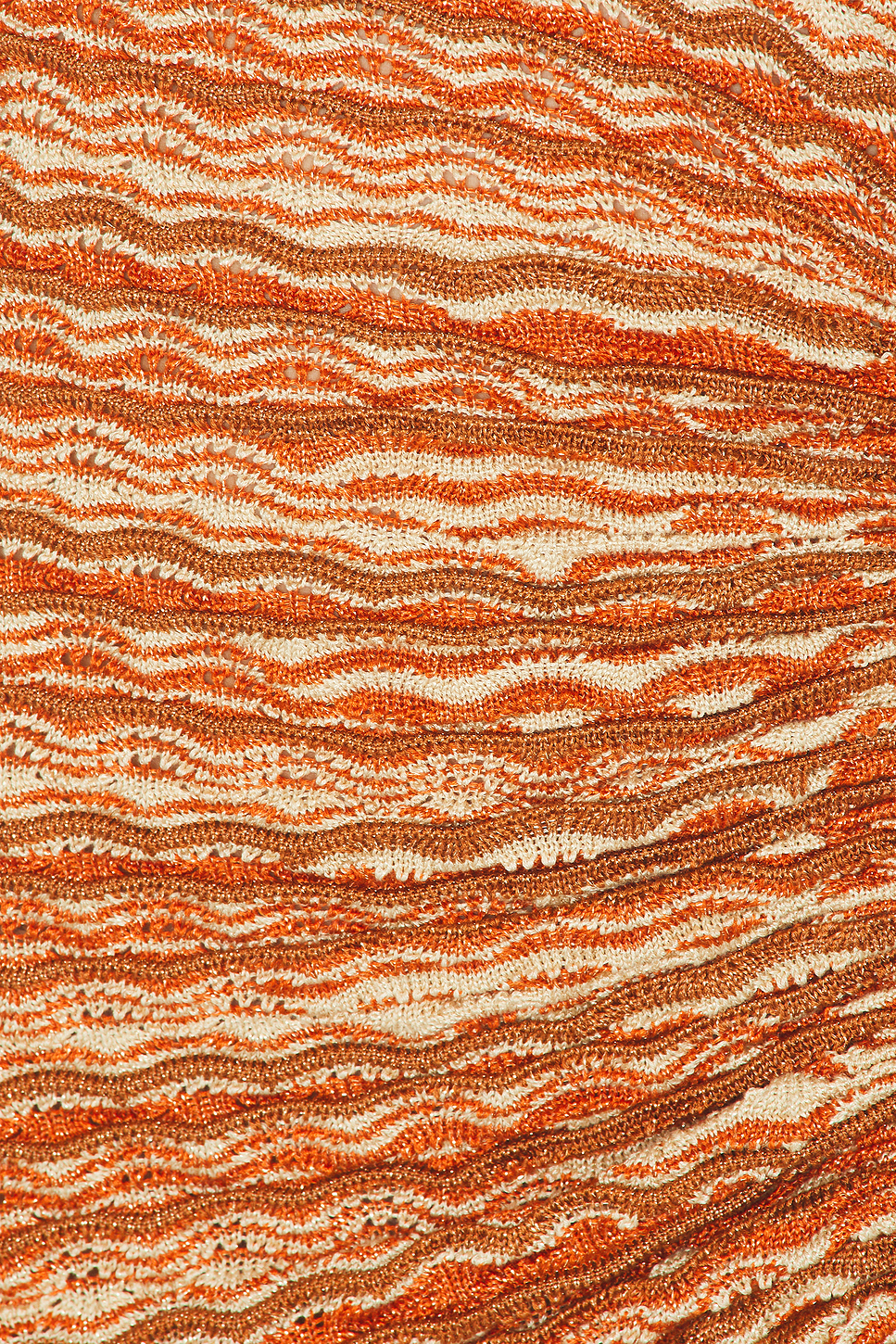
A midi dress listed in 95% lyocell with 3% nylon and 2% metallic fibre, hand wash, unlined, with a pull on construction, in a midweight fully fashion knit with a slit at the hem, made in China, ranked sixth in the retailer's short sleeve dress list, at 598 dollars. There are no reviews and no fit votes, so there is no score to quote. This is the first lyocell encountered here, and it breaks an assumption this series has been making quietly for hundreds of listings, which makes it one of the more useful pages examined. The knit construction is also stated in a way met nowhere else, and that single phrase answers a problem which has been recurring throughout. The reference is the Hilary Dress by Cult Gaia in Corallo Multi. Dongguan Bafinasa Garments Co., Ltd. develops comparable knit dresses on OEM and ODM terms, from yarn selection and fully fashion programming to retail or FBA ready packing. We publish this as a development reference and build your own version of it, and we do not supply the branded original or reproduce anyone else's label.
Key Features
- 95% lyocell as stated, the first lyocell encountered in this series. See the note below
- 3% nylon and 2% metallic fibre as stated, with metallic now spanning a very wide range here
- Hand wash as stated, and the dominant fibre is what makes that defensible. See the note below
- Midweight fully fashion knit as stated, and that phrase resolves something recurring. See the note below
- Pull on construction as stated, with no opening anywhere
- Slit at the hem as stated
- Unlined as stated
- Measurements published for size S, with bust 28 in and hips 30 in. See the note below
Customisable Options
- Yarn: lyocell to the reference, offered across alternatives where different hand or weight is wanted
- Knit: fully fashion to the reference, programmed per size so panels arrive shaped rather than cut
- Metallic: trace amount to the reference, increased or removed since it changes nothing structural at this level
- Care: hand wash to the reference, plus drying instructions given how knit behaves wet
- Length from knee to ankle, gauge options, hem slit height, size set, colour development, private label and care labelling
Specifications
| Style | Lyocell metallic knit midi dress |
| Reference | Cult Gaia, Hilary Dress, style GAIA-WD420, manufacturer style SWTDR38025Y13843, colour Corallo Multi |
| Composition | 95% lyocell, 3% nylon, 2% metallic fibre as stated. See the note below |
| Dominant Fibre | Lyocell, and its behaviour differs sharply from the rest of its own family. See the note below |
| Fabric | Midweight fully fashion knit as stated. See the note below, since this wording is unusual |
| Construction | Pull on as stated. See the note below |
| Detail | Slit at the hem as stated |
| Lining | Unlined as stated |
| Care | Hand wash as stated. See the note below, since this follows from the dominant fibre |
| Sizes Published | XS, S, M and L |
| Measurements Published | S: bust 28 in, waist 24 in, hips 30 in, length 52 in. See the note below |
| Chart Note | Bust and hips sit around six inches below the model despite there being no opening |
| Coverage | Only size S has figures. XS, M and L are blank |
| Model | 182 cm, bust 86 cm, waist 58 cm, hips 91 cm, wearing size S |
| Production | Made in China as stated |
| Reference Retail | 598 USD, quoted to show the price band this sits in, not as our price |
| Customer Reviews | None on the reference listing, so we quote no score |
| Best Seller Badge | Rank 6 in the retailer's short sleeve dress list |
| Categories | Filed by the retailer under midi dresses and short sleeve dresses |
| Occasion | Occasions, evenings, resort, holidays, warm weather |
| MOQ | 100 pcs per style per colourway, mixed sizes and colourways accepted |
| Sampling | 7-10 days after tech pack or reference sample confirmation |
| Bulk Lead Time | 20-30 days after sample approval and deposit |
| Service | OEM / ODM / private label, lyocell yarn sourcing, fully fashion programming, retail or FBA ready packing |
Size Chart
| Size | Bust | Waist | Hips | Length | Source | ||||||||||||
|---|---|---|---|---|---|---|---|---|---|---|---|---|---|---|---|---|---|
| S | 28 | in | 24 | in | 30 | in | 52 | in / | 132 | cm | As published | ||||||
| XS | 31 | in / | 79 | cm | 24 | in / | 61 | cm | 34 | in / | 86 | cm | 132 | cm / | 52 | in | Our proposal |
| S | 33 | in / | 84 | cm | 26 | in / | 66 | cm | 36 | in / | 91 | cm | 134 | cm / | 52.8 | in | Our proposal |
| M | 35 | in / | 89 | cm | 28 | in / | 71 | cm | 38 | in / | 97 | cm | 136 | cm / | 53.5 | in | Our proposal |
| L | 37 | in / | 94 | cm | 30 | in / | 76 | cm | 40 | in / | 102 | cm | 138 | cm / | 54.3 | in | Our proposal |
The published size S gives bust 28 in, waist 24 in, hips 30 in and length 52 in against a model at roughly 34, 23 and 36. Bust and hips sit about six inches below her on a garment with no opening anywhere, and there is a stated reason for that.
Occasions and Styling
Suits occasions, evenings, resort wear, holidays and warm weather. Lyocell drapes fluidly and moves well in heat, and the slit at the hem keeps a long line walkable, though how long it stays that way depends on how it is dried.
Production and Quality Control
There are no reviews and no fit votes on this listing, so we quote no score. Lyocell appears here for the first time and it breaks an assumption made quietly for hundreds of listings, which makes this one of the more useful pages examined. The knit construction is also stated in a way met nowhere else, and that phrase resolves a recurring problem.
Lyocell, and why same family does not mean same behaviour, and that is the first thing. Ninety five per cent of this is lyocell, which this series has not met before, and it belongs in a group already heavily populated here. Regenerated cellulose has appeared constantly, most often as viscose, occasionally under other names, and this series has an established description of the group which has been repeated hundreds of times: it loses around half its strength when wet, it shrinks, and it creases badly as it dries, none of which can be undone. That description is wrong for lyocell. Lyocell is made by dissolving cellulose in a different solvent and extruding it in a closed loop which recovers almost all of it, and the fibre which results has a much more ordered internal structure than viscose. The practical consequence is the single fact which matters here: lyocell retains most of its strength when wet, keeping something in the region of eighty five per cent rather than falling to around half. That is not a marginal difference within one family. It is the difference between a fibre which has to be kept out of water and one which tolerates it, and those two statements sit inside the same group. Now hold that against the instruction, which is hand wash. This page becomes considerably more legible with that one fact, because this series has examined many garments dominated by viscose and nearly every one of them carried the strict professional instruction, and that was never arbitrary, since a cloth at half strength in water is not going to survive agitation. Substitute a regenerated cellulose which keeps most of its strength and the instruction can relax, which is exactly what this one does. So this is the first time here that a difference in care between two garments can be attributed to one specific fibre substitution rather than to brand habit or to something structural, and it is worth saying plainly how unusual that is, since this series has repeatedly had to conclude that no stated thing accounted for the difference. The general lesson is sharper than anything learned about families so far. This series has been reasonably happy working at family level, having recently compared two linings where one pairing shared a family and moved in proportion while another shared nothing and had two unrelated failure modes sharing one fate, and concluded that what matters is how layers behave together. That reasoning was sound and it remains sound. But families are groupings made for convenience, and this shows their limit in a way which is genuinely actionable: difference within a family can exceed difference between families. Treating every regenerated cellulose as though it were viscose would have produced exactly the wrong recommendation here, and there was no way to tell them apart without knowing which one this was. Which is also the argument for stating specific fibres rather than groups, and this page did state it, so there was no ambiguity to resolve.
Fully fashion, and it answering a problem that has recurred throughout, and that is the second thing. This is stated as a midweight fully fashion knit, and that phrase contains two things worth separating. Fully fashion describes a particular way of making knitwear. Rather than knitting a length of cloth and cutting shapes out of it, the panels are knitted directly to the finished shape on the machine, with increases and decreases worked in during knitting so that a front and back emerge already shaped. Several consequences follow and one of them settles something this series has been circling for a long while. Because each panel is knitted to shape, its edges are finished as part of knitting rather than by being cut, so there is no raw edge anywhere to fray or unravel. Now set that against crochet, which was described recently and again alongside this one, where the difficulty identified was precisely that each loop is held only by the next one passing through, so damage does not stay where it happens but travels along the row. Fully fashion neatly removes most of that exposure at the edges, which is exactly where such things start. It has further advantages worth knowing about: since there are no offcuts, there is considerably less yarn wasted, and since panels are shaped rather than forced into shape by cutting and seaming, the garment tends to sit better on the body. The trade-off is real and worth stating rather than glossing, which is that programming is expensive and each size needs replicating separately, so this approach suits smaller runs of higher value pieces rather than commodity volumes. Then there is the second word, midweight, which has now appeared often enough here to be among the most valuable things these pages state, since this series established comparing two similar cotton garments that a construction name describes how yarns are arranged while only quantity says how much material is present, and quantity decides most practical questions. Both words together do more than either alone. What remains is something this series has found on nearly every hand wash instruction examined, which is that washing is addressed and what follows is not. Knit carries no virtue here: when wet it becomes heavy, its own weight pulls it downward, and its loops have nothing holding them in a fixed geometry, so it grows rather than merely stretching. Hanging this to dry is close to the worst available choice, since gravity does all of that while it dries and it will set the longer shape. Drying flat is the answer, costing about ten words, and this series has now found this exact gap repeatedly, most sharply on constructions where what happens after washing carries most of the risk.
Six inches below her with no opening, and what three garments finally establish, and that is the third thing. Published measurements are bust twenty eight, waist twenty four, hips thirty, against a model at approximately thirty four, twenty three, thirty six, so around six inches less at bust and hips and roughly level at the waist, on a garment with no opening at all. This is now the third garment in recent batches presenting large negative ease together with a stated absence of any fastening, and putting the three together gives something none did alone. This series has spent a great deal assembling the mechanisms allowing a garment to fit a body smaller than its own measurements, having built up six: knit because loops open, elastane high enough to compress rather than merely recover, bias cutting though only along one direction, shirring because gathered elastic draws cloth in, closure that is adjusted rather than stretched, and padding which unlike the others involves nothing moving at all. This garment contains no elastane whatsoever, so the second contributes nothing, and there is no gathered element and nothing obviously padded. What remains is knit structure. Now the comparison across the three is instructive in a way none was individually. Two crocheted garments examined either side of this one showed shortfalls around six and eight inches with no stretch fibre at all. This one shows six. So loop structure alone, with no stretch fibre contributing anything, appears able to deliver something in the region of six to eight inches reliably. To get substantially beyond that appears to require adding something which actively pulls back, and there is a garment examined directly alongside this one which supplies the far end of exactly that comparison, showing what a much larger elastane contribution produces. Where the three differ is also worth noting, since it prevents the comparison being too neat: this one is level at the waist while the others were not, and this one is midweight, meaning there is rather more material present and therefore rather less room for loops to open before something resists. So the practical reading is that construction sets how much stretch the geometry permits, weight sets how much of that is reachable, and elastane sets how much beyond that is possible. All three appear here in one place, which this series has noted recently is unusual, and it is worth adding one caution which has now arisen three times running. Recent garments have increasingly needed several mechanisms stacked to account for their numbers, and the recurring lesson is worth keeping in this exact form: before reaching for an elaborate explanation, look for stated elements which either move or distort how numbers are taken, since most of the time these pages have already said what accounts for it. Every bulk shipment gets a measurement report against your approved chart.
Optional upgrades include naming lyocell rather than any group it belongs to, since treating it as viscose would have produced exactly the wrong recommendation here, adding drying instructions to the care label, since knit grows rather than stretching when wet and drying flat is the difference between a garment which stays the same length and one which does not, publishing measurements for XS, M and L, since one of four repeats throughout, offering the same style cut and sewn as well as fully fashion, since the two suit different volumes and the second wastes considerably less yarn, specifying gauge rather than only weight, since that sets how far the loops can open before something resists, stating whether the metallic content can be increased or removed, since at trace level it changes nothing structural, extending the size range if demand supports it, hem slit height rather than only that there is one, length options rather than fifty two inches alone, colour development, private label, hangtag and care labelling.
Pre-production sample approval, in-line inspection during cutting and sewing, and a final AQL inspection before packing, with measurement reports and photos shared before shipment.
Send us your tech pack, a photo or a reference garment and we will quote within 24 hours. Contact bafinasa@bafinasa.com or WhatsApp +86 13827222469.