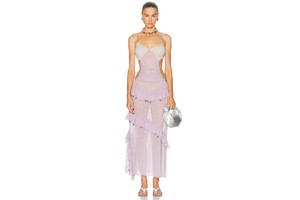
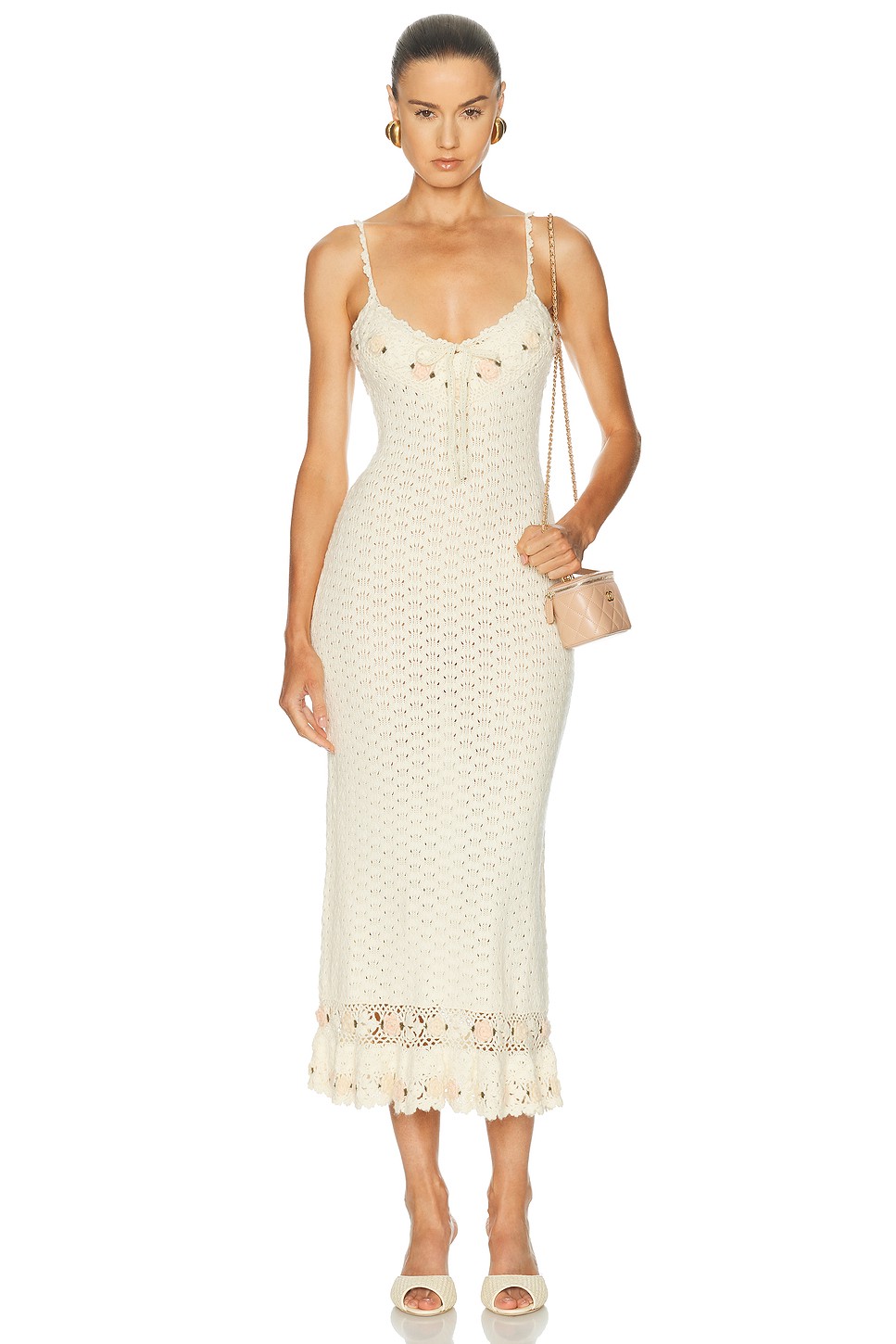
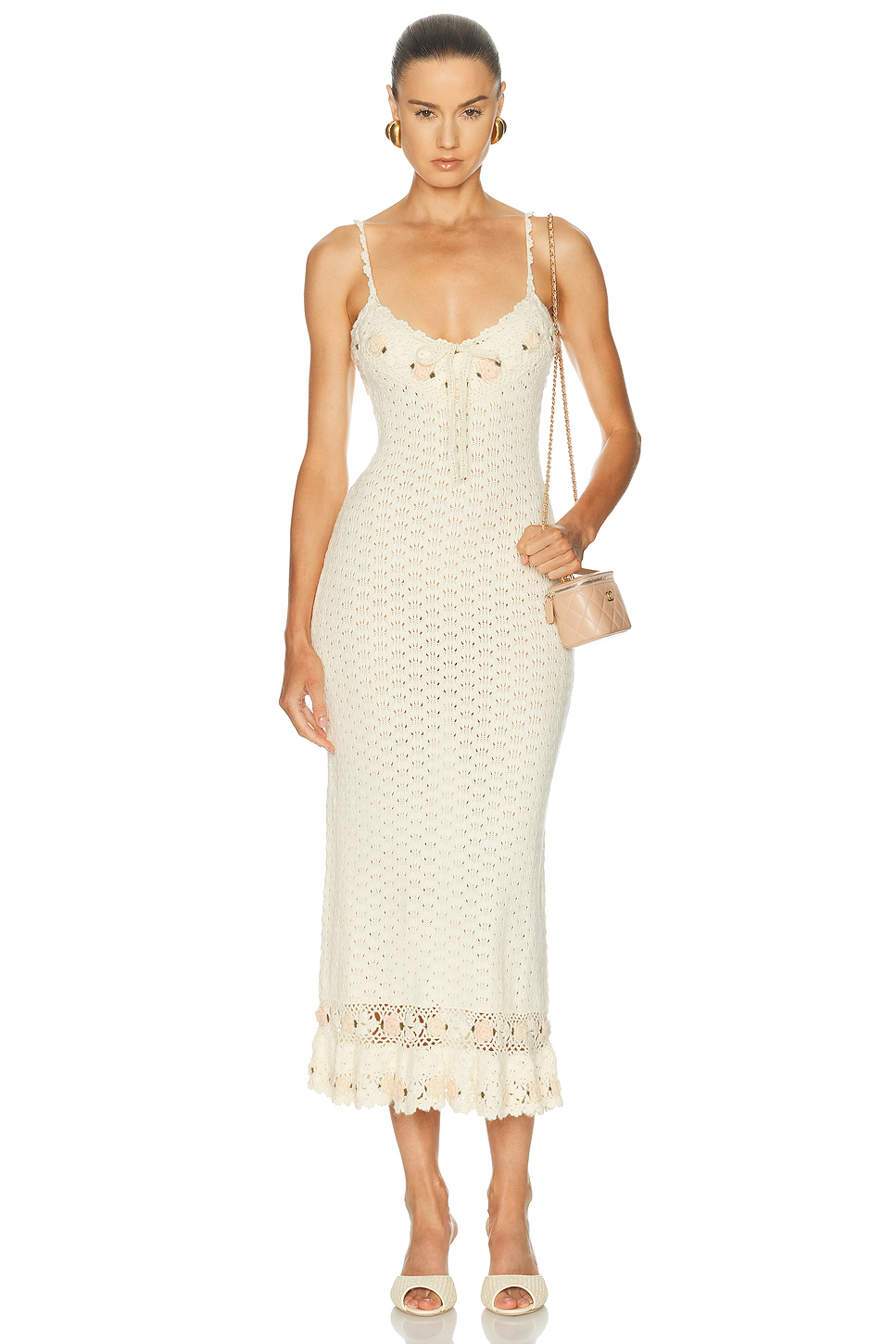
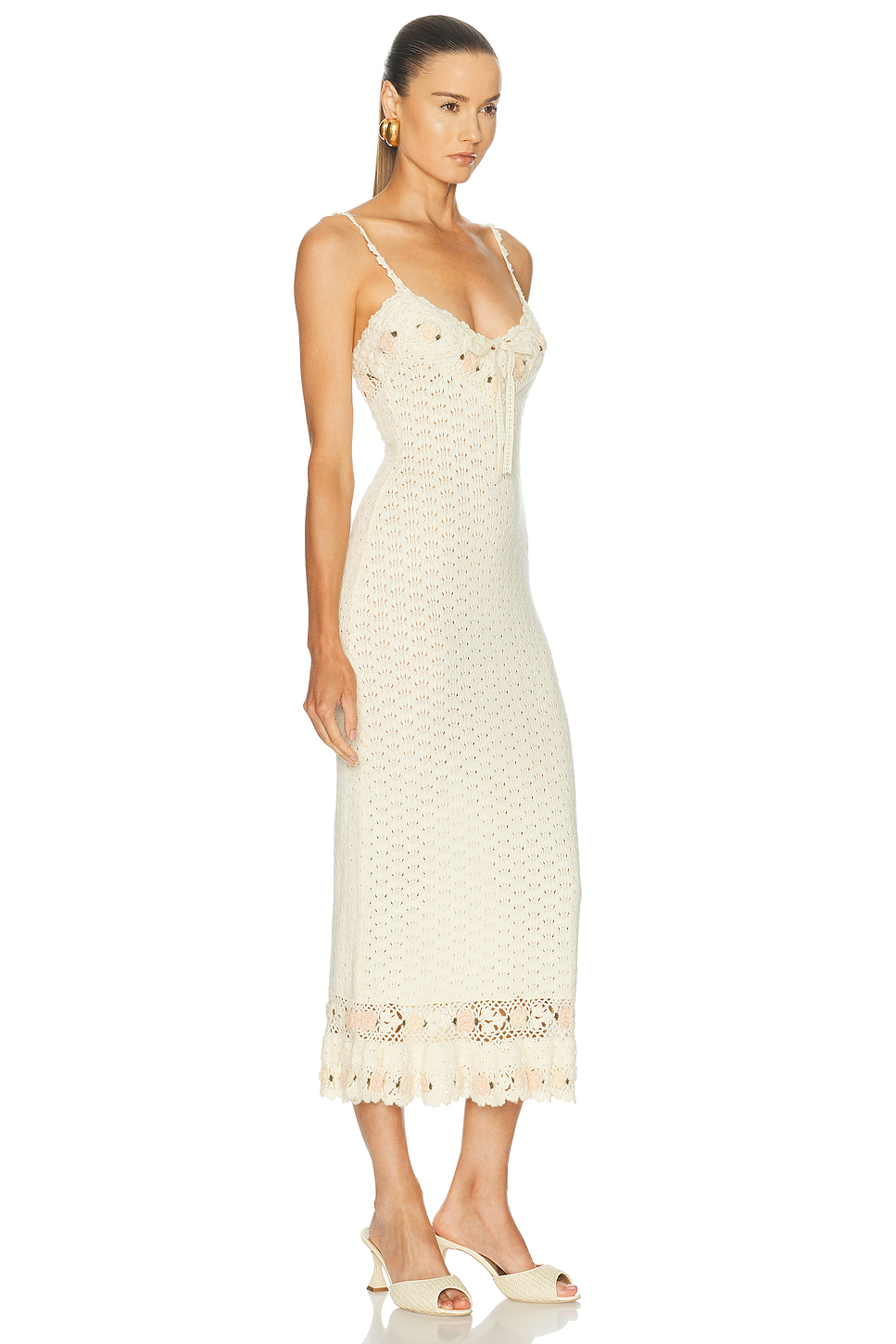
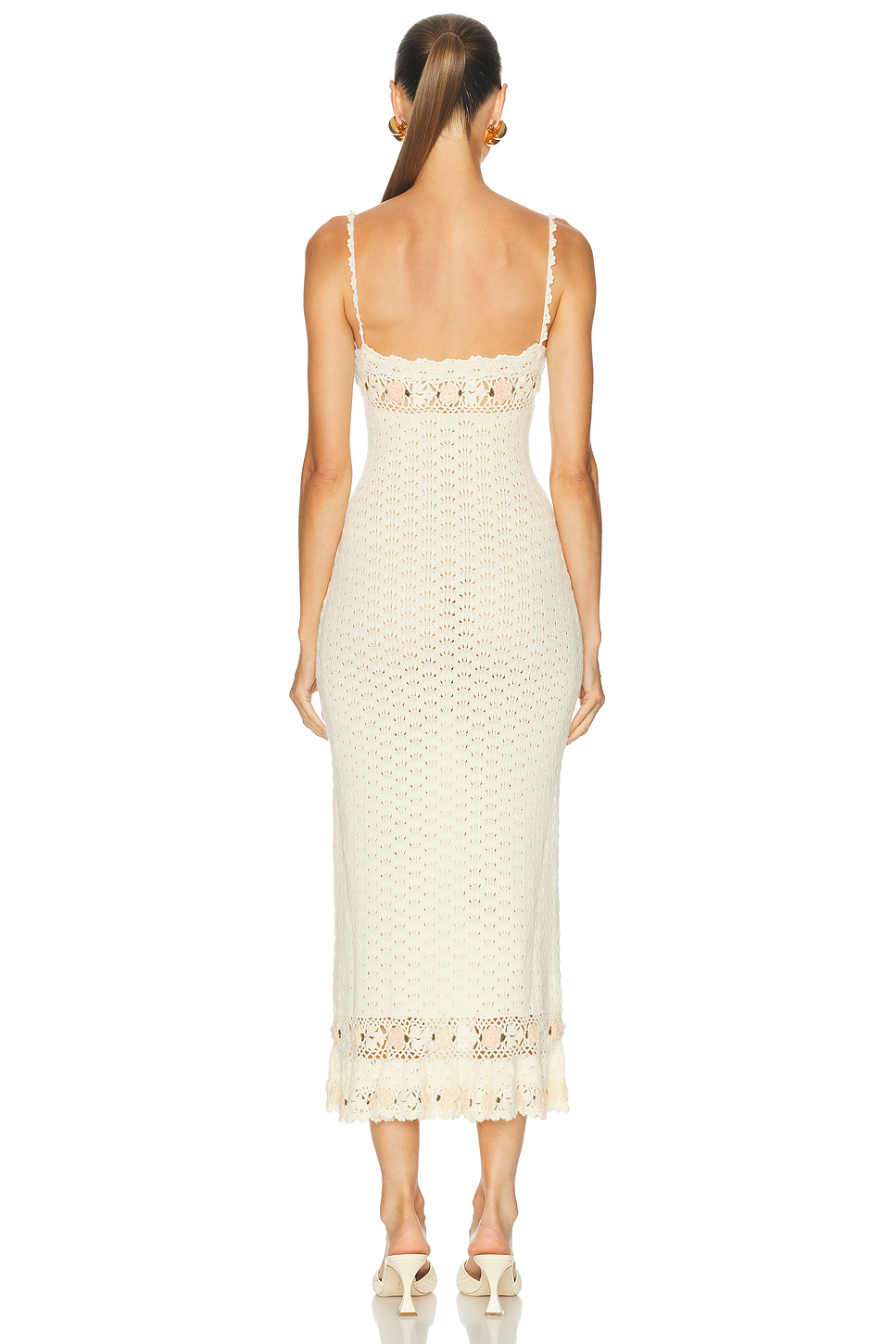
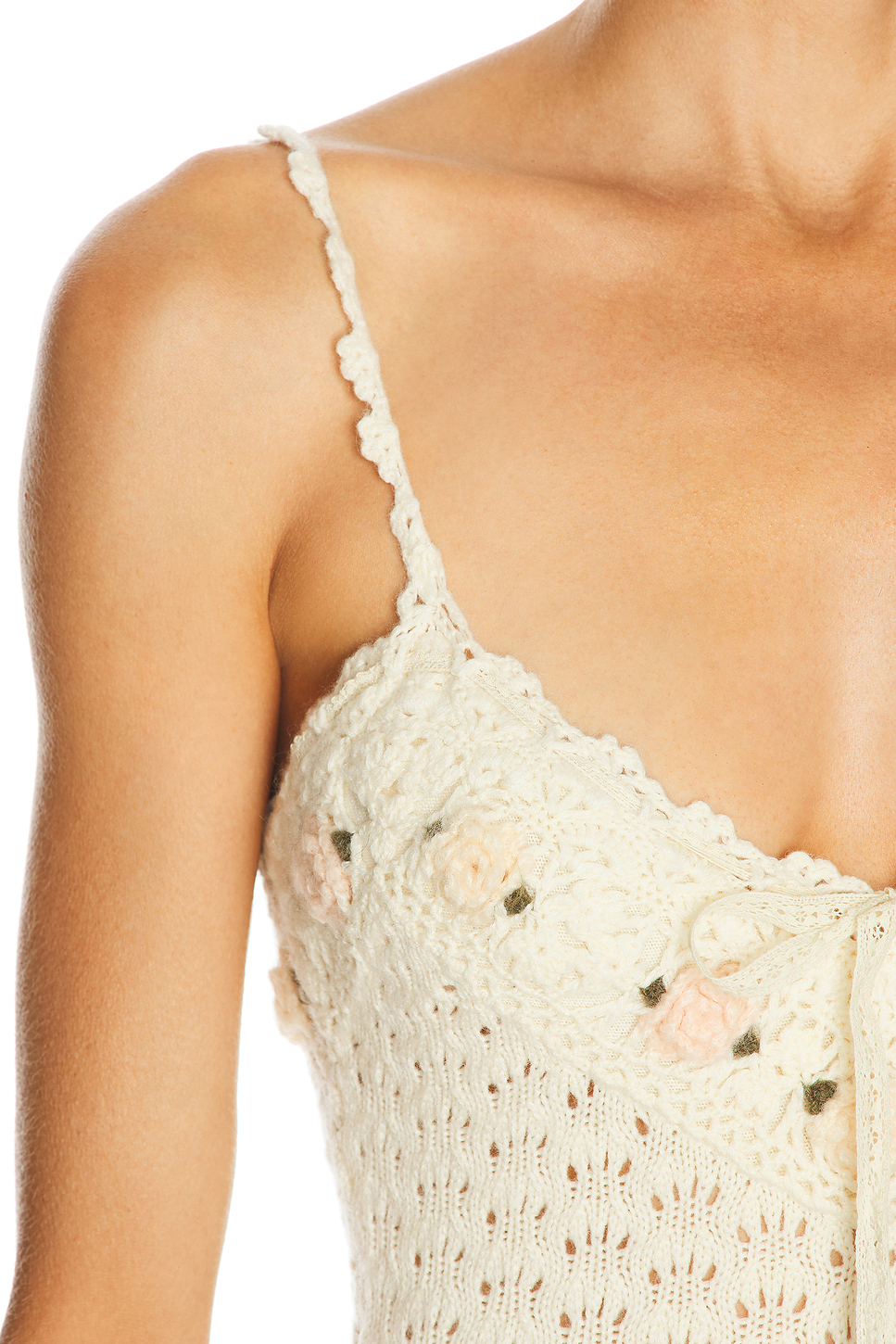
A midi dress listed in an unusually long composition of six fibres: 42% polyamide, 25% viscose, 18% wool, 9% acrylic, 4% cashmere and 2% mohair, dry clean only, unlined, with a pull on construction, in a soft crocheted knit with a floral detail at the hem and a plainly stated note that the fabric is semi-sheer, made in China, at 695 dollars. There are no reviews and no fit votes, so there is no score to quote. This is the first garment examined here with no fibre in the majority at all, and handling it properly required revising a rule used hundreds of times before. The negative ease here is also the third case in a row of a particular kind, which finally makes the three say something none did alone. The reference is the Rosarium Lady Length Dress by Mirror Palais in Creme. Dongguan Bafinasa Garments Co., Ltd. develops comparable knit dresses on OEM and ODM terms, from yarn selection and knit development to retail or FBA ready packing. We publish this as a development reference and build your own version of it, and we do not supply the branded original or reproduce anyone else's label.
Key Features
- Six fibres stated, and no single one of them holds a majority. See the note below
- Three of those six are animal fibres behaving quite differently from one another
- Dry clean only as stated, and the majority of this cloth demands it rather than any one fibre
- Soft crocheted knit as stated, the second crochet examined here and the first stated as sheer
- Stated plainly as semi-sheer with undergarments visible, using wording met twice before
- Pull on construction as stated, with no opening anywhere
- Unlined as stated, so nothing sits behind an open knit
- Floral detail at the hem as stated
Customisable Options
- Yarn: blended to the reference, though we would propose fewer fibres doing the same job rather than all six
- Knit: open crocheted structure to the reference, offered at several gauges since that decides everything here
- Opacity: we would offer a lining option or a denser gauge rather than only stating the outcome
- Care: we would keep dry clean only and explain which fibre actually requires it
- Length from knee to ankle, gauge options, lining options, colour development, private label and care labelling
Specifications
| Style | Six fibre open knit midi dress |
| Reference | Mirror Palais, Rosarium Lady Length Dress, style MRPF-WD66, manufacturer style MPK241, colour Creme |
| Composition | 42% polyamide, 25% viscose, 18% wool, 9% acrylic, 4% cashmere, 2% mohair as stated. See the note below |
| Fibre Count | Six stated fibres, totalling one hundred. See the note below |
| Majority | None. No single fibre exceeds half. See the note below, since this is the first here |
| Fabric | Soft crocheted knit as stated. See the note below |
| Opacity | Stated as semi-sheer fabric with undergarments visible, on the listing itself |
| Construction | Pull on as stated. See the note below |
| Lining | Unlined as stated |
| Care | Dry clean only as stated. See the note below |
| Detail | Floral detail at the hem as stated |
| Sizes Published | XS, S, M and L |
| Measurements Published | S: bust 28 in, waist 22 in, hips 32 in, length 51 in. See the note below |
| Chart Note | All three girths sit below the model, and there are quite large shortfalls at every point |
| Coverage | Only size S has figures. XS, M and L are blank |
| Model | 179 cm, bust 86 cm, waist 61 cm, hips 86 cm, wearing size S |
| Production | Made in China as stated |
| Reference Retail | 695 USD, quoted to show the price band this sits in, not as our price |
| Customer Reviews | None on the reference listing, so we quote no score |
| Best Seller Badge | Rank 24 in the retailer's sweater dress list |
| Categories | Filed by the retailer under midi dresses and sleeveless dresses, while the badge records it under sweater |
| Occasion | Occasions, evenings, resort, layering, warmer weather |
| MOQ | 100 pcs per style per colourway, mixed sizes and colourways accepted |
| Sampling | 7-10 days after tech pack or reference sample confirmation |
| Bulk Lead Time | 20-30 days after sample approval and deposit |
| Service | OEM / ODM / private label, blended yarn development, open knit structure, retail or FBA ready packing |
Size Chart
| Size | Bust | Waist | Hips | Length | Source | ||||||||||||
|---|---|---|---|---|---|---|---|---|---|---|---|---|---|---|---|---|---|
| S | 28 | in | 22 | in | 32 | in | 51 | in / | 130 | cm | As published | ||||||
| XS | 31 | in / | 79 | cm | 24 | in / | 61 | cm | 34 | in / | 86 | cm | 130 | cm / | 51.2 | in | Our proposal |
| S | 33 | in / | 84 | cm | 26 | in / | 66 | cm | 36 | in / | 91 | cm | 132 | cm / | 52 | in | Our proposal |
| M | 35 | in / | 89 | cm | 28 | in / | 71 | cm | 38 | in / | 97 | cm | 134 | cm / | 52.8 | in | Our proposal |
| L | 37 | in / | 94 | cm | 30 | in / | 76 | cm | 40 | in / | 102 | cm | 136 | cm / | 53.5 | in | Our proposal |
The published size S gives bust 28 in, waist 22 in, hips 32 in and length 51 in against a model at roughly 34, 24 and 34. Every girth sits below her, by two inches at the waist and six at the bust, despite there being no opening anywhere on the garment.
Occasions and Styling
Suits occasions, evenings, resort wear and layering, and warmer weather given how much air this construction passes. What goes underneath is part of the look rather than hidden from it, and the listing says as much itself.
Production and Quality Control
There are no reviews and no fit votes on this listing, so we quote no score. This garment has six stated fibres and not one of them holds a majority, which required revising a rule this series has used hundreds of times. Its negative ease is also the third consecutive case of a particular kind, and three together say something none did alone.
Six fibres and no majority, and a rule needing revision, and that is the first thing. The composition is given as forty two per cent polyamide, twenty five viscose, eighteen wool, nine acrylic, four cashmere, two mohair, which adds up cleanly and is worth crediting since so often here it does not. Now, this series has relied for a very long time on a rule about how to read mixtures. Where two fibres sit with one clearly dominant, there tends to be one dominant failure mode, described originally on a pairing at roughly three to one, and restated when working through a garment where the proportions were close enough for both to matter. That rule presumes something which has quietly been true every previous time: that there is a fibre to be dominant. Here there is not. Forty two is the largest single contribution and it is short of half, and the resulting position is that a bit over half of this cloth is made of things which each need handling, none of which is in charge. So the rule had to be restated, and the revision is worth writing out because it applies to plenty of other garments. Where no single fibre dominates, ask instead which family dominates, since failure modes cluster by family rather than by individual fibre. Grouped that way this reads quite differently and much more usefully. Polyamide and acrylic together are synthetic and comparatively unbothered by water. Viscose is regenerated cellulose and loses around half its strength when wet. Wool, cashmere and mohair are all animal protein fibres, which together come to twenty four per cent, well clear of the viscose, and this is where the interesting part sits. This series has spent hundreds of listings referring to wool as the thing other fibres are measured against, since its overlapping surface scales interlock irreversibly under warmth, moisture and agitation, and nothing reverses that afterwards. Cashmere is a goat undercoat, extremely fine and extremely soft, warm for its weight, and markedly less durable than wool. Mohair comes from the angora goat, with a longer smoother fibre which carries lustre and a characteristic halo, and critically its scales lie flatter than wool's, so it felts less readily. Three protein fibres in one yarn, and not one of them behaving like the next. Looked at family by family rather than fibre by fibre, what emerges is that nothing here is in a position to set how this garment is treated, and the instruction states dry clean only, which follows from that and from nothing more specific. There is a practical note worth adding for anybody developing something similar. Six fibres in one yarn is genuinely difficult to execute well, since every component must take dye similarly, respond to finishing similarly, wear at a comparable rate, and move together when cleaned, and each additional fibre multiplies the combinations. Given that three of the six here are protein fibres doing variations on one job, reducing the count would very likely produce something at least as good with considerably less to go wrong, which is why this is listed among the options rather than merely observed.
Crochet declared sheer, and negative ease with nothing stretching, and that is the second thing. This is soft crocheted knit, which is the second crochet encountered here and gives an opportunity the first one did not. Crochet was described recently at some length, and the central point was that it has no ground cloth: it is built loop into loop, so the openings are not absences in a surface but the structure itself, with each loop held only by the next passing through it, which means damage can travel rather than staying local. That first garment was stated as midweight, and this series noted then that the single weight word did more work than anything else on the page, since open crochet at its most sparse is barely more than thread while a denser version changes considerably how likely any of those tendencies are to bite. This one is stated as soft rather than by weight, and it is also stated plainly as semi-sheer with undergarments visible. Read those two together and something follows which connects back usefully. Open crochet being sheer is not incidental but structural, and seeing the listing say so directly confirms reasoning done recently rather than contradicting it. Now the measurements, which are the substantive part. Bust twenty eight, waist twenty two, hips thirty two, against a model at approximately thirty four, twenty four, thirty four, so shortfalls of six at the bust, two at the waist and two at the hips, on a garment stated to have no opening of any kind. This series has spent considerable assemblage on the mechanisms allowing a garment to fit a body smaller than its own measurements, having built up six across many examinations. The point worth making now is about which of them does not apply here, because it sharpens the whole catalogue. There is no elastane anywhere in this composition, not even a trace amount, so fibre stretch contributes nothing at all. What remains is knit structure alone: the loops open because of how they are arranged, and that is geometry rather than material. That distinction turns out to be the useful one, and it is the third garment in succession making it. A hundred per cent cotton crochet was examined recently at around eight inches of negative ease with no stretch fibre either, another blended knit nearby showed six, and now this at six. Three garments, three different fibre profiles, none containing elastane, all producing substantial negative ease, all knit. So the general principle finally states itself cleanly: there are two independent sources of negative ease, geometry and material, and they stack rather than substituting for one another. Loop structure alone appears capable of delivering something in the region of six to eight inches. Getting beyond that requires adding a fibre which actively pulls back, which is precisely what happens at the far end of this range, and that connects directly to a garment examined alongside this one.
What still is not said, and the categories for once agreeing, and that is the third thing. There is one further wrinkle to the opacity note which deserves being drawn out, since this series has now met this exact wording three times across three unrelated makers. Every version carries a calibrated word rather than a state, saying semi-sheer rather than simply sheer, and this series argued recently that this single word is what makes the sentence useful at all, because a binary answers whether to be careful while a degree answers how careful, and how careful decides what can be worn underneath. That holds here. But note what sits alongside it, because it changes what the warning asks a customer to do. This garment has no lining, it is open crochet so there are openings by definition, and the colour is described as creme, which is toward the palest end of anything met here. So there are three things pointing the same way and none of them mitigates another. This series has maintained repeatedly that reading several facts together rather than picking one gives a clearer answer than any single fact does, and that reasoning applied here says a customer should plan for this being genuinely see-through rather than merely possibly so. The listing states the conclusion, which is more than most do, and deserves credit. What it does not do is offer anything about it. There is no lining option, no indication whether a denser gauge is available elsewhere in the range, and nothing about what might be worn beneath. So the useful sentence tells somebody what to expect and then leaves entirely to them what to do about it. On the categories, there is finally something mildly encouraging to record. Three schemes say three things, recording this under midi, under sleeveless and under sweater, and although three different answers to one question is normally where this series starts objecting, here two of the three are checkable against the page and both check out. Sleeveless is consistent with what else appears. Sweater is the useful one, stating this is knit rather than woven, which immediately explains the negative ease worked through above without needing any further inference, and this series noted recently how much load one correctly used category word can carry. So a pattern continues to emerge across recent batches rather than one single conclusion: these labels are informative whenever they happen to be right, unreliable generally, and worth checking against what else is said rather than trusted or dismissed wholesale. Every bulk shipment gets a measurement report against your approved chart.
Optional upgrades include reducing the fibre count from six to something defensible, since three of them are protein fibres doing variations on one job and each additional fibre multiplies what has to agree, naming which single fibre requires dry cleaning rather than expecting any one to be inferred from a list of six, publishing measurements for XS, M and L, since one of four repeats the pattern throughout, offering a lining option or a denser gauge rather than only stating that this is sheer, offering some solution alongside the warning rather than leaving entirely to the customer what to do about it, specifying gauge rather than soft, since that single variable decides opacity and durability at once, keeping the calibrated opacity wording since a degree is considerably more useful than a binary, extending the size range if demand supports it, length options rather than fifty one inches alone, colour development, private label, hangtag and care labelling.
Pre-production sample approval, in-line inspection during cutting and sewing, and a final AQL inspection before packing, with measurement reports and photos shared before shipment.
Send us your tech pack, a photo or a reference garment and we will quote within 24 hours. Contact bafinasa@bafinasa.com or WhatsApp +86 13827222469.