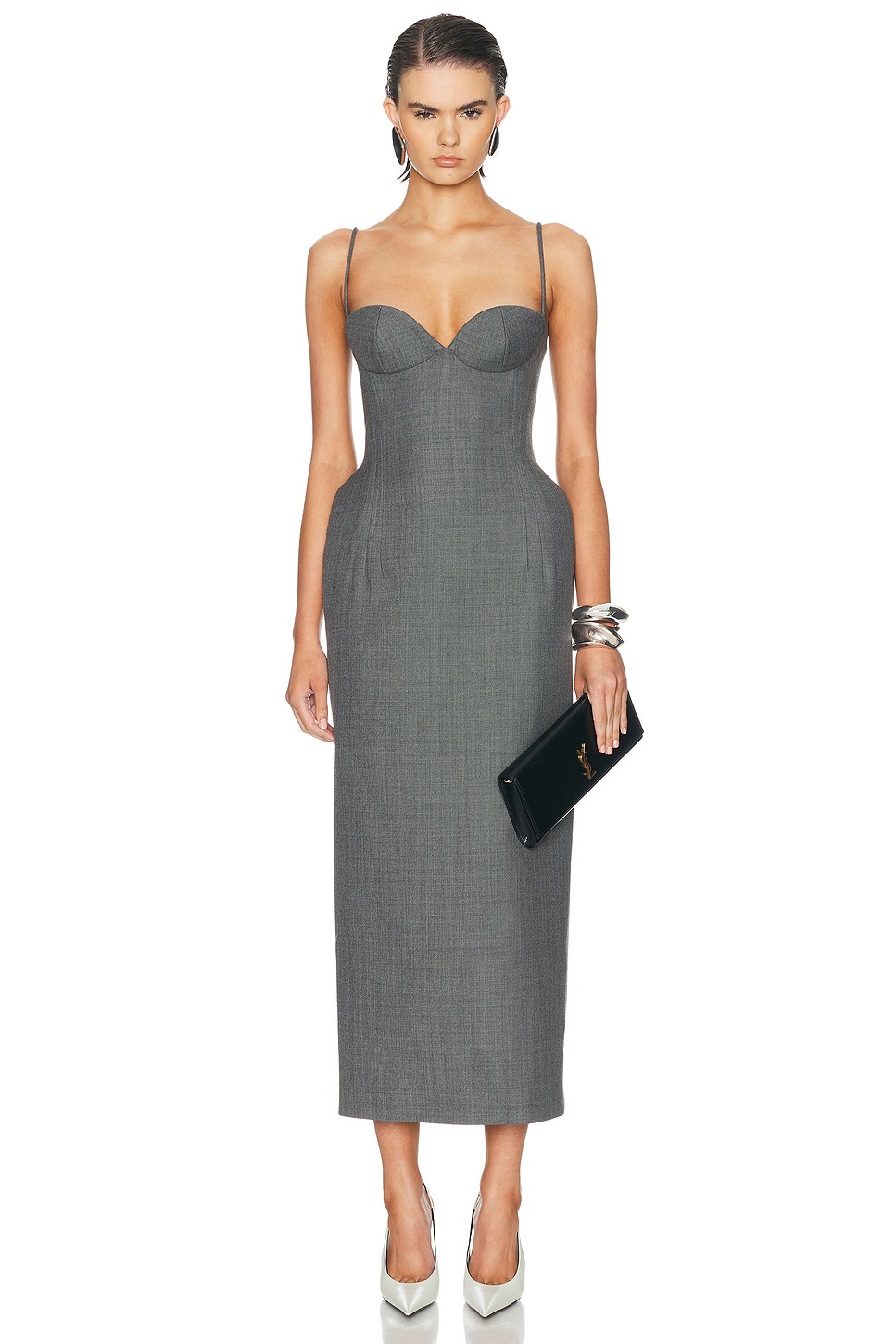
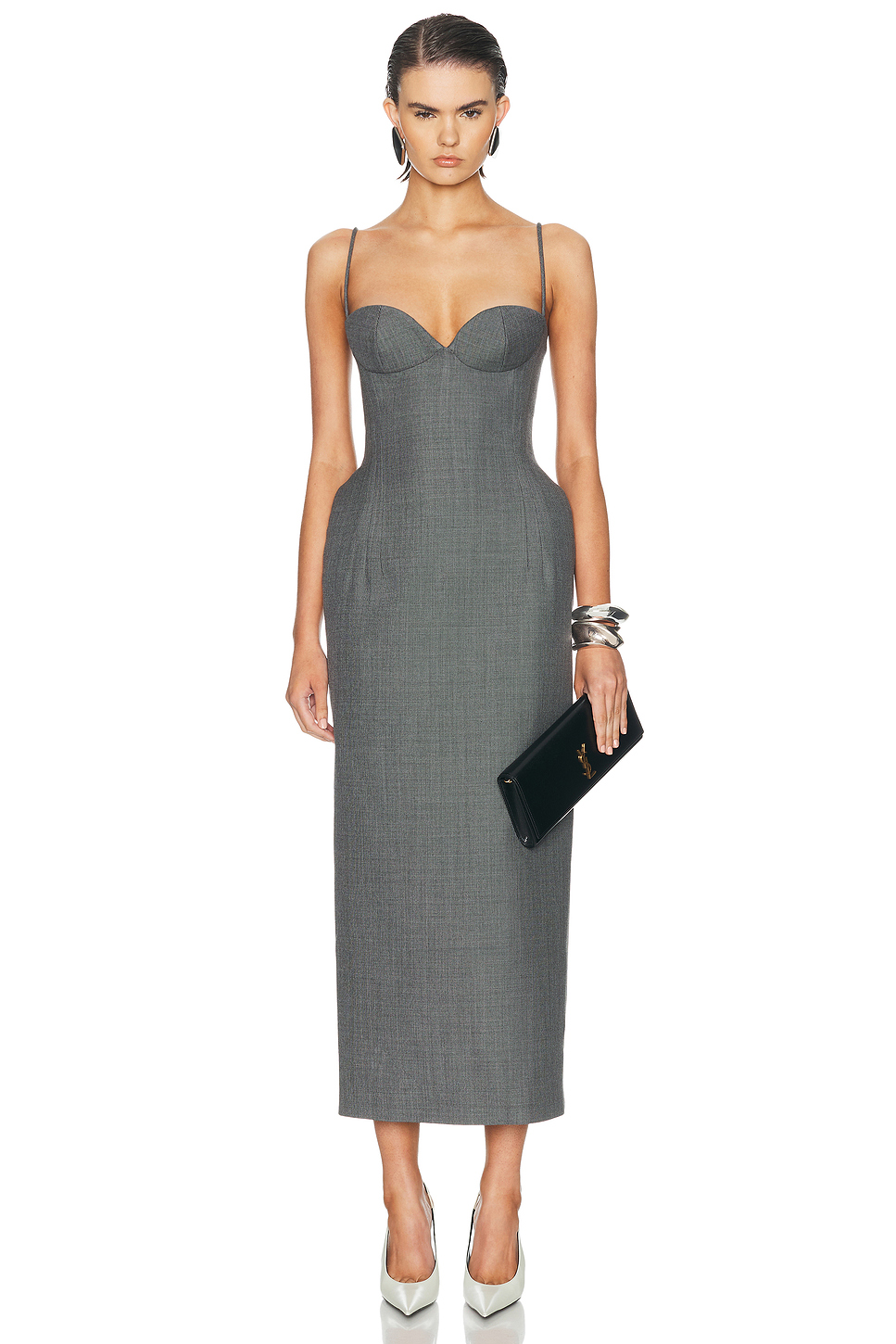
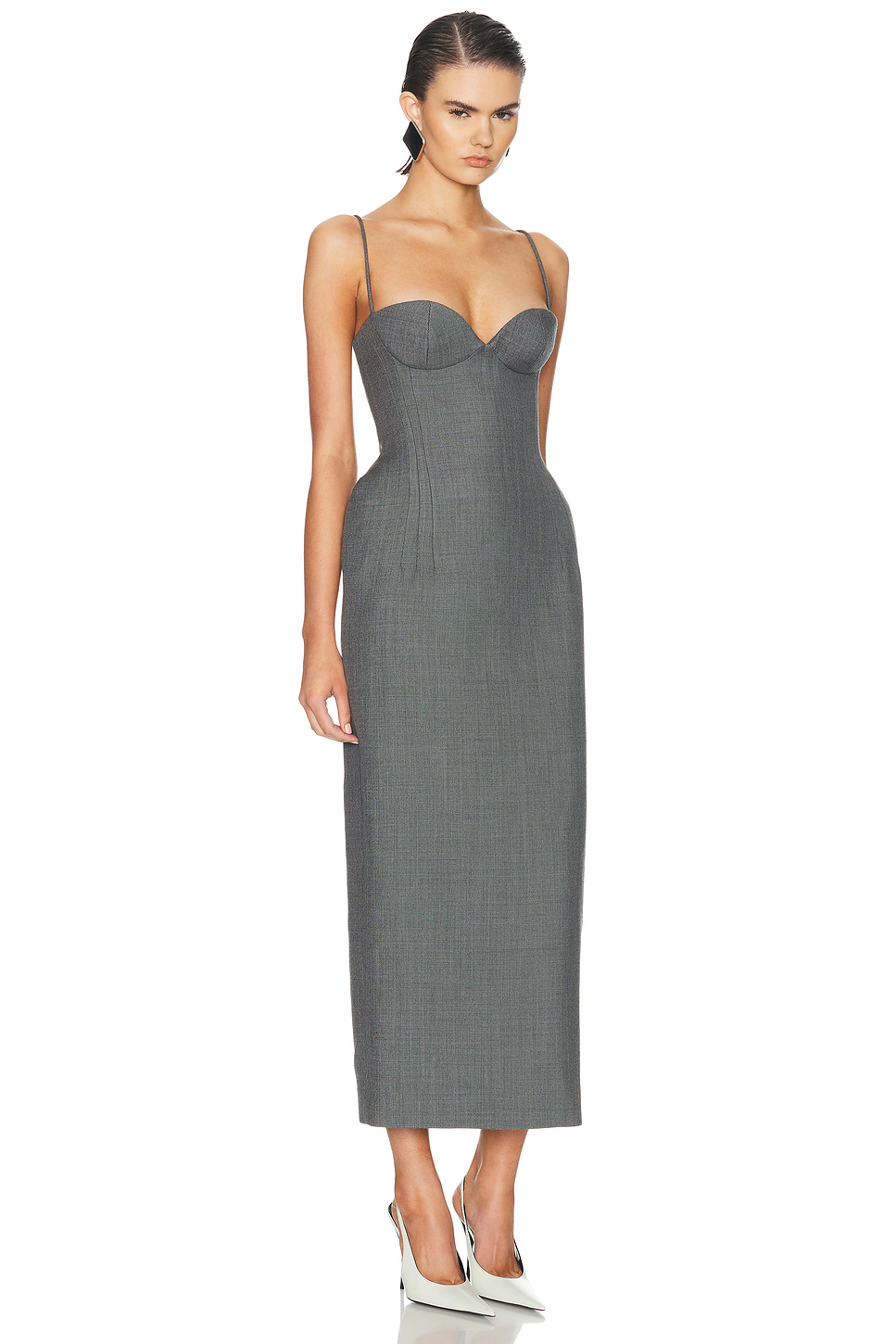
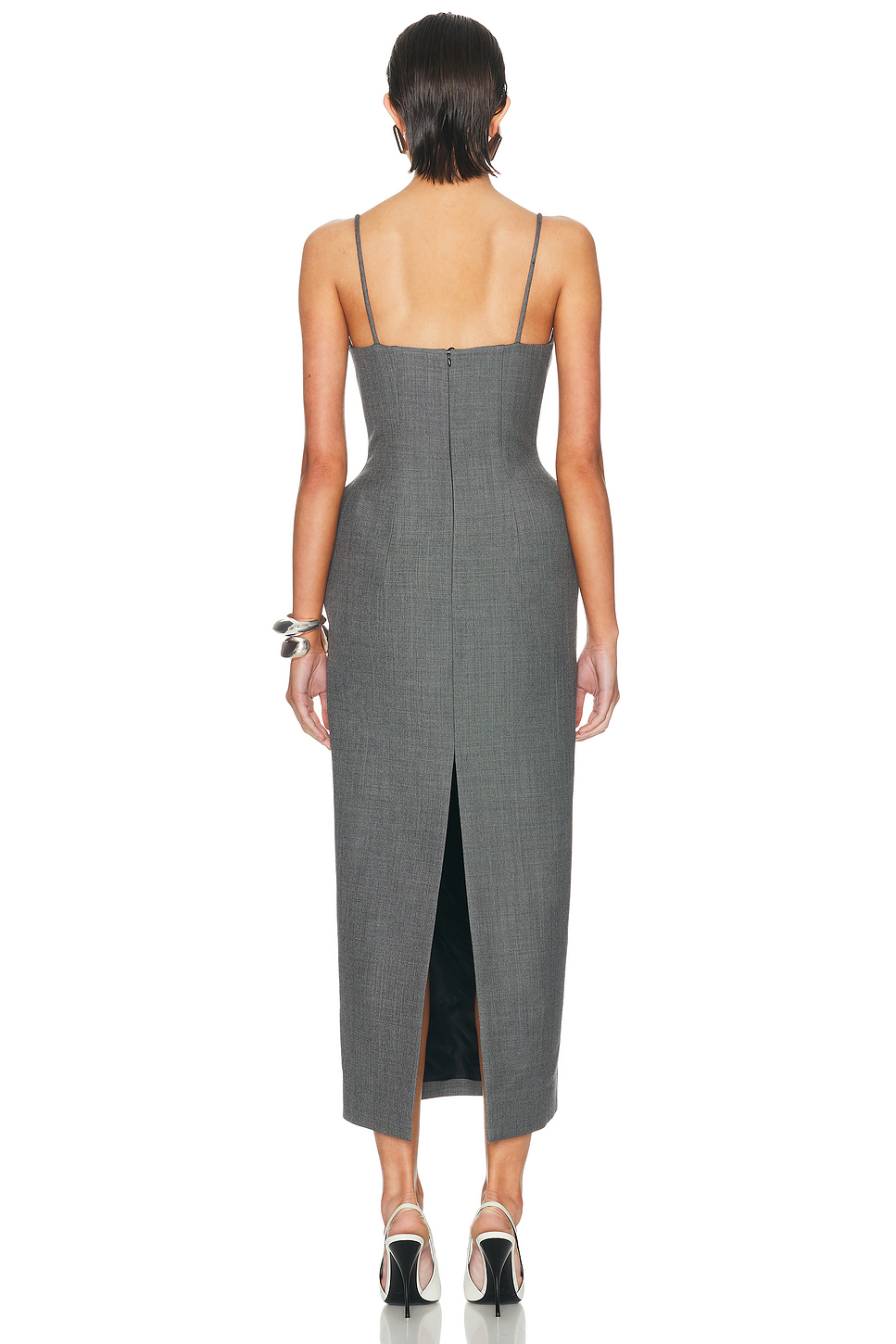
A bustier dress listed with a self of 100% wool and a lining of 100% silk, dry clean only, fully lined, in a heavyweight suiting with padded hips and cups, a vent at the back and a hidden zip at the back, made in Poland, at 2,475 dollars. There are no reviews and no fit votes, so there is no score to quote. This is the most demanding pairing of two layers this series has met, and it is also the clearest case anywhere here of a garment where every stated fact points the same way. One detail on this page also resolves a small puzzle about measurements that has been accumulating quietly for many batches. The reference is the Bustier Midi Dress by Magda Butrym in Grey. Dongguan Bafinasa Garments Co., Ltd. develops comparable structured dresses on OEM and ODM terms, from fabric selection and lining matching to retail or FBA ready packing. We publish this as a development reference and build your own version of it, and we do not supply the branded original or reproduce anyone else's label.
Key Features
- Self in 100% wool as stated, with lining in 100% silk as stated. See the note below
- The widest split between two layers met anywhere here, and both halves are demanding. See the note below
- Heavyweight suiting fabric as stated, which along with the structure explains most of how this behaves
- Padded hips and cups as stated, and this does something specific to the measurements. See the note below
- Dry clean only as stated, and this is the easiest such instruction to justify in this series
- Vent at the back as stated
- Hidden zip at the back as stated
- Made in Poland as stated
Customisable Options
- Fabric: wool suiting to the reference, with wool type and weight specified rather than only the word suiting
- Lining: silk to the reference, and we would confirm whether it permits spot cleaning given what the outer does not tolerate
- Structure: padded cups to the reference, offered padded or unpadded since that changes the measurement noticeably
- Vent: single vent height and placement to be specified rather than inherited
- Length from knee to midi, padding options, lining alternatives where silk is not wanted, size set, colour development, private label and care labelling
Specifications
| Style | Wool silk lined bustier dress |
| Reference | Magda Butrym, Bustier Midi Dress, style MAGF-WD170, manufacturer style 125726, colour Grey |
| Self | 100% wool as stated. See the note below |
| Lining | 100% silk as stated. See the note below, since this pairing is unusual |
| Fabric | Heavyweight suiting as stated. See the note below |
| Structure | Padded hips and cups as stated. See the note below, since this explains the bust figure |
| Vent | Vent at the back as stated |
| Lining Coverage | Fully lined as stated |
| Care | Dry clean only as stated. See the note below, since two fibres demand it independently |
| Closure | Hidden zip at the back as stated |
| Sizes Published | 34, 36, 38 and 40, four consecutive sizes |
| Measurements Published | 36: bust 31 in, waist 28 in, hips 40 in, length 51.5 in. See the note below |
| Chart Note | The bust sits below the model while other points sit above. See the note below, since this is fully explained here |
| Coverage | Only size 36 has figures. Sizes 34, 38 and 40 are blank |
| Model | 178 cm, bust 84 cm, waist 62 cm, hips 89 cm, wearing size 36 |
| Production | Made in Poland as stated |
| Reference Retail | 2,475 USD, quoted to show the price band this sits in, not as our price |
| Customer Reviews | None on the reference listing, so we quote no score |
| Best Seller Badge | None. The listing carries no rank |
| Categories | Filed by the retailer under bustier dresses and midi dresses |
| Occasion | Occasions, evenings, formal events, cooler weather |
| MOQ | 100 pcs per style per colourway, mixed sizes and colourways accepted |
| Sampling | 7-10 days after tech pack or reference sample confirmation |
| Bulk Lead Time | 20-30 days after sample approval and deposit |
| Service | OEM / ODM / private label, wool suiting sourcing, silk lining matching, retail or FBA ready packing |
Size Chart
| Size | Bust | Waist | Hips | Length | Source | ||||||||||||
|---|---|---|---|---|---|---|---|---|---|---|---|---|---|---|---|---|---|
| 36 | 31 | in | 28 | in | 40 | in | 51.5 | in / | 131 | cm | As published | ||||||
| 34 | 31 | in / | 79 | cm | 24 | in / | 61 | cm | 34 | in / | 86 | cm | 131 | cm / | 51.6 | in | Our proposal |
| 36 | 33 | in / | 84 | cm | 26 | in / | 66 | cm | 36 | in / | 91 | cm | 133 | cm / | 52.4 | in | Our proposal |
| 38 | 35 | in / | 89 | cm | 28 | in / | 71 | cm | 38 | in / | 97 | cm | 135 | cm / | 53.1 | in | Our proposal |
| 40 | 37 | in / | 94 | cm | 30 | in / | 76 | cm | 40 | in / | 102 | cm | 137 | cm / | 53.9 | in | Our proposal |
The published size 36 gives bust 31 in, waist 28 in, hips 40 in and length 51.5 in against a model at roughly 33, 24 and 35. The bust sits about two inches under her while the other points sit above, and this page states enough to explain that entirely rather than leaving it to be guessed at.
Occasions and Styling
Suits occasions, evenings, formal events and cooler weather. Wool suiting holds shape and warmth while silk lining allows it to go on and off easily over other layers, and the structure does its own work so there is little to arrange once on.
Production and Quality Control
There are no reviews and no fit votes on this listing, so we quote no score. This is the most demanding pairing of two layers encountered anywhere here, and the clearest instance yet of every stated fact arriving at the same answer. One small detail also resolves a puzzle about measurements that has been building quietly for a long while.
Wool outside and silk inside, and why this is the extreme case, and that is the first thing. This series has been tracking how these listings split a garment into layers for a long time. The count of separate ways is now considerable. Most common by far is the single word shell, appearing alone with nothing following, which this series established early means the question has been raised and then declined. Then there are various wordings which do give both layers, and among those a clear range: pairs which match each other, pairs which differ modestly, and occasionally a pair where one is entirely synthetic and the other entirely not. Now to this one. Self is hundred per cent wool. Lining is hundred per cent silk. Nothing else. There is no shared component, no trace element in common, not even a finishing fibre common to both. Two entirely different classes of fibre facing each other across the thickness of one garment, and each of them is separately the more demanding end of its own class. To be precise about what each does, since this series has been pointing at both for hundreds of listings without either being the subject. Wool is a protein fibre whose surface carries overlapping scales, and when it meets warmth plus moisture plus agitation those scales interlock and the structure tightens irreversibly, which is what felting is, and there is no process which reverses it afterwards. This is why nearly every property this series has noted of other fibres has been framed against it, particularly the observation that cotton cannot felt. Silk is also a protein fibre but behaves nothing like wool: it spots permanently wherever water sits and dries, meaning marks appear where the water was rather than where anything was spilled, and it loses brightness under ultraviolet light. So the two failure modes here have nothing in common at all, and neither can be repaired afterwards. Given that, the instruction is the easiest to justify encountered anywhere in this series, since stating dry clean only is not a precaution here but simply what follows. There is a subtlety about having two layers which is worth drawing out, because handling it well is most of what makes a garment like this work. These two cloths are attached to each other, so whatever happens to one happens to both, and since they respond differently to everything, keeping them in proportion is the whole problem. This series has made the point repeatedly about layers generally, that what matters is how they behave together rather than how either behaves alone, and this is the sharpest version of it: not merely differing degrees of caution, but two entirely different things going wrong in two entirely different ways, in two materials sharing the same fate.
Heavyweight suiting and why the fabric name earns its place, and that is the second thing. This is stated as heavyweight suiting fabric, and both words are doing something this series can be specific about. Suiting is built with far more yarn per area than ordinary cloth and finished to hold shape rather than to drape, so it resists creasing and hangs from its own structure. Heavyweight restates that from the other direction, adding quantity to arrangement. This series established recently, comparing two similar cotton garments, that construction names do not reassure and weights do, on the grounds that one describes how yarns are arranged and the other how much material is present, with quantity deciding most practical questions. This instance sharpens that usefully, because here both are present and they agree, which is unusual: most pages give one or neither. A structure which holds its own shape does something specific worth noting. It means this garment does not rely on the body to give it form, so it can be worn by rather different figures and look much the same, and conversely that it will not flatteringly follow anything either, since it has already decided what shape it is. That is a genuine advantage for consistency and a genuine limitation for fit, and it is visible in the numbers, in that there is rather more ease at every point than on more fluid garments examined recently. Then the padding, which is stated as padded hips and cups, and this is where it gets interesting. Padding is not fabric and not trim. It is a separate element introduced to create volume where the body may not supply it, and it is the only element here which contributes nothing to strength or drape or durability. Its single job is to occupy space. Now this series has spent considerable time assembling the mechanisms by which a garment fits a body smaller than its own measurements, having built up five across many examinations: knit because loops open, elastane high enough to compress rather than merely recover, bias cutting though only along one direction, shirring because gathered elastic draws cloth in, and closure that is adjusted rather than stretched. Every one of those five works by the material moving. This is a sixth, and it belongs to none of them, because nothing here moves. Which matters less as a matter of counting than for what it changes about reading numbers, and that deserves stating carefully since it resolves something. A bust measurement is taken flat, across a garment laid down. A padded cup is three-dimensional, having risen out of the flat plane before anybody measures anything, so a flat measurement of it systematically under-reports what it can actually contain. The published bust here is thirty one against a model at roughly thirty three, so about two below, and the padding alone accounts for that without needing anything else at all. Recent cases in this series have needed increasingly elaborate arrangements to explain their negative ease, one needing two mechanisms stacked, and this needed none, because the answer was sitting there stated in plain words all along. That is the second time this has been true, and it is worth repeating the general lesson it teaches: when a measurement looks unaccountable, first look for a stated element which would distort how measurements are taken, since every mechanism leading to this will always be about something moving, and some things do not.
The sales categories, and one of them doing real work, and that is the third thing. This is filed under bustier dresses and midi dresses, and those two behave quite differently from one another, which is worth drawing out because this series has developed a rule about exactly this. The first of them is genuinely useful, and the reason is specific. It directly states something about construction which would otherwise need inferring: a bustier garment is held up by its own internal structure rather than by straps, which means it needs internal boning or a rigid base to stay put at all, and this page corroborates that independently by listing padded cups, since padding of that kind normally sits in something structured enough to hold it. So the category word has been checked against what else is stated and found consistent, which is precisely the test this series suggested using. Compare that against a garment examined very recently at forty one inches filed as mini alongside others at thirty two and a half inches called the same thing, which then sat beside garments at fifty four and a half and fifty five inches filed as maxi and midi respectively, producing a set no consistent threshold could generate. The distinction arrived at then was that construction and silhouette labels make claims about the garment which can be right or wrong and tested against what else is said, while length labels make claims about how a garment looked on whoever modelled it and carry no information about anybody else. This is a second instance of the former working, following a category which recently resolved an apparent conflict in some measurements, so it is worth now saying plainly that these labels are informative whenever they happen to be correct and unreliable generally. There is also a small piece of corroboration for the length side worth noting rather than complaining about. This one is fifty one and a half inches and filed as midi, and fifty four and a half inches filed as maxi was noted recently, and forty one inches filed as mini likewise. Those three arrange themselves quite sensibly: forty one as mini, fifty one and a half as midi, fifty four and a half as maxi. So it is not that these words are always wrong or random, which would be a poor account of what has been observed. It is that they are consistent within stretches and then not, and the single case which broke the arrangement was fifty five inches filed as midi against fifty four and a half filed as maxi. Nothing in that is fixable by choosing better thresholds, since what happened is a boundary being crossed in the wrong direction by half an inch. This page also states a vent at the back, which this series has not met before, and that is worth one sentence because it interacts with everything above. A vent exists to let a narrow garment permit movement it could not otherwise allow, since suiting of this weight will not stretch at all to accommodate a step. So it is compensating for precisely the property that makes the fabric good for holding shape, and its presence tells you how unyielding this garment is. Every bulk shipment gets a measurement report against your approved chart.
Optional upgrades include offering the same structure with and without padding, since that single element changes how the bust measures by around two inches and nothing else on the page explains the figure, publishing measurements for sizes 34, 38 and 40, since one of four remains the rule rather than the exception, stating vent height and placement rather than only that there is one, naming the wool type and its weight rather than only suiting, confirming how to deal with the silk lining when it needs attention since it cannot tolerate what the wool does, keeping dry clean only and saying why, given that two unrelated failure modes both demand it here, offering lining alternatives where silk is not wanted, extending the size range past size 40 if demand supports it, length options since the structure does not depend on drape, colour development, private label, hangtag and care labelling.
Pre-production sample approval, in-line inspection during cutting and sewing, and a final AQL inspection before packing, with measurement reports and photos shared before shipment.
Send us your tech pack, a photo or a reference garment and we will quote within 24 hours. Contact bafinasa@bafinasa.com or WhatsApp +86 13827222469.