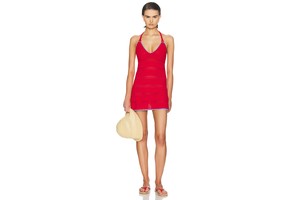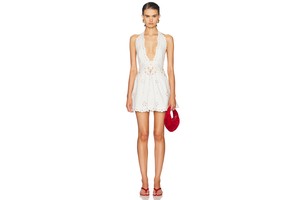
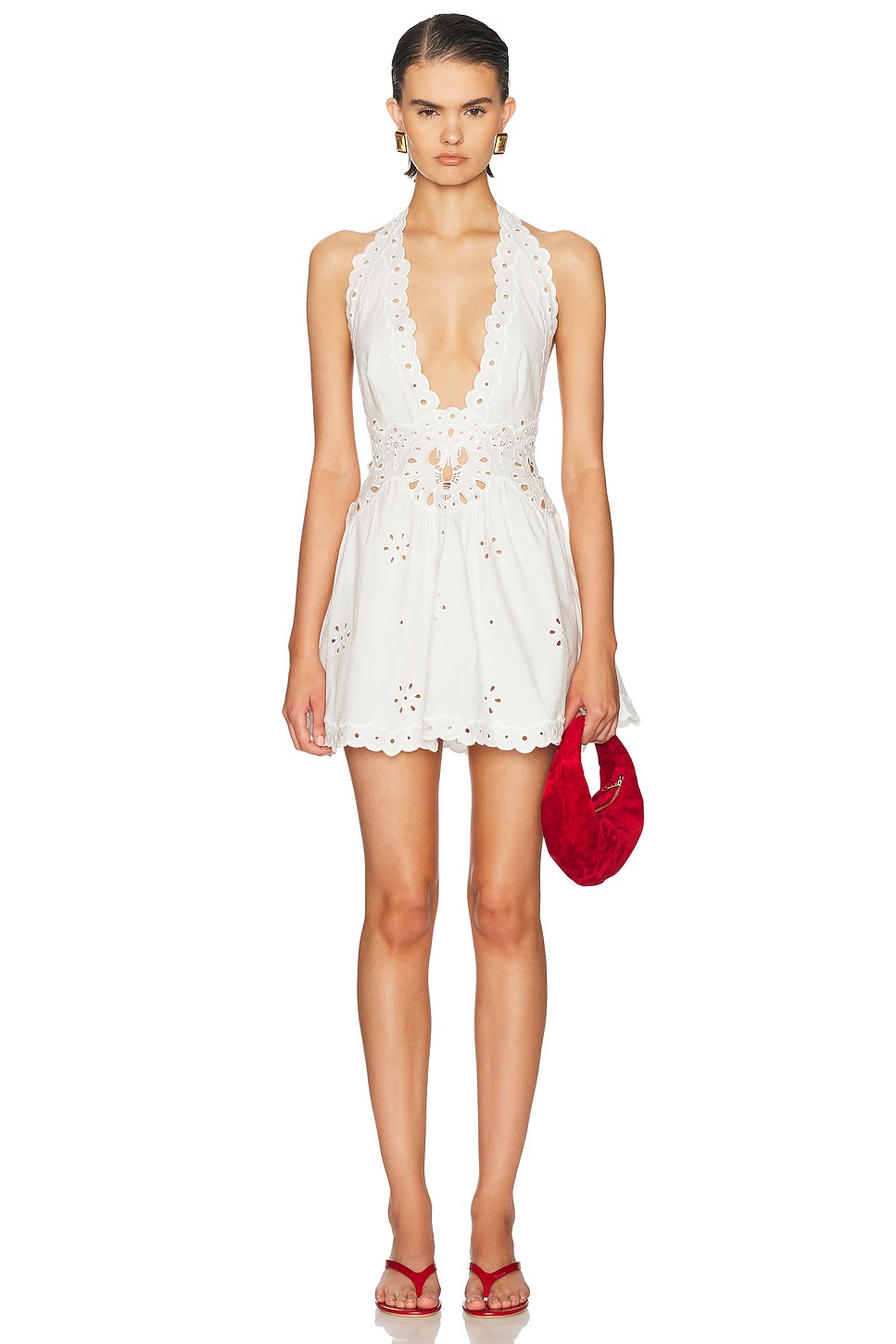
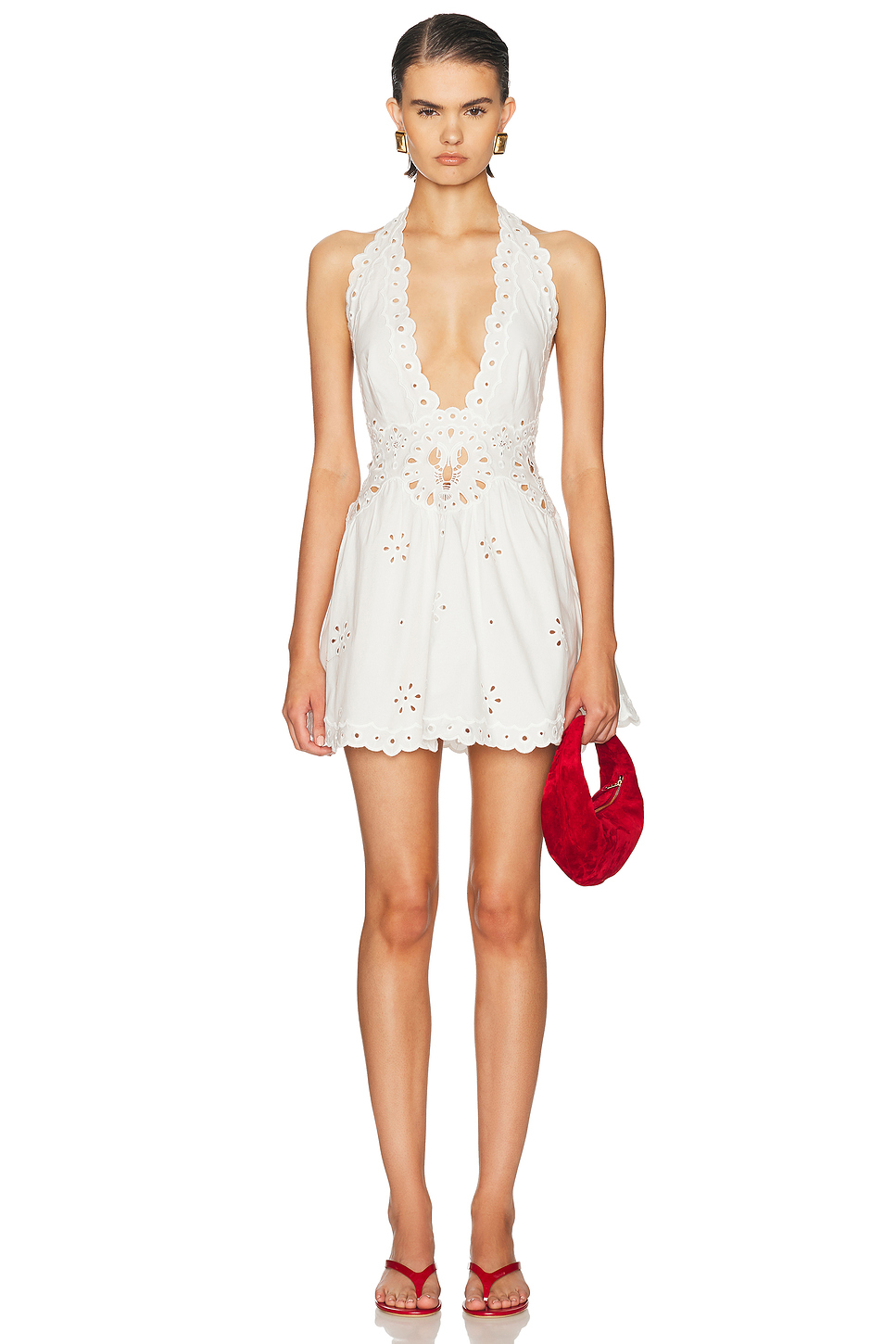
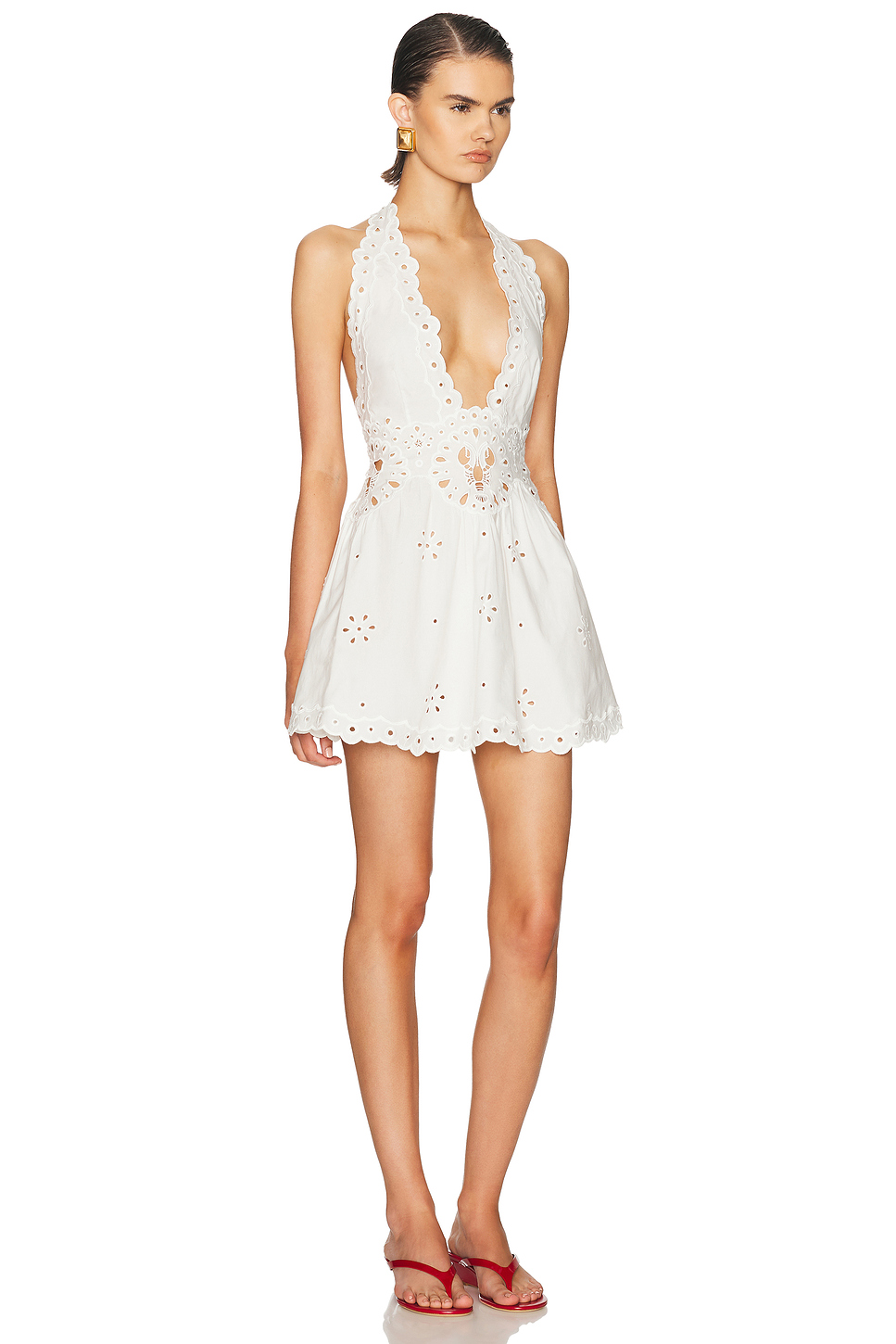
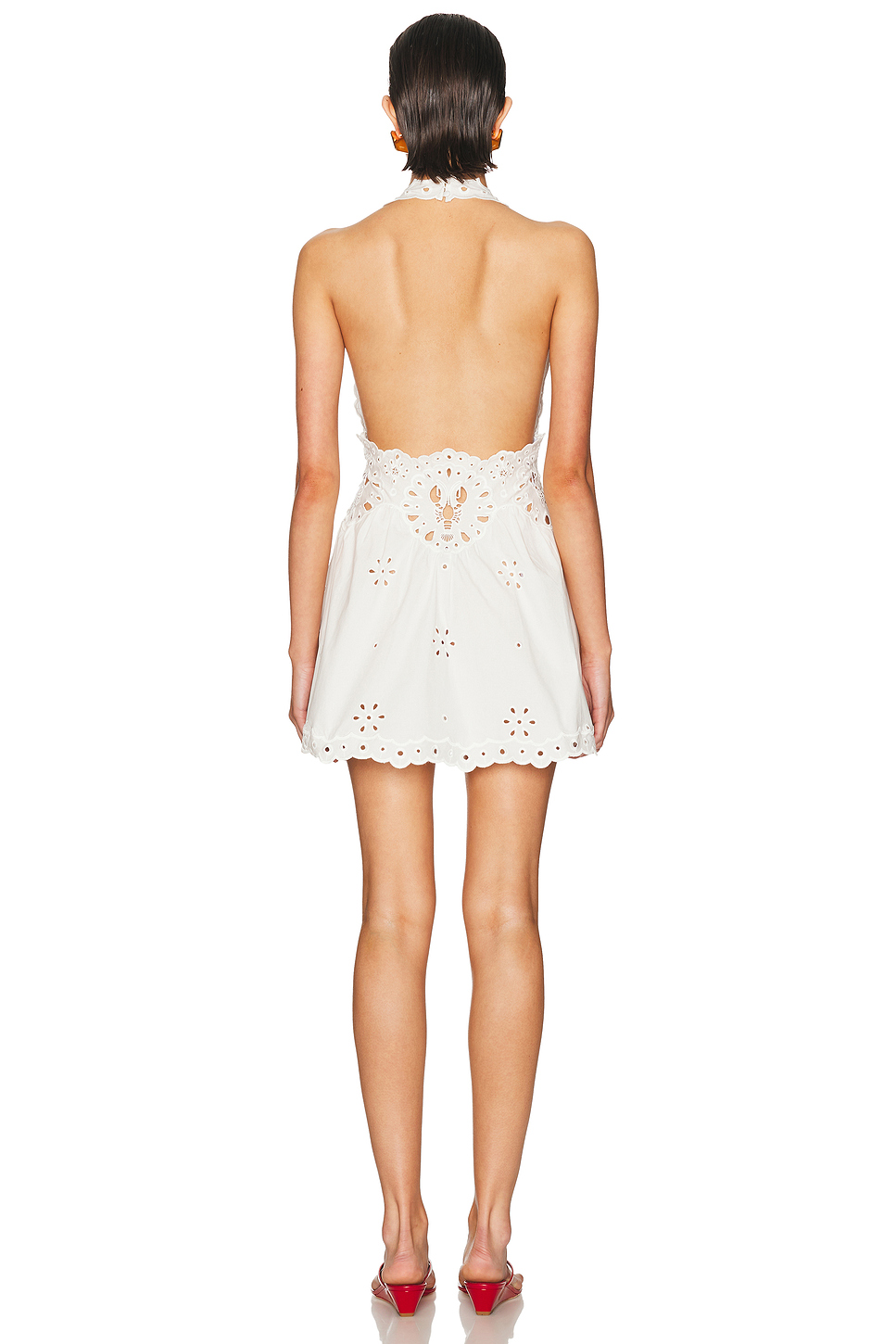
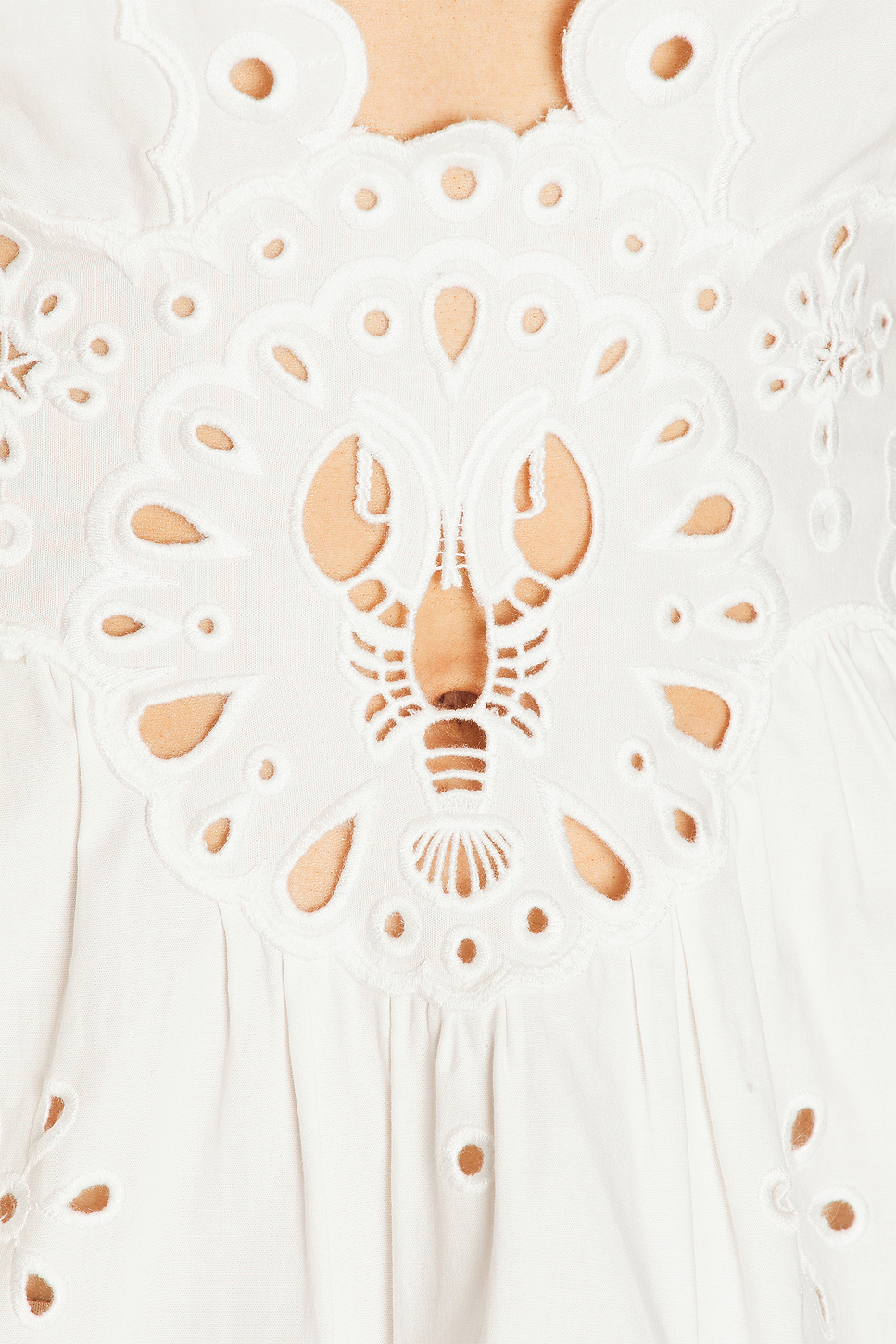
A mini dress listed in 97% cotton and 3% elastane, dry cleanable, unlined, in an eyelet poplin, closing with an invisible zip at the side and buttons at the halter neck, made in China, ranked twelfth in the retailer's fit and flare dress list, at 479 dollars. There are no reviews and no fit votes, so there is no score to quote. Putting a weave name beside a structure name produces something worth taking apart, because each of them pulls that answer in the opposite direction. The shape category in which this is placed also turns out to explain the measurements better than anything the page says itself. The reference is the Beranice Dress by retrofete in Ivory. Dongguan Bafinasa Garments Co., Ltd. develops comparable eyelet poplin dresses on OEM and ODM terms, from fabric sourcing and eyelet embroidery to retail or FBA ready packing. We publish this as a development reference and build your own version of it, and we do not supply the branded original or reproduce anyone else's label.
Key Features
- 97% cotton, 3% elastane as stated, and the cotton content is the lowest of three recent cotton garments here
- Eyelet poplin as stated, and these two words answer the same question in opposite directions. See the note below
- Unlined as stated, which combined with the above makes this the hardest combination yet for opacity
- Dry cleanable as stated, which permits rather than excludes home washing. See the note below
- Halterneck with button closure as stated, alongside an invisible zip at the side
- Ivory, which is toward the difficult end of the colours met here
- Made in China as stated
- Measurements published for one size, including bust 28 in and hips 40 in. See the note below
Customisable Options
- Fabric: eyelet poplin to the reference, and we would specify both the ground cloth weight and the eyelet scale
- Lining: offered either way, since an unlined pale eyelet is the hardest combination there is to judge from a photograph
- Care: we would test rather than inherit, since the eyelet is what argues for caution here rather than the cotton
- Neck: halter with button closure to the reference, with button material stated rather than implied
- Length from mini to knee, eyelet placement, lining options, size set, colour development, private label and care labelling
Specifications
| Style | Eyelet poplin halter mini dress |
| Reference | retrofete, Beranice Dress, style RTFF-WD773, manufacturer style R-PF26-12746-17, colour Ivory |
| Composition | 97% cotton, 3% elastane as stated |
| Fabric | Eyelet poplin as stated. See the note below, since these two words pull against each other |
| Lining | Unlined as stated, which combined with the fabric makes the opacity question harder rather than easier |
| Care | Dry cleanable as stated, which permits rather than excludes washing. See the note below |
| Neck | Halterneck with button closure as stated |
| Closure | Invisible zip at the side as stated |
| Sizes Published | XS, S, M and L |
| Measurements Published | S: bust 28 in, waist 28 in, hips 40 in, length 32 in. See the note below |
| Chart Note | The bust sits about five inches under the model while the hips sit above. See the note below on what explains that |
| Coverage | Only size S has figures. XS, M and L are blank |
| Model | 178 cm, bust 84 cm, waist 62 cm, hips 89 cm, wearing size S |
| Production | Made in China as stated |
| Reference Retail | 479 USD, quoted to show the price band this sits in, not as our price |
| Customer Reviews | None on the reference listing, so we quote no score |
| Best Seller Badge | Rank 12 in the retailer's fit and flare dress list. Note the category is about silhouette rather than length |
| Categories | Filed by the retailer under mini dresses and halter dresses, and also placed among fit and flare dresses |
| Occasion | Summer, holidays, warm weather, parties |
| MOQ | 100 pcs per style per colourway, mixed sizes and colourways accepted |
| Sampling | 7-10 days after tech pack or reference sample confirmation |
| Bulk Lead Time | 20-30 days after sample approval and deposit |
| Service | OEM / ODM / private label, eyelet poplin sourcing, halter construction, retail or FBA ready packing |
Size Chart
| Size | Bust | Waist | Hips | Length | Source | ||||||||||||
|---|---|---|---|---|---|---|---|---|---|---|---|---|---|---|---|---|---|
| S | 28 | in | 28 | in | 40 | in | 32 | in / | 81 | cm | As published | ||||||
| XS | 31 | in / | 79 | cm | 24 | in / | 61 | cm | 34 | in / | 86 | cm | 81 | cm / | 31.9 | in | Our proposal |
| S | 33 | in / | 84 | cm | 26 | in / | 66 | cm | 36 | in / | 91 | cm | 83 | cm / | 32.7 | in | Our proposal |
| M | 35 | in / | 89 | cm | 28 | in / | 71 | cm | 38 | in / | 97 | cm | 85 | cm / | 33.5 | in | Our proposal |
| L | 37 | in / | 94 | cm | 30 | in / | 76 | cm | 40 | in / | 102 | cm | 87 | cm / | 34.3 | in | Our proposal |
The published size S gives bust 28 in, waist 28 in, hips 40 in and length 32 in against a model at roughly 33, 24 and 35. The bust sits about five inches under her while the waist and hips sit above, and the retailer's own silhouette category describes that shape precisely.
Occasions and Styling
Suits summer, holidays, warm weather and parties. Eyelet ventilates, which suits heat, though this one is unlined in a pale colour, so what goes underneath is a decision rather than an afterthought.
Production and Quality Control
There are no reviews and no fit votes on this listing, so we quote no score. Putting a weave name beside a structure name here resolves in one direction, and working out why settles something this series has been qualifying for a while. The silhouette category this sits in also explains the measurements better than anything the page states.
Eyelet poplin, and watching which word wins settles a question left open recently, and that is the first thing. This is worth taking slowly because two things this series has established are meeting each other here, and neither alone gives the answer. The first is about poplin, which has been relied on as a partial reassurance several times: it is a plain weave with fine warp yarns packed closely against heavier weft yarns, giving a dense cloth, and higher density transmits less light than a looser weave of the same fibre and weight. That was genuinely useful on pages saying nothing else bearing on the question. But there was an unstated condition in it every time, which is that density depends on how much material there is, and this series said recently that it had been unable to test that condition. It was tested shortly afterwards, when two similar cotton poplin garments were compared and the difference between them was that one was described as lightweight and the other as mid-weight, and the conclusion was that poplin alone does not reassure and the weight does, assembled into a rule worth keeping: a weave name tells you how yarns are arranged, and a weight tells you how much material is there, and quantity is what most of these questions turn on. The second is about eyelet, which is the same openwork met recently in three French words and then again in English, where the observation was that openwork is the one case where sheerness is definitional rather than incidental, since the holes are deliberate, distributed rather than clustered, and pass the whole way through, so light goes wherever there is a hole. Now here they are in one phrase, and there is no ambiguity about which governs. Poplin says densely packed. Eyelet says holes through it. Eyelet wins, and it wins not by being louder but because what it describes is physically incompatible with what poplin is offering: those holes remove material across the whole cloth, including wherever poplin's density was doing its work. So this is a second way the poplin reassurance fails, and it is a different kind of failure from the one found recently, since that one came from insufficient material and this one comes from material deliberately removed. Saying both together gives something more useful than either: knowing a cloth is poplin tells you nothing about opacity until you also know whether anything has been taken out of it. Note also that this page does not state a weight, so even the lever identified recently is unavailable. And it is unlined, and ivory toward the pale end where this series has noted repeatedly that pale shades reflect more and show more. So on this garment, three things push the same way and only one pushes back, and the one pushing back has been defeated by holes.
Dry cleanable again, and the fourth instance, and here the awkwardness is clearest, and that is the second thing. This series has objected to this wording three times now, and each objection has rested on the same distinction stated plainly each time because it is decisive: dry clean only closes washing off, while dry cleanable permits professional cleaning without saying anything about whether washing is allowed, leaving the very question a customer needs answered while appearing to have answered it. The three earlier instances were a lining largely of rayon, an unlined rayon satin, and a velvet whose pile does not recover from being flattened, and what was noted in assembling them was that they shared more than the wording, since in every case the garment contained something arguing hard for the stricter line. That observation is why random carelessness stopped being the likeliest reading, since random error should appear on ordinary garments as readily as demanding ones. This is the fourth, and it is the most awkward of the set for a specific reason: the arguments for caution here are structural rather than about fibre. Cotton is the most washable fibre in this series, stronger wet than dry, immune to felting, prone to losing neither half its strength nor permanently marking. But eyelet consists of edges, hundreds of them, each stitched only to stop it fraying, and this series applied exactly that reasoning recently to open constructions generally, noting that agitation lets threads catch one another in ways that cannot be undone. There are two other candidates: buttons at the halter neck, since buttons vary enormously in what they tolerate and this series has noted before that trim drives instructions even when the base cloth is washable; and the absence of a lining, meaning there is no second layer helping anything hold shape. So three candidates, and the page gives the permissive wording. There is something here worth separating from the complaint, because this series tries to weigh what a page does rather than only what it omits. Dry cleanable is at least an answer, and the commonest failure across dozens of these examinations has been pages carrying no instruction at all, where the customer assumes the permissive outcome because for most garments that is simply true. This page avoided that. But it stopped one word short, and given what is described above, that word is carrying a great deal. It is also worth recording what this series has now met three different instructions on cotton within a short stretch, being machine washable, hand wash cold, and here something stricter still. Cotton is the same fibre in all three. Whatever decides these answers is not the fibre, and this is the second time within a very few garments that comparing cotton against cotton has shown it.
Fit and flare, and the label does something no page here has managed, and that is the third thing. This garment is placed among fit and flare dresses, and this series has had a complicated relationship with these categories, having found repeatedly that the same input does not reliably produce the same label, most sharply when two identically named garments from unrelated makers landed in different categories. So the working conclusion has been that a label is worth reading for what it reveals incidentally and worth distrusting for what it asserts. This one is the strongest case yet for the first half of that, and the reason is that it explains measurements the page otherwise leaves unexplained. Bust twenty eight against roughly thirty three is about five inches under, while hip forty against thirty five is about five above, and waist twenty eight against twenty four is four above. That is the familiar pattern of a bust disagreeing with everything beside it, which this series has a rule for: ask first whether the garment is strapless, halter or sleeveless, since each removes or weakens the landmarks a bust figure depends on. This is a halterneck, so the rule fires, and with three per cent elastane there is certainly no compression available, since anything below roughly five per cent is a recovery additive rather than something a fit can rest on. So the rule tells you where to look and the answer comes from the label. Fit and flare is a description of silhouette meaning close through the upper body and spreading below the waist, and that is exactly what these three numbers describe: under at the bust, then increasingly above as you descend. So the label did not merely add information, it resolved a conflict, and this series has not previously found a category doing that. It is worth being clear that this does not overturn what was concluded earlier about labels being unreliable, since a category can be assigned inconsistently and still be informative when it happens to be correct, and both things remain true. What it suggests is worth stating because it changes how these should be read: the silhouette based categories have been the most useful ones met, having here explained a discrepancy that looked like an error and nowhere contradicted what was measured. There is one final note about this particular figure. Five inches of negative ease at the bust with no elastane to speak of means whatever holds this up is doing real work, and nothing on the page describes the halter ties or buttons beyond naming them, this series having recently catalogued closure that is adjusted rather than stretched as a distinct family. Every bulk shipment gets a measurement report against your approved chart.
Optional upgrades include strengthening the instruction and saying what it protects, since the arguments here are structural rather than about fibre and nobody would guess them, offering a lining or stating plainly that there is none and what that means for opacity, since this is the hardest combination yet met, specifying the ground cloth weight and the eyelet scale separately, since one tells you how much material there is and the other how much was removed, stating what the buttons are made of, since they sit at the neck where everybody sees them and they vary enormously, publishing measurements for XS, M and L, since one out of four has been the rule rather than the exception, describing how the halter closes given that it is carrying five inches of negative ease, keeping the fit and flare filing since it explains the shape better than the page does, colour development including pale shades tested specifically for opacity, private label, hangtag and care labelling.
Pre-production sample approval, in-line inspection during cutting and sewing, and a final AQL inspection before packing, with measurement reports and photos shared before shipment.
Send us your tech pack, a photo or a reference garment and we will quote within 24 hours. Contact bafinasa@bafinasa.com or WhatsApp +86 13827222469.