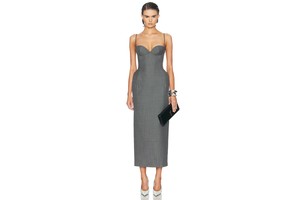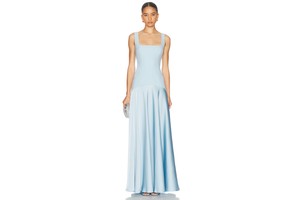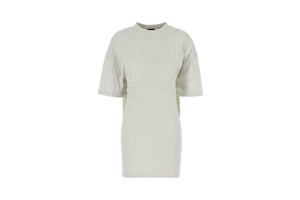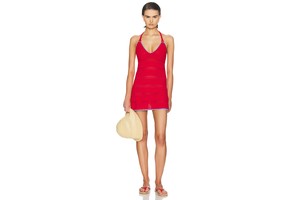
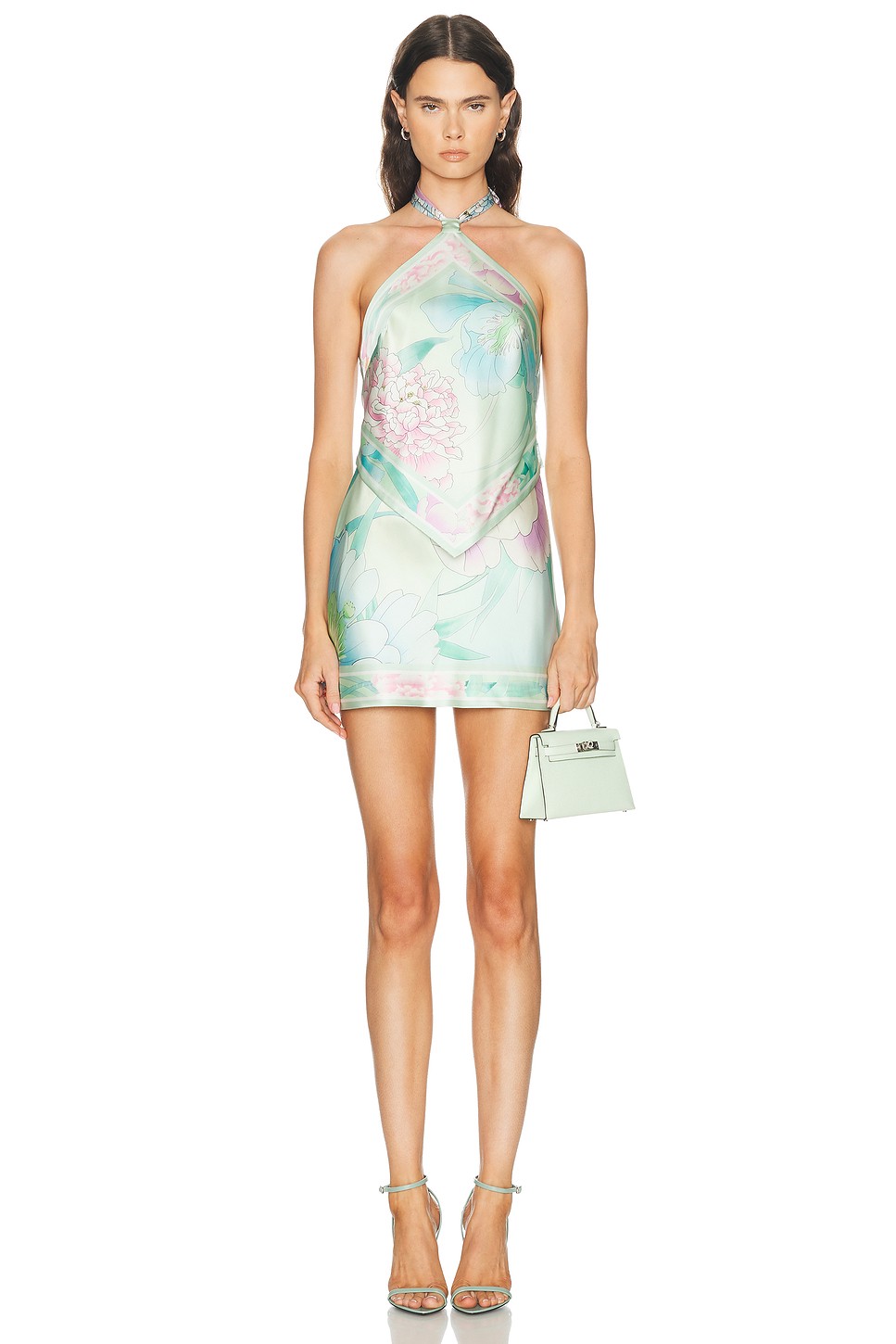
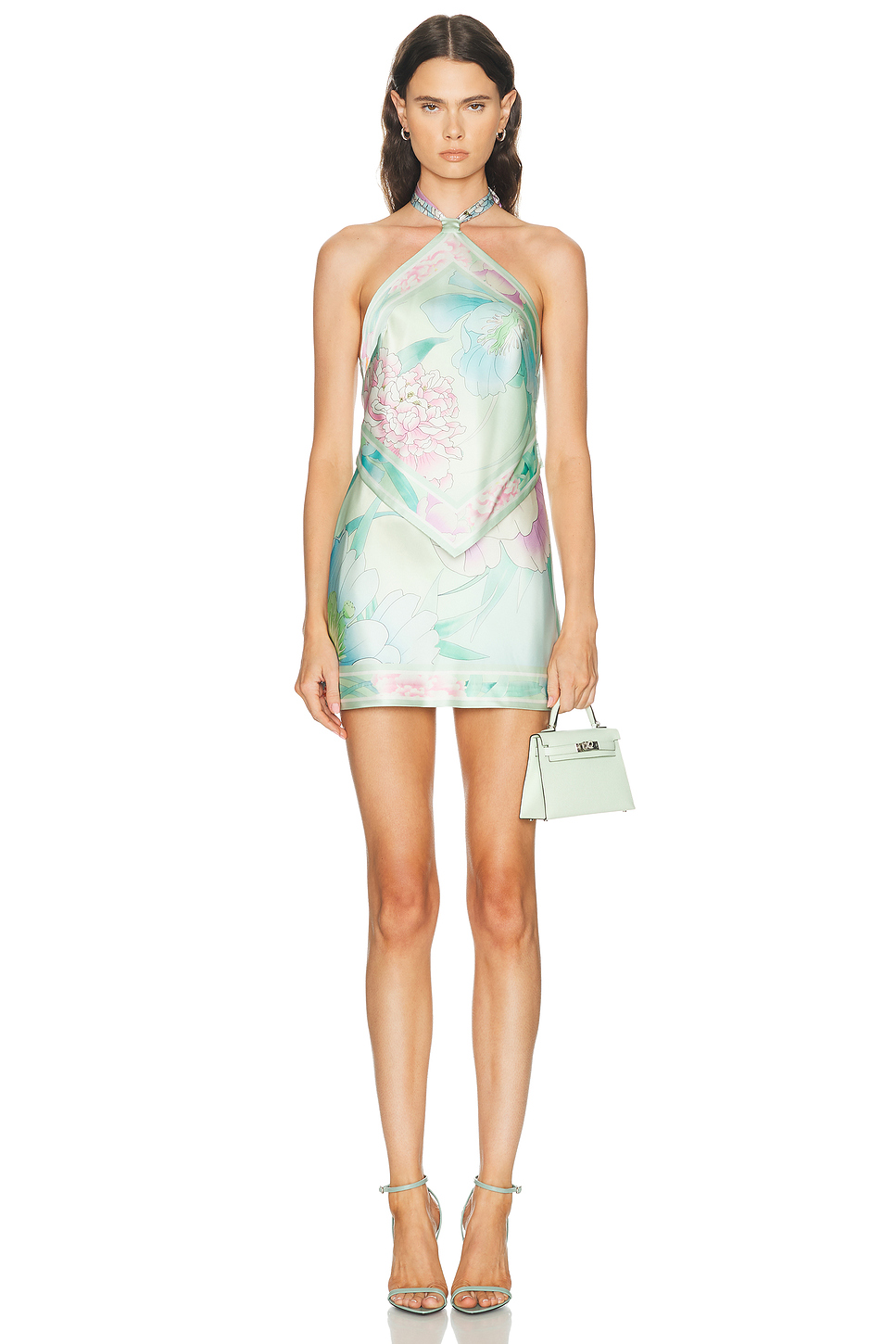
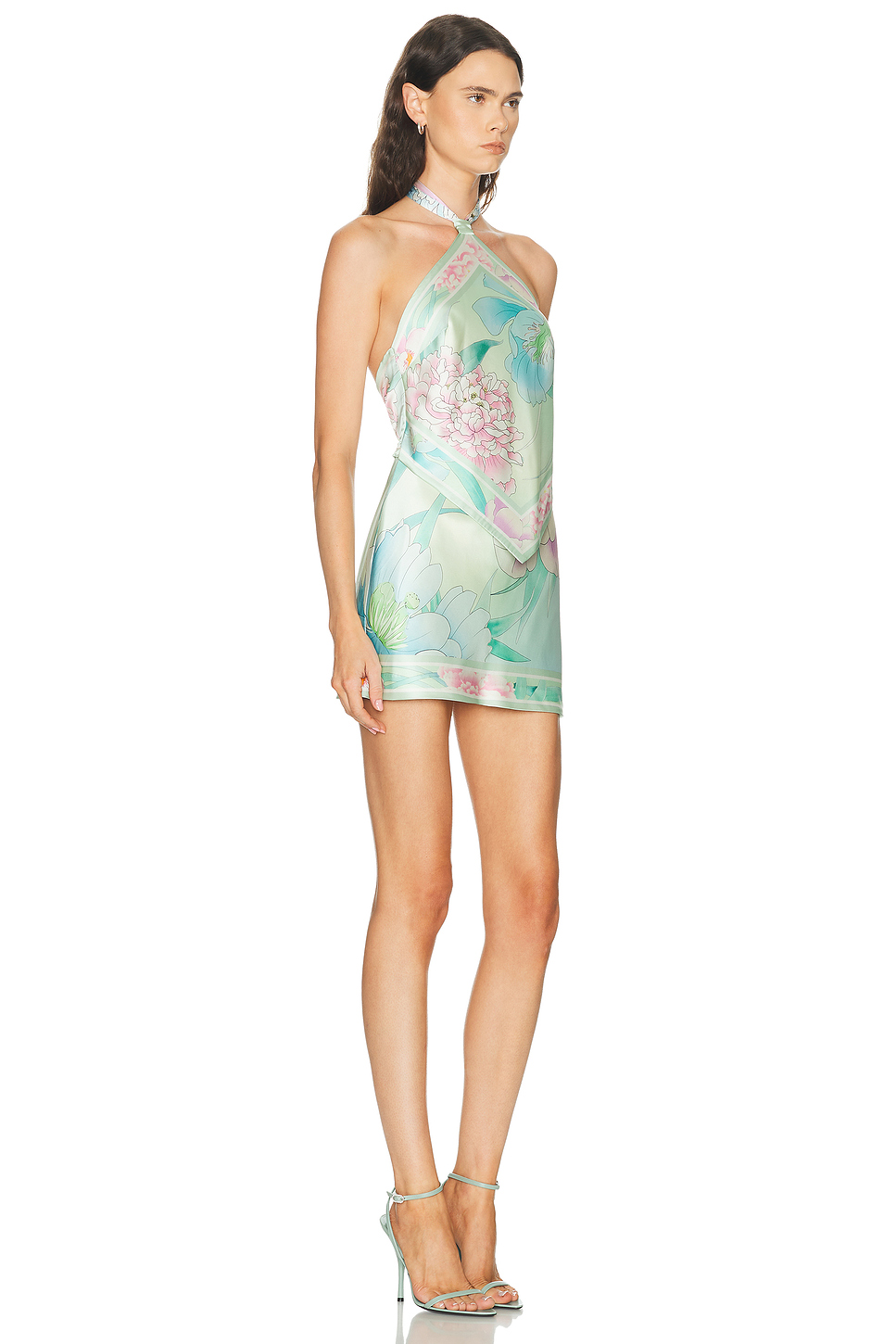
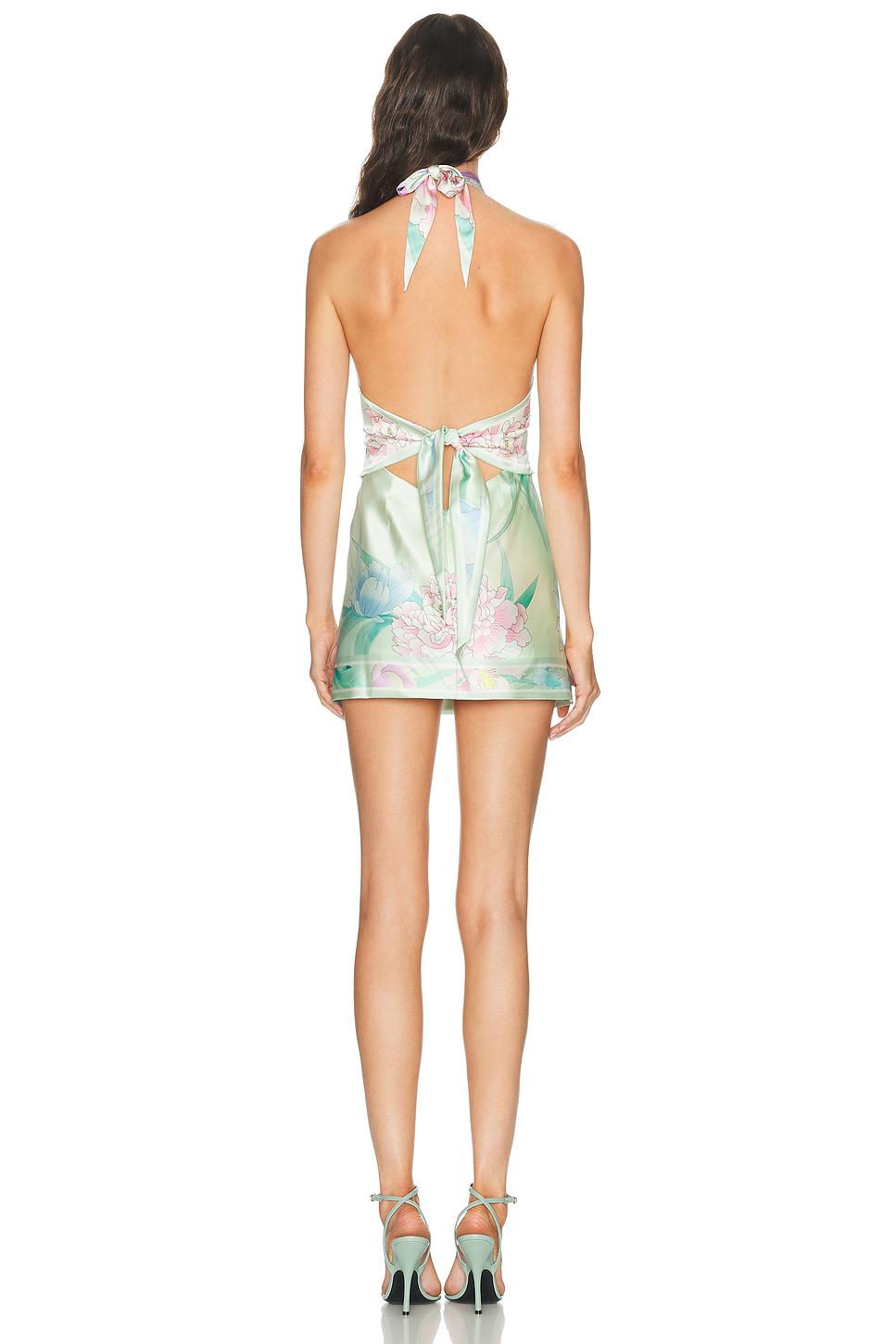
A printed mini dress listed with a self of 95% silk and 5% elastane alongside a contrast fabric of 97% polyester and 3% elastane, fully lined, dry clean only, in a mid-weight satin, with a hidden back zip and tie fastening and a halterneck design, made in China, ranked seventh in the retailer's floral dress list, at 509 dollars. There are no reviews and no fit votes, so there is no score to quote. This is the third page here to give a second layer rather than implying one, and the two layers are further apart than anything previously encountered, so looking at what holds them together is more interesting than noting the gap. There is also another satin in this series to compare against, and combining it with what was examined there produces the cleanest account yet of how a shape figure below the body can be explained. The reference is the Adelaide Dress by retrofete in Beija Flor Pistachio. Dongguan Bafinasa Garments Co., Ltd. develops comparable printed silk dresses on OEM and ODM terms, from fabric sourcing and digital printing to retail or FBA ready packing. We publish this as a development reference and build your own version of it, and we do not supply the branded original or reproduce anyone else's label.
Key Features
- Self in 95% silk with 5% elastane, and a contrast fabric of 97% polyester with 3% elastane, both stated. See the note below
- Fully lined as stated, and dry clean only as stated
- Mid-weight satin as stated, which allows a direct comparison with another garment examined here. See the note below
- Halterneck design with tie fastening as stated, alongside a hidden zip at the back
- Printed floral design as stated, and the listing places seventh among floral dresses
- Hidden back zip with tie fastening as stated
- Made in China as stated
- Measurements published for one size, including bust 30 in and length 34 in. See the note below
Customisable Options
- Fabric: printed silk satin to the reference, with the base cloth before printing specified rather than only the name
- Contrast: we would either match the two, or keep dry clean only permanently, and say which we have done
- Lining: fully lined to the reference, and we would name the lining fibre rather than only saying there is one
- Care: dry clean only, which is correct here, and we would say what it is protecting
- Length from mini to knee, print scale, contrast placement, halter construction, size set, colour development, private label and care labelling
Specifications
| Style | Printed silk halter mini dress |
| Reference | retrofete, Adelaide Dress, style RTFF-WD758, manufacturer style SS24-8739, colour Beija Flor Pistachio |
| Self | 95% silk, 5% elastane as stated. See the note below |
| Contrast Fabric | 97% polyester, 3% elastane as stated. See the note below |
| Fabric | Mid-weight satin as stated. See the note below for the comparison this allows |
| Lining | Fully lined as stated, with the lining fibre not named |
| Care | Dry clean only as stated, which is the correct instruction for what is described here |
| Neck | Halterneck design with tie fastening as stated |
| Closure | Hidden zip at the back with tie fastening as stated |
| Printed floral design as stated | |
| Sizes Published | XS, S, M and L |
| Measurements Published | S: bust 30 in, waist 26 in, hips 35 in, length 34 in. See the note below |
| Chart Note | The bust sits about four inches under the model while the waist and hips sit at or above. See the note below |
| Coverage | Only size S has figures. XS, M and L are blank |
| Model | 182 cm, bust 86 cm, waist 58 cm, hips 91 cm, wearing size S |
| Production | Made in China as stated |
| Reference Retail | 509 USD, quoted to show the price band this sits in, not as our price |
| Customer Reviews | None on the reference listing, so we quote no score |
| Best Seller Badge | Rank 7 in the retailer's floral dress list, which is a strong position |
| Categories | Filed by the retailer under mini dresses and halter dresses, the second agreeing with what is stated |
| Occasion | Occasions, evenings, parties, warm weather events |
| MOQ | 100 pcs per style per colourway, mixed sizes and colourways accepted |
| Sampling | 7-10 days after tech pack or reference sample confirmation |
| Bulk Lead Time | 20-30 days after sample approval and deposit |
| Service | OEM / ODM / private label, silk satin sourcing, digital print development, retail or FBA ready packing |
Size Chart
| Size | Bust | Waist | Hips | Length | Source | ||||||||||||
|---|---|---|---|---|---|---|---|---|---|---|---|---|---|---|---|---|---|
| S | 30 | in | 26 | in | 35 | in | 34 | in / | 86 | cm | As published | ||||||
| XS | 31 | in / | 79 | cm | 24 | in / | 61 | cm | 34 | in / | 86 | cm | 86 | cm / | 33.9 | in | Our proposal |
| S | 33 | in / | 84 | cm | 26 | in / | 66 | cm | 36 | in / | 91 | cm | 88 | cm / | 34.6 | in | Our proposal |
| M | 35 | in / | 89 | cm | 28 | in / | 71 | cm | 38 | in / | 97 | cm | 90 | cm / | 35.4 | in | Our proposal |
| L | 37 | in / | 94 | cm | 30 | in / | 76 | cm | 40 | in / | 102 | cm | 92 | cm / | 36.2 | in | Our proposal |
The published size S gives bust 30 in, waist 26 in, hips 35 in and length 34 in against a model at roughly 34, 24 and 34. The bust sits about four inches under her while the waist and hips sit at or above, and this page describes enough to explain that combination.
Occasions and Styling
Suits occasions, evenings, parties and warm weather events. A printed silk mini is an occasion piece, and it is worth knowing that dry clean only is correct here rather than merely cautious, which decides what happens after rather than before.
Production and Quality Control
There are no reviews and no fit votes on this listing, so we quote no score. This is the third page to give a second layer rather than implying one, and these two are further apart than anything seen before, which makes how they are held together the interesting part. It also allows the cleanest account yet of a shape figure below the body.
The widest gap found yet, and what holds it together is more useful than the gap itself, and that is the first thing. This page states two compositions outright: the self at ninety five per cent silk with five per cent elastane, and a contrast fabric at ninety seven per cent polyester with three per cent elastane. This series has spent very considerable space on whether pages say what a garment is made of when it is made of more than one thing, and the treatments have differed widely. Most often a relative word appears and nothing follows. Occasionally the second element arrives, and recently there was one page whose field covered both fabric and lining and they matched each other exactly, which was noted as the first complete match and credited even though meeting that standard cost one extra word. Then another gave three compositions in succession, two for the main and contrast cloths and one for the lining, and comparing those first two produced something interesting: the same two fibres in different proportions, which was described as the conservative version of this situation, and contrasted against an earlier instance where the contrast cloth came from an entirely different family. This is that severe version again, and it is the widest seen. Silk is a protein fibre and polyester is a synthetic polymer, so they share nothing at the level this series cares about: they take dye differently, they absorb different amounts of moisture, they move differently with heat, and crucially they respond differently to water, since silk spots permanently while polyester is dimensionally stable and barely notices. So there is a real mismatch here, and the interesting question is not how wide it is but what keeps it from mattering. The answer is the instruction, and this is worth setting out carefully because the same mechanism has been described several times now and this is its clearest example. Dry clean only closes washing off entirely, which means neither fibre ever meets the water that would separate them. Nothing has been fixed, and this series has been at pains to say so each time: an instruction does not permanently resolve a mismatch, it makes it dormant. The fault sleeps rather than leaves, and it wakes the moment anybody relaxes that instruction or anybody ignores it once. That is why this listing needs the line it already has, and why it should not be softened later without changing the contrast fabric along with it. There is one thing missing, which is that despite going to the trouble of stating both components, the lining is stated only as existing. Its fibre is not named, and layers belong in the same fibre so that they stay in proportion afterwards, which was restated very recently when a page did exactly the right thing for once. So this garment has been careful about two of its three parts and silent on the third. It is also worth noting what sits alongside this comparison: this page places seventh among this retailer's floral dresses. This series recently found a garment ranked second despite costing very little and saying several candid things, and used that to remove one objection. This does not add much on its own, but it is another instance of a page carrying an inconvenient truth, since dry clean only is a real cost of ownership stated plainly, sitting comfortably high in a list.
The same satin, an entirely different answer, and pairing them settles it, and that is the second thing. There is another garment in this series made of a mid-weight satin, and putting the two together is unusually productive because they agree on what matters most here. Both are mid-weight satin. Beyond that almost everything differs: that one was one hundred per cent rayon and unlined with a permissive instruction, and this is silk rich and fully lined with the strictest one. Satin itself deserves a word first, since it is what they share and what makes the pair worth looking at. Satin is constructed so that yarns float across several others before going under one, and those floats across the surface are what produce the smooth lustrous face that makes the cloth desirable. They are also the most exposed part of any weave, being raised and free along most of their length, so they are the first thing anything abrading encounters. Now consider what happens when fibres are set against that structure. In the other garment the fibre was rayon, and this series has described its behaviour in detail: it loses around half its strength when wet, it shrinks, and it creases badly as it dries. So the cloth reaches its weakest exactly when it is wet, and the weave has put its most vulnerable threads on the surface where friction finds them first, which together were noted as a poor pairing. Here the fibre is silk rather than rayon, and silk has its own well known difficulty, which is that water spots it permanently. But this garment is fully lined, and the instruction forbids water altogether, so neither of those worries is ever reached. Two things follow from the pair, and the first is the general one worth carrying forward. The same weave with the same weight can be a fragile garment or a manageable one depending entirely on what accompanies it, so reading a fabric name tells you the shape of the problem and never the size of it. The second concerns how they differ, which is instructive in a different way. That other garment was given the weaker of two similar instructions, permitting professional cleaning without ruling washing in or out, and this series objected because leaving the question open on that fibre invites exactly the wrong assumption. This one is given the stronger instruction, which closes it, and everything on this page supports that being deliberate rather than habitual, since there are two components here that would each justify it. This series has several times concluded that strict instructions were habit rather than judgement, having looked at garments whose contents could not account for them. That suspicion is not available here.
A bust four inches under the body, and for once the page explains it twice over, and that is the third thing. The published bust is thirty inches against a model at roughly thirty four, so there are about four inches of negative ease, while waist and hip sit at or above her. This series established a rule for exactly this shape some batches ago: when the bust sits below the body while adjacent measurements sit at or above it, ask first whether the garment is strapless, halter or sleeveless, since each removes or weakens the landmarks a bust figure depends on. This is a halterneck, so the rule engages immediately and correctly, which is gratifying since it has now been applied enough times to trust. What makes this case worth dwelling on is not that the rule fired but that there are two mechanisms here rather than one, and they are of different kinds, which is something none of the earlier cases offered. The first is the five per cent elastane. This series has built up a threshold over many garments: below roughly five per cent is a recovery additive, helping seams return and the garment hold its line without compressing anybody, while nearer a fifth genuinely draws inward and a fit can rest on it. Five per cent sits directly on that boundary, which is worth flagging because it means this component is doing something but is not, on its own, enough to account for four inches. The second is the tie fastening at the neck, described alongside the hidden zip. This series recently added a fifth mechanism to its catalogue after examining a boned bodice drawn closed with hooks, calling the family adjustable closure rather than stretch, and noting that unlike knit or elastane it depends on nothing extending, and unlike shirring the degree is set deliberately each time it is worn. A halter tie is the same kind of answer: the circumference is drawn to the body by something being pulled rather than by anything giving. Putting those together gives the honest reading, which is that neither alone explains four inches and together they do. That is a small extension worth recording, since until now every case examined has resolved to a single mechanism: these can stack, and when they do, attributing the whole effect to whichever one is easiest to see will be wrong. There is one further piece of reassurance available and it comes from an unusual place, which is the retailer's own filing under halter. Many labels encountered here have been unreliable, with two identically named garments from different makers having landed in different categories, so this series reads them with caution. But this one agrees with what the page itself describes, and where that happens it is worth accepting the confirmation rather than reflexively doubting it. Every bulk shipment gets a measurement report against your approved chart.
Optional upgrades include naming the lining fibre, since two of three components have been stated carefully and the third has not, matching the contrast fabric to the self, or keeping dry clean only permanently if it is kept, and saying which has been done, since the mismatch sleeps rather than leaves, publishing measurements for XS, M and L, since one size out of four has been the standard complaint throughout, stating both relaxed and drawn figures given that a tie sets the circumference rather than any stretch doing it, specifying the base cloth rather than only the word satin, since the weave raises the floats that everything abrades against, offering print scale options since that decides how the floral reads at distance, alternative halter constructions, colour development, private label, hangtag and care labelling.
Pre-production sample approval, in-line inspection during cutting and sewing, and a final AQL inspection before packing, with measurement reports and photos shared before shipment.
Send us your tech pack, a photo or a reference garment and we will quote within 24 hours. Contact bafinasa@bafinasa.com or WhatsApp +86 13827222469.