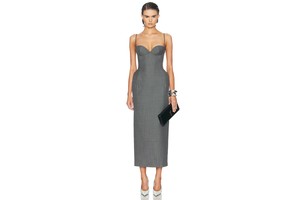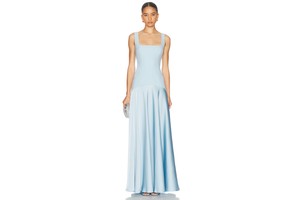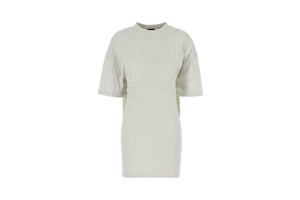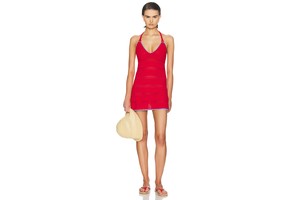
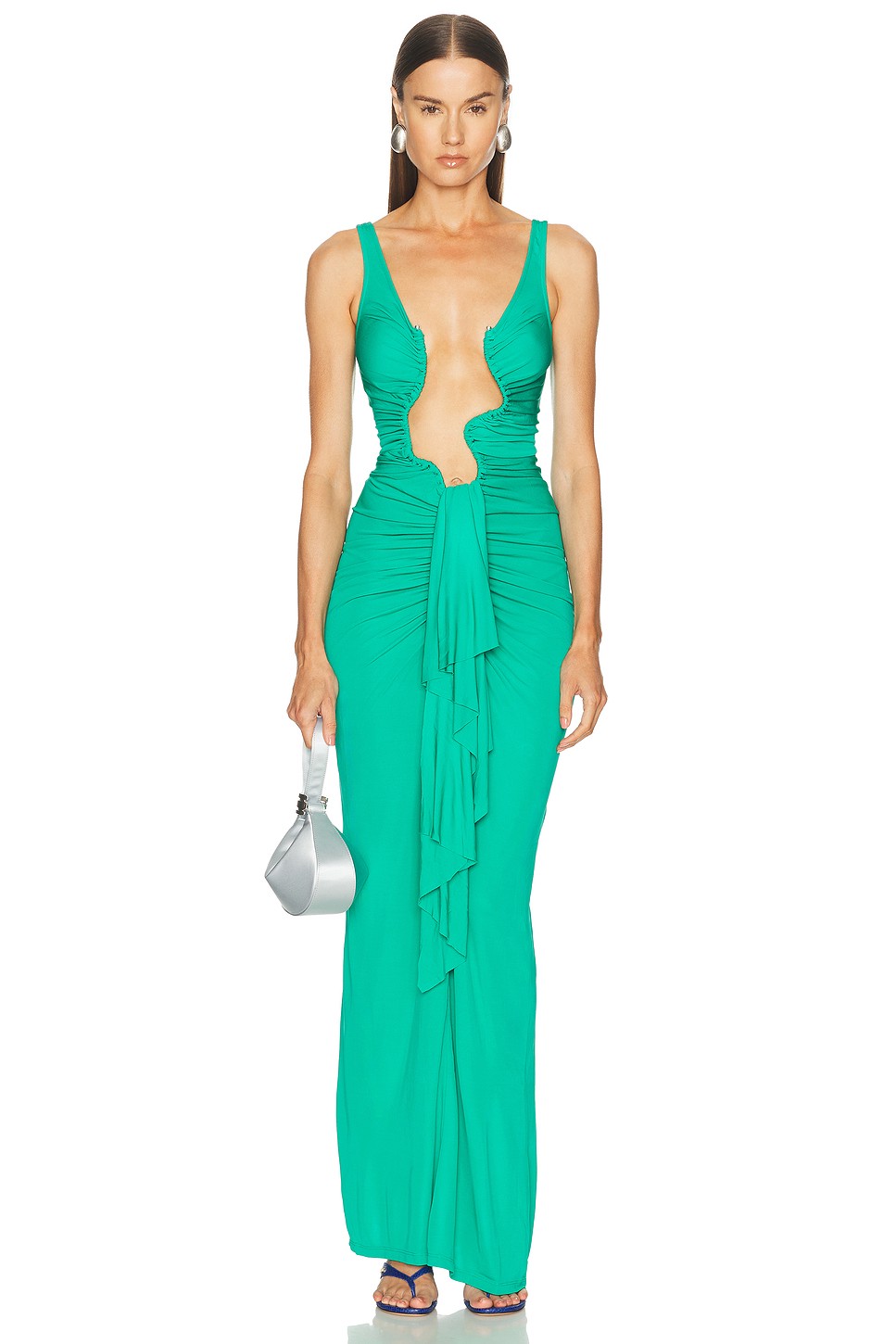
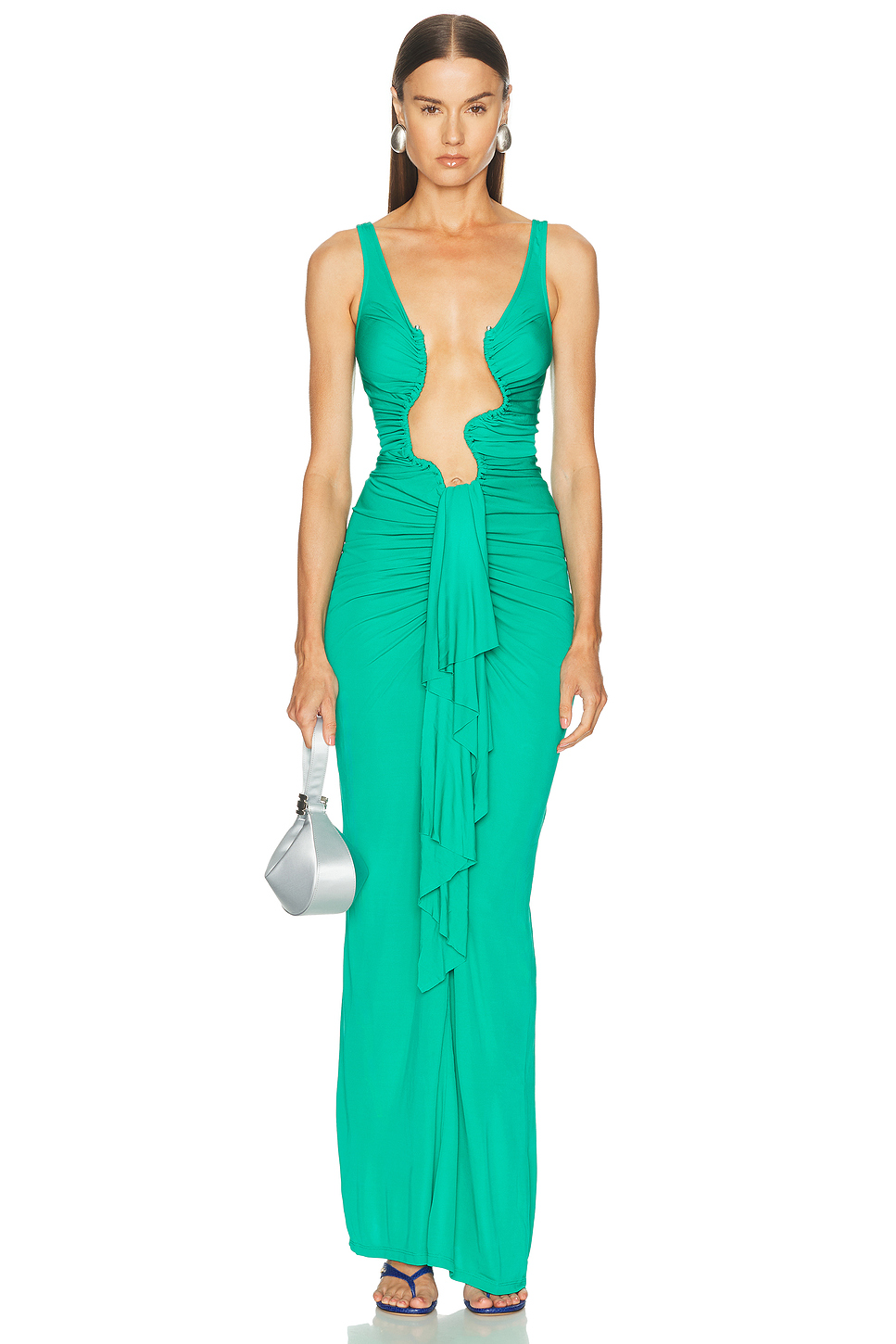
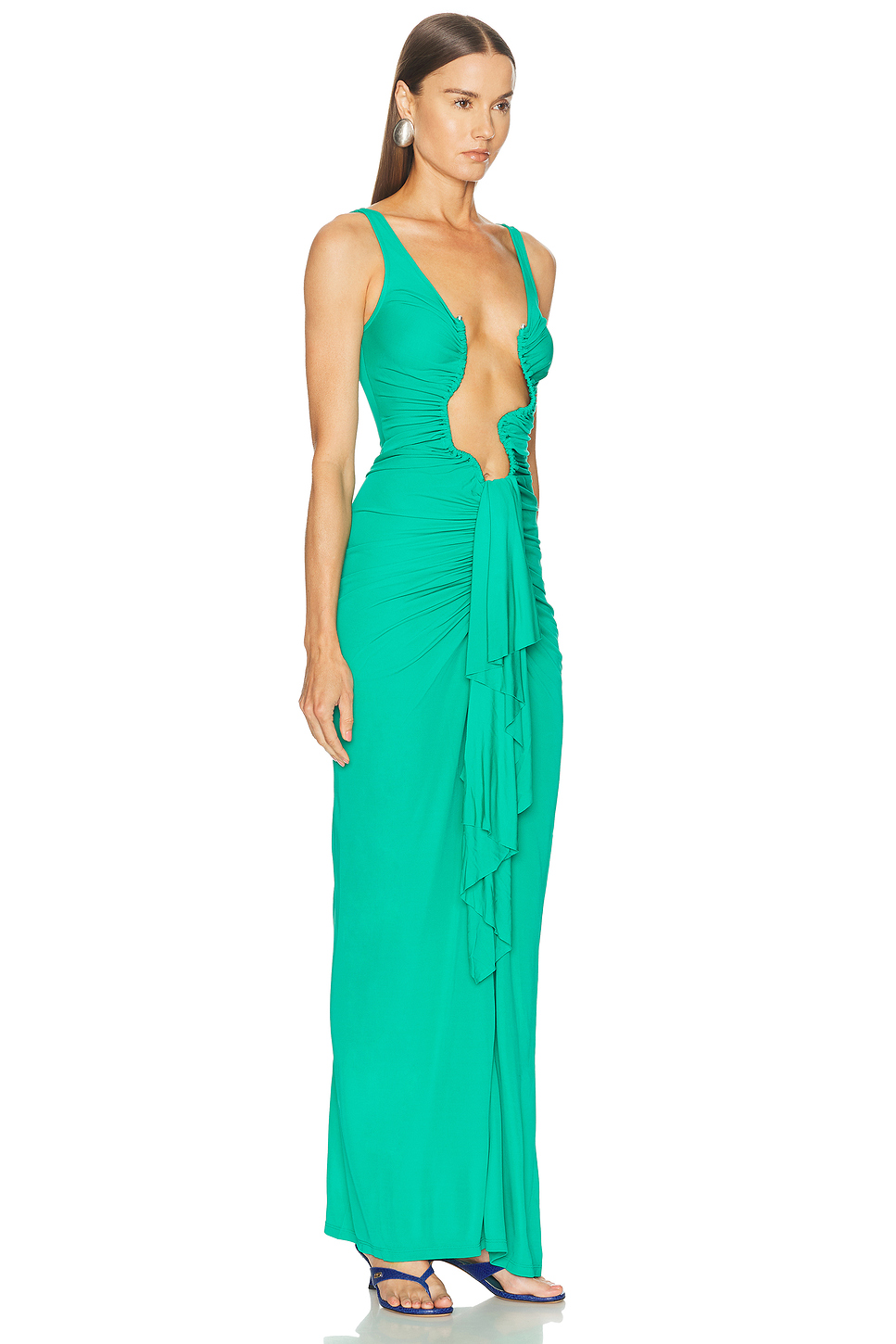
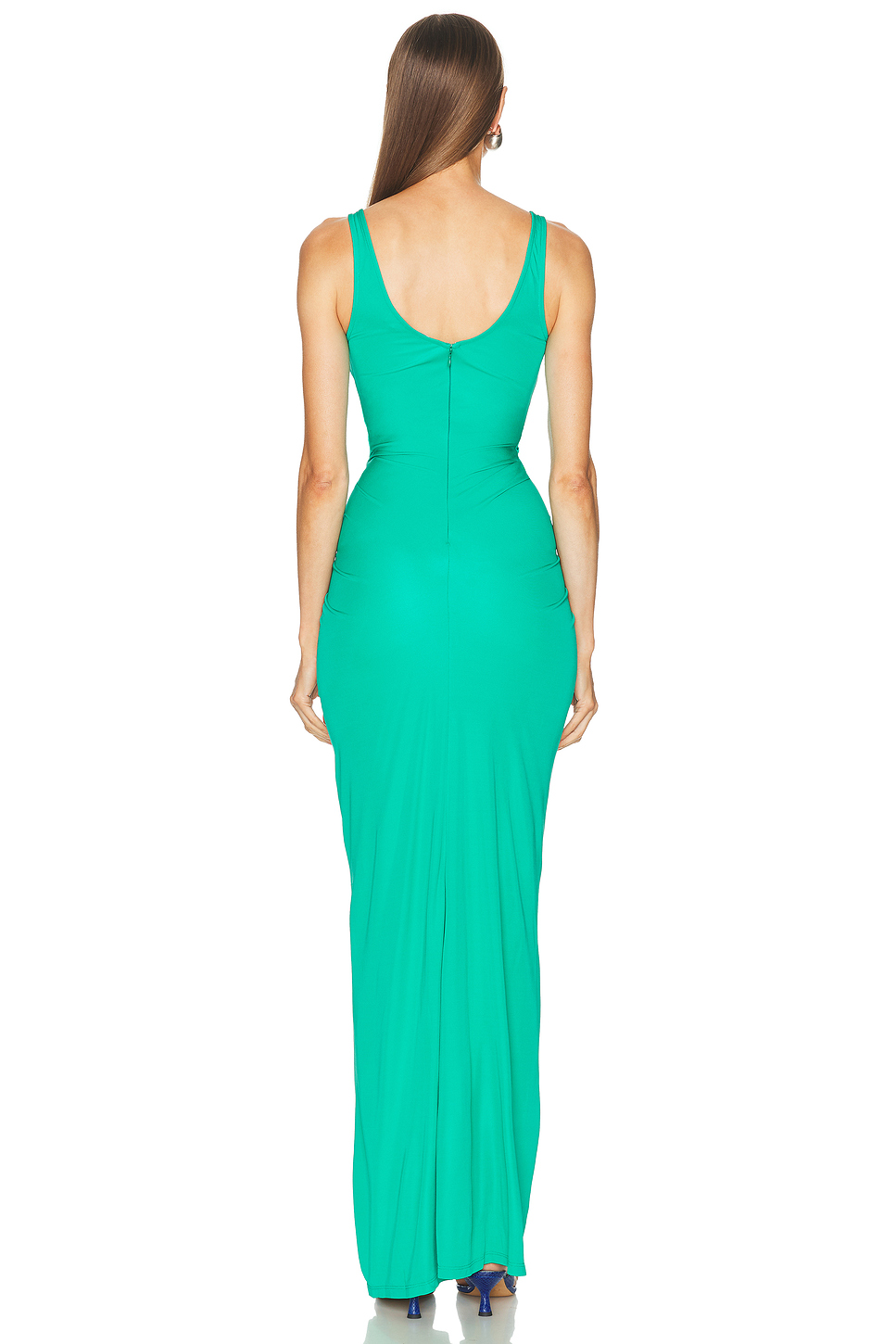
A dress listed with fabric one given as 100% viscose and fabric two as 100% brass, dry cleanable, unlined, with a deep V neckline on an underwire and draped strap detail at the front, closing with a hidden zip at the back, made in India, at 995 dollars. There are no reviews and no fit votes, so there is no score to quote. This is the first time a metal has appeared in a composition field here, and thinking about why that is not a mistake explains more than the garment. Three separate stated things also converge on the same conclusion about how this fits, which is not something this series has been able to say often. The reference is the Salacia Jersey Drape Dress by Christopher Esber in Malachite. Dongguan Bafinasa Garments Co., Ltd. develops comparable viscose jersey dresses on OEM and ODM terms, from fabric sourcing and hardware to retail or FBA ready packing. We publish this as a development reference and build your own version of it, and we do not supply the branded original or reproduce anyone else's label.
Key Features
- Fabric one given as 100% viscose, and fabric two as 100% brass. See the note below, since a metal in a composition field is new here
- Deep V neckline on an underwire with draped strap detail at the front as stated
- Viscose jersey, named in the product title, which is what accounts for the measurements. See the note below
- Dry cleanable as stated, which permits rather than excludes home washing. See the note below
- Unlined as stated, so nothing sits behind the viscose
- Hidden zip at the back as stated
- Made in India as stated
- Sizes given in both Australian and United States numbering, which is the most useful conversion yet offered
Customisable Options
- Fabric: viscose jersey to the reference, with the knit construction and weight specified rather than only the name
- Hardware: brass to the reference, and we would specify the finish since what follows differs completely by it
- Neckline: deep V on an underwire to the reference, developed carefully since this component does structural work
- Care: dry clean only rather than dry cleanable, since brass discolours and the instruction here is currently open
- Length from midi to floor, jersey weight, hardware finish, underwire options, size set, colour development, private label and care labelling
Specifications
| Style | Cut out viscose drape dress |
| Reference | Christopher Esber, Salacia Jersey Drape Dress, style CHRF-WD379, manufacturer style 25013556, colour Malachite |
| Fabric One | 100% viscose as stated. See the note below |
| Fabric Two | 100% brass as stated. See the note below, since this is new here |
| Neckline | Deep V neckline on an underwire, with draped strap detail at the front as stated |
| Lining | Unlined as stated |
| Care | Dry cleanable as stated, which permits rather than excludes washing. See the note below |
| Closure | Hidden zip at the back as stated |
| Sizes Published | Aus 4 to Aus 12, shown alongside US 0 to US 8, five consecutive sizes with both scales |
| Measurements Published | Aus 6: bust 24 in, waist 19 in, hips 32 in, length 58 in. See the note below |
| Chart Note | Every measurement sits well below the model, and three stated things explain it together. See the note below |
| Coverage | Only Aus 6 carries figures. The remaining four sizes are blank |
| Model | 179 cm, bust 86 cm, waist 61 cm, hips 86 cm, wearing Aus 6 |
| Photographs | Three |
| Production | Made in India as stated |
| Reference Retail | 995 USD, quoted to show the price band this sits in, not as our price |
| Customer Reviews | None on the reference listing, so we quote no score |
| Best Seller Badge | None. The listing carries no rank |
| Categories | Filed by the retailer under bodycon dresses and cut out dresses |
| Occasion | Occasions, evenings, formal events |
| MOQ | 100 pcs per style per colourway, mixed sizes and colourways accepted |
| Sampling | 7-10 days after tech pack or reference sample confirmation |
| Bulk Lead Time | 20-30 days after sample approval and deposit |
| Service | OEM / ODM / private label, viscose jersey sourcing, brass hardware development, retail or FBA ready packing |
Size Chart
| Size | Bust | Waist | Hips | Length | Source | ||||||||||||
|---|---|---|---|---|---|---|---|---|---|---|---|---|---|---|---|---|---|
| Aus 6 | 24 | in | 19 | in | 32 | in | 58 | in / | 147 | cm | As published | ||||||
| Aus 4 | 31 | in / | 79 | cm | 24 | in / | 61 | cm | 34 | in / | 86 | cm | 147 | cm / | 57.9 | in | Our proposal |
| Aus 6 | 33 | in / | 84 | cm | 26 | in / | 66 | cm | 36 | in / | 91 | cm | 149 | cm / | 58.7 | in | Our proposal |
| Aus 8 | 35 | in / | 89 | cm | 28 | in / | 71 | cm | 38 | in / | 97 | cm | 151 | cm / | 59.4 | in | Our proposal |
| Aus 10 | 37 | in / | 94 | cm | 30 | in / | 76 | cm | 40 | in / | 102 | cm | 153 | cm / | 60.2 | in | Our proposal |
The published Aus 6 gives bust 24 in, waist 19 in, hips 32 in and length 58 in against a model at roughly 34, 24 and 34. Every figure sits well below her, and this page states three separate things that together account for it.
Occasions and Styling
Suits occasions, evenings and formal events. A viscose jersey with metal hardware at the neck is an evening piece, and it is worth knowing that the hardware needs more care than the cloth does.
Production and Quality Control
There are no reviews and no fit votes on this listing, so we quote no score. A metal appearing in a composition field is new here, and understanding why it is not a mistake is more informative than the garment. Three stated things also converge on how this fits, which this series has rarely been able to say.
Brass in a composition field, and why this is correct rather than another category error, and that is the first thing. This listing gives two entries: fabric one hundred per cent viscose and fabric two hundred per cent brass. Brass is a metal, an alloy of copper and zinc, so this is the first time anything other than a fibre has appeared where a composition goes. It is worth being immediately clear that this is not the same failure met recently, and the contrast is instructive enough to set out. Not long ago a page was examined whose two layers were both described as being made of cloth, and this series called that a category error rather than compression, because the word named the thing being described rather than any substance in it, so nothing whatever had been said and the sentence resolved as though it had. Here something genuinely different is happening. Fabric two is indeed part of what this garment is made of, the brass being named as a material, and calling it fabric recognises that on this garment the metal is not decoration added afterwards but a component built into the construction, sitting at the neckline where it visibly does work. So the same word that was empty in one place is correct in another, and the reason is simply that one asked what a substance is while the other is describing what a garment comprises. That distinction matters beyond this garment because it shows these fields are not self interpreting: whether a word is informative depends on what question the reader thinks the field is answering. Now, why brass being here explains a lot. This garment has a deep V neckline carried on an underwire, and an underwire is a rigid shaped component that holds a neckline open and supports weight from underneath rather than letting it hang from the shoulders. This series met rigid support recently in the form of boning, three times in fact, and comparing those produced something useful: the same stated feature doing different amounts of work depending on what was around it, with around one fifth elastane meaning the cloth was already gripping so the boning reinforced, and five per cent meaning the boning was doing the holding, and most recently none at all meaning it was the entire mechanism. An underwire is that same principle in a different place, and here there is no elastane whatever in the viscose, so nothing else is holding anything and the metal is doing it entirely. There is also the matter of what brass does over time, and this is the reason the composition disclosure matters practically. Brass contains copper, and copper reacts with moisture and air to form the dull green layer called patina, or simply darkens, depending on how it is finished. If there is a clear lacquer it is protected until the lacquer is scratched. If it is left bare it will change, quickly and unevenly, particularly where it touches skin. So naming the metal tells a customer something she could act on, and leaving it as hardware or omitting it entirely would remove that chance.
The fourth instance of the weaker wording, and here the case against it is strongest, and that is the second thing. This series has now objected to this instruction three times, on a rayon rich lining, an unlined rayon satin, and a velvet whose pile does not recover, and having assembled them reached the view that random carelessness was unlikely, since in each case the garment contained something arguing hard for stricter handling. This is the fourth and it is the clearest, because the argument here is not inferable from fibres but visible on the garment. Start with the obvious candidate. Brass discolours as described above, and it does so far faster when it meets water, soap, perspiration or cosmetics and is not dried immediately and completely. Once a metal has darkened unevenly, particularly on a piece sitting against skin at the neckline where everybody sees it, there is no way back to evenness short of removing and refinishing it. Next consider the viscose. Viscose is regenerated cellulose, and it loses around half its strength when wet, shrinks, and creases badly as it dries, none of which can be undone afterwards. And it matters that this is a jersey, since knit constructions distort readily under agitation, being loops that shift against each other rather than a locked grid, which is why knit is the commonest explanation across this series for garments fitting smaller than it seems they should. Then there is the underwire itself, which this series identified as a candidate very recently on a different garment, reasoning there that if the garment gets wet the rigid component and the cloth around it behave differently, so the component either ridges visibly through the front or works its way out through the end of its channel, and once bent stays bent. So there are three arguments here and each would justify the stricter instruction alone. What this page gives instead is the wording that leaves the question open, and this series has made the same point each time but it sharpens here: absent a clear instruction people assume the permissive answer, because for most garments that is true. On a garment with reactive metal at the neck, assuming wrong does not produce a disappointing wash but a visible and permanent change to the most noticeable part of it. One word would close it. It is worth adding what this page gets right, since proportion has been a concern throughout. It names the metal, it names the construction, it gives both size scales, and it publishes a full set of measurements. Each of those is better than most. It is one word away from being a good page.
Three stated things converging on how this fits, and the first time that has happened cleanly, and that is the third thing. Bust twenty four against roughly thirty four, waist nineteen against twenty four, hips thirty two against thirty four, so everything sits below her, by ten inches at the bust and five at the waist. This series has met measurements below the body many times and built a catalogue of explanations: knit structure because loops open, elastane high enough to compress rather than merely recover, bias cutting though along one direction only, shirring where gathered elastic draws cloth in, and recently closure adjusted rather than stretched. Most often only one applies and the others are excluded by what the page says. Here something better happens, which is that three separate stated things point the same way and each corroborates the others. The first is jersey in the product title. Jersey is a knit, and this series has noted before that two words exist for this one thing and that a customer knowing one will not necessarily recognise the other. Knit is the commonest mechanism here and permits the largest shortfalls, since loops open under load and recover when it is removed. The second is that both retailers' filings here are bodycon and cut out, the first meaning close to the body, which is a description of the fit rather than of anything about construction, and it corroborates ten inches of negative ease rather than contradicting it. The third is the viscose itself. Viscose drapes more heavily than most fibres of the same weight, and combining a heavy draping fibre with a knit gives a cloth that clings and follows rather than standing away, which is what permits a shape this much smaller than the body to look deliberate rather than strained. So the honest conclusion is that this is explained, and explained in a way this series has rarely managed: not by one lucky detail but by three independent pieces agreeing. It is worth stating why that is the notable part. Nearly every page examined supplies one fragment, and the reader must either accept it or find nothing to test it against. Here there is corroboration, which is what turns a plausible reading into a reasonably settled one. It is also worth contrasting with another garment in this same batch where every measurement likewise sat below the model and the page left two candidates standing, neither eliminable, so no such convergence was available. Two pages, the same phenomenon, and one readable and one not, decided entirely by whether the pages described their own cloth. There is one more thing worth crediting, and it concerns sizes rather than construction. This is offered from Australian 4 to Australian 12 with United States equivalents alongside, five consecutive sizes in both scales. This series has commended dual labelling before, and noted once before that the same garment can be labelled differently by different systems, but this is the first instance crossing two national numbering systems, which is considerably more useful than anything else met, since a customer can read her own scale directly. The familiar complaint applies regardless: one size measured out of five, and the rest blank. Every bulk shipment gets a measurement report against your approved chart.
Optional upgrades include strengthening dry cleanable to dry clean only, since brass discolours unevenly and that is the most visible part of this garment, saying what the instruction protects, since there are three independent reasons here and knowing them lets a customer be careful in the right places, specifying whether the brass is lacquered or left bare, since that decides how quickly it changes, naming the jersey construction and weight rather than relying on jersey in the product title, publishing measurements for the remaining four sizes, since one out of five across two complete size scales is worse value than it looks, keeping both size scales since that is genuinely useful and uncommon, describing how the underwire is anchored given that it is carrying everything here with no elastane to share the load, offering alternative hardware finishes tested against whatever care method is chosen, colour development, private label, hangtag and care labelling.
Pre-production sample approval, in-line inspection during cutting and sewing, and a final AQL inspection before packing, with measurement reports and photos shared before shipment.
Send us your tech pack, a photo or a reference garment and we will quote within 24 hours. Contact bafinasa@bafinasa.com or WhatsApp +86 13827222469.