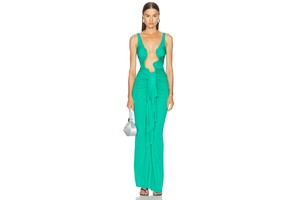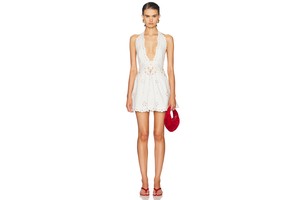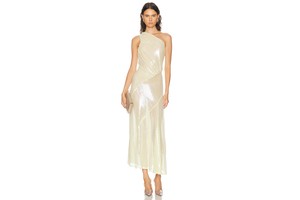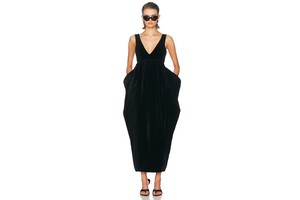
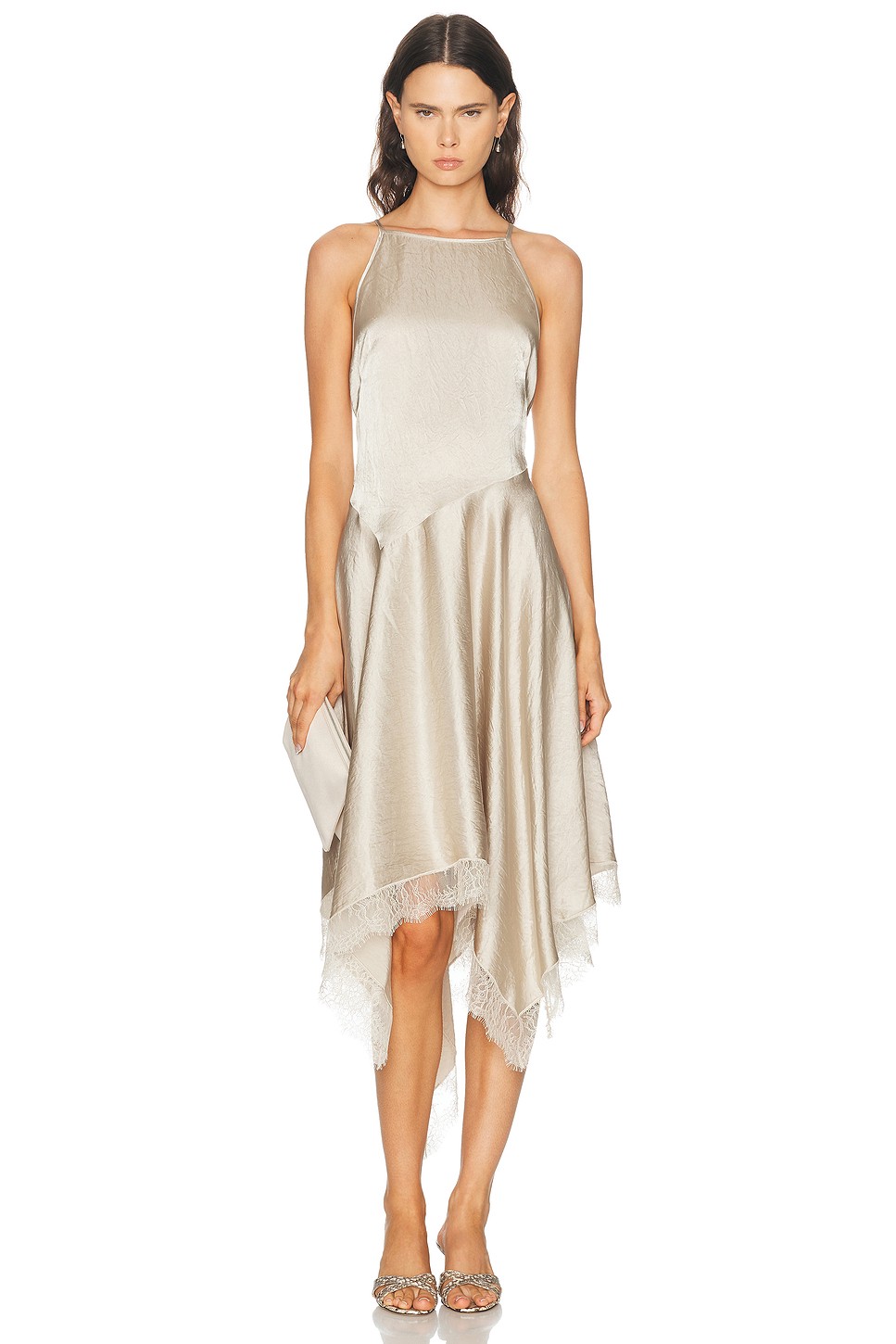
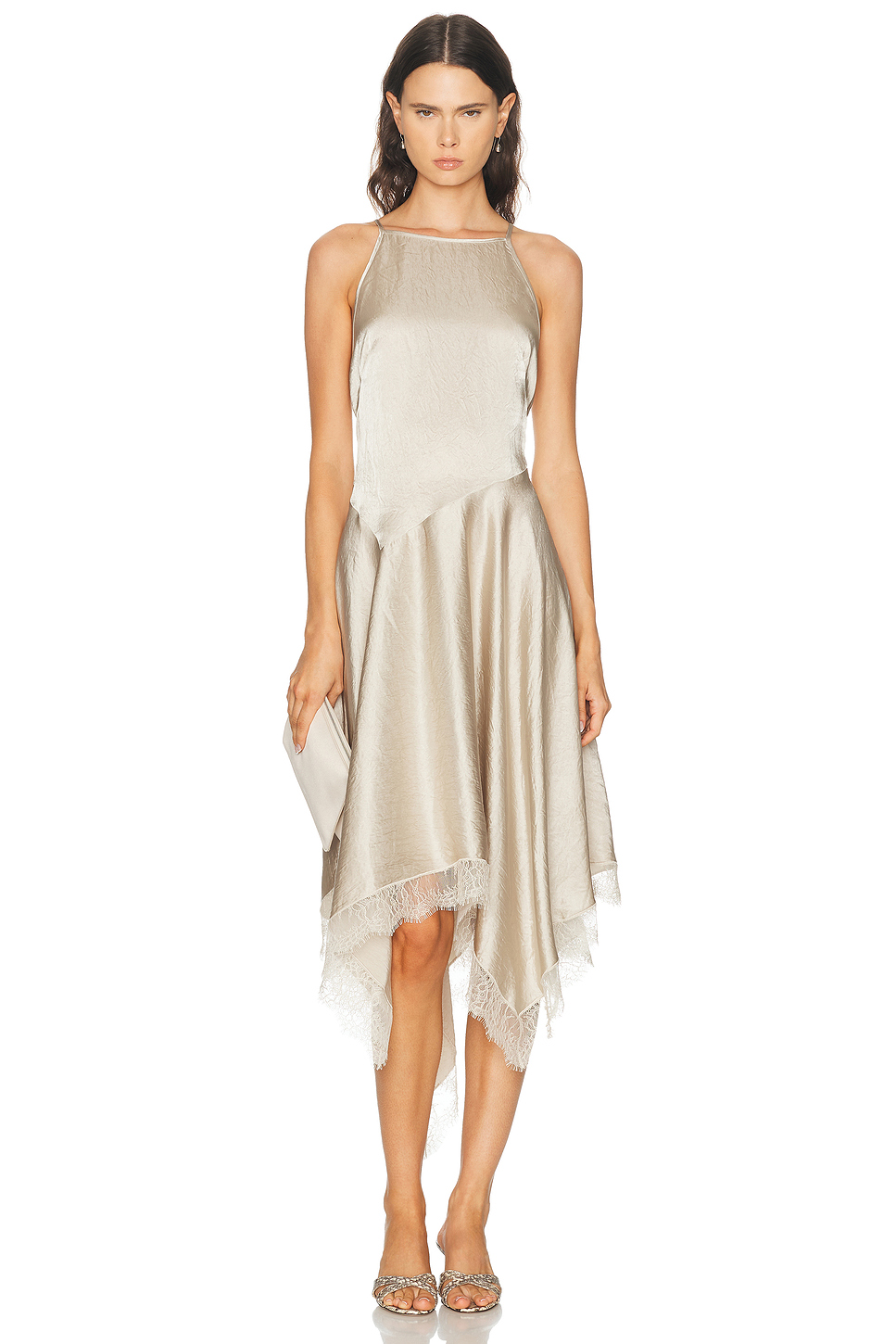
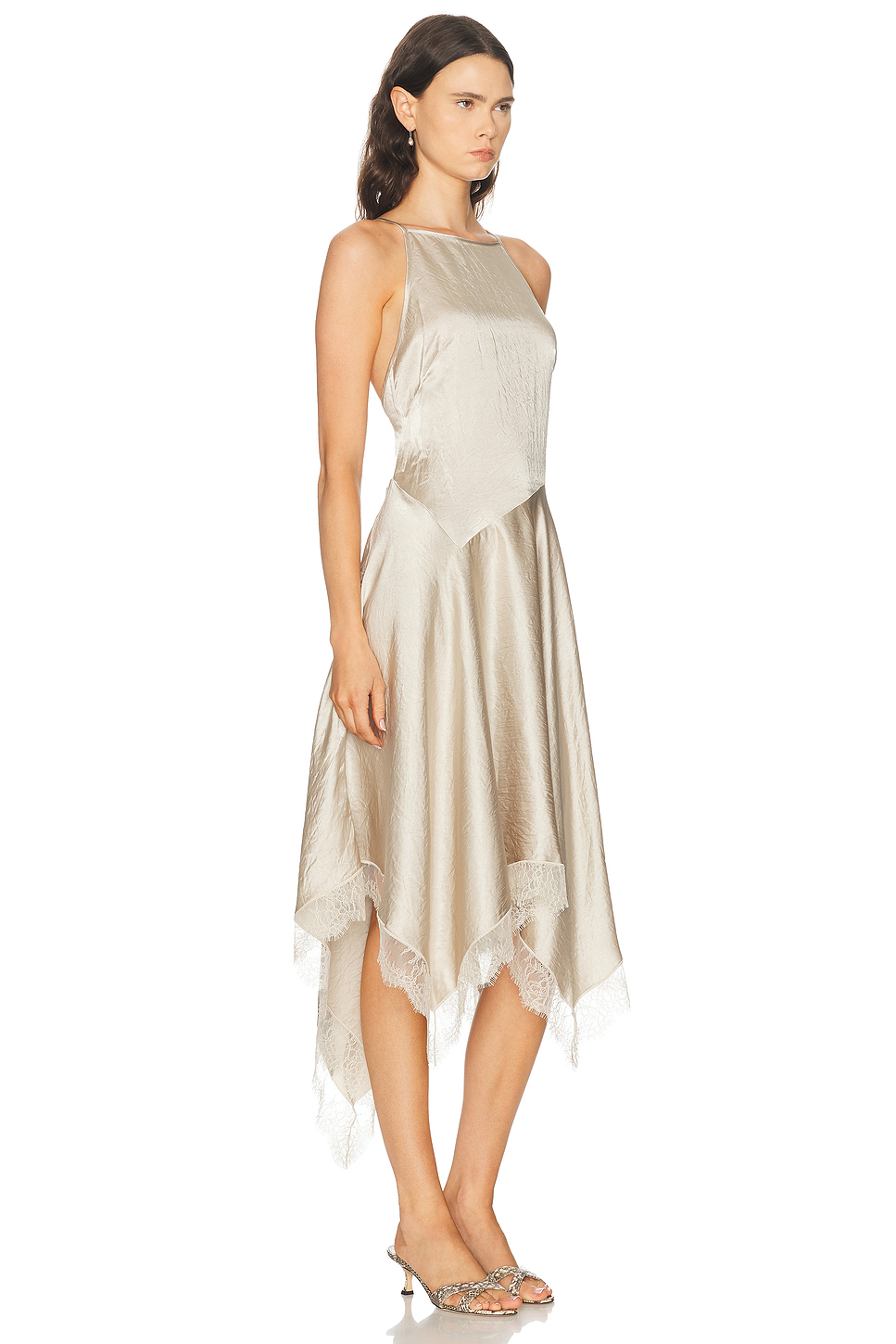
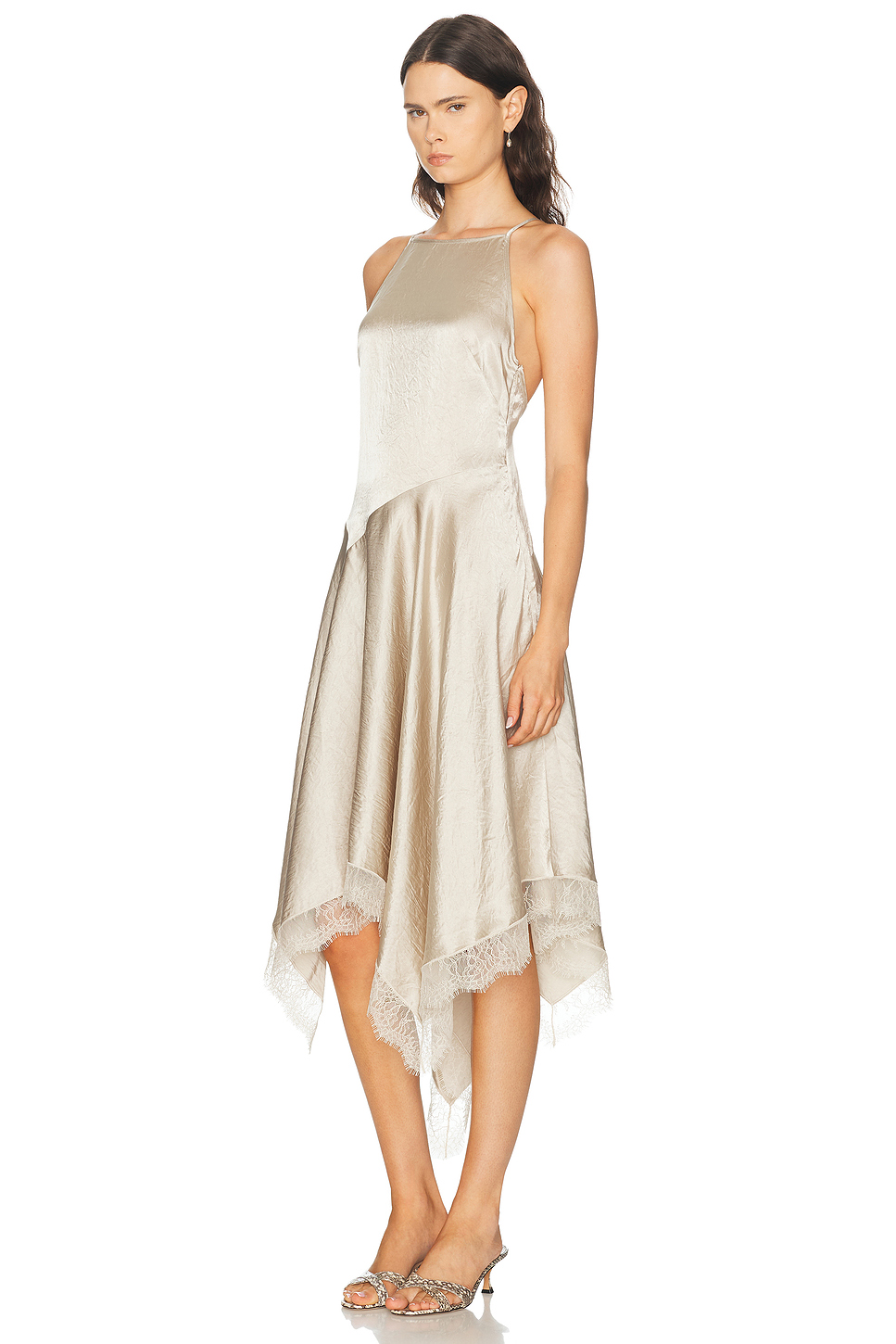
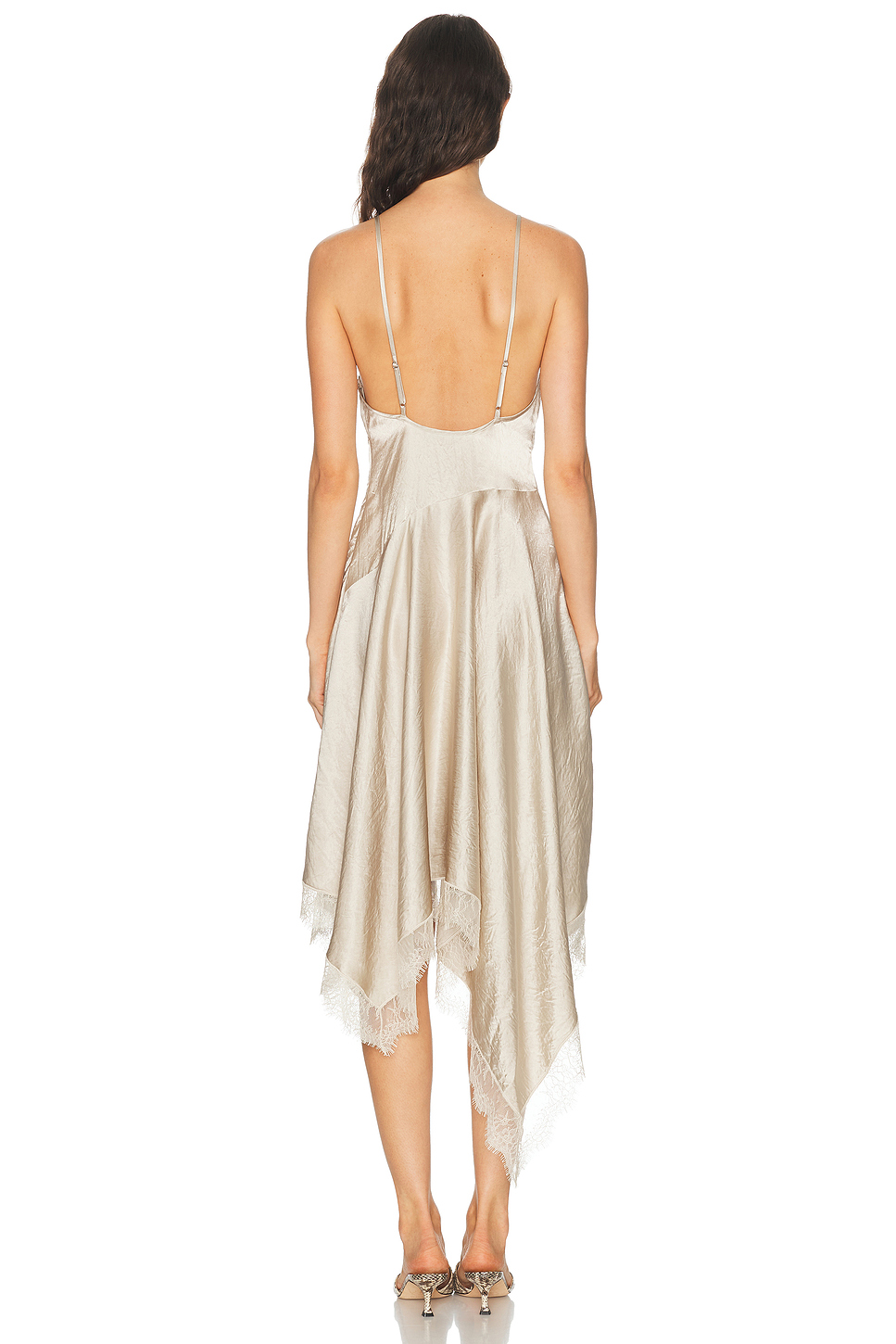
A midi dress listed in 100% rayon, dry cleanable, unlined, in a mid-weight satin with scalloped eyelash lace trim and an asymmetrical hem, closing with a hidden back zip and hook and eye, made in China, ranked fifty seventh in the retailer's midi dress list, at 329 dollars. There are no reviews and no fit votes, so there is no score to quote. This is the second time a particular care wording has appeared here and it carries the weaker of two meanings, which matters more on this composition than it did on the first. Unlined is also stated outright rather than left to implication, which is the first unambiguous negative answer to a question running through this entire series. The reference is the Mela Midi Dress by EAVES in Silver Taupe. Dongguan Bafinasa Garments Co., Ltd. develops comparable satin dresses on OEM and ODM terms, from fabric sourcing and lace trim to retail or FBA ready packing. We publish this as a development reference and build your own version of it, and we do not supply the branded original or reproduce anyone else's label.
Key Features
- 100% rayon as stated, which is among the fibres this series treats most carefully in water
- Dry cleanable as stated, and that wording permits rather than excludes home washing. See the note below
- Unlined as stated, and this is the first unambiguous answer rather than an absence. See the note below
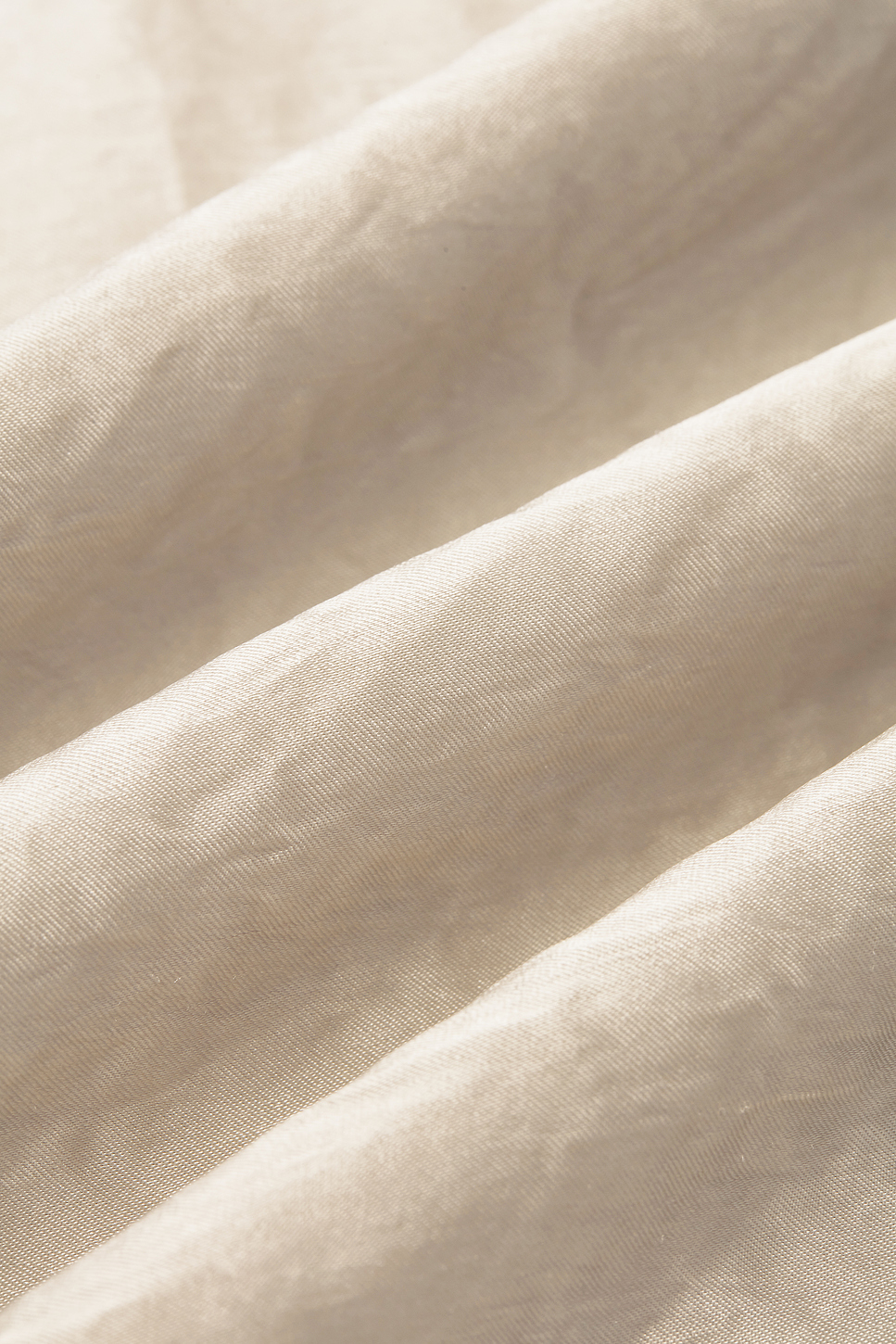
- Mid-weight satin as stated, and a satin weave changes what rayon does
- Scalloped eyelash lace trim as stated, and trim sets care instructions. See the note below
- Asymmetrical hem as stated, which the retailer records as a second filing
- Hidden back zip with hook and eye closure as stated
- Sizes XXS to XL published, which is the widest size run met here, with model figures but no size chart
Customisable Options
- Fabric: rayon satin to the reference, with the weave specified rather than only the word satin
- Trim: scalloped eyelash lace to the reference, and we would specify exactly where it sits
- Lining: we would offer lined or unlined deliberately, since each changes what the garment can do
- Hem: asymmetrical to the reference, which we would keep true rather than approximate
- Care: we would settle this by testing rather than by either word, and publish the reason
- Length from midi to maxi, satin weight, trim placement, lining options, size set, colour development, private label and care labelling
Specifications
| Style | Rayon satin asymmetrical midi dress |
| Reference | EAVES, Mela Midi Dress, style EAVR-WD92, manufacturer style EAD10078 F26, colour Silver Taupe |
| Composition | 100% rayon as stated |
| Fabric | Mid-weight satin as stated. See the note below on what a satin weave adds |
| Trim | Scalloped eyelash lace as stated |
| Lining | Unlined as stated. See the note below, since this is the first direct negative |
| Care | Dry cleanable as stated, which permits rather than excludes washing. See the note below |
| Closure | Hidden back zip with hook and eye closure as stated |
| Hem | Asymmetrical as stated |
| Sizes Published | XXS, XS, S, M, L and XL, six sizes |
| Measurements | None published. No size chart, though model figures are given |
| Model | 5 ft 9 in, bust 32 in, waist 24 in, hips 34 in, wearing size XS |
| Photographs | Five |
| Production | Made in China as stated |
| Reference Retail | 329 USD, quoted to show the price band this sits in, not as our price |
| Customer Reviews | None on the reference listing, so we quote no score |
| Best Seller Badge | Rank 57 in the retailer's midi dress list. The category is about length rather than colour |
| Categories | Filed by the retailer under midi dresses and asymmetrical dresses, the second being about shape rather than length |
| Occasion | Occasions, evenings, formal events |
| MOQ | 100 pcs per style per colourway, mixed sizes and colourways accepted |
| Sampling | 7-10 days after tech pack or reference sample confirmation |
| Bulk Lead Time | 20-30 days after sample approval and deposit |
| Service | OEM / ODM / private label, rayon satin sourcing, lace trim application, retail or FBA ready packing |
Size Chart
| Size | Bust | Waist | Hips | Length | Source | ||||||||||||
|---|---|---|---|---|---|---|---|---|---|---|---|---|---|---|---|---|---|
| XXS | 31 | in / | 79 | cm | 24 | in / | 61 | cm | 34 | in / | 86 | cm | 120 | cm / | 47.2 | in | Our proposal |
| XS | 33 | in / | 84 | cm | 26 | in / | 66 | cm | 36 | in / | 91 | cm | 122 | cm / | 48 | in | Our proposal |
| S | 35 | in / | 89 | cm | 28 | in / | 71 | cm | 38 | in / | 97 | cm | 124 | cm / | 48.8 | in | Our proposal |
| M | 37 | in / | 94 | cm | 30 | in / | 76 | cm | 40 | in / | 102 | cm | 126 | cm / | 49.6 | in | Our proposal |
| L | 37 | in / | 94 | cm | 30 | in / | 76 | cm | 40 | in / | 102 | cm | 128 | cm / | 50.4 | in | Our proposal |
Six sizes are published from XXS to XL, the widest run met here, with model figures at 5 ft 9 in wearing size XS, but no size chart. There is no length figure to compare against the retailer's own midi filing.
Occasions and Styling
Suits occasions, evenings and formal events. A satin midi with lace trim is an occasion piece, and it is worth knowing that rayon and water are a poor combination, which decides what happens after the event rather than during it.
Production and Quality Control
There are no reviews and no fit votes on this listing, so we quote no score. The care wording used here appeared once before and it is the weaker of two similar meanings, which matters more on this fibre than it did then. Unlined is also stated outright, which is the first unambiguous answer to a question running right through this series.
Dry cleanable rather than dry clean only, and on rayon that distinction carries weight, and that is the first thing. This series met this exact wording once before, on a garment whose lining was eighty four per cent rayon while the face was largely polyester, and the point made then was a linguistic one that turns out to be decisive. There are two instructions that sound alike and are not. Dry clean only closes washing off. Dry cleanable permits dry cleaning without saying anything about whether the garment may be washed, so it leaves the question open while appearing to have answered it. On that earlier garment the objection was that the rayon rich component alone should have forced the stricter instruction and only the weaker one had been given, so the wording was doing less work than it appeared. Here the whole garment is rayon, not merely its lining, and it is worth spelling out why that makes the objection sharper rather than merely repeating it. Rayon loses around half its strength when wet, it shrinks, and it creases badly as it dries, and unlike some fibres none of that can be put right afterwards. This series has noted before that with certain constructions this is worse rather than better, having observed that in an open structure a single thread gives way before any whole cloth does. There is something specific to add here, which is the satin weave. Satin is constructed so that yarns float across several others before going under one, which is what produces the smooth lustrous face, and those floats are comparatively exposed. So there are two properties meeting in this cloth: the fibre is at its weakest precisely when wet, and the weave has its most vulnerable threads on the surface where anything abrading will find them first. Combining weak and exposed is a poor pairing, and it is why this instruction matters more here than it did on the earlier garment, where the rayon was inside rather than out. Now, it is worth being fair about what the page does rather than only noting what it fails to do. Dry cleanable tells a customer she may have this cleaned professionally, which is actionable and better than silence, and this series has said repeatedly throughout that a missing instruction where one was needed is the commonest failure on these pages. But it does not say whether she may wash it, and on this composition that is precisely the question she needs answered. There is a reasonable expectation most customers will hold, worth stating since it determines what actually happens afterwards: reading that something may be dry cleaned, plenty of people will infer that washing is possible, because for most garments that is true. On this particular cloth that inference produces a specific and costly mistake, and the line separating it from a correct instruction is only one word long. There is one further candidate for what ought to drive the instruction and it is separate from the fibre, which is the hook and eye at the back. This series examined hardware named on a listing recently and noted what happens to plated metal: it tarnishes or oxidises when it meets water and soap and is not dried promptly and thoroughly, and once a metallic surface has lost its brightness nothing restores it. So even setting rayon aside entirely, there is hardware here that argues for conservative handling, which makes the open wording harder to account for than it was on the previous garment.
Unlined stated outright, and this is the first unambiguous answer rather than an absence, and that is the second thing. The question of what sits behind the outer cloth has run through this whole series in various forms, and the treatments have differed considerably. Most commonly nothing is said at all, so the customer meets the word shell and is left to wonder, which this series has noted repeatedly is a structure that raises a question and declines to answer it. Occasionally the opposite has happened and the second layer has been named, recently twice in succession, which was credited even though receiving the number also revealed how far apart the two layers were. Once both were separated and yet both were described only as cloth, which was a category error rather than compression. And recently one page stated it was fully lined, which was noted as solving the problem rather than merely describing it. This garment says unlined, and that deserves marking as something distinct, which is that it is an answer rather than a gap. Saying there is nothing there is as informative as saying what is there, and more informative than saying nothing, because it settles the question instead of leaving it available for guessing. It is worth adding what it permits, since this is where a stated negative does real work. Knowing there is no lining means several things follow immediately. Opacity depends entirely on the cloth itself, its weight and its colour, with nothing behind it to help. Drape depends entirely on the cloth, since there is no second layer stiffening or weighting it. And the inside finish matters more, because there is nothing concealing seam allowances, so how those are constructed becomes visible from both sides. All three are knowable here in a way they would not have been from silence, even though the page states none of them directly. That last point generalises, and it is the reason this belongs alongside the better disclosures rather than merely being noted in passing: stating a negative removes a whole branch of speculation, which is why it functions differently from merely omitting to mention anything. There is something else worth recording here, which is that this page has no elastane at all and yet serves six sizes from XXS to XL, the widest run met anywhere in this series and the first appearance of either XXS or XL. Six sizes with no stretch in the cloth means each size is genuinely a different pattern rather than one shape relying on give, which is genuinely more work and worth noting as such. But there are no measurements published and no size chart, only model figures, so there is no way for anybody to find their size in this run or check the length against the retailer's filing. Six sizes with no figures is arguably no more useful to a customer choosing than two sizes with no figures, and it costs the maker considerably more, so the effort put into offering the range is partly wasted on the page describing it.
Two smaller things, one about trim and one about shape, and both are more consequential than they look, and that is the third thing. The first is the lace trim. This series has now met applied trim several times and each has been the sort of detail that decides a care instruction rather than merely decorating, having noted early on the principle that additions drive the instruction even when the base cloth is perfectly washable. What is new here is the description, since scalloped eyelash lace is considerably more specific than anything previously encountered. Eyelash lace is made so that short loops project beyond a scalloped edge, giving a soft fringe along the border, and those projecting loops are the least held part of anything on the garment. They are attached at a base and free everywhere else, so there is nothing preventing them catching on anything they meet, including each other, and there is no way to put one right once it has pulled or matted. So there is a good candidate here for the strict instruction, separate from the rayon and separate from the hardware, and that makes three independent things arguing in the same direction. It is worth noting what this listing declines to say, which is where the trim sits. Trim at the hem behaves differently from trim at a neckline or under an arm, both in what it meets and in how much friction it takes, so being told something is trimmed without being told where leaves the most useful part out. The second is the hem. The page states an asymmetrical hem, and the retailer files this under asymmetrical as a second category, so shape rather than length or colour. This is worth noting as one of those accidents this series keeps recording, where a filing reveals something real and otherwise absent: many pages say nothing whatever about shape, and here one field supplies it. But there is a practical consequence to an uneven hem that deserves saying because it is not obvious until it happens, and it concerns alterations rather than washing. A straight hem can be shortened by anybody with a needle, evenly, keeping the original proportion. An asymmetrical one cannot, since taking length off the bottom changes where each point falls and therefore changes the design rather than merely resizing it. So this garment is harder to adjust than a symmetric one, and that interacts unfortunately with what was noted above, which is that six sizes are offered with no measurements allowing anybody to find the right one in the first place. The colour deserves a final word, since Silver Taupe is doing something slightly unusual. Whether that word implies any metallic content is not something this page allows anybody to determine, and this series noted very recently that a product name may point at things absent from the composition, having examined one garment named after an animal fibre containing none. Nothing here suggests deception, and the likeliest reading is simply a grey beige that reads faintly cool. But it is the kind of word where a customer cannot tell, and that is the recurring shape rather than a complaint about any particular garment. Every bulk shipment gets a measurement report against your approved chart.
Optional upgrades include choosing between dry cleanable and dry clean only and saying which, since on rayon satin the difference is one word and one ruined garment, publishing what the instruction is protecting, since there are three independent candidates here and knowing them lets a customer be careful in the right places, stating where the lace trim sits, since placement decides how much friction it takes, adding a size chart so six sizes become usable rather than merely impressive, publishing the length so the asymmetrical hem can be placed, keeping the hem genuinely uneven if altered, since shortening changes the design rather than resizing it, specifying whether Silver Taupe involves any metallic content, since nobody can tell from the word, offering lined or adding the option, private label, hangtag and care labelling.
Pre-production sample approval, in-line inspection during cutting and sewing, and a final AQL inspection before packing, with measurement reports and photos shared before shipment.
Send us your tech pack, a photo or a reference garment and we will quote within 24 hours. Contact bafinasa@bafinasa.com or WhatsApp +86 13827222469.