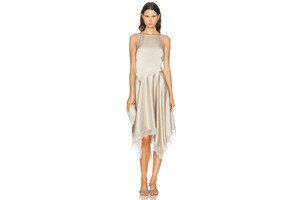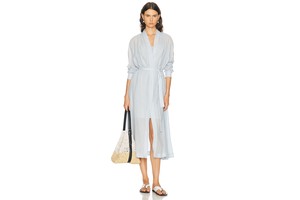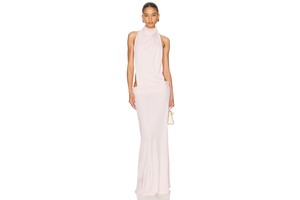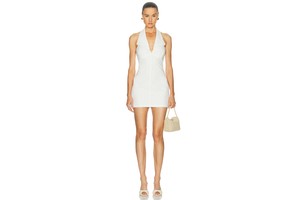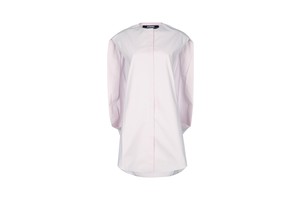
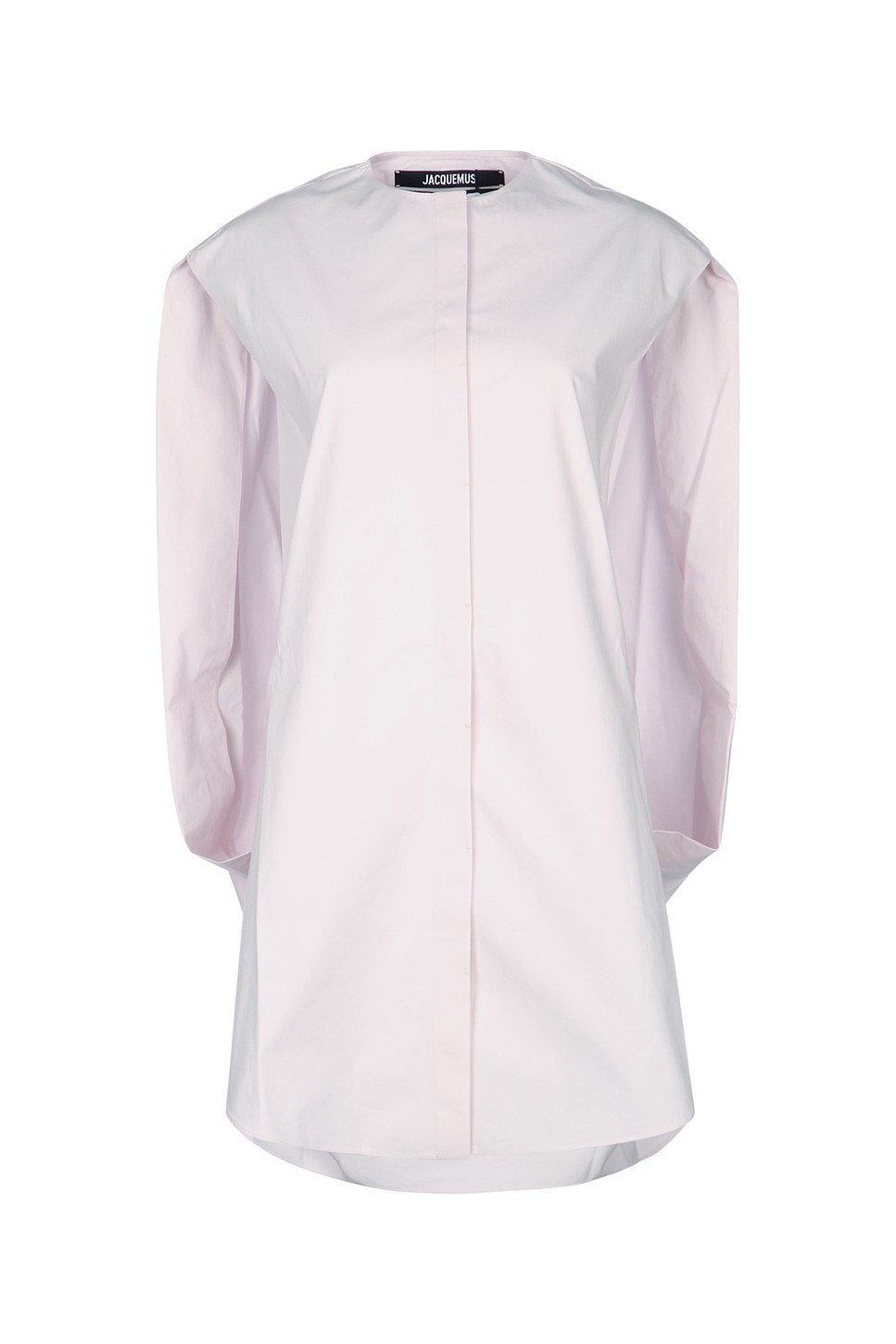
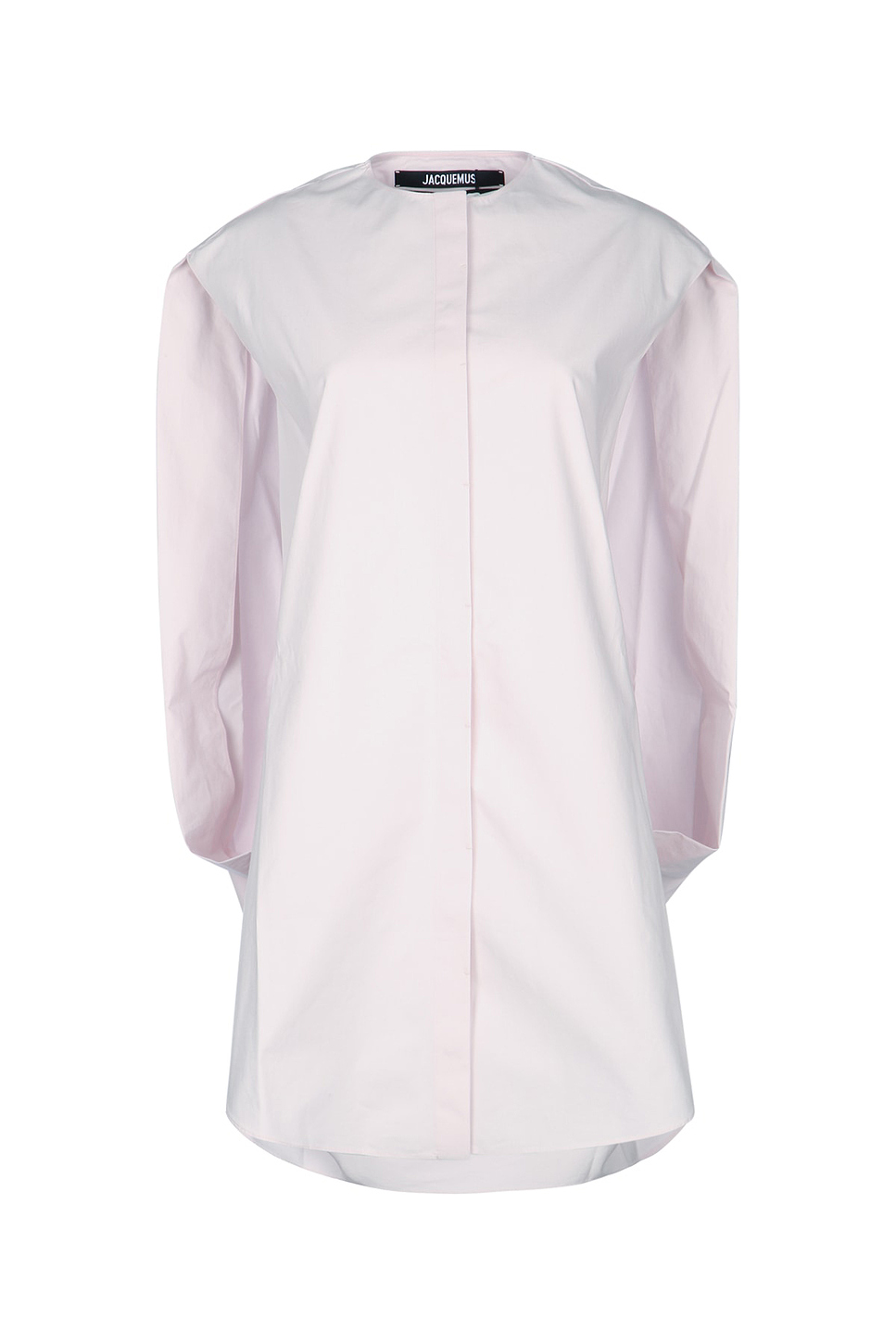
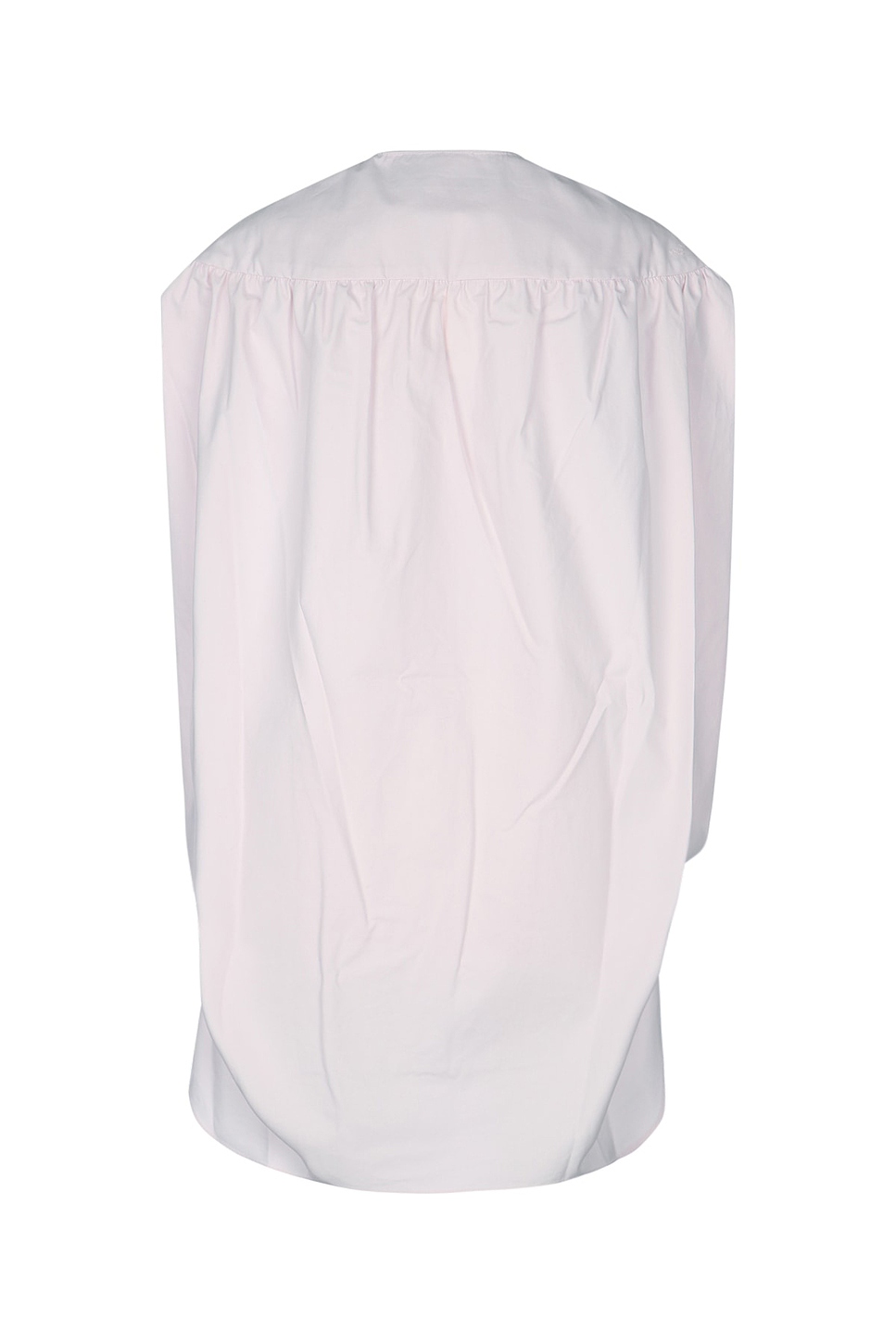

A dress listed with a principal material of 100% cotton, made in Italy, filed by the retailer under mini dresses, at 796 dollars. There are no reviews and no fit votes, so there is no score to quote. The product information amounts to the composition, the country and two stock numbers, with two photographs and three consecutive sizes. The word used to introduce the composition is the one thing here worth dwelling on, because this is the second time this series has met it and the two instances behave in opposite ways. The three consecutive sizes are also the strongest instance yet of a case this series has learned to read carefully. The reference is the Jacquemus La Robe Berlingot in Light Pink. Dongguan Bafinasa Garments Co., Ltd. develops comparable cotton dresses on OEM and ODM terms, from fabric sourcing to retail or FBA ready packing. We publish this as a development reference and build your own version of it, and we do not supply the branded original or reproduce anyone else's label.
Key Features
- Principal material: 100% cotton as stated, and the word itself is worth examining. See the note below
- Second encounter with this particular construction this series has been counting. See the note below
- Made in Italy as stated
- Three consecutive sizes published: 34, 36 and 38, which is the strongest such instance yet
- Filed by the retailer under mini dresses
- Light pink, which raises the opacity question in the absence of any statement about it
- No care instruction stated anywhere on the listing
- No size chart, no measurements and no model figures published
Customisable Options
- Fabric: cotton to the reference, with the weight and weave decided from a tested sample
- Construction: we would specify whether this is poplin, broadcloth or something looser, since that decides opacity
- Opacity: we would state plainly whether there is anything between the wearer and the cloth
- Second layer: we would name it rather than leaving the word principal dangling
- Care: we would add one line, since cotton is the most washable fibre in this series
- Length from mini to knee, weave and weight, size set, colour development, private label and care labelling
Specifications
| Style | Pink cotton mini dress |
| Reference | Jacquemus, La Robe Berlingot, style FEXN-WD1873, manufacturer style DRW00759AW00648 410, colour Light Pink |
| Principal Material | 100% cotton as stated. See the note below on what the word implies |
| Second Layer | Not stated, though the composition is introduced as a principal material |
| Opacity | Not stated anywhere on the listing, which for a light pink is the question most likely to be asked |
| Care | None stated on the listing |
| Sizes Published | 34, 36 and 38, three consecutive sizes. See the note below |
| Measurements | None published. No size chart and no model body figures on this listing |
| Photographs | Two |
| Production | Made in Italy as stated |
| Reference Retail | 796 USD, quoted to show the price band this sits in, not as our price |
| Customer Reviews | None on the reference listing, so we quote no score |
| Best Seller Badge | None. The listing carries no rank |
| Categories | Filed by the retailer under mini dresses, with no second category |
| Occasion | Warm weather, daytime, holidays, casual occasions |
| MOQ | 100 pcs per style per colourway, mixed sizes and colourways accepted |
| Sampling | 7-10 days after tech pack or reference sample confirmation |
| Bulk Lead Time | 20-30 days after sample approval and deposit |
| Service | OEM / ODM / private label, cotton sourcing, lining options, retail or FBA ready packing |
Size Chart
| Size | Bust | Waist | Hips | Length | Source | ||||||||||||
|---|---|---|---|---|---|---|---|---|---|---|---|---|---|---|---|---|---|
| 34 | 31 | in / | 79 | cm | 24 | in / | 61 | cm | 34 | in / | 86 | cm | 85 | cm / | 33.5 | in | Our proposal |
| 36 | 33 | in / | 84 | cm | 26 | in / | 66 | cm | 36 | in / | 91 | cm | 87 | cm / | 34.3 | in | Our proposal |
| 38 | 35 | in / | 89 | cm | 28 | in / | 71 | cm | 38 | in / | 97 | cm | 89 | cm / | 35 | in | Our proposal |
| 40 | 37 | in / | 94 | cm | 30 | in / | 76 | cm | 40 | in / | 102 | cm | 91 | cm / | 35.8 | in | Our proposal |
This listing offers three consecutive sizes, 34, 36 and 38, and publishes no size chart, no measurements and no model body figures. There is nothing on the page from which a customer could judge the fit, and no length figure to compare against the retailer's own mini filing.
Occasions and Styling
Suits warm weather, daytime, holidays and casual occasions. A light pink cotton mini is a warm weather piece, and it is worth knowing before choosing what goes underneath that pale colours show more than dark ones do, and nothing on this page addresses it.
Production and Quality Control
There are no reviews and no fit votes on this listing, so we quote no score. The word introducing the composition has now been met twice and behaves in opposite ways between the two, which makes it more informative than either instance alone. Three consecutive sizes is also the strongest case yet of something this series has learned to read with care.
The second encounter with this word, and the two instances point in opposite directions, and that is the first thing. This series has counted nine occurrences of this relative way of giving a composition, and the spellings have varied throughout: the word for shell, then this same word meaning principal, then the same idea appearing in Portuguese, and most recently the English word exterior carrying a stray full stop. The idea has never changed. Anything introduced as one part relative to some other invites the question of what that other is, and until recently the answer never came. Then something shifted, and two successive listings actually named the other layer, first a pair of gowns whose second layer was polyester against a face combining silk with viscose, then another whose viscose lining sat against almost ninety per cent wool, and this series credited both while noting that receiving the number also revealed how far apart the two layers were. The word now appears again, and on its own it tells nothing about whether anything follows, which is precisely why comparing the two instances is more useful than examining either. On that earlier garment the same single field carried three compositions one after another: the main cloth at sixty five viscose to thirty five silk, a contrast cloth at fifty five viscose to forty five silk, and then a lining of one hundred per cent polyester. So the word was the opening move of a full account, and everything it implied was delivered. Here one hundred per cent cotton arrives and the field ends. The word did its inviting and nothing came. That is the useful observation and it is worth stating as a principle, since it turns into something a customer can apply: this construction is a promise about structure rather than information about it. It says the garment has an inside without saying what that inside is, so the correct response is to treat it as a question the listing has raised and declined to answer, rather than as either a disclosure or evidence of simplicity. What follows from that here is unusually mild, and this series would rather say so than inflate it. Cotton is the most washable fibre encountered across this whole series. It takes water without complaint, it is stronger wet than dry, and unlike wool it does not felt, unlike viscose it does not lose half its strength, and unlike silk it does not spot permanently. Because of that, whatever the unnamed second layer happens to be, the hard direction of the mismatch is likely to run the other way: the cotton will hold and whatever lines it will be what sets the limit. This series has said repeatedly that the danger of an unnamed layer is two layers responding differently to water and ending up puckering along every seam or bubbling loose inside, a logic that was severe on those two gowns and severe again on the near solid wool garment. Against cotton it is considerably less alarming. So the missing second layer matters less here than anywhere this construction has appeared, and it is fair to record that.
Three consecutive sizes, the strongest instance yet, and it still leaves the interesting question open, and that is the second thing. Thirty four, thirty six and thirty eight are three consecutive sizes, and this series established some while ago how to read short runs: a consecutive run signals deliberate narrowness needing some mechanism on the garment to make it work, whereas a run with a size missing from the middle is not a range but simply what is left. That was then sharpened by comparing three short runs from one source at once, with the conclusion that consecutive runs of two prove little, since clearing stock easily leaves two adjacent sizes, whereas three or more in sequence are hard to explain by accident. This is the strongest such case yet met, and it is worth saying why, since the reason is not merely that there are three. Two adjacent listings in recent batches each offered exactly two sizes, and in both it was noted that clearing stock leaves two adjacent sizes quite readily, so nothing could be concluded. Three consecutive is different in kind, and the arithmetic is straightforward: any process removing sizes at random rarely leaves three in sequence, so a deliberate decision somewhere along the way is the likelier explanation. Now the question this series asks in every such case, which is what mechanism could let one garment serve this range. Four have been catalogued over many listings: knit structure, since loops open; elastane at levels high enough to compress rather than merely recover; cutting on the bias, though that works along one direction rather than uniformly; and shirring, where gathered elastic thread draws cloth in and releases it. None is available here. There is no elastane in this composition at all, no knit is stated, no shirring is described, and bias alone would not explain three sizes. What remains is cotton, and it deserves a fair hearing rather than a dismissal. Cotton does soften and relax with wear, so a cotton garment does give slightly over the first hours, and unlike a synthetic it does not spring back. That is real, but it is small and importantly it is not recoverable, so it would not make a size 34 comfortable on somebody needing a 38. The honest conclusion is that this looks like a deliberate narrow run for a garment cut to a specific proportion, and the missing piece is not the decision but any ability to act on it, since there are no measurements and no model anywhere on the page. It is worth adding the contrasting detail that makes the case more interesting: within the same retailer, listings offering three sizes have appeared alongside listings offering one, and this batch contains both a three size garment costing 796 dollars and another costing nearly five times as much offering a single figure. If the number of sizes were decided by how the garment was positioned, that inversion would be surprising. If it is decided by what arrived, it is what we would expect.
Two smaller observations, one about a name that may not be readable by everyone looking at it and one about colour, and that is the third thing. The first concerns the product name, which is French. This series has met this before, when a French product title was found to contain the word for knit, so that only a reader of French could discover the garment's construction, and it was observed then that this is information available to some customers and not others depending on language rather than on anything they had done. Here the name translates roughly as the berlingot dress, berlingot being a particular boiled sweet sold in a tapered or faceted shape. So unlike that earlier instance, this name does not conceal a construction: it is a reference to a silhouette, and it tells an English reader very little either way. That is worth noting in its own right, because together the two instances establish something useful. A name in another language may conceal something decisive or may conceal nothing, and the customer has no way to tell which, since she cannot read it. So the general point stands and is slightly stronger than before: anything placed in a product name is available only to whoever can read that language, and there is no way to know in advance whether what is being missed mattered. The second observation concerns colour. This garment is light pink, and whether light passes through a cloth cannot be judged from photographs taken under lighting arranged to make the garment look its best, so the customer cannot see it and must either ask or guess. This series recently drew that principle sharply by comparing colours directly and observing that a deep berry gown was genuinely less at risk than pale counterparts precisely because deeper dye absorbs more light. Light pink sits toward the difficult end of that scale, having been met here before in white cotton, where it was noted that white reflects rather than absorbs and therefore shows what is under it more readily than any other colour. There is one further complication on this particular page worth adding, because it changes what resources the customer has. On each of those white garments the fabric was named as poplin, and this series pointed out then that poplin is a plain weave with fine warp yarns packed closely against heavier weft yarns, giving a dense cloth, and that higher density transmits less light than a looser weave of the same fibre and weight. Nothing here names the weave at all. It says cotton and stops, so the one piece of reassurance those other pages supplied by accident is absent from this one, and apart from the composition and the country there is nothing else on the page. Every bulk shipment gets a measurement report against your approved chart.
Optional upgrades include naming the second layer or dropping the word that implies one, since a principal without its counterpart is a question rather than an answer, stating the weave and the weight, since those decide opacity and the page currently offers nothing else to reason from, adding a statement about opacity outright given what a pale colour asks, adding a care instruction even though the correct answer for cotton is permissive, offering measurements or model figures so the three sizes can be acted on at all, more than three sizes offered if the range is deliberate, the length published so the retailer's own mini filing can be checked, private label, hangtag and care labelling.
Pre-production sample approval, in-line inspection during cutting and sewing, and a final AQL inspection before packing, with measurement reports and photos shared before shipment.
Send us your tech pack, a photo or a reference garment and we will quote within 24 hours. Contact bafinasa@bafinasa.com or WhatsApp +86 13827222469.