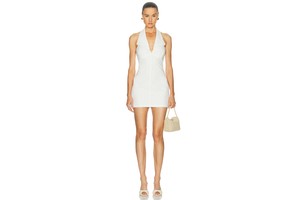
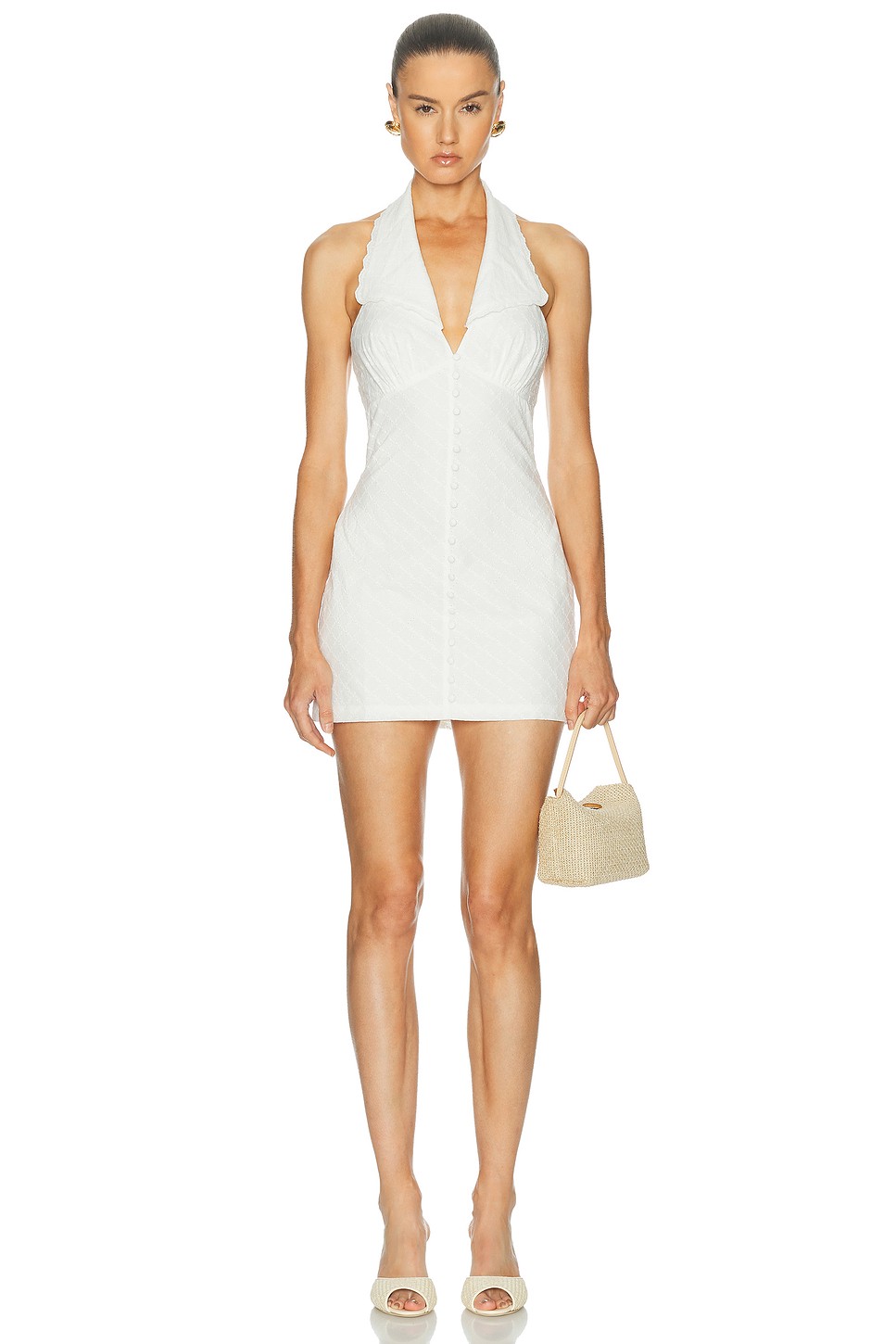
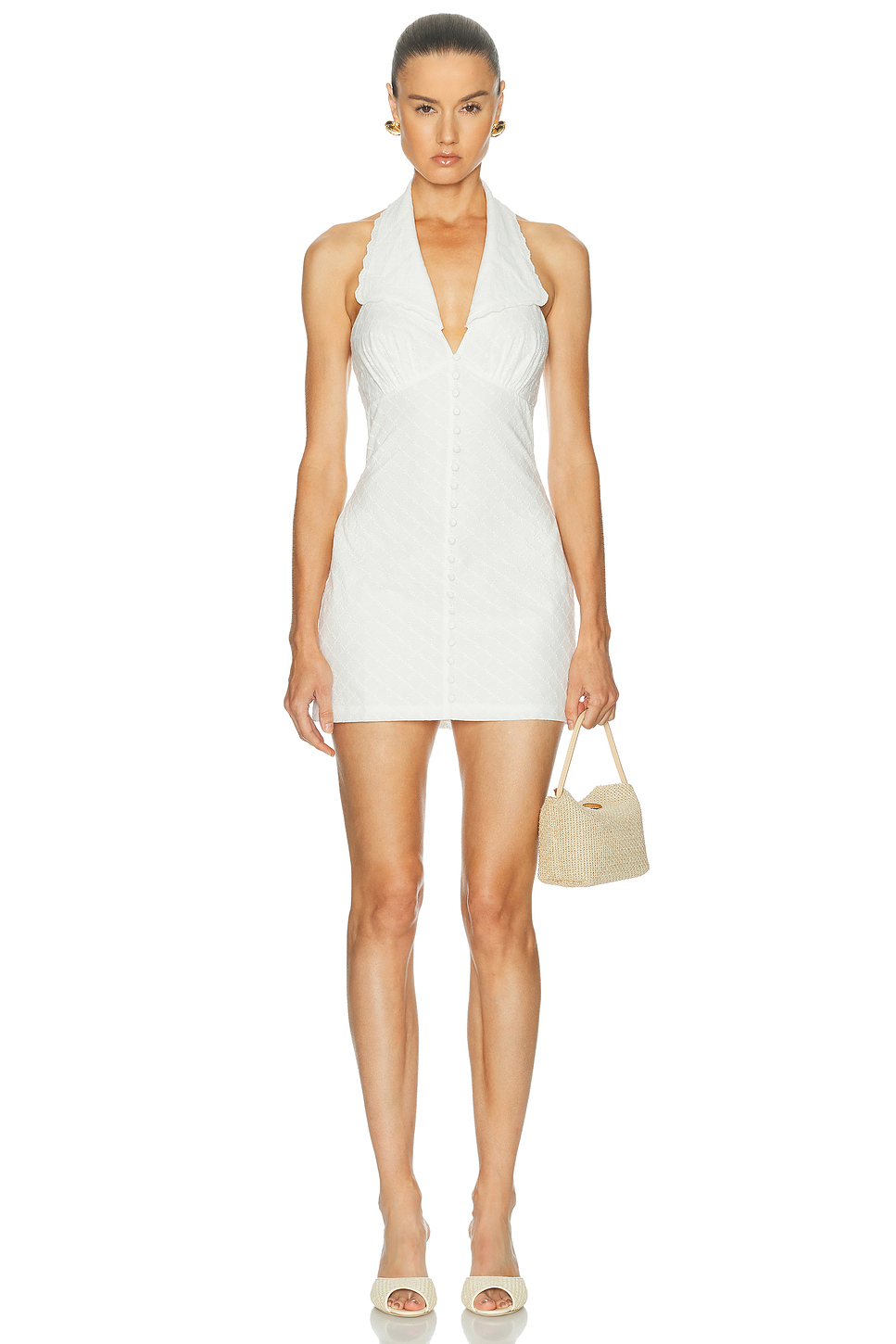
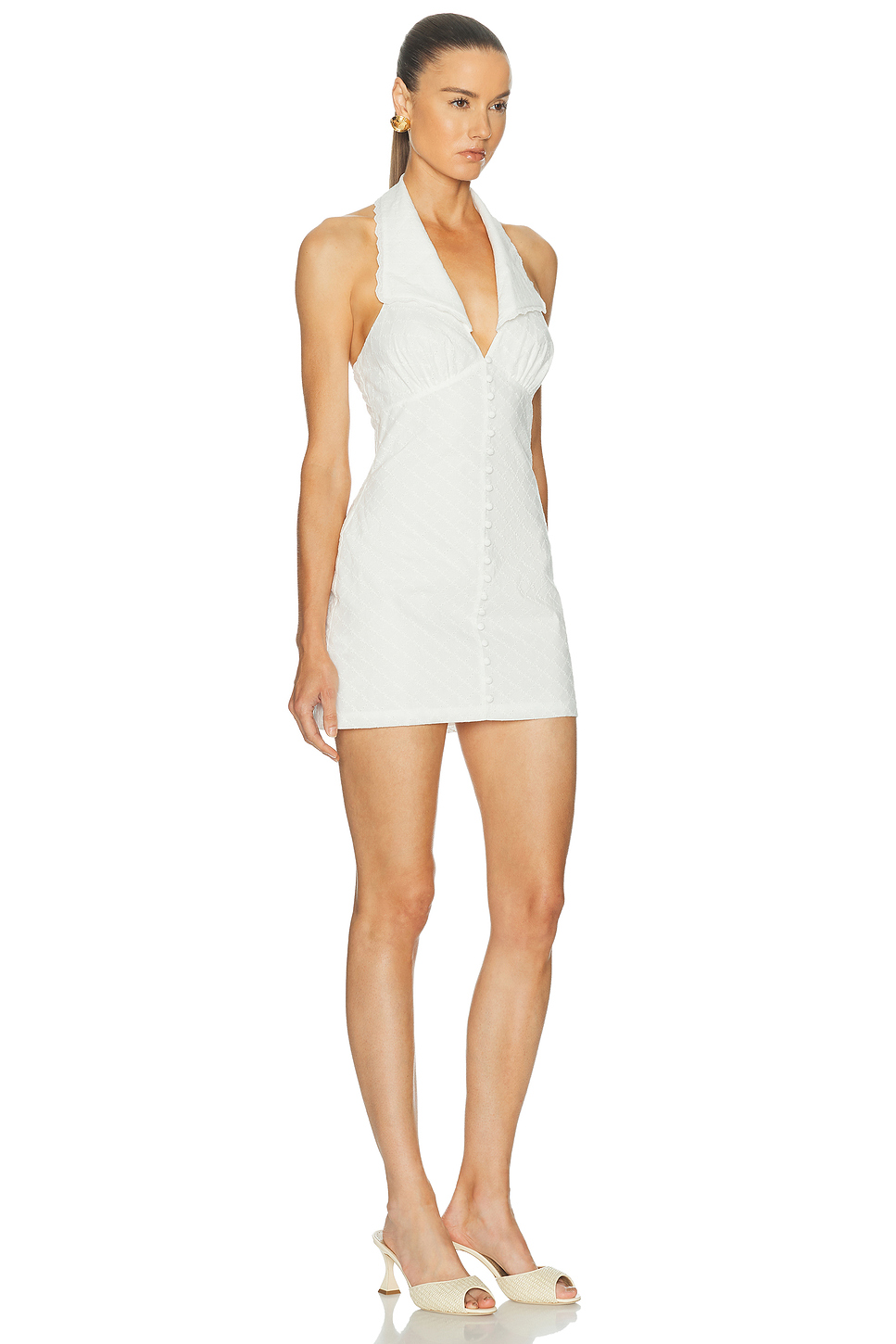
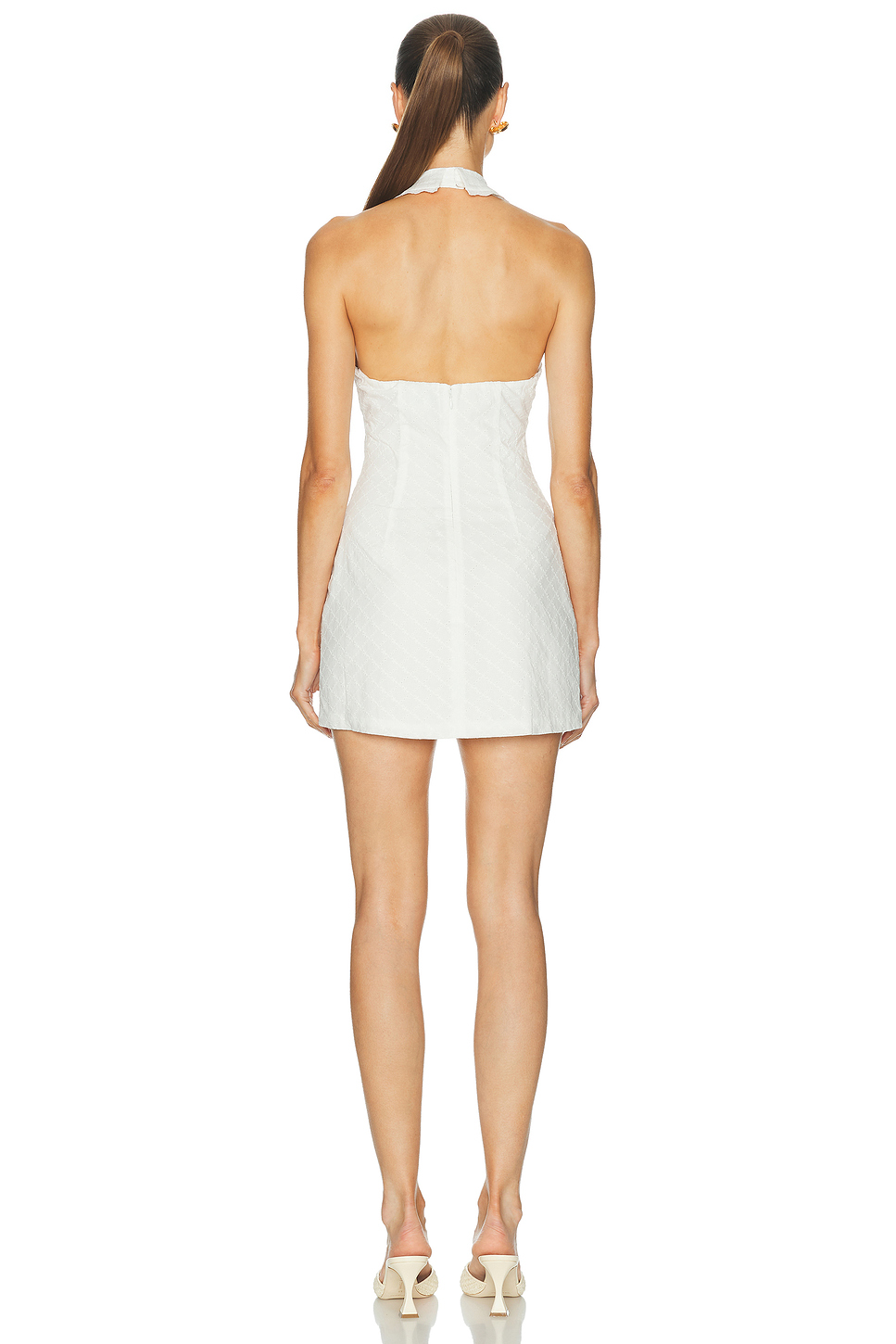
A mini dress listed as 100% cotton in a mid-weight eyelet cloth with lace trim, fully lined, with a boned bodice, halter ties and hook-and-eye closures at the neck, and a hidden zip at the back, dry clean only, made in China, ranked seventh in the retailer's white dress list, at 595 dollars. There are no reviews and no fit votes, so there is no score to quote. One hundred per cent cotton with the strictest instruction available is not a contradiction and examining it demonstrates something this series established early and has used ever since. The eyelet is also the same thing under a different name as something examined recently, and finding both names is more useful than finding either. And this is the third boned bodice here, completing a sequence none of the listings themselves could have revealed. The reference is the Eyelet Mini Dress by Mirror Palais in White. Dongguan Bafinasa Garments Co., Ltd. develops comparable eyelet dresses on OEM and ODM terms, from fabric sourcing and boning to retail or FBA ready packing. We publish this as a development reference and build your own version of it, and we do not supply the branded original or reproduce anyone else's label.
Key Features
- 100% cotton as stated, with dry clean only as stated, and those two together are the point. See the note below
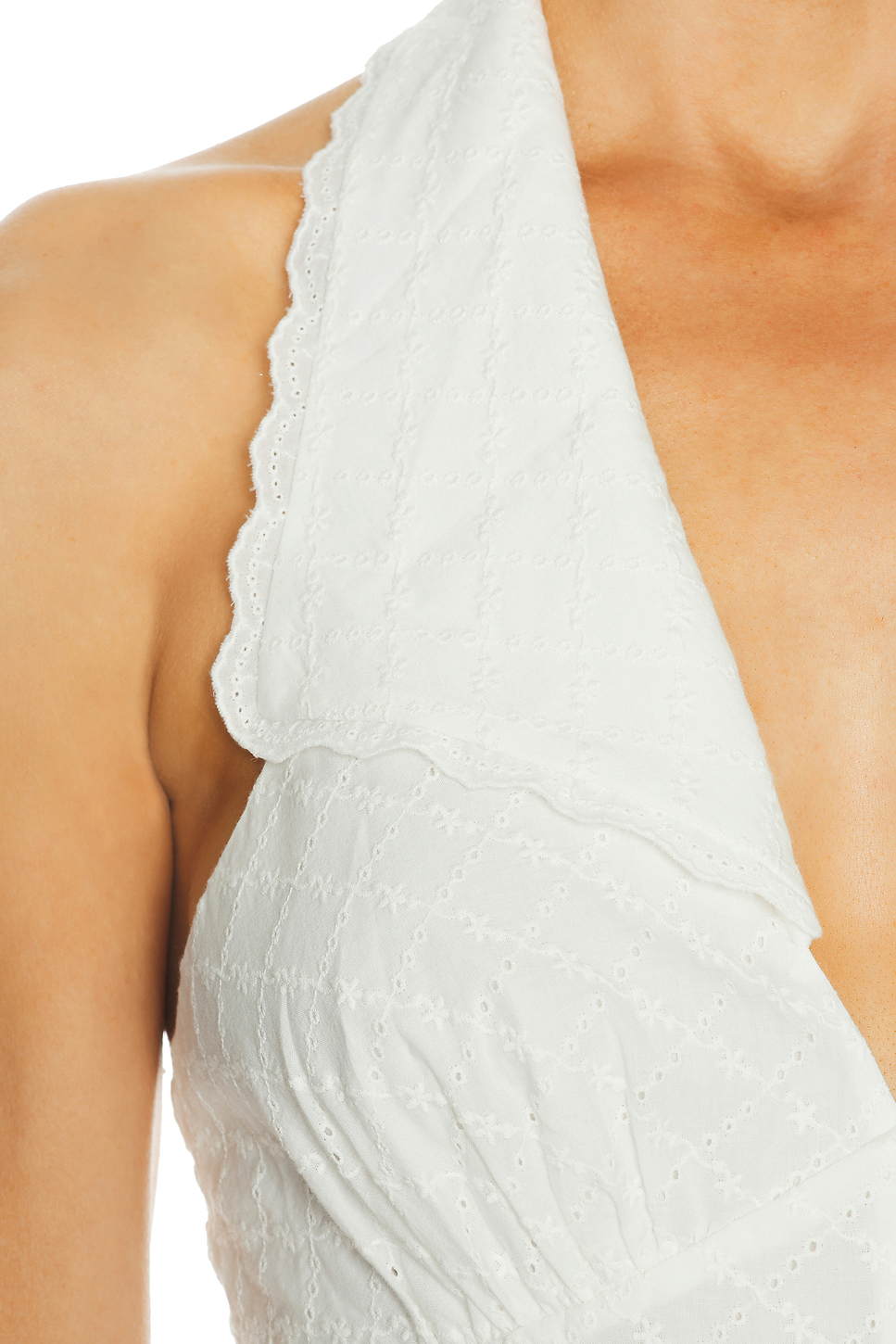
- Mid-weight eyelet fabric with lace trim as stated, and eyelet is the other name for something met recently. See the note below
- Fully lined as stated, which answers the question eyelet raises before anybody asks it
- Structured boned bodice design as stated, which is the third here and completes a sequence. See the note below
- Halter ties with hook-and-eye closures at the neck as stated
- Hidden zip at the back as stated
- There are four separate candidates for what the instruction is protecting. See the note below
- Measurements published for one size, including bust 28 in and length 31 in
Customisable Options
- Fabric: cotton eyelet to the reference, with the ground cloth and embroidery both specified
- Boning: structured bodice to the reference, and we would specify what the bones are made of
- Lining: we would name the lining fibre, since it is currently stated only as being there
- Neck: halter ties and hook-and-eye to the reference, with hardware chosen against the chosen care method
- Length from mini to knee, eyelet pattern, boning layout, lining options, size set, colour development, private label and care labelling
Specifications
| Style | Eyelet boned mini dress |
| Reference | Mirror Palais, Eyelet Mini Dress, style MRPF-WD61, manufacturer style MP2592, colour White |
| Composition | 100% cotton as stated |
| Fabric | Mid-weight eyelet with lace trim as stated. See the note below, since this is the other name for something met recently |
| Lining | Fully lined as stated, with the lining fibre not named. See the note below |
| Bodice | Structured boned design as stated. See the note below, since this is the third here |
| Neck | Halter ties with hook-and-eye closures as stated |
| Closure | Hidden zip at the back as stated |
| Care | Dry clean only as stated. See the note below, since there are four candidates for what it protects |
| Sizes Published | XS, S, M and L |
| Measurements Published | S: bust 28 in, waist 26 in, hips 36 in, length 31 in |
| Chart Note | The bust sits about six inches under the model. See the note below |
| Coverage | Only size S has figures. XS, M and L are blank |
| Model | 179 cm, wearing size S, bust 86 cm, waist 61 cm, hips 86 cm |
| Production | Made in China as stated |
| Reference Retail | 595 USD, quoted to show the price band this sits in, not as our price |
| Customer Reviews | None on the reference listing, so we quote no score |
| Best Seller Badge | Rank 7 in the retailer's white dress list, which is a high position |
| Categories | Filed by the retailer under mini dresses and bodycon dresses, which explains the measurement pattern |
| Occasion | Warm weather, holidays, daytime occasions, celebrations |
| MOQ | 100 pcs per style per colourway, mixed sizes and colourways accepted |
| Sampling | 7-10 days after tech pack or reference sample confirmation |
| Bulk Lead Time | 20-30 days after sample approval and deposit |
| Service | OEM / ODM / private label, eyelet sourcing, boning and corsetry, lining, retail or FBA ready packing |
Size Chart
| Size | Bust | Waist | Hips | Length | Source | ||||||||||||
|---|---|---|---|---|---|---|---|---|---|---|---|---|---|---|---|---|---|
| S | 28 | in | 26 | in | 36 | in | 31 | in / | 79 | cm | As published | ||||||
| XS | 31 | in / | 79 | cm | 24 | in / | 61 | cm | 34 | in / | 86 | cm | 79 | cm / | 31.1 | in | Our proposal |
| S | 33 | in / | 84 | cm | 26 | in / | 66 | cm | 36 | in / | 91 | cm | 81 | cm / | 31.9 | in | Our proposal |
| M | 35 | in / | 89 | cm | 28 | in / | 71 | cm | 38 | in / | 97 | cm | 83 | cm / | 32.7 | in | Our proposal |
| L | 37 | in / | 94 | cm | 30 | in / | 76 | cm | 40 | in / | 102 | cm | 85 | cm / | 33.5 | in | Our proposal |
The published size S gives a 28 inch bust, a 26 inch waist, a 36 inch hip and a 31 inch length against a model at roughly 34, 24 and 34. The bust sits about six inches under her while the others sit at or above, and here there are three things combining to explain that.
Occasions and Styling
Suits warm weather, holidays, daytime occasions and celebrations. A white cotton eyelet mini is a warm weather piece, and it is worth knowing that eyelet is one of the few open structures that is genuinely comfortable in heat, since the holes are what ventilate it, though being fully lined changes that somewhat.
Production and Quality Control
There are no reviews and no fit votes on this listing, so we quote no score. The most washable fibre in this series carrying the strictest instruction is not a contradiction, and working through why demonstrates something established early and used ever since. The eyelet also has two names, and this is the second one found.
Eyelet is the same thing under another name, and finding both is more useful than finding either, and that is the first thing. This series examined a garment recently whose name contained three French words, broderie anglaise, and made a particular observation about them, which was that those words carry more information than other instances of this pattern because they mean openwork, and meaning openwork means the garment is sheer in places, for reasons worth restating since they are the whole point. The holes are deliberately introduced, they are evenly distributed rather than clustered, and they go all the way through rather than being merely raised texture, which together mean light passes wherever there is a hole and not wherever there is cloth. This garment is described, in English, as eyelet. That is the same construction named in the other language, broderie anglaise being the French for English embroidery, and the two denote an embroidered fabric in which the motif is formed largely by holes with stitched edges. Finding both names is worth more than finding one, and there is a specific reason rather than merely a tidiness to it. This series has several times recorded the reverse phenomenon, where the same thing is called two names so that the connection is invisible: a fibre appearing variously as viscose and as rayon and under several translated forms, a garment category variously as knit and as jersey, and most relevantly here a relative composition word changing spelling four times while meaning always the same thing. If a customer has learned that broderie anglaise means sheerness, nothing in the word eyelet tells her she has met it again, and somebody who would have avoided one will buy the other. That asymmetry is the general point and it runs in one direction only: knowing one name does not grant knowledge of the other, so the more names there are for a thing, the less likely any customer is to recognise it twice. What is unusual and commendable here is what the page does next. It states that the garment is fully lined. This series said of the broderie anglaise garment that because the holes are the entire point of the fabric, a lining is not a refinement but the thing making the garment wearable at all, and required rather than optional. That prediction has now been met exactly, since a fully lined eyelet garment is precisely that argument acted on. It is also worth contrasting this with how the same question has been handled elsewhere, since two methods have been catalogued and this is neither. Several garments have stated their transparency outright, three of them in an identical sentence from unrelated makers, including that undergarments are not included. One was found disclosed only through being filed among sheer dresses, which was noted to be weaker because it depended on whether the customer ever saw that label. This page takes the third route, which is solving it rather than merely describing it, and that is better than either, because knowing a garment is sheer is not the same as being able to do anything about it. There is one omission worth naming. The lining is stated to exist but its fibre is not named, and this series has said throughout that layers should be in the same fibre so that they stay in proportion afterwards, having recently seen how bad the mismatch can be when it is wide.
One hundred per cent cotton and dry clean only, and there are four separate candidates here, and that is the second thing. This series established early on and has used constantly since that a care instruction is set by the most fragile component rather than by the predominant fibre, demonstrated first on a cotton twill which needed dry cleaning because of applied decoration despite cotton being among the most washable fibres there is. Cotton makes the point better than any other fibre could, because it genuinely is the most washable here: it takes water without complaint, it is stronger wet than dry, it does not felt the way wool does, it does not lose half its strength the way viscose does, and it does not spot permanently the way silk does. So every cause of this instruction is a cause other than the fibre, and unusually there are four legitimate candidates on this one garment, each of which would justify it alone. The first is the eyelet itself. This series has noted before about another open construction, lace, that it is not a solid cloth with warp and weft locked into each other but a structure held in shape by its own geometry, so agitation makes threads catch on one another in ways that cannot be undone. Eyelet is that argument in a stiffer form, since each hole is a raw edge stitched to stop it fraying, and there are hundreds of them, so there are hundreds of places where a caught thread starts something. The second is the boning, and this is the first time this series has identified it as a candidate, which makes it worth explaining. Rigid bones sit in channels, and if the garment gets wet the bones are affected while the cloth around them is affected differently, since a wet cotton contracts slightly while a steel bone does not, producing either a ridge showing through the front or a bone pushing through the end of its channel, and once the shape of a bone has been bent it stays bent. Nothing about that is recoverable. The third is the hardware, since the neck has hook-and-eye closures, and this series examined named hardware recently on a ponte dress and described what goes wrong with plated metal: it tarnishes or oxidises when it meets water and soap and is not dried promptly and thoroughly, and once a metallic surface has lost its brightness nothing restores it. Wire hooks are small and thin and sit against skin, which makes them neither quick to dry nor easy to dry well. The fourth is the lace trim, since any applied trim brings threads that are not the ground fabric's fibre, and this series noted early on that such additions are what drive the instruction even when the base cloth is perfectly washable. Now, how this compares is worth saying, because it is the reason this one is the best illustration yet. Four or five synthetic garments have been examined carrying strict instructions where no candidate could be found at all, which led to the conclusion that habit at the level of the brand was the likelier driver than judgement about the garment. Here there are four, so the instruction is plainly considered rather than habitual. There is a caveat this series would rather state than gloss, and it is that the listing does not say which of these four it is protecting. It gives the instruction and nothing else, so a customer knows to keep water away but not what she is keeping it away for, and therefore not which parts need particular care. Ranked seventh in the retailer's white dress list, this page has done more than most and still has one sentence left to write.
The third boned bodice, and the sequence completes itself, with a note on six inches of negative ease, and that is the third thing. This series met its first boned bodice some batches ago, then a second from the same maker, and comparing them produced something neither page could show alone, because both stated boning while only the numbers distinguished them. The first had elastane around nineteen per cent, which is enough genuinely to compress a body, so its boning was reinforcing work the cloth already did, whereas the second had five per cent, which this series has consistently treated as a recovery additive rather than something a fit can rest on, so there the boning was doing the primary holding rather than helping. That comparison established something generally useful, which is that a stated construction does not tell you how much work it is doing, and that two garments describing themselves identically can be relying on it very differently. This is the third, from yet another maker, and it contains no elastane at all. So the sequence runs nineteen, five, zero, and the third completes it rather than merely extending it, because zero is the endpoint of the line rather than another point on it. With no elastane there is nothing in this cloth that grips or compresses, so nothing can slip or fatigue gradually; either the bones hold the garment up or it falls, which makes this the purest case of the three and the one where reading the word boned at face value would be most nearly correct. It is also the one where failure is least graceful, and that is worth saying plainly, because it extends what the earlier comparison established: the less the surrounding cloth contributes, the more abruptly consequences arrive. There are two additions specific to this garment worth making. First, the page also describes the closures at the neck, since there are halter ties with hook-and-eye components, and a tie is adjustable in a way nothing on the other two garments was, which means this bodice can be drawn tighter or looser rather than sitting at one fixed circumference. Second, the measurement pattern confirms all of the above independently. The published bust is twenty eight inches against a model at roughly thirty four, so there are about six inches of negative ease, while the waist and hip sit at or above her. This series established some time ago how to read that shape: when the bust sits below the body while adjacent measurements sit at or above, ask first whether the garment is strapless, halter or sleeveless, since each removes or weakens the landmarks a bust measurement depends on. This is a halter, so the rule engages immediately, and with no elastane compression cannot be the explanation. What resolves it here is that there are mechanisms beyond those the rule usually reaches, and this series has been collecting them for many batches: knit structure, since loops open; elastane high enough to compress; cutting on the bias, though that works along one direction rather than uniformly; and shirring, where gathered elastic thread draws cloth in and releases it. None of those four is available, but there is a fifth this series has not previously had occasion to set down, which is a bodice boned and then drawn closed. Boning holds the shape from within while ties and closures pull the circumference down to the body, and unlike knit or elastane neither depends on anything stretching, so the ease figures can be genuinely six inches under with no recovery involved. It is worth noting how much more information sits behind this page than behind the others considered recently, since it publishes measurements, model figures, its construction, whether it is lined, how it closes, what the fabric is and what to do about it. Each of those could have been taken alone and none would have yielded much. Together they let three separate lines of reasoning converge on the same conclusion, which is the practical argument for why disclosing things matters rather than merely being nice. Every bulk shipment gets a measurement report against your approved chart.
Optional upgrades include naming the lining fibre, since it is currently stated only as being there and layers belong in the same fibre, saying which part of the garment the care instruction is protecting, since there are four candidates and that decides what needs particular care, specifying what the bones are made of, since steel bends permanently and synthetics do better with water, testing the hook-and-eye plating against whatever care method is chosen, publishing measurements for the remaining three sizes, keeping the eyelet disclosed in words rather than relying on customers knowing that eyelet and broderie anglaise are the same construction, alternative eyelet patterns since the pattern decides how much is open, alternative boning layouts, additional sizes, colour development, private label, hangtag and care labelling.
Pre-production sample approval, in-line inspection during cutting and sewing, and a final AQL inspection before packing, with measurement reports and photos shared before shipment.
Send us your tech pack, a photo or a reference garment and we will quote within 24 hours. Contact bafinasa@bafinasa.com or WhatsApp +86 13827222469.