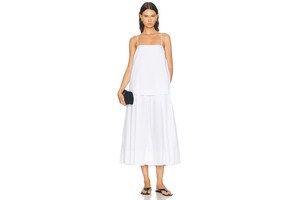
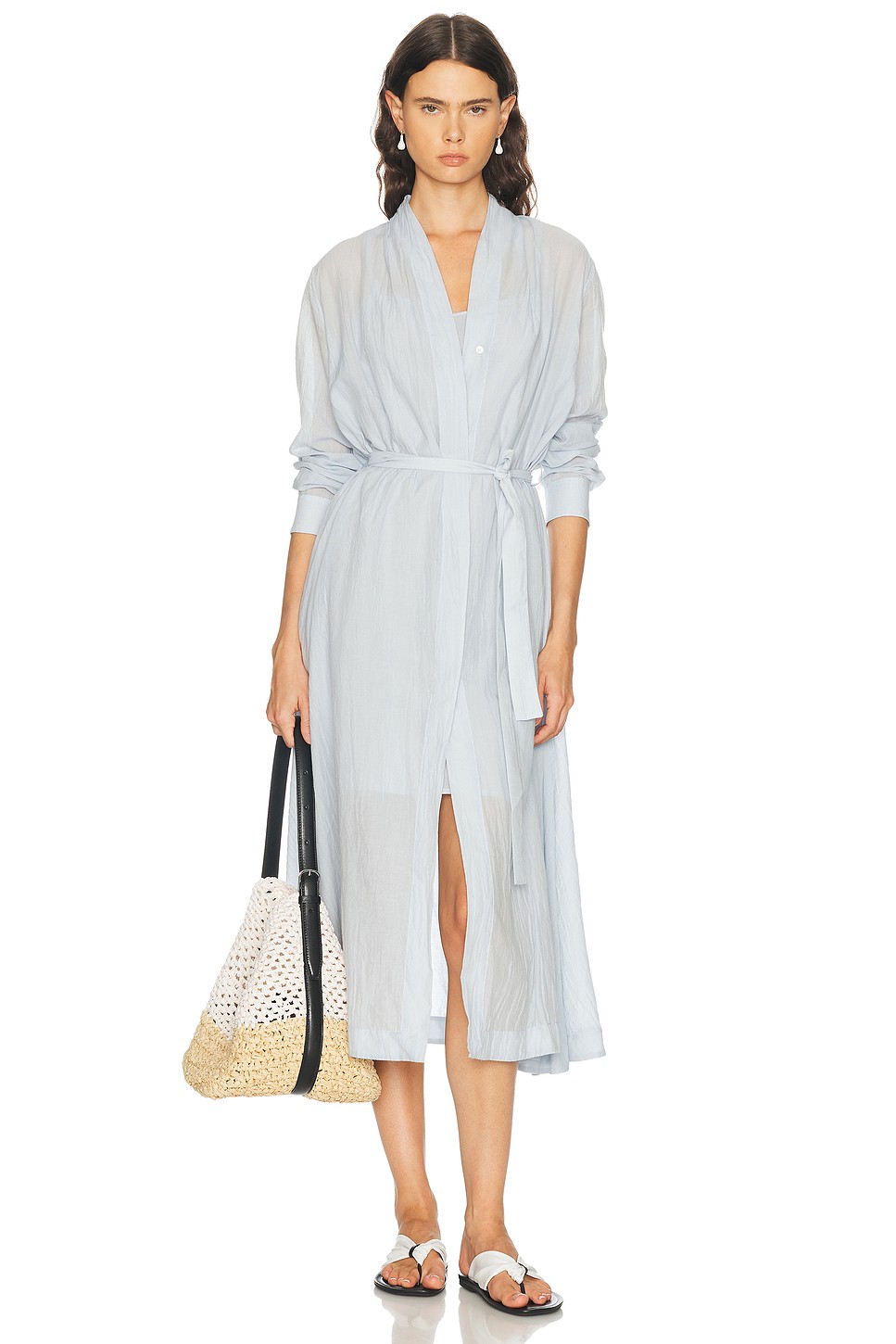
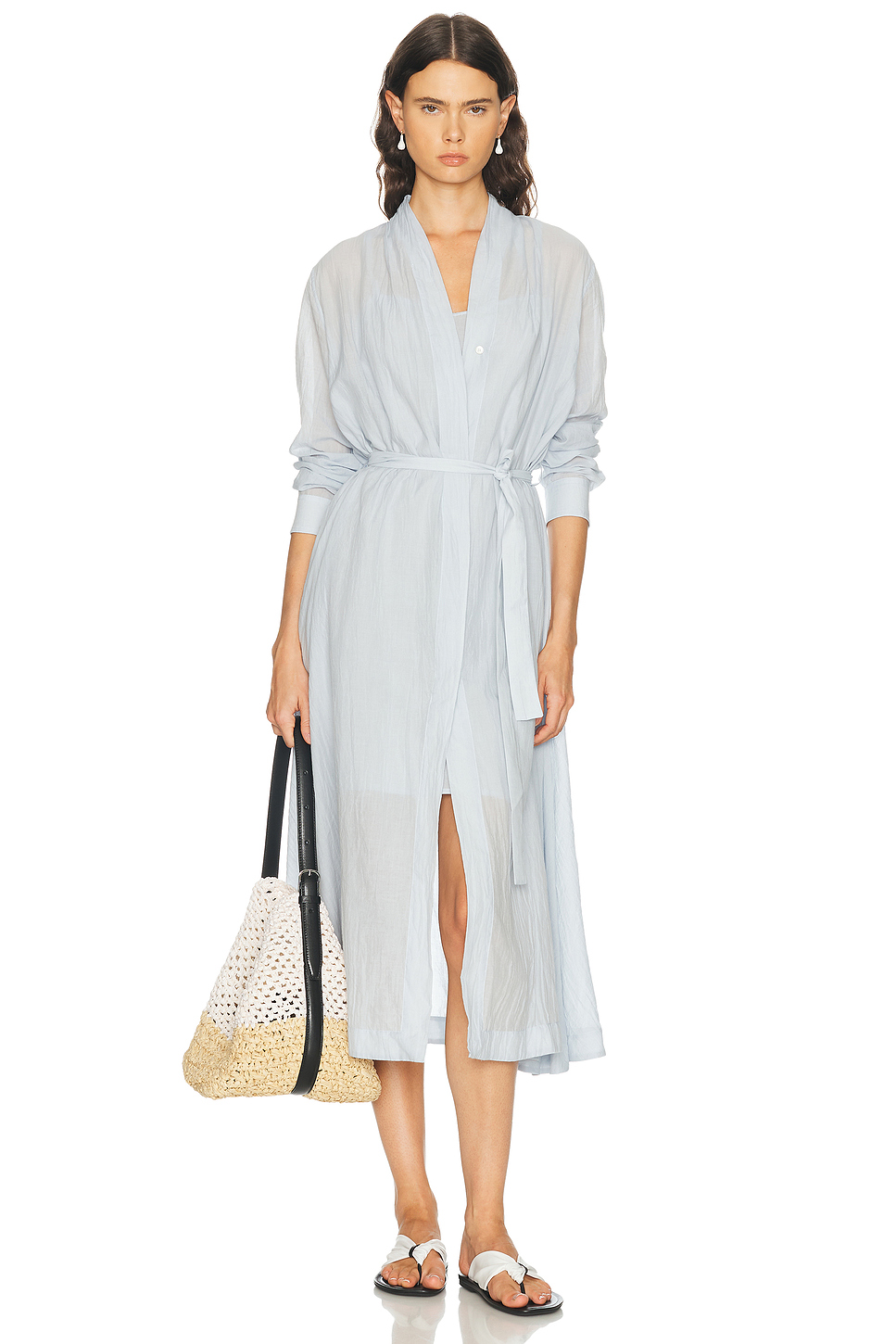
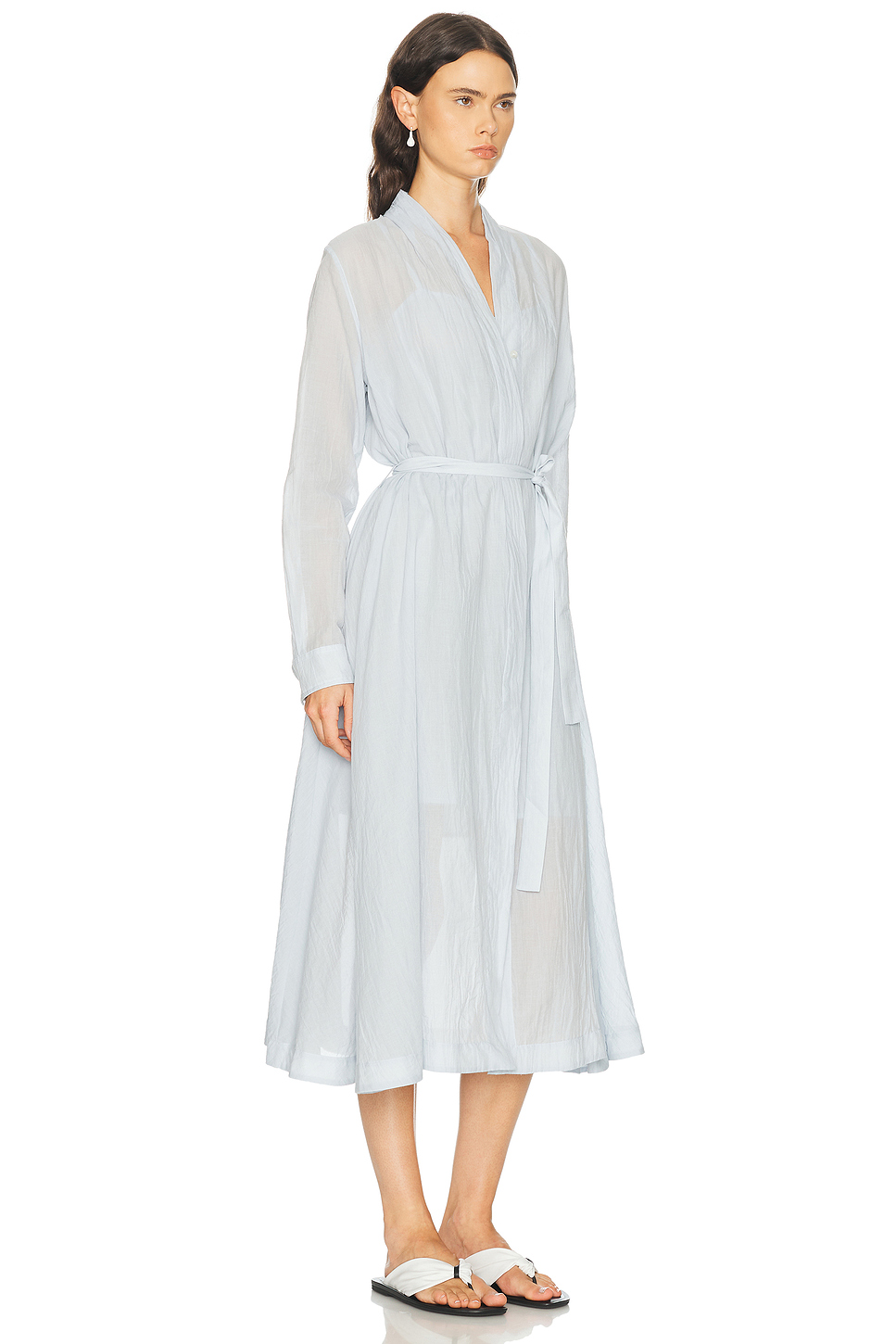
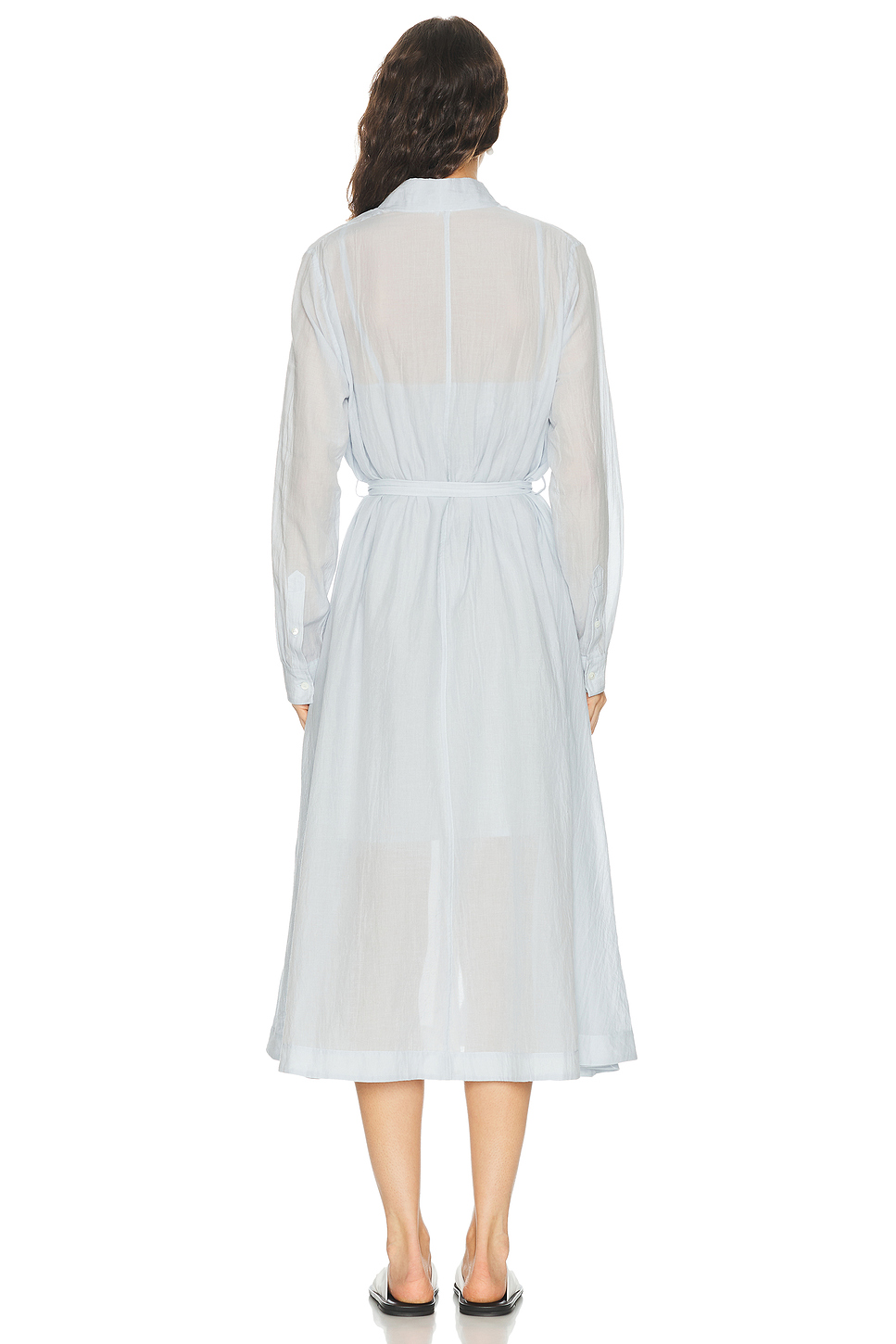

A midi dress listed with fabric and lining both given as 100% organic cotton, dry clean only, fully lined with a detachable lining, front button closure, waist tie included, in a mid-weight voile, made in Portugal, at 1,040 dollars. There are no reviews and no fit votes, so there is no score to quote. The composition field here is the first this series has found that accounts for both layers in one line, and the two turn out to match each other exactly, which is an outcome sought since early on and not previously observed. There is also a word in the fabric name doing more work than it appears to, and a set of measurements explaining why this garment comes with a belt. The reference is the Belted Cotton Voile Dress by Toteme in Sky. Dongguan Bafinasa Garments Co., Ltd. develops comparable voile dresses on OEM and ODM terms, from fabric sourcing and lining to retail or FBA ready packing. We publish this as a development reference and build your own version of it, and we do not supply the branded original or reproduce anyone else's label.
Key Features
- Fabric and lining both stated as 100% organic cotton in one field. See the note below, since this is the first complete match
- Fully lined with a detachable lining as stated, and detachable introduces something new. See the note below
- Dry clean only as stated, despite cotton being the most washable fibre here
- Voile, named outright, and the name carries something. See the note below
- Front button closure as stated
- Waist tie included as stated, and the measurements show why. See the note below
- Mid-weight stated, which is one more piece than most give
- Made in Portugal as stated
Customisable Options
- Fabric: cotton voile to the reference, with weight specified rather than left to be inferred
- Lining: we would offer lining and detachable lining options, and name the lining fibre as this page does
- Care: we would test rather than inherit the instruction, and say what it protects
- Organic cotton available on request, with documentation, though we note it does not change any technical decision
- Length from midi to maxi, voile weight, lining options, belt options, size set, colour development, private label and care labelling
Specifications
| Style | Belted cotton voile midi dress |
| Reference | Toteme, Belted Cotton Voile Dress, style TOTF-WD129, manufacturer style 263-WRD0355-FB0668-206, colour Sky |
| Fabric and Lining | 100% organic cotton, both stated in one field. See the note below, since this is the first complete match |
| Fabric | Mid-weight voile as stated. See the note below on what the name carries |
| Lining | Fully lined, with a detachable lining as stated. See the note below |
| Care | Dry clean only as stated. See the note below |
| Closure | Front button closure as stated |
| Waist | Waist tie included as stated. See the note below on why that follows from the measurements |
| Sizes Published | 32, 34, 36 and 38, four consecutive sizes |
| Measurements Published | 36: bust 46 in, waist 52 in, hips 66 in, length 48 in, sleeve 25.5 in. See the note below |
| Chart Note | Every measurement sits far above the model, and the waist tie explains it. See the note below |
| Coverage | Only size 36 has figures. Sizes 32, 34 and 38 are blank |
| Model | 182 cm, bust 86 cm, waist 58 cm, hips 91 cm, wearing size 36 |
| Production | Made in Portugal as stated |
| Reference Retail | 1,040 USD, quoted to show the price band this sits in, not as our price |
| Customer Reviews | None on the reference listing, so we quote no score |
| Best Seller Badge | None. The listing carries no rank |
| Categories | Filed by the retailer under midi dresses and long sleeve dresses, both consistent with what is published here |
| Occasion | Warm weather, resort, daytime occasions, professional settings |
| MOQ | 100 pcs per style per colourway, mixed sizes and colourways accepted |
| Sampling | 7-10 days after tech pack or reference sample confirmation |
| Bulk Lead Time | 20-30 days after sample approval and deposit |
| Service | OEM / ODM / private label, cotton voile sourcing, detachable lining construction, retail or FBA ready packing |
Size Chart
| Size | Bust | Waist | Hips | Length | Source | ||||||||||||
|---|---|---|---|---|---|---|---|---|---|---|---|---|---|---|---|---|---|
| 36 | 46 | in | 52 | in | 66 | in | 48 | in / | 122 | cm | As published | ||||||
| 32 | 31 | in / | 79 | cm | 24 | in / | 61 | cm | 34 | in / | 86 | cm | 122 | cm / | 48 | in | Our proposal |
| 34 | 33 | in / | 84 | cm | 26 | in / | 66 | cm | 36 | in / | 91 | cm | 124 | cm / | 48.8 | in | Our proposal |
| 36 | 35 | in / | 89 | cm | 28 | in / | 71 | cm | 38 | in / | 97 | cm | 126 | cm / | 49.6 | in | Our proposal |
| 38 | 37 | in / | 94 | cm | 30 | in / | 76 | cm | 40 | in / | 102 | cm | 128 | cm / | 50.4 | in | Our proposal |
The published size 36 gives bust 46 in, waist 52 in, hips 66 in, length 48 in and sleeve 25.5 in against a model at roughly 34, 24 and 34. Every measurement sits well above her, which is not an error and there is a stated reason here.
Occasions and Styling
Suits warm weather, resort, daytime occasions and professional settings. Voile is a warm weather cloth because of how little it weighs, and the belt is what lets this volume be shaped, so it is worth knowing both are doing their own job.
Production and Quality Control
There are no reviews and no fit votes on this listing, so we quote no score. The composition field here accounts for both layers in one line and they match each other exactly, which is an outcome sought since early on and not previously found. There is also a word in the fabric name doing more work than it appears to, and the measurements explain the belt.
The first composition field that covers both layers, and they match, and that is the first thing. This series has spent enormous space on one question, which is whether a page says what a garment is made of when there is more than one layer, and almost every time the answer has been no. Ten or so instances accumulated and they differed mainly in the word chosen: a word meaning shell, appearing again and again with nothing following; the same idea as principal material, which once turned out to introduce three full compositions in a row and was doing honest work; the same idea in Portuguese; the English word exterior with a stray full stop after it; and both layers named but both described in a word meaning cloth rather than a fibre, which was a category error rather than compression. Then very recently two listings in succession actually named both, first pairing almost ninety per cent wool with a viscose lining, then a near even mixture of viscose and acetate over polyester, and receiving the numbers was credited even though it also revealed how far apart the two layers were in both cases. What this one does is new. It puts both layers in a single field joined by the word and, fabric and lining both one hundred per cent organic cotton, so the question this series has been asking all along is answered in one line. And they match. Not approximately, but exactly the same fibre and the same proportion, which is the outcome wanted from the very beginning, since the rule stated early and repeated throughout is that layers belong in the same fibre so they respond alike when anything happens to either, with diverging behaviour producing a garment that puckers along every seam or bubbles loose inside its own lining. There is nothing to criticise here on that account, and it is worth being clear that this is merely doing it correctly rather than exceeding expectation. That distinction matters because the standard being met was set very low. This page met it with one field and one extra word where most pages have not managed it with several lines, and the practical lesson is the hopeful one: it did not require anything expensive or difficult, just deciding that both layers were worth naming. There is one more thing worth separating out, which is the word organic. This is the second garment in this batch described as organic cotton, and it is worth saying precisely what kind of claim this is, because it is not like the words usually encountered here. Organic cotton is certified at the level of how the crop was grown, so it says something about farming practice and nothing at all about the fibre it produced. Every technical conclusion this series reaches about cotton holds identically for this garment: it takes water without complaint, it is stronger wet than dry, and unlike wool it does not felt, unlike viscose it does not lose half its strength, and unlike silk it does not spot permanently. So this is the first time a word appearing on one of these pages changes no technical judgement whatsoever, which is interesting in itself, since every other word examined has either been decisive or has concealed something decisive. It is worth being careful not to overclaim, though. Organic cotton is plausibly processed with fewer aggressive chemicals, and that could matter to somebody with sensitive skin or simply preferences about what they buy, so the claim is not empty. It is simply operating in a different register from the fibre properties, and keeping those two registers separate is how you read a composition field without confusing one kind of claim for the other.
Voile means sheer, and this page answers that before anybody asks, and that is the second thing. Voile is worth explaining because it is another instance of something this series has now found several times, which is a fabric name carrying information that customers cannot use unless they know the word. Recently it was broderie anglaise, where three French words were noted to mean openwork and therefore to mean the garment is sheer in places, and shortly after came eyelet, which is the same construction under the other language's name, with the observation then that knowing one name does not grant knowledge of the other. Voile belongs in that group, though it works slightly differently. It is a French word meaning veil, and it denotes a light open plain weave cloth, being light and sheer essentially by definition rather than accidentally. So unlike those other cases, where the sheerness follows from holes being deliberately introduced, here it follows from how little there is. Low yarn count, fine yarns, loosely set, therefore transparent. The distinction worth drawing is that this is a continuum rather than a binary, so it is not that this cloth either transmits light or does not. It transmits some, and how much depends on weight, so knowing the cloth is voile tells you to ask rather than tells you the answer. That is where this page does something genuinely well, and there are two moves rather than one. It states fully lined, which is this series's preferred solution, having argued recently that a lining is what makes certain fabrics wearable at all rather than a refinement, and having noted before that knowing a garment is sheer is not the same as being able to do anything about it. And it states the weight outright as mid-weight, which most pages do not, and which converts the continuum above into something estimable, because mid-weight voile with a cotton lining behind it is a considerably less risky proposition than the same word unqualified. This is worth stating as a general rule since two such cases have now accumulated in the space of one batch: a fabric name alone narrows things without settling them, whereas a fabric name plus a weight may well settle them. It also happens that there is a third element here, which is colour, and Sky is pale, which this series has noted before matters, since deep dye absorbs light while pale shades reflect it and therefore show more. So every input available says transparency ought to be addressed on this garment, and it is addressed, by lining rather than by statement. There is one oddity to record, which is that despite all this the care instruction is dry clean only, and cotton is the most washable fibre in this series. This is not automatically wrong, since the instruction is set by whatever is most fragile rather than by the fibre making up most of the garment, a principle established early on a cotton twill needing dry cleaning because of its applied decoration. There are candidates here too: the front buttons, since buttons vary enormously in what they tolerate; the waist tie; and voile being loose and fine enough to distort. But the line does not say which, so a customer knows to keep water away without knowing what she is protecting.
Every measurement sits far above the model, and that is exactly why the belt is there, and that is the third thing. The published figures for size 36 give a bust of forty six inches, a waist of fifty two and hips of sixty six, against a model at roughly thirty four, twenty four and thirty four. Every one sits far above her measurements, with the waist some twenty eight inches above and the hips some thirty two, so this is not a fitted garment being measured loosely, it is a garment deliberately made far larger than the body going into it. Two things follow, and they are connected. The first is that this reading is available chiefly because the page gives both, which is a small vindication of something this series keeps arguing. Model figures without a chart would have shown only that the model exists, and a chart without a model would have shown only that the numbers are large, with no way to know whether large meant generous or meant the size differed. Having both is what turns it into a proportion, and there have been several pages recently where one arrived without the other and nothing could be concluded. The second is what explains the belt. A volume this far above the body does not hold a shape on its own, particularly in a cloth this light, since voile has little weight and therefore nothing to fall from, so without something drawing it in the whole thing reads as a rectangle. The waist tie is doing structural work rather than decoration, and saying that is useful because it changes how a customer treats it. If the belt were decoration, losing it would be a small matter. If the belt is what gives this garment its shape, losing it removes the shape. There is a practical consequence, which is worth noting since it is not obvious from the listing: this is a garment whose appearance depends on how the tie is done, so how somebody knots it is what makes it look designed rather than shapeless. Now, there are two things here worth crediting in passing, since this series spends more time complaining than praising and proportions matter. There is a sleeve measurement at twenty five and a half inches, and sleeves are frequently missing altogether, this series having examined several long sleeved garments without ever being told the sleeve length. And both of the retailer's filings here agree with the numbers, since long sleeve is consistent with that sleeve measurement and midi is consistent with a forty eight inch length, which incidentally is within an inch of a length recorded twice before from unrelated makers, and three independent makers converging that closely is worth having noted even though it settles nothing on its own. The coverage deserves one complaint, which is that only size 36 carries figures. Sizes thirty two, thirty four and thirty eight are offered and blank, and there are four consecutive sizes, which this series has now met four times with the same shape and which consistently indicates a deliberate narrow European run rather than clearing leftovers, since random omission rarely leaves four in sequence. Four sizes with one measured is a pattern rather than an accident, and adding three rows would take nothing. Every bulk shipment gets a measurement report against your approved chart.
Optional upgrades include saying what the dry clean instruction protects, since cotton is the most washable fibre here and there are three plausible candidates, offering the lining as detachable or fixed and being explicit about which, since detachability changes what care is actually necessary, publishing measurements for sizes 32, 34 and 38, since one size out of four is a pattern rather than an accident, specifying what the buttons are made of, since buttons vary enormously in what they tolerate and they sit at the front where everybody sees them, specifying the belt construction and including a spare, since the belt is doing structural work rather than decoration, testing whether this construction genuinely needs dry cleaning rather than inheriting the instruction, stating the voile weight numerically rather than only as mid-weight, private label, hangtag and care labelling.
Pre-production sample approval, in-line inspection during cutting and sewing, and a final AQL inspection before packing, with measurement reports and photos shared before shipment.
Send us your tech pack, a photo or a reference garment and we will quote within 24 hours. Contact bafinasa@bafinasa.com or WhatsApp +86 13827222469.