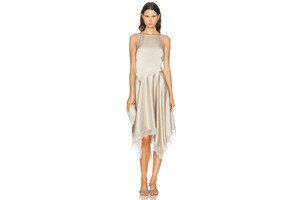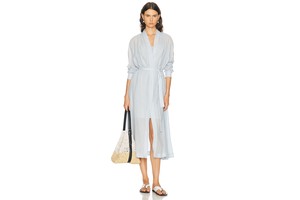
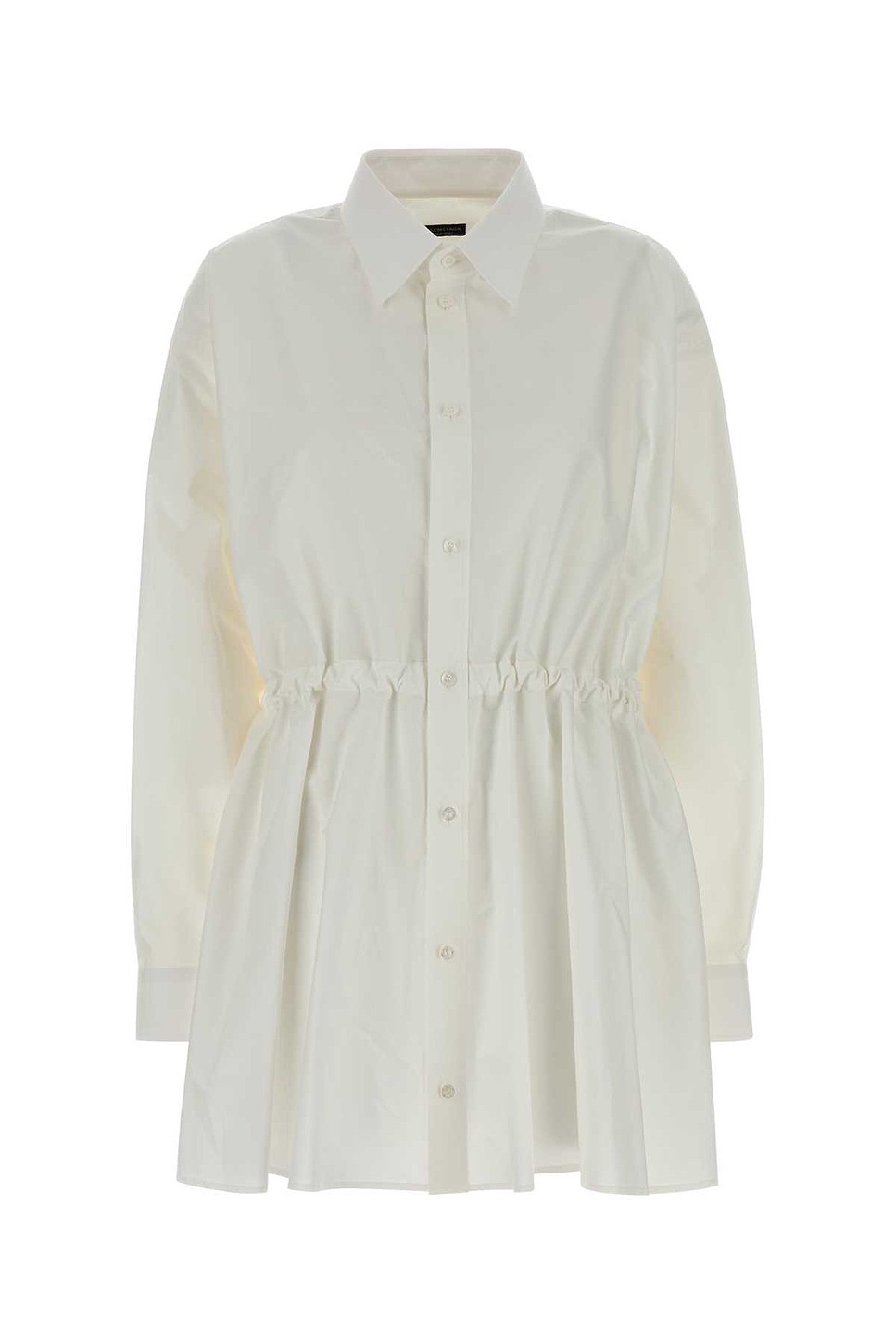
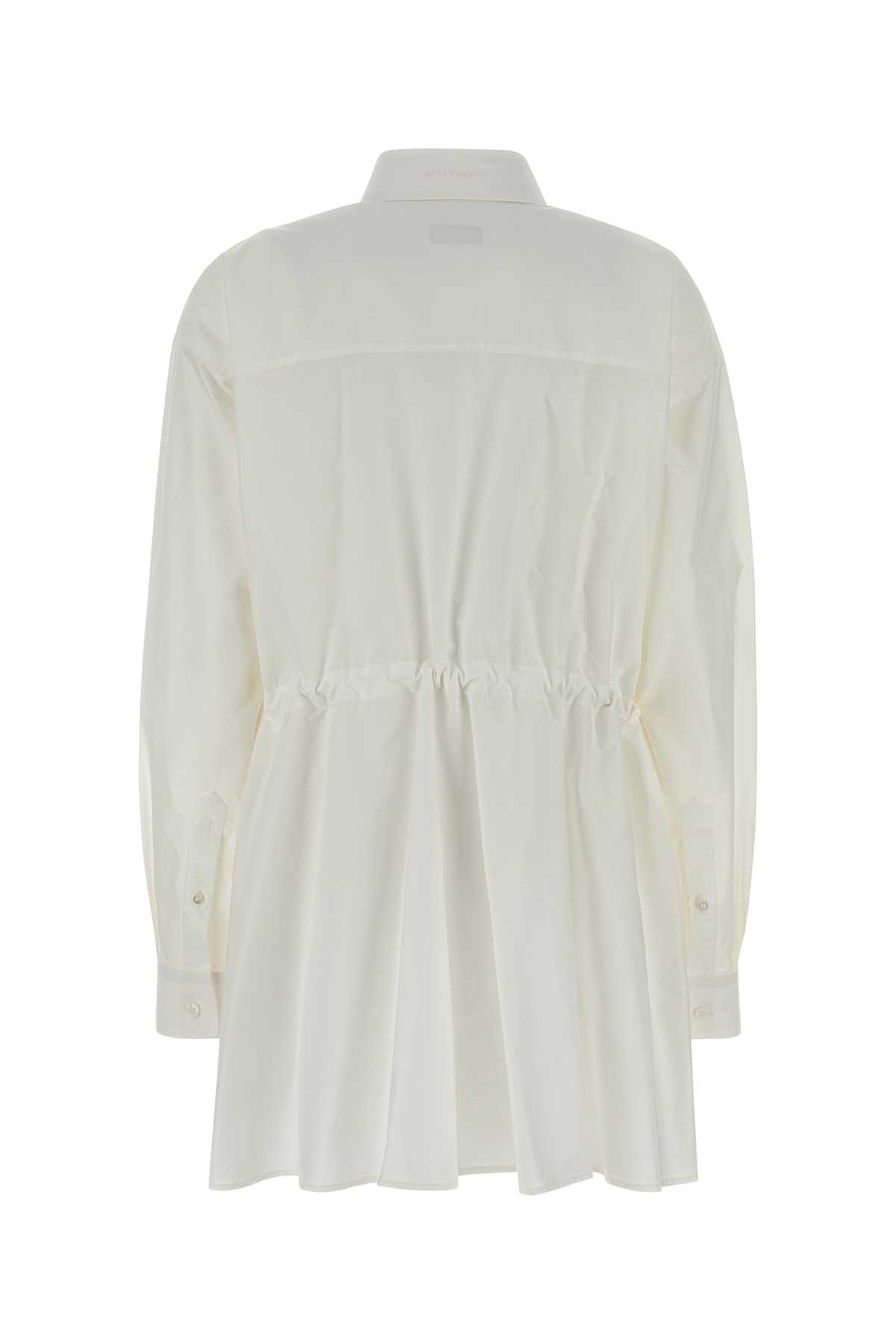
A white poplin shirt dress listed with a shell of 100% cotton, made in Italy, filed by the retailer under long sleeve dresses, at 1,730 dollars. There are no reviews and no fit votes, so there is no score to quote. The product information amounts to the composition, the country and two stock numbers, with two photographs and sizes 36 and 38. There is another shirt dress in this same batch with an identical product name from a different maker, and setting the two side by side settles a question this series could previously only suspect. The composition line here is also identical, word for word, to two other garments from two more makers, which makes this the third such recurrence found and the pattern worth drawing together. The reference is the Balenciaga white poplin shirt dress in White. Dongguan Bafinasa Garments Co., Ltd. develops comparable poplin shirt dresses on OEM and ODM terms, from fabric sourcing to retail or FBA ready packing. We publish this as a development reference and build your own version of it, and we do not supply the branded original or reproduce anyone else's label.
Key Features
- Shell: 100% cotton as stated. See the note below on how often this exact line recurs
- Poplin, named in the product title rather than in a specification, for the third time
- White, which raises the opacity question before any other colour does
- Filed by the retailer under long sleeve dresses, and there is a near twin filed differently. See the note below
- Made in Italy as stated
- Two sizes published: 36 and 38. See the note below
- No care instruction stated anywhere on the listing
- No size chart, no measurements and no model figures published
Customisable Options
- Fabric: cotton poplin to the reference, with the weight and count set from a tested sample
- Weave: poplin kept, since it is what makes this cloth dense enough to be made up in white
- Closure: a full front placket to the shirt dress convention, and we would specify buttons rather than imply them
- Opacity: we would state plainly whether this garment is lined, since white poplin asks first and asks hardest
- Length from mini to knee, poplin weight, lining options, size set, colour development, private label and care labelling
Specifications
| Style | White cotton poplin shirt dress |
| Reference | Balenciaga, white poplin shirt dress, style FEXN-WD1251, manufacturer style 852450TRM28 9000, colour White |
| Shell | 100% cotton as stated. See the note below on the recurrence of this line |
| Second Layer | Not stated, though the composition is given as a shell |
| Fabric | Poplin, named in the product title rather than in a specification |
| Opacity | Not stated on the listing, which for white poplin is the question most likely to be asked |
| Care | None stated on the listing |
| Sizes Published | 36 and 38, two adjacent sizes. See the note below |
| Measurements | None published. No size chart and no model body figures on this listing |
| Photographs | Two |
| Production | Made in Italy as stated |
| Reference Retail | 1,730 USD, quoted to show the price band this sits in, not as our price |
| Customer Reviews | None on the reference listing, so we quote no score |
| Best Seller Badge | None. The listing carries no rank |
| Categories | Filed by the retailer under long sleeve dresses, with no second category. See the note below |
| Occasion | Warm weather, professional settings, daytime, travel |
| MOQ | 100 pcs per style per colourway, mixed sizes and colourways accepted |
| Sampling | 7-10 days after tech pack or reference sample confirmation |
| Bulk Lead Time | 20-30 days after sample approval and deposit |
| Service | OEM / ODM / private label, cotton poplin sourcing, shirt dress construction, retail or FBA ready packing |
Size Chart
| Size | Bust | Waist | Hips | Length | Source | ||||||||||||
|---|---|---|---|---|---|---|---|---|---|---|---|---|---|---|---|---|---|
| 36 | 31 | in / | 79 | cm | 24 | in / | 61 | cm | 34 | in / | 86 | cm | 95 | cm / | 37.4 | in | Our proposal |
| 38 | 33 | in / | 84 | cm | 26 | in / | 66 | cm | 36 | in / | 91 | cm | 97 | cm / | 38.2 | in | Our proposal |
| 40 | 35 | in / | 89 | cm | 28 | in / | 71 | cm | 38 | in / | 97 | cm | 99 | cm / | 39 | in | Our proposal |
| 42 | 37 | in / | 94 | cm | 30 | in / | 76 | cm | 40 | in / | 102 | cm | 101 | cm / | 39.8 | in | Our proposal |
This listing offers two sizes, 36 and 38, and publishes no size chart, no measurements and no model body figures. There is nothing on the page from which a customer could judge the fit, and no length figure to indicate where this garment falls.
Occasions and Styling
Suits warm weather, professional settings, daytime and travel. A white cotton shirt dress is among the more versatile things in a wardrobe, and it is worth knowing before choosing what goes underneath that white shows more than any other colour, and this page says nothing about it.
Production and Quality Control
There are no reviews and no fit votes on this listing, so we quote no score. There is another shirt dress in this batch with an identical product name from a different maker, and the pair settles something this series could only suspect before. The composition line here is also identical to two others from two further makers, which makes three recurrences and a pattern worth drawing together.
The same product name from another maker, and the two were filed differently, and this settles it, and that is the first thing. This batch contains a white poplin shirt dress from Gucci costing 2,283 dollars, and this is a white poplin shirt dress from Balenciaga costing 1,730 dollars. The product names are identical, word for word, describing the same fabric, the same garment type and the same colour. Two unrelated makers do not independently name a garment the same way down to the word, so like other recurrences found here, something shared produced it, and that something is the retailer rather than either maker. So far so familiar. What the pair actually settles is something else, and it is the part worth dwelling on. The Gucci is filed by that same retailer under shirt dresses. This one is filed by that same retailer under long sleeve dresses. Both are the same garment type in the same fabric in the same colour, described in the same words, filed by the same organisation, and they were filed differently. This series has been collecting cases where these labels disagree and each one narrowed what could be said. Two garments of exactly fifty inches were found filed as midi on one and maxi on the other, which suggested the labels depend on the judgment involved rather than on anything measurable. Since then it has been found several times that these labels do genuinely useful work by accident, disclosing knit structure, sleeve coverage, whether a silhouette is shaped at the waist, and how a garment closes, most of which appeared nowhere else on those pages. Those two things sit together rather than cancelling, and the general shape of the lesson is now clearer than it was: a category label is worth reading for what it reveals incidentally, and worth distrusting for what it asserts, because the same input does not reliably produce the same label. This pair is the strongest evidence yet for that second half, because unlike those earlier cases there is nothing here that might explain a difference. Two garments measuring identically might at least be argued over at the margins. These two do not even have published lengths to argue about, and their names are the same, so the difference in filing has no input other than whoever did it. There are consequences worth naming. It means a customer cannot use these labels to sort reliably, since searching shirt dress will surface the Gucci and not this one despite the two being described identically. And it means the accidental information arrives unreliably, so learning that this one has sleeves comes down to luck rather than to anything a customer can depend on finding.
The same composition line three times from three makers, and drawing the recurrences together, and that is the second thing. This page says shell, one hundred per cent cotton, and nothing more. Another page in recent batches from a different maker said precisely the same thing, and so did a third from a third maker. All three were made in Italy, all three were white, all three named their fabric as poplin in the product title, all three published no care instruction, no size chart, no measurements and no model, and all three carried two photographs. Those three make a pattern, and this series has by now identified four distinct things recurring across unrelated makers on the same retailer, so it is worth assembling them because together they describe something structural rather than a series of coincidences. First there is vocabulary: three garments stated their transparency in an identical sentence from three unrelated makers, including the clause noting that undergarments are not included, from which it was concluded that this had been written once and applied to many rather than composed by each maker, and that this was therefore dependable, since disclosure that appears predictably can be trusted to appear. Second there is this composition line, now three times word for word. Third there is the copy template noted recently, in which a composition is followed by a paragraph of promotional description beginning by calling the garment elegant and then introducing features with the word featuring, with the maker's own name sitting in the product name and referred back to in the copy. Fourth there are the size offerings, since single figures have now appeared five times from this retailer, including two garments costing 3,448 and 3,690 dollars, alongside one honest instance elsewhere with a justification. Individually each could be dismissed. Together they say something specific and rather useful, and it is worth being precise about what it is and is not. What it says is that a lot of what appears on these pages was applied by one organisation at one point rather than supplied by each maker describing their own work. That explains why the same disclosures recur and why the same omissions recur, since absence is replicated by a process just as reliably as presence is. It also means the problem is systemic and therefore fixable in one place rather than one garment at a time, which is a better conclusion than criticising any individual page. What it does not say is anything about the garments, and this series has been careful about that distinction throughout: the argument is always about the page describing the thing rather than about how well the thing was made. Now, one point specific to this garment should be made because it is mild, and this series would rather be accurate than score a point. The unstated second layer is less alarming here than it has been almost anywhere this wording appeared, because cotton is the most washable fibre in this series, being stronger wet than dry, immune to felting, and prone to losing neither half its strength nor permanently marking. So whatever lines it is likely to be the more fragile partner, which reverses the usual direction of the mismatch. This series has said the danger is two layers responding differently and then puckering along every seam or bubbling loose, which was severe recently on a pair whose face combined silk with viscose over a polyester lining and severer still against almost ninety per cent wool. Here the alarm is lower, and it is better to say so than to flatten every instance into the same complaint.
Two sizes where another garment has three and another has one, and what that says, with a note on what the filing gives, and that is the third thing. Thirty six and thirty eight are two adjacent sizes, and this series has established very clearly how little that proves: consecutive runs of two are what clearing stock leaves behind quite readily, so nothing can be concluded from them about whether the range is deliberate. Three or more in sequence is different in kind, since any process removing sizes at random rarely leaves three running together, and this batch contains an example of exactly that, being a cotton dress with thirty four, thirty six and thirty eight. So placing the three cases side by side is instructive, because this same retailer published one size on two garments costing thousands of dollars, two sizes here, and three sizes elsewhere. If the number of sizes were chosen to suit the garment or its price, that arrangement would be inexplicable. If it reflects what was received, it is exactly what we would expect, and this series reached that reading some batches ago from four accompanying fingerprints: the maker's name appearing inside the product name rather than in the brand field; information running to composition, country and two stock numbers and nothing further; never any size chart, measurements or model; two or three photographs. Nothing here resists that reading, since there is no elastane in this composition at all, no knit described and no shirring, so there is no mechanism by which one size could serve several bodies, exactly as there was none on those single figure garments. There is one thing on this page worth drawing out, and it is the filing, because long sleeve dresses is a label about coverage rather than about length or occasion, and that distinguishes it from most. Sleeves are the piece of information most often missing, since this series has examined white poplin garments twice before without ever learning anything about whether they had sleeves, and coverage cannot be guessed, because the same bodice can carry a sleeve ending past the wrist or be cut sleeveless entirely. So this label does disclose something real and otherwise absent. But it says the sleeves exist without saying anything about them, since a sleeve can stop anywhere from above the elbow to well past the hand, and no sleeve measurement appears here. That is the recurring shape of all useful accidents on pages like this one: what arrives is real, partial, and available by chance rather than by design. Every bulk shipment gets a measurement report against your approved chart.
Optional upgrades include stating whether there is a lining and therefore what happens about opacity, which white poplin asks before anything else, adding a care instruction even though cotton is the most washable fibre here and the correct answer is permissive, specifying buttons and placket rather than leaving them implied by the word shirt, moving poplin from the title into a field, publishing a sleeve measurement rather than leaving long undefined, offering measurements and model figures so the two sizes can be acted on, more than two sizes offered, since two adjacent figures cannot be distinguished from what clearing stock leaves behind, alternative poplin weights and counts, alternative lengths, colour development including pale shades tested for opacity specifically, private label, hangtag and care labelling.
Pre-production sample approval, in-line inspection during cutting and sewing, and a final AQL inspection before packing, with measurement reports and photos shared before shipment.
Send us your tech pack, a photo or a reference garment and we will quote within 24 hours. Contact bafinasa@bafinasa.com or WhatsApp +86 13827222469.