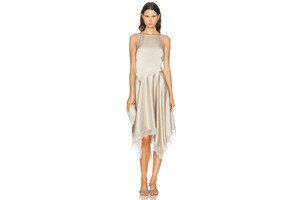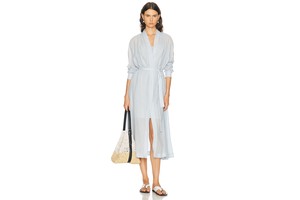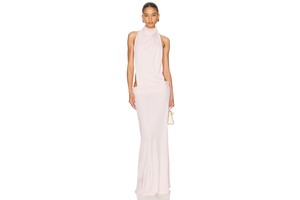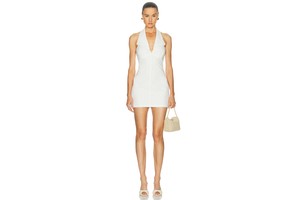
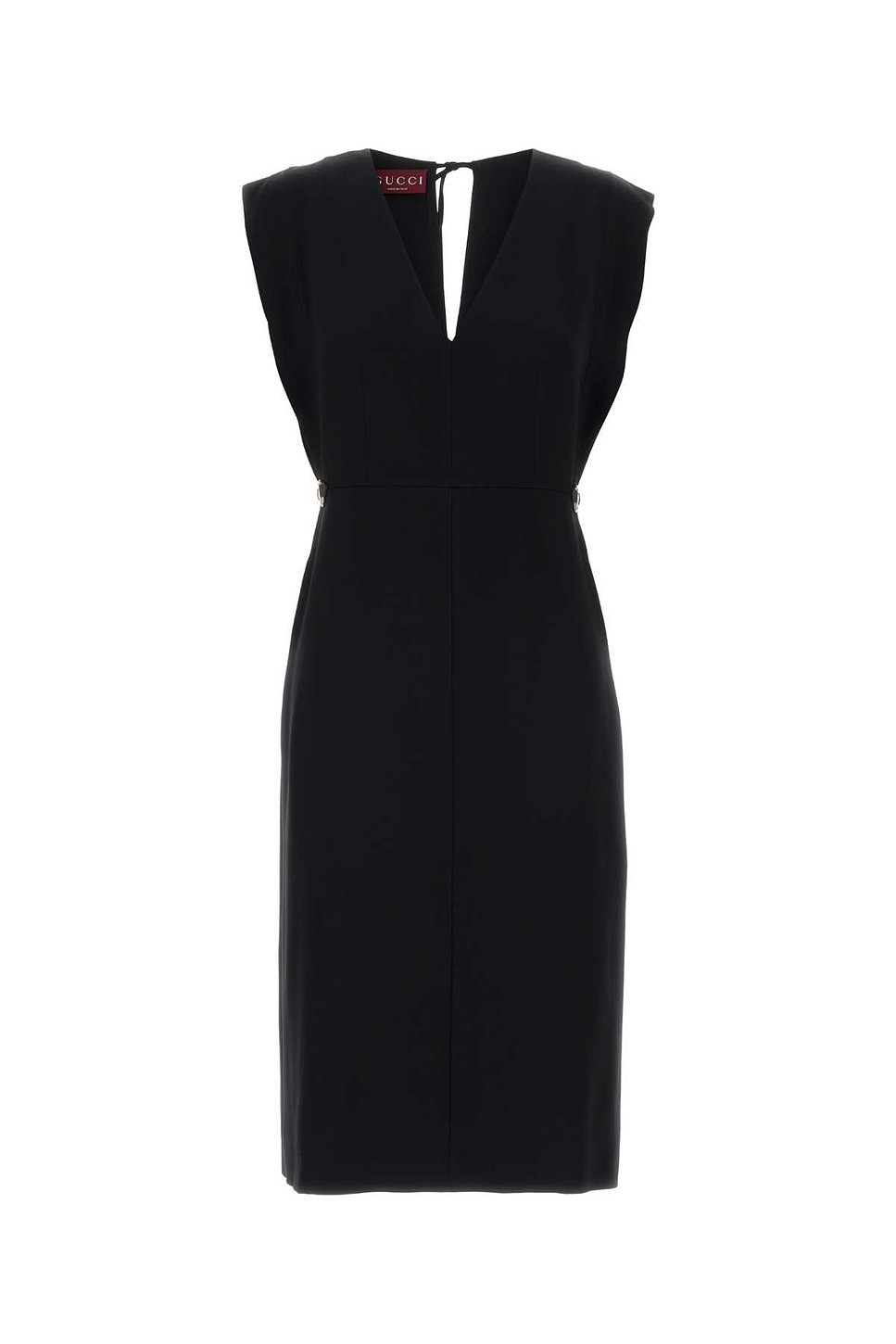
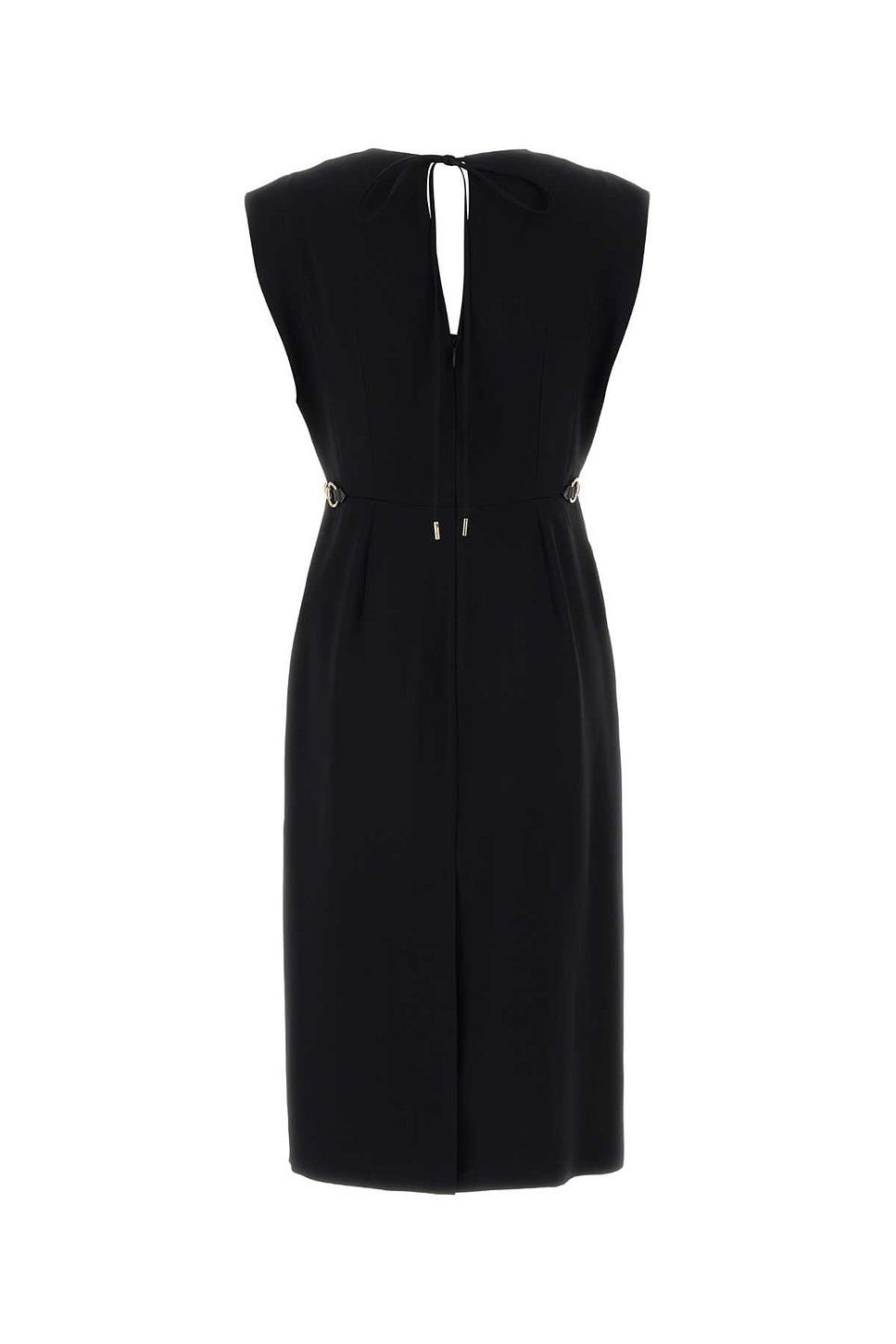
A black crepe dress listed with a shell of 77% acetate and 23% viscose, made in Italy, at 3,690 dollars. There are no reviews and no fit votes, so there is no score to quote. The product information amounts to the composition, the country and two stock numbers, with two photographs and one size. This is the highest priced garment this series has examined, and paired against something published very recently it completes a comparison that has been building for dozens of listings. It is also the third member of a group whose existence is more interesting than any single instance of it, since three different makers have arrived at the same pairing by taking their own different routes to it. The reference is the Gucci black crepe dress in Black. Dongguan Bafinasa Garments Co., Ltd. develops comparable crepe dresses on OEM and ODM terms, from fabric sourcing to retail or FBA ready packing. We publish this as a development reference and build your own version of it, and we do not supply the branded original or reproduce anyone else's label.
Key Features
- Shell: 77% acetate, 23% viscose as stated. See the note below on why this pairing recurs
- Crepe, named in the product title rather than in a specification
- Third member of a group this series has been assembling. See the note below
- Black, which reduces rather than removes one particular question
- Made in Italy as stated
- One size published: 42. See the note below
- Filed by the retailer under sleeveless dresses
- No care instruction stated anywhere on the listing, which this composition needs more than most
Customisable Options
- Fabric: acetate viscose crepe to the reference, with the weight and twist set from a tested sample
- Ratio: seventy seven and twenty three to the reference, and we would discuss shifting either way
- Crepe: twist level chosen from testing rather than assumed, since it decides both the surface and how it hangs
- Care: dry clean only added, since both components need it and neither can be put right afterwards
- Length from knee to ankle, crepe weight, size set, colour development, private label and care labelling
Specifications
| Style | Acetate viscose crepe dress |
| Reference | Gucci, black crepe dress, style FEXN-WD1241, manufacturer style 837156Z8B2Z 1000, colour Black |
| Shell | 77% acetate, 23% viscose as stated. See the note below |
| Second Layer | Not stated, though the composition is given as a shell |
| Fabric | Crepe, named in the product title rather than in a specification |
| Care | None stated on the listing, which for this composition is the most consequential absence on the page. See the note below |
| Sizes Published | 42 only. See the note below |
| Measurements | None published. No size chart and no model body figures on this listing |
| Photographs | Two |
| Production | Made in Italy as stated |
| Reference Retail | 3,690 USD, the highest reference price this series has examined |
| Customer Reviews | None on the reference listing, so we quote no score |
| Best Seller Badge | None. The listing carries no rank |
| Categories | Filed by the retailer under sleeveless dresses, with no second category |
| Occasion | Occasions, evening events, formal daytime |
| MOQ | 100 pcs per style per colourway, mixed sizes and colourways accepted |
| Sampling | 7-10 days after tech pack or reference sample confirmation |
| Bulk Lead Time | 20-30 days after sample approval and deposit |
| Service | OEM / ODM / private label, acetate and viscose crepe sourcing, retail or FBA ready packing |
Size Chart
| Size | Bust | Waist | Hips | Length | Source | ||||||||||||
|---|---|---|---|---|---|---|---|---|---|---|---|---|---|---|---|---|---|
| 42 | 31 | in / | 79 | cm | 24 | in / | 61 | cm | 34 | in / | 86 | cm | 110 | cm / | 43.3 | in | Our proposal |
| 44 | 33 | in / | 84 | cm | 26 | in / | 66 | cm | 36 | in / | 91 | cm | 112 | cm / | 44.1 | in | Our proposal |
| 46 | 35 | in / | 89 | cm | 28 | in / | 71 | cm | 38 | in / | 97 | cm | 114 | cm / | 44.9 | in | Our proposal |
| 48 | 37 | in / | 94 | cm | 30 | in / | 76 | cm | 40 | in / | 102 | cm | 116 | cm / | 45.7 | in | Our proposal |
This listing publishes one size, 42, and no size chart, no measurements and no model body figures. There is nothing on the page from which a customer could judge the fit, and no length figure to indicate where this garment falls.
Occasions and Styling
Suits occasions, evening events and formal daytime. A black crepe dress is the most conventional choice there is for these, and it is worth knowing that both fibres here need water kept away from them, which decides what happens after the event as well as during it.
Production and Quality Control
There are no reviews and no fit votes on this listing, so we quote no score. At 3,690 dollars this is the most expensive garment examined here, and paired with something published very recently the two together close an argument this series has been assembling for a long while. It is also the third instance of a pairing whose recurrence is worth explaining.
Three thousand six hundred and ninety dollars buys the same four lines that one hundred and twenty dollars buys, and putting those two together closes something, and that is the first thing. This series has argued throughout that how much a page tells you has no relationship at all to what the garment costs, and constructed the evidence gradually: many listings above a thousand dollars publishing four lines or fewer; batches in which three separate garments above 1,900 dollars disclosed identically little; the previous record holder at 3,448 dollars offering the shell, the lining, the country and nothing else with two photographs and a single size; and alongside those a thirty fold range being established between the cheapest garment yet examined at 120 dollars and the most expensive. Compare those two ends directly, since they sit six listings apart. The 120 dollar garment published the fibre, the country, a care instruction, whether it was lined, how it closed, the fabric weight, the fabric construction, measurements across five sizes including both length and sleeve length, and model figures, with five photographs. This one publishes the composition, the country and two stock numbers, with two photographs. The cheaper costs roughly one thirtieth as much and discloses several times more. Two things follow and both are worth stating plainly because they are the reason the comparison matters. The first is what it establishes: the missing information does not cost money to supply, so silence is not a resource limit. The second is what it does not establish, and this series has been careful about this every time, having said repeatedly that the argument is about disclosure rather than about how well anything is made. Nothing here permits a conclusion about the garment itself, only about the page describing it. It is worth adding the practical observation made before, that garment categories with less margin are often photographed and measured in greater volume and more routinely, so the question any listing is answering is whether a process exists rather than whether it can be afforded for one style. Now the second point about this page, which is that the careless thing absent here is worse than usual. Most missing information leaves the customer to guess. This missing item invites her to act. Both fibres fail in water, and a failure is not recoverable in either, so guessing wrong does not produce a disappointing wash but a garment that cannot be worn again. That is the distinction this series has drawn between an instruction protecting something and an instruction merely being cautious, drawn first on a cotton twill needing dry cleaning because of its applied decoration despite cotton being among the most washable fibres, and it applies here with unusual force.
The third acetate and viscose pairing, and asking why will explain more than the count, and that is the second thing. This series met its first acetate and viscose shell recently, at roughly three parts acetate to one part viscose with the second layer named as polyester and an instruction of dry clean only. It met a second very shortly after, this time fifty five viscose to forty five acetate, again totalling one hundred per cent, again with no instruction, and the comparison between the two produced something useful: at lopsided proportions there is one dominant failure mode to plan around, while at almost even proportions both kinds of failure are visible at once, which suggested the situation should be assessed by how many different failures are in play rather than only by how fragile the parts are. This is the third, at seventy seven acetate to twenty three viscose, which sits close to the first. So three makers have now chosen this pairing, and none of them has made quite the same choice within it, since the ratios range across nearly all of the possible span from nearly equal to very lopsided. That spread is the reason this is worth explaining rather than merely listing, and there is a sound answer. Both fibres come from cellulose, acetate being a chemically modified form of it and viscose a regenerated form, and that shared origin means they hang, dye and take finish in broadly similar ways while neither behaves like a synthetic. What acetate contributes is lustre and a particular dense drape along with some weight. What viscose contributes is softness, better moisture handling and lower cost. Blending them produces a cloth intended to read like a fine silk without silk's price or its particular weaknesses, and that is why three separate makers arrived here independently, each settling on proportions that suit what they wanted from the drape. The honest observation is that the cloth was chosen for how it looks and moves, and its behaviour in water is the side effect of that choice rather than a mistake. It is worth adding what each component does specifically, since this series has described both mechanisms. Acetate stiffens and dulls in water and it marks, and those marks are not dirt on the surface but a change in how the surface reflects light, which is why they cannot be cleaned off. Viscose, being regenerated cellulose, loses around half its strength when wet and is prone to shrinking and to creasing badly as it dries. So neither is safe, they fail in different ways, and neither failure can be put right. Now consider how those three have been handled. Of the three, one carried dry clean only, which is the correct answer and the only one of the three that lets neither failure occur. The other two carry nothing at all. Three makers choosing the same two fragile fibres, and only one telling anybody what to do about it, is a better description of the problem than anything found in a single listing. There is one further detail specific to this garment worth adding, which is that the fabric is crepe. Crepe means the yarns are twisted hard enough to crinkle the surface, so the twist has already put the yarn under strain before anything is worn, and this series made exactly this point recently about another crepe, noting that adding water to strained yarn with failure modes available is asking a great deal. That applies here as well.
One size at the highest price yet recorded, and there is now a pattern strong enough to name, and that is the third thing. This listing publishes one size, 42. This series has worked through single figure offerings several times, beginning with the observation that everything established for reading size runs depends on comparing at least two sizes, so a single figure is neither consecutive nor gapped and nothing internal can be concluded from it, continuing with the practical consequence that no decision is available to the customer, so either it fits or she cannot buy it, and the absence of measurements therefore does more damage than usual since there is no neighbouring size to move to. Then three such instances appeared together from one source, and the useful observation was their sharing a source: a brand launching a style decides how many sizes to make, whereas a retailer receiving whatever remains late in a season receives whatever sizes are left, and at the end of a season what is left is often a single piece in a single size. That described a stockist rather than a designer, and this series has since been noting the accompanying fingerprints whenever they appear together: the maker's name sitting in the product name rather than the brand field, information running to composition, country and two stock numbers and nothing further, never any size chart, measurements or model, two or three photographs, and most recently a copy template in which a composition is followed by a paragraph of promotional description. This garment shows all of them. The count is now worth taking, since it changes what can be said. There have been five single size listings from this retailer, against one honest instance elsewhere, which was a chiffon tunic published as one size where the shape itself supplied the justification, since a garment hanging from the shoulders need not correspond to anybody's measurements, and where a model figure was even given. Five against one, with every one of the five showing the same accompanying pattern, is enough to say that a single figure here is a stockroom artefact rather than a design decision, and it is better understood that way because it stops it looking like an aesthetic choice. Nothing about this garment resists that reading: there is no knit described, no elastane at all, and no shirring, so there is no mechanism by which one figure serves several bodies, exactly as there was none on the others. It is worth closing with what this costs at this price. A customer considering 3,690 dollars has one size, no measurements, no model, and no care instruction, and the first two of those together mean she cannot even find out by asking. Every bulk shipment gets a measurement report against your approved chart.
Optional upgrades include adding dry clean only, since both fibres fail in water and neither failure can be put right afterwards, either matching the lining to the shell or keeping that instruction permanently, showing the crepe weight and twist since those decide how the cloth hangs and how the surface reads, offering more than one size since nothing described here lets a single figure serve several bodies, publishing measurements at the very least for size 42, stating the length so the silhouette can be placed, alternative ratios tested for drape since three makers have now each chosen their own, alternative fibres if the drape can be reached without two components that both dislike water, colour development, private label, hangtag and care labelling.
Pre-production sample approval, in-line inspection during cutting and sewing, and a final AQL inspection before packing, with measurement reports and photos shared before shipment.
Send us your tech pack, a photo or a reference garment and we will quote within 24 hours. Contact bafinasa@bafinasa.com or WhatsApp +86 13827222469.