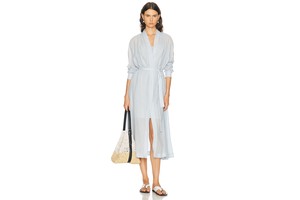
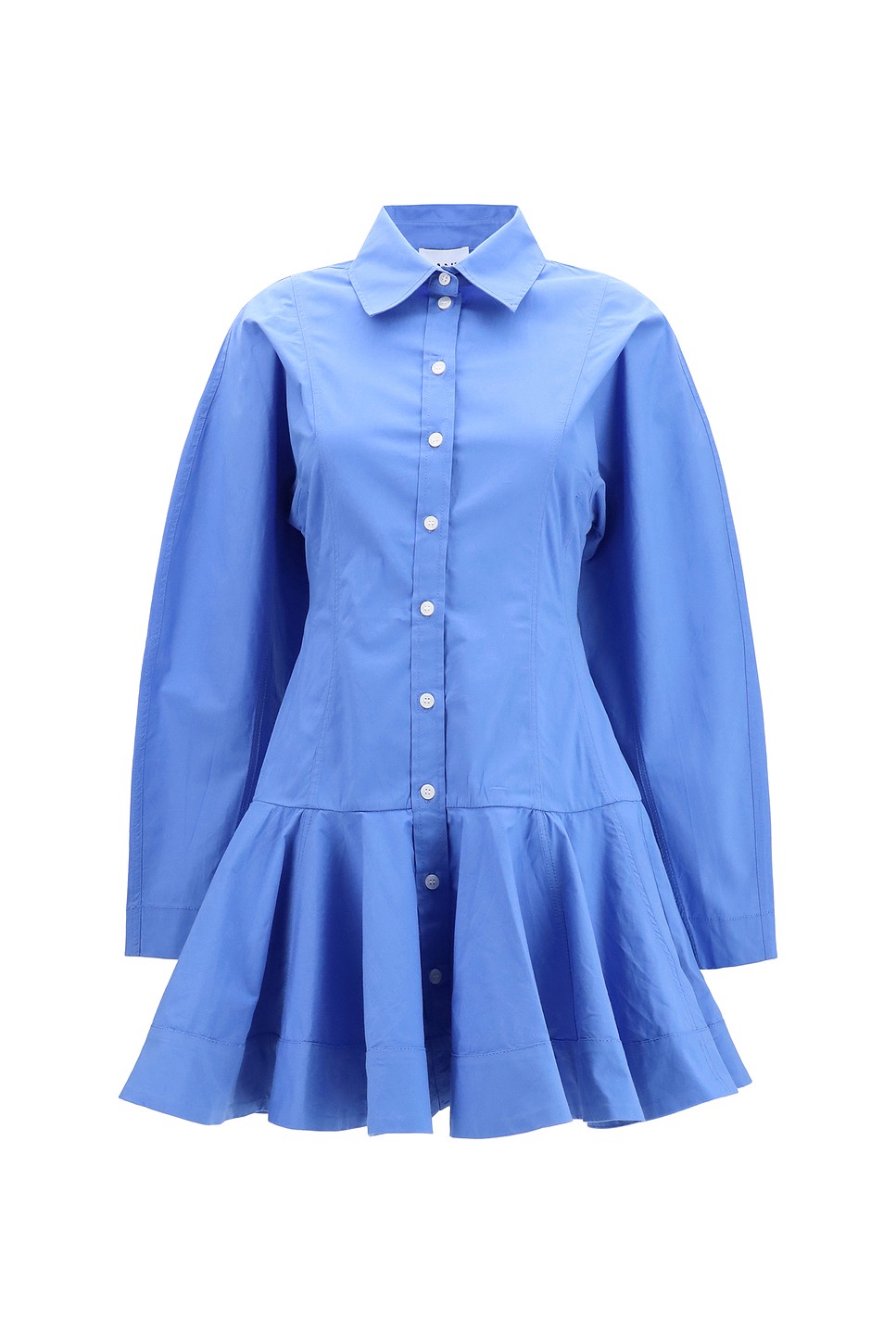
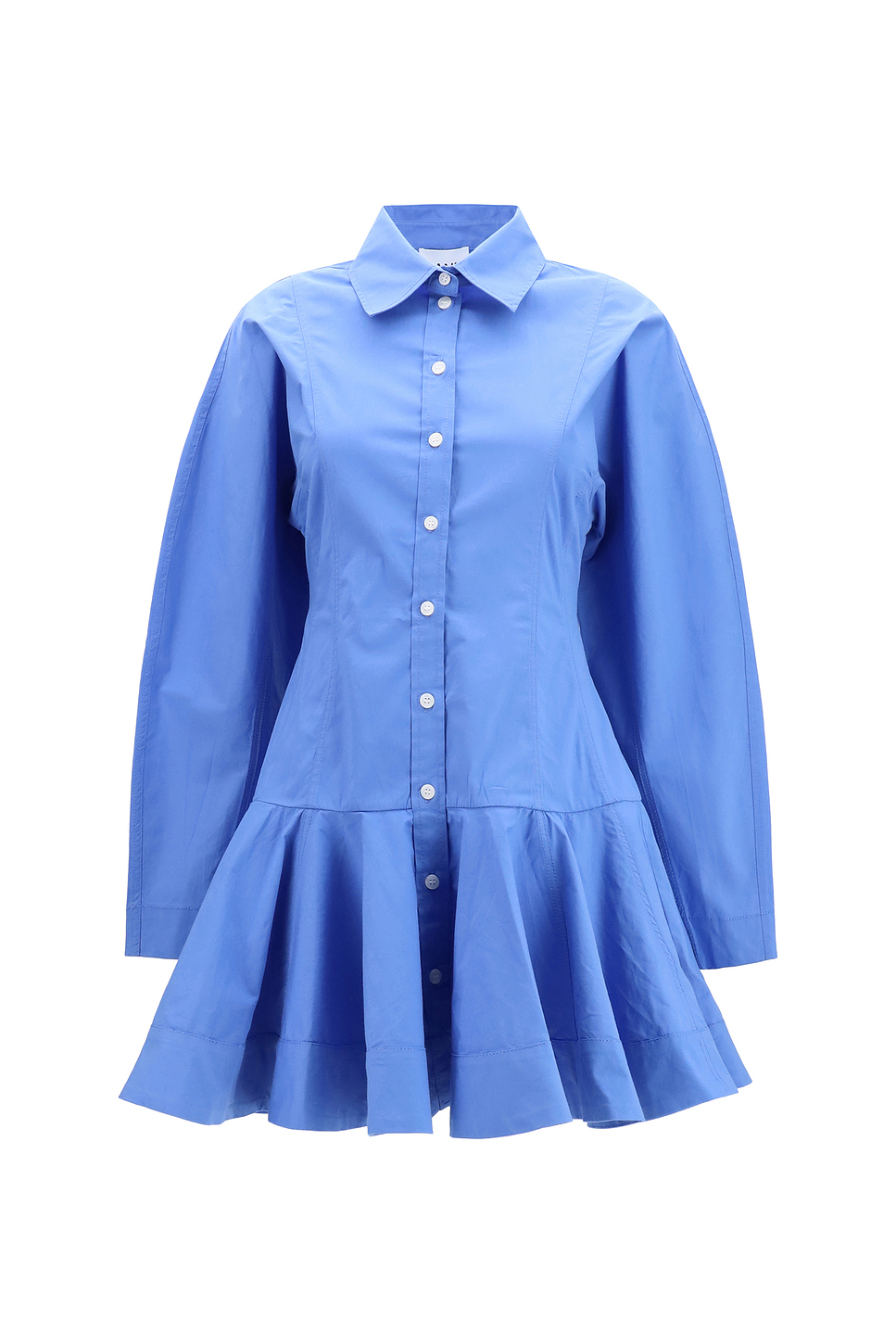
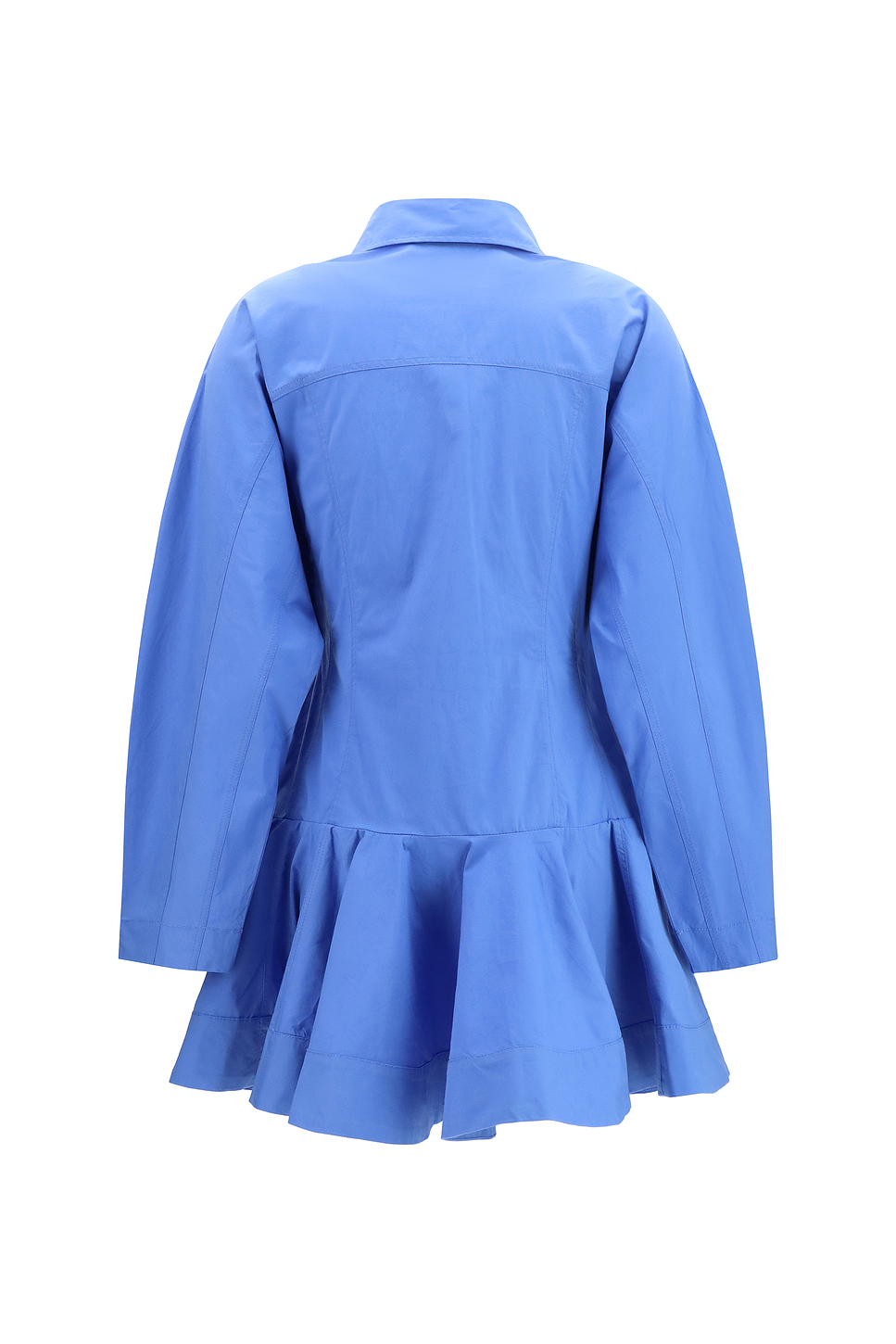
A shirt dress listed as 97% cotton with 3% elastane, with a classic collar, a front button closure, long sleeves, a gathered hem and a balloon skirt, finished with a logo patch and ties at the back, made in India, filed by the retailer under mini dresses, at 344 dollars. There are no reviews and no fit votes, so there is no score to quote. Everything known about how this garment is constructed appears inside a single paragraph of promotional copy rather than in any field, and this is now the second instance of that in recent batches, which changes what it is. There is also one size published, and comparing that with the same figure elsewhere sharpens something. The reference is the Ganni cotton shirt dress with balloon skirt in Brown Plaid. Dongguan Bafinasa Garments Co., Ltd. develops comparable shirt dresses on OEM and ODM terms, from fabric sourcing to retail or FBA ready packing. We publish this as a development reference and build your own version of it, and we do not supply the branded original or reproduce anyone else's label.
Key Features
- 97% cotton, 3% elastane as stated
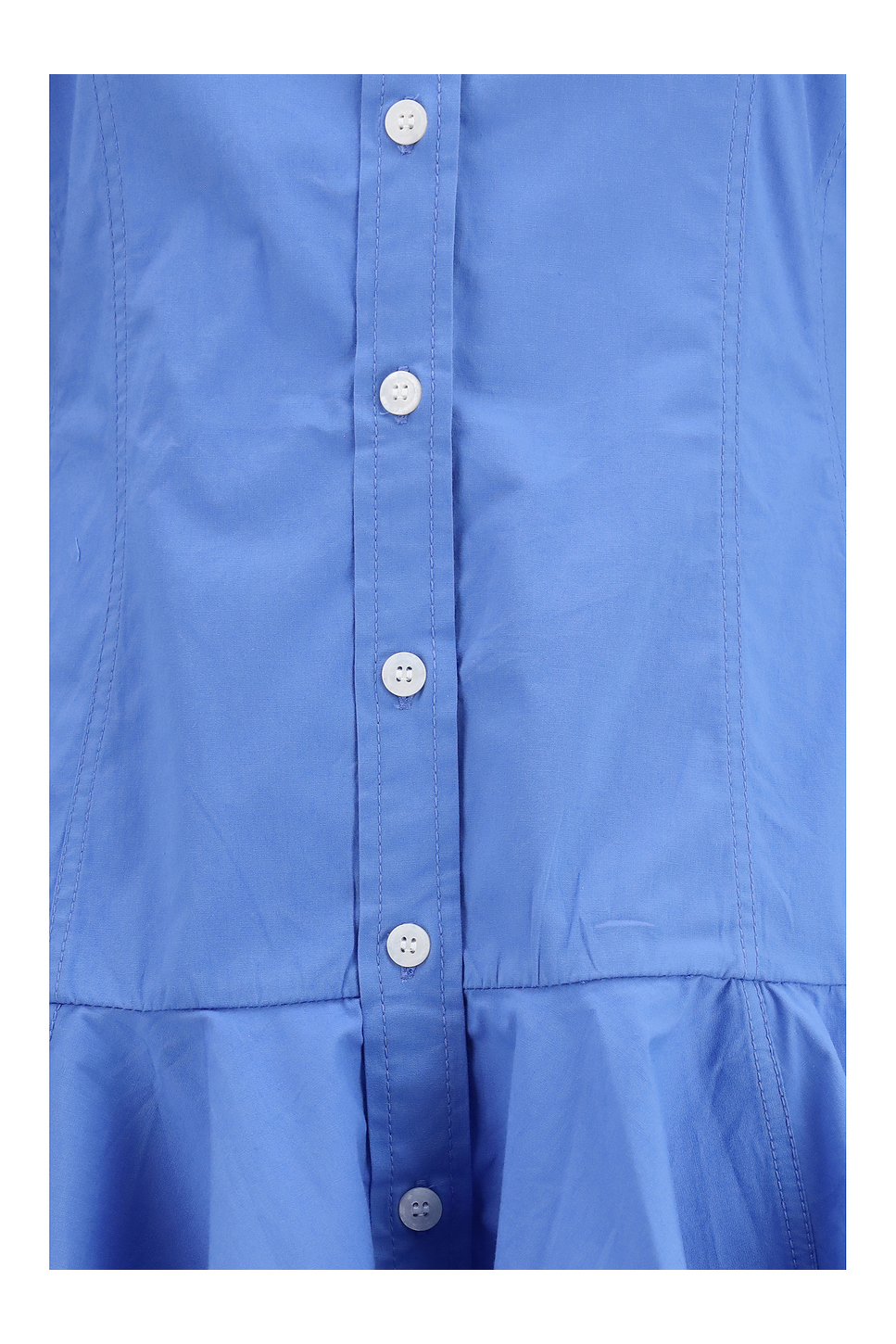
- Classic collar with a front button closure as described in copy rather than stated in a field. See the note below
- Long sleeves as described in copy
- Gathered hem and balloon skirt as described in copy, and both describe shape rather than merely decoration
- Logo patch and ties at the back as described in copy
- Made in India as stated
- One size published: IT 36. See the note below
- Filed by the retailer under mini dresses, with no length figure anywhere to check that against
Customisable Options
- Fabric: cotton with elastane to the reference, with the weight set from a tested sample
- Closure: front buttons to the reference, and we would specify count, size and whether there is a placket facing
- Skirt: balloon shape with gathered hem to the reference, since those are what make this garment distinctive
- Sleeve: long to the reference, and we would publish where it stops rather than only the word
- Length from mini to knee, gathering depth, sleeve shape, placket options, size set, colour development, private label and care labelling
Specifications
| Style | Balloon skirt cotton shirt dress |
| Reference | Ganni, cotton shirt dress with balloon skirt, style FEXN-WD1999, manufacturer style A1030645_591, colour Brown Plaid |
| Composition | 97% cotton, 3% elastane as stated |
| Collar and Closure | Classic collar with a front button closure, as described in copy rather than in a field. See the note below |
| Sleeves | Long sleeves as described in copy, with no sleeve measurement published |
| Hem and Skirt | Gathered hem and balloon skirt as described in copy. See the note below |
| Back Detail | Logo patch and ties at the back as described in copy |
| Sizes Published | IT 36 only. See the note below |
| Measurements | None published. No size chart and no model body figures on this listing |
| Photographs | Three |
| Production | Made in India as stated |
| Reference Retail | 344 USD, quoted to show the price band this sits in, not as our price |
| Customer Reviews | None on the reference listing, so we quote no score |
| Best Seller Badge | None. The listing carries no rank |
| Categories | Filed by the retailer under mini dresses, with no second category |
| Length | Not stated anywhere, so the retailer's mini filing cannot be checked |
| Occasion | Everyday, casual, professional settings, transitional weather |
| MOQ | 100 pcs per style per colourway, mixed sizes and colourways accepted |
| Sampling | 7-10 days after tech pack or reference sample confirmation |
| Bulk Lead Time | 20-30 days after sample approval and deposit |
| Service | OEM / ODM / private label, cotton sourcing, gathered and balloon constructions, retail or FBA ready packing |
Size Chart
| Size | Bust | Waist | Hips | Length | Source | ||||||||||||
|---|---|---|---|---|---|---|---|---|---|---|---|---|---|---|---|---|---|
| IT 36 | 31 | in / | 79 | cm | 24 | in / | 61 | cm | 34 | in / | 86 | cm | 90 | cm / | 35.4 | in | Our proposal |
| IT 38 | 33 | in / | 84 | cm | 26 | in / | 66 | cm | 36 | in / | 91 | cm | 92 | cm / | 36.2 | in | Our proposal |
| IT 40 | 35 | in / | 89 | cm | 28 | in / | 71 | cm | 38 | in / | 97 | cm | 94 | cm / | 37 | in | Our proposal |
| IT 42 | 37 | in / | 94 | cm | 30 | in / | 76 | cm | 40 | in / | 102 | cm | 96 | cm / | 37.8 | in | Our proposal |
This listing publishes one size, IT 36, and no size chart, no measurements and no model body figures. There is nothing on the page from which a customer could judge the fit, and nothing stating a length to compare against the retailer's own mini filing.
Occasions and Styling
Suits everyday wear, casual wear, professional settings and transitional weather. A cotton shirt dress with a gathered hem is a practical garment, and it is worth knowing that long sleeves plus a full gathered skirt make it cover rather more than the word suggests, so it suits more of the year than a summer dress would.
Production and Quality Control
There are no reviews and no fit votes on this listing, so there is no score to quote. Every fact about how this garment is made lives in one paragraph of promotional copy, and this is the second time now, which upgrades it from an oddity to something worth explaining. One size here also has a comparison available that makes it read differently.
The second garment whose entire specification lives in one paragraph of copy, and it is the same shape as the first, and that is the first thing. A recent batch examined a lace dress where the composition appeared at the front of a sentence of promotional wording and everything else followed in the same paragraph, the silhouette, the hem, a removable belt and the closure. This series described that as a new location for misplaced information, having previously found it in product names and once, by accident, in how the retailer filed things, and noted that it was worse than either because four facts were hidden together and because they included things nobody could guess, nobody having any way to infer that there was a belt at all, let alone that it came off. This garment is built the same way. The composition sits at the front, followed by copy describing a classic collar, a front button closure, long sleeves, a gathered hem, a balloon skirt, and a logo patch with ties at the back. Six facts, all in one paragraph, none of them in a field. Two details make this instance more informative than the first. The first is that some of the same wording recurs, and that is what turns this into something structural rather than accidental. Both paragraphs describe their garment as elegant. Both use the same construction, introducing features with the word featuring. Both place the maker's own name into the product name and then refer back to that maker in the copy. Independent writers do not converge on this pattern, which is the same reasoning this series applied when two then three unrelated makers were found using an identical sentence about transparency, concluding from that repetition that something shared was producing it and identifying the retailer as the only thing shared. The conclusion here is the same and it is more useful than a complaint about one listing would be: this is a template applied at the retailer level, so the problem is systemic and therefore fixable at one place rather than one garment at a time. The second detail is about the particular facts hidden here, and they are worth listing because each is something a customer might buy this garment for. There is a front button closure, which means this opens fully down the front and can be worn open as a layer. There is a gathered hem, which means the skirt is drawn in at the bottom rather than falling straight, and that single fact changes the silhouette more than most listed features do. There are long sleeves, which means this covers the arms and therefore suits cooler weather than a sleeveless cotton dress would. And there is a logo patch with ties at the back, which is a genuine design feature rather than branding incident. None of those are guessable from three photographs, and none appears anywhere except inside a sentence whose principal purpose is to describe the garment as elegant and contemporary.
A comparison with another single size garment makes this one read differently, and one extra character in the size label turns out to matter, and that is the second thing. This listing publishes one size, IT 36. This series has elsewhere looked at single figures and built up how to read them, starting from the observation that everything established for short size runs depends on comparing at least two sizes, so a single figure is neither consecutive nor gapped and nothing internal can be concluded from it, and continuing through several instances where the practical consequence was recorded: no decision is available to the customer, so either it fits or she cannot buy it, and the absence of measurements therefore does more damage than usual because there is no neighbouring size to move to. Then three such instances appeared together from one source, and this series noted that the interesting fact was their sharing a source, since a brand launching a style decides how many sizes to make while a retailer receiving whatever remains late in a season gets whatever sizes are left. That described a stockist rather than a designer. This garment shows signs of belonging in that same group, having the same fingerprints: the maker's name sitting in the product name rather than the brand field, the information running to composition, country and stock numbers, no size chart, measurements or model ever, two or three photographs, and now the copy template described above. So far it fits. But there is one difference and it is worth crediting, because it is a genuine improvement and this series would rather notice improvements than only faults. The size reads IT 36 rather than simply 36. That is two extra characters, and what they do is resolve an ambiguity none of the other single figure listings had resolved. A bare 36 could be Italian, could be French, could be German, and those do not correspond to the same body. This series has noted before the value of sizes carrying more than one system, having recently credited two pages, one offering six sizes each labelled with both a US and a UK figure and another offering four sizes each labelled with both a number and a letter, and remarking that this removed a conversion the customer would otherwise perform and might get wrong. IT before the figure does that job here in miniature. So having one size remains the problem it always was, and it is worth adding what is missing to make it worse: nothing about this garment says it was made to be forgiving. There is no knit described, no shirring, and the elastane sits at three per cent, which this series has repeatedly placed below the level at which it does anything for fit, having recently used the same threshold to explain why two garments declaring the same boned bodice were doing different amounts of work. So there is no mechanism by which this single figure serves several bodies, exactly as there was none on those other three. It is worth contrasting that with the one honest single size this series has met, being a chiffon tunic published as one size where the shape itself was the justification, since a garment hanging from the shoulders does not need to correspond to anybody's measurements, and where a model figure was even given. Nothing of that kind is here.
Three remaining observations, each small but each deciding something, and that is the third thing. The first concerns what gathered actually means when it appears unexpectedly, and this series has one prior instance worth recalling because it changed how much weight this single word carries. On a cotton dress recently examined, the published bust sat some ten inches below the model while the waist sat above her, and considering why, the answer was found in the fabric being gathered: a gathered panel lies in a contracted state when laid flat to measure, so what gets recorded is the contracted dimension rather than the dimension it assumes once worn, and the difference there was around ten inches. So gathered is not decoration, it is a statement about what any measurement of that part means. Here it says the hem is drawn in, which means the skirt is longer than it looks from the outside and moves differently from a straight skirt, and it also means that anybody measuring this garment would record the contracted figure at that point rather than the spread one. That is worth knowing before reading any chart. The second observation concerns the retailer's filing, and comparing it against a near twin is what makes it visible. This batch also examined another shirt dress, in white cotton poplin, which the retailer filed under shirt dresses. This one is filed under mini dresses. Both are shirt dresses by their own product names, so the same garment type has been filed once by its type and once by its length, and neither page publishes a single measurement to check the length against. This series has repeatedly found these labels doing useful accidental work, having noted several times that on pages this sparse they become the only source of information available, but it has also recently begun recording when they disagree with each other, having found one length of exactly fifty inches filed as midi on one garment and as maxi on another, which showed the labels depend on who did the filing rather than on anything measurable. Two shirt dresses filed differently is the same lesson from a different direction, and it is worth drawing the general point: a category label is worth reading for what it accidentally reveals and worth distrusting for what it asserts. The third is simply that nothing here addresses opacity. The garment is described as Brown Plaid, and this series noted recently that a pattern complicates this question rather than answering it, since checks are typically a dark ground crossed with lighter stripes so light passes most readily through the pale bands while the busy print conceals in photography what the weave is doing. Nothing is said about lining either, and against that background one sentence would settle it. Every bulk shipment gets a measurement report against your approved chart.
Optional upgrades include moving every fact now living in the copy into fields, since the closure, the gathered hem and the long sleeves are each things a customer might buy this garment for, publishing the length so the retailer's own mini filing can be checked against something, publishing a sleeve measurement rather than leaving long undefined, offering more than one size since nothing described here lets a single figure serve several bodies, keeping the IT prefix since it resolves an ambiguity three other single size listings left open, stating whether there is anything between the plaid and the skin, specifying button count and size and whether the placket is faced, alternative gathers and balloon depths since those decide how this reads more than any other single feature, alternative lengths, additional sizes, colour development and private label, hangtag and care labelling.
Pre-production sample approval, in-line inspection during cutting and sewing, and a final AQL inspection before packing, with measurement reports and photos shared before shipment.
Send us your tech pack, a photo or a reference garment and we will quote within 24 hours. Contact bafinasa@bafinasa.com or WhatsApp +86 13827222469.