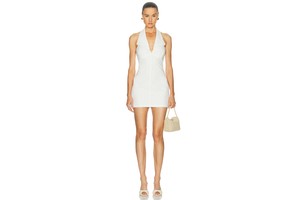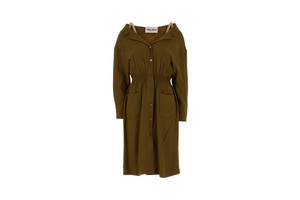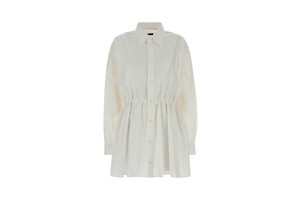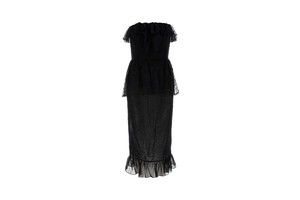
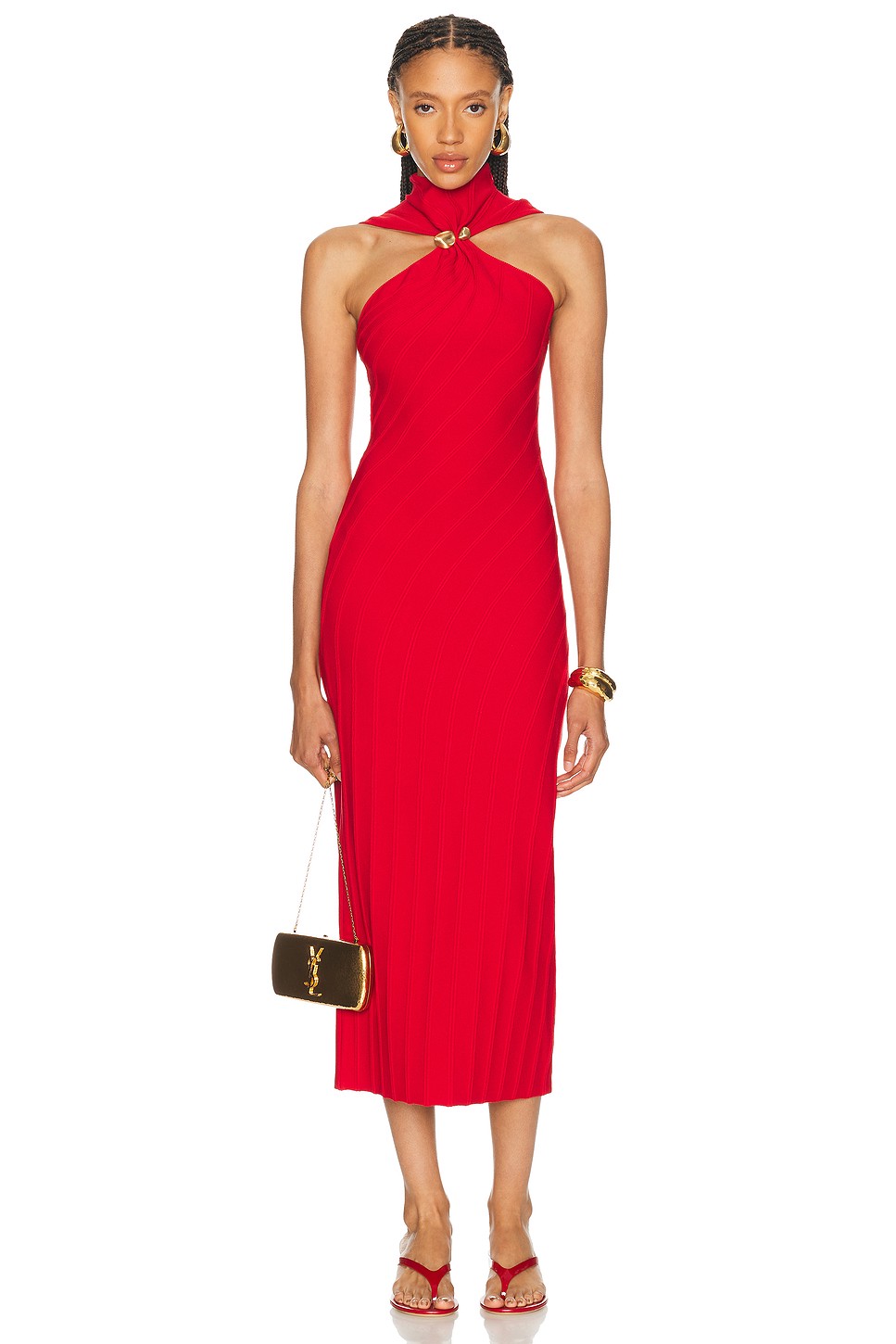
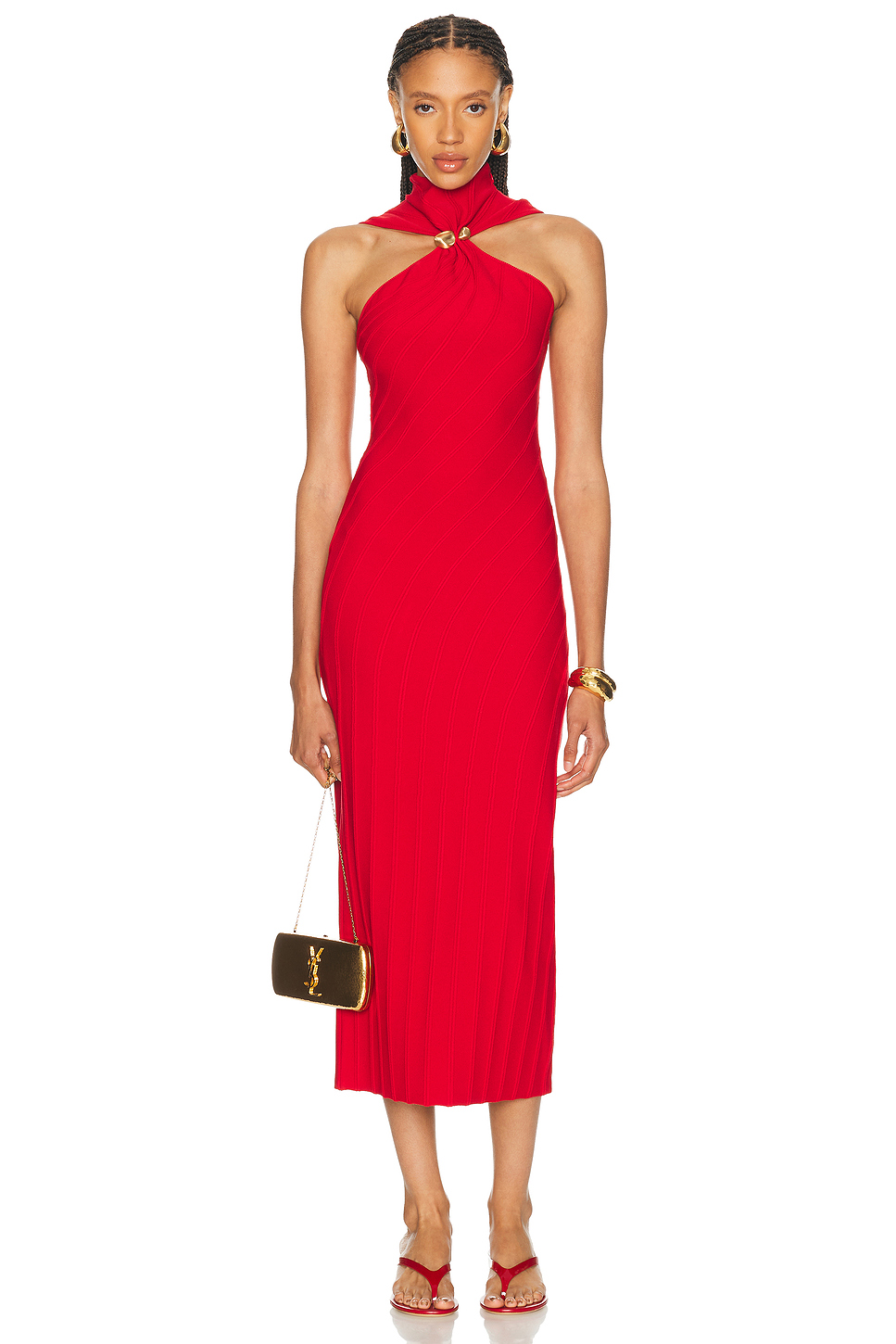
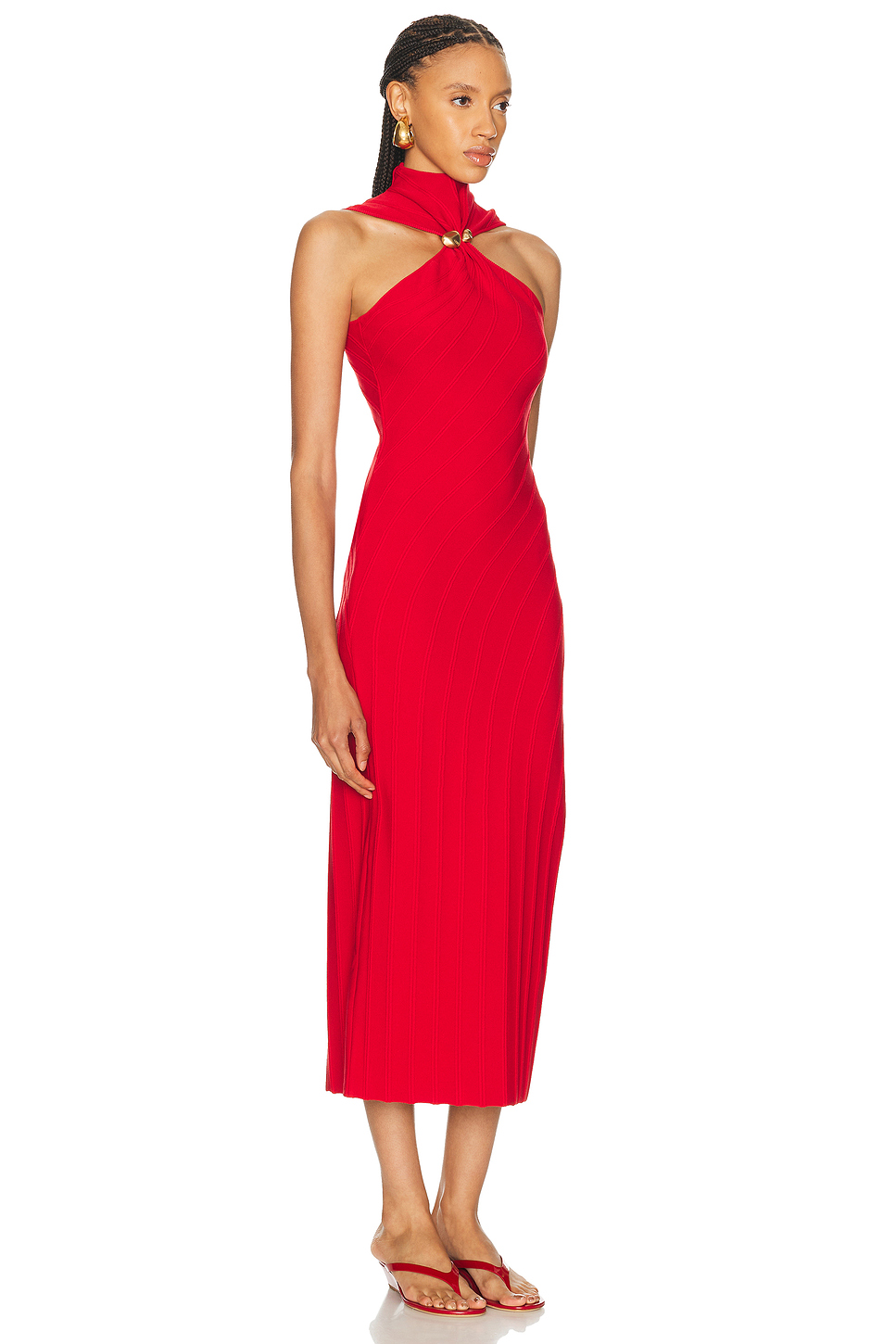
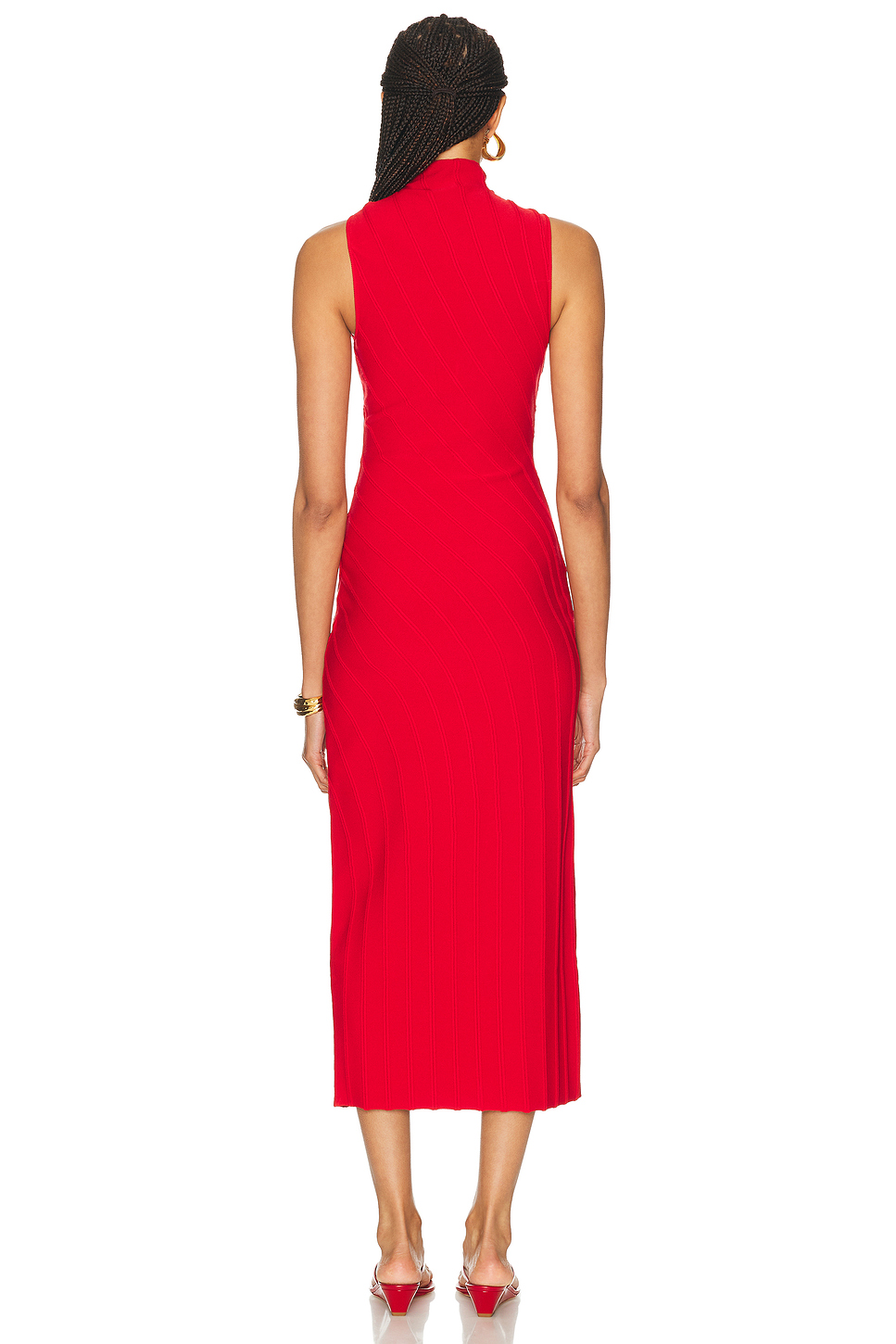
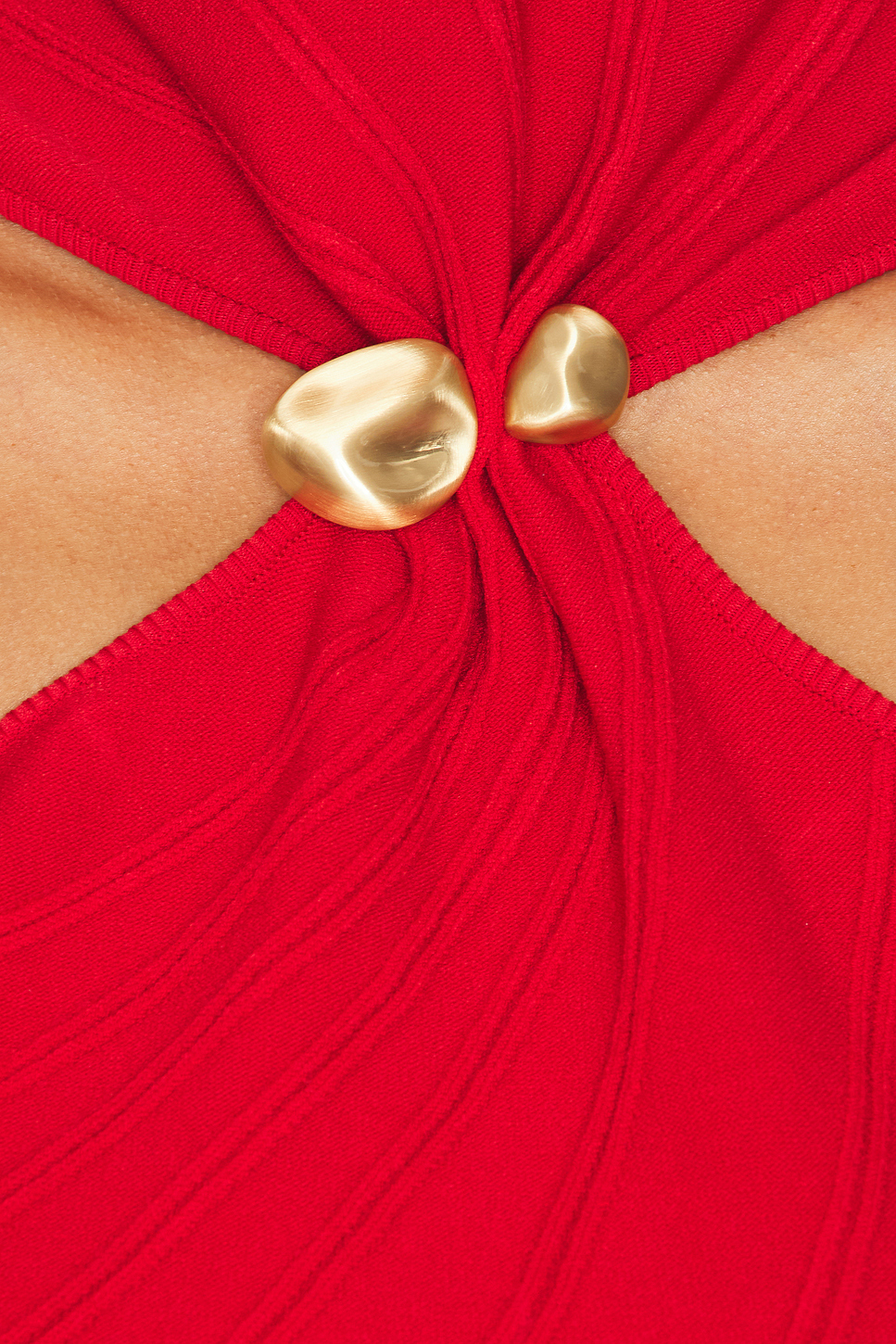
A halter neck midi dress listed as 72% rayon, 16% polyester, 11% nylon and 1% elastane in a heavyweight ponte cloth, unlined, closed with a hidden zip at the side of the neckline, with gold-tone hardware detailing at the front, hand wash cold, made in China, ranked twenty ninth in the retailer's midi dress list, at 594 dollars. There are no reviews and no fit votes, so there is no score to quote. Three things make this one the most informative page this series has examined in some time. It states its fabric construction in plain words, which resolves by direct evidence a question elsewhere here could only be inferred. It names its hardware, which supplies the missing piece in an argument about care instructions that has been running for several batches. And its measurements sit below the body in a way that now has several comparators. The reference is the Jessica Dress by Cult Gaia in Vermillion. Dongguan Bafinasa Garments Co., Ltd. develops comparable knit dresses on OEM and ODM terms, from ponte sourcing and hardware to retail or FBA ready packing. We publish this as a development reference and build your own version of it, and we do not supply the branded original or reproduce anyone else's label.
Key Features
- 72% rayon, 16% polyester, 11% nylon, 1% elastane as stated. See the note below on what that last figure does
- Heavyweight ponte cloth as stated, which names the construction outright. See the note below
- Unlined as stated
- Hidden zip closure at the side of the neckline as stated, which is an unusual placement worth noting
- Gold-tone hardware detailing at the front as stated, and this interacts with the care instruction. See the note below
- Hand wash cold as stated, and there is a real reason for it here
- Measurements published for one size, including length 50 in
- Made in China as stated
Customisable Options
- Fabric: ponte knit to the reference, with the weight set from a tested sample
- Fibre blend: rayon rich with polyester and nylon to the reference, and we would discuss raising the elastane slightly
- Hardware: gold-tone to the reference, with plating tested against whatever care method is chosen
- Closure: side neckline zip as stated, and we would offer a more accessible alternative
- Length from midi to ankle, ponte weight, hardware finish, closure options, size set, colour development, private label and care labelling
Specifications
| Style | Halter neck ponte midi dress |
| Reference | Cult Gaia, Jessica Dress, style GAIA-WD399, manufacturer style DR35236YN2494, colour Vermillion |
| Composition | 72% rayon, 16% polyester, 11% nylon, 1% elastane as stated. See the note below |
| Fabric | Heavyweight ponte cloth as stated, which names the construction. See the note below |
| Lining | Unlined as stated |
| Closure | Hidden zip at the side of the neckline as stated. See the note below |
| Hardware | Gold-tone hardware detailing at the front as stated. See the note below |
| Care | Hand wash cold as stated, which here has a clear justification |
| Sizes Published | XS, S, M, L |
| Measurements Published | S: bust 26 in, waist 24 in, hips 34 in, length 50 in |
| Chart Note | Every measurement sits at or below the model. See the note below |
| Coverage | Only size S has figures. XS, M and L are blank |
| Model | 178 cm, wearing size S, bust 79 cm, waist 62 cm, hips 86 cm |
| Production | Made in China as stated |
| Reference Retail | 594 USD, quoted to show the price band this sits in, not as our price |
| Customer Reviews | None on the reference listing, so we quote no score |
| Best Seller Badge | Rank 29 in the retailer's midi dress list, which is a mid position |
| Categories | Filed by the retailer under midi dresses and halter dresses, which explains the measurement pattern |
| Occasion | Evenings, occasions, dinners, celebrations |
| MOQ | 100 pcs per style per colourway, mixed sizes and colourways accepted |
| Sampling | 7-10 days after tech pack or reference sample confirmation |
| Bulk Lead Time | 20-30 days after sample approval and deposit |
| Service | OEM / ODM / private label, ponte knitting, metal hardware sourcing, retail or FBA ready packing |
Size Chart
| Size | Bust | Waist | Hips | Length | Source | ||||||||||||
|---|---|---|---|---|---|---|---|---|---|---|---|---|---|---|---|---|---|
| S | 26 | in | 24 | in | 34 | in | 50 | in / | 127 | cm | As published | ||||||
| XS | 31 | in / | 79 | cm | 24 | in / | 61 | cm | 34 | in / | 86 | cm | 127 | cm / | 50 | in | Our proposal |
| S | 33 | in / | 84 | cm | 26 | in / | 66 | cm | 36 | in / | 91 | cm | 129 | cm / | 50.8 | in | Our proposal |
| M | 35 | in / | 89 | cm | 28 | in / | 71 | cm | 38 | in / | 97 | cm | 131 | cm / | 51.6 | in | Our proposal |
| L | 37 | in / | 94 | cm | 30 | in / | 76 | cm | 40 | in / | 102 | cm | 133 | cm / | 52.4 | in | Our proposal |
The published size S gives a 26 inch bust, a 24 inch waist, a 34 inch hip and a 50 inch length against a model at roughly 31, 24 and 34. Every measurement sits at or below her, and with knit construction stated outright there is no longer any need to infer why.
Occasions and Styling
Suits evenings, occasions, dinners and celebrations. A fitted ponte halter in a bright red is an evening piece, and 50 inches is about 127 centimetres, which on a model at 178 centimetres falls around the ankle, so it covers more ground than the word midi usually suggests.
Production and Quality Control
There are no reviews and no fit votes on this listing, so there is no score to quote. This page states its fabric construction outright, names the hardware, and gives measurements that can be compared against several others. Each of those three settles something this series previously had to argue its way to.
The fabric says ponte, and that single word settles a question this series has had to infer twice, and that is the first thing. This series has several times found itself without a statement of how a cloth is constructed and asking what would explain what it was seeing. On one garment it deduced knit from nothing but a chart, having established four mechanisms by which a garment can measure smaller than the body covering it, being knit structure, elastane, cutting on the bias and shirring, and eliminated three to leave one. On another it found the word jersey sitting in the product title, which supplied a mechanism for a three size run, since knit accommodates more than one body because its loops can open. But this series also noted then that finding such words in titles is a pattern rather than a good practice, having since counted five cases where construction shows up in a product name rather than in a field. Here the word is neither deduced nor hidden in a title. It appears in the description, plainly, along with the weight. Ponte is worth describing because it explains several things at once. It is a double knit, made on a machine with two sets of needles so that two faces are interknitted, and that structure is what distinguishes it from single jersey: it is stable rather than curling at the edges, considerably thicker, and it recovers rather than sagging, which is precisely why it is used for garments meant to hold a shape. So stating it answers several questions before they are asked. It explains how a garment can measure at or under the body, since knit derives from loops that open. It explains why the hand is smooth and the drape substantial. And the word heavyweight alongside it tells you this is cloth with body rather than the lighter ponte sometimes used for trousers. Now compare that with what has been available elsewhere. A page in this same batch publishes nine pieces of information including its own knit construction, and does so at one nineteenth of another page's cost, so this is demonstrably possible rather than merely desirable. Which brings us to what makes this instance worth separating out from anything else here, and it is not the ponte. This garment contains one per cent elastane, which is comfortably the lowest figure met in this series. For several batches the threshold used here has been that below roughly five per cent elastane is a recovery additive rather than something a fit can rest on, while levels approaching a fifth genuinely compress a body, and that distinction recently explained why two garments declaring the same boned construction were doing quite different amounts of work. At one per cent there is no question at all, and it is worth asking why it is present, since there is a plausible answer. Rayon dominates this blend at seventy two per cent, and rayon is poor at recovering from being stretched, so a small amount of elastane is not here to compress anything but to stop the cloth going slack where it is pulled, in the manner a tiny amount of elastane prevents a wool garment bagging at the elbows. So the ponte supplies the compression and the elastane supplies the recovery, and distinguishing those two roles is the point worth carrying away.
Gold hardware named in a description, and this is the piece an argument has been missing for several batches, and that is the second thing. This series has examined several synthetic garments carrying strict care instructions and asked each time what the instruction was protecting, since the principle established early on is that a care instruction is set by the most fragile component rather than by the predominant fibre. In three of those cases no candidate could be found at all, and it was noted that this pointed toward habit at the level of the brand rather than judgement about the garment. In a fourth case a candidate emerged, though inferred rather than stated: the sheer organza whose crispness comes from finishing that water would remove. What was missing throughout was a listing that named the thing doing the deciding, and this one does, stating that there is gold-tone hardware at the front. So the comparison becomes concrete rather than speculative, and it runs like this. This series worked through what happens to metal trim on garments, most recently on a chiffon tunic whose embellishment was explicitly metallic, concluding that metal does not soften or curl with heat the way plastic does, so the pressing objection largely falls away, but brings a different set of problems: metal tarnishes or oxidises when it meets water and soap and is not dried promptly and thoroughly, and once a metallic surface has lost its brightness there is nothing that restores it, since there is no way to clean tarnish off a trim without damaging what surrounds it. Gold-tone names a particular version of that risk, and the distinction is worth stating. Tone means the colour rather than the substance, so what is being described is a plating or a coloured finish over some base metal, and any plated surface is a layer that can be worn through or lifted by abrasion and by prolonged contact with water. A solid fitting would tarnish and could be polished. A plated one cannot. Now place that beside the instruction actually given, which is hand wash cold. That is milder than anything those three unexplained garments offered, all of which were labelled dry clean only, yet here there is more metal to account for, since there is named hardware rather than an inference. Two conclusions follow and both are useful. The first is that hand wash cold with prompt drying is an adequate answer for plated hardware, so the instruction is defensible. The second is that this page is doing something none of the others did, which is telling the customer both facts at once, so she can understand why she is being asked to wash it by hand and will therefore be more likely to do it. That last point is the one this series keeps returning to, and it is worth stating once more in this form: the same water that removes the tarnish risk removes nothing at all if nobody is told it is there.
Everything at or below the body, a zip in an awkward place, and a length that disagrees with how it was filed, and that is the third thing. The published size gives a bust of 26 inches against a model at roughly 31, a waist of 24 against 24 and a hip of 34 against 34. So the bust is some five inches under her and the other two are equal. This series has met this shape before and built a way of reading it, having found it three times in recent batches and established that when the bust sits below the body while adjacent measurements sit at or above, the first question is whether the garment is strapless, halter or sleeveless, since each removes or weakens the landmarks a bust measurement depends on. This garment is filed under halter, so the rule applies immediately, and there being almost no elastane rules out compression, so the tape position remains the best available explanation. Two refinements are now possible because this page states more than those earlier ones did. The first is that this series met a counterexample recently, being a sleeveless organza where everything measured above the model, and explained it by whether the cloth drapes onto the body or stands away from it, since organza holds its own shape and has a clear gap for the tape to follow whereas draping cloths settle onto whoever is underneath. That completes the distinction worth carrying: a reading depends on both where the measurement was plausibly taken and what the cloth does while it is taken. Ponte drapes and is knit, so it lies close, which is exactly the condition that makes a bust reading unreliable. The second refinement is that at twenty six inches the bust here is further below the model than it was on any of those three, and if the cloth were woven rather than knit even that would be hard to accept, but as knit it is straightforward, since loops opening is enough to explain around five inches. Now the closure, which deserves separate mention because it is harder than its being a single zip suggests. A hidden zip at the side of the neckline means reaching up beside the neck to find a pull that cannot be seen, and closing it means holding two halves of a halter together with one hand while drawing with the other, all without sight of what you are doing. This series has noted before that position matters more than count, having looked at garments with several closures where the difficulty was where they sat rather than how many there were, and it noted on one recent page that hook and eye above a zip is doing useful quiet work by taking strain off the top of the zip rather than merely adding a movement. Here there is no such relief, and there is no second closure to help. One line of guidance would cost almost nothing. Finally the length, which is quietly interesting. Fifty inches is about 127 centimetres, and this series has consistently used 127 as the ankle point in a set of landmarks running 79 for mini, 113 for midi, 127 for ankle and around 140 for floor. On a model at 178 centimetres this falls near the ankle, yet the retailer files it under midi dresses. There is another garment in this batch measuring exactly fifty inches which is filed under maxi. So the same number produces two different words depending on who filed it, which is worth knowing before trusting any category label as though it were a measurement. Every bulk shipment gets a measurement report against your approved chart.
Optional upgrades include testing the plating on the hardware against whatever care method is chosen and publishing what was tested, since gold-tone means a layer that can lift, adding drying instructions explicitly, since tarnish needs prompt thorough drying and this is the step most often skipped, offering a second closure or relocating the zip, since reaching beside the neck without sight of it is harder than being told it is one closure suggests, either raising the elastane slightly or leaving it and saying the ponte is doing the work, publishing measurements for the remaining three sizes, publishing the length in centimetres given it is about 127, the hardware offered in a solid rather than plated finish as an alternative, alternative ponte weights, alternative lengths, extended sizing, colour development and private label, hangtag and care labelling.
Pre-production sample approval, in-line inspection during cutting and sewing, and a final AQL inspection before packing, with measurement reports and photos shared before shipment.
Send us your tech pack, a photo or a reference garment and we will quote within 24 hours. Contact bafinasa@bafinasa.com or WhatsApp +86 13827222469.