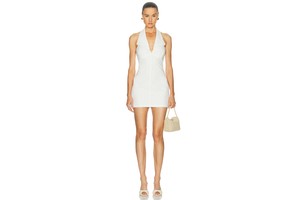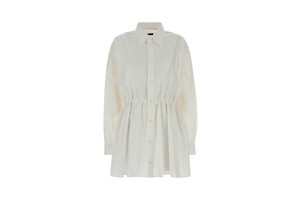
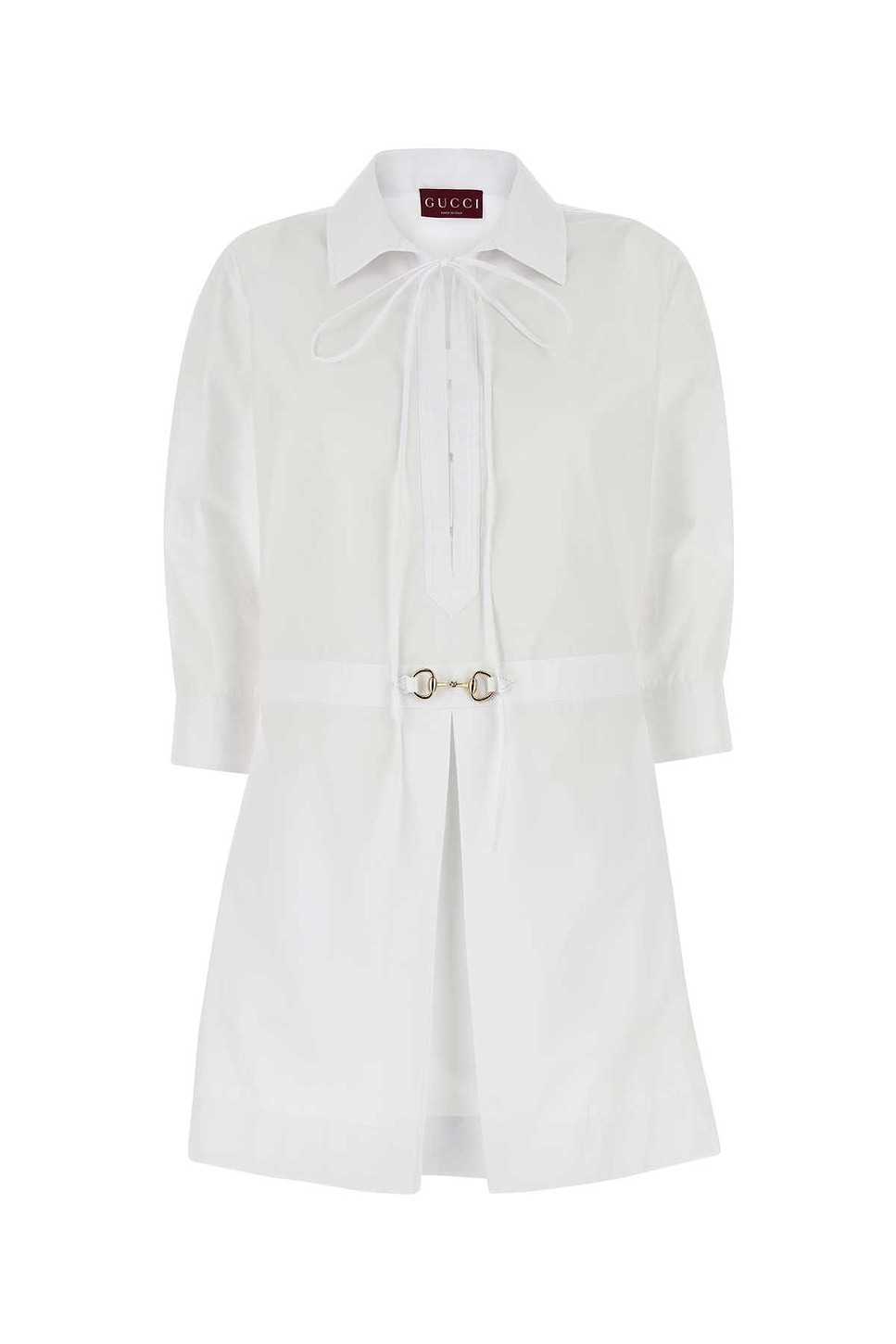
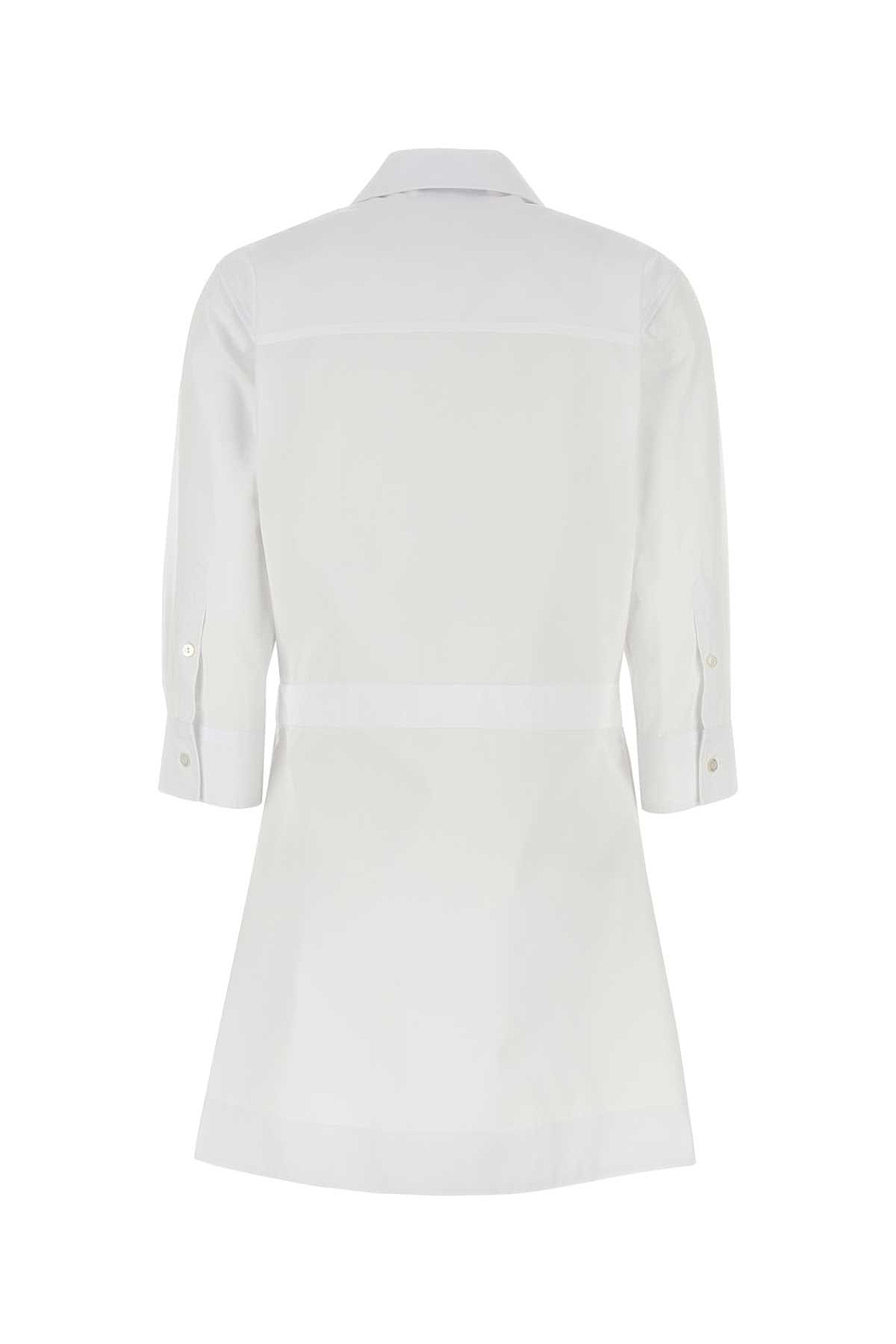
A shirt dress listed with a shell of 100% cotton, made in Italy, filed by the retailer under shirt dresses, at 2,283 dollars. There are no reviews and no fit votes, so there is no score to quote. The product information amounts to the composition, the country and two stock numbers, with two photographs and sizes 40 and 42. This is very nearly the same listing as one examined in a recent batch, differing in two small respects, and that closeness is what makes both of them readable. It also happens to be the clearest example yet of something this series has been arguing about how much a page tells you relative to what it costs. The reference is the Gucci white poplin shirt dress in White. Dongguan Bafinasa Garments Co., Ltd. develops comparable cotton shirt dresses on OEM and ODM terms, from fabric sourcing to retail or FBA ready packing. We publish this as a development reference and build your own version of it, and we do not supply the branded original or reproduce anyone else's label.
Key Features
- Shell: 100% cotton as stated. See the note below
- Poplin, named in the product title rather than in a specification
- White, which raises the opacity question before any other colour does
- Filed by the retailer under shirt dresses, which quietly says something about how this garment closes. See the note below
- Made in Italy as stated
- Two sizes published: 40 and 42. See the note below
- No care instruction stated anywhere on the listing
- No size chart, no measurements and no model figures published
Customisable Options
- Fabric: cotton poplin to the reference, with the weight and count set from a tested sample
- Weave: poplin kept, since it is what gives this cloth its dense smooth hand
- Closure: a full front placket to the reference, and we would specify button count and type rather than leaving it implied
- Opacity: we would state plainly whether this garment is lined, since white poplin is the hardest case there is
- Length from mini to knee, poplin weight, lining options, size set, colour development, private label and care labelling
Specifications
| Style | White cotton poplin shirt dress |
| Reference | Gucci, white poplin shirt dress, style FEXN-WD964, manufacturer style 832066Z8B11 9000, colour White |
| Shell | 100% cotton as stated. See the note below |
| Second Layer | Not stated, though the composition is given as a shell |
| Fabric | Poplin, named in the product title rather than in a specification |
| Opacity | Not stated on the listing, which for white poplin is the question most likely to be asked |
| Care | None stated on the listing |
| Sizes Published | 40 and 42, two adjacent sizes. See the note below |
| Measurements | None published. No size chart and no model body figures on this listing |
| Photographs | Two |
| Production | Made in Italy as stated |
| Reference Retail | 2,283 USD, quoted to show the price band this sits in, not as our price |
| Customer Reviews | None on the reference listing, so we quote no score |
| Best Seller Badge | None. The listing carries no rank |
| Categories | Filed by the retailer under shirt dresses, with no second category. See the note below |
| Occasion | Warm weather, daytime, professional settings, travel |
| MOQ | 100 pcs per style per colourway, mixed sizes and colourways accepted |
| Sampling | 7-10 days after tech pack or reference sample confirmation |
| Bulk Lead Time | 20-30 days after sample approval and deposit |
| Service | OEM / ODM / private label, cotton poplin sourcing, shirt dress construction, retail or FBA ready packing |
Size Chart
| Size | Bust | Waist | Hips | Length | Source | ||||||||||||
|---|---|---|---|---|---|---|---|---|---|---|---|---|---|---|---|---|---|
| 40 | 31 | in / | 79 | cm | 24 | in / | 61 | cm | 34 | in / | 86 | cm | 95 | cm / | 37.4 | in | Our proposal |
| 42 | 33 | in / | 84 | cm | 26 | in / | 66 | cm | 36 | in / | 91 | cm | 97 | cm / | 38.2 | in | Our proposal |
| 44 | 35 | in / | 89 | cm | 28 | in / | 71 | cm | 38 | in / | 97 | cm | 99 | cm / | 39 | in | Our proposal |
| 46 | 37 | in / | 94 | cm | 30 | in / | 76 | cm | 40 | in / | 102 | cm | 101 | cm / | 39.8 | in | Our proposal |
This listing offers two sizes, 40 and 42, and publishes no size chart, no measurements and no model body figures. There is nothing on the page from which a customer could judge the fit, and no length figure to indicate where this garment falls.
Occasions and Styling
Suits warm weather, daytime, professional settings and travel. A white cotton shirt dress is among the more versatile garments in a wardrobe, and it is worth knowing that white shows what is underneath it more readily than any other colour, which is why the opacity question arrives first here.
Production and Quality Control
There are no reviews and no fit votes on this listing, so there is no score to quote. This page and a page examined recently are close to identical, differing in two respects, and that closeness is what makes the pair readable. Both also belong to a larger pattern this series has been measuring about disclosure against price.
Nearly the same listing as one already examined, and the two differences are worth isolating, and that is the first thing. A recent batch looked at a white cotton poplin mini from another maker costing 2,191 dollars. Compare the two directly. Both describe the composition as a shell. Both say one hundred per cent cotton. Both name the fabric only in the product title, using the same word for it. Both are made in Italy. Both publish nothing beyond the composition, the country and two stock numbers. Both carry two photographs. Neither publishes a care instruction, a size chart, measurements or a model figure. Neither states whether there is a lining. Neither says anything about opacity, and both are white. The price differs by ninety two dollars, which is about four per cent. Everything else that distinguishes them comes down to two things. The first is size offering: that garment published a single size, 36, while this one publishes two adjacent sizes, 40 and 42. The second is how the retailer filed them: that one under mini dresses, this one under shirt dresses. Each of those two differences is more informative than it first looks. On the first, this series has noted that consecutive runs of two prove very little, since clearing stock easily leaves two adjacent sizes, whereas three or more in sequence are hard to explain by accident. So having two here rather than one does not materially improve our ability to reason about intent; it tells us only that there are two pieces rather than one. On the second difference, the filing is doing real work, and it is the interesting part of this pair. This series has repeatedly observed these category labels contributing information by accident, when pages this sparse have nothing else to give: a garment filed under sweater dresses had its knit structure stated by implication; one filed under long sleeve dresses disclosed coverage nowhere else published; one filed under shift dresses explained measurements that looked wrong but were simply what that silhouette is. Shirt dress belongs in that sequence, and what it says here is how this garment closes. A shirt dress takes its shape from shirting, which means a full front placket with buttons, usually a collar, and a body cut to be opened and stepped into rather than pulled over. So although no closure is described anywhere on this page and there are no measurements to infer from, the category alone tells the customer this is a garment that opens down the front. That is genuinely useful, and it is worth noting how quietly it arrives. Comparing the pair makes one further point, and it is perhaps the most interesting thing about them: the same fewer ought not to be assumed, since the difference between these two pages are entirely about describing the garment rather than about how much trouble anyone went to. Neither had more attention than the other, so what differs between them is just what was available to say.
Two thousand two hundred and eighty three dollars buys the composition, the country and nothing else, and this batch supplies both ends of that comparison, and that is the second thing. This series has argued throughout that disclosure has no relationship at all to what a garment costs, and has assembled the case piece by piece: listing after listing above a thousand dollars publishing four lines or fewer; a batch in which three separate garments above 1,900 dollars disclosed identically little; and most recently the highest priced garment yet examined at 3,448 dollars offering less than most things costing a tenth of it. Each time the same explanation was offered, and it holds here without modification. Everything else on a listing costs effort, whether that is a photographic session, a copywriter, or somebody standing with a tape measure over a sample garment. A care instruction costs none of those things. It requires only knowing what the cloth is and what was done to it, and both of those are settled before the garment is even finished. So its absence here is not a resource limit, and saying so matters because the alternative reading, that the money went elsewhere, is the one people usually reach for. What makes this batch unusual is that it supplies the counterpart in the same six garments. Elsewhere in this batch is a cotton jersey t-shirt dress costing 120 dollars which publishes nine pieces of information, the fibre, the country, a care instruction, whether it is lined, how it closes, the fabric weight, the fabric construction, measurements across five sizes including sleeve length, and model figures, along with five photographs. That is one nineteenth of this garment's price and roughly four times the information. Putting the two numbers side by side matters more than either alone, because when this series made this argument before, it always compared across wide price gaps, which invites the objection that cheaper garments say more because they have nothing else to sell. Nineteen to one removes that objection entirely. It also strengthens something observed recently, which is that even a small price difference can come with a very large difference in disclosure, a twenty five per cent gap having been noted to accompany roughly twice the detail. This is that observation carried to its conclusion.
Two remaining observations, one about a word that quietly gives more than it appears to and one about what white costs, and that is the third thing. The first concerns poplin. This series has tracked how often a useful fact ends up in a product name rather than in a field, starting with the word for knit hidden in a French product title where only a French speaker would find it, and continuing through twill, poplin already once before, jersey, and broderie anglaise, where it was noted that those three words do more work than the others because they mean openwork and therefore mean the garment is sheer somewhere. This is now the sixth instance and the second appearance of this particular word. What it tells you is genuinely useful and should be set out, since it is a specification sitting in plain sight. Poplin is a plain weave made with fine warp yarns packed closely against heavier weft yarns, which gives a cloth with faint crosswise ribs, a dense smooth surface and a crisp hand. Density is the operative word here, because it bears directly on the question this page declines to answer. A densely packed weave transmits less light than a loose one of the same fibre and weight, so poplin is a comparatively good choice for something being made up in white. There is a real irony in that, which is worth naming because it recurs: this page declines to say anything about opacity while accidentally supplying the most reassuring fact available to it in two words a customer is likely to skip past. The second observation is what white costs, and this series has returned to this often enough that the argument is short. Whether light passes through a cloth cannot be judged from photographs taken under flattering light, since lighting is arranged to make the garment look its best, so the customer cannot see it and must either ask or guess. Recent batches have made clear how much better this can be handled, because four garments have now stated their transparency in plain words and three of them used an identical sentence despite coming from three unrelated makers, which settled that this is a retailer level rule rather than one brand being conscientious, and one of those three even added the clause nobody else considered, being that whatever is needed underneath does not come with it. This page states none of it. It says nothing about lining, nothing about opacity, and nothing about care. Standing in front of a white cotton dress costing 2,283 dollars, the customer has two photographs and nothing else. Every bulk shipment gets a measurement report against your approved chart.
Optional upgrades include stating whether there is a lining and therefore what happens about opacity, which is the question white asks before any other colour, adding a care instruction even though cotton is the most washable fibre in this series and the correct answer is permissive, specifying the closure explicitly rather than leaving it to be inferred from the word shirt, keeping poplin for its density and saying so in a field rather than only in the name, more than two sizes offered since two adjacent figures tell the customer nothing about intent, measurements published at the very least for size 40, the length stated so the silhouette can be placed, alternative poplin weights and counts, alternative lengths, colour development including pale shades tested for opacity specifically, private label, hangtag and care labelling.
Pre-production sample approval, in-line inspection during cutting and sewing, and a final AQL inspection before packing, with measurement reports and photos shared before shipment.
Send us your tech pack, a photo or a reference garment and we will quote within 24 hours. Contact bafinasa@bafinasa.com or WhatsApp +86 13827222469.