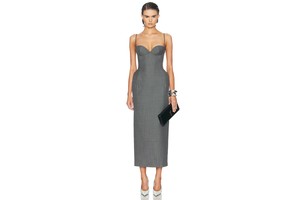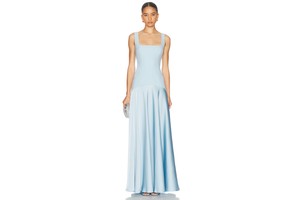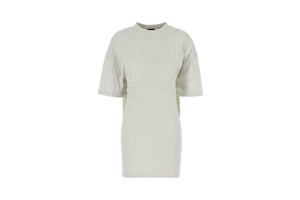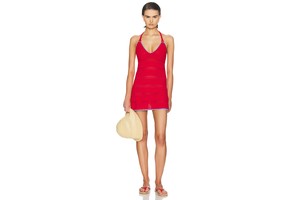
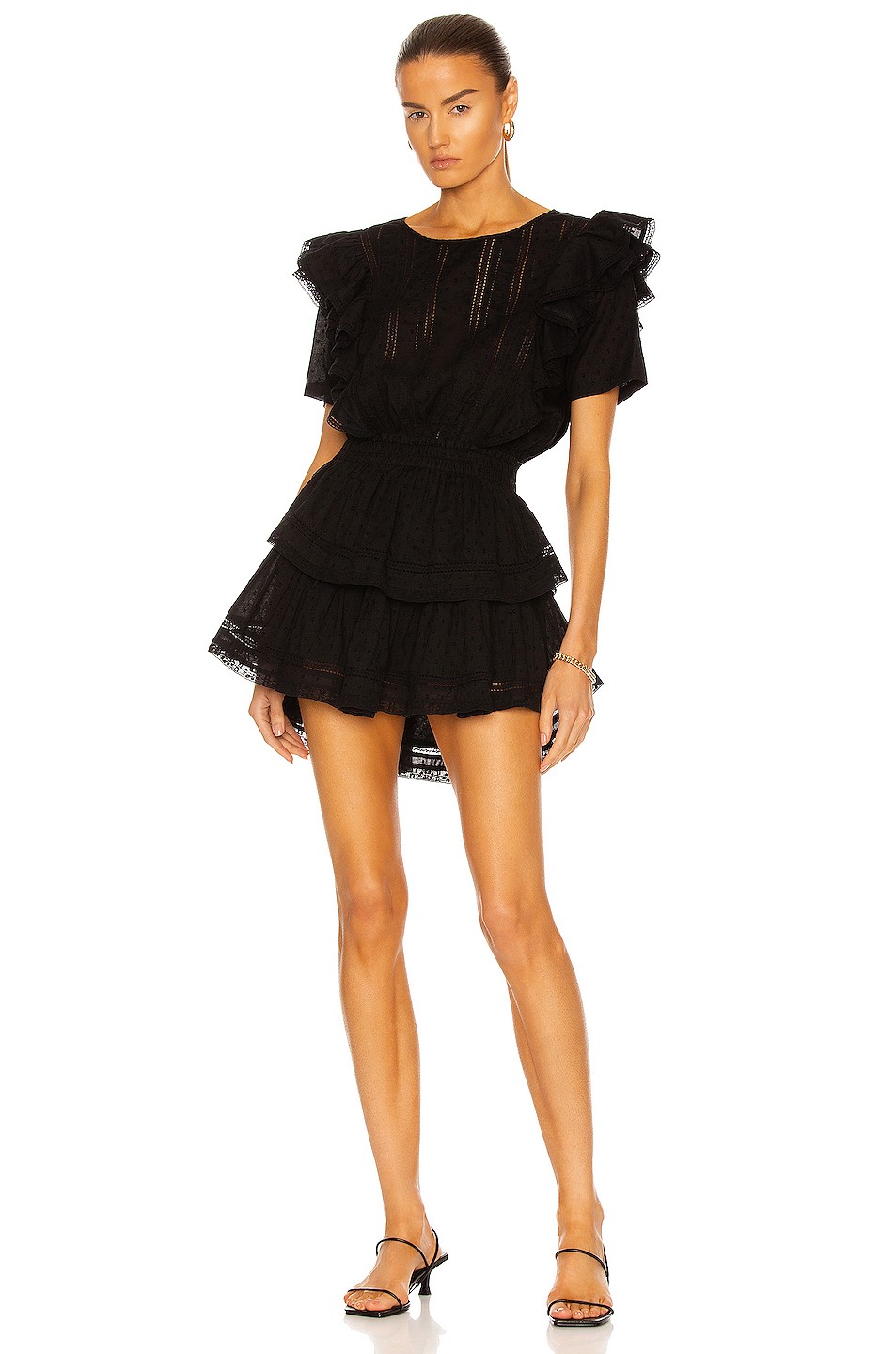
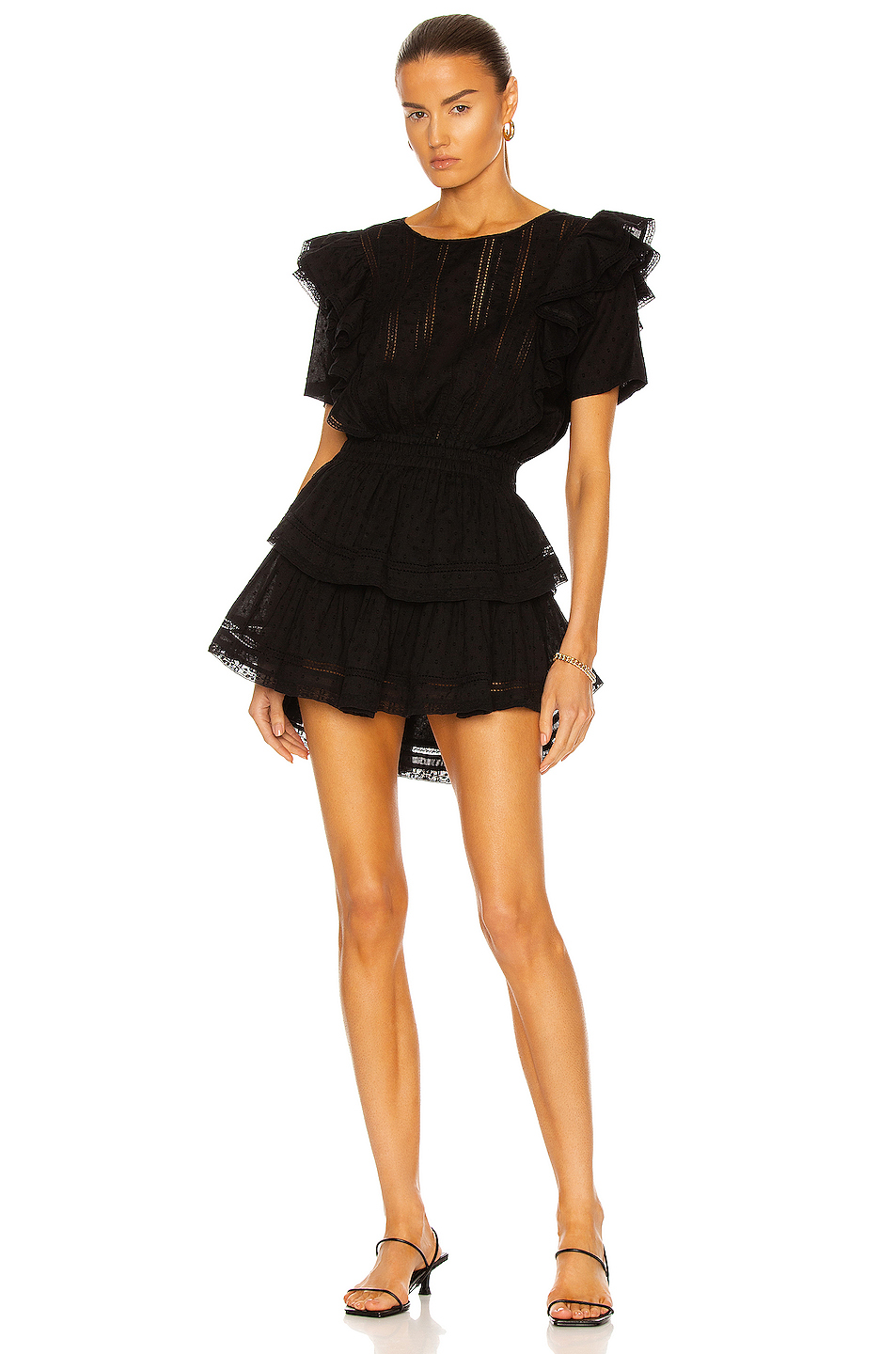
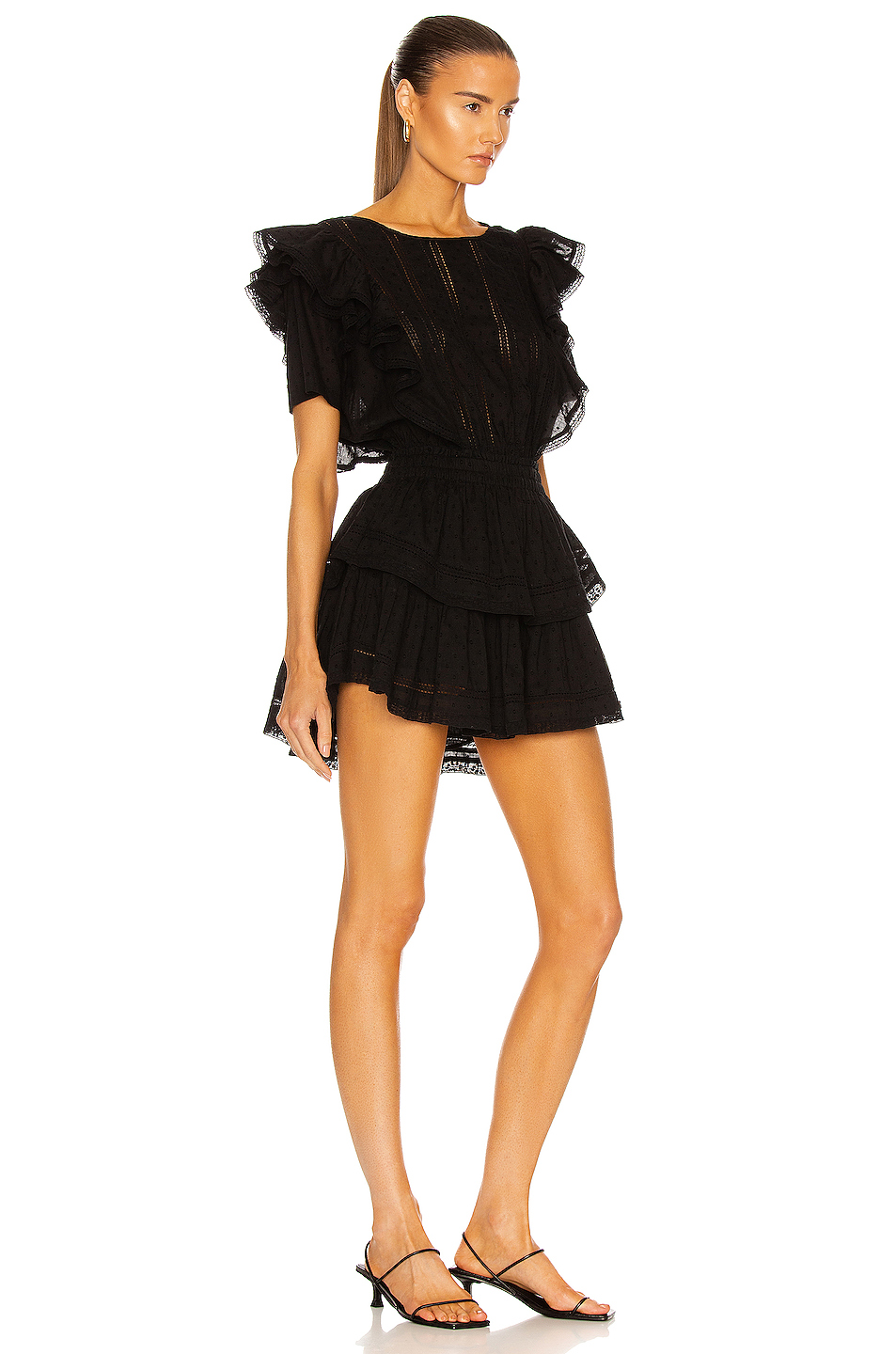
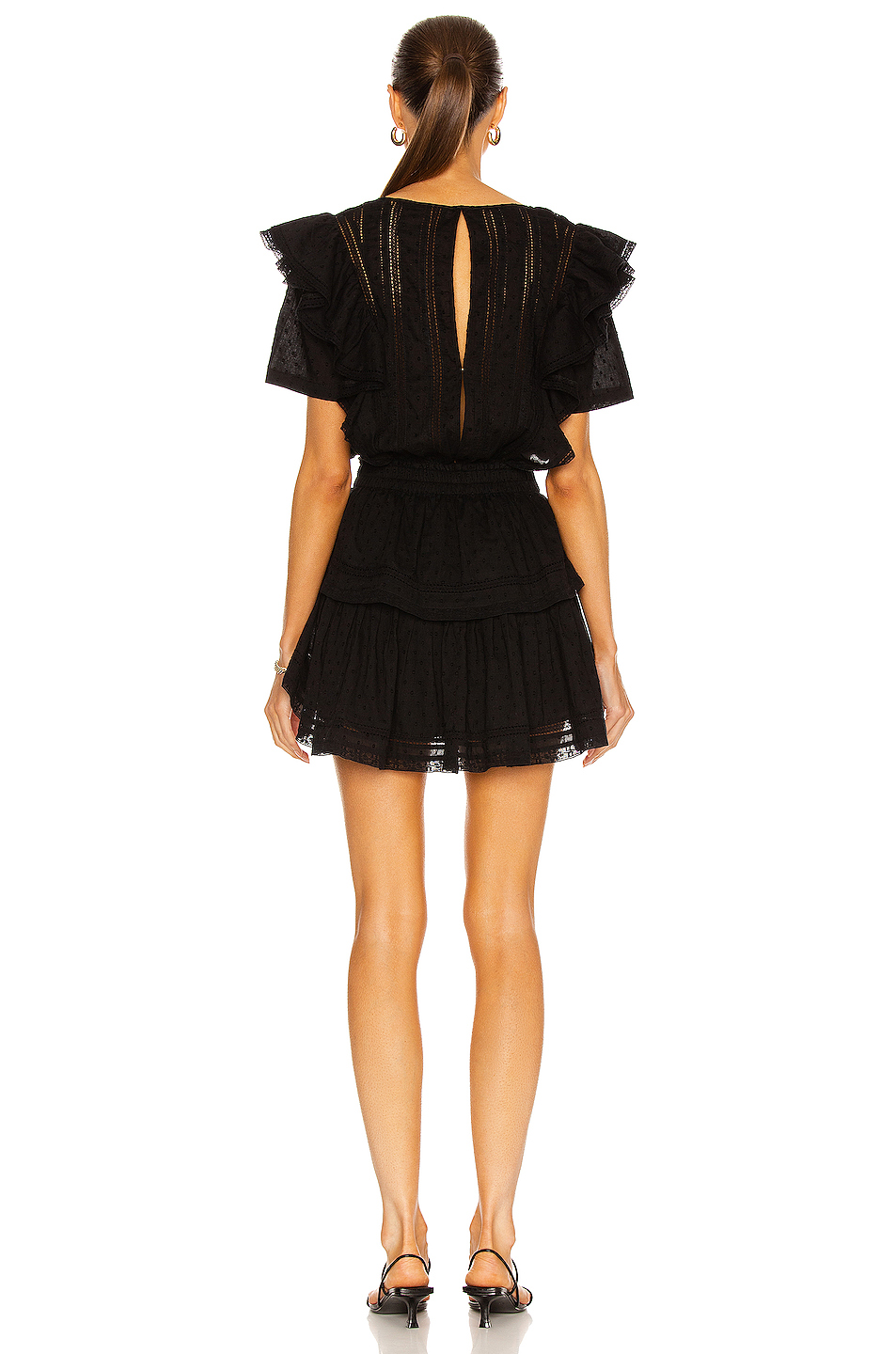
A black mini dress listed in 100% cotton, hand wash, partially lined, with eyelet detail at the back and hook fastening at the skirt, an elasticated waist, layered fabric along the shoulders and skirt, and cut threadwork mesh, made in India, ranked thirty eighth in the retailer's black dress list, at 345 dollars. There are no reviews and no fit votes, so there is no score to quote. This is the most complete set of measurements this series has been given, four sizes across five dimensions, and examining it closely shows that having figures is not the same as having usable ones. There is also an unusual amount of construction detail here, and one of those details decides the fit question rather than merely decorating. The reference is the Natasha Dress by LoveShackFancy in Black. Dongguan Bafinasa Garments Co., Ltd. develops comparable cotton eyelet dresses on OEM and ODM terms, from fabric sourcing and eyelet embroidery to retail or FBA ready packing. We publish this as a development reference and build your own version of it, and we do not supply the branded original or reproduce anyone else's label.
Key Features
- 100% cotton as stated, with hand wash as stated
- Partially lined as stated, which is the third time this wording has appeared here
- Eyelet detail at the back as stated, together with cut threadwork mesh. See the note below
- Elasticated waist as stated, and this is what settles the difficult reading. See the note below
- Layered fabric along the shoulders and skirt as stated
- Hook fastening at the skirt top as stated
- Made in India as stated
- Measurements published across four sizes and five dimensions, which is more than any other page here. See the note below
Customisable Options
- Fabric: cotton with eyelet embroidery to the reference, with the ground cloth weight specified
- Trim: cut threadwork mesh and layered fabric to the reference
- Lining: partial to the reference, and we would say which parts rather than only that it is partial
- Waist: elasticated to the reference, and we would state the relaxed and extended measurements separately
- Care: hand wash to the reference, validated by washing trials since embroidery and cotton respond differently
- Length from mini to knee, eyelet pattern, lining placement, size set, colour development, private label and care labelling
Specifications
| Style | Cotton eyelet layered mini dress |
| Reference | LoveShackFancy, Natasha Dress, style LNCF-WD5, manufacturer style LD194-263, colour Black |
| Composition | 100% cotton as stated |
| Fabric | Cotton with eyelet embroidery and cut threadwork mesh as stated. See the note below |
| Lining | Partially lined as stated. See the note below |
| Care | Hand wash as stated |
| Waist | Elasticated waist as stated, which matters for reading the chart. See the note below |
| Closure | Eyelet detail at the back with hook fastening at the skirt top as stated |
| Detail | Layered fabric along the shoulders and skirt as stated |
| Sizes Published | XS, S, M, L and XL, five sizes |
| Measurements Published | XS to L: bust 34, 35, 36 and 37 in, hip 37, 38, 39 and 40 in, length 32.5 to 34 in, sleeve 9 to 10 in. See the note below |
| Chart Note | The waist column does not behave like the others, and there is a way to work around it. See the note below |
| Coverage | Four of five sizes carry figures. Only XL is blank, which is unusual here |
| Model | 179 cm, bust 86 cm, waist 61 cm, hips 86 cm, wearing size S |
| Photographs | Three |
| Production | Made in India as stated |
| Reference Retail | 345 USD, quoted to show the price band this sits in, not as our price |
| Customer Reviews | None on the reference listing, so we quote no score |
| Best Seller Badge | Rank 38 in the retailer's black dress list. Note the category is colour rather than length |
| Categories | Filed by the retailer under black dresses and mini dresses |
| Occasion | Summer, holidays, warm weather, casual occasions |
| MOQ | 100 pcs per style per colourway, mixed sizes and colourways accepted |
| Sampling | 7-10 days after tech pack or reference sample confirmation |
| Bulk Lead Time | 20-30 days after sample approval and deposit |
| Service | OEM / ODM / private label, cotton eyelet sourcing, embroidery development, retail or FBA ready packing |
Size Chart
| Size | Bust | Waist | Hips | Length | Source | ||||||||||||
|---|---|---|---|---|---|---|---|---|---|---|---|---|---|---|---|---|---|
| S | 35 | in | 36 | in | 38 | in | 33 | in / | 84 | cm | As published | ||||||
| XS | 31 | in / | 79 | cm | 24 | in / | 61 | cm | 34 | in / | 86 | cm | 83 | cm / | 32.7 | in | Our proposal |
| S | 33 | in / | 84 | cm | 26 | in / | 66 | cm | 36 | in / | 91 | cm | 85 | cm / | 33.5 | in | Our proposal |
| M | 35 | in / | 89 | cm | 28 | in / | 71 | cm | 38 | in / | 97 | cm | 87 | cm / | 34.3 | in | Our proposal |
| L | 37 | in / | 94 | cm | 30 | in / | 76 | cm | 40 | in / | 102 | cm | 89 | cm / | 35 | in | Our proposal |
This listing publishes four sizes across five dimensions, which is more than any other page examined here. The bust, hip, length and sleeve columns increase steadily by about an inch per size, and that internal consistency is exactly what allows the remaining column to be checked against them.
Occasions and Styling
Suits summer, holidays, warm weather and casual occasions. Eyelet is comfortable in heat because the holes ventilate it, and this one is partially lined, so it will be a little warmer than an unlined version and a good deal less transparent than it would otherwise be.
Production and Quality Control
There are no reviews and no fit votes on this listing, so we quote no score. This publishes more measurements than any other page examined here, and looking at them closely shows that having figures is not the same as having usable figures. One stated construction detail also turns out to decide the fit question.
Four sizes across five dimensions, and one column does not fit, and that is the first thing. To be clear about how unusual this page is: it publishes twenty figures, being four sizes across bust, waist, hip, length and sleeve, and four sizes out of five offered carry them. This series has spent enormous space complaining about pages offering many sizes with one measured, having noted recently that some patterns repeat often enough to be systematic rather than accidental, and compared against that record this is genuinely the best thing encountered. So it is more useful to say what examining it reveals than merely to praise it. Take the columns one at a time. Bust runs 34, 35, 36 and 37, so exactly one inch per size. Hip runs 37, 38, 39 and 40, again one inch per size. Length runs 32.5, 33, 33.5 and 34, so half an inch per size. Even sleeve rises steadily. Those four columns describe a consistent garment being graded in a regular way, and that is what makes examining the fifth possible at all. Waist runs 24, 36, 38 and 30. It rises by twelve inches from XS to S, then by two, then falls by eight. That is not a garment, because grading does not reverse direction and it certainly does not make the largest size smaller than the one below it. Some of those figures cannot describe the same dress. Now, why this is worth dwelling on rather than merely noting is that it demonstrates something this whole series has been circling for dozens of listings. The argument has been that these pages do not tell customers enough, and the natural reading of that argument is that the fix is more numbers. This page supplies more numbers than any other and still cannot be trusted on one dimension, which means the problem was never quantity alone. More data is only an improvement when the data is right, and completing a table is not the same as completing it correctly. There is a practical consequence that is actually useful, and this series would rather give a customer something she can act on than merely criticise. Because four columns behave consistently and only one does not, she has a way to proceed: measure against bust and hip, whose internal behaviour is regular and therefore trustworthy, and disregard waist. And by a genuinely fortunate coincidence, waist is the one measurement this garment does not need from a chart, because of the elasticated waist discussed below. The single unreliable column is also the single least necessary one.
An elasticated waist, which explains several things at once, and that is the second thing. The listing states an elasticated waist, and this series has catalogued the mechanisms by which a garment can fit a body smaller than itself, having built up four over many examinations and recently added a fifth after looking at a boned bodice drawn closed with ties and hooks. Those were knit structure, since loops open; elastane high enough to compress rather than merely recover; cutting on the bias, though that works in one direction rather than uniformly; shirring, where gathered elastic thread draws cloth in and releases; and then closure that is adjusted rather than stretched. An elasticated waist belongs to that last family, and it is worth saying what distinguishes the family, which is that nothing needs to stretch for it to work. Knit relies on loops opening and elastane relies on the fibre itself extending, and both can fatigue over time. An elasticated waist is different: the cloth is gathered and elastic is threaded through or behind it, so there is already more fabric than the circumference needs and the elastic decides how much is drawn in. Because nothing is being stretched to its limit, it does not fatigue in the way compression does, and because it is gathered rather than tightened by a single fastening it distributes over the whole circumference rather than concentrating at one point. What makes this genuinely useful on this particular page is how it interacts with the unreliable column. A waist figure on a chart normally tells a customer the single most important thing about whether a garment will close. On an elasticated waist there is no single figure to give, since there is a relaxed measurement and an extended one and the useful range is everything between them. So either those four waist figures are attempts to express one of those two states, in which case comparing them across sizes makes little sense, or they are simply wrong, and it is impossible to tell which from here. Either way the conclusion is the same and it is reassuring: this is precisely the garment where a bad waist figure costs least, because the fit at the waist is provided by the elastic rather than by anybody choosing the right number. There is something further worth adding about what an elasticated waist does to silhouette, since this series has recently started seeing shape categories doing useful work. It permits a garment to be loose elsewhere without the whole thing reading as shapeless, because whatever the body above and below is doing, the waist is drawn in. Looking at these numbers again with that in mind, hip runs sixteen to twenty six inches above the model depending on the size, and that amount of ease reads very differently once something is gathering it at the middle.
Openwork again, and this time it is named twice over, alongside a hand wash instruction on cotton, and that is the third thing. This page states eyelet detail at the back and also cut threadwork mesh, and this is now the third time this series has met eyelet under that name and the fourth member of the openwork family altogether, having begun with three French words that were noted to mean openwork and therefore to mean the garment is sheer in places, then met the same thing under its English name, and most recently seen it combined with a further open construction. What distinguishes openwork from everything else in this series is that it is the one case where sheerness is not incidental but definitional: the holes are deliberately introduced, they are distributed rather than clustered, and they go all the way through, so light passes wherever there is a hole and not wherever there is cloth. This series argued recently that this makes a lining the thing letting the garment be worn rather than a refinement, and stated that fairly strongly. It is worth qualifying that now, because this page and the three others settle it between them. Across those four garments the same problem has been answered four different ways: one was lined, one was fully lined, one was partially lined, and this one is partially lined too but not for the same reason as anything above. So required was too strong a word, since it plainly is not: there are choices being made here, not a constraint being obeyed, and this series should say so plainly rather than let earlier phrasing stand uncorrected. Now, the interesting thing about partial lining on this particular garment, and the reason it belongs with the features rather than only with the numbers, is that partial here follows from something rather than being a compromise. The eyelet is described as being at the back, and cut threadwork mesh is described too, so the open qualities are placed rather than distributed over the whole garment. Lining part of a garment whose openness is localised is a coherent decision, and the natural reading is that whatever is most open is what got covered. That still leaves the useful question unanswered, which is which parts, and that has now come up on every page using this wording, so it can be stated plainly: partial answers more than nothing but invites the obvious next question and does not answer it. On the instruction, this series has now seen cotton handled three ways in quick succession, machine washable once, hand wash cold once, and hand wash here. All three are defensible on this fibre, which is the most washable examined here, being stronger wet than dry, immune to felting, and prone to losing neither half its strength nor permanently marking. But there is something else on this garment that argues for care, which is the embroidery itself. Eyelet edges are raw and stitched only to stop them fraying, so there are many edges and each is a place a caught thread can begin, and this is the same reasoning applied recently to another open structure, where it was noted that such damage cannot be undone. So the hand wash instruction here is proportionate rather than habitual, which this series has not always been able to say. Every bulk shipment gets a measurement report against your approved chart.
Optional upgrades include publishing the waist figures correctly, since four columns are consistent and only that one cannot describe a real garment, giving the relaxed and extended waist measurements separately, which is what an elasticated waist actually requires, saying which parts are lined rather than only that it is partial, since the answer is different on every garment using that word, specifying the ground cloth weight since eyelet sheerness depends as much on the cloth between the holes as on the holes, adding the fifth size to the chart, since four out of five is close to being complete, keeping hand wash and saying that it protects the embroidery edges rather than the cotton, which reframes it as proportionate, alternative eyelet patterns since the pattern decides how much is open, alternative embroidery placements, colour development, private label, hangtag and care labelling.
Pre-production sample approval, in-line inspection during cutting and sewing, and a final AQL inspection before packing, with measurement reports and photos shared before shipment.
Send us your tech pack, a photo or a reference garment and we will quote within 24 hours. Contact bafinasa@bafinasa.com or WhatsApp +86 13827222469.