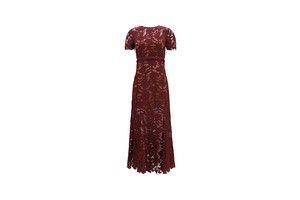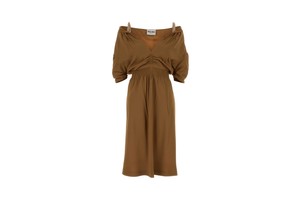
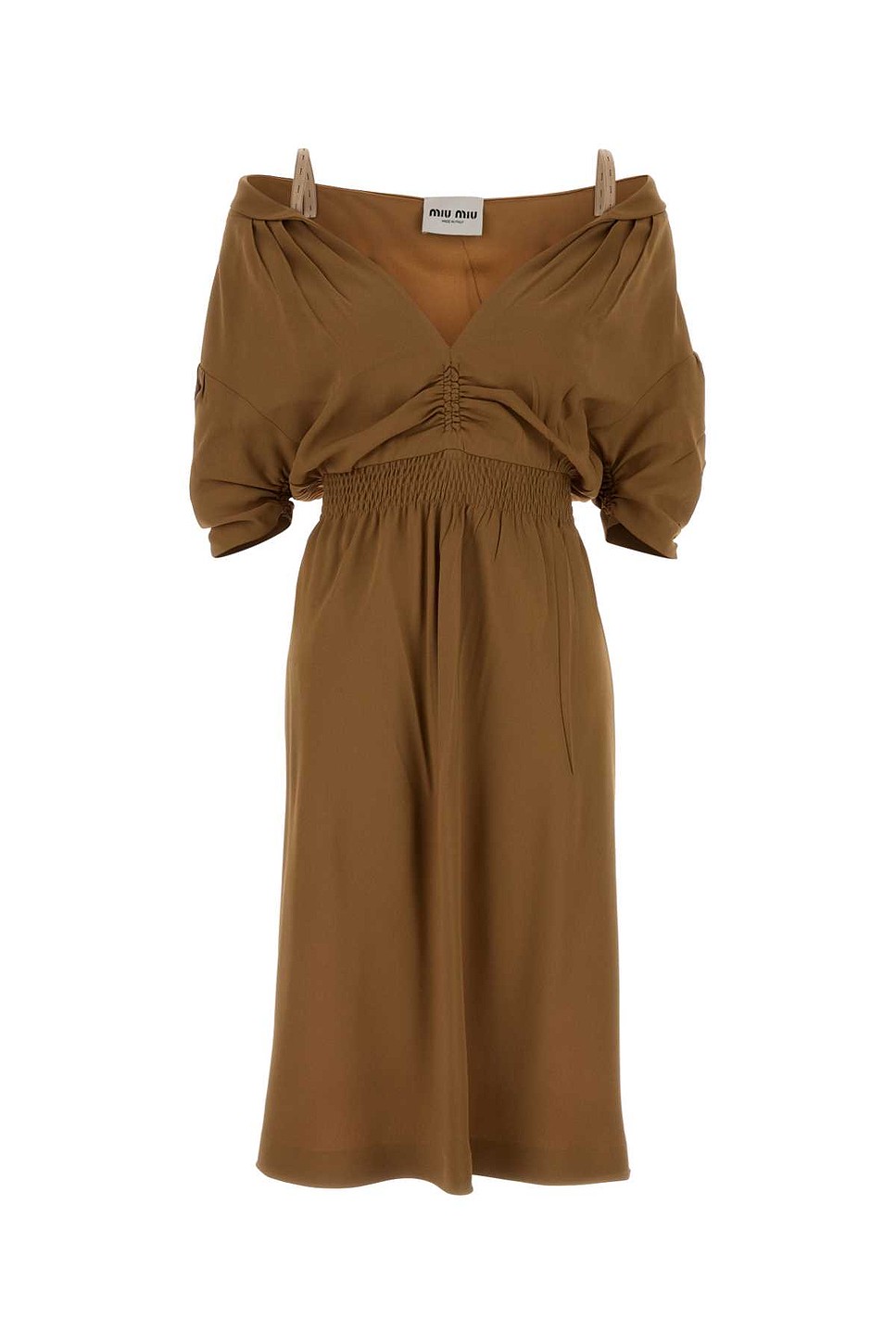
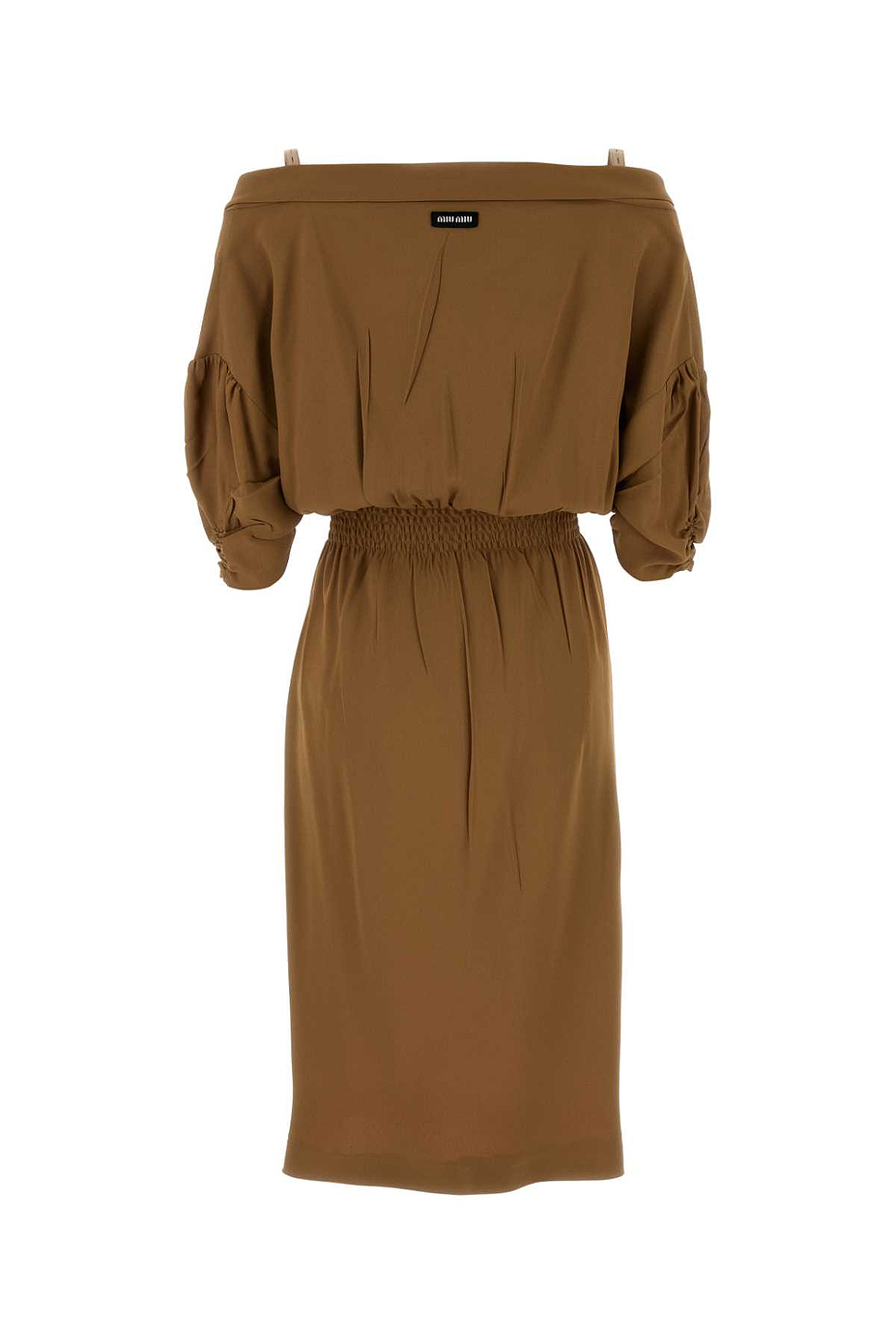
A short sleeve dress listed with a shell of 74% acetate and 26% viscose, in crepe, made in Italy, at 2,768 dollars. There are no reviews and no fit votes, so there is no score to quote. The whole product information is four lines: the composition, the country, and two stock numbers. There is no care instruction, no size chart, no measurements and no length, and two photographs. What makes this one worth attention is not anything missing, since the gaps are the same ones seen repeatedly, but something present: this composition appeared already in this series, on a completely different garment at a very different price, and finding the same pair of numbers twice changes what each listing tells you. There is also a size run here that only becomes legible when read against two others in this same batch. The reference is the Miu Miu camel crepe dress in Camel. Dongguan Bafinasa Garments Co., Ltd. develops comparable crepe dresses on OEM and ODM terms, from fabric sourcing to retail or FBA ready packing. We publish this as a development reference and build your own version of it, and we do not supply the branded original or reproduce anyone else's label.
Key Features
- Shell: 74% acetate, 26% viscose as stated, which is an identical composition to another garment examined in this series
- Crepe fabric as stated. See the note below
- Made in Italy as stated
- Filed by the retailer under short sleeve dresses
- Two consecutive sizes published: 40 and 42. See the note below
- No care instruction stated anywhere on the listing
- No size chart, no measurements and no model body figures published
- No second layer described despite the composition being given as a shell
Customisable Options
- Fabric: acetate viscose crepe to the reference, with the weight set from a tested sample
- Care: we would add dry clean only, since both fibres in this composition demand it
- Lining: we would either establish what the shell implies or state that there is none
- Sizing: consecutive sizes suggest a deliberate narrow run, so we would confirm that against the pattern
- Length from mini to midi, crepe weight, sleeve length, size set, colour development, private label and care labelling
Specifications
| Style | Acetate viscose crepe dress |
| Reference | Miu Miu, camel crepe dress, style FEXN-WD1254, manufacturer style MF6048SOOO16Z1 F0040, colour Camel |
| Shell | 74% acetate, 26% viscose as stated. See the note below, since this exact pair of numbers appeared once already |
| Second Layer | Not stated, though the composition is given as a shell |
| Fabric | Crepe as stated, which describes a texture rather than a fibre |
| Care | None stated on the listing. See the note below |
| Sizes Published | 40 and 42, consecutive. See the note below |
| Measurements | None published. No size chart and no model body figures on this listing |
| Photographs | Two |
| Production | Made in Italy as stated |
| Reference Retail | 2,768 USD, the highest reference price in this series so far |
| Customer Reviews | None on the reference listing, so we quote no score |
| Best Seller Badge | None. The listing carries no rank |
| Categories | Filed by the retailer under short sleeve dresses, with no second category |
| Occasion | Formal daytime, events, occasions, city |
| MOQ | 100 pcs per style per colourway, mixed sizes and colourways accepted |
| Sampling | 7-10 days after tech pack or reference sample confirmation |
| Bulk Lead Time | 20-30 days after sample approval and deposit |
| Service | OEM / ODM / private label, acetate sourcing, crepe development, retail or FBA ready packing |
Size Chart
| Size | Bust | Waist | Hips | Length | Source | ||||||||||||
|---|---|---|---|---|---|---|---|---|---|---|---|---|---|---|---|---|---|
| 38 | 31 | in / | 79 | cm | 24 | in / | 61 | cm | 34 | in / | 86 | cm | 92 | cm / | 36.2 | in | Our proposal |
| 40 | 33 | in / | 84 | cm | 26 | in / | 66 | cm | 36 | in / | 91 | cm | 94 | cm / | 37 | in | Our proposal |
| 42 | 35 | in / | 89 | cm | 28 | in / | 71 | cm | 38 | in / | 97 | cm | 96 | cm / | 37.8 | in | Our proposal |
| 44 | 37 | in / | 94 | cm | 30 | in / | 76 | cm | 40 | in / | 102 | cm | 98 | cm / | 38.6 | in | Our proposal |
This listing publishes no size chart, no measurements and no model body figures, and offers two consecutive sizes, 40 and 42. There is nothing on the page from which a customer could judge the fit or the length, and no sleeve length either, despite how the retailer files it.
Occasions and Styling
Suits formal daytime, events, occasions and city wear. An acetate crepe dress in camel is an occasion piece rather than a casual one, and it is worth knowing that crepe's characteristic surface texture is the reason it hides creases well.
Production and Quality Control
There are no reviews and no fit votes on this listing, so there is no score to quote. Something present here rather than something missing is what makes this one interesting, and it is the size run's meaning, which only resolves when three garments are read together.
This exact pair of numbers has appeared before in this series, on a different garment at a very different price, and that changes what each of them tells you, and that is the first thing. The shell is 74% acetate and 26% viscose. Those are the same two figures, in the same order, as another dress examined recently in this series, which was a pale green satin at 1,142 dollars. Here the same composition, described as crepe rather than satin, carries a reference price of 2,768 dollars, so the two differ by 1,626 dollars, which is to say the second costs more than twice the first. There are two things worth drawing from that, and they pull in different directions. The first is that this is very probably not coincidence. A ratio like seventy four to twenty six is not the kind of number arrived at twice independently, and it looks like a standard cloth: this series noted when discussing another acetate and viscose combination that acetate contributes drape and a high lustre, and the fact that both garments are made in Italy and both are carried under a buyer store field suggests the same handful of mills supplying a recognisable grade. The second thing is harder and more useful. If those two garments are substantially the same cloth, then the difference between 1,142 and 2,768 dollars is not fibre cost. It is weight, finish, construction, hardware, the number of operations in assembly, whatever lining exists, and the name attached to it. That is genuinely informative for anyone developing product, because it indicates how much of a retail price is available to be spent on those decisions rather than on the raw material. There is a caution that belongs beside it. Knowing the two share a composition tells you nothing about whether they share anything else, since the same figures can describe cloths of quite different weights and finishes, and this series has more than once had cause to note that texture and construction words such as crepe, satin, poplin and twill describe how yarns are arranged and say nothing whatsoever about what they are made of. So the useful conclusion is narrow and defensible: the fibre here is known and standard, and the rest has to be established by handle and by test rather than assumed from a percentage.
The failures of both these fibres are already understood, which makes the absence of an instruction here more consequential rather than less, and that is the second thing. Acetate and viscose each fail in water, and they fail differently, which is worth having clear because it means no single method avoids both problems by moderation. Viscose loses around half its strength when wet, so any agitation while damp risks distortion, and it absorbs water readily. Acetate stiffens, loses lustre and can mark, and the marks are not stains that lift but changes in how the surface reflects light, so they do not come out. This series placed a garment of this identical composition at the top of what amounts to a ladder of how badly a thing can respond to water, below which sat a viscose and linen blend where linen partly reinforces the viscose because it is stronger wet than dry, and below that a cotton twill correctly labelled dry clean only because of its trim rather than its cloth. The observation made there applies with equal force here: this composition contains no moderating fibre anywhere in it, so there is nothing to lean on, and it is members of this family that set the strictest requirement. This listing publishes no care instruction at all. It is worth repeating why that particular absence is not a neutral omission, since the argument has been built up over many garments. A weak instruction tells a customer something and leaves the rest to her judgement. No instruction invites her to decide the whole question herself, and standing in front of what reads as a plain camel dress she will very probably decide it is washable. This series has also observed repeatedly that a care instruction is the cheapest thing on any listing, because unlike photography or copy it costs no effort at all, requiring only knowledge of what the cloth is and what was done to it, both of which are settled before the garment is finished. What is striking about this particular batch is that three separate listings costing over 1,900 dollars each publish exactly four lines of information, so the observation that disclosure has no relationship to price is nowhere better evidenced. It is worth adding one further gap, which is that the composition is given as a shell. This series has kept count of that word, having found it several times, and noted each time that it is a relative term implying a second layer that is then not given. It has happened once more here. In this instance it matters rather more than usual, because the reason for lining a crepe is specific: crepe has body, so it often goes unlined, but if there is a lining here and its fibre differs from the shell, then the two will shrink at different rates and either pucker along every seam or bubble loose inside, which is the failure that appears only after washing and therefore survives sampling.
The two sizes here are consecutive, and three garments in this batch between them sharpen a rule into something usable, and that is the third thing. Two sizes are published, 40 and 42, and unlike the 38 and 42 offered elsewhere in this batch these two sit next to each other. This series built its reading of short runs on another garment, concluding that a short run which is consecutive signals deliberate narrowness, needing something on the garment to make it work, while a run missing a size from its middle is not a range but what is left over. What this batch supplies is the rare opportunity to apply that to three comparable cases at once rather than to one in isolation, because all three are short runs carried under the same retailer buyer store field. One offers 38 and 42, with a gap. This one offers 40 and 42, consecutive. A third offers 38, 40 and 42, consecutive across three sizes. So two of the three pass the consecutive test and one fails, which is confirmation rather than restatement, since garments of the same kind were told apart from one another. There is, however, a limit in the rule that only shows up when looked at closely, and stating it is the useful part. Clearance of remaining stock can easily leave two adjacent sizes, so a consecutive run of two is weak evidence either way. It is a consecutive run of three or more that is hard to explain by accident, because clearance rarely leaves exactly three in sequence. So the strongest reading available from this batch is that the three size garment is likely deliberate, this one is unproven, and the gapped one is very likely clearance. That refinement did not exist when the rule was written. Finally, it is worth noting what else the retailer contributes here, which is a filing under short sleeve dresses with no sleeve length published on the listing, so there is one claim about the sleeves and no measurement anywhere to check it against. Every bulk shipment gets a measurement report against your approved chart.
Optional upgrades include adding dry clean only, since neither fibre tolerates water and there is no third fibre to lean on, establishing whether there is a lining and in what fibre, since the two layers would shrink differently otherwise, consecutive sizing confirmed deliberately rather than by clearance, a size chart and model body measurements published, a sleeve length published to match how it is filed, the crepe weight specified, since the same percentages can describe very different cloths, alternative crepe finishes, alternative blend ratios, alternative lengths, extended sizing, colour development and private label, hangtag and care labelling.
Pre-production sample approval, in-line inspection during cutting and sewing, and a final AQL inspection before packing, with measurement reports and photos shared before shipment.
Send us your tech pack, a photo or a reference garment and we will quote within 24 hours. Contact bafinasa@bafinasa.com or WhatsApp +86 13827222469.