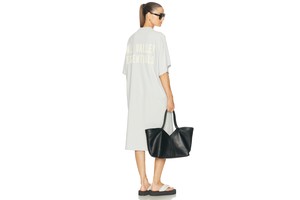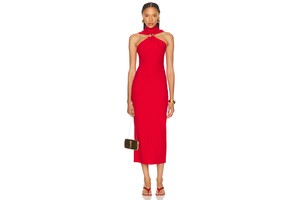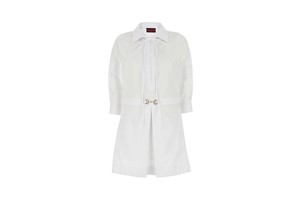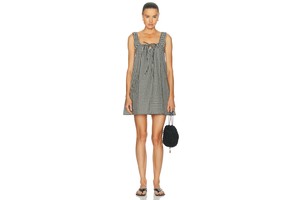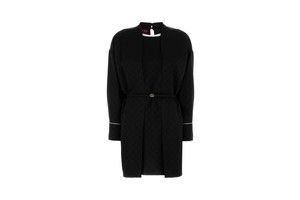
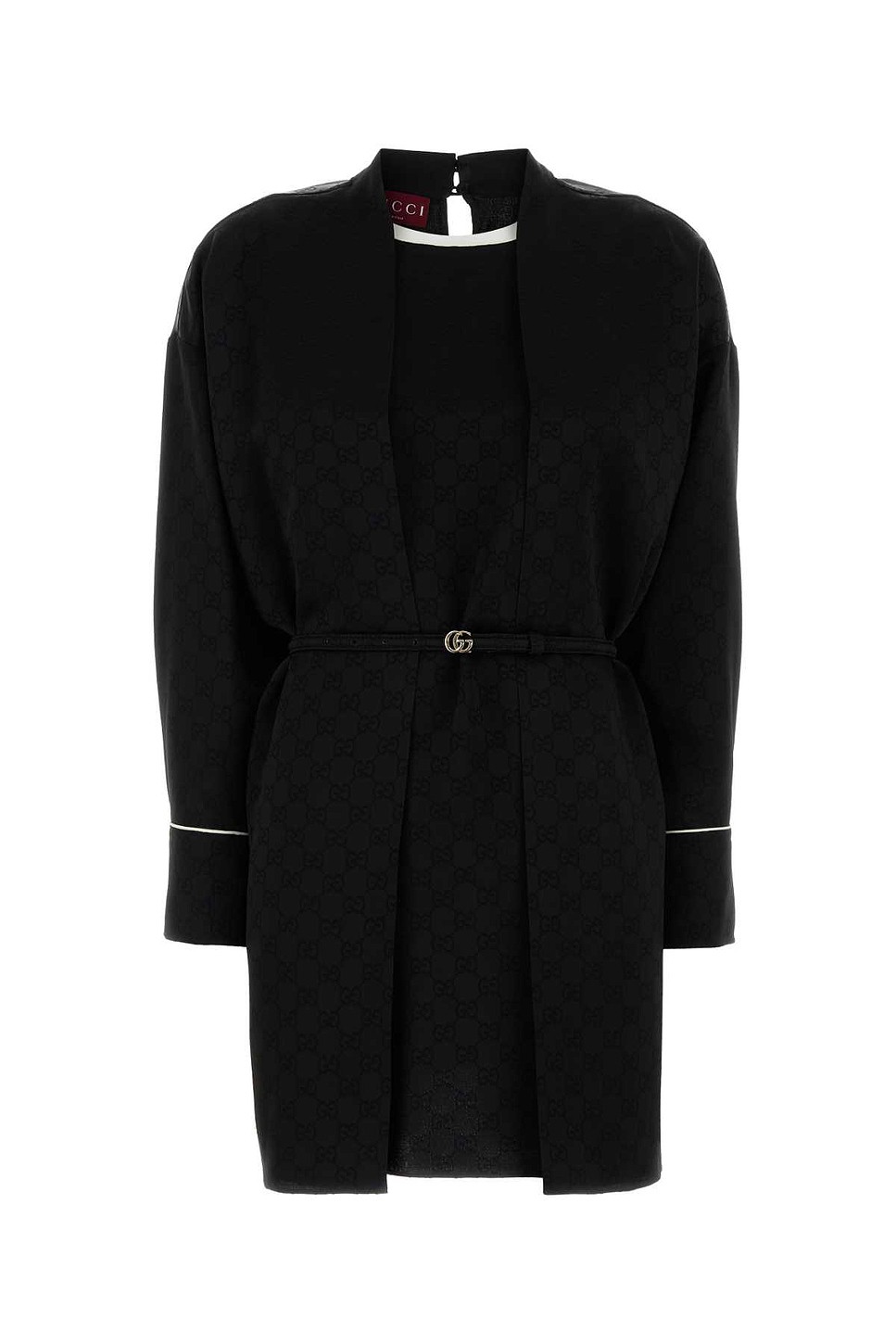
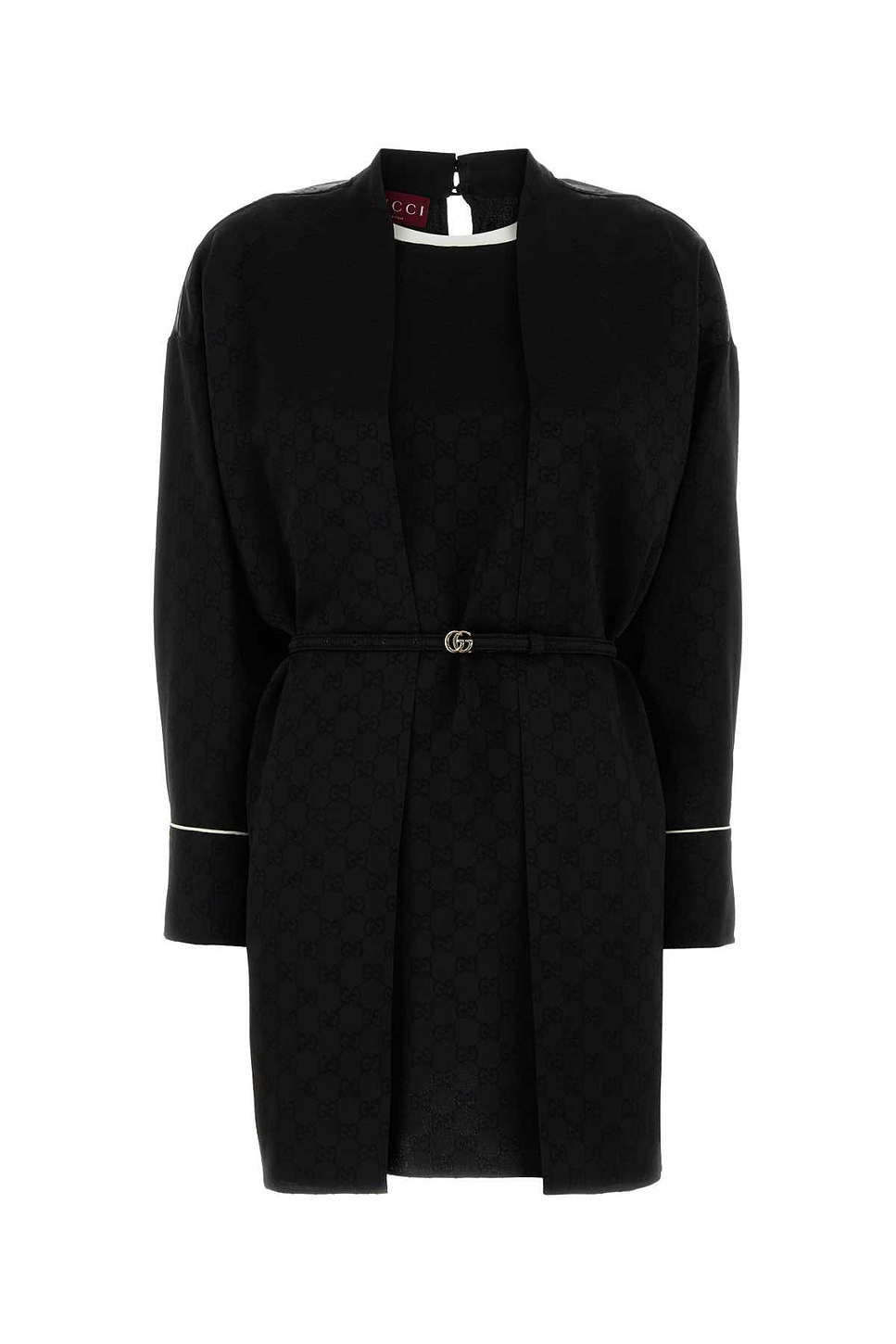
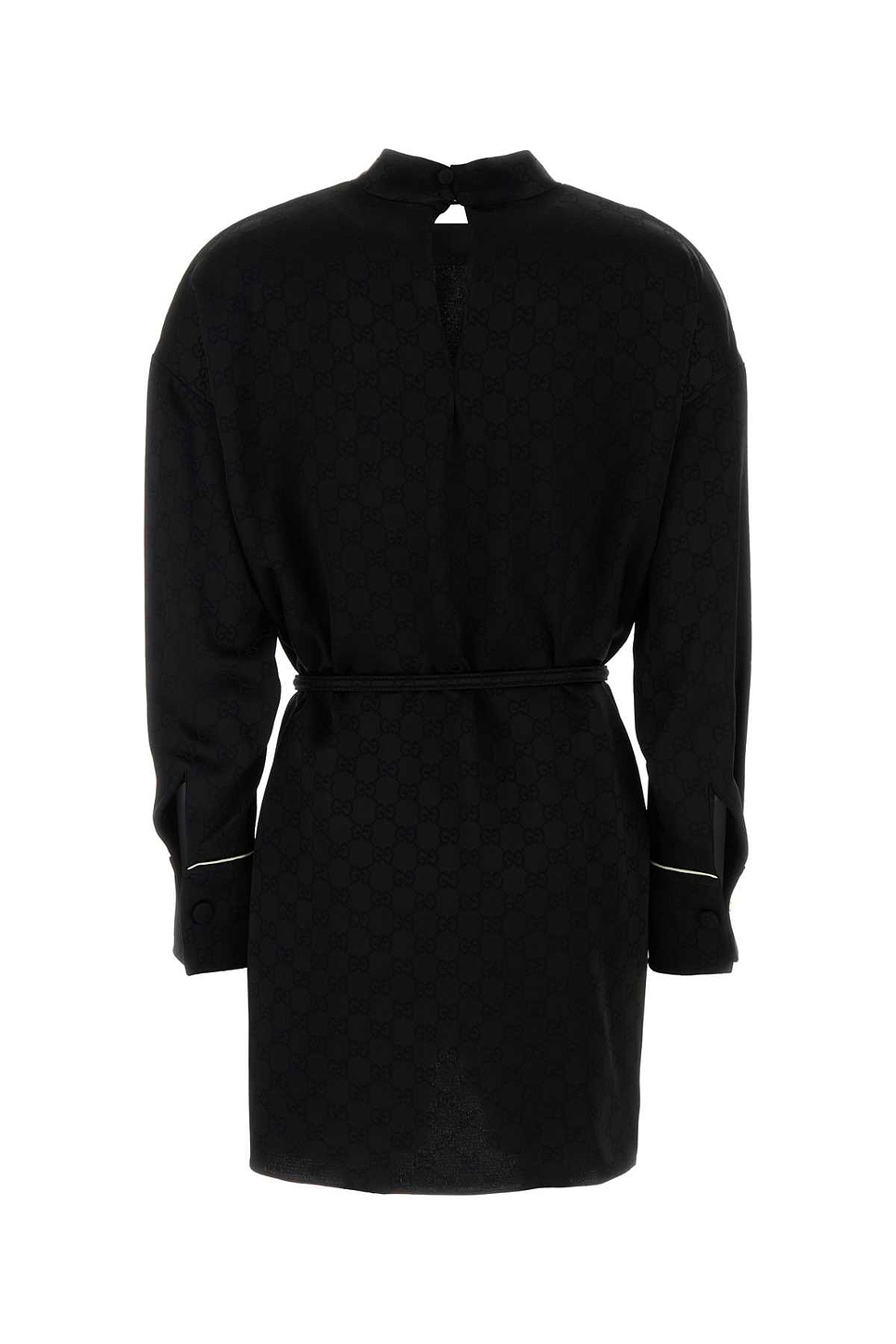
A dress listed with a shell of 55% viscose and 45% acetate, made in Italy, filed by the retailer under long sleeve dresses, at 3,114 dollars. There are no reviews and no fit votes, so there is no score to quote. The product information amounts to the composition, the country and two stock numbers, with two photographs. This is the second garment in this series whose shell combines viscose with acetate and nothing else, so the two together define the top of a scale that was built one rung at a time. There is also a contradiction between two fields on this page that has nothing to do with fabric, and it is worth naming because it is the first of its kind here. The reference is the Gucci black crepe dress in Grey. Dongguan Bafinasa Garments Co., Ltd. develops comparable crepe dresses on OEM and ODM terms, from fabric sourcing to retail or FBA ready packing. We publish this as a development reference and build your own version of it, and we do not supply the branded original or reproduce anyone else's label.
Key Features
- Shell: 55% viscose, 45% acetate as stated. See the note below on why this pairing is demanding rather than merely delicate
- Composition of the shell reported as one hundred per cent of the stated fibres, with the second layer not described
- Crepe, named in the product title
- Made in Italy as stated
- Three adjacent sizes published: 38, 40 and 42. See the note below
- No care instruction stated anywhere on the listing
- No size chart, no measurements and no model figures published
Customisable Options
- Fabric: viscose acetate crepe to the reference, with the weight and crepe character set from a tested sample
- Ratio: we would discuss whether a higher viscose or a higher acetate content serves the drape better
- Sleep: long sleeve to the filing, and we would publish the sleeve length rather than leaving it implied
- Care: we would add dry clean only, since neither component tolerates water well
- Length from midi to ankle, sleeve length, crepe weight, size set, colour development, private label and care labelling
Specifications
| Style | Viscose acetate crepe dress |
| Reference | Gucci, black crepe dress, style FEXN-WD1248, manufacturer style 836272Z8B13 1043, colour Grey |
| Shell | 55% viscose, 45% acetate as stated. See the note below |
| Second Layer | Not stated, though the composition is given as a shell |
| Fabric | Crepe, named in the product title |
| Sleeve | Filed by the retailer under long sleeve dresses. See the note below |
| Care | None stated on the listing. See the note below |
| Sizes Published | 38, 40 and 42, three consecutive sizes. See the note below |
| Measurements | None published. No size chart and no model body figures on this listing |
| Photographs | Two |
| Production | Made in Italy as stated |
| Reference Retail | 3,114 USD, quoted to show the price band this sits in, not as our price |
| Customer Reviews | None on the reference listing, so we quote no score |
| Best Seller Badge | None. The listing carries no rank |
| Categories | Filed by the retailer under long sleeve dresses, with no second category |
| Colour Note | The listing records Grey while the product name says Black. See the note below |
| Occasion | Occasions, evening events, dinners, formal daytime |
| MOQ | 100 pcs per style per colourway, mixed sizes and colourways accepted |
| Sampling | 7-10 days after tech pack or reference sample confirmation |
| Bulk Lead Time | 20-30 days after sample approval and deposit |
| Service | OEM / ODM / private label, milled crepe sourcing, full lining, retail or FBA ready packing |
Size Chart
| Size | Bust | Waist | Hips | Length | Source | ||||||||||||
|---|---|---|---|---|---|---|---|---|---|---|---|---|---|---|---|---|---|
| 38 | 31 | in / | 79 | cm | 24 | in / | 61 | cm | 34 | in / | 86 | cm | 120 | cm / | 47.2 | in | Our proposal |
| 40 | 33 | in / | 84 | cm | 26 | in / | 66 | cm | 36 | in / | 91 | cm | 122 | cm / | 48 | in | Our proposal |
| 42 | 35 | in / | 89 | cm | 28 | in / | 71 | cm | 38 | in / | 97 | cm | 124 | cm / | 48.8 | in | Our proposal |
| 44 | 37 | in / | 94 | cm | 30 | in / | 76 | cm | 40 | in / | 102 | cm | 126 | cm / | 49.6 | in | Our proposal |
This listing offers three sizes, 38, 40 and 42, and publishes no size chart, no measurements and no model body figures. There is nothing on the page from which a customer could judge the fit, and nothing at all stating either the length or the sleeve length.
Occasions and Styling
Suits occasions, evening events, dinners and formal daytime. A dark crepe dress with long sleeves covers more than the party dresses this series usually examines, which makes it usable across more of the year and in more conservative settings.
Production and Quality Control
There are no reviews and no fit votes on this listing, so there is no score to quote. This is the second viscose and acetate shell this series has found, which fixes the top of a scale rather than merely adding to it. Two fields on this page also disagree with each other, which is a first here and worth naming.
The second viscose and acetate shell, and what differs between them is instructive, and that is the first thing. This series assembled a small scale for garments whose components all fail in water, built one rung at a time. At the bottom was cotton with applied decoration, where the base fibre is among the most washable there is and only the addedwork forces dry cleaning. Next came a blend of viscose with linen, where linen is stronger wet than dry and so partly held things together, though not enough. Then wool at a little over forty per cent over a lining of another fibre with no instruction at all, where two layers moved by different amounts. Then lace and crepe of unspecified fibre with a recommended rather than required instruction, the softest wording met. And at the top sat a shell of acetate and viscose totalling one hundred per cent with nothing to hold anything, and no instruction. This garment is built from exactly those same two fibres, also totalling one hundred per cent, and also with no instruction anywhere on the page. So it joins that garment at the top, and the comparison between the two clarifies what the top of the scale actually means. In the earlier one the proportions were lopsided, around three parts acetate to one part viscose, so although neither fibre tolerates water, the dominant failure mode was one particular kind. Here the split is almost even, at fifty five and forty five, which changes the picture in a way worth drawing out. These two fibres do not fail in the same way, and this series has described both mechanisms separately. Viscose, being regenerated cellulose, loses around half its strength when wet and is prone to shrinking and to creasing badly while drying. Acetate behaves differently again: water stiffens it and dulls its surface permanently, and it marks. Importantly, those marks are not dirt sitting on the surface but a change in how the surface reflects light, which is why they cannot be cleaned off. So with almost even proportions there is no single dominant failure to plan around, because both kinds will be visible at once. That is the distinction worth carrying forward, and it suggests the scale should be read not only by how fragile the components are but by how many different kinds of failure are in play at once. On top of that, the fabric here is crepe, and this series has noted before how much weight that word carries, having recently looked at a crepe whose own description was too vague to allow any judgement at all. Crepe means the yarns are twisted hard enough to produce a crinkled surface, and twisting this hard already puts the yarn under strain before the garment is ever worn. Adding water to strained yarn into which two different failures are available is not a good combination.
Two fields on this page disagree with each other, which is a new kind of problem here, and that is the second thing. The listing records the colour as Grey while the product name describes it as Black. This is a direct contradiction between two pieces of information the same retailer published about the same garment, and this series has not previously come across that particular fault, having instead found mismatches of other kinds. There have been names disagreeing with measurements, one garment called mini while actually measuring around 133 centimetres. There have been names disagreeing with the retailer's own filing. There have been compositions described with relative words whose other half was never given. There have been descriptions of fabric too vague to judge. But in all of those, two statements could be reconciled or one could be checked against something. Here they simply cannot both be right, and there is no third source on the page to settle it, since there is no separate colour description and no additional imagery labelled any other way. It is worth being clear about how much harm this does, because the answer is not very much and saying so keeps the criticism honest. Both candidates are dark, and this series has noted the reason dark colour matters: a deeper dye absorbs more light, so it is considerably less likely to show what is underneath than a pale one, which genuinely reduces opacity risk. So whichever of the two is correct, the practical conclusion is the same, and nothing a customer decides changes. But it is worth recording for a different reason, which is that this page offers very few facts and one of them is unreliable. When a listing gives you four things to go on, each one has to carry more weight, and there are two photographs, which is another way of saying very little to check anything against. This is also the third garment in this series from the same retailer in a row where disclosure runs to the composition, the country and two stock numbers and nothing else, which suggests the arrangement is systematic rather than the result of any one garment being neglected.
Three consecutive sizes at over three thousand dollars, and that combination has no easy explanation, and there is a filing here doing useful work, and that is the third thing. Thirty eight, forty and forty two are three consecutive sizes, and this series has established that three or more in sequence are hard to explain by accident, since clearing stock can easily leave two adjacent sizes but rarely leaves three in a row. So unlike the two size garment examined alongside this one, where nothing could be concluded at all, here something can be said, which is that the narrow range looks deliberate. What is missing is any mechanism to support it. This series has been collecting those, and there are four that let one garment cover more than one body: knit structure, where loops open, having recently credited a jersey garment for exactly this; elastane, at levels high enough to compress; cutting on the bias, though that works along one direction rather than uniformly; and shirring, where gathered elastic thread draws cloth in and releases it. None is available here. There is no elastane in this composition at all, no knit is stated, no shirring is described, and bias cutting would not explain a range of three on its own. What remains is crepe, and this deserves a fair hearing rather than dismissal. A crepe yarn is twisted hard, and that twist stores energy, so crepe cloth does have somewhat more give than a flat woven of the same fibre. That is real. But it is worth being precise about its size, which is modest, and it is also worth noting what makes this case harder than the alternatives: crepe recovers rather than accommodates, so it will stretch and return during wear rather than holding a larger body comfortably for a whole evening. So a plausible reading is that this is a deliberately narrow run for a garment cut to a specific silhouette, with whatever give crepe offers making each size slightly more forgiving than it would otherwise be. That is the honest answer, and it should be credited to the retailer's own filing that we know anything at all about this garment's coverage, which is the third useful point. Long sleeve dresses is a category about sleeves rather than about length or occasion, and this series has noted that these category labels do occasionally contribute real information by accident, most clearly when a garment filed under sweater dresses had its knit structure stated by implication. Here the same mechanism gives something genuinely needed and otherwise absent, since this page publishes no sleeve measurement and no length at all. But it gives the sleeve exists without saying how long it is, and that distinction has come up repeatedly, since a sleeve can stop anywhere from the wrist to well past the hand. Every bulk shipment gets a measurement report against your approved chart.
Optional upgrades include adding dry clean only, since with almost even proportions of two fibres that fail differently there is no single failure to plan around, choosing whether higher viscose or higher acetate serves the drape better and testing both, publishing the sleeve length rather than leaving it to be inferred from a filing, publishing the body length as well, resolving whether this garment is grey or black, since that page offers little else and each fact carries more weight when there are few, alternatives heavier in viscose for drape, alternatives including a small elastane content if three sizes are to be served comfortably, a lining fibre declared and matched to the shell, additional sizes, colour development and private label, hangtag and care labelling.
Pre-production sample approval, in-line inspection during cutting and sewing, and a final AQL inspection before packing, with measurement reports and photos shared before shipment.
Send us your tech pack, a photo or a reference garment and we will quote within 24 hours. Contact bafinasa@bafinasa.com or WhatsApp +86 13827222469.