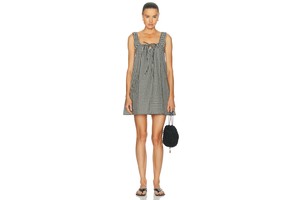
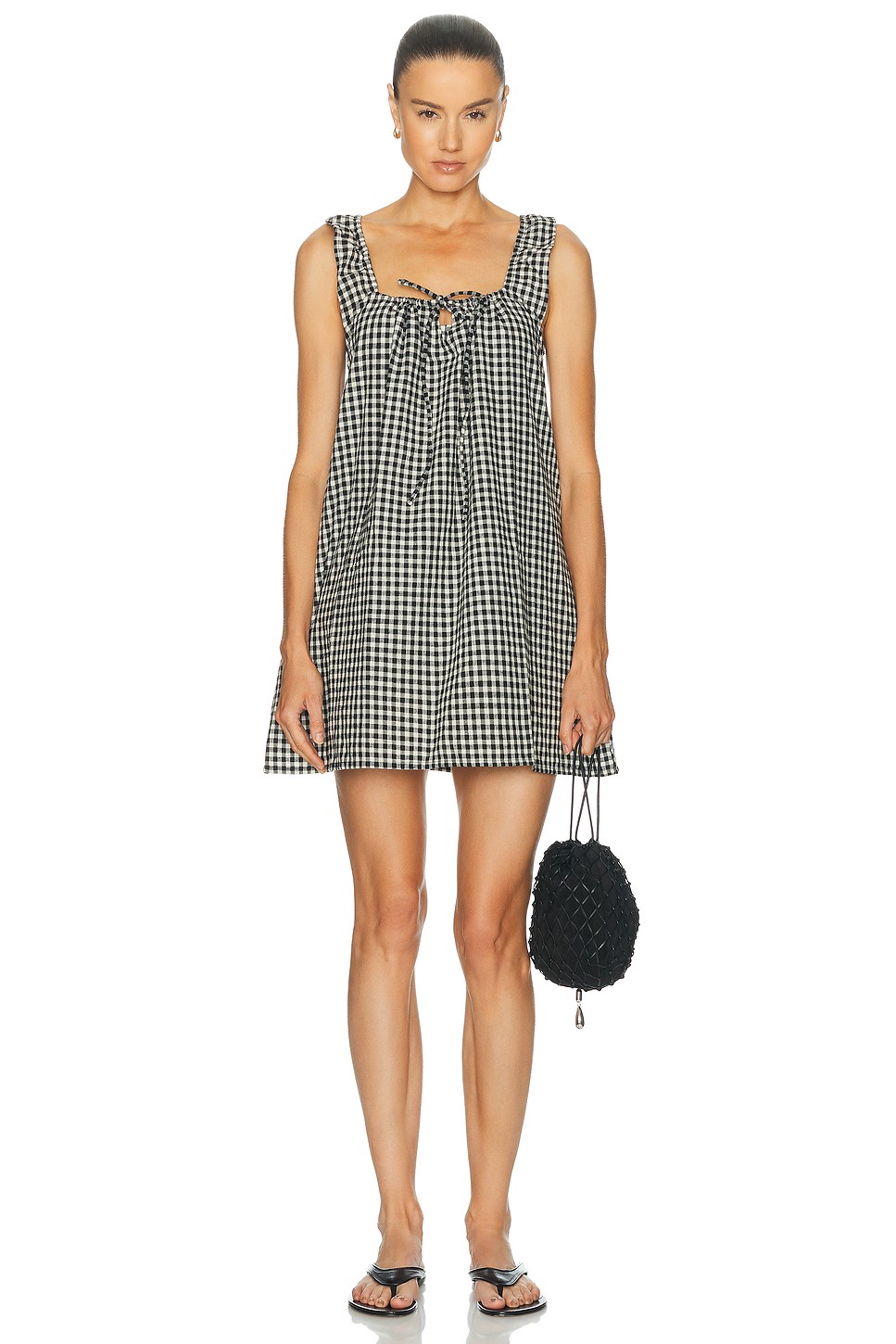
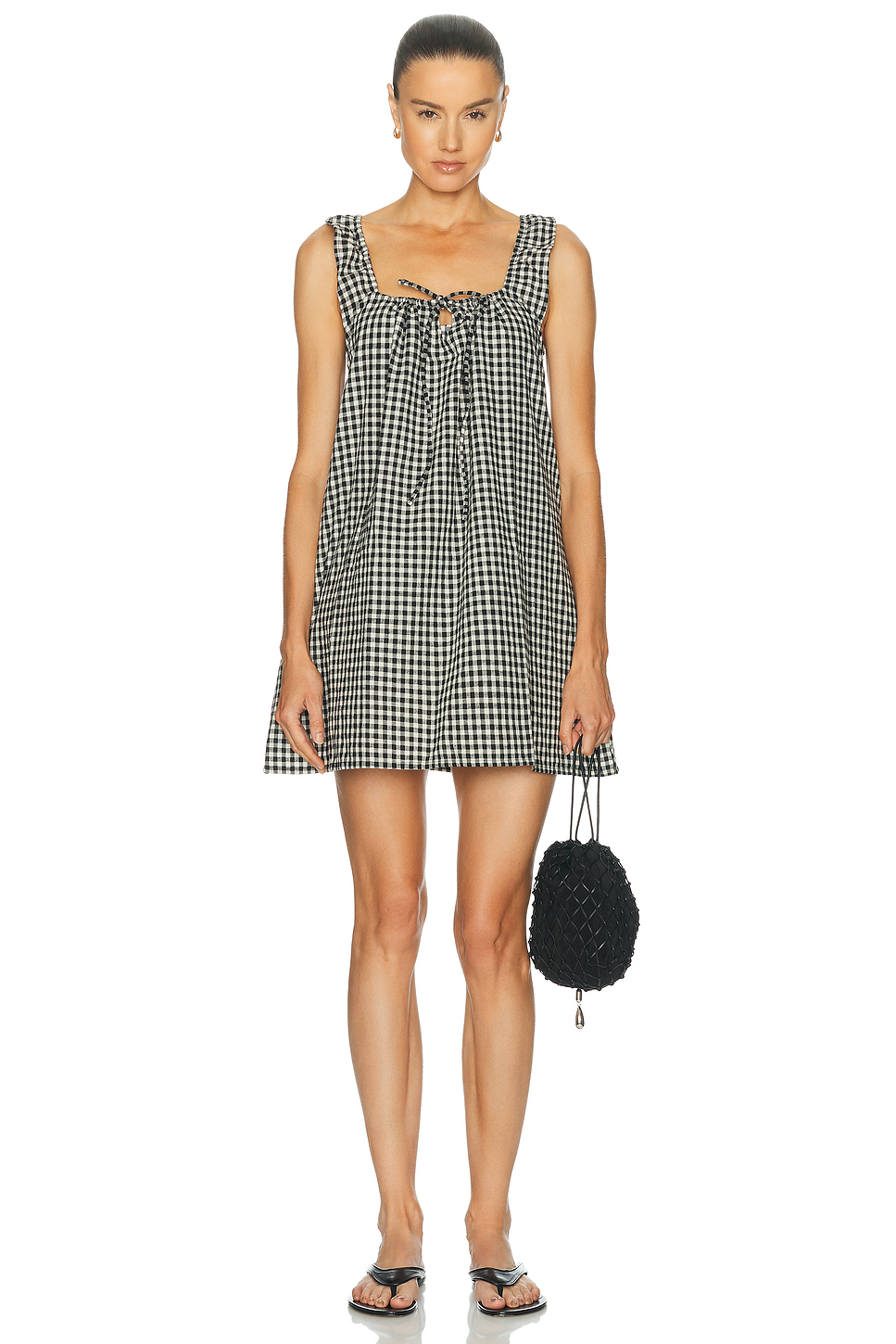
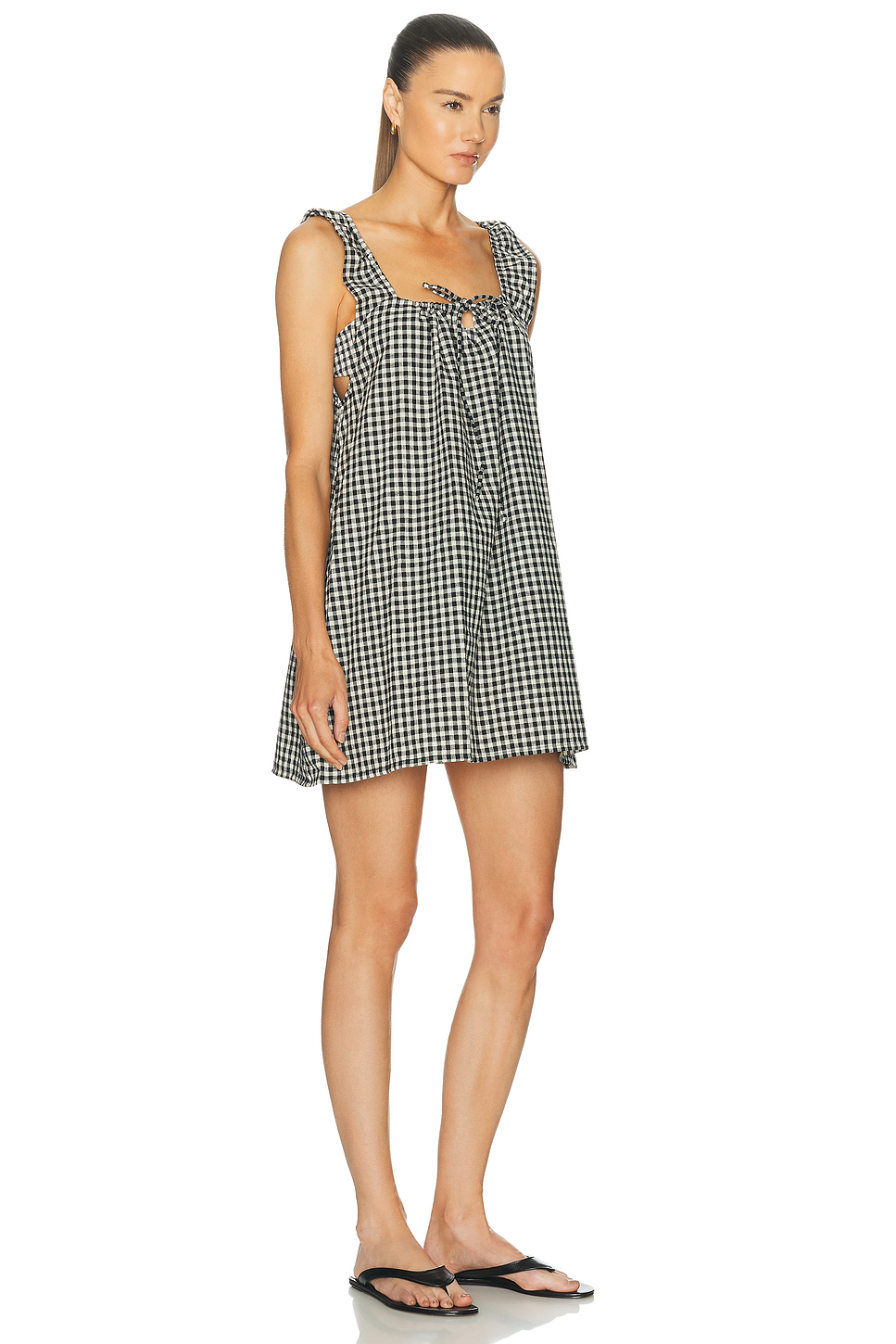
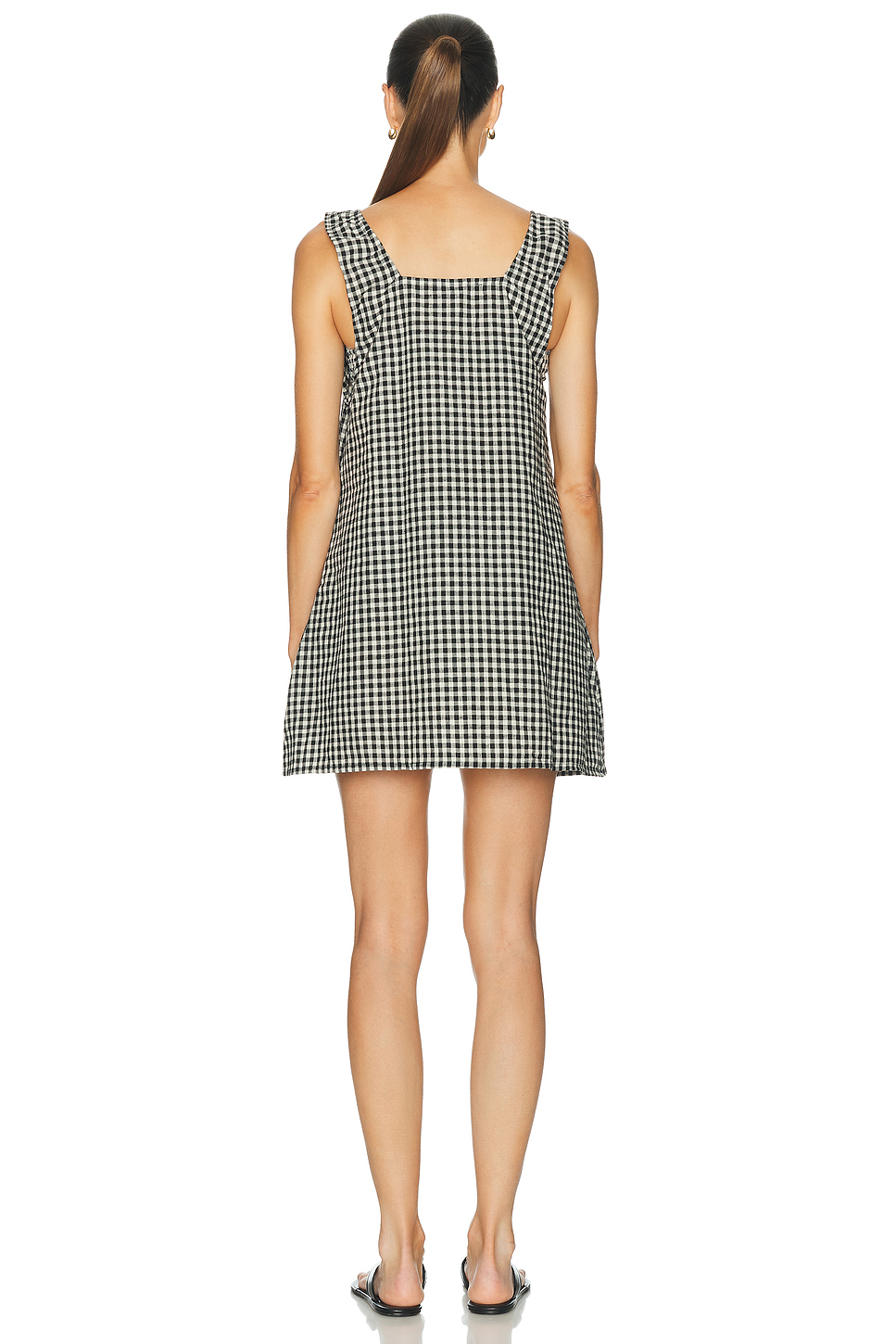
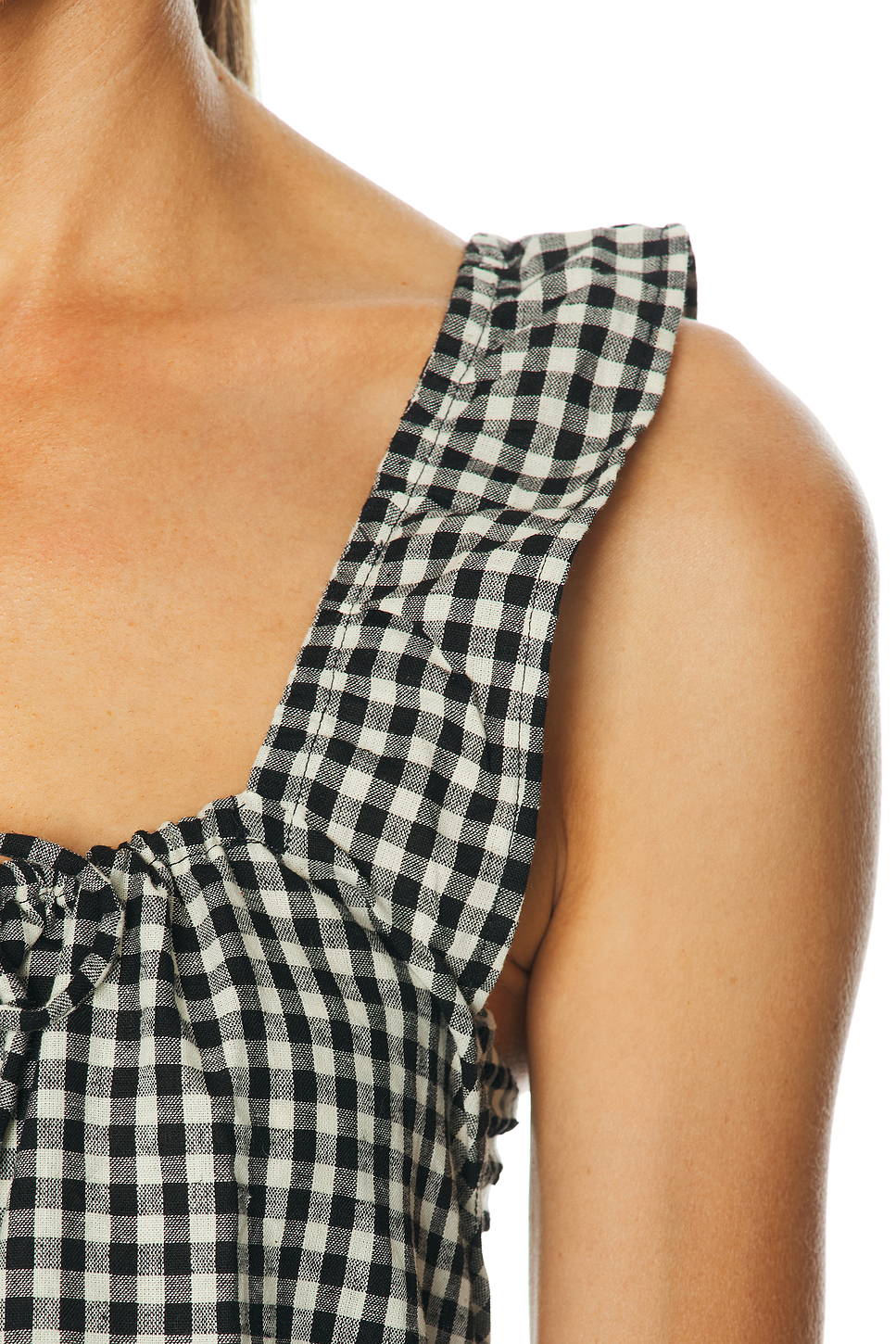
A shift dress listed as 55% French linen and 45% cotton, unlined, with a front tie closure and pockets at the side seams, in a lightweight linen cloth, hand wash, made in Indonesia, ranked twenty fourth in the retailer's shift dress list, at 288 dollars. There are no reviews and no fit votes, so there is no score to quote. The proportions here almost exactly repeat a blend examined in a recent batch with a different fibre standing in the linen's place, which is worth noting because it makes the reasoning transferable. The measurements are also the largest this series has met, and unlike the other large ones there is a single word that explains them entirely. The reference is the Lucy Dress by Juillet in Tuxedo Plaid. Dongguan Bafinasa Garments Co., Ltd. develops comparable linen dresses on OEM and ODM terms, from linen sourcing to retail or FBA ready packing. We publish this as a development reference and build your own version of it, and we do not supply the branded original or reproduce anyone else's label.
Key Features
- 55% French linen, 45% cotton as stated, and the origin adjective carries meaning. See the note below
- Front tie closure as stated
- Pockets at the side seams as stated
- Lightweight linen fabric as stated
- Unlined as stated, with the opacity question left open for a patterned cloth
- Hand wash as stated, which is the right answer for this blend
- Measurements published for one size, including a 33 in length and the largest waist reading yet
- Made in Indonesia as stated
Customisable Options
- Fabric: French linen cotton to the reference, with the weight set from a tested sample
- Ratio: we would test higher linen for drape and higher cotton for crease resistance, since these pull apart
- Closure: front tie to the reference, and we would specify what it ties with, since that is the part that wears
- Pockets: kept, and we would check they do not add bulk at the hip
- Length from mini to knee, linen weight, tie placement, pocket options, size set, colour development, private label and care labelling
Specifications
| Style | French linen shift dress |
| Reference | Juillet, Lucy Dress, style JLLT-WD3, manufacturer style JUI-PF26-RTW-DRE-LUCY-TP, colour Tuxedo Plaid |
| Composition | 55% French linen, 45% cotton as stated. See the note below |
| Fabric | Lightweight linen as stated |
| Closure | Front tie as stated |
| Pockets | Two pockets at the side seams as stated |
| Lining | Unlined as stated, with no statement about opacity |
| Care | Hand wash as stated, which is correct here |
| Sizes Published | XS, S, M, L |
| Measurements Published | S: bust 40 in, waist 48 in, hips 52 in, length 33 in |
| Chart Note | Every circumference is far above the model, and the waist by twenty four inches. See the note below |
| Coverage | Only size S has figures. XS, M and L are blank |
| Model | 179 cm, wearing size S, bust 86 cm, waist 61 cm, hips 86 cm |
| Production | Made in Indonesia as stated |
| Reference Retail | 288 USD, quoted to show the price band this sits in, not as our price |
| Customer Reviews | None on the reference listing, so we quote no score |
| Best Seller Badge | Rank 24 in the retailer's shift dress list, which is a mid position |
| Categories | Filed by the retailer under mini dresses and shift dresses, which explains the shape rather than merely labelling it |
| Occasion | Everyday, warm weather, casual, travel, holidays |
| MOQ | 100 pcs per style per colourway, mixed sizes and colourways accepted |
| Sampling | 7-10 days after tech pack or reference sample confirmation |
| Bulk Lead Time | 20-30 days after sample approval and deposit |
| Service | OEM / ODM / private label, linen sourcing, tie closures, pockets, retail or FBA ready packing |
Size Chart
| Size | Bust | Waist | Hips | Length | Source | ||||||||||||
|---|---|---|---|---|---|---|---|---|---|---|---|---|---|---|---|---|---|
| S | 40 | in | 48 | in | 52 | in | 33 | in / | 84 | cm | As published | ||||||
| XS | 31 | in / | 79 | cm | 24 | in / | 61 | cm | 34 | in / | 86 | cm | 84 | cm / | 33.1 | in | Our proposal |
| S | 33 | in / | 84 | cm | 26 | in / | 66 | cm | 36 | in / | 91 | cm | 86 | cm / | 33.9 | in | Our proposal |
| M | 35 | in / | 89 | cm | 28 | in / | 71 | cm | 38 | in / | 97 | cm | 88 | cm / | 34.6 | in | Our proposal |
| L | 37 | in / | 94 | cm | 30 | in / | 76 | cm | 40 | in / | 102 | cm | 90 | cm / | 35.4 | in | Our proposal |
The published size S gives a 40 inch bust, a 48 inch waist, a 52 inch hip and a 33 inch length against a model at roughly 34, 24 and 34. Every circumference is far above her, the waist by about twenty four inches, and that is explained by a single word rather than needing to be excused.
Occasions and Styling
Suits everyday wear, warm weather, casual wear, travel and holidays. A linen shift with pockets and a front tie is an everyday piece, and it is worth knowing that linen creases readily by nature, which is part of its character rather than a fault, and increases with every washing rather than diminishing.
Production and Quality Control
There are no reviews and no fit votes on this listing, so there is no score to quote. The proportions here nearly repeat a blend from a recent batch with a different fibre in the same role, which means the reasoning carries over rather than having to start again. The measurements are the largest yet met, and one word explains them completely.
The same proportions with a different fibre in the same slot, and knowing why makes the reasoning transferable, and that is the first thing. A recent batch examined a jersey t-shirt dress whose exterior was fifty five per cent hemp with forty five per cent cotton, and this series explained then why the cotton was there. Both hemp and linen are bast fibres, taken from the stem of a plant rather than from a seed pod and freed by retting, which is controlled rotting to dissolve what binds the fibre bundles together. That shared origin gives them a shared character: long fibres, high strength, low elasticity, a crisp rather than soft hand, and a tendency to crease. Hemp was described as the more extreme version, being coarser still, and coarseness was connected to something established earlier about a different fibre altogether, which is that what makes a fibre prickle is not roughness in the abstract but diameter, since a thick enough fibre triggers pain receptors rather than merely bending against the skin, the threshold being around thirty microns. Cotton is short stapled by comparison, soft and familiar, so blending it in at forty five per cent softens the hand and takes the edge off while leaving enough of the bast fibre for strength and longevity. Those same proportions appear here, fifty five and forty five, and once it is understood that family membership rather than individual identity drives most of these behaviours, nothing in that explanation needs rewriting for linen. The ratio reads as a deliberate balance rather than a cost decision, and each direction can be stated as a dial: more of the bast fibre is stronger, more durable, crisper and slower to soften; more cotton is softer from the start and weaker over time. Two additions specific to this garment are worth making, and they are the ones a customer would feel. The first is creasing, and this series has noted before how readily linen creases, which follows directly from low elasticity: a fibre that does not stretch also does not recover, so a crease once formed tends to stay. Anyone buying linen is accepting that, and this series would rather say so plainly than have it discovered later. The second is the word French, which is doing real work here. This is the first time this series has met a fibre identified by where it came from rather than only by what it is, and it is a genuine quality signal rather than decoration. The flax grown along the channel coast of France, Belgium and the Netherlands benefits from a particular maritime climate, and the retting there is traditionally done in the field by dew and weather rather than in tanks, which is slower and less uniform but produces a fibre that is longer, softer and more consistent in colour. So the adjective is telling you something about how this cloth will feel and how evenly it will take dye, which neither the word linen alone nor the name for hemp in the other garment did. It is worth noting the comparison that makes this concrete: those two blends have nearly identical proportions and nearly identical reasoning, but only one of them says anything about how good its bast fibre is.
Twenty four inches over at the waist, and one word explains it entirely rather than excusing it, and that is the second thing. The published size gives a bust of 40 inches against a model at roughly 34, a waist of 48 against 24 and a hip of 52 against 34. So the waist reading is some twenty four inches above her body, which is comfortably the largest this series has met, exceeding even the fifteen inches found recently on a sheer lace maxi and the ten found before that on another gathered dress. This series has now several times asked what large positive measurements are for rather than assuming carelessness, and has found two reasons. The first was that positive measurements replace a missing closure, since a garment with no zip and no stretch fibre has to pass over the shoulders and hips without opening, and that was the reading given for a cotton dress with about ten inches over at the bust and nine at the waist. The second was that they describe how the fabric itself behaves, since openwork lace has no reason to be pulled close and holding it against the body defeats both its appearance and its comfort. This garment has a third reason, and it is the cleanest of the three because it needs no inference at all. The retailer files it under shift dresses. A shift is a garment that hangs straight from the shoulders without being shaped to the waist, so ease at the waist is not something to be explained away but the definition of the silhouette. There is no seam at the waist to pull in and no darting implied anywhere, so asking why the waist is twenty four inches larger than the body misunderstands what kind of garment this is. This is worth setting beside the other two reasons because together they form something usable: when a measurement looks wrong, look first for whether the shape, the closure or the fabric already explains it, and only afterwards look for error. Here the shape explains it completely, and it is worth noting that the retailer's filing did the work, which this series has observed happening before, most clearly when a garment filed under sweater dresses had its knit structure stated by implication and more recently when one filed under long sleeve dresses disclosed coverage it published nowhere else. Those category labels are not intended as specification, but on pages this sparse they become it. One further point follows from twenty four inches, and it cuts against a worry this series has raised often. A shift this loose does not need ease to get over the shoulders, so nothing here is a compromise forced by the absence of a closure, and unlike the pull-on cases there is a closure anyway, being a front tie. The practical consequence is simply that this silhouette will read very differently on a smaller body than on the model, and there are no other sizes giving figures to extrapolate from.
Three smaller things worth getting right, and each is the sort of thing that decides whether this garment gets worn, and that is the third thing. The first is pockets. This garment has them at the side seams, and this series has noted before that pockets in a dress are not automatic, having examined listings where their absence or presence was worth remarking on. There is a genuine interaction with everything above, however, which is worth stating because it is specific rather than general. In a garment cut this loosely, pocket bags hang free inside rather than being held flat against the body by the cloth being pulled close, and anything carried in them pulls the hem out of line at the hip. That is manageable, and it is solved either by tacking the pocket bags to the facing at the waist or by making them shallow. Worth deciding before sampling rather than discovering on a fit model. The second is what the front tie is actually made of, since this listing does not say. A tie can be a length of self fabric, a cotton tape, a cord or a ribbon, and they behave quite differently: self fabric in this blend will crease and soften in step with the garment, while a synthetic ribbon may not, and anything narrow will cut rather than hold. There is also a question of how long it is and whether it can be replaced, since closures of this kind wear out faster than the cloth around them. One line would settle all of it. The third concerns opacity, and this series has returned to it so often that the general argument can be stated briefly: whether light passes through a cloth cannot be judged from photographs taken under flattering light, so silence leaves the customer guessing. What is interesting here is how the pattern complicates an observation made recently. This series noted, on a deep berry gown, that deeper dye absorbs more light and is therefore considerably less likely to show what is underneath than a pale colour, which genuinely reduced that gown's risk. This garment is described as Tuxedo Plaid, which is not a single colour at all but a pattern, and a check or plaid is typically a dark ground crossed with lighter stripes. That means two things worth stating plainly. Some stripe elements are pale, and those pale bands are where light will pass most readily, so the risk is not uniform across the garment the way it would be on a solid colour. And a busy pattern conceals the answer in photography far better than plain cloth does, since the eye cannot separate variation in the weave from variation in the print. So this listing states that it is unlined and says nothing about opacity, at a point where this series has already seen how much better that can be done, since three garments have now stated it plainly in identical words from different makers and one even added that undergarments do not come with it. Every bulk shipment gets a measurement report against your approved chart.
Optional upgrades include stating what the front tie is made of and whether it can be replaced, since that closure wears faster than the cloth, tacking or shallowing the pocket bags so they do not pull the hem out of line in so loose a silhouette, adding a lining or a slip option and stating plainly whether patterned areas show anything underneath, publishing measurements for the remaining three sizes since twenty four inches over at the waist will read very differently on different bodies, either higher linen for drape or higher cotton for crease resistance and testing both, buttons or snaps offered as alternatives to the tie for anyone who does not want to tie it, alternative lengths, additional sizes, colour development including pale grounds tested for opacity specifically, private label, hangtag and care labelling.
Pre-production sample approval, in-line inspection during cutting and sewing, and a final AQL inspection before packing, with measurement reports and photos shared before shipment.
Send us your tech pack, a photo or a reference garment and we will quote within 24 hours. Contact bafinasa@bafinasa.com or WhatsApp +86 13827222469.