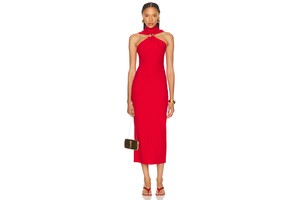
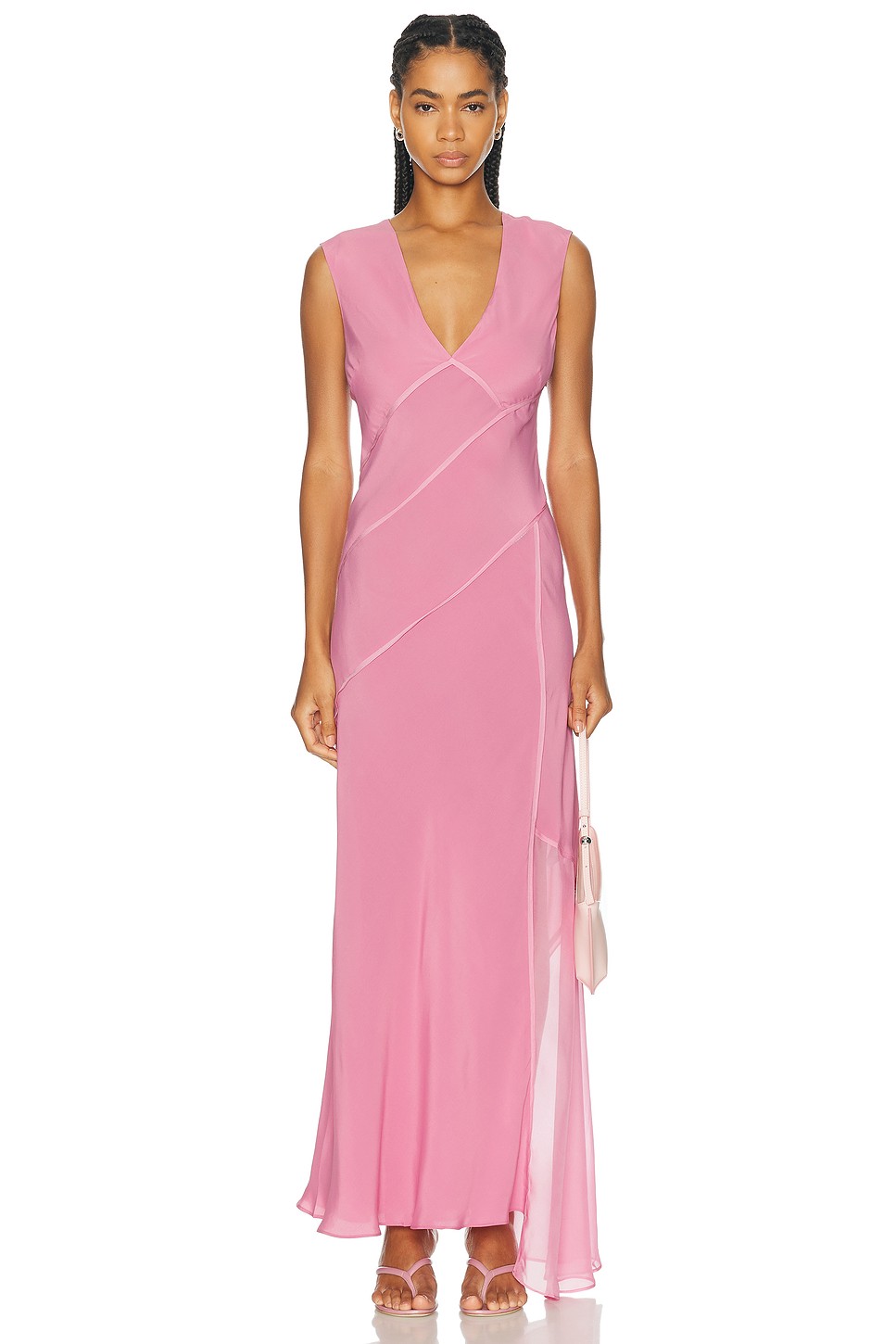
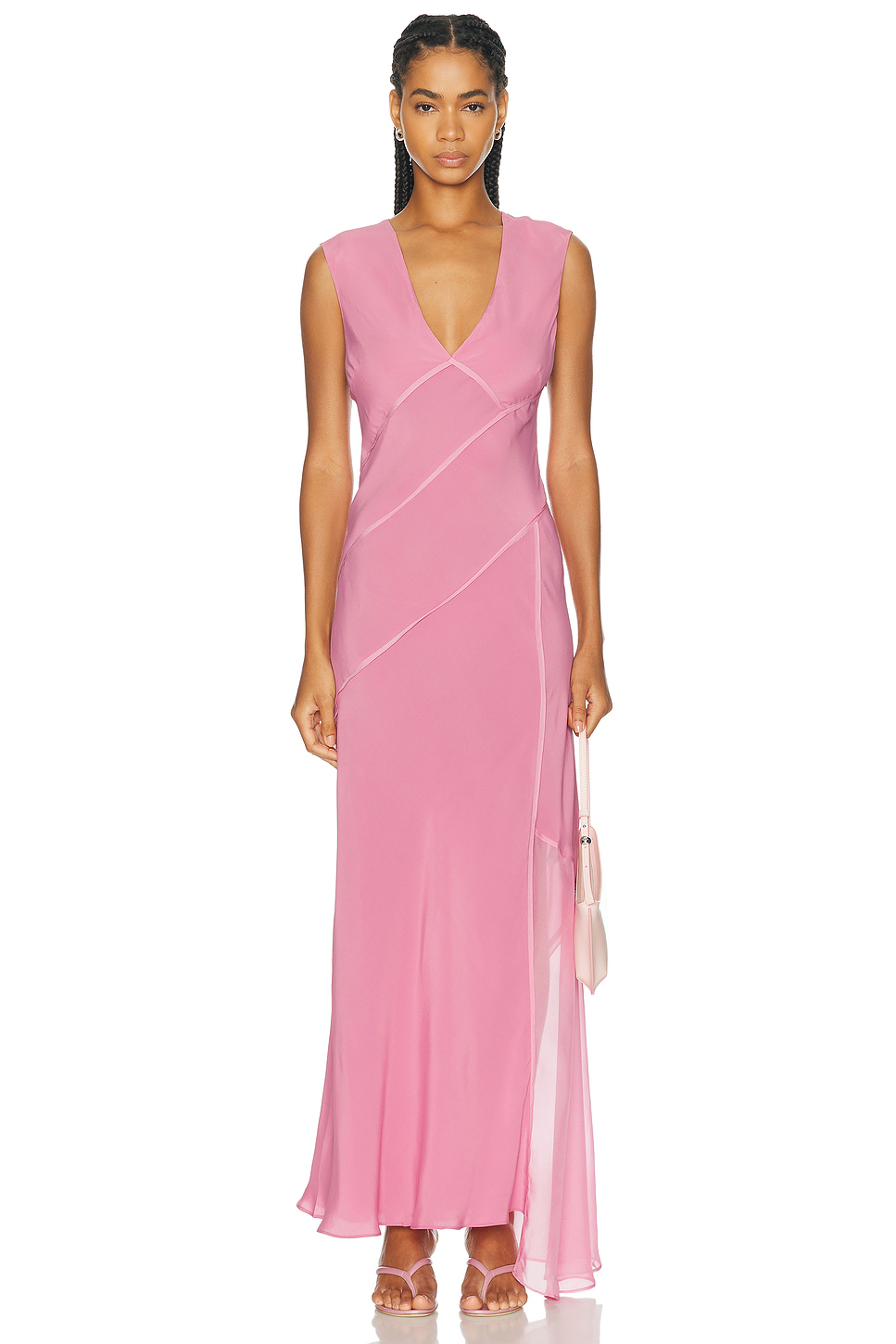
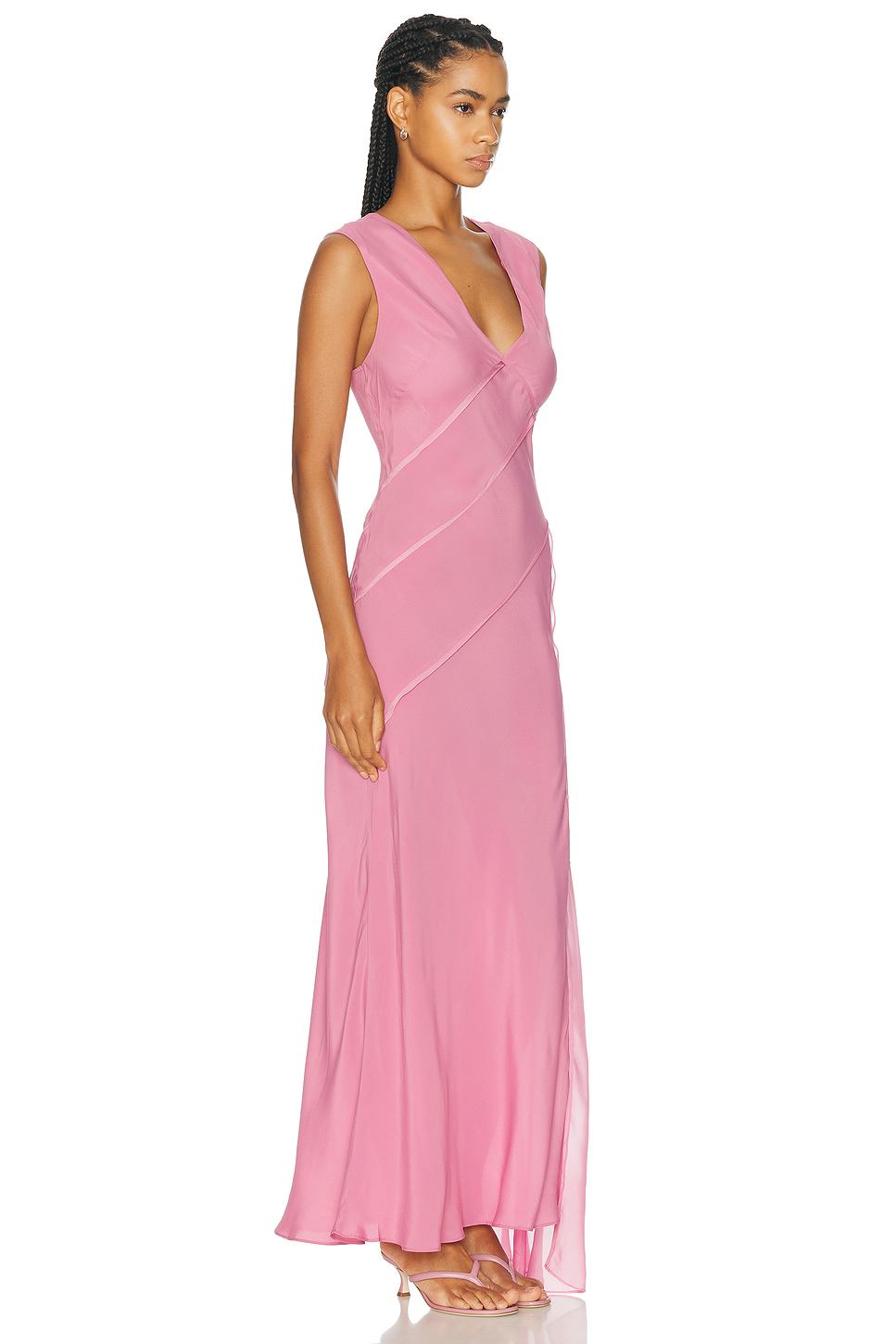
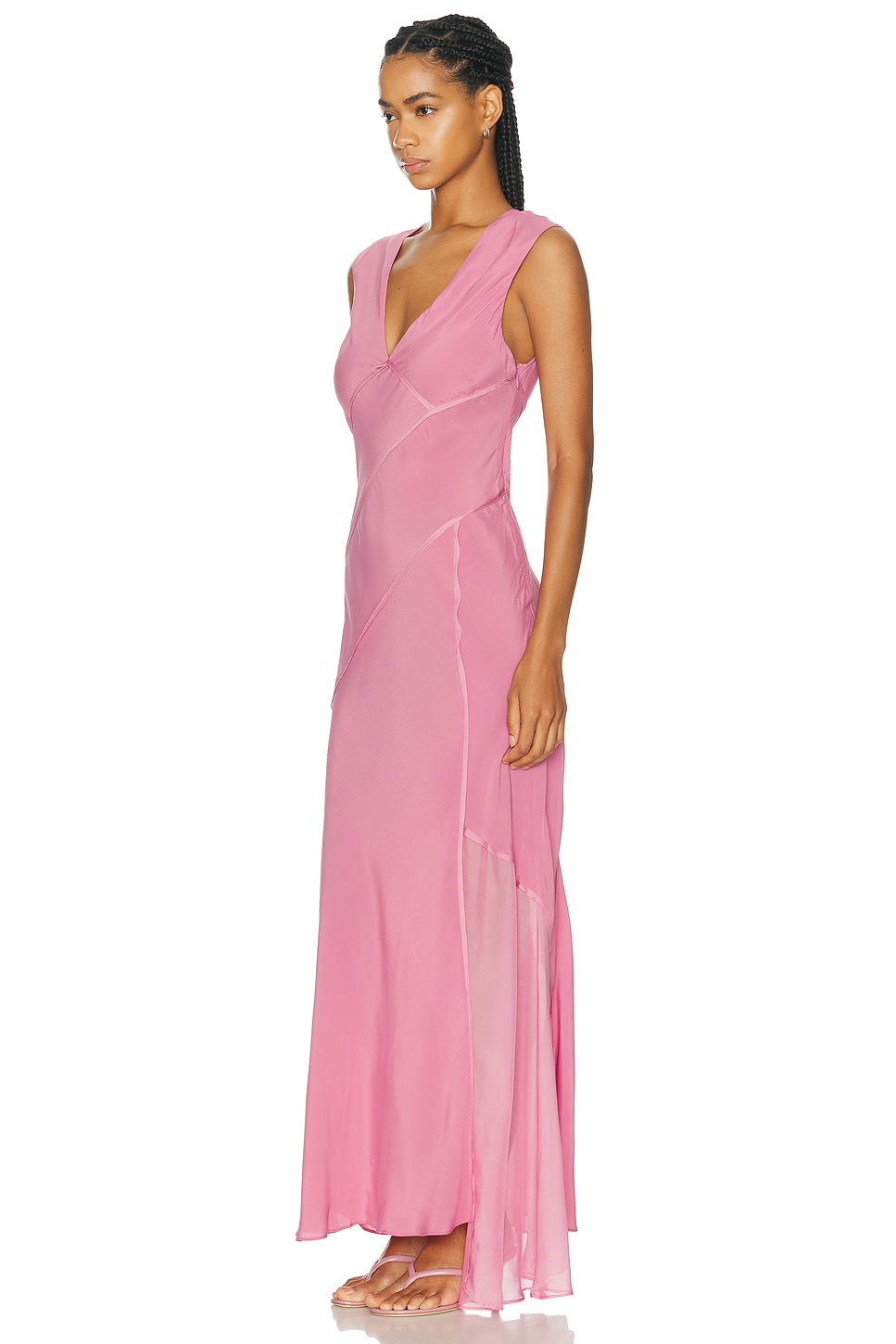
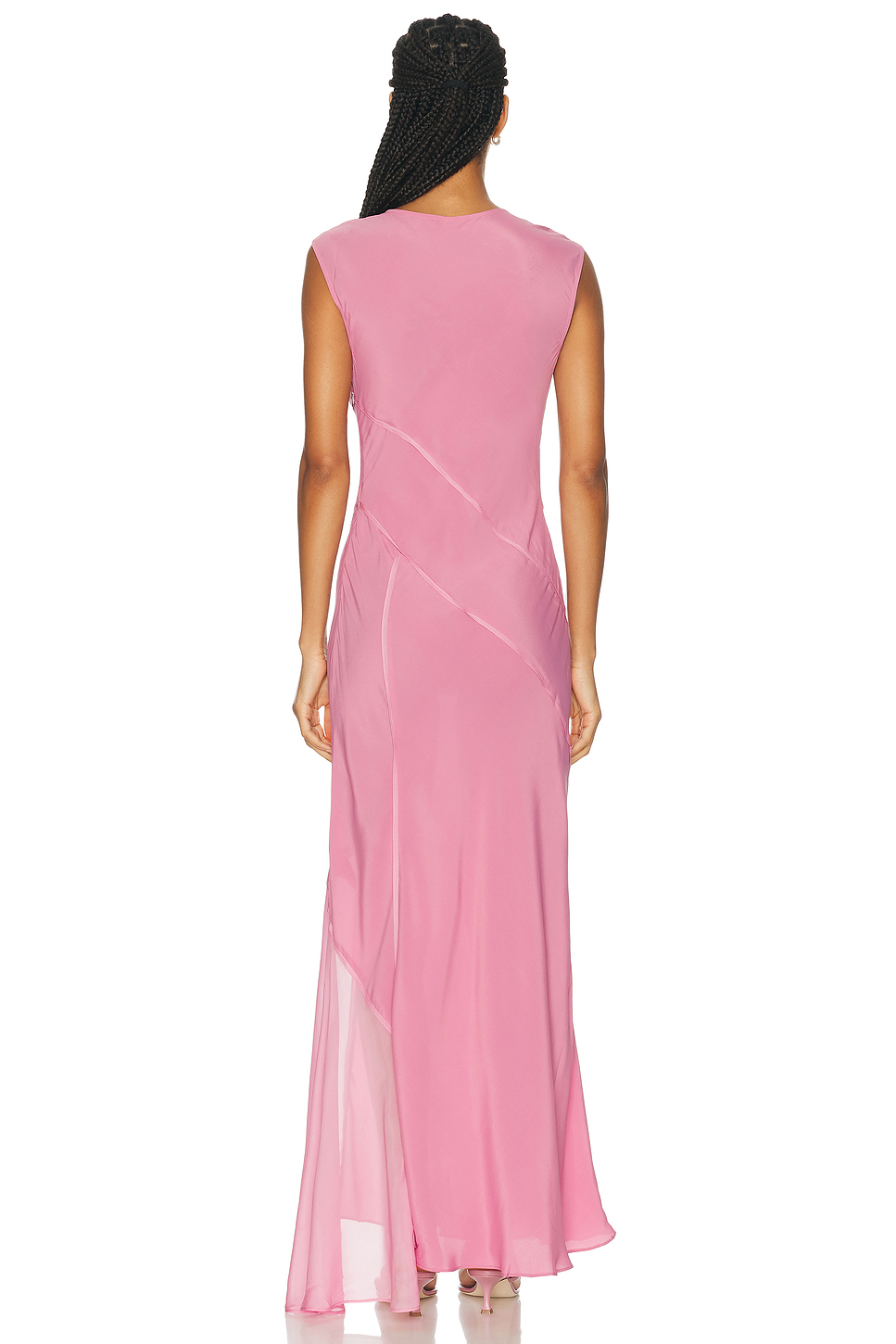
A gown listed with a self fabric of 65% viscose and 35% silk, a contrast fabric of 55% viscose and 45% silk, and a lining of 100% polyester, in a lightweight satin, partly lined, closed with a hidden zip and hook and eye at the back, dry clean only, made in China, ranked forty fourth in the retailer's gown list, at 502 dollars. There are no reviews and no fit votes, so there is no score to quote. Three composition fields appear here where most listings give one, and reading them together says something clear about how this garment was designed. There is also a measurement pattern that independently corroborates something this series has established twice, and this occurrence extends it further than before. The reference is the Elin Panelled Gown by SIR. in Berry. Dongguan Bafinasa Garments Co., Ltd. develops comparable occasion gowns on OEM and ODM terms, from fabric sourcing to retail or FBA ready packing. We publish this as a development reference and build your own version of it, and we do not supply the branded original or reproduce anyone else's label.
Key Features
- Self: 65% viscose, 35% silk as stated
- Contrast: 55% viscose, 45% silk as stated, which differs from the self only in proportion. See the note below
- Lining: 100% polyester as stated, and how it relates to the other two matters
- Lightweight satin fabric as stated
- Partly lined as stated, with what is not covered left unsaid
- Hidden zip at the back with hook and eye as stated
- Dry clean only as stated, which is the right instruction for this composition
- Measurements published for one size, including a 58 in length
Customisable Options
- Fabric: viscose silk to the reference, with the weight set from a tested sample
- Panels: developed to the reference, since the construction depends on how the pieces meet
- Lining: we would discuss matching it to the shell, though the instruction removes the usual risk
- Opacity: we would state what the partial lining covers, since that is the question the word creates
- Length from ankle to floor, panel arrangement, lining coverage, size set, colour development, private label and care labelling
Specifications
| Style | Panelled satin occasion gown |
| Reference | SIR., Elin Panelled Gown, style SIF-WD242, manufacturer style SIR226-1002, colour Berry |
| Self | 65% viscose, 35% silk as stated |
| Contrast | 55% viscose, 45% silk as stated. See the note below |
| Lining | 100% polyester as stated. See the note below |
| Fabric | Lightweight satin as stated |
| Lining Presence | Partly lined as stated, with what is left uncovered not stated |
| Closure | Hidden zip at the back, with hook and eye, as stated |
| Care | Dry clean only as stated, which is correct here |
| Sizes Published | 0 / XS, 1 / S, 2 / M, 3 / L, each shown with two labels |
| Measurements Published | Size 1 / S: bust 31 in, waist 28 in, hips 36 in, length 58 in |
| Chart Note | The bust is a little under the model while the waist and hip are over. See the note below |
| Coverage | Only size 1 / S has figures. The other three sizes are blank |
| Model | 178 cm, wearing size 1 / S, bust 84 cm, waist 58 cm, hips 86 cm |
| Production | Made in China as stated |
| Reference Retail | 502 USD, quoted to show the price band this sits in, not as our price |
| Customer Reviews | None on the reference listing, so we quote no score |
| Best Seller Badge | Rank 44 in the retailer's gown list, which is a lower position |
| Categories | Filed by the retailer under gowns and sleeveless dresses |
| Occasion | Formal events, weddings, black tie, evening occasions |
| MOQ | 100 pcs per style per colourway, mixed sizes and colourways accepted |
| Sampling | 7-10 days after tech pack or reference sample confirmation |
| Bulk Lead Time | 20-30 days after sample approval and deposit |
| Service | OEM / ODM / private label, viscose silk sourcing, panelled construction, retail or FBA ready packing |
Size Chart
| Size | Bust | Waist | Hips | Length | Source | ||||||||||||
|---|---|---|---|---|---|---|---|---|---|---|---|---|---|---|---|---|---|
| 1 / S | 31 | in | 28 | in | 36 | in | 58 | in / | 147 | cm | As published | ||||||
| 0 / XS | 31 | in / | 79 | cm | 24 | in / | 61 | cm | 34 | in / | 86 | cm | 145 | cm / | 57.1 | in | Our proposal |
| 1 / S | 33 | in / | 84 | cm | 26 | in / | 66 | cm | 36 | in / | 91 | cm | 147 | cm / | 57.9 | in | Our proposal |
| 2 / M | 35 | in / | 89 | cm | 28 | in / | 71 | cm | 38 | in / | 97 | cm | 149 | cm / | 58.7 | in | Our proposal |
| 3 / L | 37 | in / | 94 | cm | 30 | in / | 76 | cm | 40 | in / | 102 | cm | 151 | cm / | 59.4 | in | Our proposal |
The published size 1 / S gives a 31 inch bust, a 28 inch waist, a 36 inch hip and a 58 inch length against a model at roughly 33, 23 and 35. The bust sits a little under her while the waist and hip sit over, and that combination has a reading this series has met before.
Occasions and Styling
Suits formal events, weddings, black tie and evening occasions. A panelled satin gown in a deep berry is a formal piece, and 58 inches is about 147 centimetres, which on a model at 178 cm falls around ankle to floor depending on how it sits.
Production and Quality Control
There are no reviews and no fit votes on this listing, so there is no score to quote. Three composition fields appear here rather than the usual one, and read together they describe a deliberate design. There is also a measurement pattern that corroborates a rule established earlier and extends it further.
Three fields rather than one, and comparing the first two tells you how this was designed, and that is the first thing. Most listings in this series publish a single composition, sometimes with a lining, and this series has noted how often even that single figure is incomplete: a word like shell implying a second layer that is then not given, sometimes with principal material contradicting itself by declaring one hundred per cent while leaving no room for anything secondary. Here there are three: self, contrast and lining, and the first two repay comparison because they contain the same two fibres in different proportions. The self is 65% viscose with 35% silk, the contrast 55% viscose with 45% silk. So the contrast is richer in silk by ten points. This series met this structure once before, on a strapless occasion dress giving a body fabric and a contrast fabric, and noted then that the two were of completely different families, since the body was nearly all synthetic while the contrast combined cotton with silk, which meant the two could not possibly respond to water in the same way and needed an instruction that accounted for both. That was a severe mismatch, and it is useful contrast here, because this is the mild form of the same situation. Using the same two fibres and varying only the ratio is the conservative way to build a garment with contrasting panels, since the two pieces behave alike and differ only in degree, whereas crossing families risks one moving while the other does not. So the dyemaker has one fewer problem too, and it is worth knowing why: these fibres sit in different families, viscose being regenerated cellulose and silk being protein, so they do not necessarily take the same dyestuff equally, and changing the proportion between panels changes the shade each piece dyes unless that is managed deliberately. Either these panels were developed together or they were carefully matched, and given they are described as visible contrast, the more likely reading is deliberate. There is a further point about what the differing silk content does, which is concrete rather than abstract. Silk contributes lustre and a particular slip, so the piece carrying forty five per cent will look and move differently from the piece carrying thirty five, and in a panelled garment that difference is what makes the construction legible. Now the lining, and this is where a real question sits. A lining should be in the same fibre as what it lines, since layers of the same fibre shrink alike and stay in proportion, while layers that shrink differently either pucker along every seam or bubble loose inside. Here the shell is a silk bearing cellulose blend and the lining is polyester, and this series has recently examined a very similar gown where the same question arose and been asked to consider another with a pure silk lining. Polyester does not move in water at all, and viscose loses around half its strength when wet, so if this garment ever got wet the two would separate badly. What saves it is the instruction, and this is the third time that connection has appeared: dry clean only removes the condition under which the mismatch matters, so a lining that would be a liability on a washable garment is dormant here. It is worth being precise that the fault is not removed, only made inactive, which means the instruction cannot be relaxed later without changing the lining too.
The bust reads low and its neighbours read high, and this occurrence extends a rule from shoulder shapes to sleeveless ones, and that is the second thing. The published size gives a bust of 31 inches against a model at roughly 33, a waist of 28 against 23 and a hip of 36 against 35. So the bust is about two inches under her while the waist is five over and the hip one over. This series established a way of reading that shape on a gathered sheath dress, where the bust was four inches under while the waist and hip were over, and concluded it could not be stretch because elastane acts on the whole garment and cannot reduce one circumference while enlarging the neighbouring one. The explanation offered concerned the tape rather than the fabric, and specifically that a strapless or halter shape lacks the landmarks a standard bust measurement depends on. Since then the same pattern appeared again on a satin halter with the bust seven inches under and the waist seven over, and the repetition converted it from an interpretation into something dependable, and the rule was stated as checking for the shoulder shape before concluding anything at all about the fabric. This is the third occurrence and it is sleeveless rather than strapless or halter, which matters because it extends the rule. What all three have in common is now clearer than it was: each removes or weakens the landmarks around the upper edge. A strapless garment has no strap over the shoulder and no armscye as a continuous reference. A halter replaces them with ties or a band at the neck. A sleeveless bodice has an armscye cut deeper than one intended to carry a sleeve. In each case whoever measures has to decide where the fullest point lies on a shape that does not say, and hands differ. So the refined rule reads as follows: when the bust sits below the body while adjacent measurements sit at or above it, first ask whether the garment is strapless, halter or sleeveless, and only after that consider anything about the fibre. Here the answer is swift, because there is no elastane anywhere in this composition, so compression is not available as an explanation at all. It is also worth noting that the two inches is small compared with the seven seen on the halter, which fits, since a sleeveless bodice preserves more of the armscye than a halter does. One further observation worth making is that the length agrees with everything else on this page. This series has repeatedly found product names disagreeing with lengths, having recently noted one where mini described a garment measuring 133 centimetres, and another where nothing at all confirmed or denied it. Here the name says gown, the retailer files it under gowns, and the length is 58 inches or about 147 centimetres, which is what a gown measures. Three independent statements agreeing is unusual enough to credit.
Partly lined leaves a question hanging, and this is the third time, and there is a mitigating fact about this particular colour worth naming, and that is the third thing. This series has met partial lining twice before. The first was a strapless evening dress where nothing was said about which parts were covered. The second was a lace and crepe garment that was also partly lined and whose own reviewers then reported that it did not cover the chest adequately and was see through in places, so the connection between saying partly and the consequences going unstated was no longer theoretical. In each case the observation made was the same: the word promises to tell you where the lining runs and then does not, so it creates exactly the question it appears to answer. Here the same word appears again, and the same question hangs. What is new in this instance is the colour, which is a deep berry, and the interaction is worth drawing out because it is not often said explicitly. Whether light passes through a cloth depends partly on colour, since a darker dye absorbs more light than a pale one, so a deep colour is considerably less likely to show what is underneath than white or pale pink would be. That genuinely reduces the risk here, and it should be acknowledged rather than glossed, so this is milder than the pale unlined garments examined recently. It does not remove the question, however, and there are two reasons worth giving. The first is that this gown is made of lightweight satin, and this series has noted before that lustre comes from long floats lying flat and reflecting light in one direction, which generally means a smooth surface and often a finer yarn, neither of which helps opacity. The second is that partial lining by definition covers some places and not others, so even a low risk concentrates wherever the lining stops, and knowing where that boundary falls is the thing a customer cannot find out. It would take one sentence. There is one further observation about this page that is creditable and should be noted, since it is the sort of thing that usually goes wrong. The sizes are given with two labels each, so that size 1 is also shown as S, and this removes a conversion the customer would otherwise perform herself and might perform wrongly. The recent strapless sequin mini in this batch does the same across six sizes. Both then publish no measurements at all, so neither can be acted upon, and this series has noted repeatedly that breadth of range is not the same as a usable chart. Every bulk shipment gets a measurement report against your approved chart.
Optional upgrades include stating which parts the lining covers, since that is the only question the word partly creates, keeping dry clean only because it is what makes the polyester lining dormant rather than merely tolerable, either matching the lining to the shell or accepting that the instruction cannot later be relaxed, publishing where the bust is measured so the row becomes legible, measurements published for the remaining three sizes, the length offered in centimetres given it is about 147 cm, keeping the dual size labelling, alternative panel arrangements, alternative lining coverage, alternative lengths, extended sizing, colour development and private label, hangtag and care labelling.
Pre-production sample approval, in-line inspection during cutting and sewing, and a final AQL inspection before packing, with measurement reports and photos shared before shipment.
Send us your tech pack, a photo or a reference garment and we will quote within 24 hours. Contact bafinasa@bafinasa.com or WhatsApp +86 13827222469.