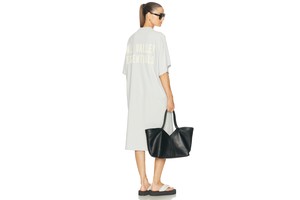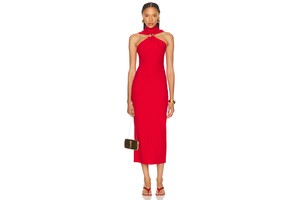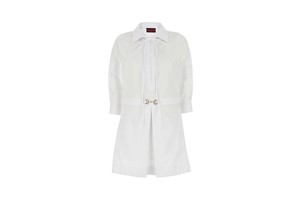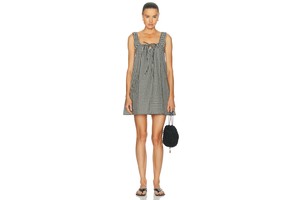
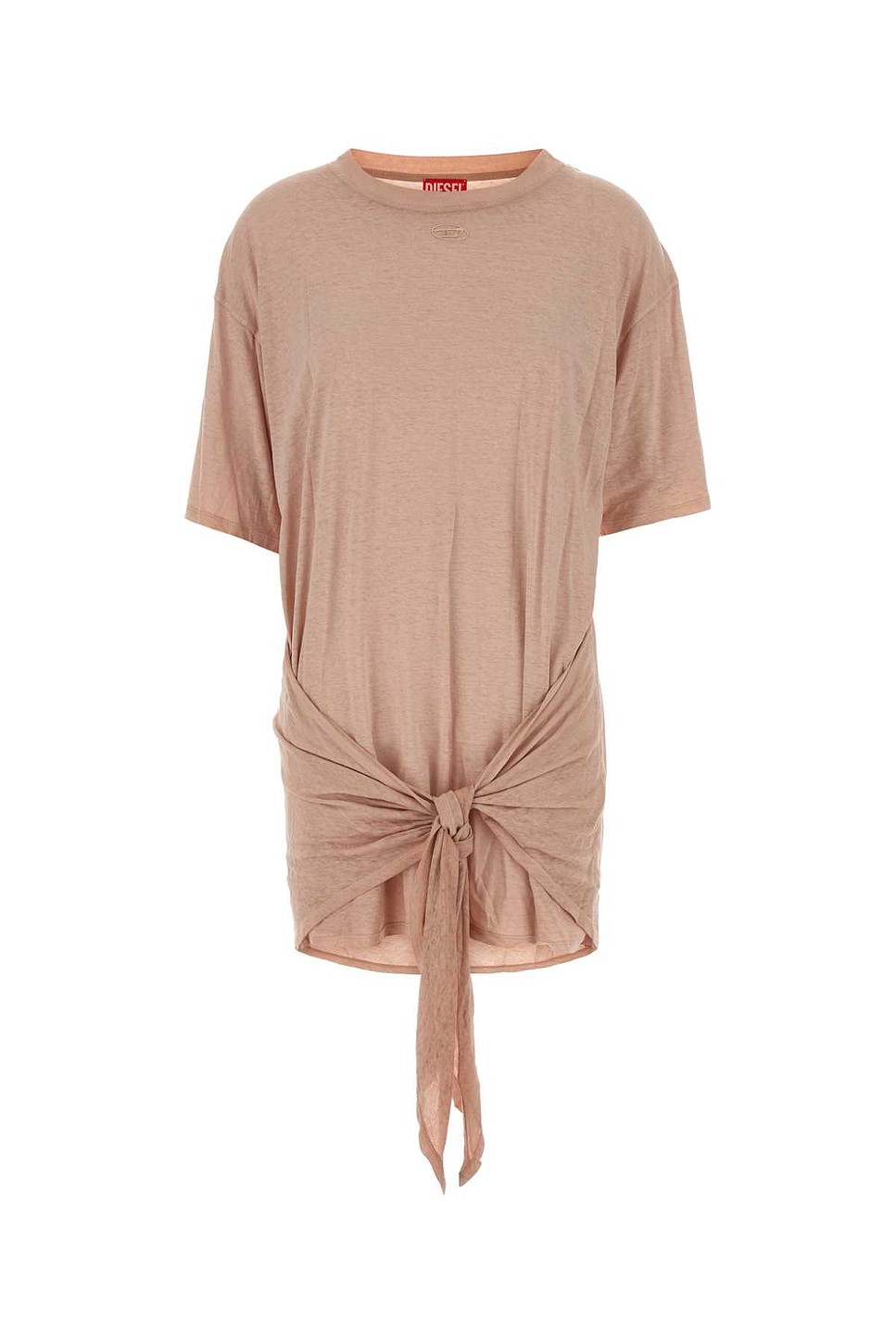
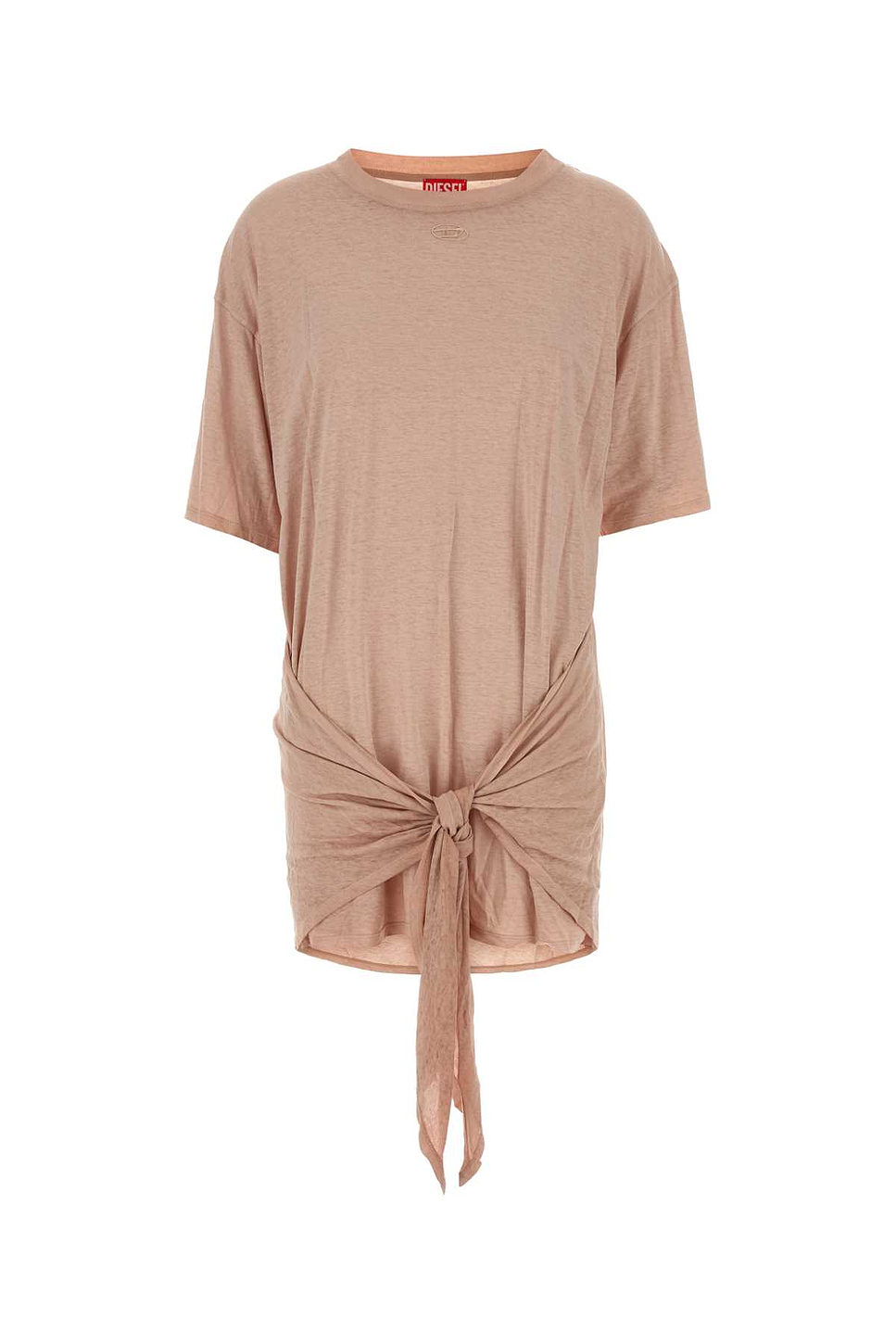
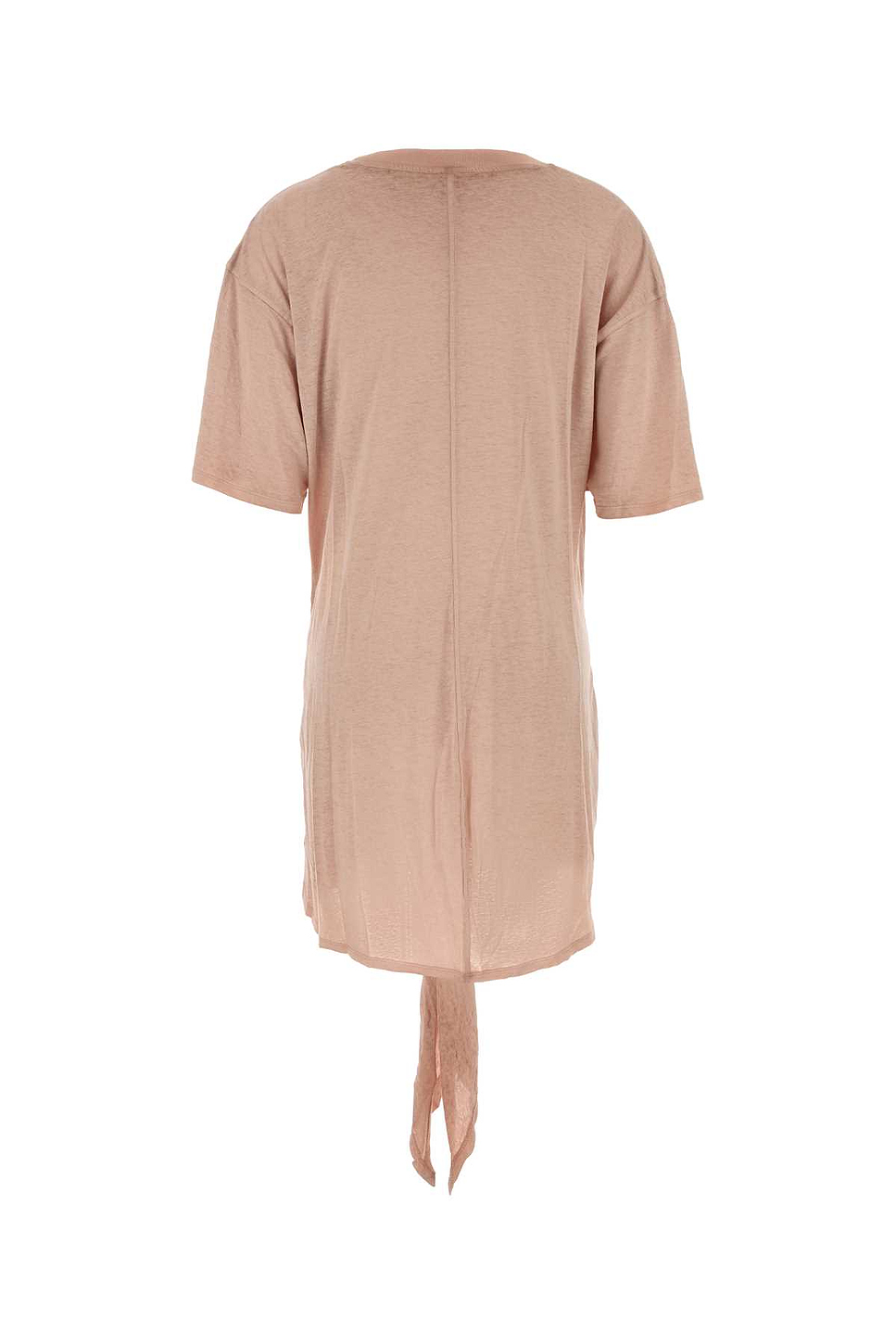
A pink jersey t-shirt dress listed with an exterior of 55% hemp and 45% cotton, made in China, filed by the retailer under mini dresses, at 225 dollars. There are no reviews and no fit votes, so there is no score to quote. The product information amounts to the composition, the country and two stock numbers, with two photographs. Two things make this one worth attention rather than dismissing it as thin. Hemp is the first fibre of its kind in this series, and knowing what it is explains why cotton sits beside it in exactly this proportion. And this batch supplies an unusually clean comparison of disclosure against price, because a garment costing fifty five dollars more publishes roughly twice the detail. The reference is the Diesel pink jersey t-shirt dress in Pink. Dongguan Bafinasa Garments Co., Ltd. develops comparable knit dresses on OEM and ODM terms, from yarn sourcing to retail or FBA ready packing. We publish this as a development reference and build your own version of it, and we do not supply the branded original or reproduce anyone else's label.
Key Features
- Exterior: 55% hemp, 45% cotton as stated. See the note below on why this pairing and this ratio make sense
- Jersey construction, named in the product title rather than in a specification. See the note below
- T-shirt dress shape, agreeing with what the retailer files it under
- Made in China as stated
- Three sizes published: XS, S and M. See the note below
- No second layer described despite the composition being given as an exterior
- No care instruction stated anywhere on the listing
- No size chart, no measurements and no model figures published
Customisable Options
- Yarn: hemp cotton to the reference, with the count and knit structure set from a tested sample
- Ratio: we would test higher cotton for softness and higher hemp for durability, since these pull in opposite directions
- Finish: we would ask for the fabric to be softened, since hemp starts firm and improves with washing
- Structure: we would name the knit rather than leave it in the title
- Length from mini to knee, knit weight, neckline, size set, colour development, private label and care labelling
Specifications
| Style | Hemp cotton jersey t-shirt dress |
| Reference | Diesel, pink jersey t-shirt dress, style FEXN-WD1895, manufacturer style A212550BMCI 7AW, colour Pink |
| Exterior | 55% hemp, 45% cotton as stated. See the note below |
| Second Layer | Not stated, though the composition is given as an exterior |
| Construction | Jersey, named in the product title rather than in a specification. See the note below |
| Care | None stated on the listing |
| Sizes Published | XS, S and M, which is three sizes. See the note below |
| Measurements | None published. No size chart and no model body figures on this listing |
| Photographs | Two |
| Production | Made in China as stated |
| Reference Retail | 225 USD, quoted to show the price band this sits in, not as our price |
| Customer Reviews | None on the reference listing, so we quote no score |
| Best Seller Badge | None. The listing carries no rank |
| Categories | Filed by the retailer under mini dresses, with no second category |
| Occasion | Everyday, warm weather, casual, travel |
| MOQ | 100 pcs per style per colourway, mixed sizes and colourways accepted |
| Sampling | 7-10 days after tech pack or reference sample confirmation |
| Bulk Lead Time | 20-30 days after sample approval and deposit |
| Service | OEM / ODM / private label, hemp cotton yarn sourcing, knit development, retail or FBA ready packing |
Size Chart
| Size | Bust | Waist | Hips | Length | Source | ||||||||||||
|---|---|---|---|---|---|---|---|---|---|---|---|---|---|---|---|---|---|
| XS | 31 | in / | 79 | cm | 24 | in / | 61 | cm | 34 | in / | 86 | cm | 86 | cm / | 33.9 | in | Our proposal |
| S | 33 | in / | 84 | cm | 26 | in / | 66 | cm | 36 | in / | 91 | cm | 88 | cm / | 34.6 | in | Our proposal |
| M | 35 | in / | 89 | cm | 28 | in / | 71 | cm | 38 | in / | 97 | cm | 90 | cm / | 35.4 | in | Our proposal |
| L | 37 | in / | 94 | cm | 30 | in / | 76 | cm | 40 | in / | 102 | cm | 92 | cm / | 36.2 | in | Our proposal |
This listing publishes no size chart, no measurements and no model body figures, and offers three sizes, XS, S and M. There is nothing on the page from which a customer could judge the fit or the length.
Occasions and Styling
Suits everyday wear, warm weather, casual wear and travel. A hemp cotton jersey t-shirt dress is an everyday piece, and it is worth knowing that hemp feels firm at first and softens with washing, so a new one is not quite what it becomes.
Production and Quality Control
There are no reviews and no fit votes on this listing, so there is no score to quote. Hemp appears here for the first time in this series, and understanding it explains the cotton beside it. This batch also permits a comparison of disclosure against price that is cleaner than any this series has managed before.
Hemp is new here, and knowing what it is explains both the cotton and the ratio, and that is the first thing. This series has not previously examined hemp, though it has examined its close relative and the resemblance is useful. Both are bast fibres, meaning they come from the stem of the plant rather than from a seed pod, and they are extracted by retting, which is controlled rotting to dissolve the material binding the fibre bundles together. That origin gives them their shared character: long fibres, high strength, low elasticity, a crisp rather than soft hand, and a tendency to crease. Hemp is more extreme than its relative in several respects. It is stronger, it lasts considerably longer, it tolerates ultraviolet light better, and it is coarser. That last property is the one bearing on this garment, and it is worth connecting to something said earlier in this series about a different fibre entirely, which is that what makes a fibre prickle is not coarseness in the abstract but diameter, since a thick enough fibre triggers pain receptors rather than merely bending against the skin, the threshold being around thirty microns. Hemp sits at the coarse end of the natural fibres by that measure, which is why it was historically used for rope and canvas, and why it feels firm against the body. Now consider what the cotton is doing. Cotton is short stapled in comparison, soft, and familiar, so blending forty five per cent of it into fifty five per cent hemp is not incidental: it softens the hand and takes the edge off the coarseness while leaving enough hemp for strength and longevity. The ratio therefore reads as a deliberate balance rather than a cost decision, and it is worth noting what each direction would give, since that is what makes the number meaningful. More hemp would be stronger, more durable, coarser and slower to soften. More cotton would be softer from the first wearing and weaker over time. There is one further property worth knowing, and it is the rare one: unlike most fibres, hemp does not weaken in water, and this series has had cause to remark several times how unusual that is. Viscose loses around half its strength when wet, acetate stiffens and marks, silk is permanently spotted, and wool felts irreversibly. Cotton itself gains strength when wet. Hemp behaves similarly, so the frequent claim that it improves with washing has two parts, one being softening as the fibre bundles break up with use and the other being that washing does it no structural harm. Finally, it is worth noting this series has usually met these properties through fibre names rather than through plant families, and grouping by family is more efficient: bast fibres share most behaviours, so lessons transfer.
A garment costing fifty five dollars more in this batch publishes roughly twice as much, and that is the cleanest version of an argument this series has made many times, and that is the second thing. The price here is 225 dollars. The product information is the composition, the country and two stock numbers, and there are two photographs. No care instruction, no closure described, no size chart, no measurements, no model figures. Elsewhere in this batch is a sheer lace maxi costing 280 dollars which publishes its opacity in plain words, states it is unlined and what follows from that, gives the closure, gives the construction, gives measurements including length for a size, gives a care instruction, and gives the country. So the second garment costs about twenty five per cent more and discloses roughly twice as much. This series has been arguing for a long time that disclosure has no relationship to price, and has built that case at the expensive end, finding listings at 1,026 dollars and 1,142 dollars and 1,470 dollars with four lines, then three in a batch above 1,900 dollars disclosing identically little, and most recently a garment at 3,448 dollars publishing less than most things costing a tenth of it. Every one of those comparisons spans a large price difference, and a sceptic could reasonably say that the cheap garments tell you more because they have nothing else to sell. This comparison removes that objection, because twenty five per cent is not enough distance for it. Both are ordinary ready to wear from ordinary makers, and the difference in what they tell you is not explained by where they sit in the market. The explanation offered throughout still holds and still costs nothing to remedy: everything else on a listing requires effort, whether that is a photo shoot or somebody with a tape measure, whereas a care instruction requires only knowing what the cloth is and what was done to it, both settled before the garment is finished. There is one point specific to this garment rather than to the general argument. Hemp cotton jersey is robust, arguably the most washable combination yet examined in this series, since neither fibre is harmed by water and one of them gains strength in it, and yet no instruction appears. So the absence is not even protecting anything, it is simply leaving the customer to decide, and before a garment described as a jersey t-shirt dress she will very probably decide it goes in the machine. In this instance that guess happens to be nearly right, which is worth saying because it makes the point sharper: even when the customer guesses correctly, she had to guess.
The title says jersey and that is the fifth time this series has found information in a title, and three sizes has a mechanism available, and that is the third thing. This series has been tracking the habit of putting useful information in a product name rather than in a specification, and there are now five instances, which is enough to call it a pattern rather than a series of accidents. The earliest was the word for knit buried in a French product title, so that only a French speaker could learn anything from it. Then twill, then poplin, then broderie anglaise, and now jersey. It is worth noting that this habit has become slightly less obscure over time, since the first required French and the latest four are recognisable English words, but the underlying convention has not changed: information that belongs in a field is placed where a customer has to notice it and interpret it herself. There is, however, something genuinely useful available in this particular case, and it is worth drawing because it answers a question these pages usually leave open. Jersey is a knit, and this series has spent considerable space establishing what that implies, having recently deduced knit structure from nothing but a chart on one garment, noting four mechanisms by which a garment can measure smaller than the body it covers and eliminating three of them to leave knit. What makes the statement useful here is that it supplies a mechanism for the three sizes offered. A knit garment accommodates more than one body size because its loops can open, unlike a woven where yarns are locked at right angles, so a short size run has something supporting it. This series has recently compared three short runs from the same source and refined how they should be read, concluding that a consecutive run of two proves little since clearing stock easily leaves two adjacent sizes, whereas three or more in sequence are hard to explain by accident. Those three were of another character entirely, being short because of how much was left rather than how it was made. Here there is a reason to expect a short range to work, which is the difference between three sizes chosen and three sizes remaining. Finally, there is one word worth counting, since this series has kept count of it for a long time. The composition is given as exterior, and previous listings have given it as shell, as principal material, and variably translated. Four spellings now for one idea, and in each case the second layer goes unmentioned. On a jersey t-shirt dress there may well be no second layer at all, which would be entirely reasonable, but the word leaves the question open rather than answering it. Every bulk shipment gets a measurement report against your approved chart.
Optional upgrades include adding a care instruction, since nothing here needs protecting but hemp cotton is washable and saying so removes a guess, moving the word jersey from the title into a specification, stating whether there is a second layer rather than leaving exterior to imply one, asking for the fabric to be softened since hemp starts firm, a softening wash test across several cycles so the hand can be described accurately, testing a higher cotton ratio for softness and a higher hemp ratio for longevity, measurements published for the three sizes, a fourth and fifth size, alternative knit weights, alternative necklines, alternative lengths, colour development and private label, hangtag and care labelling.
Pre-production sample approval, in-line inspection during cutting and sewing, and a final AQL inspection before packing, with measurement reports and photos shared before shipment.
Send us your tech pack, a photo or a reference garment and we will quote within 24 hours. Contact bafinasa@bafinasa.com or WhatsApp +86 13827222469.