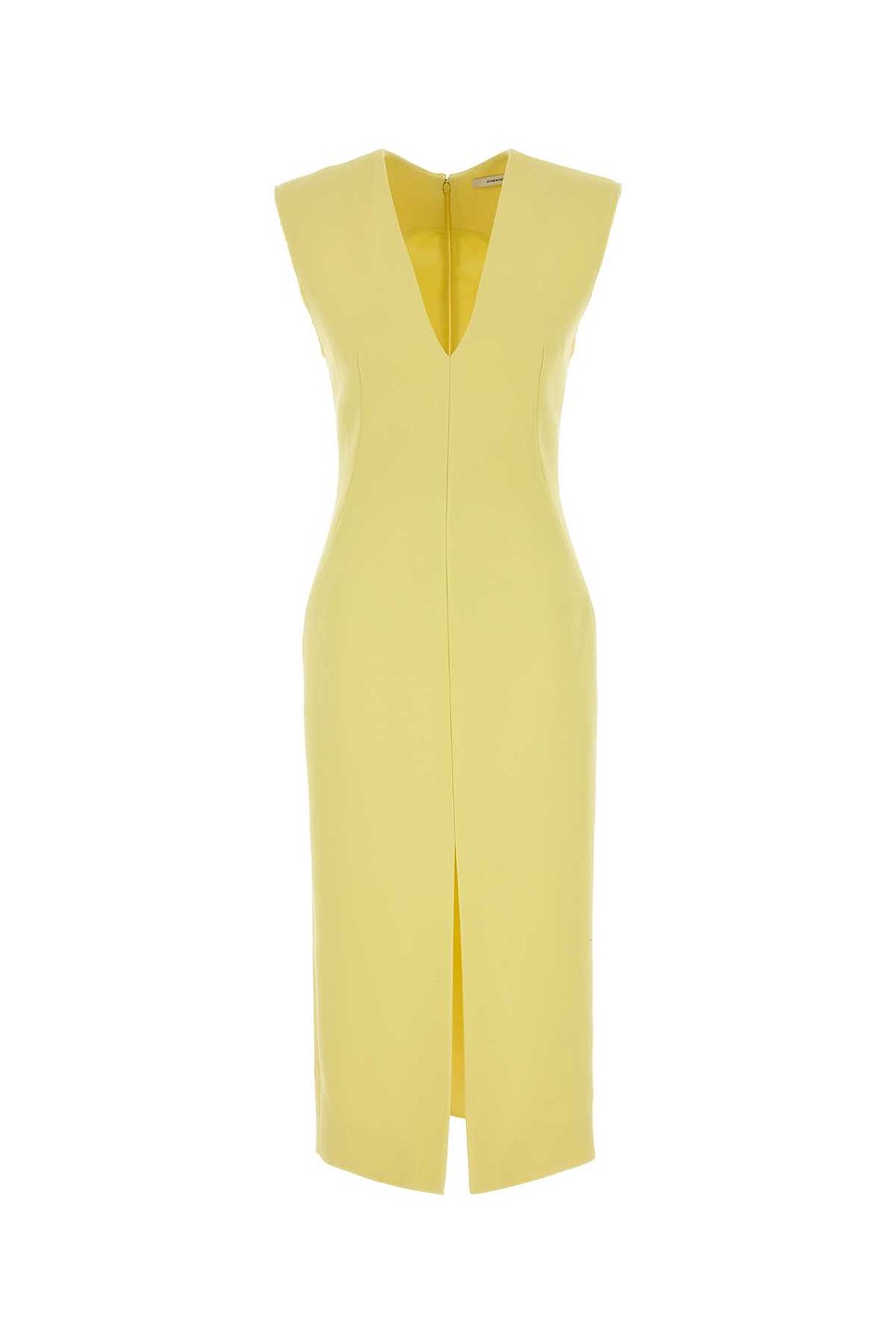
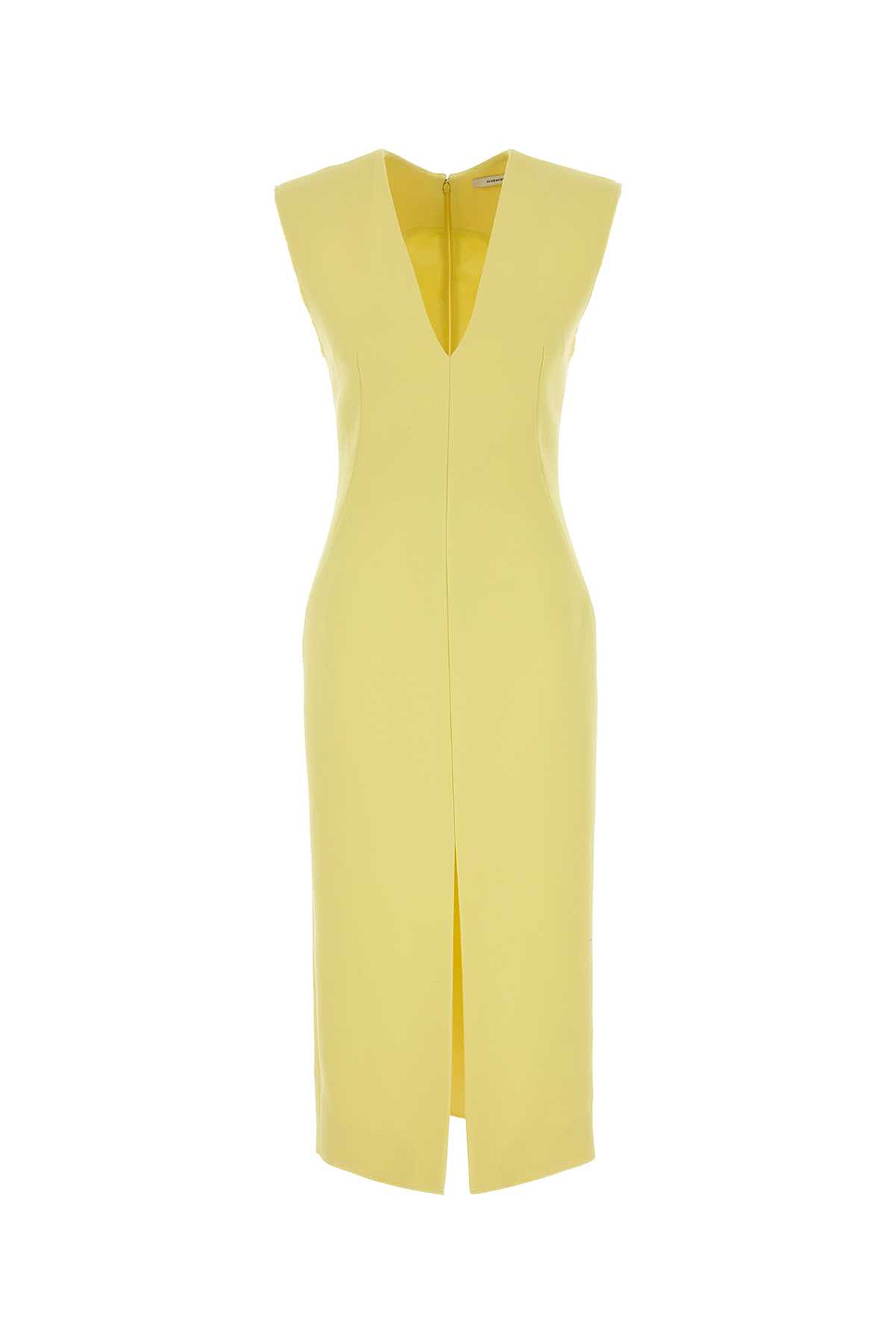
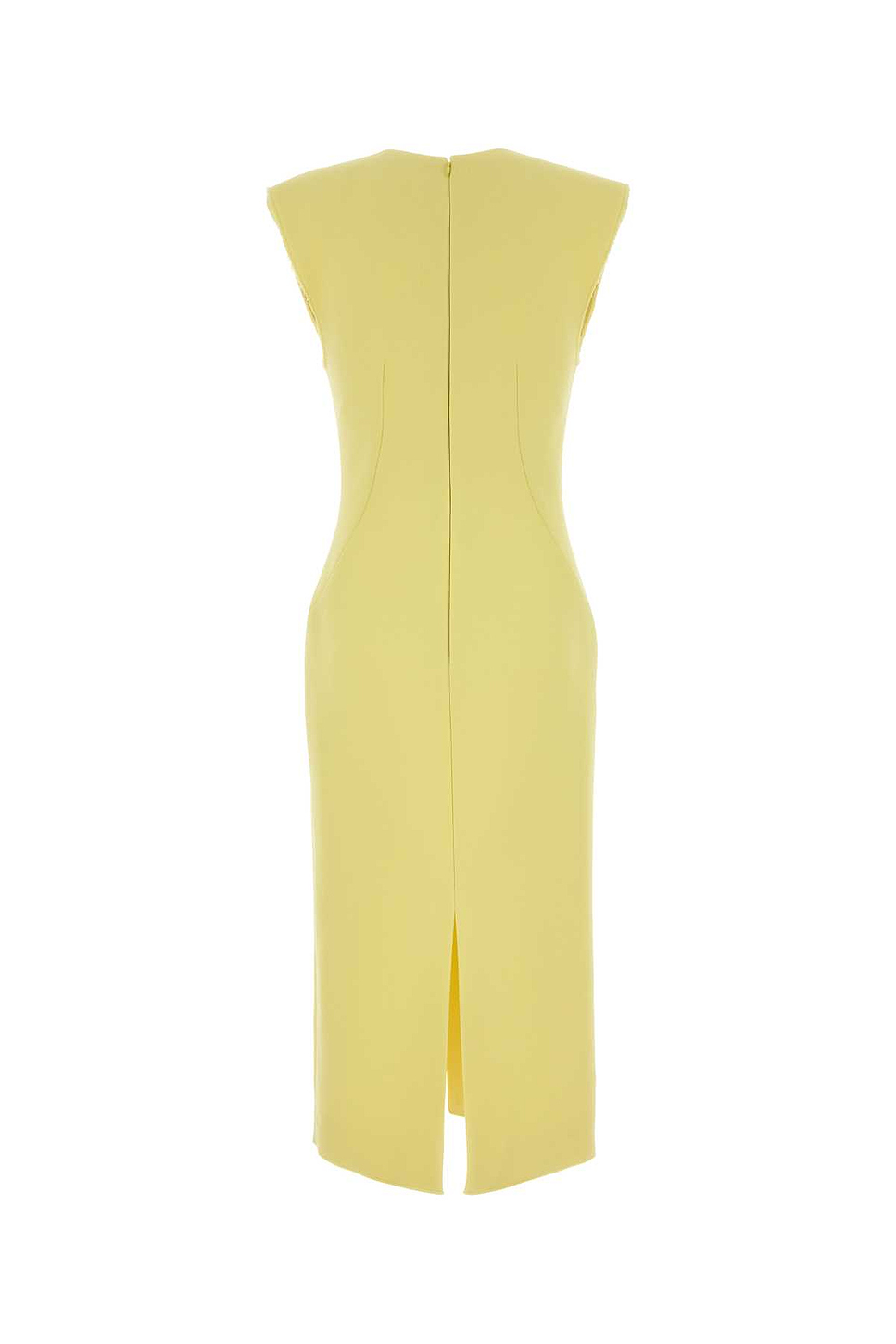
A yellow dress listed with a shell of 90% wool, 7% nylon and 3% elastane and a lining of 100% viscose, made in Italy, filed by the retailer under midi dresses, at 2,883 dollars. There are no reviews and no fit votes, so there is no score to quote. The product information amounts to the two compositions, the country and two stock numbers, with two photographs. There is no care instruction anywhere on the listing, and ninety per cent wool without one is the sharpest instance of a problem this series has met before. There is also a word in the product name whose relationship to the composition is worth examining rather than accepting. The reference is the Givenchy yellow stretch crepe dress in Yellow. Dongguan Bafinasa Garments Co., Ltd. develops comparable wool dresses on OEM and ODM terms, from fabric sourcing to retail or FBA ready packing. We publish this as a development reference and build your own version of it, and we do not supply the branded original or reproduce anyone else's label.
Key Features
- Shell: 90% wool, 7% nylon, 3% elastane as stated. See the note below
- Lining: 100% viscose as stated, which differs from the shell in how it responds to water
- Stretch crepe, named in the product title. See the note below on what the stretch claim rests on
- Made in Italy as stated
- Yellow, and filed by the retailer under midi dresses
- No care instruction stated anywhere on the listing. See the note below
- Two sizes published: 36 and 38
- No size chart, no measurements and no model figures published
Customisable Options
- Fabric: wool rich stretch crepe to the reference, with the weight set from a tested sample
- Elastane: we would discuss the level, since three per cent recovers but does not compress
- Lining: we would raise matching it to the shell, since viscose and wool move differently in water
- Care: we would add dry clean only, which is what this composition needs
- Length from midi to knee, crepe weight, lining options, size set, colour development, private label and care labelling
Specifications
| Style | Wool stretch crepe dress |
| Reference | Givenchy, yellow stretch crepe dress, style FEXN-WD1438, manufacturer style BW22LH167R 725, colour Yellow |
| Shell | 90% wool, 7% nylon, 3% elastane as stated. See the note below |
| Lining | 100% viscose as stated. See the note below |
| Fabric | Stretch crepe, named in the product title |
| Care | None stated on the listing, which for this composition is a meaningful absence. See the note below |
| Sizes Published | 36 and 38, which is two adjacent sizes. See the note below |
| Measurements | None published. No size chart and no model body figures on this listing |
| Photographs | Two |
| Production | Made in Italy as stated |
| Reference Retail | 2,883 USD, quoted to show the price band this sits in, not as our price |
| Customer Reviews | None on the reference listing, so we quote no score |
| Best Seller Badge | None. The listing carries no rank |
| Categories | Filed by the retailer under midi dresses, with no second category |
| Occasion | Occasions, professional settings, cool weather events |
| MOQ | 100 pcs per style per colourway, mixed sizes and colourways accepted |
| Sampling | 7-10 days after tech pack or reference sample confirmation |
| Bulk Lead Time | 20-30 days after sample approval and deposit |
| Service | OEM / ODM / private label, wool suiting sourcing, lining, retail or FBA ready packing |
Size Chart
| Size | Bust | Waist | Hips | Length | Source | ||||||||||||
|---|---|---|---|---|---|---|---|---|---|---|---|---|---|---|---|---|---|
| 36 | 31 | in / | 79 | cm | 24 | in / | 61 | cm | 34 | in / | 86 | cm | 115 | cm / | 45.3 | in | Our proposal |
| 38 | 33 | in / | 84 | cm | 26 | in / | 66 | cm | 36 | in / | 91 | cm | 117 | cm / | 46.1 | in | Our proposal |
| 40 | 35 | in / | 89 | cm | 28 | in / | 71 | cm | 38 | in / | 97 | cm | 119 | cm / | 46.9 | in | Our proposal |
| 42 | 37 | in / | 94 | cm | 30 | in / | 76 | cm | 40 | in / | 102 | cm | 121 | cm / | 47.6 | in | Our proposal |
This listing offers two sizes, 36 and 38, and publishes no size chart, no measurements and no model body figures. There is nothing on the page from which a customer could judge the fit, and no length figure to confirm or question the retailer's filing of this garment under midi dresses.
Occasions and Styling
Suits occasions, professional settings and cool weather events. Ninety per cent wool makes this a cool weather garment, and that is the opposite of what a bright yellow party dress usually suggests, which is worth knowing before choosing when to wear it.
Production and Quality Control
There are no reviews and no fit votes on this listing, so there is no score to quote. No care instruction appears, and ninety per cent wool without one is worth examining carefully, because this series has met the same shape before at a much lower wool content. There is also a word in the product name worth testing against what the shell actually contains.
Ninety per cent wool with no instruction is the sharpest form of a problem met already, and that is the first thing. This series examined a black mini whose shell was around forty three per cent wool with a lining of another fibre entirely, and which also stated no care instruction, and the conclusion then was that the missing line was not an inconvenience but a switch, since nothing else decides what happens to that garment. Wool fails in a particular way and it is worth being precise about the mechanism, because it is unlike every other failure this series has catalogued. Wool fibre has scales along its surface, and under the combined action of water, heat and agitation those scales interlock, so the fibre mass contracts irreversibly into a denser felted state. Nothing reverses it. Once a wool garment has felted it cannot be returned to its original dimensions, so the failure is permanent rather than merely cosmetic. Contrast this with the other fibres gathered so far. Viscose loses around half its strength when wet but recovers as it dries. Acetate stiffens and marks, and those marks cannot be removed, though the garment still fits. Cotton shrinks, usually once and then no more. Only felting is both permanent and dimensional, meaning the garment stops fitting as well as looking wrong. Now consider what that means here. At forty three per cent wool, felting was already a real risk. At ninety per cent, there is no component strong enough to hold the shape while the wool does what it does, which is why this series has elsewhere noted that a blend's fate depends on whether anything is present to hold things together, having compared a partly supported blend unfavourably against one where every component failed together. This garment sits at the far end of that logic, since the shell is almost entirely the fragile component. It is worth adding what should have been written, which costs one line: dry clean only. There is a further point about the lining, and this is where a second problem sits quietly. The lining is one hundred per cent viscose while the shell is almost entirely wool. Those two respond to water in completely different ways, the wool contracting irreversibly and the viscose losing around half its strength, so they do not simply both fail, they fail by different amounts in different directions. This series has stated the general rule throughout, that layers should be in the same fibre so that they stay in proportion afterwards, and has tracked how often even knowing about the second layer is denied to the reader. There is one mitigating observation, and it is the same one this series has now drawn three times in recent batches: an instruction of dry clean only would put the mismatch to sleep, since neither layer ever gets wet. That is precisely why the absence here compounds rather than merely adds.
The title says stretch and the shell contains three per cent elastane, and reconciling those two is the interesting part, and that is the second thing. This series established a way of reading elastane levels some time ago and has used it consistently since: below roughly five per cent it is a recovery additive rather than something a fit can rest on, whereas levels approaching a fifth genuinely compress a body. That threshold has proved its usefulness repeatedly. On one recent strapless garment it was what distinguished two garments declaring the same boned construction, since twenty per cent could hold itself up by compression alone while five per cent could not, so the boning was doing the work in the second case and merely reinforcing in the first. Applying it here, three per cent is clearly in the additive range. That does not make the product name dishonest, and it is worth saying so plainly rather than scoring a cheap point. Elastane at this level does what the word stretch claims: it lets the cloth extend and recover rather than pulling permanently out of shape, which is genuinely why it is in a crepe suiting, since it keeps a garment from bagging at the elbows and the seat during a day's wear. What it will not do is hold a garment against the body or size it down, so a customer seeing stretch and expecting the cloth to accommodate a size difference is reading more into the word than the composition supports. So the correct statement is that stretch describes behaviour rather than fit accommodation, and the distinction matters more on a wool garment than elsewhere, for a reason worth giving. Wool without any elastane creases and does not recover well, so even a small amount measurably improves how a wool garment wears, which is probably why it is here at all. There is also seven per cent nylon, and it is doing its familiar quiet work, since nylon is the strongest of the common apparel fibres and contributes abrasion resistance without changing anything else about the cloth, this series having noted the same pairing before. Finally, there is something worth noting about the two compositions appearing in one string, since the second layer is given here rather than omitted. That is genuinely creditable and this series has noted that recent batches have finally begun to do it. But receiving both numbers also reveals the problem described above, which is that the two are entirely different fibre families and no instruction reconciles them.
Two adjacent sizes, and nothing else, and this lands exactly on the weak part of a method this series has been refining, and that is the third thing. This series built up a way of reading short size runs over several batches. The first observation was that a short run which is consecutive signals deliberate narrowness needing some mechanism on the garment to make it work, while a run missing a size from its middle is not a range but what is left over. That was then refined by comparing three short runs from one source at once, with the conclusion that a consecutive run of two proves little, because clearing stock easily leaves two adjacent sizes, whereas three or more in sequence are hard to explain by accident. Thirty six and thirty eight sit exactly on that weak case, so nothing can be concluded about intent, and it is better to say that than to invent a reading. What can be noted is that this garment does have a small mechanism available in its three per cent elastane, and that this series has recently credited another listing for having one, since a knit accommodates more than one body because its loops can open. Here the mechanism is weaker than that, for the reason given above, so even taking it at its most generous it would explain comfort across a narrow range rather than a size run of two being deliberate. The further point is that whatever the size logic is, there is no way to act on it, since no measurements are published and there is no model. That combination is now familiar, having been noted on several recent garments, and it bears repeating because it is the part that actually costs the customer something: she cannot compare herself against anything. There is one last observation about the filing which is worth setting down, because it is the sort of small contradiction this series finds instructive. The product name describes neither length nor sleeve nor shape, saying only what it is made of and what colour it is, while the retailer files it under midi dresses. So length information exists on this page and exists nowhere in the product name, which reverses the usual arrangement, since this series has more often found a name asserting a length that the measurements then contradicted, one clear case being a garment called mini which actually measured around 133 centimetres. Here the name asserts nothing and the retailer asserts something, and since no length figure is published there is no way to confirm it. Every bulk shipment gets a measurement report against your approved chart.
Optional upgrades include adding dry clean only, which ninety per cent wool requires and ninety per cent wool otherwise makes irreversible, either matching the lining fibre to the shell or keeping that instruction permanently, since the two layers fail in incompatible ways when wet, raising the elastane if the stretch claim is meant to describe fit rather than recovery, publishing measurements for the two sizes at the very least, adding a model figure so either size can be placed against a body, publishing the length so the retailer's own midi filing can be checked, alternative crepe weights, alternative linings, additional sizes, colour development and private label, hangtag and care labelling.
Pre-production sample approval, in-line inspection during cutting and sewing, and a final AQL inspection before packing, with measurement reports and photos shared before shipment.
Send us your tech pack, a photo or a reference garment and we will quote within 24 hours. Contact bafinasa@bafinasa.com or WhatsApp +86 13827222469.