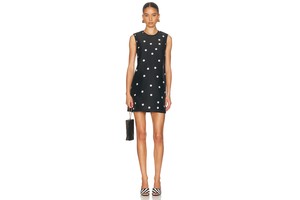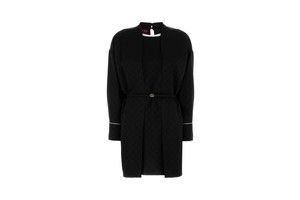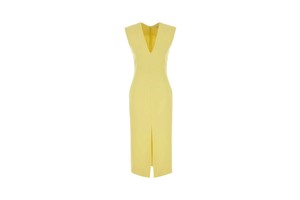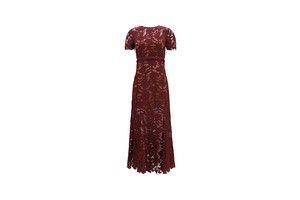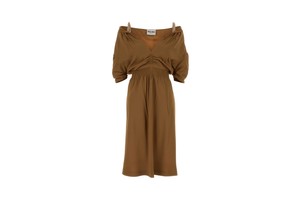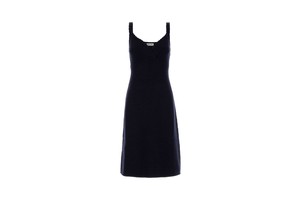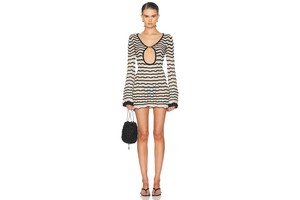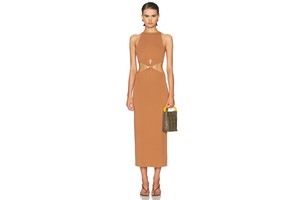
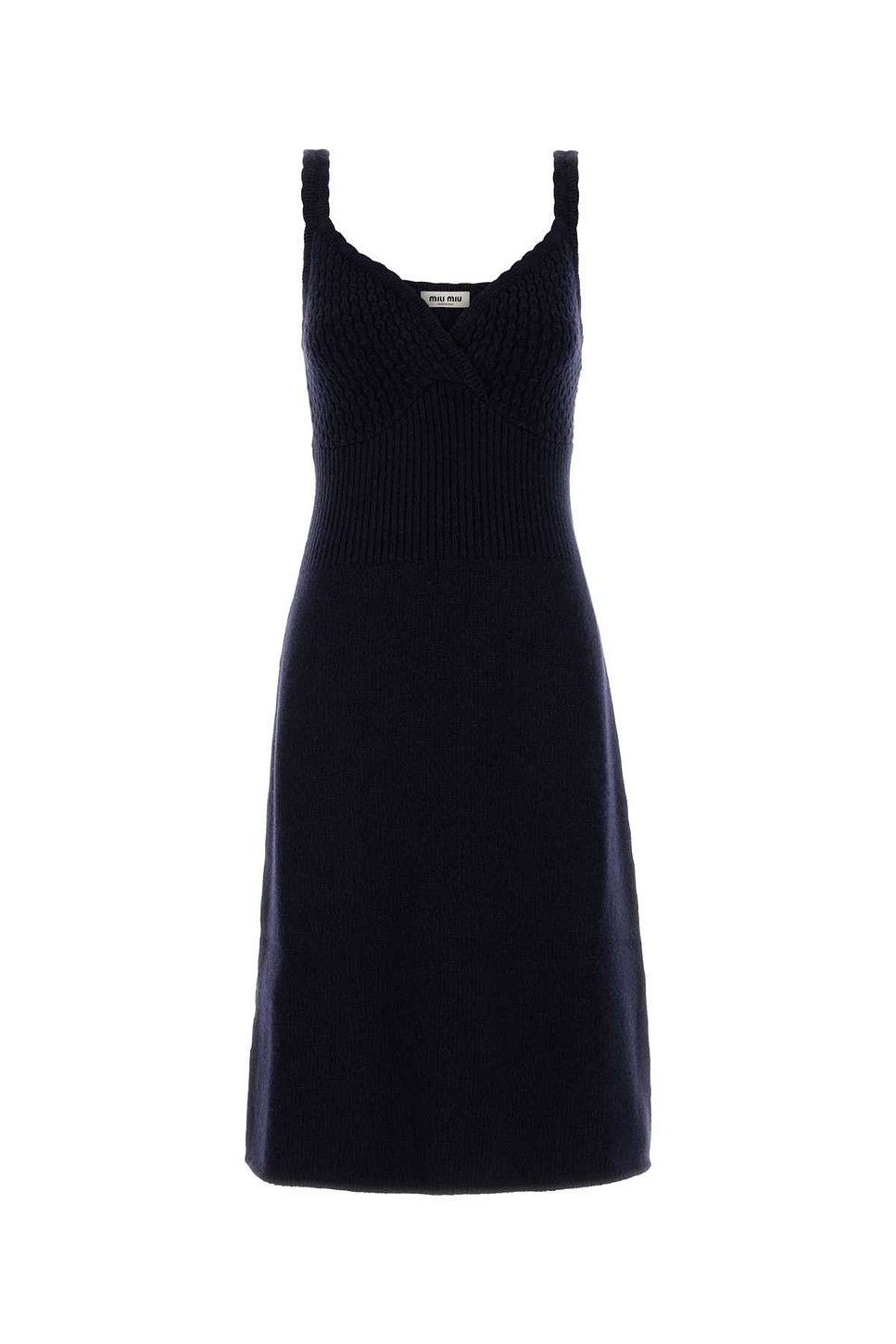
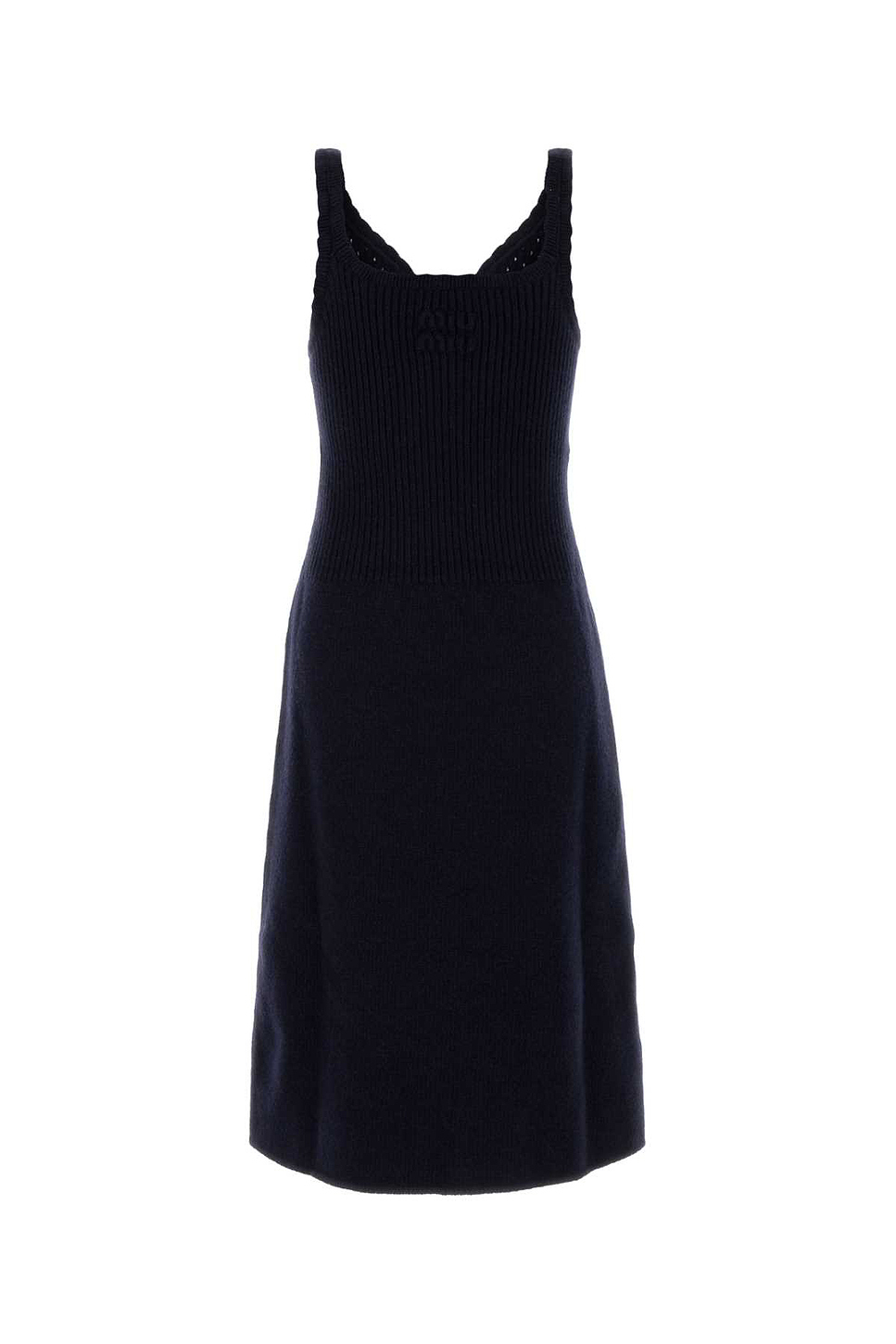
A wool dress listed with a shell of 100% virgin wool, made in Italy, filed by the retailer under sweater dresses, at 2,076 dollars. There are no reviews and no fit votes, so there is no score to quote. The whole product information is four lines: the composition, the country, and two stock numbers. There is no care instruction, no closure described, no length and no measurements, and two photographs. Two facts here combine into something worth drawing out, and one fact is missing that matters more here than in any listing this series has assessed. There is also a pattern in this batch worth reading across several garments rather than one. The reference is the Miu Miu navy blue wool dress in Blue. Dongguan Bafinasa Garments Co., Ltd. develops comparable knit dresses on OEM and ODM terms, from yarn sourcing to retail or FBA ready packing. We publish this as a development reference and build your own version of it, and we do not supply the branded original or reproduce anyone else's label.
Key Features
- Shell: 100% virgin wool as stated, which is a defined term rather than a grade. See the note below
- Filed under sweater dresses by the retailer, which identifies the construction
- Made in Italy as stated
- Two sizes published: 38 and 42, with nothing in between. See the note below
- No care instruction stated anywhere on the listing
- No size chart, no measurements and no model body figures published
- Two photographs
- No second layer described despite the composition being given as a shell
Customisable Options
- Yarn: virgin wool to the reference, with the count and knit structure set from a tested sample
- Fibre diameter: we would ask for it, since it decides whether this can be worn next to the skin. See the note below
- Care: we would add dry clean only, since wool demands it more than almost any fibre
- Knit structure: we would name it, since the retailer's own filing already implies it
- Length from mini to knee, knit stitch, neckline, size set, colour development, private label and care labelling
Specifications
| Style | Virgin wool knit dress |
| Reference | Miu Miu, navy blue wool dress, style FEXN-WD1147, manufacturer style MMA913SOOO18H1 F0008, colour Blue |
| Shell | 100% virgin wool as stated. See the note below on what that term means |
| Second Layer | Not stated, though the composition is given as a shell |
| Construction | Knit, implied by the retailer filing the garment under sweater dresses. See the note below |
| Care | None stated on the listing. See the note below |
| Fibre Diameter | Not stated, and it is the one figure that decides next to skin comfort. See the note below |
| Sizes Published | 38 and 42 only, with nothing in between. See the note below |
| Measurements | None published. No size chart and no model body figures on this listing |
| Photographs | Two |
| Production | Made in Italy as stated |
| Reference Retail | 2,076 USD, quoted to show the price band this sits in, not as our price |
| Customer Reviews | None on the reference listing, so we quote no score |
| Best Seller Badge | None. The listing carries no rank |
| Categories | Filed by the retailer under sweater dresses, with no second category |
| Occasion | Cool weather, daytime, layering, city |
| MOQ | 100 pcs per style per colourway, mixed sizes and colourways accepted |
| Sampling | 7-10 days after tech pack or reference sample confirmation |
| Bulk Lead Time | 20-30 days after sample approval and deposit |
| Service | OEM / ODM / private label, virgin wool sourcing, knit development, retail or FBA ready packing |
Size Chart
| Size | Bust | Waist | Hips | Length | Source | ||||||||||||
|---|---|---|---|---|---|---|---|---|---|---|---|---|---|---|---|---|---|
| 36 | 31 | in / | 79 | cm | 24 | in / | 61 | cm | 34 | in / | 86 | cm | 92 | cm / | 36.2 | in | Our proposal |
| 38 | 33 | in / | 84 | cm | 26 | in / | 66 | cm | 36 | in / | 91 | cm | 94 | cm / | 37 | in | Our proposal |
| 40 | 35 | in / | 89 | cm | 28 | in / | 71 | cm | 38 | in / | 97 | cm | 96 | cm / | 37.8 | in | Our proposal |
| 42 | 37 | in / | 94 | cm | 30 | in / | 76 | cm | 40 | in / | 102 | cm | 98 | cm / | 38.6 | in | Our proposal |
This listing publishes no size chart, no measurements and no model body figures, and offers two sizes, 38 and 42, with nothing between them. There is nothing on the page from which a customer could judge the fit or the length.
Occasions and Styling
Suits cool weather, daytime, layering and city wear. A virgin wool knit dress is a cold weather piece rather than a warm one, and it is worth saying that a sweater dress is the rare garment expected to be worn over tights, which changes how its length reads on the body.
Production and Quality Control
There are no reviews and no fit votes on this listing, so there is no score to quote. Two facts here combine into something worth drawing out, one missing fact matters more here than almost anywhere else in this series, and there is a size pattern in this batch only visible across several garments.
The word virgin means new rather than fine, and it is the second time this term has appeared, and that is the first thing. Virgin wool is widely read as referring to a first shearing, as though it were a grade describing fineness, and this series examined that reading once already and found it mistaken. What the term actually denotes in trade usage is wool that has never been used before, meaning fibre that has never been made into a textile and recovered, its opposite being reclaimed wool, which has been torn out of existing cloth and is consequently shorter, weaker and duller for having been through the process. So the claim is about the fibre being new, not about the animal being young, and it is worth repeating because it is checkable: under American labelling rules it sits alongside a defined term for recycled wool and each is required to be declared honestly, which makes it comparable to the Supima cotton claim examined elsewhere in this batch, where the useful property was likewise that a definition stands behind the word. Most fibre claims are not like that. There is a second point to be made here, and it is the one that actually decides whether this garment is comfortable. What makes wool prickle is not coarseness in the abstract but fibre diameter, and the mechanism is specific: a fibre thick enough triggers pain receptors in the skin rather than merely bending against it, the threshold being around thirty microns, whereas below roughly twenty microns the fibre bends under the pressure of contact without being felt at all, which is why fine merino can be worn next to the skin. This is always worth knowing, and it matters more here than in the earlier case, which was examined on a strapless wool garment with no lining, where we noted wool would sit directly against the neck and under the arms and that the neck is among the most sensitive areas. There the exposure was limited to particular areas. Here the garment is a sweater dress, so wool is against the entire body for the whole time it is worn. That is the strongest form of this question and the page has no answer to it.
The fabric almost certainly cannot tolerate water, and the way it fails is the one that cannot be undone, and there is no instruction, and that is the second thing. Wool behaves differently from any fibre examined so far in this series, and it is worth setting the mechanisms side by side because they part company in a way that changes what a missing instruction costs. Viscose loses around half its strength when wet, so it is weakened, and while that deformation is rarely reversible the garment itself survives. Acetate stiffens, loses lustre and marks in water, the marks being changes in how a surface reflects light rather than stains. Wool felts. Its fibres carry scales, and when moisture, heat and agitation are present together those scales interlock irreversibly, so the cloth becomes smaller, denser and firmer, with no route back. That is why a wool garment put through a machine emerges in a child's size. There is no version of this that recovers. This series has mentioned that several times, most recently on a strapless wool garment offering dry cleanable rather than the strict wording, and before that on a wool mini over a polyester lining with no care instruction at all, where we said the missing line was not an inconvenience but a switch deciding whether faults went live at once. This listing is the severe version of that case, because the switch is missing and there is no second fibre anywhere in the composition to dilute what happens. One hundred per cent wool will felt entirely. There is a useful contrast available from earlier in this batch, where three listings strutted out full care instructions matching their cloth exactly: cotton declared machine washable, and a viscose and silk blend declared dry clean only, both correct. So the instruction exists and is understood in this part of the trade. What is notable about how expensive retail listings behave is that this series has now found several costing over a thousand dollars whose entire content is four lines, and the argument has been made consistently that how much a page discloses has no relationship to what the garment costs, since other parts of the same page, such as photography and copy, all cost effort while a care instruction costs only the knowledge of what the cloth is and what was done to it. That knowledge exists before the garment is finished. So its absence is a choice rather than a limitation.
The size run has a gap in its middle, and this is now the third such case, and the batch supplies the contrast that makes the reading usable, and that is the third thing. Two sizes are published, 38 and 42, with nothing between. This series built a way of reading short runs from another listing, which was that a run that is short but consecutive signals a deliberate narrowness, requiring something on the garment to make it work, usually stretch or generosity, while a run missing a size from its middle is not a range at all but what happens to be left, the first instance being a knit dress offered in 34 and 38 with no 36. Two further garments in this same batch allow that distinction to be tested in unusually useful conditions, because all three are carried under the same retailer buyer store field and all three are short runs, but they differ. One offers 40 and 42, consecutive. One offers 38, 40 and 42, consecutive across three sizes. This one offers 38 and 42, with 40 missing. So the first two pass the consecutive test and this one fails it, which is a genuine confirmation rather than a restatement, since three garments of the same kind were distinguished from each other rather than one being classified in isolation. It is worth being careful about what the consecutive cases establish, because there is a limit worth stating. A run of two consecutive sizes is weak evidence either way, since clearing stock often leaves two adjacent sizes, whereas a run of three consecutive sizes is much more likely to be deliberate, because clearance rarely leaves exactly three in a row. That refinement did not exist when the rule was first written, and this batch is what supplies it. There is one more thing worth noting on this garment specifically, which is that the retailer has filed it under sweater dresses, and that single piece of information does work most listings fail to do: sweater means knit, so the construction is stated, in effect, and it is stated by the retailer rather than by whoever wrote the description. This series has spent a great deal of space on listings where the construction can only be inferred, having deduced knit from nothing but a chart on one recent garment and having found the word buried in a French product title on another. This is better than either of those, and it is worth crediting while noting that it arrived by accident. Every bulk shipment gets a measurement report against your approved chart.
Optional upgrades include asking for and publishing fibre diameter, since one hundred per cent wool covers the whole body and that number decides comfort, a care instruction added and specifically dry clean only, since felting has no remedy, the knit structure named rather than left to be inferred from how the retailer filed it, consecutive sizing if this is being made rather than cleared, a size chart and model body measurements published, alternative wool counts and stitch structures, alternative necklines, alternative lengths, extended sizing, colour development and private label, hangtag and care labelling.
Pre-production sample approval, in-line inspection during cutting and sewing, and a final AQL inspection before packing, with measurement reports and photos shared before shipment.
Send us your tech pack, a photo or a reference garment and we will quote within 24 hours. Contact bafinasa@bafinasa.com or WhatsApp +86 13827222469.