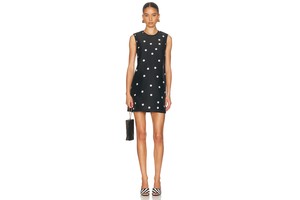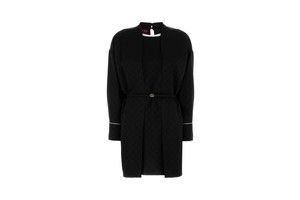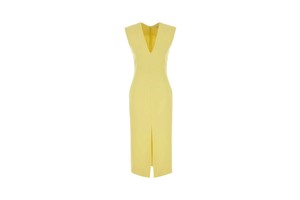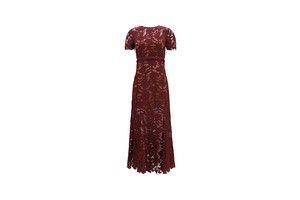
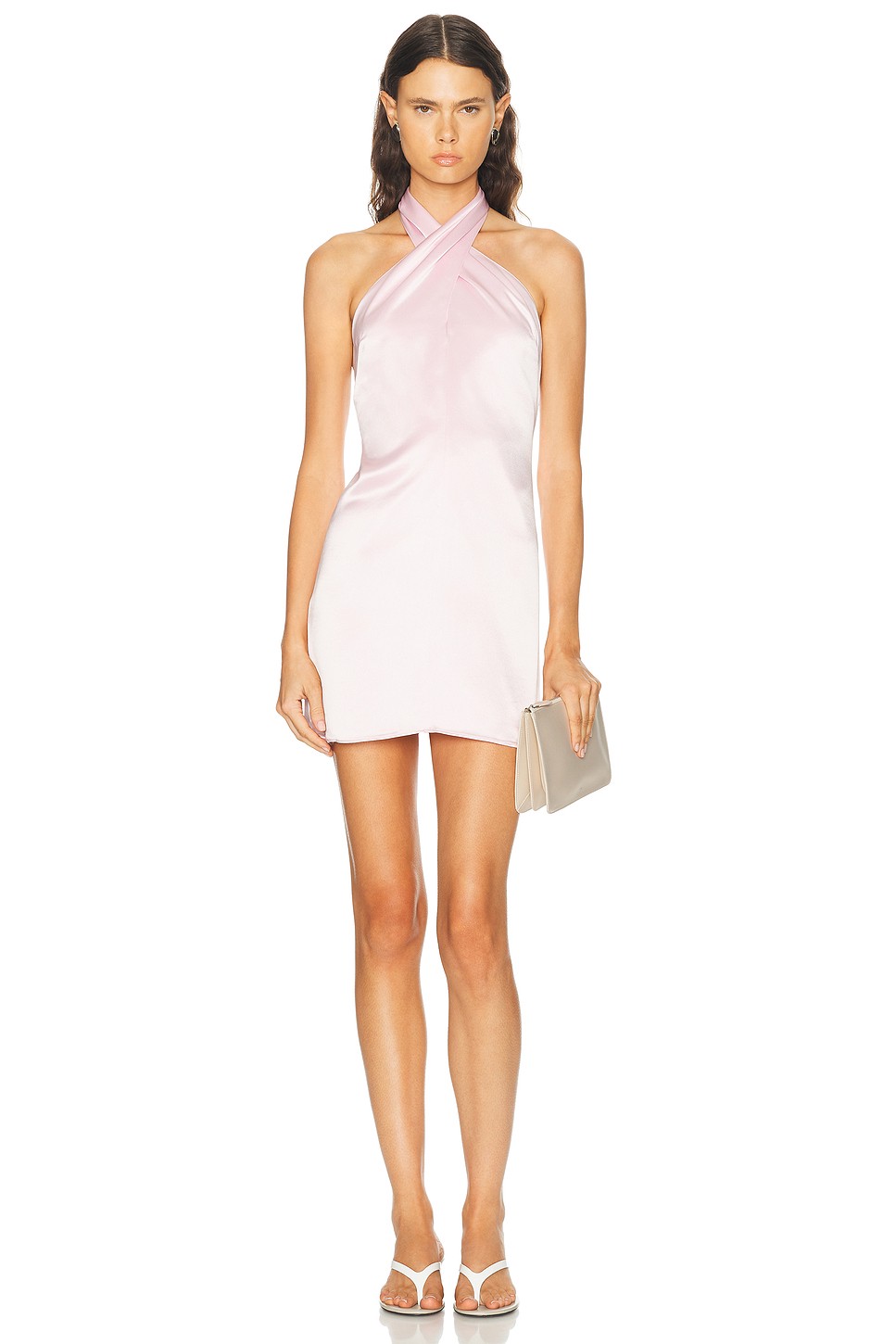
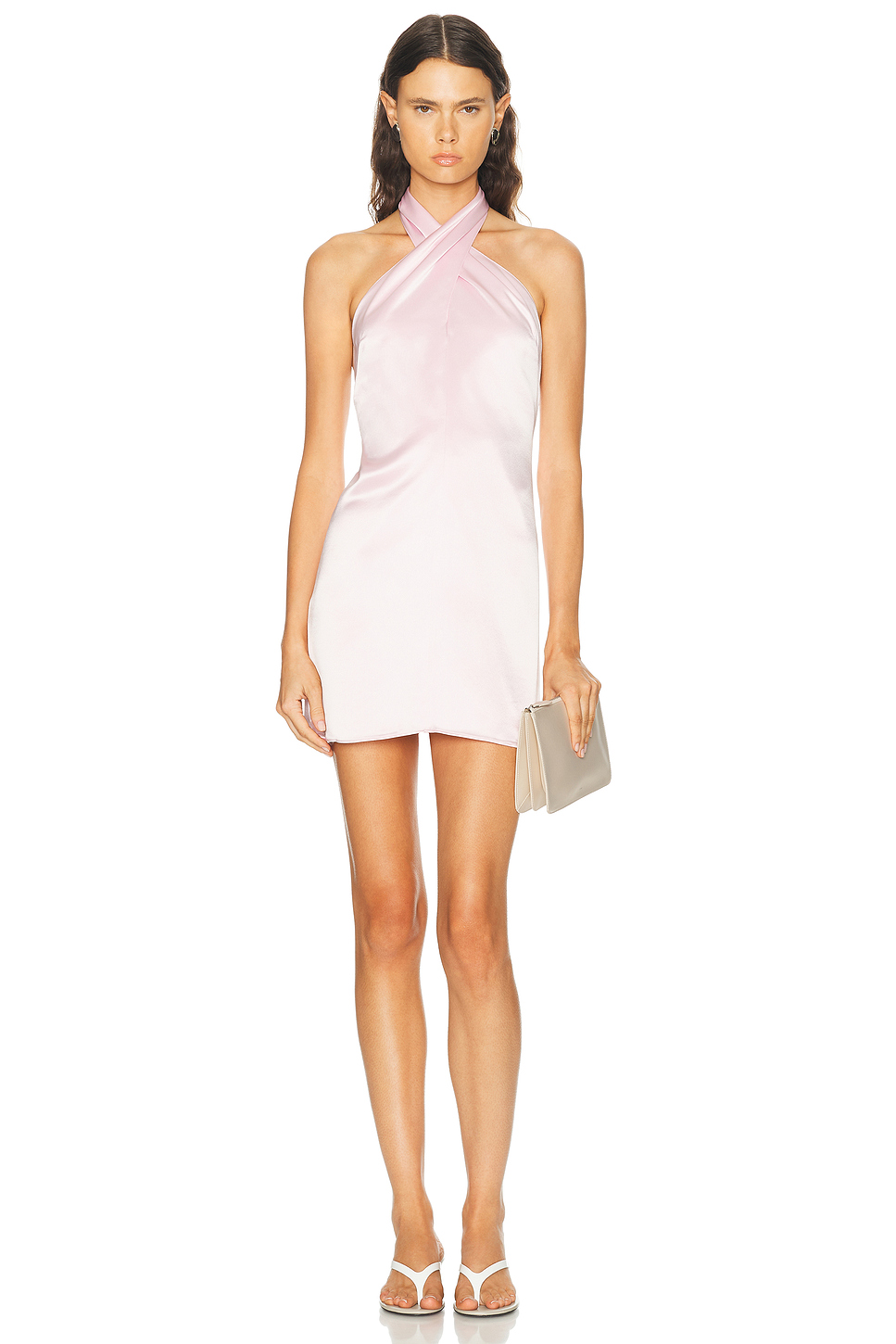
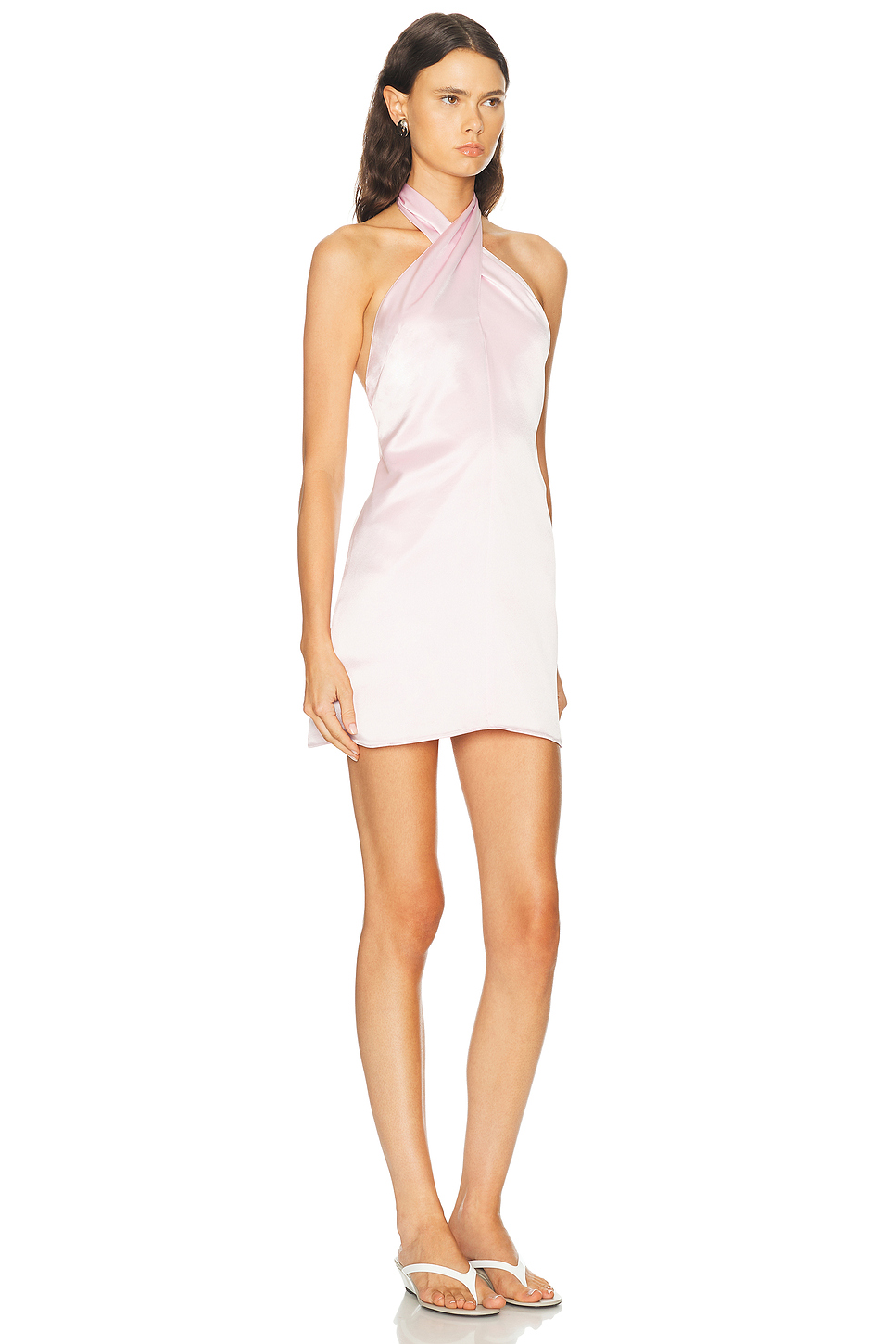
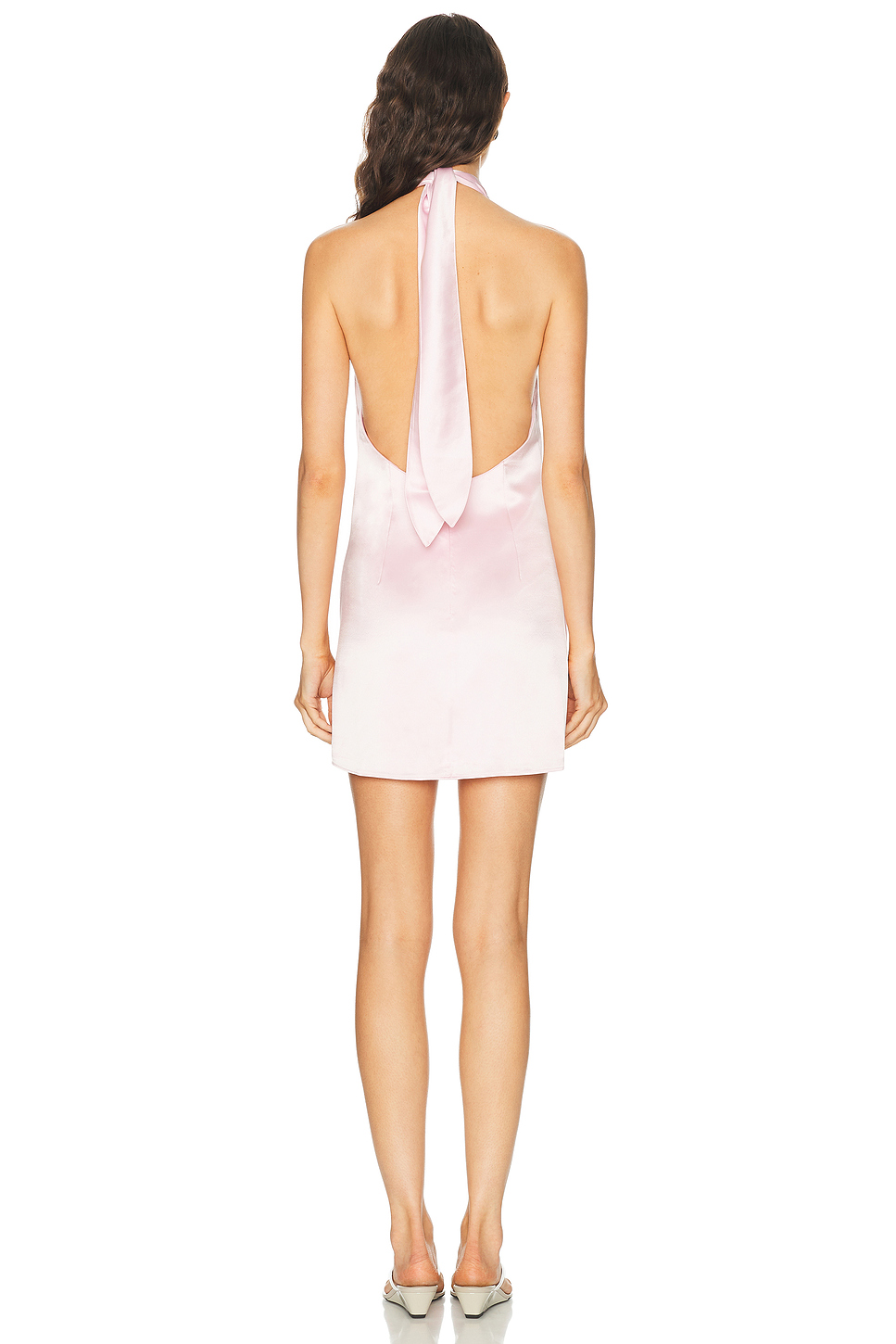
A halter dress listed with a self fabric of 75% rayon and 25% polyester and a lining of 98% polyester and 2% elastane, in a lightweight satin, fully lined, with a partial zip at the back, dry clean only, made in China, ranked forty second in the retailer's halter dress list, at 398 dollars. There are no reviews and no fit votes, so there is no score to quote. The measurements here run in opposite directions at neighbouring points, and there is a reason for that this series has now met twice, both times on the same construction. There is also one word in the composition that is another name for a fibre this series has assessed many times under a different name, and one feature here worth crediting because it is better than the common answer. The reference is the Ezra Dress by SANS FAFF in Blush Pink. Dongguan Bafinasa Garments Co., Ltd. develops comparable satin dresses on OEM and ODM terms, from fabric sourcing to retail or FBA ready packing. We publish this as a development reference and build your own version of it, and we do not supply the branded original or reproduce anyone else's label.
Key Features
- Self: 75% rayon, 25% polyester as stated. See the note below on the word rayon
- Lining: 98% polyester, 2% elastane as stated, which is the minimum that satisfies a rule worth knowing
- Lightweight satin fabric as stated
- Fully lined as stated, which is necessary rather than merely good here
- Partial zip at the back as stated, which is a better answer than a full one
- Halter styling as stated
- Dry clean only as stated, which is correct for this composition
- Made in China as stated
Customisable Options
- Fabric: rayon polyester satin to the reference, with the lustre and weight set from a tested sample
- Lining: we would keep at least this much elastane in it, since it must match or exceed the shell
- Closure: partial zip kept, since it asks the wearer for less
- Measurement: we would publish exactly where the bust is taken, since halter shapes have no standard position
- Length from mini to midi, halter width, satin finish, size set, colour development, private label and care labelling
Specifications
| Style | Ezra satin halter dress |
| Reference | SANS FAFF, Ezra Dress, style SAFF-WD53, manufacturer style SH-SF01250811-2, colour Blush Pink |
| Self | 75% rayon, 25% polyester as stated. See the note below |
| Lining | 98% polyester, 2% elastane as stated |
| Fabric | Lightweight satin as stated |
| Lining Presence | Fully lined as stated |
| Closure | Partial zip at the back as stated |
| Halter | Halter styling as stated, which bears on how the bust is measured. See the note below |
| Care | Dry clean only as stated, which is right for this composition |
| Sizes Published | XS, S, M, L |
| Measurements Published | S: bust 27 in, waist 30 in, hips 36 in, length 40 in |
| Chart Note | The bust is seven inches under the model while the waist is seven over, which is not stretch. See the note below |
| Coverage | Only the worn size has numbers. The other three sizes are blank |
| Model | 182 cm, wearing size S, bust 86 cm, waist 58 cm, hips 91 cm |
| Production | Made in China as stated |
| Reference Retail | 398 USD, quoted to show the price band this sits in, not as our price |
| Customer Reviews | None on the reference listing, so we quote no score |
| Best Seller Badge | Rank 42 in the retailer's halter dress list, which is a mid position |
| Categories | Filed by the retailer under mini dresses and halter dresses |
| Occasion | Weddings, formal daytime, events, evenings |
| MOQ | 100 pcs per style per colourway, mixed sizes and colourways accepted |
| Sampling | 7-10 days after tech pack or reference sample confirmation |
| Bulk Lead Time | 20-30 days after sample approval and deposit |
| Service | OEM / ODM / private label, satin sourcing, halter engineering, retail or FBA ready packing |
Size Chart
| Size | Bust | Waist | Hips | Length | Source | ||||||||||||
|---|---|---|---|---|---|---|---|---|---|---|---|---|---|---|---|---|---|
| S | 27 | in | 30 | in | 36 | in | 40 | in / | 102 | cm | As published | ||||||
| XS | 31 | in / | 79 | cm | 24 | in / | 61 | cm | 34 | in / | 86 | cm | 100 | cm / | 39.4 | in | Our proposal |
| S | 33 | in / | 84 | cm | 26 | in / | 66 | cm | 36 | in / | 91 | cm | 102 | cm / | 40.2 | in | Our proposal |
| M | 35 | in / | 89 | cm | 28 | in / | 71 | cm | 38 | in / | 97 | cm | 104 | cm / | 40.9 | in | Our proposal |
| L | 37 | in / | 94 | cm | 30 | in / | 76 | cm | 40 | in / | 102 | cm | 106 | cm / | 41.7 | in | Our proposal |
The published size S gives a 27 inch bust, a 30 inch waist, a 36 inch hip and a 40 inch length against a model at roughly 34, 23 and 36. The bust sits seven inches under her while the waist sits seven inches over her, and the hip matches exactly, and that pattern has a specific reading rather than being noise.
Occasions and Styling
Suits weddings, formal daytime, events and evenings. A blush pink satin halter is an occasion piece rather than a day one, and 40 inches is about 102 centimetres, which on a model at 182 centimetres is short, so it is worth checking against your own height before ordering.
Production and Quality Control
There are no reviews and no fit votes on this listing, so there is no score to quote. One row of measurements here cannot be produced by any stretch behaviour, and the explanation has now appeared twice on the same construction. One word in the composition is another name for a well known fibre. And one feature deserves credit rather than criticism.
The bust is seven inches under and the waist is seven over, and that pair cannot be stretch, and this is now the second halter to behave exactly this way, and that is the first thing. The published size S gives a bust of 27 inches against a model at roughly 34, a waist of 30 against 23, and a hip of 36 against 36. So the bust is about seven inches smaller than her and the waist about seven inches larger, a spread of fourteen inches between two adjacent measurements, with the hip matching her exactly. This series has a settled way of reading that shape, and it rests on a property of stretch rather than on intuition: elastane acts on the whole garment, so it cannot make one circumference smaller while leaving the neighbouring one larger. So the first conclusion is negative and firm, which is that nothing here is compressing her, and indeed there is no elastane in the shell at all. What makes this occurrence valuable is that it is the second of its kind and the two are the same construction. The earlier case was a gathered sheath dress with a bust four inches under the model while the waist was three over and the hip four over, and the explanation offered there was not the fabric but the tape, on the grounds that stretch cannot pick out one measurement. It was halter shaped too. So the same reading has now been reached twice on the same pattern of garment, and that repetition converts it from an interpretation into something dependable enough to advise from. The mechanism is worth stating plainly, because it is about what there is to measure against. A standard bust is taken around the fullest point with the tape horizontal, and on an ordinary bodice there are landmarks to work from, being side seams and an armscye. A halter removes them. There may be no side seam to start the tape, the armscye is cut away or cut deep, and the front panel is often curved rather than straight across. So the person measuring has to decide where the fullest point is on a shape that does not define it, and different hands choose differently. Hence the rule worth adopting, which is that when one measurement sits well below the body and its neighbours sit at or above it, check whether the garment is halter or strapless before concluding anything at all about the fabric. There is a second way to read this chart that is worth offering because it is available and cheap, which is to publish where the tape was placed. That single addition would make this row legible, and it costs one line.
Rayon and viscose are the same fibre under two names, and failing to know that would lose an entire body of hard earned knowledge, and that is the second thing. The self fabric is given as seventy five per cent rayon. Rayon and viscose are two names for one thing, being regenerated cellulose made by dissolving wood pulp or other plant material and extruding it as continuous filament, and the naming split is largely regional, rayon being the customary term in North America and viscose in Europe and much of Asia. Everything this series established about viscose therefore applies here without modification, and that body of conclusions is neither small nor incidental. Viscose loses around half its strength when wet, which is why it needs the strictest wording rather than anything softer. It absorbs water readily and therefore moves and can spot. This series demonstrated the consequences with unusual clarity by comparing two listings of nearly identical composition, one saying dry cleanable and the other dry clean only, and finding that only the second was right, since the first invited washing without saying so. Here the instruction is dry clean only, which is correct. There is a broader lesson in this worth naming, because it is about how a customer's knowledge is built. Someone who has learned that viscose demands care will not recognise rayon as the same thing, and someone who has learned that rayon is unfussy, if anyone has, will not carry that warning to the garment labelled viscose. The same failure visited elsewhere in this batch in the opposite direction, where a description could be read as either silk velvet or ordinary silk cloth and the two lead to entirely different handling. So the practical request is simple: use one name, and if using the regional one, put the other beside it. It is also worth noting what the twenty five per cent polyester is doing, and the answer follows the principle this series settled when examining a viscose and linen blend, which is that a blend behaves according to the fibre that predominates. Polyester at twenty five per cent improves recovery and reduces creasing, and it does not make the garment washable, since three quarters of it is still cellulose that weakens in water.
The lining has slightly more elastane than the shell, and that small difference is doing real work, and the partial zip asks less of the wearer, and that is the third thing. The shell has no elastane at all and the lining has two per cent. This looks backwards, because a lining is the quiet layer, inside, never meant to be noticed, existing to cover and to slip, so giving it anything the outer fabric lacks seems like a transposition. This series examined precisely this question and concluded it was correct, and the reasoning is worth restating because it governs every lined garment. A lined garment cannot stretch further than the less extensible of its two layers. If the shell reaches a certain extension and the lining reaches less, the lining becomes the limit: the moment the shell tries to go beyond it, load transfers to the lining, and what the wearer feels is not the shell yielding but the lining refusing. So the whole garment behaves according to the tighter layer, and the only way to stop the lining governing is to make it at least as extensible as what it lines. Two per cent here is therefore not excess, it is the minimum that satisfies the condition. It is useful to place this against the strongest instance yet recorded, found elsewhere in this batch on a ruched mesh bodycon where the shell carried ten per cent elastane and the lining thirty, a gap of twenty points, and where the argument was that no maker pays for thirty per cent elastane in a layer nobody sees unless that layer has to go somewhere demanding. Here the shell is not stretch fabric at all, so two per cent clears the bar. The same rule operating at two scales, satisfied at both, is what makes it a rule rather than a coincidence. On the closure, the listing says partial zip at the back, and this deserves credit rather than criticism, which this series has not often been able to say about back placed fastenings. Considerable space has gone into how hard it is to reach a closure behind the back, with the consistent conclusion that what matters is not how many there are but whether the wearer can see them and whether she can get her hands to them in an unrestricted posture. A partial zip asks less than a full one, because there is less distance to pull and correspondingly less to align, and this garment also has its halter doing part of the holding so nothing further is needed down below. It is the commonest case in this series where less was better. Every bulk shipment gets a measurement report against your approved chart.
Optional upgrades include publishing where the bust is measured, which would make this chart legible in one line, keeping at least two per cent elastane in the lining so the shell is never the limit, the satin alternative of rayon and viscose named together, the partial zip kept, since it asks less of the wearer, halter width specified, since load sits at the back of the neck, the length published in centimetres against the model's height given the model is 182 cm, alternative satin weights, alternative lining compositions, alternative lengths, extended sizing, colour development and private label, hangtag and care labelling.
Pre-production sample approval, in-line inspection during cutting and sewing, and a final AQL inspection before packing, with measurement reports and photos shared before shipment.
Send us your tech pack, a photo or a reference garment and we will quote within 24 hours. Contact bafinasa@bafinasa.com or WhatsApp +86 13827222469.