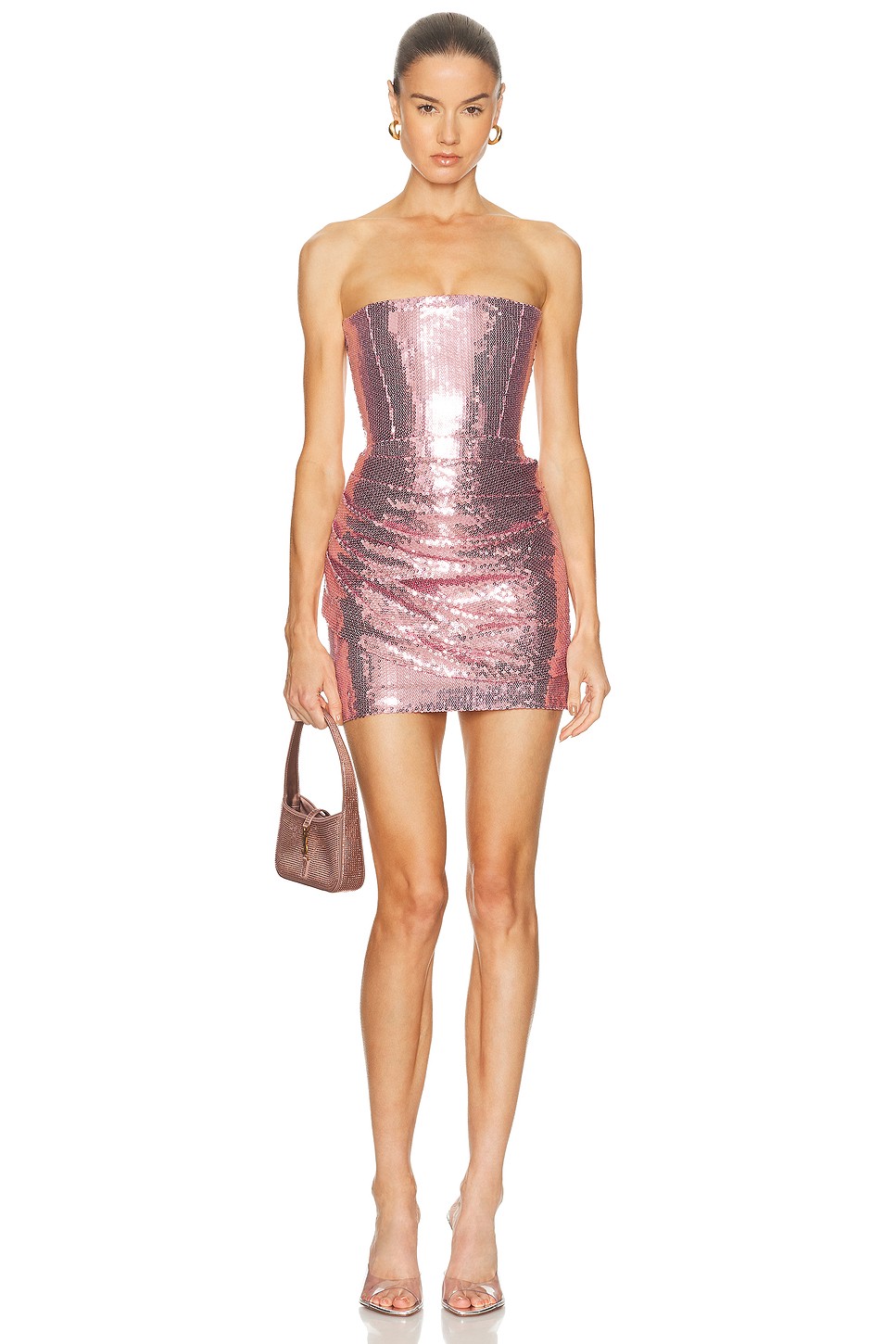
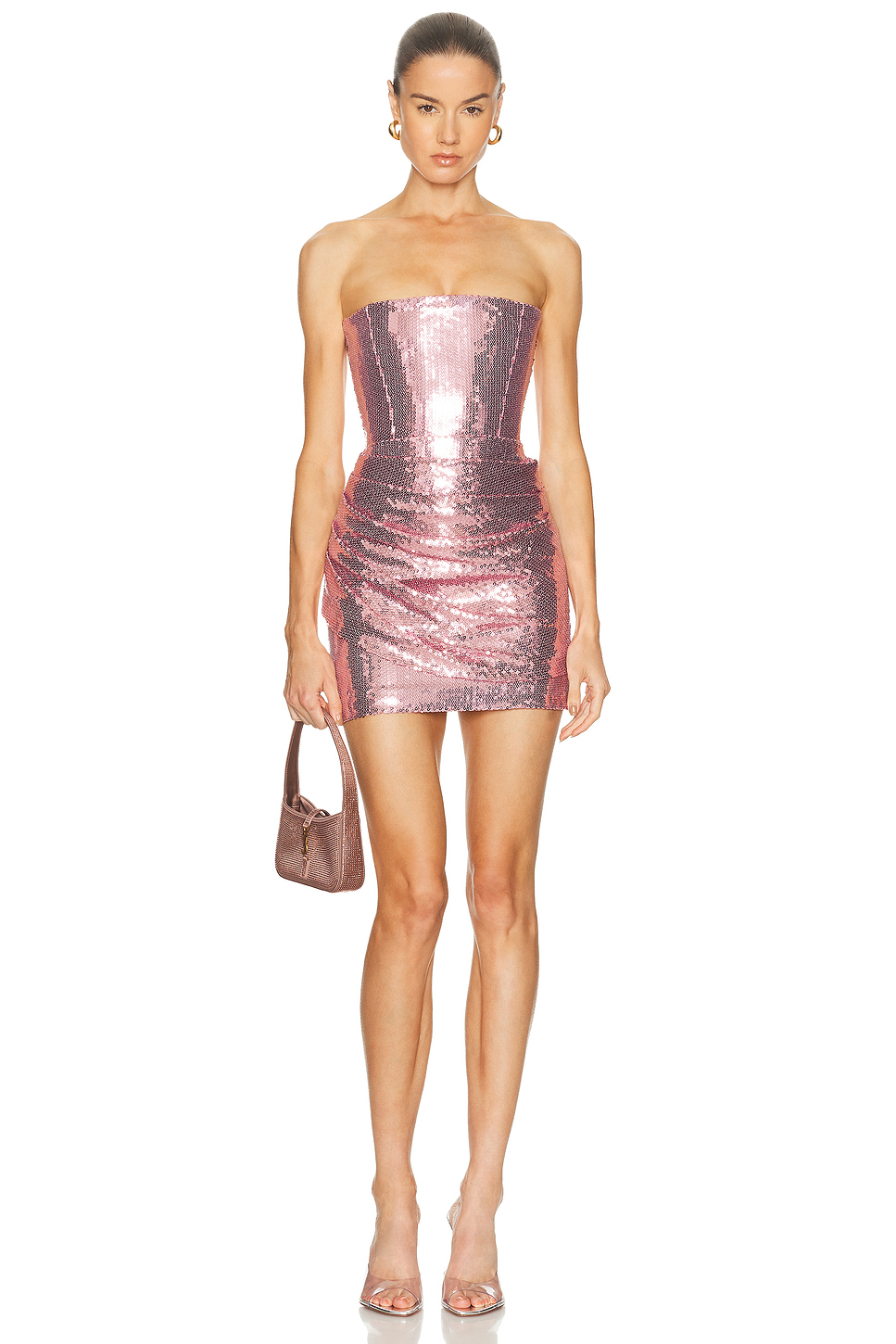
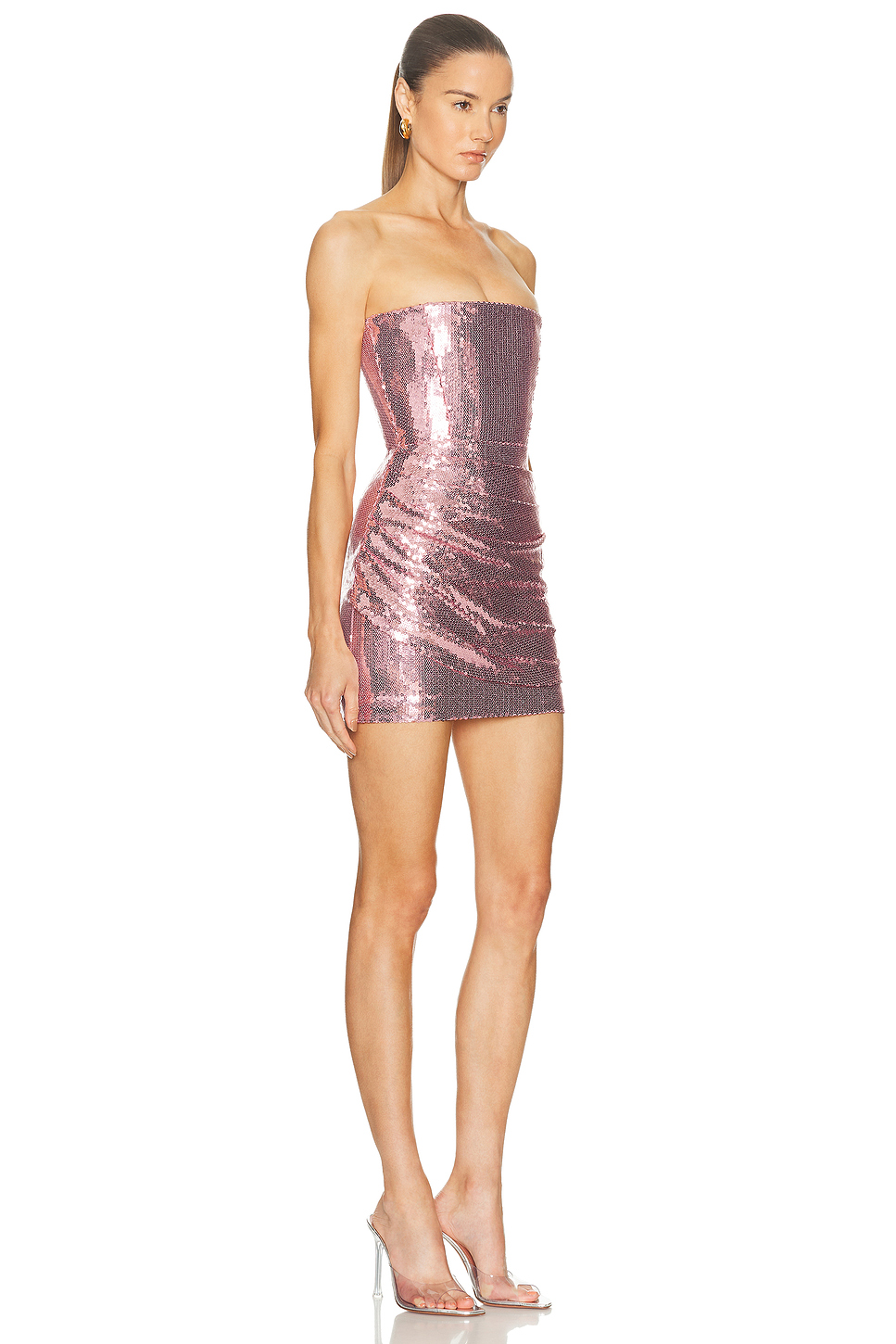
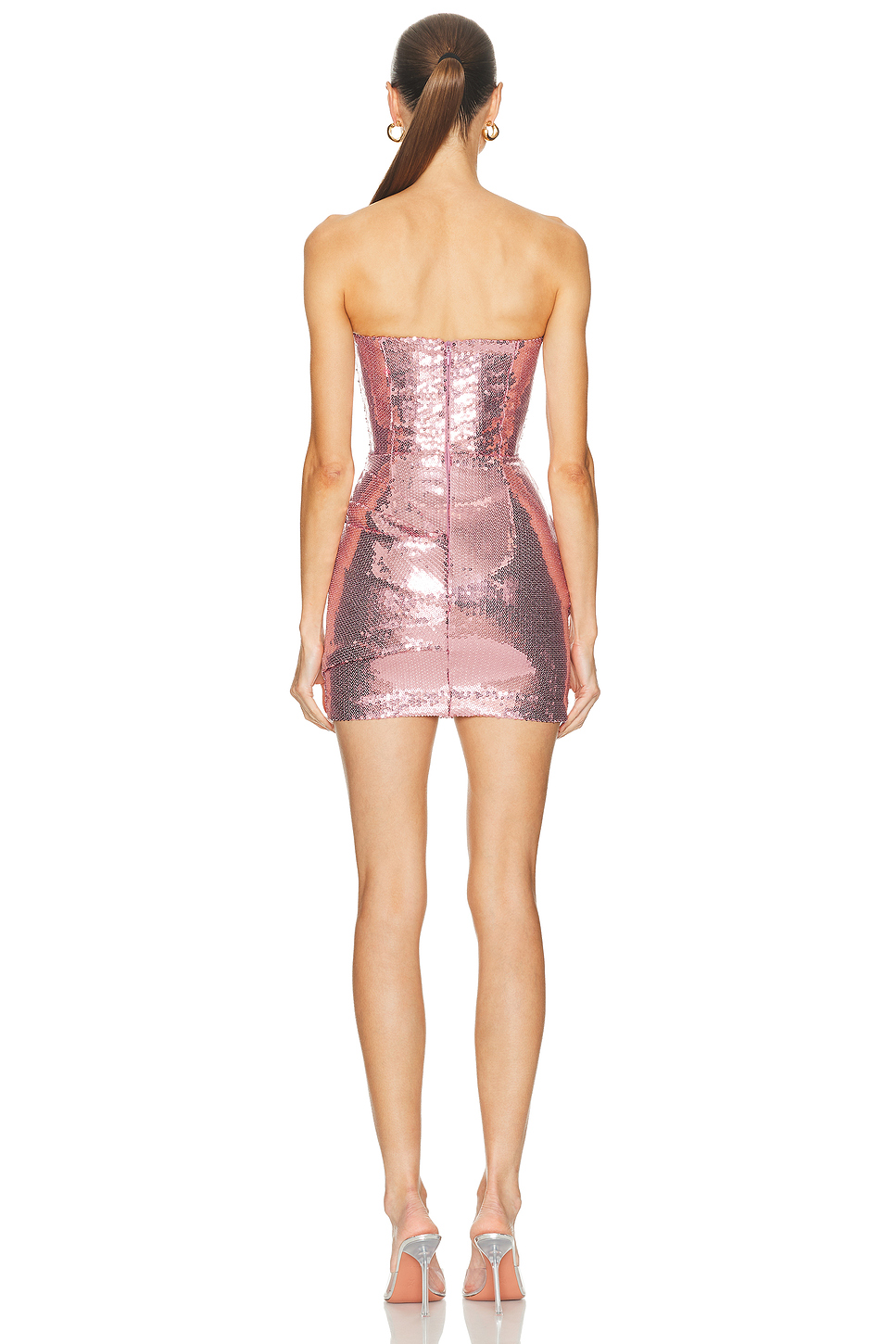
A strapless sequin dress listed with a self fabric of 95% polyester and 5% elastane and a lining of 84% rayon and 16% polyester, with a boned bodice, a draped skirt, sequin embellished textile, fully lined, closed with a hidden zip at the back, made in Australia, filed under bustier and mini dresses, at 1,140 dollars. There are no reviews and no fit votes, so there is no score to quote. There is a boned bodice here, which is the second listing in this series to say so, and comparing the two explains why the construction exists. There is also a care instruction here that is stated too gently for what this garment contains, and there is an unusually good comparison available for it. The reference is the for FWRD Strapless Draped Sequin Mini Dress by Alex Perry in Pink. Dongguan Bafinasa Garments Co., Ltd. develops comparable occasion dresses on OEM and ODM terms, from fabric and embellishment sourcing to retail or FBA ready packing. We publish this as a development reference and build your own version of it, and we do not supply the branded original or reproduce anyone else's label.
Key Features
- Self: 95% polyester, 5% elastane as stated
- Lining: 84% rayon, 16% polyester as stated, which is the fibre setting what this garment needs
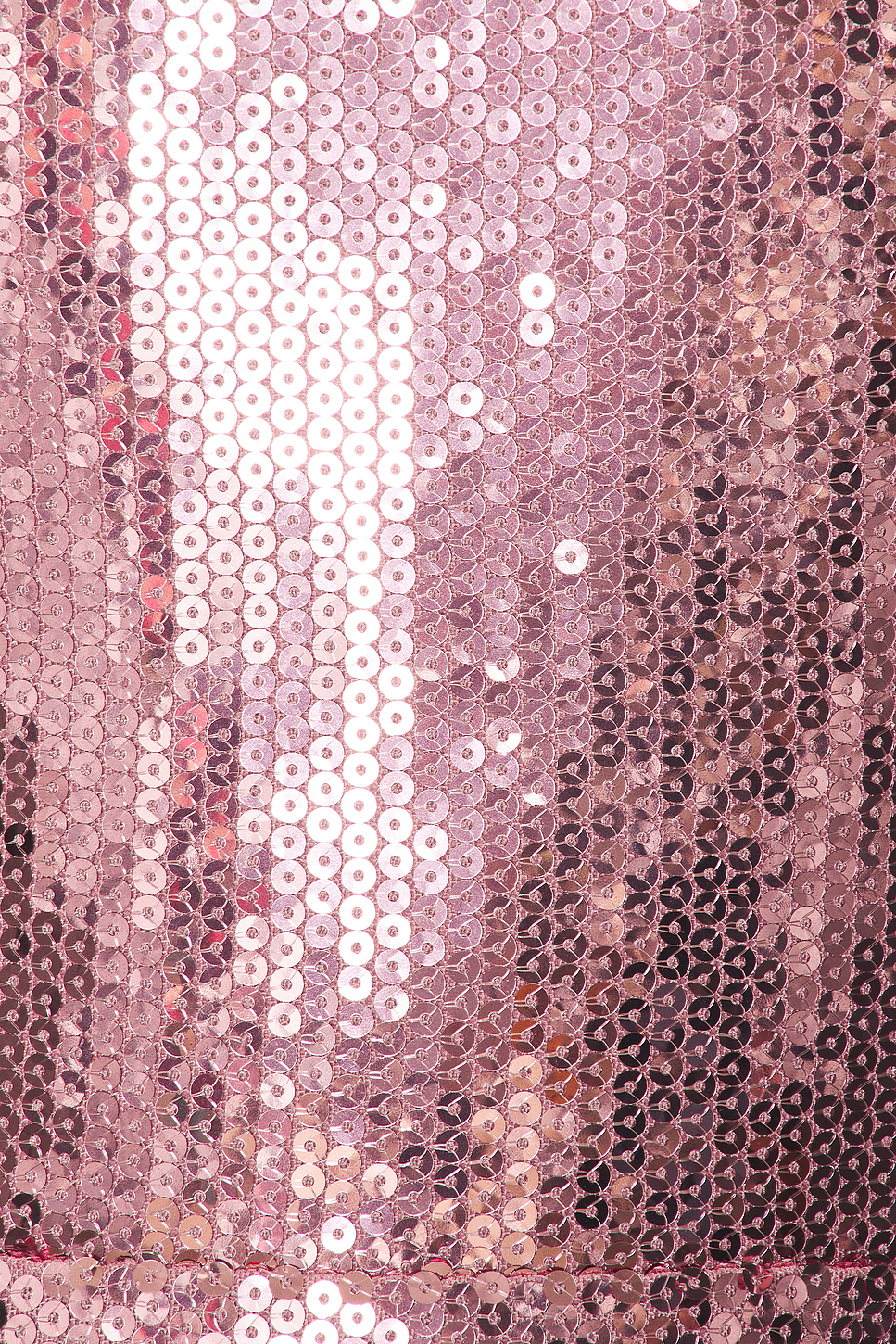
- Sequin embellished textile as stated
- Boned bodice construction as stated, with a draped skirt. See the note below
- Strapless, filed by the retailer under bustier dresses
- Fully lined as stated
- Hidden zip at the back as stated
- Made in Australia as stated
Customisable Options
- Fabric: polyester elastane to the reference, with the weight set from a tested sample
- Embellishment: sequins to the reference, with attachment tested for washing and for heat
- Lining: we would discuss the rayon content, since it sets what the care instruction must say
- Structure: boned bodice to the reference, since it is how a strapless garment is held up
- Length from mini to knee, sequin density, boning extent, size set, colour development, private label and care labelling
Specifications
| Style | Strapless sequin bustier mini |
| Reference | Alex Perry, for FWRD Strapless Draped Sequin Mini Dress, style APEF-WD302, manufacturer style D1717RE26, colour Pink |
| Self | 95% polyester, 5% elastane as stated |
| Lining | 84% rayon, 16% polyester as stated. See the note below |
| Embellishment | Sequin embellished textile as stated. See the note below |
| Structure | Boned bodice construction, with a draped skirt, as stated. See the note below |
| Closure | Hidden zip at the back as stated |
| Lining Presence | Fully lined as stated |
| Care | Dry cleanable as stated, which is gentler than this garment requires. See the note below |
| Sizes Published | US 0 to US 10, six sizes, each shown with its UK equivalent |
| Measurements | None published. There is no size chart on this listing |
| Model | 179 cm, wearing size US 2 / UK 6, bust 34 in, waist 24 in, hips 34 in |
| Production | Made in Australia as stated |
| Reference Retail | 1,140 USD, quoted to show the price band this sits in, not as our price |
| Customer Reviews | None on the reference listing, so we quote no score |
| Best Seller Badge | None. The listing carries no rank |
| Categories | Filed by the retailer under bustier dresses and mini dresses |
| Occasion | Evenings, parties, formal events, celebrations |
| MOQ | 100 pcs per style per colourway, mixed sizes and colourways accepted |
| Sampling | 7-10 days after tech pack or reference sample confirmation |
| Bulk Lead Time | 20-30 days after sample approval and deposit |
| Service | OEM / ODM / private label, sequin embellishment, boning, retail or FBA ready packing |
Size Chart
| Size | Bust | Waist | Hips | Length | Source | ||||||||||||
|---|---|---|---|---|---|---|---|---|---|---|---|---|---|---|---|---|---|
| US 0 | 31 | in / | 79 | cm | 24 | in / | 61 | cm | 34 | in / | 86 | cm | 84 | cm / | 33.1 | in | Our proposal |
| US 2 | 33 | in / | 84 | cm | 26 | in / | 66 | cm | 36 | in / | 91 | cm | 86 | cm / | 33.9 | in | Our proposal |
| US 4 | 35 | in / | 89 | cm | 28 | in / | 71 | cm | 38 | in / | 97 | cm | 88 | cm / | 34.6 | in | Our proposal |
| US 6 | 37 | in / | 94 | cm | 30 | in / | 76 | cm | 40 | in / | 102 | cm | 90 | cm / | 35.4 | in | Our proposal |
| US 8 | 39 | in / | 99 | cm | 32 | in / | 81 | cm | 42 | in / | 107 | cm | 92 | cm / | 36.2 | in | Our proposal |
| US 10 | 41 | in / | 104 | cm | 34 | in / | 86 | cm | 44 | in / | 112 | cm | 94 | cm / | 37 | in | Our proposal |
This listing publishes no size chart. Six sizes are offered, each shown with its UK equivalent, and there is nothing else to go on. The model is 179 cm wearing size US 2 at roughly 34, 24 and 34, and there are no garment measurements to compare against those figures.
Occasions and Styling
Suits evenings, parties, formal events and celebrations. A pink sequin strapless mini is a party piece rather than an everyday one, and it is worth knowing that sequins make a garment considerably heavier than its base cloth suggests.
Production and Quality Control
There are no reviews and no fit votes on this listing, so there is no score to quote. Two things here are worth working through: why a boned bodice exists, which the second instance of the same construction makes clearer than the first did, and a care instruction stated too gently for what actually sits inside this garment.
The bodice is boned, and this is the second listing to say so, and putting the two side by side shows what the boning is for, and that is the first thing. This series set out some time ago the question of how a strapless garment stays up at all, and collected three answers: compression, meaning enough elastane for the garment to grip on its own; boning, meaning rigid elements in the bodice that carry the load down to the waist so it does not depend on friction; and grip at the top edge, which takes two forms, silicone tape or elastic trim, both now seen. What was unusual about the first garment found to state boning in its description was that it deployed two of those three at once, since it combined high elastane with a boned bodice lining, and it was noted then that the mechanisms are not alternatives but add together, so two being present was a good answer and only the third was missing. This garment is built the same way, with a boned bodice stated directly and the retailer filing it under bustier dresses, which by another route says the same thing. So there are now two examples of the same construction, both from the same maker, and their agreement is informative rather than merely repetitive. Setting them beside each other shows what the two mechanisms divide between them. In the earlier garment there was no shortage of elastane, roughly a fifth of the shell, so it could hold itself up by pressure alone and the boning was reinforcement. Here the shell carries five per cent. That figure sits on a boundary this series has used consistently, the argument being that below about five per cent elastane is a recovery additive rather than something a fit can rest on, while levels approaching a fifth genuinely compress a body. So this bodice cannot grip by compression in the way the other could, which means the boning is not reinforcement here but the principal means of support. The interesting conclusion is that the same visible construction can be doing different amounts of work depending on what the shell contains, so reading it off a description alone would mislead. It is worth adding what the boning also does, since it is easy to think only about holding things up. A sequin textile is heavy, considerably heavier than the cloth underneath it suggests, so there is sustained downward pull on the bodice all evening, and rigid elements resist that in a way that cloth cannot.
The lining is mostly rayon, and the instruction says dry cleanable rather than dry clean only, and the difference between those two words matters more here than usual, and that is the second thing. The shell is ninety five per cent polyester, which is among the most easily cared for fibres there is, since it does not shrink, does not felt, does not lose strength when wet, dries quickly and resists creasing. So looking at the shell alone, one might expect a gentle instruction to be reasonable. The rule this series has applied throughout is that a care instruction is set by the most fragile component rather than by the fibre that predominates, and it was demonstrated first on a cotton twill correctly labelled dry clean only despite cotton being among the most washable fibres, because its applique had been applied with threads and backing materials that behave differently from the ground fabric. This garment is built on exactly that principle: the shell is nearly all polyester, and everything demanding about it is added rather than inherent, being the sequins and the lining. The lining is the point, and it is worth recalling what rayon is, since this series met that word recently under its other name and noted that rayon and viscose are two regional names for one and the same thing, being regenerated cellulose. So everything established about viscose applies without modification, and the central fact is that it loses around half its strength when wet. Eighty four per cent of this lining is that fibre. So the lining is the limiting component by a wide margin, and it is the lining that dictates the instruction. Now look at what is written. Dry cleanable is not the same statement as dry clean only. The first permits dry cleaning without forbidding anything else, leaving hand washing open to the reader, and the second closes it off. This series has set out this scale of wording several times, having recently examined a lace piece with both绮樼氦 fibres html discussed below, and having earlier criticised another as weaker still for recommending rather than requiring. For a lining that loses half its strength in water, only the closed version is adequate. There is a comparison available that makes the point sharper than any general argument could. A second listing elsewhere in this batch is also one hundred per cent polyester lace, also without structure complications, and it says hand wash, which is right for its construction because lace snags and distorts in a machine while the fibre itself tolerates everything. Two listings in this batch therefore contain synthetic lace g structures, and one issues a correct specific instruction while this one issues a permissive one about a garment carrying a lining largely made of rayon.
There are two smaller things worth naming, one about size information and one about what the embellishment changes, and that is the third thing. On sizing, six sizes are published, each given with its UK equivalent alongside the US figure, which is genuinely helpful and worth crediting, since it removes a conversion the customer would otherwise have to do and might get wrong. But no measurements of any kind accompany them, so neither the six sizes nor the dual labelling can be acted on, and there is a model given at 179 centimetres wearing size US 2 with body figures, none of which can be compared with anything. This series has watched narrow size ranges get shorter and more interesting over recent batches, having lately compared three short runs from the same retailer source and refined how they should be read, concluding that two consecutive sizes prove little since clearance easily leaves two adjacent sizes, whereas three or more in sequence are hard to explain by accident. Nothing of that kind arises here, since six sizes is a full range, but the problem has simply moved: breadth of range is not the same thing as a usable chart, which is an observation made repeatedly, and never more plainly than here. On embellishment, sequins change several answers at once and it is worth being specific, because a sequin is not a dye or a print but an object sewn or heat set onto the cloth, and that has consequences. Attachment introduces threads that are not the fibre of the ground fabric, in the manner noted already about applique. Sequins themselves are commonly plastics, so they soften and curl under heat, which means pressing this garment is not a simple matter of temperature but a question of avoiding direct contact with the embellishment altogether. And they add weight, which returns to the first point, since added weight on the bodice is another reason the boning is there. This series has noted before that the more added to a cloth after weaving, the less the base fibre tells you about how the finished garment behaves. Every bulk shipment gets a measurement report against your approved chart.
Optional upgrades include tightening the wording from dry cleanable to dry clean only, since eighty four per cent of this lining loses half its strength in water, keeping the boned bodice because with five per cent elastane it is doing the holding rather than reinforcing it, a lining lower in rayon if washability is ever wanted, pressing instructions given for the sequins specifically since heat curls them, the dual size labelling kept since it removes a conversion, measurements published for the six sizes, alternative sequin densities and attachment methods, alternative linings, alternative lengths, extended sizing, colour development and private label, hangtag and care labelling.
Pre-production sample approval, in-line inspection during cutting and sewing, and a final AQL inspection before packing, with measurement reports and photos shared before shipment.
Send us your tech pack, a photo or a reference garment and we will quote within 24 hours. Contact bafinasa@bafinasa.com or WhatsApp +86 13827222469.