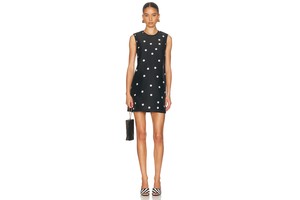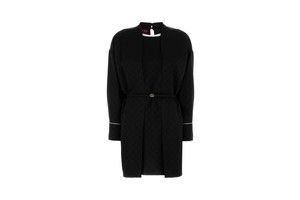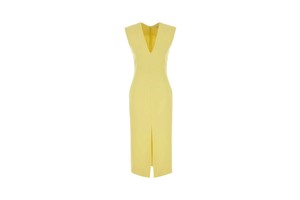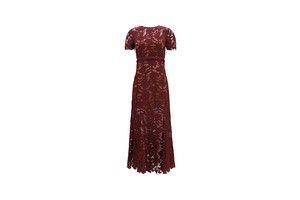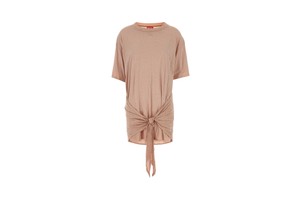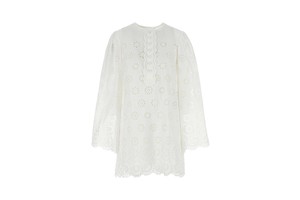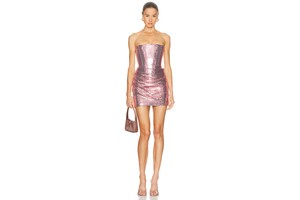
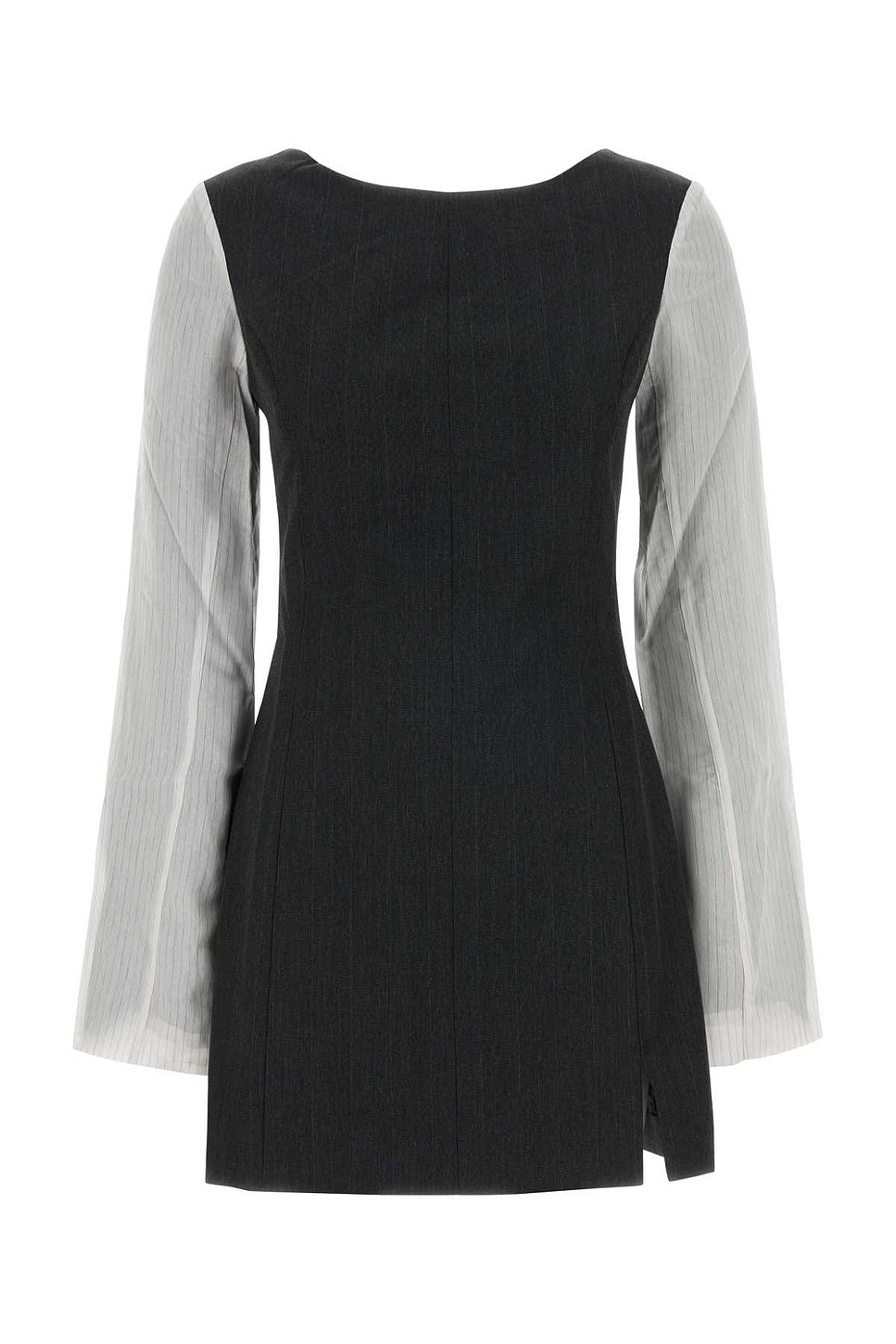
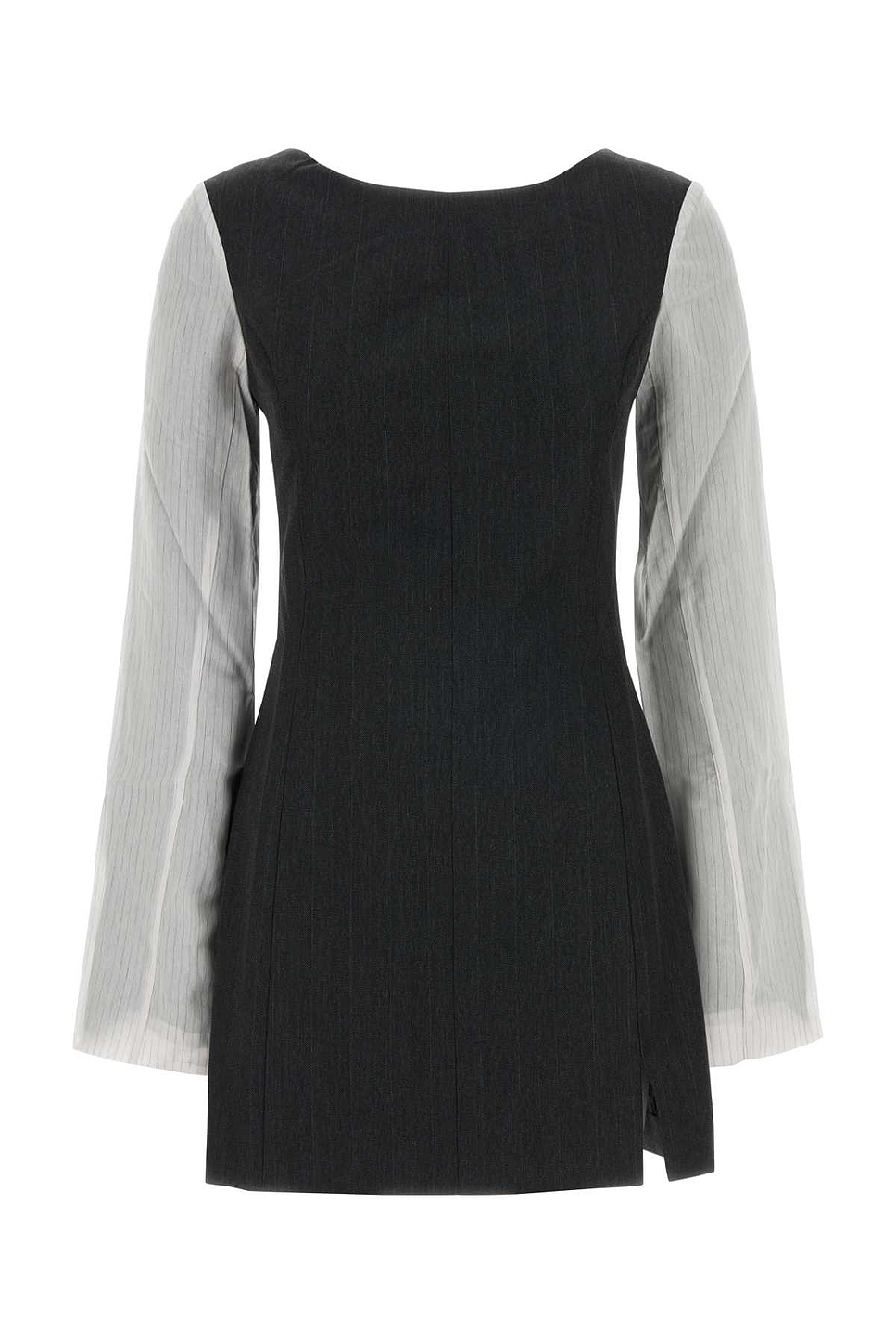
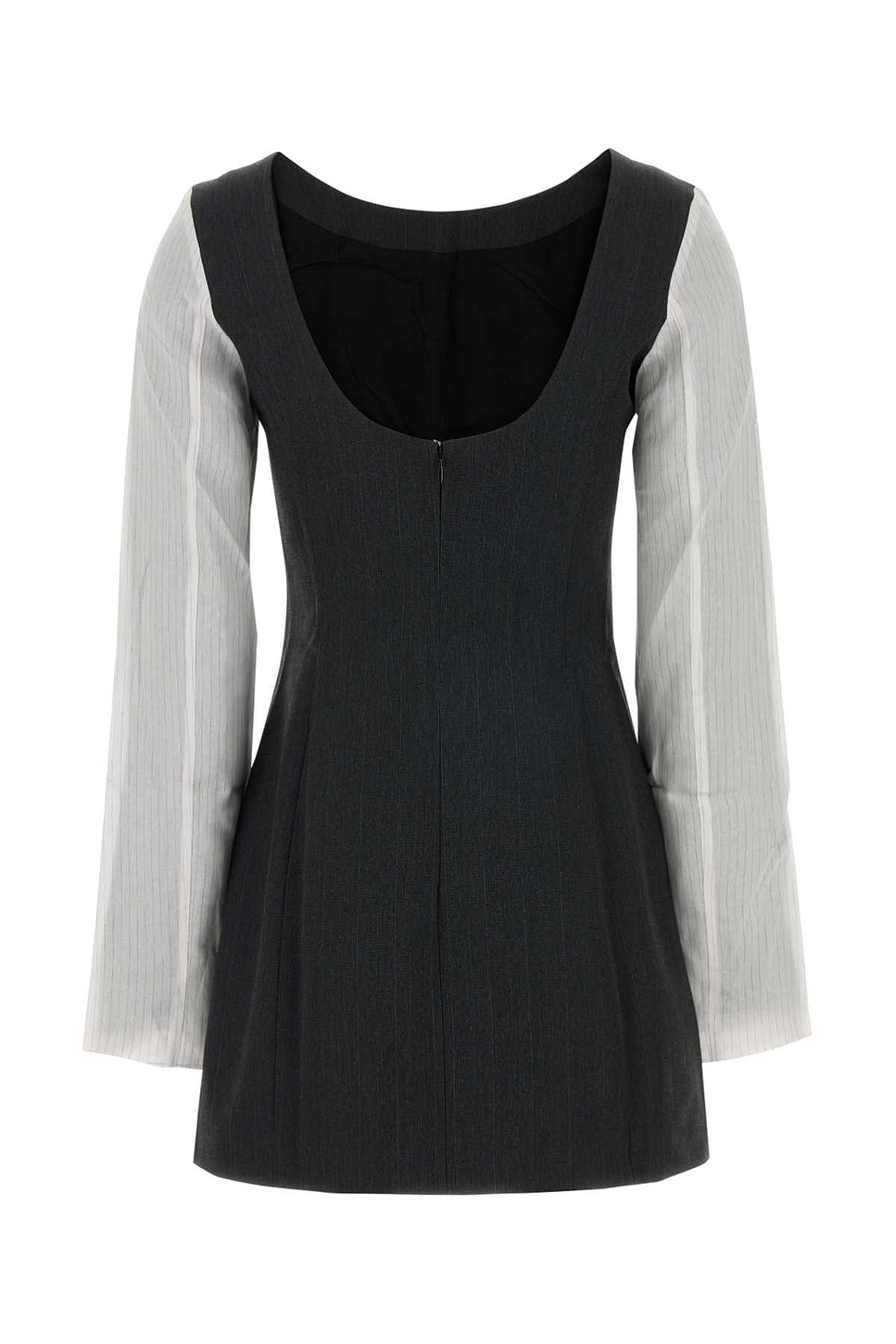
A mini dress listed with a shell of 80% polyester and 20% viscose and a lining of 100% viscose, embroidered, in a twill fabric, made in Portugal, at 680 dollars. There are no reviews and no fit votes, so there is no score to quote. The whole product information here is four lines: the two compositions, the country, and two stock numbers. There is no care instruction, no size chart, no model measurements, no closure described and no length, and two photographs. One thing on this page is worth crediting properly, because it is the first time this series has found it after several failures. There is also a mismatch between the two layers here of a severity this series has not met before, combined with the one instruction that would have made it safe being absent. The reference is the Our Legacy embroidered twill mini dress in Checked. Dongguan Bafinasa Garments Co., Ltd. develops comparable tailored mini dresses on OEM and ODM terms, from fabric sourcing and embroidery development to retail or FBA ready packing. We publish this as a development reference and build your own version of it, and we do not supply the branded original or reproduce anyone else's label.
Key Features
- Shell: 80% polyester, 20% viscose as stated
- Lining: 100% viscose as stated, which is the first time this series has seen the second layer actually named. See the note below
- Embroidered twill as stated in the product name
- Twill construction, named in the product name rather than in a specification. See the note below
- Checked pattern
- Made in Portugal as stated
- Two sizes published: 36 and 40, with nothing in between. See the note below
- No care instruction stated on the listing
Customisable Options
- Fabric: polyester viscose twill to the reference, with the weight set from a tested sample
- Lining: we would either match it to the shell or change the instruction, for the reason set out below
- Embroidery: developed to your artwork or adapted, with stitch count and stability tested before bulk
- Care: we would add one line, since this listing has none and needs it more than most
- Length from mini to knee, embroidery placement, twill weight, size set, colour development, private label and care labelling
Specifications
| Style | Embroidered twill mini with viscose lining |
| Reference | Our Legacy, embroidered twill mini dress, style FEXN-WD1805, manufacturer style W2267FSP SHOPINHER, colour Checked |
| Shell | 80% polyester, 20% viscose as stated |
| Lining | 100% viscose as stated. See the note below, since this is both creditable and consequential |
| Fabric | Twill, named in the product name rather than in the specification. See the note below |
| Detail | Embroidered, as stated in the product name |
| Care | None stated on the listing, which is the most serious gap on it |
| Closure | None stated on the listing |
| Sizes Published | 36 and 40 only, with nothing in between. See the note below |
| Measurements | None published. No size chart and no model measurements on this listing |
| Photographs | Two |
| Production | Made in Portugal as stated |
| Reference Retail | 680 USD, quoted to show the price band this sits in, not as our price |
| Customer Reviews | None on the reference listing, so we quote no score |
| Best Seller Badge | None. The listing carries no rank |
| Categories | Filed by the retailer under mini dresses, with no second category |
| Occasion | Daytime, city, layering, transitional seasons |
| MOQ | 100 pcs per style per colourway, mixed sizes and colourways accepted |
| Sampling | 7-10 days after tech pack or reference sample confirmation |
| Bulk Lead Time | 20-30 days after sample approval and deposit |
| Service | OEM / ODM / private label, twill sourcing, embroidery development, retail or FBA ready packing |
Size Chart
| Size | Bust | Waist | Hips | Length | Source | ||||||||||||
|---|---|---|---|---|---|---|---|---|---|---|---|---|---|---|---|---|---|
| 34 | 31 | in / | 79 | cm | 24 | in / | 61 | cm | 34 | in / | 86 | cm | 86 | cm / | 33.9 | in | Our proposal |
| 36 | 33 | in / | 84 | cm | 26 | in / | 66 | cm | 36 | in / | 91 | cm | 88 | cm / | 34.6 | in | Our proposal |
| 38 | 35 | in / | 89 | cm | 28 | in / | 71 | cm | 38 | in / | 97 | cm | 90 | cm / | 35.4 | in | Our proposal |
| 40 | 37 | in / | 94 | cm | 30 | in / | 76 | cm | 40 | in / | 102 | cm | 92 | cm / | 36.2 | in | Our proposal |
This listing publishes no size chart and no model measurements, and offers two sizes, 36 and 40, with nothing between them. There is nothing on the page from which a customer could judge the fit or the length.
Occasions and Styling
Suits daytime, city wear, layering and transitional seasons. An embroidered twill checks pattern mini is a structured piece rather than a soft one, and it is worth knowing that twill gives it its body, which comes from how the yarns interlace rather than from the fibre.
Production and Quality Control
There are no reviews and no fit votes on this listing, so there is no score to quote. Something here deserves credit for the first time after several failures. There is also the largest mismatch between two layers this series has met, with the instruction that would make it safe missing, and two sizes with a gap between them.
This page names its lining, and that deserves credit, because three previous listings did not, and that is the first thing. The complaint this series has repeated several times concerns the word shell. It is a relative term: something can only be the shell of a thing if there is a second thing for it to be the shell of, so its presence implies another layer whose composition has then not been given. It appeared first as a shell of viscose and linen on a Tory Burch mini with no second layer described. Then as a principal material given as one hundred per cent viscose, which was self contradicting, since a principal material already at one hundred per cent leaves no room for anything secondary. Then on a Stella McCartney satin dress with a shell of acetate and viscose and nothing else said. In every one of those, whoever wrote the description knew there were two layers and chose a word that acknowledged that, then did not complete the thought. Here the second layer is named, and its composition is given. That is a small thing and it is the first time it has happened, which says something about how rarely it does. It also deserves credit because it changes what a reader can work out, since there is now something to reason about rather than a blank. And there is a great deal to reason about, because the two layers here are further apart than anything yet encountered. The shell is eighty per cent polyester, which does not shrink at all, does not absorb water, dries fast and resists creasing. The lining is one hundred per cent viscose, which behaves almost entirely the other way: it absorbs water readily, loses around half its strength when wet, and shrinks. So one layer moves in water and the other does not, and this is a mismatch of the widest possible kind.
Shell and lining move by different amounts in water, and the instruction that would make that harmless is missing, and that is the second thing. The rule this series has stated many times is straightforward: a lining should be in the same fibre as the cloth it lines, because two layers of the same fibre shrink by the same amount and stay in proportion afterwards, while two layers that shrink differently force something to give, and what gives is either a pucker along every seam or a layer that bubbles loose inside the garment. This series has also set out how this failure hides, noting once that it appears only after washing, and therefore survives sampling and reaches the customer. It has also drawn a distinction that applies directly here. On a viscose and linen blend we noted that linen is stronger wet than dry and so partly reinforces the viscose majority without making the blend washable, the governing principle being that a blend behaves according to the fibre that predominates. On an Isabel Marant dress found in this same batch, a shell of viscose and silk lined in pure silk was discussed as a deliberate departure from the matching rule, defensible only because dry clean only removes the condition that makes the rule bite, nothing ever getting wet. Those two cases bracket this one precisely. Here there is no reinforcing fibre in the lining to reduce how much it moves, and no instruction to stop it moving. So both faults are live simultaneously, which is the situation described once already in this series on a wool mini over a polyester lining with no care instruction, where we said the missing line was not an inconvenience but a switch deciding whether both faults went active at once. The point worth adding here, because it is stronger than in that earlier case, is what follows once water is applied. The lining loses around half its strength while wet, so it is weakest exactly when it is being agitated and pulled, and when it dries it will be smaller than before while the shell around it will not have changed at all. This is corroborated from the other direction too: this series once compared two listings of nearly identical composition, one saying dry cleanable and the other dry clean only, and established that only the stricter one was right. Here the stricter wording is not merely preferable, it is the only thing standing between this garment and its own lining.
The word for the weave is in the name and not in the specification, and this is now the third time that has happened, and two sizes with nothing between them is a pattern rather than an accident, and that is the third thing. The garment is described in the product name as an embroidered twill mini dress. Twill is a weave in which the weft passes over and under groups of warp yarns in a regular offset, producing the diagonal line that identifies it, and it is worth knowing because it behaves differently from a plain weave: it drapes better, resists creasing more, hides soil more effectively, and is generally more durable, since the longer floats let the structure move. This series commented on those properties recently when discussing another printed construction. But none of that is in the specification, where a customer would look for it. It is in the title, and this is the third occurrence of information living in a name rather than a field. The first was a knit whose construction was given only inside a French product title, so that only a French reader would learn anything. The second was a check on this very batch, where voile appeared in the specification and the sheerness was stated besides it, which was held up as the ideal arrangement precisely because the word was where everybody reads it. This sits between those two. It is more accessible than the French case, since twill is the English word, but it still requires a customer to know what the word means. On the sizes, the listing offers 36 and 40 with nothing between. This series built a way of reading short size runs from another listing: where a run is short but consecutive, leanness is a design decision and something on the garment has to make it work, usually stretch or generosity, while where a run has a size missing from its middle, that is not a range but remaining stock, the instance being a knit dress offered in 34 and 38 with no 36. This is the second garment with a gap in exactly that shape, and two occurrences mean it can be read with some confidence: what is left is being sold rather than a narrowness being designed. It is worth noting what this garment does not have that would support the other reading anyway, since there is no stretch fibre anywhere in it. Every bulk shipment gets a measurement report against your approved chart.
Optional upgrades include a care instruction added and specifically dry clean only, since it is the one thing that reconciles these two layers, the lining either changed to match the shell or the instruction stated and kept, which tend the fishtail, opacity tested given the lining, a size chart and model measurements published, consecutive sizing if it is being made rather than cleared, the twill moved from the title into a specification, the embroidery stabilised and tested for shrinkage against the ground fabric, alternative twill weights, alternative lining fibres, alternative embroidery placements, alternative lengths, extended sizing, colour development and private label, hangtag and care labelling.
Pre-production sample approval, in-line inspection during cutting and sewing, and a final AQL inspection before packing, with measurement reports and photos shared before shipment.
Send us your tech pack, a photo or a reference garment and we will quote within 24 hours. Contact bafinasa@bafinasa.com or WhatsApp +86 13827222469.