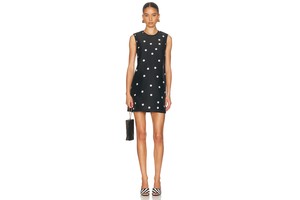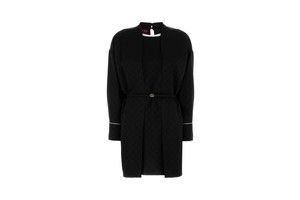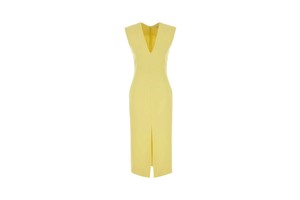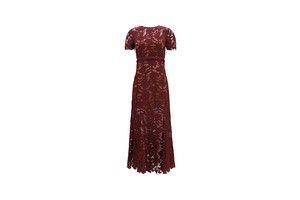
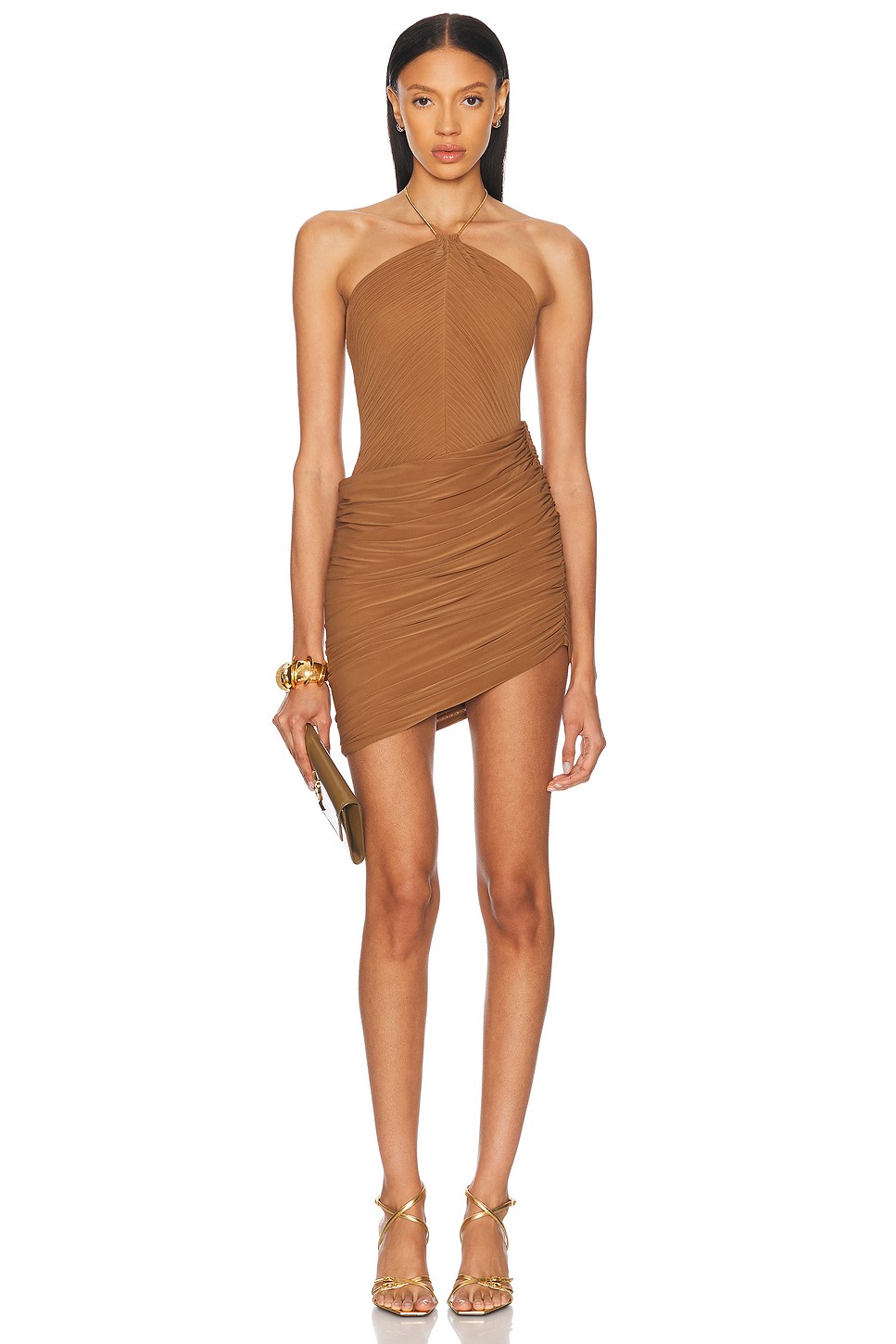
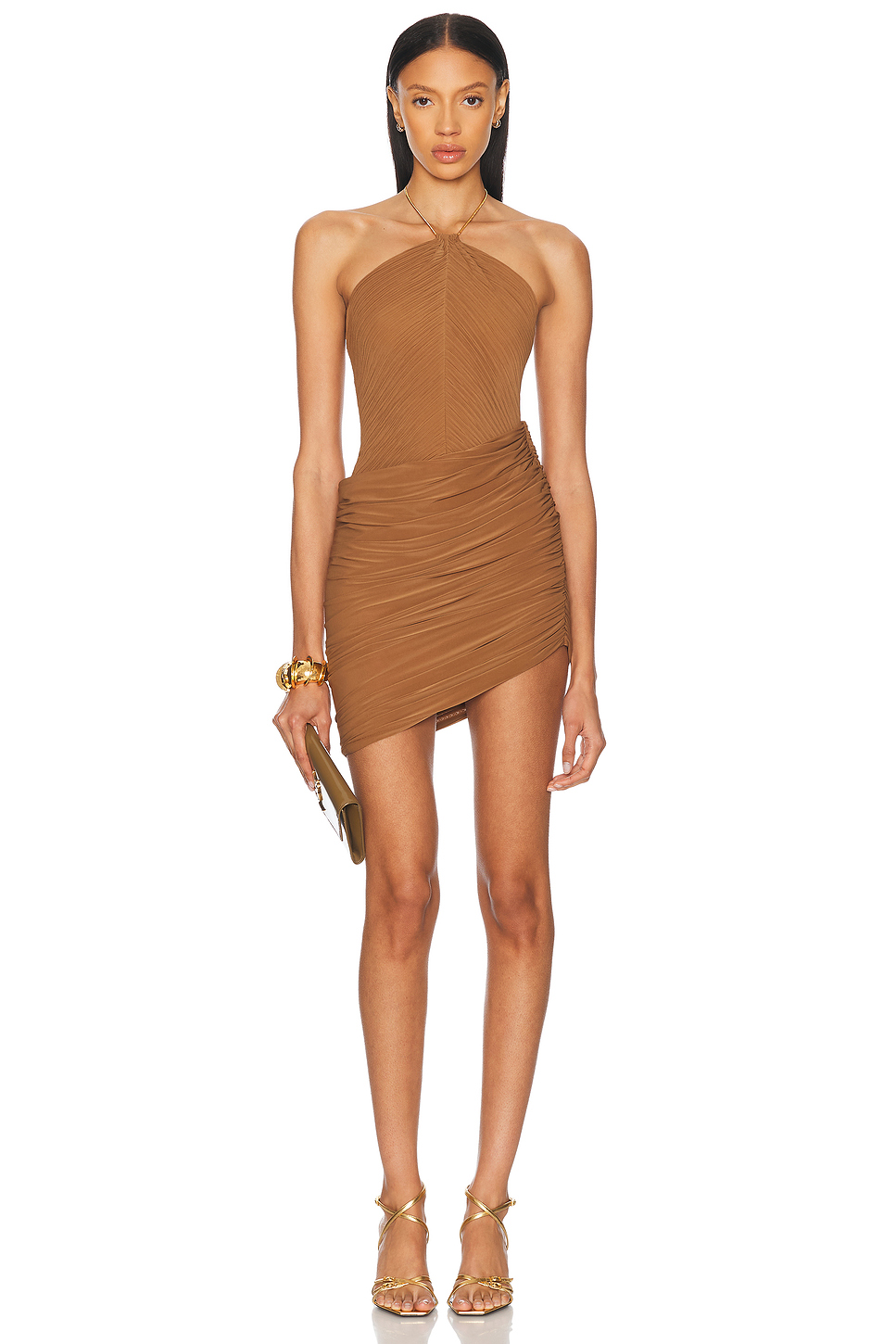
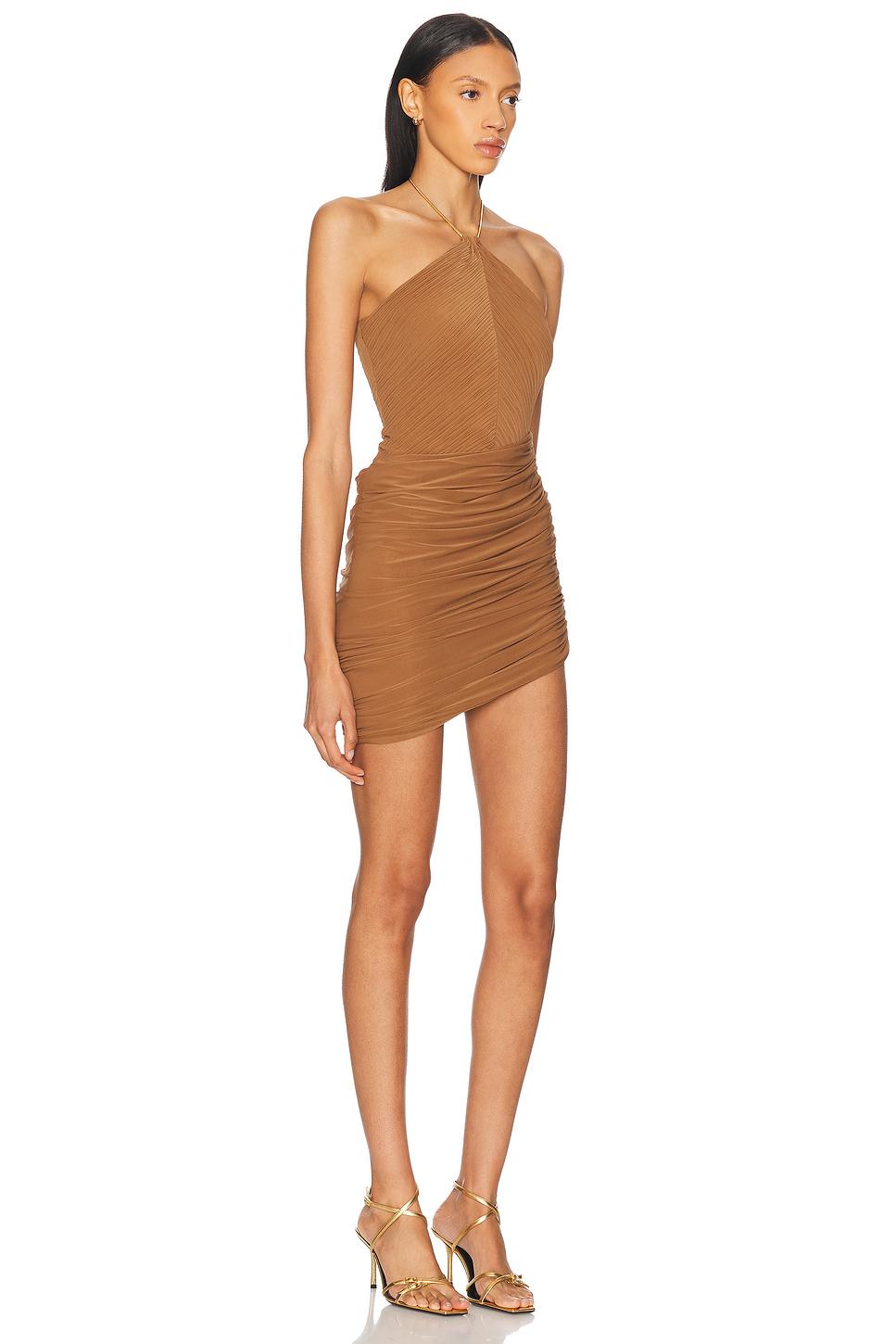
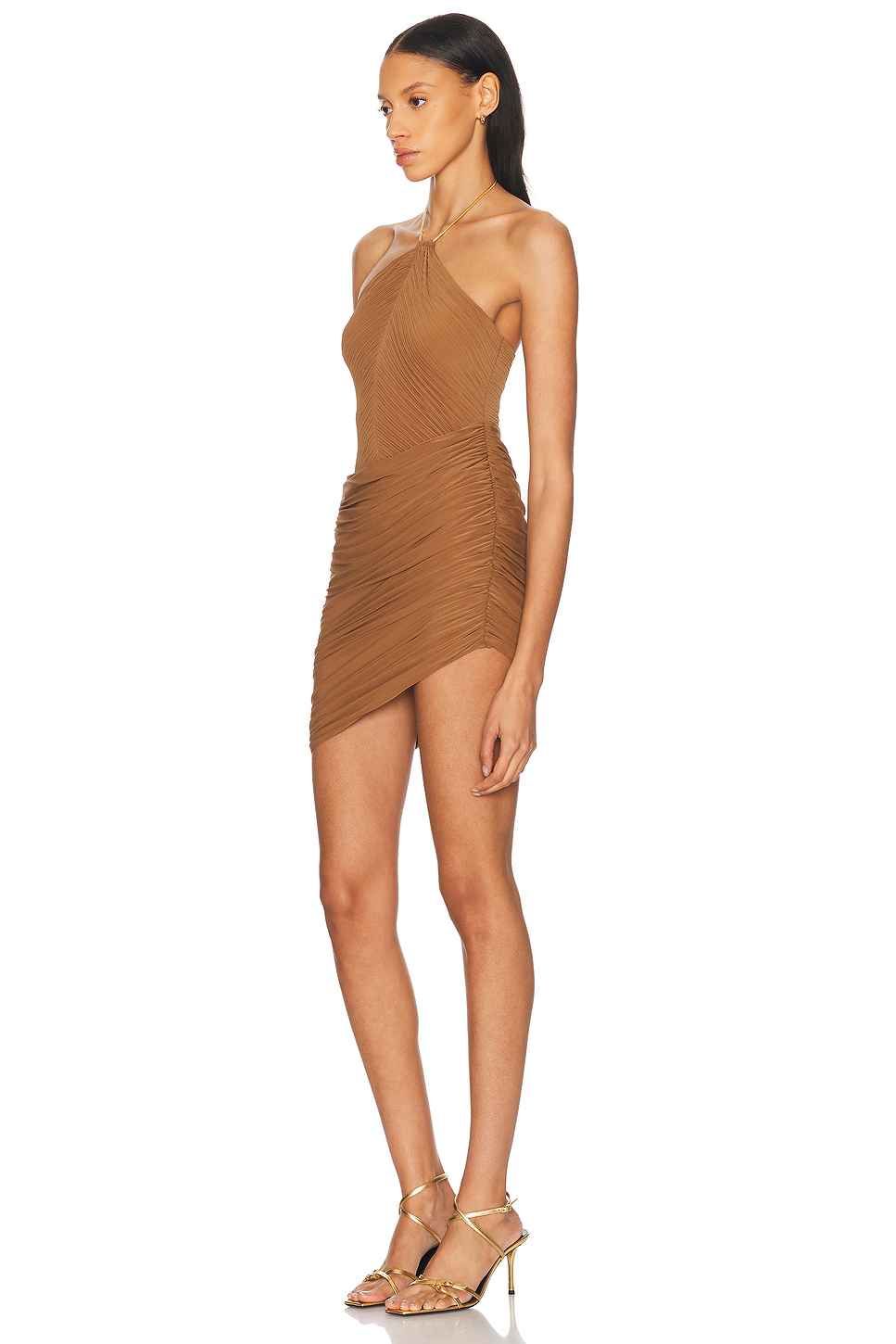
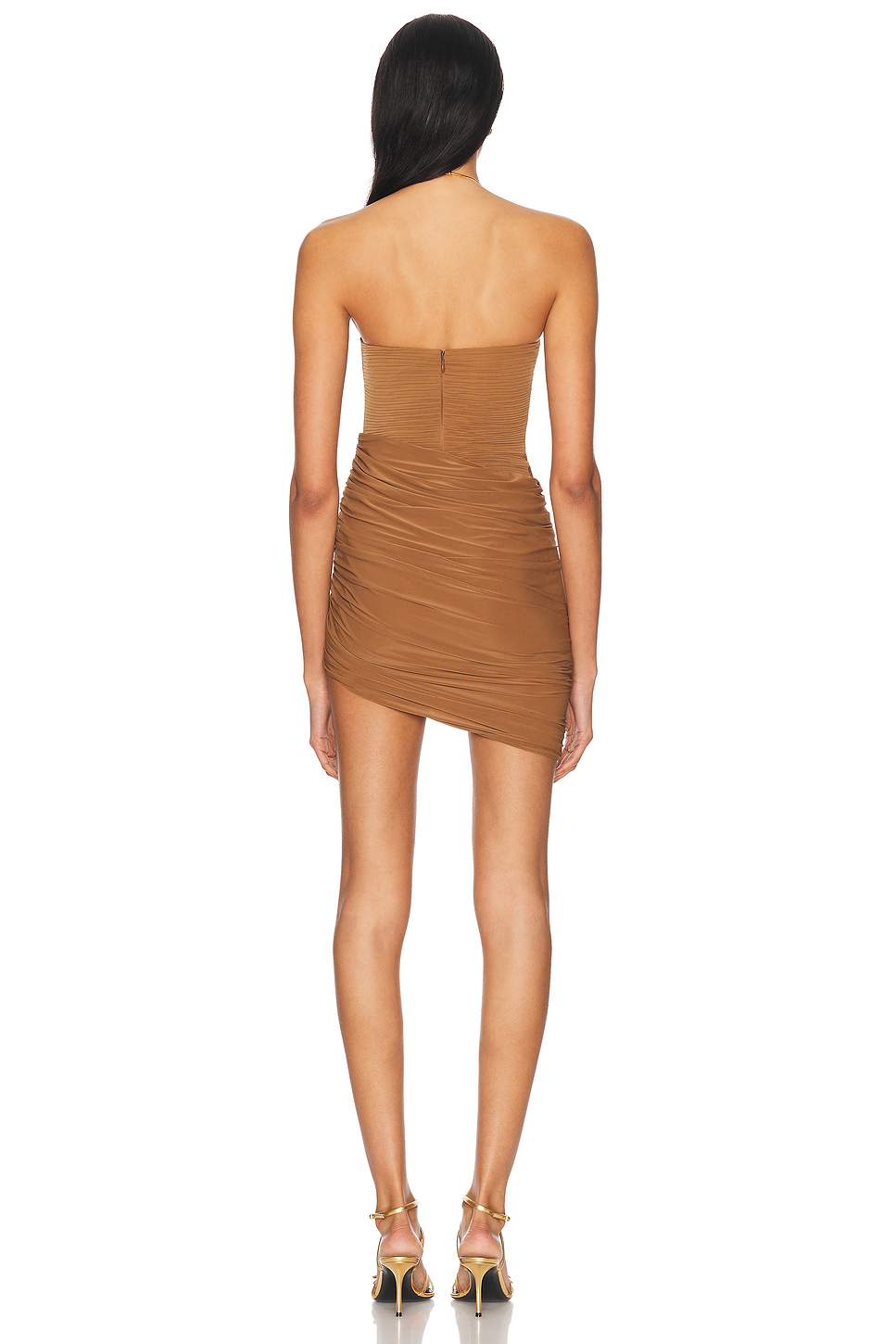
A halter dress listed as 90% polyester and 10% elastane, fully lined, with a halter chain fastened by a lobster clasp, a gusset press-stud closure and a hidden zip at the back, in a slim plain weave with an asymmetric hem, dry clean only, made in China, ranked tenth in the retailer's halter dress list, at 498 dollars. This is one of very few listings in this series carrying either fit votes or a written review, and there are twelve fit votes and one review, so there is real feedback to work from. Twelve people voted on the fit and they split almost exactly down the middle between accurate and small. The single written review is one sentence long and is the most actionable sentence this series has found. There is also a care instruction here that appears to be protecting something other than the cloth, and identifying what is the interesting part. The reference is the Delphine Dress by Ronny Kobo in Tobacco. Dongguan Bafinasa Garments Co., Ltd. develops comparable occasion dresses on OEM and ODM terms, from fabric and hardware sourcing to retail or FBA ready packing. We publish this as a development reference and build your own version of it, and we do not supply the branded original or reproduce anyone else's label.
Key Features
- 90% polyester, 10% elastane as stated
- Chain halter with a lobster clasp as stated, which is hardware rather than cloth
- Gusset press-stud closure as stated
- Hidden zip at the back as stated
- Asymmetric hem as stated
- Slim plain weave fabric as stated
- Fully lined as stated
- Dry clean only as stated, which is stricter than the fibre requires. See the note below
Customisable Options
- Fabric: polyester elastane to the reference, with the weight set from a tested sample
- Closure count: we would go to one at the neck on a slider, which is the first point under engineering below
- Chain: kept or replaced with fabric, with the reason made explicit either way on the care label
- Sizing: the fit votes are split almost evenly, so we would redevelop the block against measured bodies
- Length from mini to knee, hem shape, hardware finish, size set, colour development, private label and care labelling
Specifications
| Style | Delphine halter chain mini dress |
| Reference | Ronny Kobo, Delphine Dress, style RONR-WD778, manufacturer style 4184158TJE, colour Tobacco |
| Composition | 90% polyester, 10% elastane as stated |
| Closures | Three: a lobster clasp halter at the neck, a gusset press-stud, and a hidden back zip. See the note below |
| Halter | Chain rather than fabric, as stated |
| Hem | Asymmetric as stated |
| Fabric | Slim plain weave as stated |
| Lining | Fully lined as stated |
| Care | Dry clean only as stated. See the note below, since the fibre would tolerate far more |
| Sizes Published | XS, S, M, L |
| Measurements | None published. There is no size chart on this listing |
| Chart Gap | No size chart, and yet twelve people have voted on the fit. See the note below |
| Model | 175 cm, wearing size S, bust 32 in, waist 24 in, hips 34 in |
| Fit Votes | Twelve voters: about 41% said fits true to size, about 41% said runs small, about 16% said runs large |
| Fit Reading | A near even split between accurate and small is unusual and worth taking seriously. See the note below |
| Review | One review on the listing, quoted verbatim below |
| Rating | 1.0 out of 5, from a single review, which is too few to generalise from |
| Production | Made in China as stated |
| Reference Retail | 498 USD, quoted to show the price band this sits in, not as our price |
| Best Seller Badge | Rank 10 in the retailer's halter dress list, which is a strong position |
| Categories | Filed by the retailer under halter dresses and mini dresses |
| Occasion | Evenings, parties, events, nights out |
| MOQ | 100 pcs per style per colourway, mixed sizes and colourways accepted |
| Sampling | 7-10 days after tech pack or reference sample confirmation |
| Bulk Lead Time | 20-30 days after sample approval and deposit |
| Service | OEM / ODM / private label, polyester sourcing, chain hardware, retail or FBA ready packing |
Size Chart
| Size | Bust | Waist | Hips | Length | Source | ||||||||||||
|---|---|---|---|---|---|---|---|---|---|---|---|---|---|---|---|---|---|
| XS | 31 | in / | 79 | cm | 24 | in / | 61 | cm | 34 | in / | 86 | cm | 84 | cm / | 33.1 | in | Our proposal |
| S | 33 | in / | 84 | cm | 26 | in / | 66 | cm | 36 | in / | 91 | cm | 86 | cm / | 33.9 | in | Our proposal |
| M | 35 | in / | 89 | cm | 28 | in / | 71 | cm | 38 | in / | 97 | cm | 88 | cm / | 34.6 | in | Our proposal |
| L | 37 | in / | 94 | cm | 30 | in / | 76 | cm | 40 | in / | 102 | cm | 90 | cm / | 35.4 | in | Our proposal |
This listing publishes no size chart. Twelve people have voted on how it fits, and their answers split almost exactly evenly between true to size and runs small, so there is plenty of opinion about the sizing and no figures to go with it. The model is 175 cm wearing size S at roughly 32, 24 and 34.
Occasions and Styling
Suits evenings, parties, events and nights out. A chain halter mini in a slim fabric is an evening garment, and it is worth knowing in advance that this one has three separate things to fasten, two of them behind or above the wearer, which affects how long it takes to get into.
Production and Quality Control
Twelve people voted on the fit and split almost evenly. One person wrote a single sentence, and it is the most actionable thing this series has found. There is also a care instruction here protecting something other than the cloth, and finding out what is worth doing.
One reviewer wrote that she could not even work out how to put it on, and that sentence changes the standing of something this series has been arguing for some time, and that is the first thing. The review reads, in full: I could not even figure out how to put this thing on. It is worth being clear about the rating first, because fairness requires it: the listing carries one review and a score of 1.0, and one buyer is not a sample anybody should generalise from, since people write reviews for reasons that have nothing to do with the garment. But this sentence is a different kind of statement from a complaint about colour or length. It reports a fact about construction, and it can be checked against the listing, and checking it vindicates her. Three things must be fastened to get into this dress: a lobster clasp halter at the back of the neck, a press-stud on a gusset, and a hidden zip at the back. This series has spent a great deal of space on exactly this subject and reached a consistent position, which is that what matters is not how many closures a garment has but where they sit, and specifically whether the wearer can see them and reach them. Backitr placement has been criticised repeatedly, from a garment needing two actions behind the back, to buttons sitting behind a zip so that reaching the second meant working through the first, to lacing at the back being the hardest arrangement yet because after alignment there is still a knot to tie and ties to arrange afterwards. It was also noted that a hook at the back of the neck is harder than anything at the back alone, being both invisible and held in a restricted posture. This dress combines several of those at once, and it uses the hardest single fastening available, since a lobster clasp requires pulling a small spring-loaded lever sideways against its own spring with a fingernail, doing so behind the neck, where it cannot be seen. What changes with this review is not the argument but its status. Everything above was reasoned from where closures sit. Now somebody has stated the consequence directly, and the reasoning and the report agree, which is the strongest position this series has been in on the subject. It is also worth adding what the remedy is, because removing closures is not it. The answer is substitution rather than subtraction: replace the neck clasp with a slider, which adjusts by being pulled and needs no alignment at all, andset it once and then step in and do up the single concealed zip.
Twelve voters split almost evenly between accurate and small, and no chart exists to settle it, and that is the second thing. About forty one per cent said true to size and about forty one per cent said runs small, with roughly sixteen per cent saying large. That distribution is worth taking apart, because it is not the shape this series has seen elsewhere. Where fit votes have appeared before they have clustered: one listing with a hundred and sixty five reviews showed about seventy three per cent calling the fit accurate and only nine per cent calling it small, which is a garment whose sizing is working. This one has no such consensus. When people disagree this evenly, there are two possible explanations and they lead to different actions. Either the sizing is genuinely off somewhere in the range, so that one end fits and the other does not, or the voters are bringing very different bodies to a garment that fits only one kind. The composition bears on this, because ten per cent elastane is not trivial. This series has been consistent that elastane below about five per cent is a recovery additive rather than something a fit rests on, while levels approaching a fifth genuinely compress a body. At ten per cent a garment should have real tolerance, which makes forty one per cent of voters calling it small harder to explain away: it suggests the underlying block is cut close rather than that the fabric lacks give. And here is the second finding, which is the one to act on: there is no size chart on this listing at all. So twelve people have opinions about sizing and there is not one number anywhere to help a thirteenth decide, and she cannot compare anything against the model either, since no body measurements accompany the chart because there is no chart. This is the second time this series has found this combination, having previously found a crepe maxi whose reviewers complained about fit while the page carried no chart. The recommendation writes itself: when voters disagree about sizing, publish the numbers, because that is what turns an argument into an answer.
Dry clean only protects something other than the cloth, and finding what it is matters, and that is the third thing. The shell is ninety per cent polyester with ten per cent elastane, and polyester is among the most easily cared for fibres there is. It does not shrink, it does not felt, it does not lose strength when wet, it dries quickly and it resists creasing. Nothing in that composition requires dry cleaning, and it is worth noting how unusual that makes this instruction, because this series has almost always found care wording to be too weak rather than too strict, with the missing or open instruction being the standard complaint. So what is being protected? Working through what is on the garment, the strongest candidate is the halter, because it is a chain, meaning metal, and metal does not like water or detergent or salt from skin: it tarnishes, it can discolour at the joins, and plated finishes in particular give way with repeated wetting. Other candidates are weaker. The asymmetric hem depends on the fabric holding a shape, and elastane loses resilience over time with heat more than with water. The gusset press-stud is a small piece of metal but it is a press-stud, not something water ruins. So the chain is the likeliest reason, and there is a useful consequence to drawing that out, because if the instruction exists for the chain then the cloth does not need it, and the distinction is worth stating on the label. A customer who knew that could act accordingly. An over strict instruction has a cost, and this series has met it before from the other direction, where confusing instructions were said to push a buyer either toward cleaning she did not need or away from buying at all. The remedy here is narrow: identify what the instruction is protecting, say so, and either use a finish on the hardware that tolerates contact or accept the instruction and explain it. There is a final point worth making about the structure, which connects back to the first. A halter places load at the back of the neck rather than on the shoulders, and this series has noted that the region is sensitive and poorly suited to bearing weight, which is why narrow halter bands dig in. A chain concentrates that load further, since all of it passes through a line rather than spreading across a width, and a clasp puts a hard point into the very place least able to take one. So the single change most worth making, apart from the closure itself, would be widening how the halter meets the neck. Every bulk shipment gets a measurement report against your approved chart.
Optional upgrades include replacing the neck clasp with a slider, set once so that afterwards only the concealed zip needs doing, widening where the halter meets the neck so load spreads rather than concentrates, a hardware finish tested for contact with skin and stated on the label, the care instruction either relaxed or its reason named, since the polyester does not require it, the block redeveloped against measured bodies given how evenly the fit votes split, a size chart published with model measurements, alternative hardware treatments, alternative hem shapes, alternative lengths, extended sizing, colour development and private label, hangtag and care labelling.
Pre-production sample approval, in-line inspection during cutting and sewing, and a final AQL inspection before packing, with measurement reports and photos shared before shipment.
Send us your tech pack, a photo or a reference garment and we will quote within 24 hours. Contact bafinasa@bafinasa.com or WhatsApp +86 13827222469.