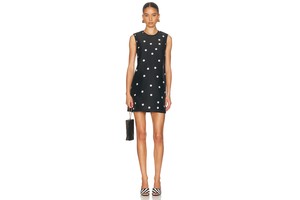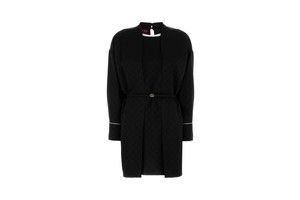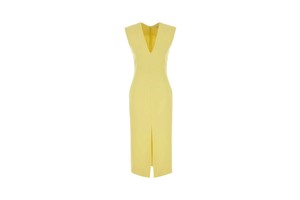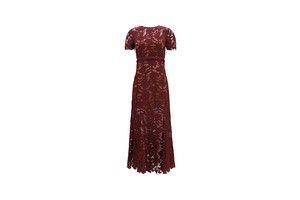
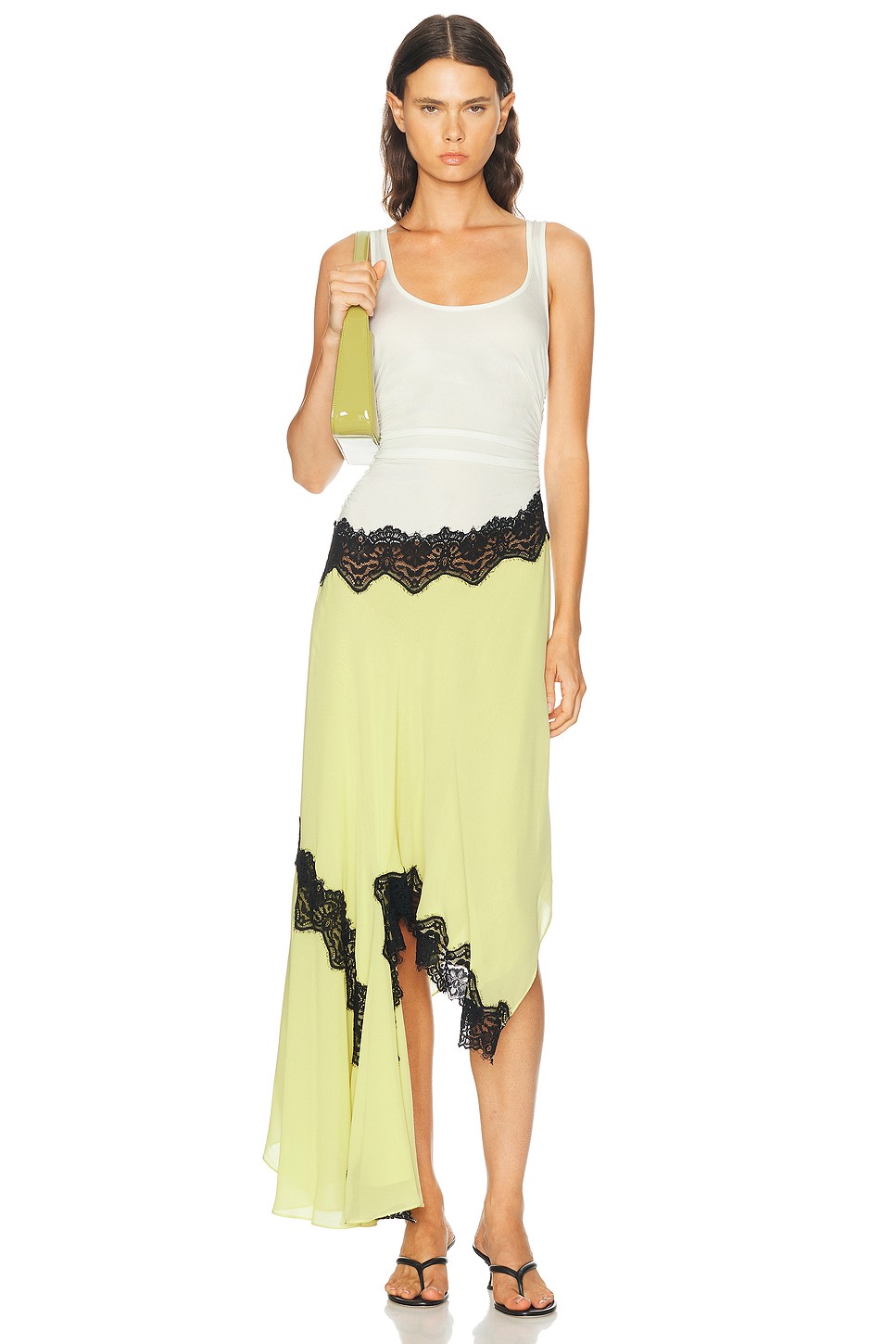
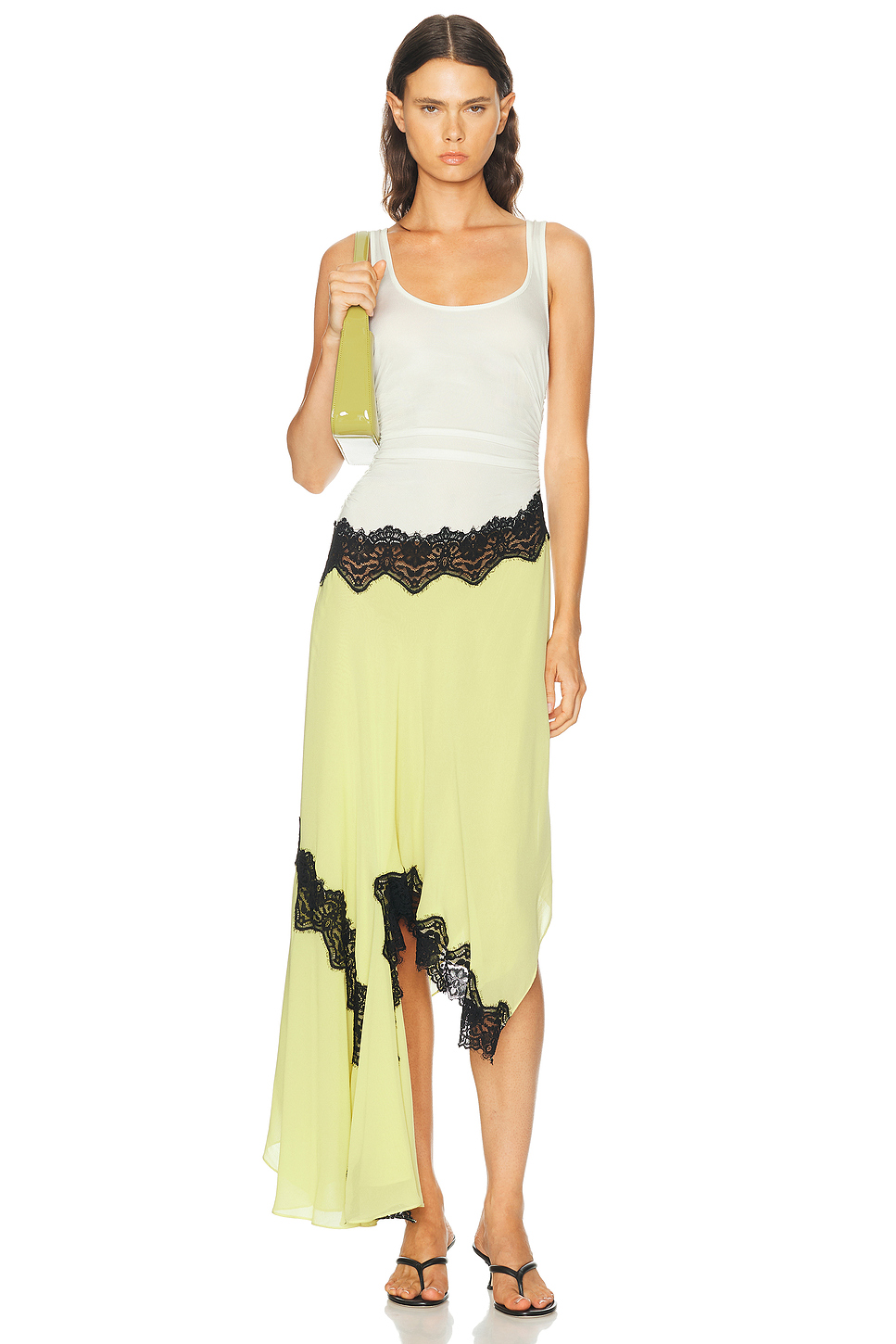
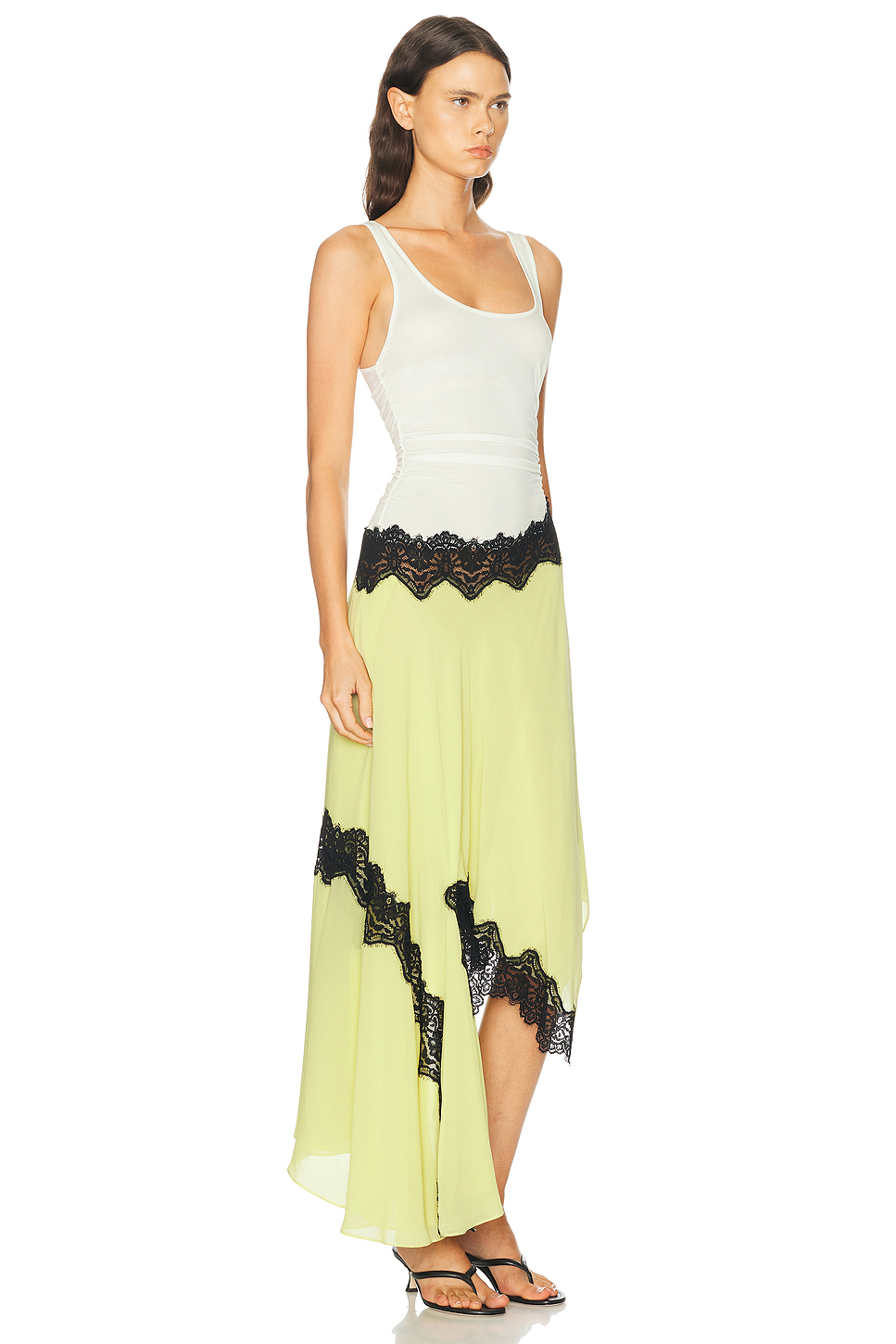
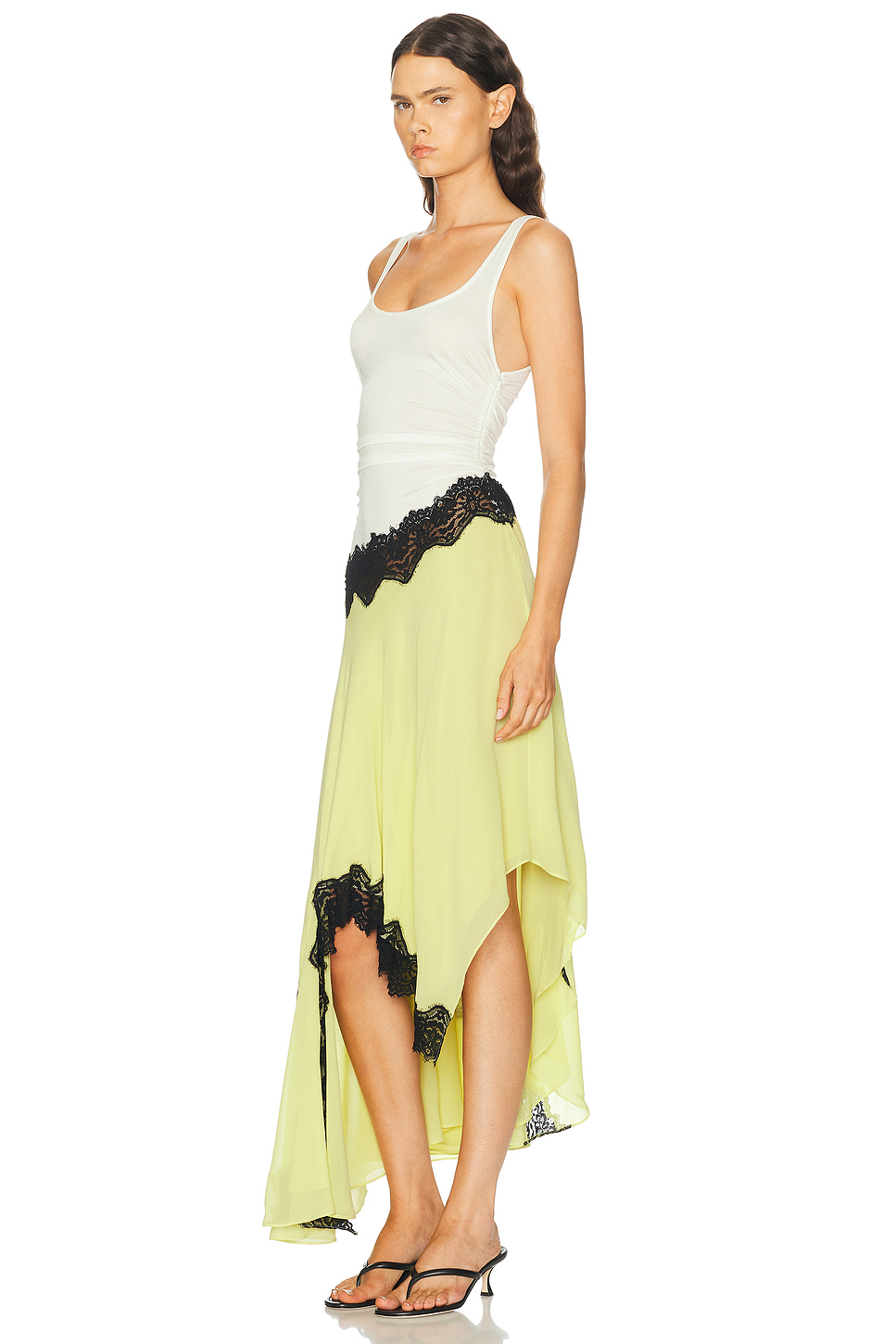
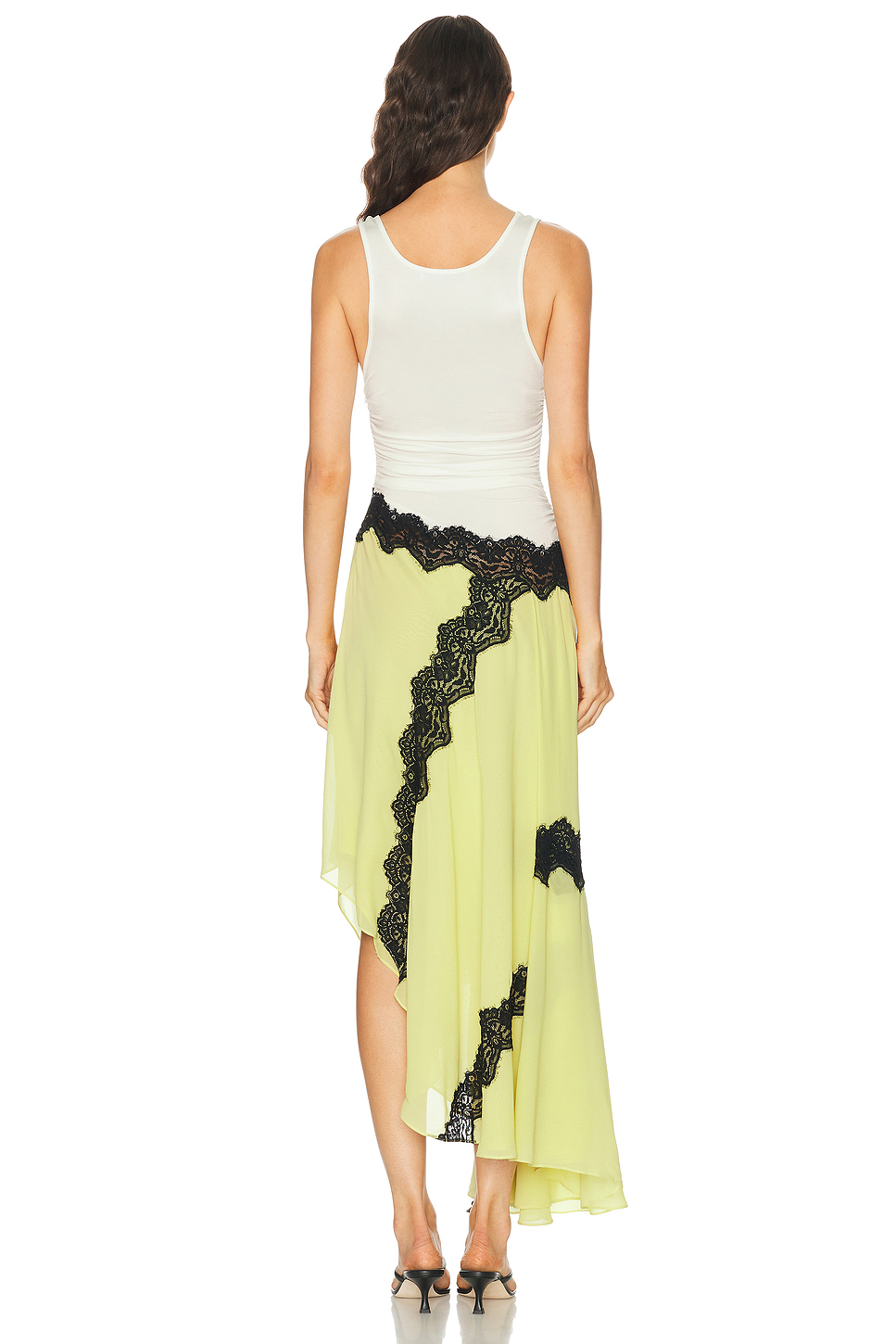
A gathered tank dress listed in a midweight crepe fabric with lace embellishment, partially lined, closed with a hidden zip at the side, imported, at 1,148 dollars. The retailer files it under lace dresses and maxi dresses. There are no reviews and no fit votes, so there is no score to quote. There is no fibre composition on this listing, and this is the third one in this series to publish a construction instead, which is enough occurrences to be worth grouping. There is also a set of measurements here whose pattern cannot be explained by stretch, and the name of the garment explains why. The reference is the Cutaway Lace Gathered Tank Dress by Christopher Esber in Chartreuse and Multi. Dongguan Bafinasa Garments Co., Ltd. develops comparable occasion dresses on OEM and ODM terms, from fabric and trim sourcing to retail or FBA ready packing. We publish this as a development reference and build your own version of it, and we do not supply the branded original or reproduce anyone else's label.
Key Features
- Midweight crepe fabric with lace embellishment as stated
- Gathered detailing as stated
- Cutaway construction as stated, which changes what the measurements mean
- Hidden zip at the side as stated
- Partially lined as stated, without saying which parts
- Dry clean recommended as stated, which is the weakest wording available
- Imported as stated
- Five sizes from Aus 4/US 0 to Aus 12/US 8
Customisable Options
- Fabric: midweight crepe as the reference, with the fibre settled before anything else
- Construction: gathered and cutaway as the reference, with both specified rather than assumed
- Lining: we would state which parts are lined, since partially lined promises exactly that
- Care: we would state dry clean only rather than recommended
- Length from midi to floor, gathering placement, cutaway shape, size set, colour development, private label and care labelling
Specifications
| Style | Cutaway lace gathered dress |
| Reference | Christopher Esber, Cutaway Lace Gathered Tank Dress, style CHRF-WD380, manufacturer style 25023448, colour Chartreuse and Multi |
| Composition | None stated on the listing. See the note below |
| Fabric | Midweight crepe with lace embellishment as stated, which describes texture and weight rather than fibre |
| Construction | Gathered, with cutaway detail, as stated. See the note below |
| Closure | Hidden zip at the side as stated |
| Lining | Partially lined as stated, with no indication of which parts. See the note below |
| Care | Dry clean recommended as stated, which is weaker than dry clean only |
| Sizes Published | Aus 4/US 0, Aus 6/US 2, Aus 8/US 4, Aus 10/US 6, Aus 12/US 8 |
| Measurements Published | Aus 6/US 2: bust 22 in, waist 18 in, hips 40 in, length 57 in |
| Chart Note | The bust is twelve inches under the model and the waist five under, while the hip is four over. See the note below |
| Model | 182 cm, wearing size Aus 6/US 2, bust 86 cm, waist 58 cm, hips 91 cm |
| Production | Imported as stated, with no country named |
| Reference Retail | 1,148 USD, quoted to show the price band this sits in, not as our price |
| Customer Reviews | None on the reference listing, so we quote no score |
| Best Seller Badge | None. The listing carries no rank |
| Categories | Filed by the retailer under both lace dresses and maxi dresses |
| Occasion | Formal events, weddings, evenings, occasions |
| MOQ | 100 pcs per style per colourway, mixed sizes and colourways accepted |
| Sampling | 7-10 days after tech pack or reference sample confirmation |
| Bulk Lead Time | 20-30 days after sample approval and deposit |
| Service | OEM / ODM / private label, crepe sourcing, lace application, retail or FBA ready packing |
Size Chart
| Size | Bust | Waist | Hips | Length | Source | ||||||||||||
|---|---|---|---|---|---|---|---|---|---|---|---|---|---|---|---|---|---|
| US 2 | 22 | in | 18 | in | 40 | in | 57 | in / | 145 | cm | As published | ||||||
| US 0 | 31 | in / | 79 | cm | 24 | in / | 61 | cm | 34 | in / | 86 | cm | 143 | cm / | 56.3 | in | Our proposal |
| US 2 | 33 | in / | 84 | cm | 26 | in / | 66 | cm | 36 | in / | 91 | cm | 145 | cm / | 57.1 | in | Our proposal |
| US 4 | 35 | in / | 89 | cm | 28 | in / | 71 | cm | 38 | in / | 97 | cm | 147 | cm / | 57.9 | in | Our proposal |
| US 6 | 37 | in / | 94 | cm | 30 | in / | 76 | cm | 40 | in / | 102 | cm | 149 | cm / | 58.7 | in | Our proposal |
| US 8 | 39 | in / | 99 | cm | 32 | in / | 81 | cm | 42 | in / | 107 | cm | 151 | cm / | 59.4 | in | Our proposal |
The published size US 2 gives a 22 inch bust, an 18 inch waist, a 40 inch hip and a 57 inch length against a model at roughly 34, 23 and 36. The bust is twelve inches under her and the waist five under, but the hip is four inches over, and that combination has a specific reading.
Occasions and Styling
Suits formal events, weddings, evenings and occasions. A chartreuse crepe dress with lace is an occasion piece rather than a day one, and 57 inches is about 145 centimetres, which on a model at 182 cm falls around the ankle.
Production and Quality Control
There are no reviews and no fit votes on this listing, so there is no score to quote. There is no fibre stated, and this is the third listing in this series to substitute a construction for one. There is also a set of measurements whose pattern rules stretch out, and one word that resolves them.
Three listings have now published a construction where a composition belongs, and at three it is worth calling it a pattern, and that is the first thing. This page says crepe fabric, midweight crepe fabric, with lace embellishment. None of that names a fibre. Crepe is a family of fabrics defined by how the yarns are twisted and woven, high twist in the warp or weft or both, so that the finished cloth has a crinkled or pebbled surface, and that structure can be built from silk, wool, polyester, acetate or viscose, all of which behave differently. So the page gives the texture and the weight and omits the thing that decides how it behaves. We found this shape of omission first on a raffia knit whose entire description was knit fabric, and noted there that the construction does not tell you the fibre, and that one missing number left three practical questions open. We found it again on a metallic satin dress described as woven and as lightweight textured satin, and made the same separation, listing what was known against the unknown that decided everything: whether it shrinks, whether it can be washed, whether it creases, whether water marks it, and what it costs. That is now three, from three different makers, and the recurrence suggests something about how this information is handled rather than a series of accidents. It is worth being fair about why the weight and the texture are genuinely useful, because midweight crepe does narrow things: it tells you the garment has body rather than being fluid, and that it will hold a gathered shape rather than collapsing under it. But it narrows and does not settle. There is one further consequence here that matters more than usual, which is set out below, and it concerns the lace, because lace and crepe are almost never the same fibre and this garment combines them.
The waist is five inches under and the hip is four over, and stretch cannot produce that, and the name explains it, and that is the second thing. The bust is 22 inches against a model at roughly 34, the waist 18 against 23, and the hip 40 against 36. So the top and middle are well under her body and the bottom is over it. This series has a consistent way of reading such patterns, and it rests on a property of stretch rather than on intuition: elastane acts on the whole garment, so it cannot make one circumference smaller while leaving the next one larger. We established that reading on a gathered sheath where one measurement was under the model while the two beside it were comfortably over, and concluded the explanation was where the tape had been placed rather than anything about stretch. Here the same logic applies and the answer is in the name, which is Cutaway Lace Gathered Tank Dress. Cutaway means that material has been removed from the garment, so at the point where the waist is measured there may be very little cloth going all the way round, and the figure then describes the narrowest part of a shape that has been cut into rather than a circumference of cloth. That reading explains the whole row. The bust is twelve inches under because the bodice is gathered, and a gathered panel measured flat gives the gathered size rather than the size it opens to when worn, which we found in its clearest form on a shirred cotton dress where that difference was about ten inches. The waist is under because it has been cut away. The hip is four inches over because below all of that is a skirt that falls freely. So the row is internally consistent once the name is read, and none of it requires stretch at all. It is worth drawing the practical lesson, which is that a chart row tells you nothing until you know what garment it belongs to, and a cutaway garment is exactly the case where figures cannot be compared across styles.
Partially lined promises to say which parts, and it does not here, and that gap has been the subject of real complaint before, and that is the third thing. A garment described as partially lined raises a question immediately, which is which parts, because a lining does one of three jobs, covering, slip or comfort, and knowing which parts has it and which do not tells the customer where the garment will show through and where it will not. This listing does not say. This is the second time in this series that partially lined has appeared without that detail, and the previous instance is instructive because it came with actual customer feedback: a crepe and lace mini whose own reviewers reported that the garment did not cover the chest adequately and was see through or mesh in places. We said there that those complaints were consistent with a garment that is only partly lined. So this is not a theoretical gap. It is worth connecting it to the construction, because the cutaway almost certainly accounts for at least some of what is unlined, since a cutaway opening is usually left open rather than backed, and this garment is also in a bright colour, which is where opacity is hardest to judge from a photograph. This series has returned to that point many times and settled on a rule, which is that opacity should be stated plainly because studio lighting arranged to flatter a garment will not reveal whether cloth transmits light. Two lines on this page would resolve all of it: say which parts are lined, and say whether anything shows through. On the care instruction, dry clean recommended is the weakest wording available, since it states a preference and leaves every method open. We have argued throughout this series that the difference between recommended and only is not pedantry, because invited interpretation is how garments get ruined, and that argument has more force here than usual, since the instruction was written without knowing what either the crepe or the lace is made of. Every bulk shipment gets a measurement report against your approved chart.
Optional upgrades include the fibre composition stated for both the crepe and the lace, which parts are lined stated explicitly, opacity tested and tested again where the garment is cut away, dry clean only rather than recommended, the gathering specified as to where and how much, the cutaway shape specified, alternative crepe weights, alternative lace placements, alternative lengths, extended sizing, colour development and private label, hangtag and care labelling.
Pre-production sample approval, in-line inspection during cutting and sewing, and a final AQL inspection before packing, with measurement reports and photos shared before shipment.
Send us your tech pack, a photo or a reference garment and we will quote within 24 hours. Contact bafinasa@bafinasa.com or WhatsApp +86 13827222469.