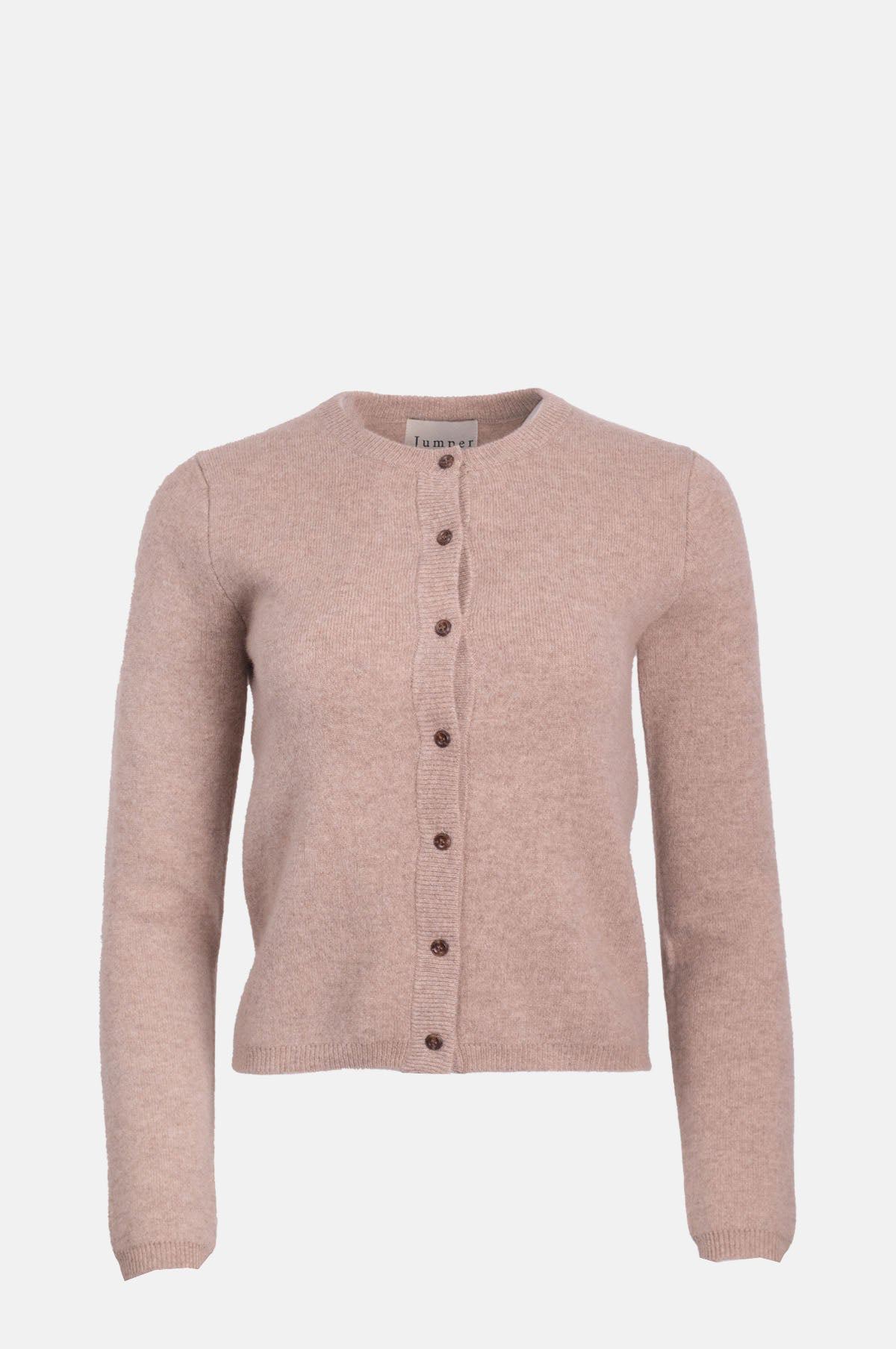

The Stretch Cardigan in almond rice from Jumper 1234, a classic cardigan with a round crew neck and long sleeves, tortoiseshell buttons running down the front and a neat ribbed finish at the edges, in a cashmere and spandex blend that is soft and stretchy and provides a neat fit with a medium thickness, listed at 219 GBP with all four sizes in stock. It is worth beginning with the fibre line, because it gives a number this run has been asking for since its first batch and has never once been given. It is worth then reading it, which is 88 per cent cashmere and 12 per cent spandex. It is worth then saying what 12 per cent is, which is a stretch percentage, and stating that this is the first garment in this run to publish one. It is worth then recalling what this run has met instead, which is garment after garment using a stretch word and giving no number: stretchy, comfort stretch, and one that said non-stretch and was proved right by its own panel. It is worth then noting the size of the share, which is that 12 per cent is high, since most knitwear carries two to five. It is worth then turning to what follows from it, because it is the most important thing on the page and it changes how the chart must be read. It is worth then saying what a 12 per cent spandex knit does, which is stretch, and therefore what every figure on the chart is a measurement of, which is the garment in one state only. It is worth then reading the chest, which is 42 to 53 centimetres flat, and asking the question the page never answers, which is whether that is the relaxed measurement or the stretched one. It is worth then stating how large the difference is, which is that a knit with this much elastane can give twenty to thirty per cent more in the stretched state, so the 42 centimetre chest could be anywhere from 42 to about 55. It is worth then saying what that does to the ease figures, which is to make every one of them uncertain by that margin. It is worth then noting that this run has found elasticated measurements given as single numbers several times before, and stating what is different here, which is that the house publishes the stretch share, so the gap can be sized rather than merely suspected. It is worth then turning to the fit word, because one batch ago this run met a fitted claim that held, and this is the second close fit claim and it does not hold. It is worth then reading it, which is a neat fit. It is worth then doubling the chest, giving 33.07 to 41.73 inches around, and setting that against bodies of 31 to 37 inches. It is worth then reading the ease off, which is 2.07, 1.65, 3.58 and 4.73. It is worth then stating what that does, which is fall once and then jump twice, by nearly two inches and then more than one. It is worth then saying what a neat fit should mean, which is consistency, and stating the result, which is that the room changes by three inches across four sizes and changes upwards. The reference is the Stretch Cardigan. Dongguan Bafinasa Garments Co., Ltd. develops comparable knitwear on OEM and ODM terms, from yarn and trim development to retail or FBA ready packing. We publish this as a development reference and build your own version of it, and we do not supply the branded original or reproduce anyone else's label.
Key Features
- A neat fit as stated, measured at 1.7 to 4.7 in of ease and rising sharply across the range. See the note below
- A cashmere and spandex blend as stated, at 88% Cashmere and 12% Spandex, the first stretch percentage published in this run. See the note below
- Soft and stretchy as stated, with the stretch share given but no relaxed and no stretched measurement on the chart. See the note below
- Medium thickness as stated, with no gauge, no ply and no weight given. See the note below
- Tortoiseshell buttons down the front as stated, with no button count, no button size, no spacing and no material given. See the note below
- Crew neck as stated, with no neck width and no neck depth given
- Long sleeves as stated, measured 61 to 63 cm, with no bicep and no cuff opening given
- Ribbed trims as stated, with no rib depth and no rib width given
Customisable Options
- Yarn: a cashmere and spandex blend to the reference, with the micron and the fibre length stated and the stretch share given, or a cashmere and wool blend with both shares given, or a merino and spandex blend, or a 100% cashmere with no stretch, or a recycled cashmere with the standard named, each quoted separately
- Stretch: 12% spandex to the reference, with the relaxed and stretched measurements both published, or 5% spandex, or 2% spandex, or a mechanical stretch yarn with the percentage given, or no stretch, each quoted separately
- Fit: a neat fit to the reference, with the chest graded evenly so the ease stays close across the range, or a regular fit, or a relaxed fit with the chest graded by about 2.5 cm, or an oversize fit, each quoted separately
- Weight: a medium thickness to the reference, with the gauge, the ply and the weight in grams per square metre stated, or a fine gauge lightweight version, or a chunky version, each quoted separately
- Buttons: tortoiseshell buttons down the front to the reference, with the material, the count, the size and the spacing stated, or corozo buttons, or horn buttons, or mother of pearl, each quoted separately
- Neck and trims: a crew neck with ribbed trims to the reference, with the neck width and depth and the rib depth and width stated, or a V-neck, or a collar, or plain edges, each quoted separately
- Composition with the fibre and the stretch share stated, micron and fibre length, ply, gauge and weight in grams per square metre, chest and waist with the flat or round method stated and both the relaxed and the stretched measurement given, sleeve length with its measurement point, bicep and cuff opening, neck width and depth, button material, count, size and spacing, rib depth and width, shrinkage figures, a hand wash temperature as a number, size set, colour development, private label and care labelling
Specifications
| Style | Stretch cardigan in a cashmere and spandex blend with a neat fit, a crew neck, a button down front, long sleeves and ribbed trims |
| Reference | Jumper 1234, Stretch Cardigan, colour Almond Rice, style LAN26-4006_AW26 Almond Rice LK10136, sizes 1 to 4 |
| Composition | Made from 88% Cashmere, 12% Spandex, as stated. See the note below |
| Stretch Share | 12% Spandex, as stated, the first stretch percentage published in this run. See the note below |
| Relaxed and Stretched Measurements | Not stated, despite the stretch share being published. See the note below |
| Micron | Not stated, despite cashmere being graded by micron and by fibre length. See the note below |
| Fibre Length | Not stated |
| Ply | Not stated |
| Gauge | Not stated |
| Cloth Weight | Not stated, in any form, despite medium thickness being used. See the note below |
| Certification | None named |
| Fit Word | Neat fit, as stated in the bullets and repeated in the description. See the note below |
| Fit Statement | Provides a neat fit with a medium thickness, as stated, and a great lightweight layer for the colder months, as stated. See the note below |
| Colour Statement | Called light brown in one sentence and black in the next, with the title saying Almond Rice. See the note below |
| Sizes Offered | 1, 2, 3 and 4, four sizes, all four in stock at the time of writing |
| Size Conversion | 1/XS, 2/S, 3/M and 4/L, as stated |
| Model | None published. See the note below |
| Chest | Pit to pit 42, 44, 49 and 53 cm, or 84 to 106 cm around. See the note below |
| Chest Around | 84, 88, 98 and 106 cm, or 33.07, 34.65, 38.58 and 41.73 in. See the note below |
| Ease at the Chest | About 2.1 in at a size 1, 1.7 at a 2, 3.6 at a 3 and 4.7 at a 4. See the note below |
| Change in Ease per Size | Minus 0.43 on the 2 cm step, then plus 1.95 on the 5 cm step and plus 1.16 on the 4 cm step. See the note below |
| Waist | Not measured |
| Hip | Not measured |
| Shoulder | Not measured |
| Sleeve | 61, 61, 62 and 63 cm, stepping 0, 1 and 1. See the note below |
| Bicep | Not measured |
| Cuff Opening | Not measured |
| Neck | Crew neck as stated, with no neck width and no neck depth given |
| Buttons | Tortoiseshell buttons down the front as stated, with no material, no count, no size and no spacing given. See the note below |
| Total Length | 53, 55, 57 and 59 cm, stepping exactly 2 cm at every step |
| Care | Hand wash only, as stated, with no temperature as a number, no drying, no iron and no bleach instruction. See the note below |
| Bullet List | Four bullets, the first of which states the fit |
| Measurements Published | Pit to pit, sleeve length and total length for all four sizes |
| Published Pit to Pit | 42, 44, 49 and 53 cm, stepping 2, 5 and 4. See the note below |
| Published Sleeve Length | 61, 61, 62 and 63 cm, stepping 0, 1 and 1. See the note below |
| Published Total Length | 53 to 59 cm, stepping exactly 2 cm at every step |
| Length as a Share of Height | Cannot be expressed, because no model is published |
| Photographs | One. See the note below |
| Production | Made in China as stated, with no certification named |
| Reference Retail | 219 GBP as listed, quoted to show the price band this sits in, not as our price |
| Category | Filed by the reference under knitwear |
| Occasion | Everyday, layering, autumn and winter |
| MOQ | 100 pcs per style per colourway, mixed sizes and colourways accepted |
| Sampling | 7-10 days after tech pack or reference sample confirmation |
| Bulk Lead Time | 20-30 days after sample approval and deposit |
| Service | OEM / DDM / private label, cashmere, merino and wool sourcing with the micron and the fibre length stated, spandex and mechanical stretch development with the share given and the relaxed and stretched measurements both published, neat, regular, relaxed and oversize knit blocks with the chest graded so the ease does what the word says, fine to chunky gauge development with the ply, the gauge and the weight in grams per square metre stated, corozo, horn and mother of pearl button development with the material, count, size and spacing given, crew, V and collared neck development with the width and depth stated, rib trim development with the depth and width given, shrinkage measured and published, hand wash care labelling with a temperature as a number, retail or FBA ready packing |
Size Chart as Published by the Reference
| Size | Pit To Pit (cm) | Sleeve Length (cm) | Total Length (cm) |
|---|---|---|---|
| 1 | 42 cm | 61 cm | 53 cm |
| 2 | 44 cm | 61 cm | 55 cm |
| 3 | 49 cm | 62 cm | 57 cm |
| 4 | 53 cm | 63 cm | 59 cm |
The pit to pit figures are flat half measures taken with the cardigan laid down, doubling to 84, 88, 98 and 106 cm around, or 33.07 to 41.73 in. Against bodies of roughly 31 to 37 in, the ease at the chest runs 2.07, 1.65, 3.58 and 4.73 in, and this run derives that a grade of g centimetres flat moves the ease by 0.79g minus 2 inches per size, which gives minus 0.43 on the 2 cm step, plus 1.95 on the 5 cm step and plus 1.16 on the 4 cm step, matching the chart on all three. The ease therefore falls once and then rises twice, so the two smaller sizes carry under two inches of room and the two larger ones carry between three and a half and four and three quarters, which is not what a neat fit should do. The panel states 12% spandex, so every figure above is a measurement of the garment in one state only, and the page does not say whether that state is relaxed or stretched. No waist, no hip, no shoulder, no bicep and no cuff opening are published, and no model is published, so the 53 to 59 cm length cannot be placed on a body. Our proposal below grades the chest evenly by 2.5 cm so the ease holds steady, grades the sleeve across the whole range, and publishes the relaxed and stretched measurements separately.
Our Proposed Body Chart
| Size | Body Bust | Sleeve | Body Waist | Body Hips | Length | Source |
|---|---|---|---|---|---|---|
| 1 | 31 in / 79 cm | 61 cm | 24 in / 61 cm | 34 in / 86 cm | 53 cm / 20.9 in | Our proposal |
| 2 | 33 in / 84 cm | 62 cm | 26 in / 66 cm | 36 in / 91 cm | 55 cm / 21.7 in | Our proposal |
| 3 | 35 in / 89 cm | 63 cm | 28 in / 71 cm | 38 in / 97 cm | 57 cm / 22.4 in | Our proposal |
| 4 | 37 in / 94 cm | 64 cm | 30 in / 76 cm | 40 in / 102 cm | 59 cm / 23.2 in | Our proposal |
Occasions and Styling
Suits everyday layering through autumn and winter. A stretch cashmere cardigan with a button front works over a tee or a shirt, and the stretch means it holds its shape when buttoned.
Production and Quality Control
The reference publishes three measurements for all four sizes, publishes a size conversion, states its fibre with a stretch share that no other garment in this run has given, names its neck, buttons, sleeves and trims, gives a care instruction, and names its country of manufacture. It gives no relaxed and no stretched measurement despite publishing a 12 per cent stretch share, no micron or fibre length for the cashmere, no ply, gauge or weight despite medium thickness being used, no button material, count, size or spacing, no neck width or depth, no bicep or cuff opening, no rib depth or width, no waist, hip or shoulder, no shrinkage figure, no certification and no model, and it calls the garment light brown and then black in the same paragraph. Three things follow: the first stretch percentage in this run and the fact that it makes the whole chart a single state measurement, the second close fit claim in this run and the first to fail, and the widest divergence between a body and a sleeve this run has measured.
Twelve, and that is the first thing, and it is worth saying what the number is before saying what it does to the rest of the page. It is worth then reading the panel, which says 88 per cent cashmere and 12 per cent spandex. It is worth then saying what that is, which is a stretch percentage, and stating that this is the first garment in this run to publish one. It is worth then recalling what this run has met instead, which is garment after garment using a stretch word and giving no number: stretchy, comfort stretch, and one that claimed non-stretch and was proved right by its own panel. It is worth then noting how large 12 per cent is, since most knitwear carries two to five. It is worth then turning to what follows, because it changes how the chart must be read. It is worth then saying what a knit with this much elastane does, which is stretch, and therefore what every figure on the chart measures, which is the garment in one state only. It is worth then reading the chest, which is 42 to 53 centimetres flat, and asking the question the page never answers, which is whether that is the relaxed measurement or the stretched one. It is worth then stating how wide the gap is, which is that a knit at this share can give twenty to thirty per cent more when stretched, so a 42 centimetre chest could be anywhere from 42 to about 55. It is worth then saying what that does to the ease figures, which is to make all of them uncertain by that margin. It is worth then noting what is different here from the other times this run has found this, which is that the house publishes the stretch share, so the gap can be sized rather than merely suspected. It is worth then turning to the fit word, because the run now has a comparison one batch old. It is worth then reading it, which is a neat fit. It is worth then doubling the chest, giving 33.07 to 41.73 inches around, and reading the ease off against bodies of 31 to 37 inches, which is 2.07, 1.65, 3.58 and 4.73. It is worth then stating what that does, which is fall once and then jump twice, by nearly two inches and then more than one. It is worth then saying what a neat fit should mean, which is consistency, and stating the result, which is that the room changes by three inches across four sizes and changes upwards. It is worth then recalling that one batch ago this run met a fitted t-shirt whose ease ran from half an inch to 0.80 and which held at every size, and saying what the two now show, which is that two close fit claims can differ by four inches of room.
Two, five and four, and that is the second thing, and it is worth setting out the two columns before saying what they do together. It is worth then reading the chest, which is 42, 44, 49 and 53, and the sleeve, which is 61, 61, 62 and 63. It is worth then working out the steps, which are 2, 5 and 4 on the chest and 0, 1 and 1 on the sleeve. It is worth then saying what those steps are, which is the largest this run has measured, against a smallest non-zero grade of 1 centimetre recorded two batches ago. It is worth then noting the sleeve, which does not grow at all between a size 1 and a size 2 while the chest grows by 2 centimetres, and stating what this run can now say about that, which is that a frozen step has appeared at the top of a column, in the middle of one, and now at the bottom of one. It is worth then stating the widest consequence, which is that across the whole range the body grows by 11 centimetres and the sleeve grows by 2, and that is the widest divergence between a body and a sleeve this run has measured. It is worth then turning to the small things, because there are three and they are all the same shape. It is worth then noting that the buttons are described as tortoiseshell, and saying what tortoiseshell describes, which is an appearance and not a material, and that no material, count, size or spacing is given. It is worth then noting that the description calls the garment light brown in one sentence and black in the next, while the title says almond rice, so one garment carries three colours in one paragraph. It is worth then noting that the description calls it a medium thickness and then a lightweight layer for the colder months, and that no gauge, no ply and no weight is published to settle which it is. It is worth then closing on the cashmere, because it is the fibre and the run has now met three. It is worth then saying what cashmere is graded by, which is micron and fibre length, and that most standards set a ceiling on the micron, and neither figure is here. It is worth then recalling that this run has met merino with no micron and extrafine merino with no micron, and stating what three garments now show, which is three fine fibres and three missing numbers. It is worth then adding the care label, which says hand wash only with no temperature, and noting that this is the second cashmere in this run and the first to be given a gentle instruction, since the other said machine wash at 30.
Optional upgrades include publishing the relaxed and stretched measurements separately now that the stretch share is known, grading the chest evenly at 2.5 cm so a neat fit stays neat across the range, grading the sleeve across the whole range instead of holding it flat between a size 1 and a size 2, publishing the micron and the fibre length for the cashmere, the ply, the gauge and the weight in grams per square metre behind the word medium thickness, the button material, count, size and spacing, the neck width and depth, the bicep and cuff opening, the rib depth and width, the waist, hip and shoulder, shrinkage figures, a hand wash temperature as a number and a drying instruction, a model reference so the length can be placed on a body, reconciling the three colour names, cashmere and wool and merino blends with both shares given, 2 and 5 per cent stretch options, fine and chunky gauges, V necks and collars, corozo, horn and mother of pearl buttons, size set, colour development, private label, hangtag and care labelling.
Pre-production sample approval, in-line inspection during cutting and sewing, and a final AQL inspection before packing, with measurement reports and photos shared before shipment.