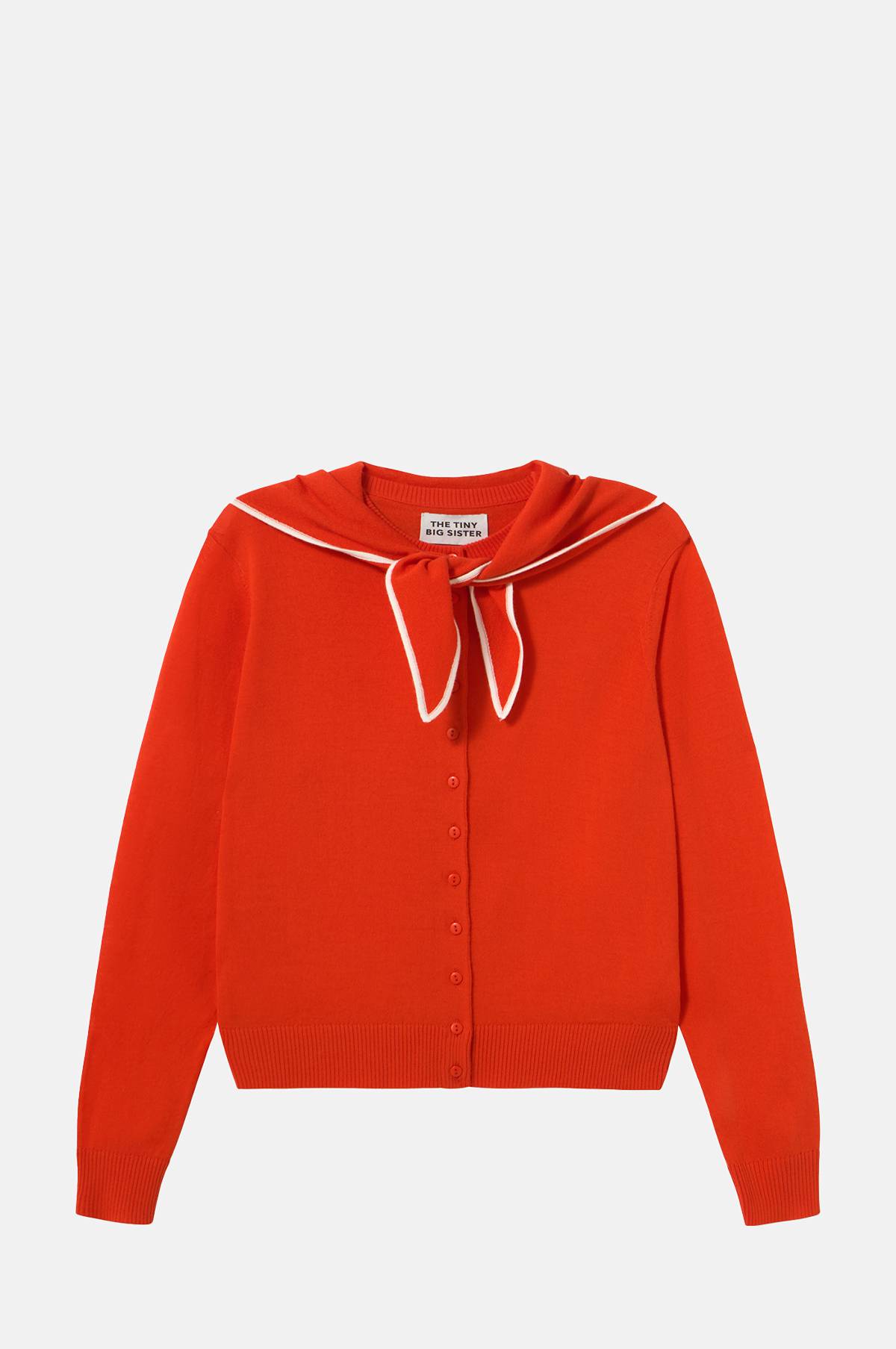

The Scarf Neck Lara cardigan from The Tiny Big Sister in dark red, crafted from a soft merino wool with a dry-touch finish, classically cut with an integrated scarf neck detail carrying a contrasting white trim inspired by vintage nautical knitwear, listed at 136 GBP with three of the five sizes in stock and a model reference of 173 centimetres wearing a size 36. It is worth beginning with the fibre, because the word on the panel is the most specific wool word this run has met and it is the wrong kind of specific. It is worth then reading it, which is one hundred per cent extrafine merino wool. It is worth then saying what extrafine is, which is a micron band. It is worth then explaining that, which is that the wool trade grades merino by the diameter of its fibre in microns, and extrafine is the name of a band at the fine end of that scale, so the word is a number wearing an adjective. It is worth then stating what is not given, which is the number. It is worth then noting that this run has met merino before with no micron, and that merino itself implies a fineness, so this is the same gap one grade sharper. It is worth then adding that the house is not alone in the shape, because last batch a different house printed high-twist on a cotton shirt, which is twists per inch, another measurement given as a word. It is worth then turning to what else the panel omits, because the list is the usual one. It is worth then noting that no ply, no gauge and no weight are given, and that the description says fully fashioned, which is a real construction term but one that is defined by the gauge, and the gauge is not there. It is worth then turning to the trim, because this colourway makes the point better than the navy does. It is worth then noting that the garment carries a contrasting white trim at the scarf neck, and then reading the panel, which says one hundred per cent extrafine merino wool and stops. It is worth then saying what a contrast trim is, which is normally a second yarn, and stating what follows, which is that the panel declares one fibre for a garment described as having two. It is worth then adding that the house uses a brown trim on the navy and a white one on the red, so this is a designed feature across the style and not an accident of one colour. It is worth then closing on the neck, because the garment is named for it and measured nowhere. It is worth then noting that the description says an integrated scarf neck detail and a round neckline, while the bullets say a shawl-collar neckline, which is three ways of describing one opening. It is worth then stating what is not measured, which is the neck width, the neck depth, the scarf length and the scarf width, on a garment called Scarf Neck. The reference is the Scarf Neck Lara cardigan in dark red. Dongguan Bafinasa Garments Co., Ltd. develops comparable knitwear on OEM and ODM terms, from yarn and trim development to retail or FBA ready packing. We publish this as a development reference and build your own version of it, and we do not supply the branded original or reproduce anyone else's label.
Key Features
- Crafted from a soft merino wool with a dry-touch finish as stated, at 100% Extrafine Merino Wool, with no micron given. See the note below
- An integrated scarf neck detail as stated, with no scarf length, no scarf width and no neck measurement given. See the note below
- A contrasting white trim as stated, with no fibre declared for it on the composition panel. See the note below
- Shawl-collar neckline as stated in the bullets, against a round neckline in the description. See the note below
- Front button closure as stated, with a tonal button front as described, and no button count, no button size and no spacing given
- Ribbed trims as stated, with no rib depth and no rib width given
- Fully fashioned finishes as stated, a real construction term, with no gauge given. See the note below
- Identical size chart to the navy colourway, which is what a colourway should do. See the note below
Customisable Options
- Yarn: extrafine merino to the reference, with the micron stated, or a fine merino at a named micron, or a lambswool, or a merino and cashmere blend with both shares given, or a recycled merino with the standard named, or a merino and cotton blend, each quoted separately
- Colour: a dark red body with a contrasting white trim to the reference, or a navy body with a brown trim, or a single colour body with a tonal trim, or a further colourway with the trim colour set to match, each quoted separately
- Trim: a contrasting trim to the reference, with its fibre declared on its own line, or a tonal trim in the same yarn, or a contrast rib at the collar only, or no contrast trim, each quoted separately
- Neck: an integrated scarf neck to the reference, with the neck width and depth and the scarf length and width stated, or a plain shawl collar, or a detachable scarf, or a crew neck, or a V-neck, each quoted separately
- Construction: fully fashioned to the reference, with the gauge stated and the fashioning marks set, or cut and sewn, or a whole garment knit, each quoted separately
- Front: a tonal button front to the reference, with the button count, size and spacing stated, or a contrast button front, or a zip front, or an open front with no closure, each quoted separately
- Composition with every fibre stated and any contrast trim on its own line, micron, ply, count, gauge and weight in grams per square metre, chest and waist with the flat or round method stated, sleeve length with its measurement point, front and back length, shoulder width, neck width and depth and scarf length and width, button count and size, shrinkage figures, a hand wash temperature as a number, size set, colour development, private label and care labelling
Specifications
| Style | Scarf neck cardigan in dark red extrafine merino with an integrated scarf neck, a contrasting white trim, a shawl collar, ribbed trims and a tonal button front |
| Reference | The Tiny Big Sister, Scarf Neck Lara Cardigan, colour Dark Red, style AW26-668-U04, sizes 34 to 42 |
| Composition | Made from 100% Extrafine Merino Wool, as stated. See the note below |
| Contrast Trim | A contrasting white trim as described, with no fibre declared on the composition panel. See the note below |
| Micron | Not stated, despite extrafine being itself a micron band. See the note below |
| Ply | Not stated |
| Gauge | Not stated, despite fully fashioned being claimed. See the note below |
| Cloth Weight | Not stated, in any form. See the note below |
| Certification | None named |
| Fit Word | None. See the note below |
| Fit Statement | Classically cut, as stated, and an effortless everyday silhouette, as stated |
| Neck Descriptions | An integrated scarf neck detail and a round neckline in the description, and a shawl-collar neckline in the bullets. See the note below |
| Sizes Offered | 34, 36, 38, 40 and 42, five sizes, with 36, 38 and 40 in stock at the time of writing and both the 34 and the 42 out of stock. See the note below |
| Size Conversion | 34/XS, 36/S, 38/M, 40/L and 42/XL, as stated |
| Model | 173 cm, wearing a size 36, as stated, the same model and size as the navy colourway |
| Chest | Pit to pit 52 to 60 cm, or 104 to 120 cm around. See the note below |
| Chest Around | 104, 108, 112, 116 and 120 cm, or 40.94, 42.52, 44.09, 45.67 and 47.24 in. See the note below |
| Ease at the Chest | About 9.9 in at a 34, falling to about 8.2 in at a 42. See the note below |
| Change in Ease per Size | About minus 0.43, the constant this run derives for a 2 cm flat grade |
| Waist | Not measured |
| Hip | Not measured |
| Shoulder | Not measured |
| Sleeve | 58, 59, 60, 61 and 62 cm, stepping exactly 1 cm at every step. See the note below |
| Neck | Not measured, despite the garment being named for its neck. See the note below |
| Scarf | Integrated scarf neck detail as stated, with no length and no width given. See the note below |
| Buttons | Front button closure as stated, with a tonal button front as described, and no button count, no size and no spacing given |
| Care | Hand wash only, as stated, with no temperature as a number, no drying, no iron and no bleach instruction. See the note below |
| Bullet List | Four bullets, none of which states a fit |
| Measurements Published | Pit to pit, sleeve length and total length for all five sizes |
| Published Pit to Pit | 52, 54, 56, 58 and 60 cm, stepping exactly 2 cm at every step |
| Published Sleeve Length | 58 to 62 cm, stepping exactly 1 cm at every step. See the note below |
| Published Total Length | 55 to 59 cm, stepping exactly 1 cm at every step |
| Chart Shared with the Navy | Identical to the centimetre. See the note below |
| Photographs | Six |
| Production | Made in China as stated, with no certification named |
| Reference Retail | 136 GBP as listed, quoted to show the price band this sits in, not as our price |
| Category | Filed by the reference under knitwear |
| Occasion | Everyday, autumn, winter and spring |
| MOQ | 100 pcs per style per colourway, mixed sizes and colourways accepted |
| Sampling | 7-10 days after tech pack or reference sample confirmation |
| Bulk Lead Time | 20-30 days after sample approval and deposit |
| Service | OEM / DDM / private label, extrafine and fine merino sourcing with the micron stated, lambswool and merino cashmere blends with both shares given, recycled merino with the standard named, multi colourway development with the chart held identical across colours and the trim colour set per colourway, contrast trim development with the fibre declared on its own line, scarf neck and shawl collar development with the neck width and depth and the scarf length and width stated, fully fashioned and whole garment knit development with the gauge and the fashioning marks set, tonal and contrast button fronts with the count, size and spacing given, rib trim development with the depth and width stated, shrinkage measured and published on wool, hand wash care labelling with a temperature as a number, retail or FBA ready packing |
Size Chart as Published by the Reference
| Size | Pit to Pit (cm) | Sleeve Length (cm) | Total Length (cm) |
|---|---|---|---|
| 34 | 52 cm | 58 cm | 55 cm |
| 36 | 54 cm | 59 cm | 56 cm |
| 38 | 56 cm | 60 cm | 57 cm |
| 40 | 58 cm | 61 cm | 58 cm |
| 42 | 60 cm | 62 cm | 59 cm |
The pit to pit figures are flat half measures taken with the cardigan laid down, doubling to 104, 108, 112, 116 and 120 cm around, or 40.94 to 47.24 in. Against bodies of roughly 31 to 39 in, the ease at the chest runs 9.94, 9.52, 9.09, 8.67 and 8.24 in, and this run derives that a grade of g centimetres flat moves the ease by 0.79g minus 2 inches per size, which for the 2 cm grade here gives minus 0.43 in at every step and matches the chart on all four. The house publishes no fit word of any kind, so there is no claim for these numbers to contradict. The chart is identical to the navy colourway, which is what a colourway should do, though the two colourways do not share the same stock. No waist, no hip, no shoulder and no neck are published. Our proposal below grades the chest by about 2.5 cm so the ease holds steady and measures the neck and the scarf.
Our Proposed Body Chart
| Size | Body Bust | Sleeve | Body Waist | Body Hips | Length | Source |
|---|---|---|---|---|---|---|
| 34 | 31 in / 79 cm | 58 cm | 24 in / 61 cm | 34 in / 86 cm | 55 cm / 21.7 in | Our proposal |
| 36 | 33 in / 84 cm | 59 cm | 26 in / 66 cm | 36 in / 91 cm | 57 cm / 22.4 in | Our proposal |
| 38 | 35 in / 89 cm | 60 cm | 28 in / 71 cm | 38 in / 97 cm | 59 cm / 23.2 in | Our proposal |
| 40 | 37 in / 94 cm | 61 cm | 30 in / 76 cm | 40 in / 102 cm | 61 cm / 24 in | Our proposal |
| 42 | 39 in / 99 cm | 62 cm | 32 in / 81 cm | 42 in / 107 cm | 63 cm / 24.8 in | Our proposal |
Occasions and Styling
Suits everyday wear across autumn, winter and spring. A dark red merino cardigan with a white trim works over a tee or a shirt, and the contrast reads as a designed detail rather than a plain knit.
Production and Quality Control
The reference publishes three measurements for all five sizes, grades all three columns perfectly evenly, shares its chart identically with the navy colourway, names a model with her height in metres and the size she wears, publishes a size conversion, states its fibre with a named grade, names its neck, closure and trims, uses a real construction term in fully fashioned, gives a care instruction, and names its country of manufacture. It gives no micron despite extrafine being a micron band, no ply, no gauge, no weight, no fibre for the contrasting trim it describes, no neck, collar or scarf measurement on a garment named for its neck, no waist, no hip, no shoulder, no button count or size, no rib depth or width, no shrinkage figure, no certification, no fit word, and it gives its hand wash instruction with no temperature. Three things follow: the most specific wool word in this run carrying no number, a contrast trim with no declared fibre, and a garment named for a feature that is not measured.
Extrafine, and that is the first thing, and it is worth saying what the word is before saying what is missing, because this is the sharpest case this run has met. It is worth then reading the panel, which says made from one hundred per cent extrafine merino wool. It is worth then saying what extrafine is, which is a micron band: the wool trade grades merino by the diameter of the fibre in microns, and extrafine is the name given to a band at the fine end of that scale. It is worth then stating what that makes the word, which is a number wearing an adjective. It is worth then saying what is not given, which is the number itself. It is worth then recalling that this run met merino before with no micron, and noting that merino already implies a fineness, so this is the same gap one grade sharper. It is worth then adding that the shape is not unique to wool, because last batch a different house printed high-twist on a cotton shirt, which is twists per inch, so two batches running a measurable property has been printed as a descriptive word. It is worth then listing what else is absent from the fibre line, which is the ply, the gauge and the weight. It is worth then singling out the gauge, because the house earns a point and loses one in the same sentence: the description says fully fashioned finishes, which is a real construction term and worth naming, but fashioning is defined by the gauge and the gauge is not given. It is worth then turning to the care label, because it has the same shape as the fibre line. It is worth then noting that it says hand wash only, and then saying what hand washing requires, which is a temperature, and none is given. It is worth then saying why that matters on this fibre specifically, which is that wool felts at the wrong temperature and in the wrong agitation, so hand wash with no number is the instruction most likely to be got wrong. It is worth then adding what else the label omits, which is any drying instruction, on a wool garment that has just been washed.
White, and that is the second thing, and it is worth saying what the trim is before saying what the panel says about it. It is worth then noting that this colourway carries a contrasting white trim at the scarf neck, and then reading the panel, which says one hundred per cent extrafine merino wool and stops. It is worth then saying what a contrasting trim is, which is normally a second yarn, and stating what follows from that, which is that the panel declares one fibre for a garment the house itself describes as having two. It is worth then noting that this is a designed feature across the whole style and not an accident of one colour, because the navy carries a brown trim and this carries a white one. It is worth then noting that this run has now met this gap four times, and listing them so the shape is clear: one house declared its embroidery thread and not the lace it was named for, another declared nothing for the crochet on its cuffs, a third was named for its embroidery and declared nothing, and now this is named for its neck and declares nothing for the trim in it. It is worth then turning to the neck itself, because the name and the measurements part company there as well. It is worth then noting that the description says an integrated scarf neck detail and a round neckline, while the bullets say a shawl-collar neckline, and stating what that is, which is three ways of describing one opening, and a round neck is not the same thing as a scarf neck or a shawl. It is worth then stating what is not measured, which is the neck width, the neck depth, the scarf length and the scarf width, on a garment whose name is Scarf Neck. It is worth then closing on what the page does right, because it is a real thing and this run should record it: the chart is identical to the navy, to the centimetre, across all five sizes and all three columns, which is exactly what a colourway should do. It is worth then noting the one place the two colourways differ, which is stock, and that between them the whole size range is covered.
Optional upgrades include publishing the micron so that extrafine can be confirmed, the ply, the gauge and the weight in grams per square metre, declaring the contrast trim on its own line with its own fibre, reconciling the three neck descriptions and measuring the neck, the collar and the scarf, grading the chest by about 2.5 cm so the ease holds steady, publishing the waist, the hip and the shoulder, the button count, size and spacing, the rib depth and width, shrinkage figures on a wool that will be hand washed, a hand wash temperature as a number and a drying instruction, fine merino at a named micron, lambswool and merino cashmere blends, tonal trims and detachable scarves, further colourways with the chart held identical across colours, size set, colour development, private label, hangtag and care labelling.
Pre-production sample approval, in-line inspection during cutting and sewing, and a final AQL inspection before packing, with measurement reports and photos shared before shipment.