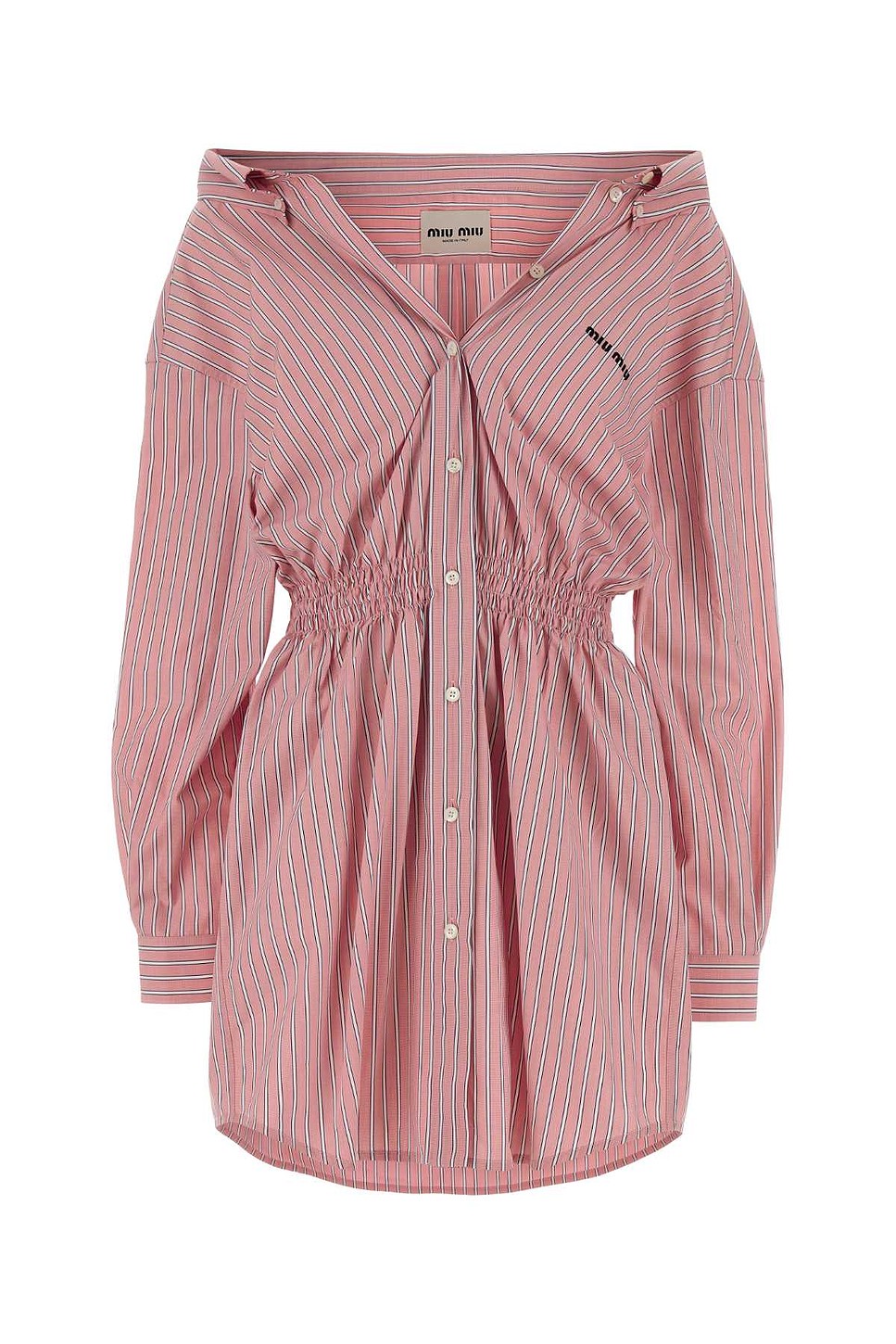
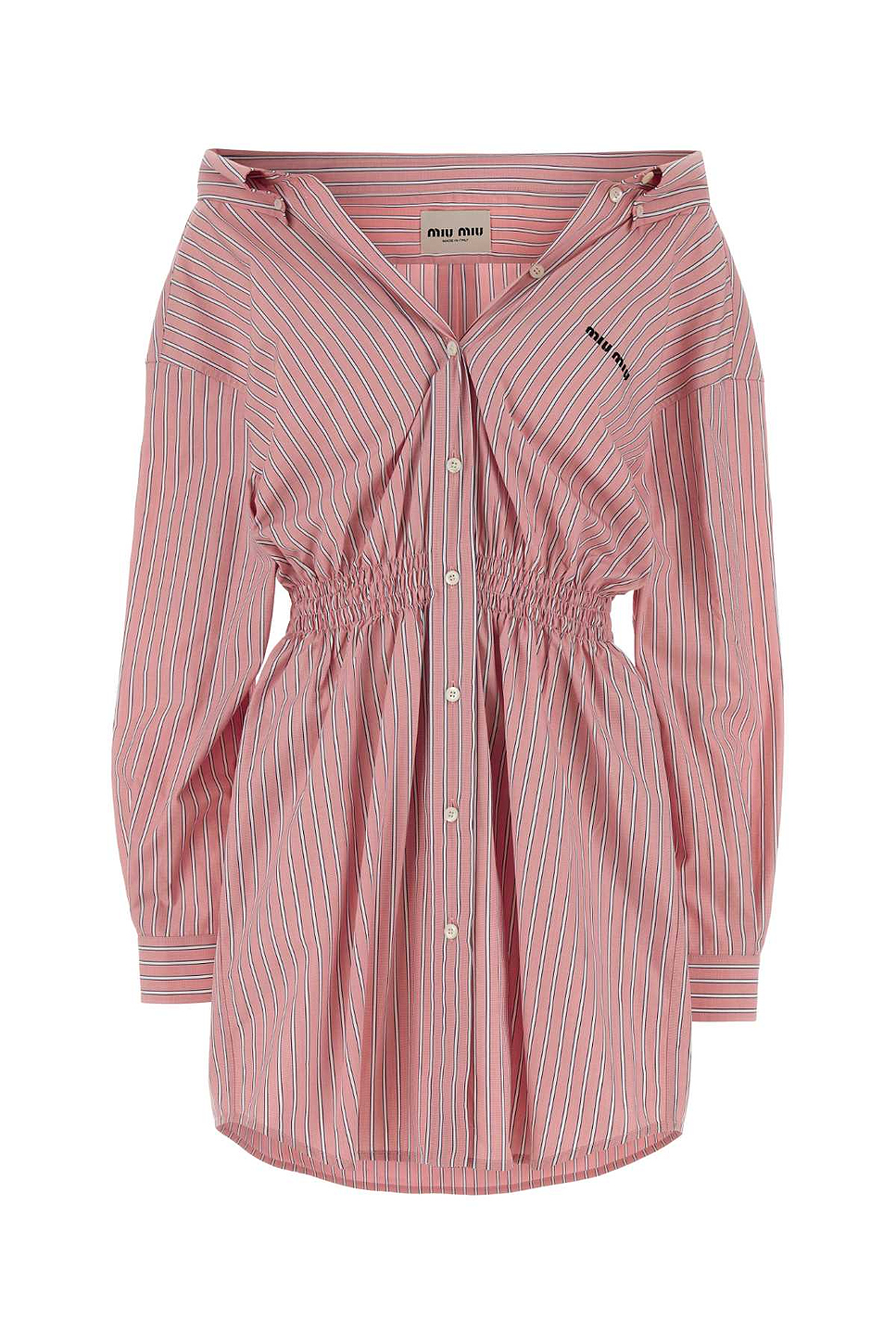
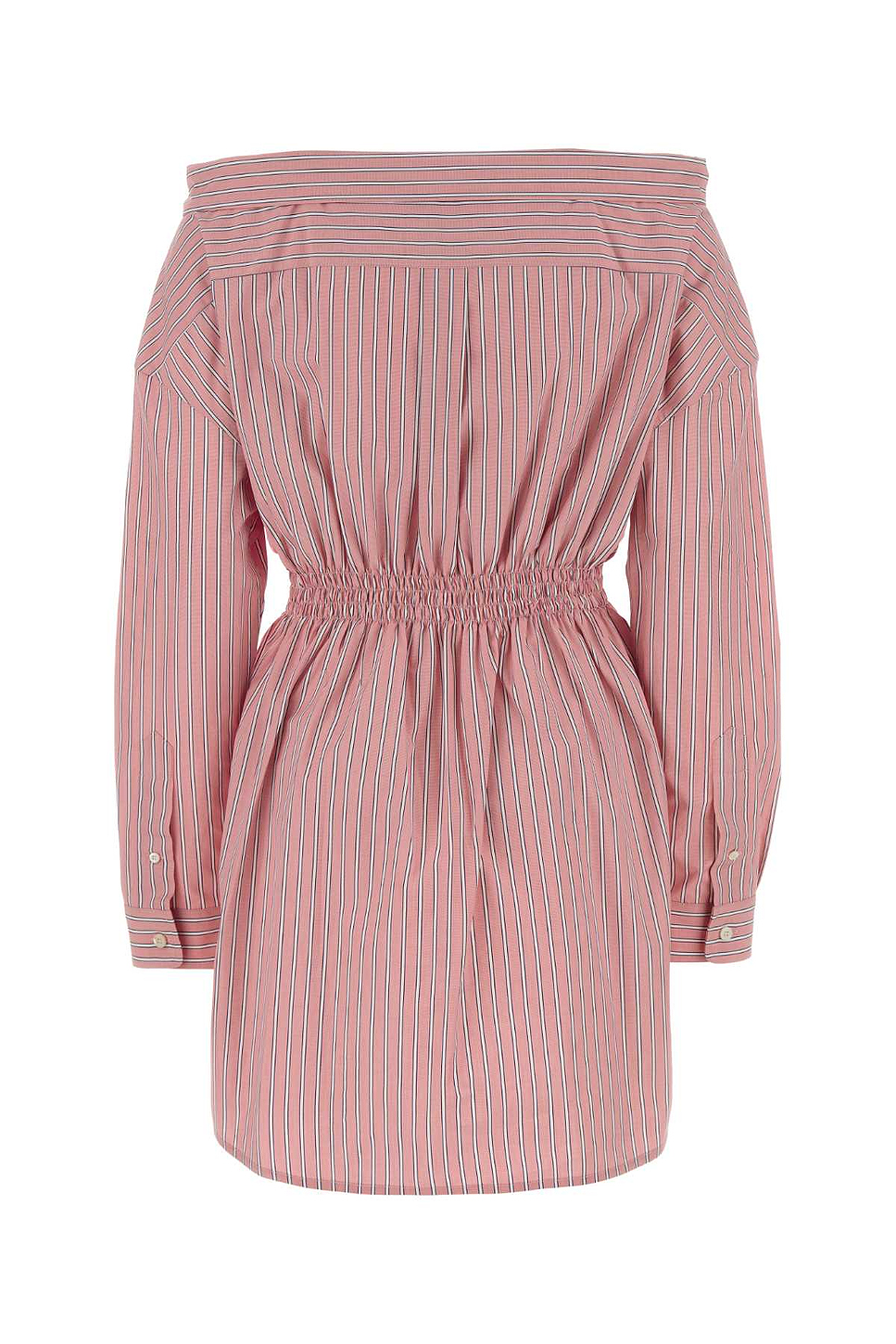
An embroidered shirt dress listed with a shell of 100% cotton, in a striped poplin, made in Italy, filed by the retailer under mini dresses, at 1,903 dollars. There are no reviews and no fit votes, so there is no score to quote. The whole product information is four lines: the composition, the country, and two stock numbers. There is no care instruction, no closure described, no size chart, no measurements, no length, and two photographs. Two observations make this one worth reading alongside the others rather than past it. One is that this is the third listing in this batch costing more than 1,900 dollars whose entire content is four lines. The other is how its size run compares with the two other short runs in this batch, since read together the three sharpen a rule this series has been using into something considerably more precise. The reference is the Miu Miu embroidered poplin shirt dress in Stripped. Dongguan Bafinasa Garments Co., Ltd. develops comparable shirt dresses on OEM and ODM terms, from fabric sourcing and embroidery development to retail or FBA ready packing. We publish this as a development reference and build your own version of it, and we do not supply the branded original or reproduce anyone else's label.
Key Features
- Shell: 100% cotton as stated
- Embroidered detail as stated in the product name
- Poplin fabric as stated in the product name rather than in a specification. See the note below
- Striped pattern
- Made in Italy as stated
- Three consecutive sizes published: 38, 40 and 42. See the note below
- No care instruction stated anywhere on the listing
- No size chart, no measurements and no model body figures published
Customisable Options
- Fabric: cotton poplin to the reference, with the weight and thread count set from a tested sample
- Embroidery: developed to your artwork or adapted, with stitch count and stability tested against the ground fabric
- Care: we would add one line, since embroidery changes what cotton can tolerate
- Construction: we would name the weave in a specification rather than leaving it in the title
- Length from mini to knee, embroidery placement, stripe scale, size set, colour development, private label and care labelling
Specifications
| Style | Embroidered poplin shirt dress |
| Reference | Miu Miu, embroidered poplin shirt dress, style FEXN-WD1808, manufacturer style MF6125SOOO180U F0028, colour Stripped |
| Shell | 100% cotton as stated |
| Second Layer | Not stated, though the composition is given as a shell |
| Detail | Embroidered, as stated in the product name. See the note below |
| Fabric | Poplin, as stated in the product name rather than in a specification. See the note below |
| Pattern | Striped |
| Care | None stated on the listing. See the note below |
| Sizes Published | 38, 40 and 42, which is three consecutive sizes. See the note below |
| Measurements | None published. No size chart and no model body figures on this listing |
| Photographs | Two |
| Production | Made in Italy as stated |
| Reference Retail | 1,903 USD, quoted to show the price band this sits in, not as our price |
| Customer Reviews | None on the reference listing, so we quote no score |
| Best Seller Badge | None. The listing carries no rank |
| Categories | Filed by the retailer under mini dresses, with no second category |
| Occasion | Daytime, city, warm weather, occasions |
| MOQ | 100 pcs per style per colourway, mixed sizes and colourways accepted |
| Sampling | 7-10 days after tech pack or reference sample confirmation |
| Bulk Lead Time | 20-30 days after sample approval and deposit |
| Service | OEM / ODM / private label, cotton poplin sourcing, embroidery development, retail or FBA ready packing |
Size Chart
| Size | Bust | Waist | Hips | Length | Source | ||||||||||||
|---|---|---|---|---|---|---|---|---|---|---|---|---|---|---|---|---|---|
| 36 | 31 | in / | 79 | cm | 24 | in / | 61 | cm | 34 | in / | 86 | cm | 88 | cm / | 34.6 | in | Our proposal |
| 38 | 33 | in / | 84 | cm | 26 | in / | 66 | cm | 36 | in / | 91 | cm | 90 | cm / | 35.4 | in | Our proposal |
| 40 | 35 | in / | 89 | cm | 28 | in / | 71 | cm | 38 | in / | 97 | cm | 92 | cm / | 36.2 | in | Our proposal |
| 42 | 37 | in / | 94 | cm | 30 | in / | 76 | cm | 40 | in / | 102 | cm | 94 | cm / | 37 | in | Our proposal |
This listing publishes no size chart, no measurements and no model body figures, and offers three consecutive sizes, 38, 40 and 42. There is nothing on the page from which a customer could judge the fit or the length.
Occasions and Styling
Suits daytime, city wear, warm weather and occasions. A striped cotton poplin shirt dress is a daytime piece, and it is worth knowing that poplin is a crisp plain weave, so this garment will hold its shape rather than drape softly.
Production and Quality Control
There are no reviews and no fit votes on this listing, so there is no score to quote. What makes it worth reading carefully rather than past is its place in a pattern of three, both in what it discloses and in the size run it offers.
This is the third listing in this batch costing over 1,900 dollars whose entire content is four lines, and at three the observation firm enough to lean on, and that is the first thing. The content here is the composition, the country, and two stock numbers. No care instruction, no closure, no measurements, no length, two photographs. This series has found this shape before at other prices: a vest style cotton piece at 1,470 dollars with nothing but fibre, country and stock numbers, a viscose blend at 1,026 with four lines, and very recently an acetate viscose shell at 1,142 with the same four, where it was noted that the product information amounted to little and that no instruction accompanied it. A remark has been repeated throughout, which is that how much a page discloses has no relationship at all to what the garment costs, and this batch supplies the strongest evidence yet for it, since three garments above 1,900 dollars disclose identically little while garments costing a sixth as much have published charts, stated opacity and full care guidance. The explanation offered before still holds and is worth restating here because the price makes it sharper. Everything else on a listing costs effort: photography requires a shoot, copy requires a writer, and a size chart requires somebody to measure a sample garment. A care instruction costs none of that. It requires only knowing what the cloth is and what was done to it, both of which are settled before the garment is finished. So its absence is not a resource limit. What is new in this instance is that a judgement can be made about what this specific garment needs, because the composition is known. Cotton is among the most washable fibres there is, and it gains strength when wet rather than losing it, so a plain cotton dress could reasonably be machine washed. But this garment is embroidered, and embroidery generally introduces threads that are not the same fibre as the ground fabric, along with backing materials that behave differently again, so the embroidered areas do not necessarily move with the cloth around them. This series set out that reasoning once already on a cotton applique piece correctly labelled dry clean only despite cotton being washable, and drew from it the general principle that a care instruction is set by the most fragile component and not by the fibre that predominates. So this garment plausibly needs a strict instruction, precisely because of the decoration, and it publishes none at all. That is worse than publishing the wrong one, which is a position stated several times in this series: a weak or wrong instruction at least tells the customer something, whereas silence invites her to decide the whole question herself, and before what reads as a simple striped cotton dress she will very probably settle on washing it.
The size run here is three consecutive sizes, and reading it against the other two short runs in this batch makes a rule sharper than it was, and that is the second thing. Three sizes are published, 38, 40 and 42, consecutive. This series built its reading of short runs from an earlier garment, concluding that a short run which is consecutive signals deliberate narrowness, needing something on the garment to make it work, while a run missing a size from its middle is not a range but what is left over. Applying that rule to one garment in isolation is weak, because there is nothing to compare against. This batch happens to provide three comparable cases at once, all short runs carried under the same retailer buyer store field, and that is unusuality useful. One offers 38 and 42, with a gap. Another offers 40 and 42, consecutive. This one offers 38, 40 and 42, consecutive across three sizes. So two of the three are consecutive and one is gapped, which is a genuine test of the distinction rather than a restatement of it. There is, however, a refinement in this that only appears when the three are set side by side, and stating it is the valuable part. Clearing remaining stock can easily leave two adjacent sizes, so a consecutive run of two is weak evidence in either direction, and it was accordingly noted elsewhere in this batch that a two size consecutive run must be treated as unproven. A consecutive run of three or more is much harder to explain by accident, since clearance rarely leaves exactly three in sequence. So this garment is the only one of the three whose short run can confidently be called deliberate rather than leftover, and that confidence comes not from anything on its page but from comparing it with two near neighbours. That is worth adopting as a practice rather than only as a conclusion: these readings get better when several garments are examined together than one at a time. It is also worth asking what makes a deliberate narrow run work on this particular garment, since some mechanism has to accommodate more than one body size. The answer is available and it is the cut rather than the fibre, since a shirt dress has generous ease built into it in order to be worn open at the front anyway, and there is no stretch fibre anywhere in the composition.
Two words in the product name carry information that belongs in a specification, and this is the second time in two batches, and that is the third thing. The garment is described in its title as an embroidered poplin shirt dress. Poplin is a plain weave with fine warp yarns packed closely and coarser weft yarns, which produces its characteristic fine horizontal rib and a crisp, smooth hand that holds shape rather than draping. That is real information, because it tells you something a composition cannot: two cotton cloths of identical fibre can behave quite differently according to how the yarns are arranged, and this series has more than once noted that words like crepe, satin and poplin describe arrangement rather than material. The problem is where it sits. A customer is expected to read it out of a product name and know what it means, and this series criticised exactly that recently when it found the word twill similarly confined to a title, noting that a single word should not be doing that much work, and before that found the word for knit buried in a French product title where only a French speaker could learn anything from it at all. The immediate comparison available is instructive, because another listing in this batch handled this well: there, voile appeared in the specification and the sheerness was stated in plain words beside it, so somebody who did not know the term still received the information. That was described as the ideal arrangement, and the point stands here. The remedy costs nothing: move poplin into a specification. There is a practical consequence for whoever might develop this, which is that thread count matters to embroidery on a ground fabric this smooth, since dense stitching into a crisp plain weave puckers unless it is stabilised, and this is one of those things better tested on a sample than discovered in production. The last point is about the word shell, which this series has been counting. It implies a second layer by using a relative term, and here again the second layer is not given. On a shirt dress that may well mean there is no lining at all, which would be entirely reasonable, but the word leaves the question hanging rather than answering it. Every bulk shipment gets a measurement report against your approved chart.
Optional upgrades include adding a care instruction, since embroidery plausibly sets what this cotton can tolerate, moving the word poplin from the title into a specification, stating whether there is a lining rather than leaving the word shell hanging, a size chart and model body measurements published, embroidery stabilised and tested for puckering against the ground fabric, the stripe scale specified, alternative poplin weights, alternative embroidery placements, alternative lengths, extended sizing, colour development and private label, hangtag and care labelling.
Pre-production sample approval, in-line inspection during cutting and sewing, and a final AQL inspection before packing, with measurement reports and photos shared before shipment.
Send us your tech pack, a photo or a reference garment and we will quote within 24 hours. Contact bafinasa@bafinasa.com or WhatsApp +86 13827222469.