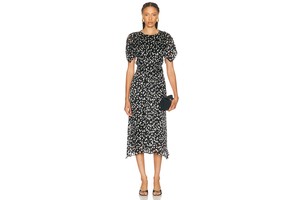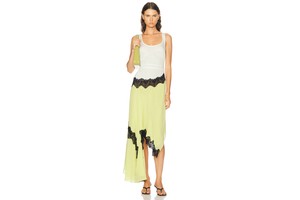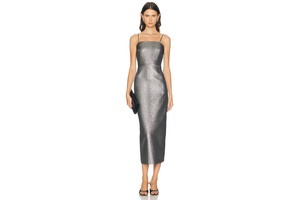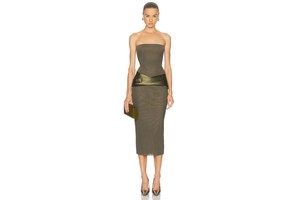
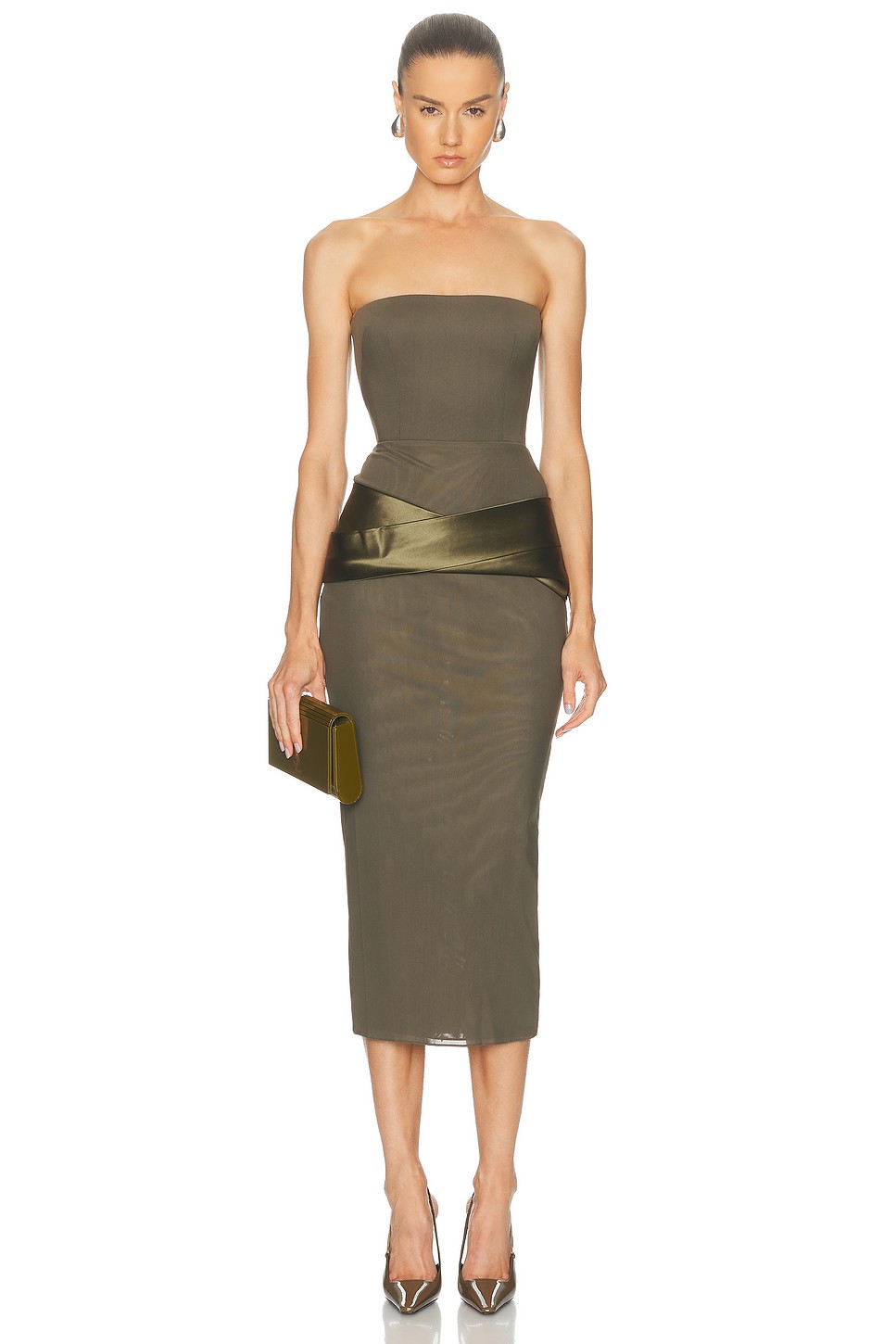
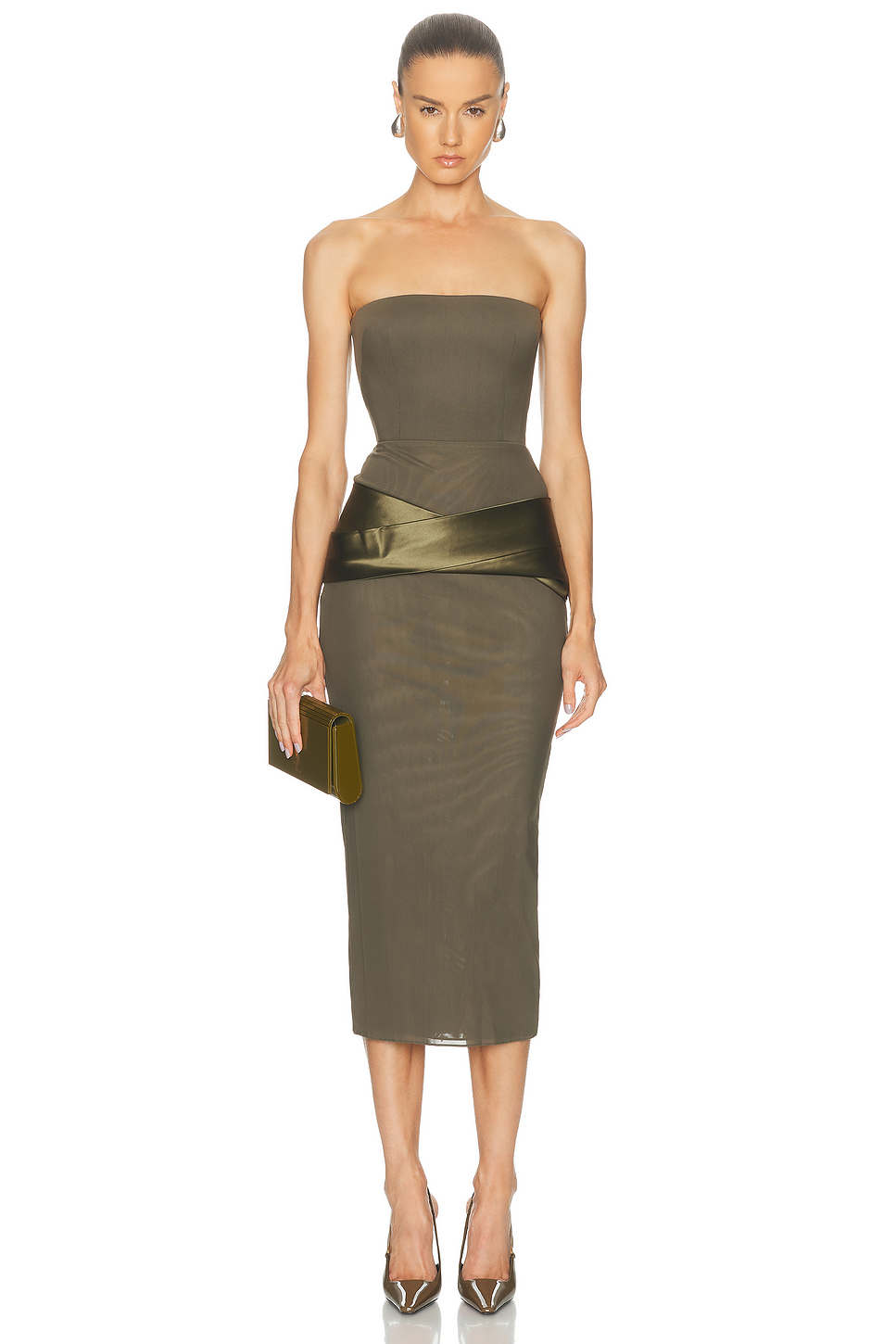
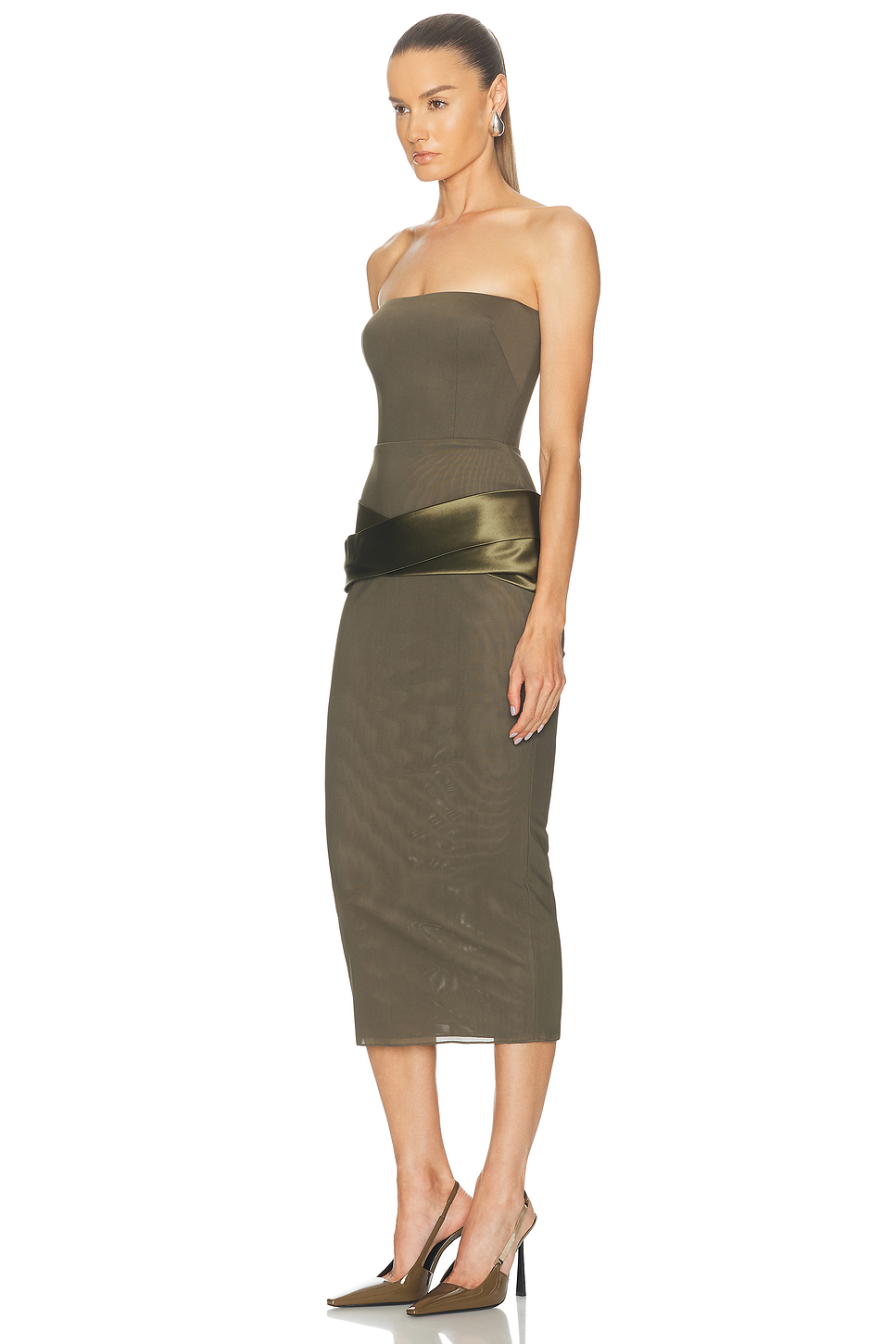
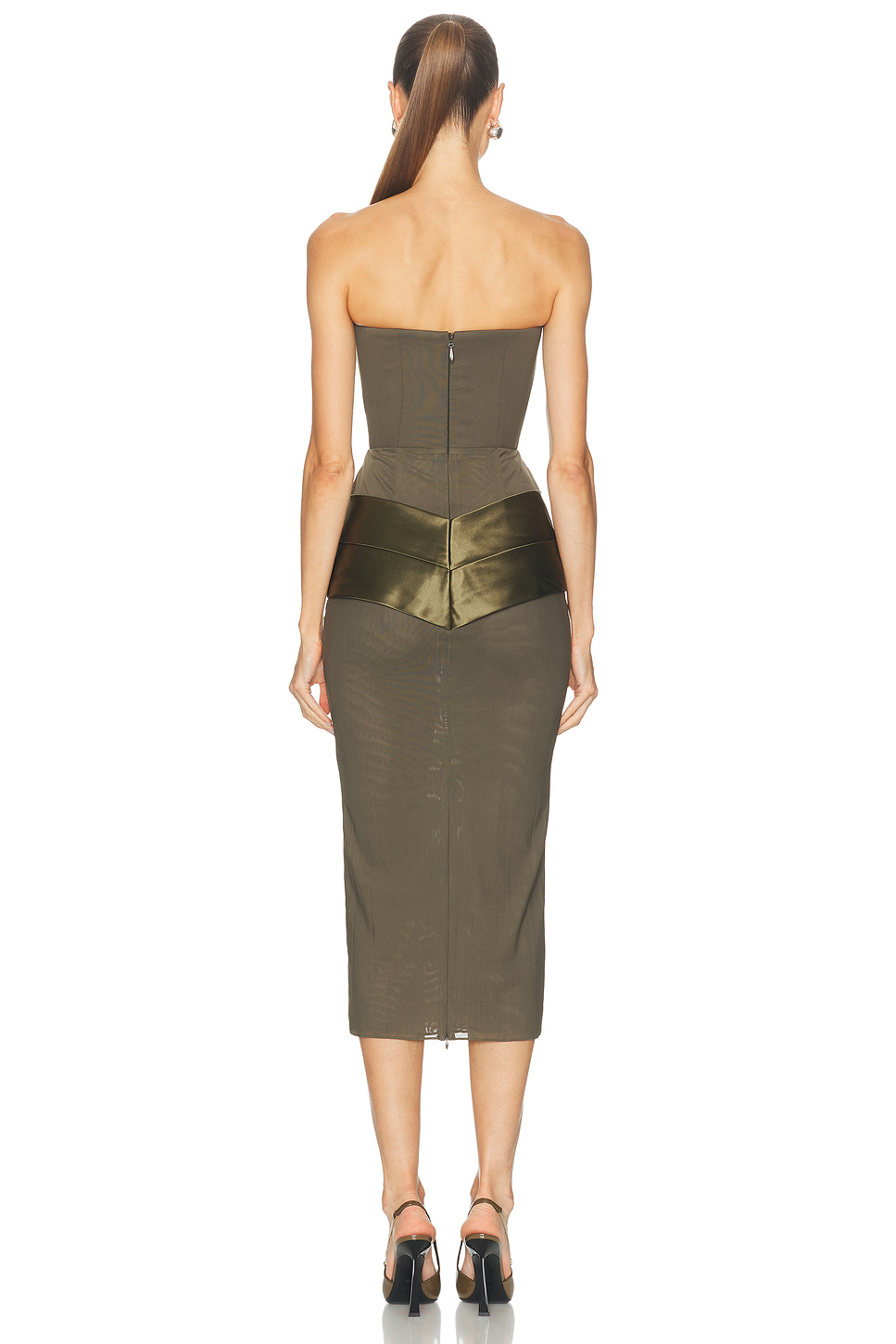
A strapless midi dress listed with a self fabric of 81% polyamide and 19% elastane and a contrast fabric of 70% cotton and 30% silk, partially lined, closed with a hidden zip at the back, in a midweight crepe with a satin waist tie, with a boned bodice lining, dry clean only, made in China, ranked fifty fourth in the retailer's bustier dress list, at 1,360 dollars. There are no reviews and no fit votes, so there is no score to quote. The measurements here show every circumference smaller than the body wearing it, and that pattern is worth reading carefully, because a strapless garment has no shoulder to hold it up and something has to replace that. There is also a second fabric here that does not behave like the first, and an instruction that is what makes that safe. The reference is the Strapless Satin Drape Dress by Alex Perry in Deep Sage. Dongguan Bafinasa Garments Co., Ltd. develops comparable strapless dresses on OEM and ODM terms, from fabric, boning and hardware sourcing to retail or FBA ready packing. We publish this as a development reference and build your own version of it, and we do not supply the branded original or reproduce anyone else's label.
Key Features
- Self: 81% polyamide, 19% elastane as stated
- Contrast: 70% cotton, 30% silk as stated
- Boned bodice lining as stated
- Midweight crepe fabric with satin waist tie as stated
- Hidden back zip closure as stated
- Partially lined as stated
- Dry clean only as stated
- Made in China as stated
Customisable Options
- Fabric: polyamide elastane crepe as the reference, with the weight set from a tested sample
- Boning: boned bodice as the reference, which is one of three ways a strapless garment stays up
- Contrast: cotton silk as the reference, with its own fibre properties respected
- Grip: we would add internal silicone tape, which the listing does not mention
- Length from knee to midi, boning layout, size set, colour development, private label and care labelling
Specifications
| Style | Strapless satin drape dress |
| Reference | Alex Perry, Strapless Satin Drape Dress, style APEF-WD343, manufacturer style D1690SS26, colour Deep Sage |
| Self | 81% polyamide, 19% elastane as stated. See the note below |
| Contrast | 70% cotton, 30% silk as stated, which does not behave like the self fabric. See the note below |
| Bodice | Boned bodice lining as stated, which is how a strapless garment is held up |
| Fabric | Midweight crepe with satin waist tie as stated |
| Closure | Hidden back zip as stated |
| Lining | Partially lined as stated |
| Care | Dry clean only as stated, which is what makes the two fabrics compatible |
| Sizes Published | US 0/UK 4, US 2/UK 6, US 4/UK 8, US 6/UK 10, US 8/UK 12 |
| Measurements Published | US 2/UK 6: bust 28 in, waist 22 in, hips 30 in, length 41.5 in |
| Chart Note | All three circumferences are smaller than the model, which is the pattern to read. See the note below |
| Chart Coverage | Only one of the five sizes has any measurements published |
| Model | 179 cm, wearing size US 2/UK 6, bust 34 in, waist 24 in, hips 34 in |
| Production | Made in China as stated |
| Reference Retail | 1,360 USD, quoted to show the price band this sits in, not as our price |
| Customer Reviews | None on the reference listing, so we quote no score |
| Best Seller Badge | Rank 54 in the retailer's bustier dress list, which is a mid position |
| Categories | Filed by the retailer under both midi dresses and strapless dresses |
| Occasion | Formal events, weddings, black tie, evenings |
| MOQ | 100 pcs per style per colourway, mixed sizes and colourways accepted |
| Sampling | 7-10 days after tech pack or reference sample confirmation |
| Bulk Lead Time | 20-30 days after sample approval and deposit |
| Service | OEM / ODM / private label, crepe sourcing, boning and corsetry, retail or FBA ready packing |
Size Chart
| Size | Bust | Waist | Hips | Length | Source | ||||||||||||
|---|---|---|---|---|---|---|---|---|---|---|---|---|---|---|---|---|---|
| US 2/UK 6 | 28 | in | 22 | in | 30 | in | 41.5 | in / | 105 | cm | As published | ||||||
| US 0/UK 4 | 31 | in / | 79 | cm | 24 | in / | 61 | cm | 34 | in / | 86 | cm | 103 | cm / | 40.6 | in | Our proposal |
| US 2/UK 6 | 33 | in / | 84 | cm | 26 | in / | 66 | cm | 36 | in / | 91 | cm | 105 | cm / | 41.3 | in | Our proposal |
| US 4/UK 8 | 35 | in / | 89 | cm | 28 | in / | 71 | cm | 38 | in / | 97 | cm | 107 | cm / | 42.1 | in | Our proposal |
| US 6/UK 10 | 37 | in / | 94 | cm | 30 | in / | 76 | cm | 40 | in / | 102 | cm | 109 | cm / | 42.9 | in | Our proposal |
| US 8/UK 12 | 39 | in / | 99 | cm | 32 | in / | 81 | cm | 42 | in / | 107 | cm | 111 | cm / | 43.7 | in | Our proposal |
The published size US 2/UK 6 gives a 28 inch bust, a 22 inch waist, a 30 inch hip and a 41.5 inch length against a model at 34, 24 and 34. Every circumference is smaller than the body wearing it, and by similar amounts, which points to compression rather than to a measuring difference. Only one of the five sizes has figures published.
Occasions and Styling
Suits formal events, weddings, black tie and evenings. A boned strapless midi in a deep green crepe is an occasion piece, and 41.5 inches on a model at 179 cm sits around the knee, which is worth stating since a strapless garment is chosen partly for how much it covers.
Production and Quality Control
There are no reviews and no fit votes on this listing, so there is no score to quote. There is a compression pattern here that is the cleanest positive example we have found, a strapless garment with two things holding it up, and a second fabric that behaves nothing like the first.
Every measurement is under the body, and that is compression, and it is worth showing why the pattern matters more than any single figure, and that is the first thing. The bust is 28 inches against a model at 34, the waist 22 against 24, and the hip 30 against 34. So the garment is six inches under at the bust, two under at the waist and four under at the hip. This series has built up a way of reading charts like this, and it rests on comparing rather than on reading one number. When every circumference sits below the body, by amounts that are broadly similar, that is compression, meaning something on the garment is squeezing it onto her. When only one measurement sits below and the ones beside it sit above, that points somewhere else entirely, which we found on a gathered sheath where a bust was four inches under while the waist was three over and the hip four over, and concluded there that the likeliest reading was not stretch at all but where the tape was put. That distinction is the useful part, because it decides whether the chart is telling you about the fabric or about whoever measured it. Here there is no ambiguity: the mechanism is stated on the page. Nineteen per cent elastane is second in this series only to the 23% on a pair of Colombian jersey dresses, and this series has been consistent that elastane below about five per cent is a recovery additive rather than something a fit is designed around, while levels approaching a fifth of the composition will genuinely compress a body. So the measurements and the composition agree with each other, which is more than many listings manage.
A strapless garment has nothing holding it up, and this one has two answers to that, and there is a third it does not mention, and that is the second thing. Every other garment in this series that covers the upper body either hangs from the shoulders, on straps, or grips the body in a band around the bust and chest. A strapless garment has neither, so there is nothing to stop gravity, and makers have arrived at three solutions. The first is compression: squeeze hard enough and friction does the work, which is what the 19% elastane here is doing. The second is structure: put bones in the bodice so the garment holds itself up and transfers the load down to the waist rather than relying on grip, and this listing states that the bodice lining is boned, which is the first time in this series a listing has said so plainly. The third is grip: a strip of silicone inside the top edge that sticks to the skin, so the garment cannot slide. This listing does not mention it, and that is the one piece of information a customer would most want, because it is the difference between an evening spent pulling the dress up and an evening spent not thinking about it. It is also worth saying that these three are not alternatives so much as layers, and this garment has two of them, which is a good answer. What the presence of boning tells you about the construction is worth knowing too. A boned bodice is built differently from an unboned one: the bones sit in channels, there is usually a firmer interlining behind them, and the whole assembly has to be engineered to sit still. This series has collected the other ways a bodice is supported, which are a stiff cloth, boning, a wire underneath, pleating, which works by having more cloth than the body needs, and shirring, which works by tension. Boning is the most structural of those and adds the most to cost, and unlike pleating or gathering it cannot be faked by a drape.
The contrast fabric behaves nothing like the self fabric, and one instruction is what makes that safe, and that is the third thing. The self fabric is polyamide with elastane, which does not shrink, dries fast, resists creasing and can be washed. The contrast fabric is cotton and silk, and both of those move in water: cotton shrinks unless it has been pre shrunk, and silk is a protein fibre that is marked by water and dulled by alkali and heat. So the two parts of this garment would respond completely differently to being washed, and the consequence of combining them is the one this series has described repeatedly, which is that when a shell and the layer or panel next to it shrink by different amounts, something has to give, and what gives is either a pucker along every seam or a panel that bubbles loose inside the garment. There is a rule this series settled on early, which is that a garment's care instruction is set by its most fragile component and not by its predominant fibre. Used here, the instruction has to follow the cotton and silk rather than the polyamide, and the page says dry clean only, which is correct. It is worth being clear about how much work that single line is doing. Dry cleaning shrinks nothing, so the mismatch between the two fabrics becomes inert: it is safe not because the fabrics are compatible but because nothing ever happens to them. This is the same reasoning we used on a silk and acetate midi whose polyester lining did not match its shell, and where we said the mismatch was only viable while the instruction held. The contrary case is instructive: on a Diesel mini we found wool in the shell over a polyester lining with no care instruction at all, and said there that the missing line was not an inconvenience but a switch, because it decided whether both faults were live at once. This listing has the switch set the right way. The last thing worth naming is smaller but practical: five sizes are offered, and only one of them has measurements published, so a wide size range does not by itself tell a customer what she needs. Every bulk shipment gets a measurement report against your approved chart.
Optional upgrades include internal silicone tape at the top edge, which does more for confidence than any other single addition and costs very little, the boning kept and its layout specified, dry clean only kept because it is what reconciles the two fabrics, measurements published for every size rather than one, the contrast fabric identified as to which part of the garment it is, alternative crepe weights, alternative boning layouts, alternative lengths, extended sizing, colour development and private label, hangtag and care labelling.
Pre-production sample approval, in-line inspection during cutting and sewing, and a final AQL inspection before packing, with measurement reports and photos shared before shipment.
Send us your tech pack, a photo or a reference garment and we will quote within 24 hours. Contact bafinasa@bafinasa.com or WhatsApp +86 13827222469.