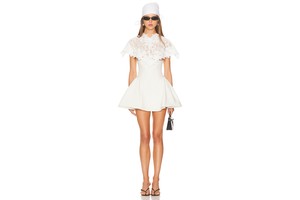
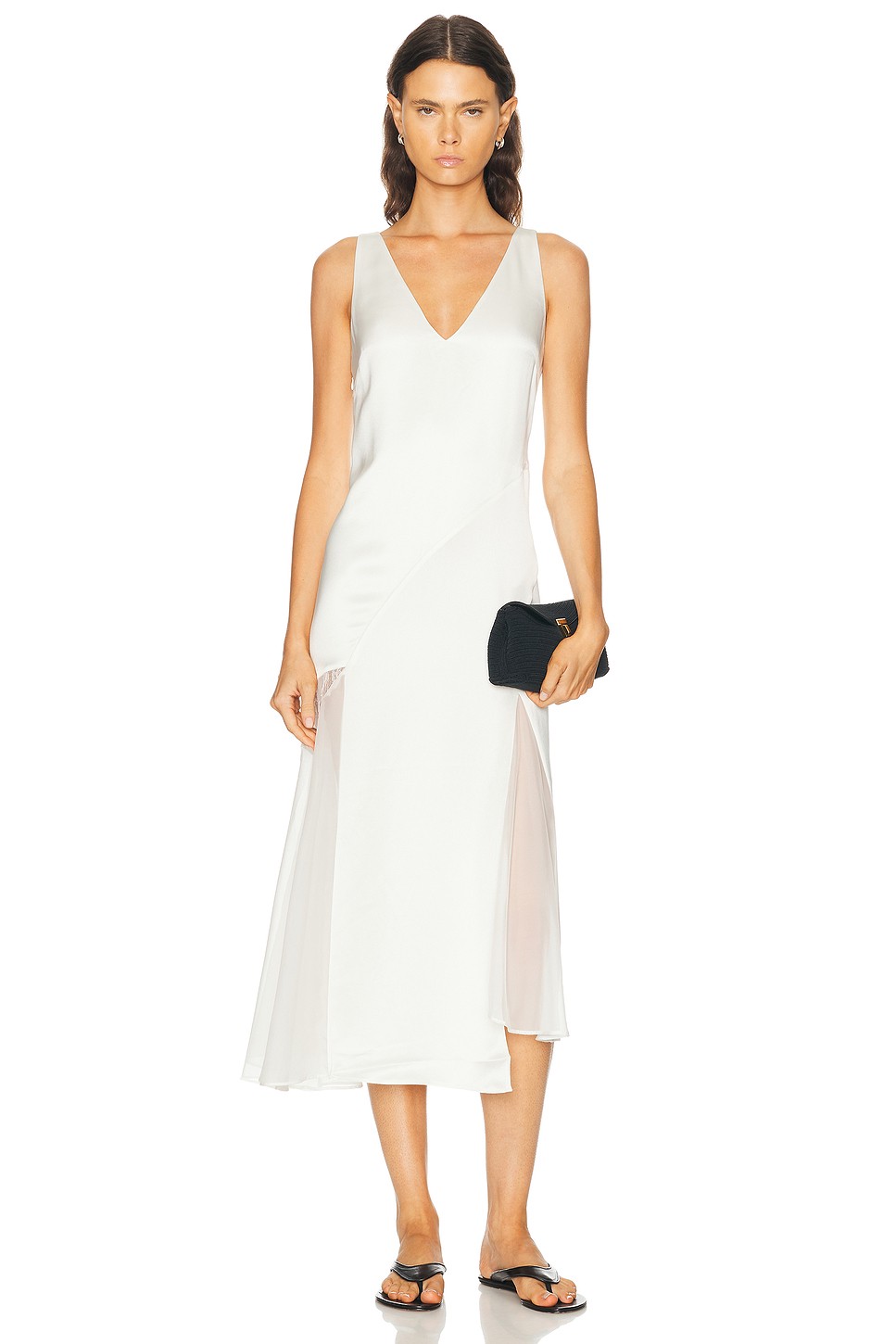
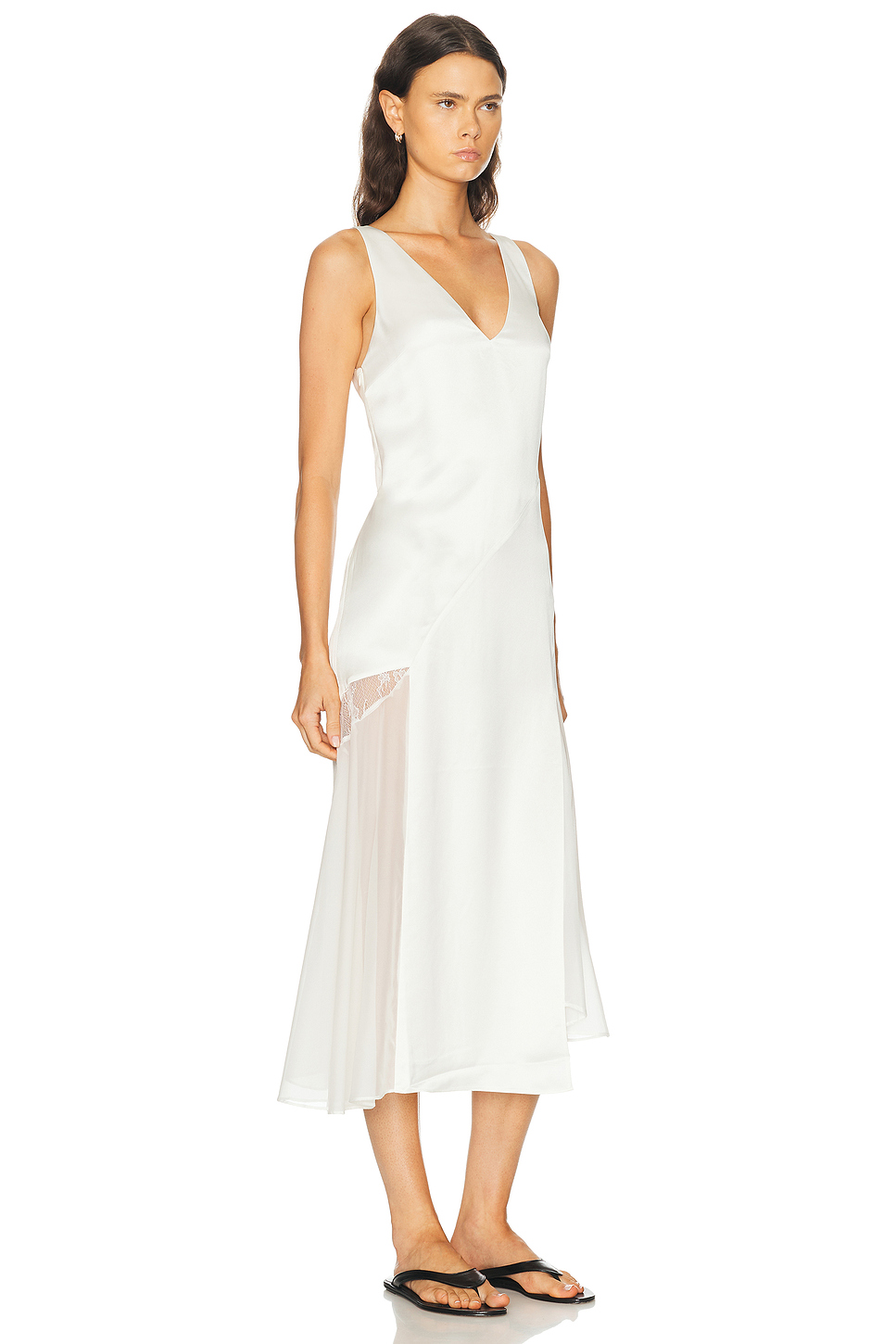
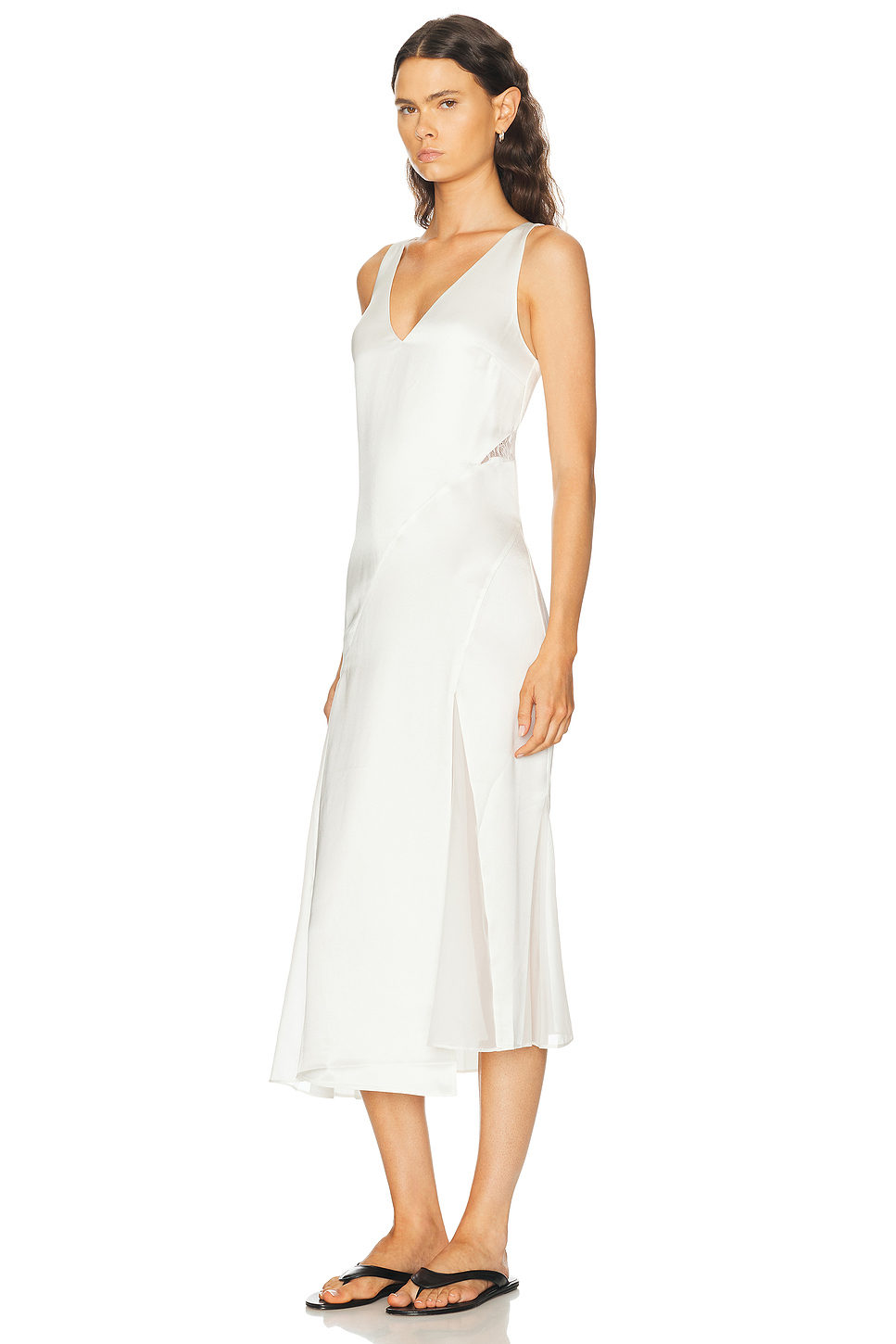
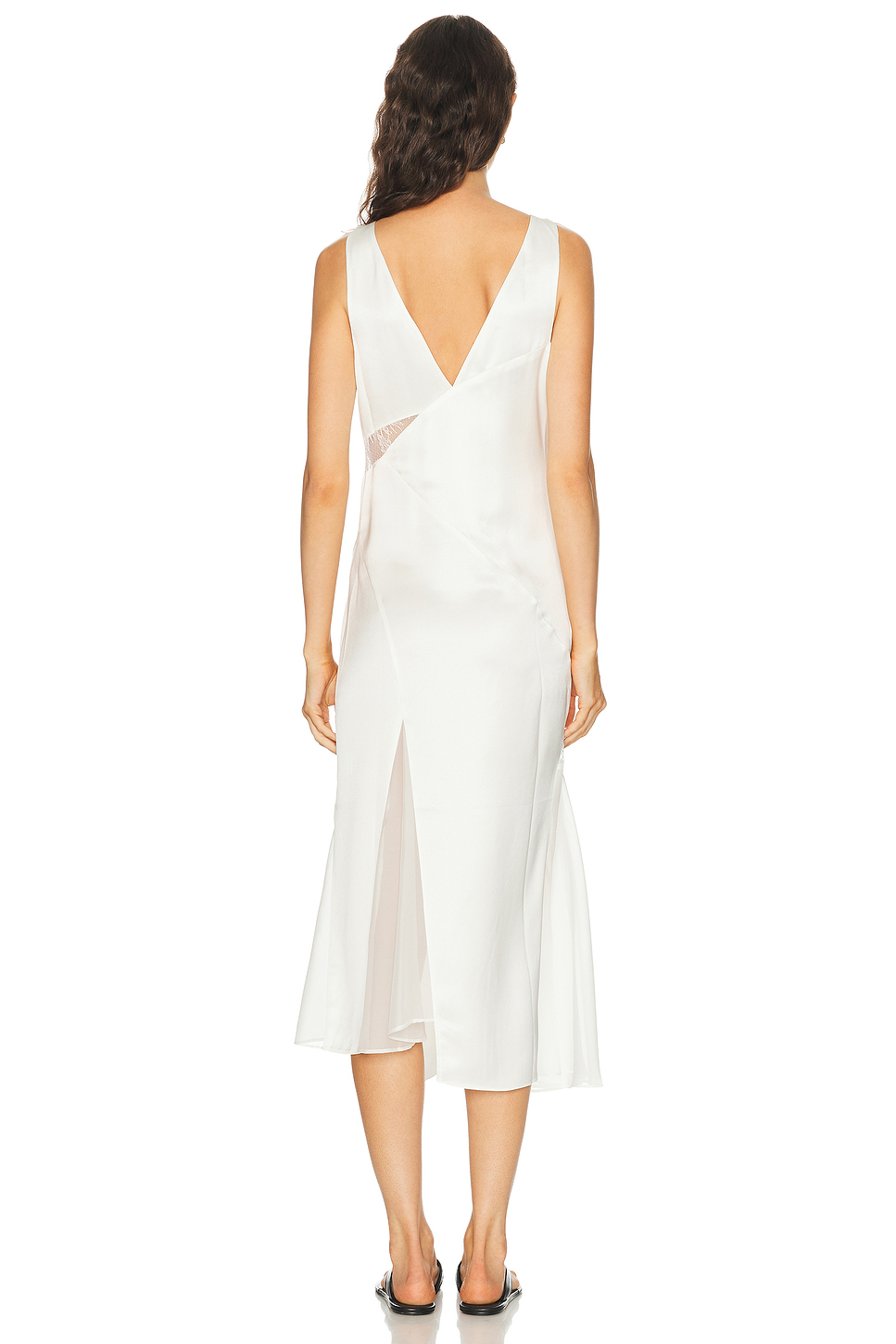
A midi dress listed as 83% acetate and 17% polyester for the shell, with a lining and trim in 100% polyester and a contrast fabric in 100% nylon, fully lined, closed with a hidden back zip and a hook and eye, in a lightweight satin and chiffon fabric, dry clean only, made in China, ranked fourteenth in the retailer's white dress list, at 560 dollars. There are no reviews and no fit votes, so there is no score to quote. This listing uses three different fibres across three parts of one garment, which is worth examining because it is either deliberate or careless and the two have very different consequences. There is also a fibre here that this series has not met before, and it behaves in a way that surprises people. The reference is the Ingrid Lace Midi Dress by SIR. in Ivory. Dongguan Bafinasa Garments Co., Ltd. develops comparable occasion dresses on OEM and ODM terms, from fabric and trim sourcing to retail or FBA ready packing. We publish this as a development reference and build your own version of it, and we do not supply the branded original or reproduce anyone else's label.
Key Features
- Shell: 83% acetate, 17% polyester as stated
- Lining and trim: 100% polyester as stated
- Contrast fabric: 100% nylon as stated
- Lightweight satin and chiffon fabric as stated
- Hidden back zip with hook and eye closure as stated
- Fully lined as stated
- Dry clean only as stated
- Made in China as stated
Customisable Options
- Fabric: acetate polyester satin as the reference, with the weight set from a tested sample
- Care: dry clean only as stated, which is correct here and should not be weakened
- Contrast: we would establish what the nylon part is, since it is the third fibre and none is described
- Lining: we would confirm the arrangement given the shell acetate content
- Length from midi to maxi, lace placement, size set, colour development, private label and care labelling
Specifications
| Style | Ingrid acetate lace midi |
| Reference | SIR., Ingrid Lace Midi Dress, style SIF-WD243, manufacturer style SIR226-1008, colour Ivory |
| Shell | 83% acetate, 17% polyester as stated. See the note below |
| Lining and Trim | 100% polyester as stated |
| Contrast | 100% nylon as stated, with no indication of where it is used |
| Fabric | Lightweight satin and chiffon as stated |
| Closure | Hidden back zip with hook and eye closure as stated |
| Lining | Fully lined as stated |
| Care | Dry clean only as stated, which is correct and matters here. See the note below |
| Sizes Published | 0/XS, 1/S, 2/M, 3/L |
| Measurements Published | 1/S: bust 33 in, waist 29 in, hips 40 in, length 50.5 in |
| Chart Note | Bust one inch under the model, waist five over, hip six over, which is ordinary for this kind of garment |
| Model | 182 cm, wearing size 1/S, bust 86 cm, waist 58 cm, hips 91 cm |
| Production | Made in China as stated |
| Reference Retail | 560 USD, quoted to show the price band this sits in, not as our price |
| Customer Reviews | None on the reference listing, so we quote no score |
| Best Seller Badge | Rank 14 in the retailer's white dress list, which is a mid position |
| Categories | Filed by the retailer under both white dresses and midi dresses |
| Occasion | Weddings, formal events, evenings, occasions |
| MOQ | 100 pcs per style per colourway, mixed sizes and colourways accepted |
| Sampling | 7-10 days after tech pack or reference sample confirmation |
| Bulk Lead Time | 20-30 days after sample approval and deposit |
| Service | OEM / ODM / private label, acetate sourcing, satin and chiffon development, retail or FBA ready packing |
Size Chart
| Size | Bust | Waist | Hips | Length | Source | ||||||||||||
|---|---|---|---|---|---|---|---|---|---|---|---|---|---|---|---|---|---|
| 1/S | 33 | in | 29 | in | 40 | in | 50.5 | in / | 128 | cm | As published | ||||||
| 0/XS | 31 | in / | 79 | cm | 24 | in / | 61 | cm | 34 | in / | 86 | cm | 126 | cm / | 49.6 | in | Our proposal |
| 1/S | 33 | in / | 84 | cm | 26 | in / | 66 | cm | 36 | in / | 91 | cm | 128 | cm / | 50.4 | in | Our proposal |
| 2/M | 35 | in / | 89 | cm | 28 | in / | 71 | cm | 38 | in / | 97 | cm | 130 | cm / | 51.2 | in | Our proposal |
| 3/L | 37 | in / | 94 | cm | 30 | in / | 76 | cm | 40 | in / | 102 | cm | 132 | cm / | 52 | in | Our proposal |
The published size 1/S gives a 33 inch bust, a 29 inch waist, a 40 inch hip and a 50.5 inch length against a model at roughly 34, 23 and 36. The bust is about one inch under and the waist and hip are over, which is ordinary for a lined occasion dress and needs no mechanism to explain.
Occasions and Styling
Suits weddings, formal events, evenings and occasions. An ivory satin and chiffon midi is an occasion piece rather than a day dress, and it is worth saying that dry clean only is a real cost of ownership for a garment at this level of formality.
Production and Quality Control
There are no reviews and no fit votes on this listing, so there is no score to quote. There is a fibre here that this series has not met and which behaves in a way people do not expect, three different fibres used across one garment, and a care instruction that is right and should stay exactly as it is.
Acetate is the reason this says dry clean only, and the failure it has is unusual, and that is the first thing. This is the first acetate in this series, and it is worth setting out what it does, because the failure is not the one people expect. Most fibres that need care fail by shrinking or by losing strength. Wool felts and shrinks permanently when it is wet, warm and agitated together. Viscose loses about half its strength when wet and distorts under its own weight while being handled. Acetate does neither of those. It can shrink somewhat, but its characteristic problem is that water makes it go stiff and then lose its sheen, and it can also develop water marks that do not come out, because the surface is not uniformly absorbent and the marks are a change in how the surface reflects light rather than a stain. On a satin that is decisive, because satin's whole effect is its lustre, which comes from long floats of yarn lying flat and reflecting light in one direction. Dull that and the fabric stops being satin. So dry clean only here is not caution, it is the instruction that keeps the garment looking like what it is. It is worth adding that this series has argued repeatedly that a care instruction is set by the most fragile component rather than by the predominant fibre, and used that to explain why a cotton twill mini with applique was correctly dry clean only despite being cotton. Here the principle lands on the main cloth rather than on a trim, which makes the instruction even more clearly right. The 17% polyester in the shell does not change that, since a minority fibre rarely rescues a majority one.
Three fibres in one garment is either deliberate or careless, and this page does not say which, and that is the second thing. The shell is acetate and polyester, the lining and trim are polyester, and there is a contrast fabric in nylon, with nothing on the page indicating where the contrast is used or what it does. Using different fibres in different places is normal and often correct: a lining may be chosen for slip, a trim for stability, a contrast for a different surface. But each choice is a decision, and a decision should be visible, because each fibre brings its own behaviour in washing, in pressing and in wear. This series has returned to one particular version of this repeatedly, which is the relationship between a shell and its lining, and the rule settled on is that they should be in the same fibre, because two layers of the same fibre shrink by the same amount and stay in relation to each other, whereas two layers that shrink differently will pucker or bubble after washing. Here the shell is predominantly acetate and the lining is polyester, so the rule is broken, and the question is whether it matters. It does not, and the reason is instructive: dry cleaning shrinks nothing, so a mismatch in shrinkage is inert under the stated care. This is the point we made on a velvet maxi whose viscose and silk shell sat over a polyester lining, where we said the instruction was what made the mismatch viable. The mismatch is only safe while the instruction holds. If anyone ever relabels this machine washable, both problems arrive at once: the acetate dulls and the two layers move apart. So the three-fibre arrangement here is defensible, and the thing missing is not the arrangement but any explanation of it.
The fastening is two-step and behind her, and the chart needs no explaining, and that is the third thing. The closure is a hidden back zip with a hook and eye. This series has spent a long stretch on fastenings behind the wearer and the order of difficulty runs from a back zip, which can be managed alone, through a button behind the back, which has to be aligned where it cannot be seen, and a tie that has to be knotted, to a hook at the back of the neck, which is hardest of all because the position is both invisible and awkward. We found a wool dress with three fastenings all at the back and said the honest thing, which is that occasion dress is often easier to get into with help and that this is not a defect. This garment has two: the hook and eye at the top and the zip below it. That is the conventional arrangement rather than an unreasonable one, and the hook is there for a reason, which is that it takes the strain off the top of the zip, since a zip closed to the very top of a fitted bodice is under tension every time the wearer moves and is the commonest thing to fail. So the hook is doing protective work. The one improvement worth naming is that a hook and eye has to be aligned by feel, and this series has noted before that a slider or a similar fastening that needs no alignment is easier, though it would change the look of the back. On the chart, the figures are unremarkable and that is worth saying: the bust is about an inch under the model and the waist and hip are five and six inches over. Nothing here needs a mechanism to explain it, which is a contrast with the eleven inches of compression we found on a 23% elastane jersey, or the four inches under with no stretch fibre at all that we found on a recycled polyester dress and concluded was probably a measurement taken in the wrong place. Every bulk shipment gets a measurement report against your approved chart.
Optional upgrades include dry clean only kept and not weakened, since acetate loses its sheen in water and the lining does not match, the contrast fabric identified on the page with what it is for, the hook and eye kept as protection for the top of the zip, alternative acetate blends if washability is wanted, alternative satin weights, alternative lace placements, alternative lengths, extended sizing, colour development and private label, hangtag and care labelling.
Pre-production sample approval, in-line inspection during cutting and sewing, and a final AQL inspection before packing, with measurement reports and photos shared before shipment.
Send us your tech pack, a photo or a reference garment and we will quote within 24 hours. Contact bafinasa@bafinasa.com or WhatsApp +86 13827222469.