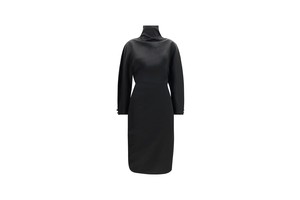
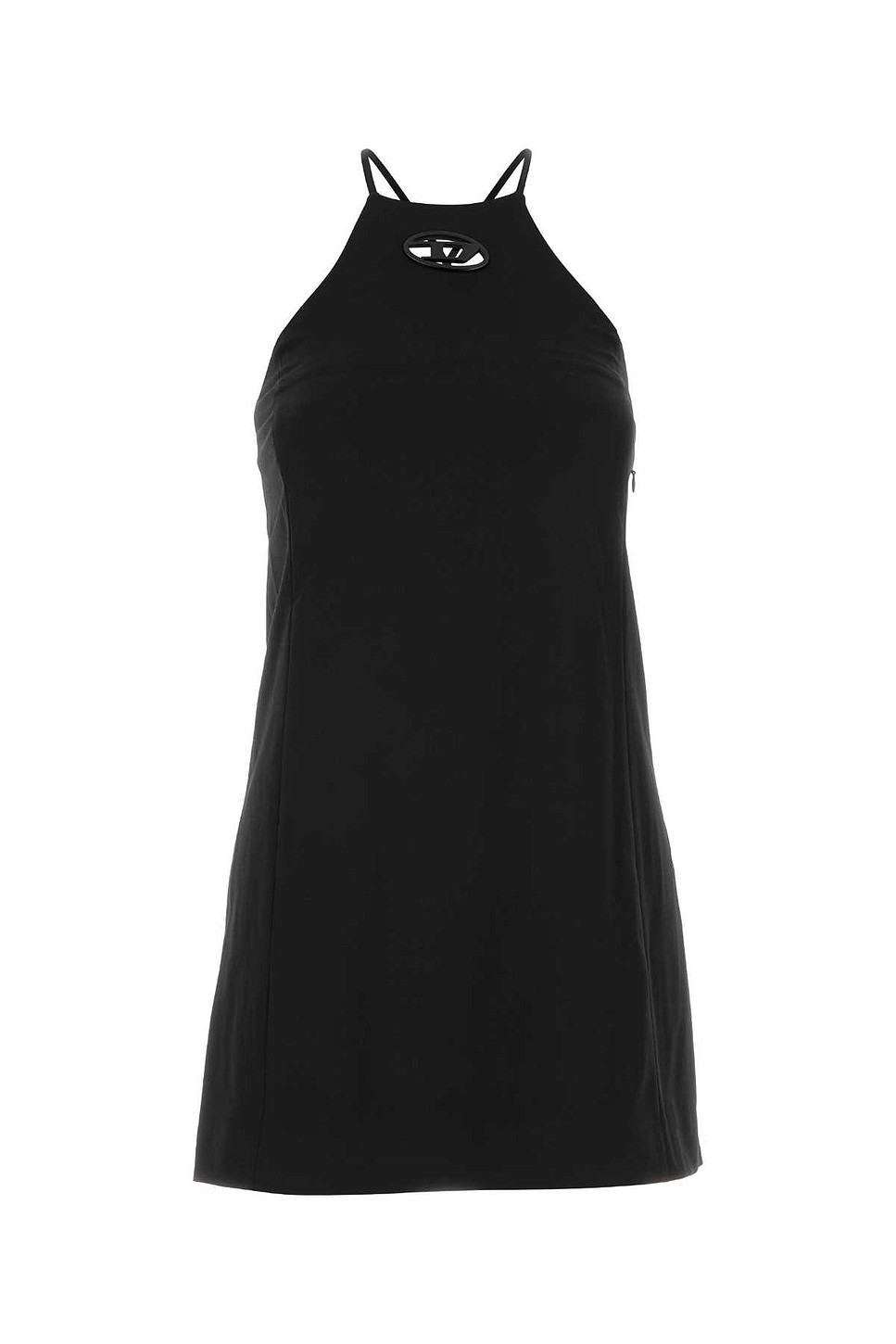
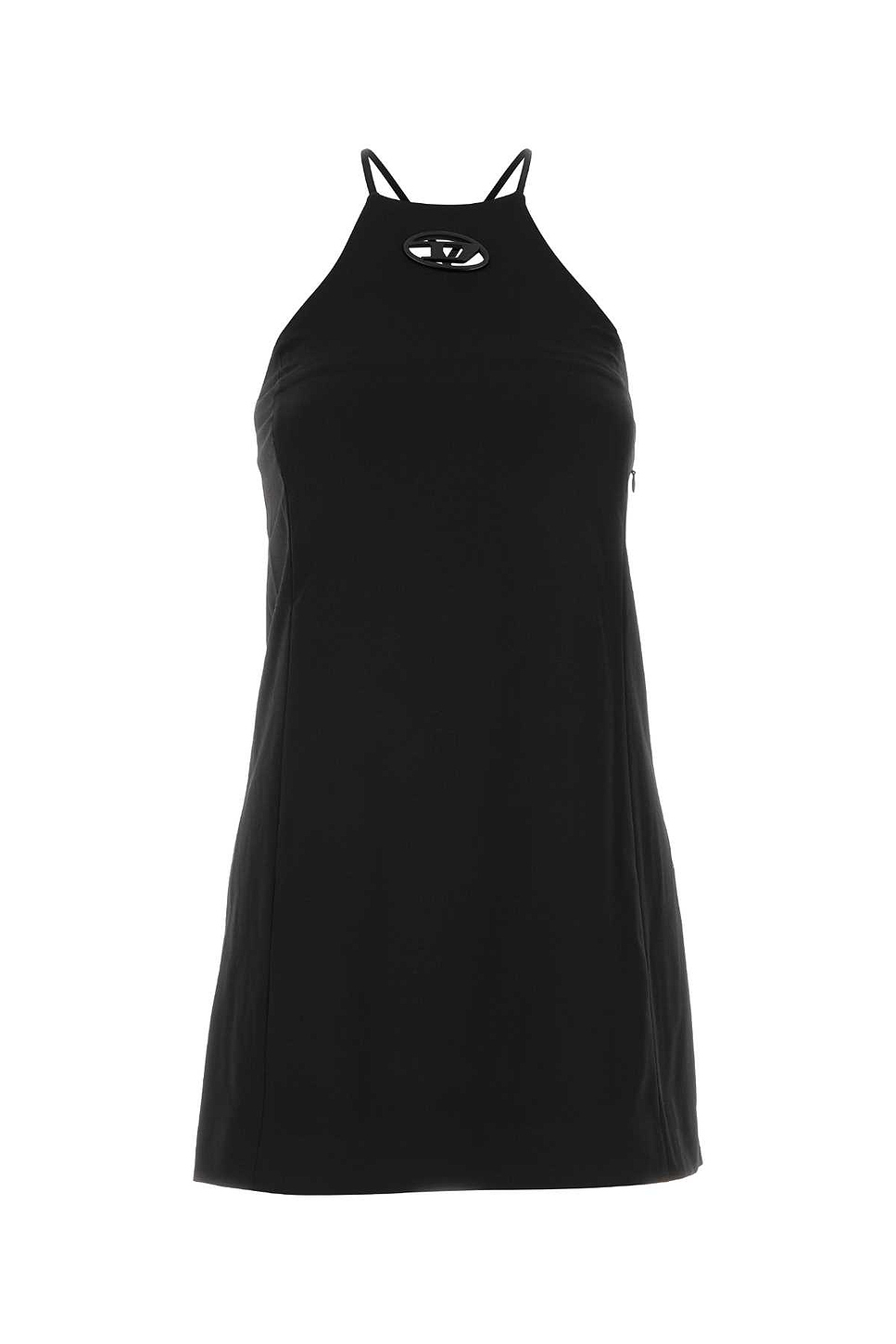
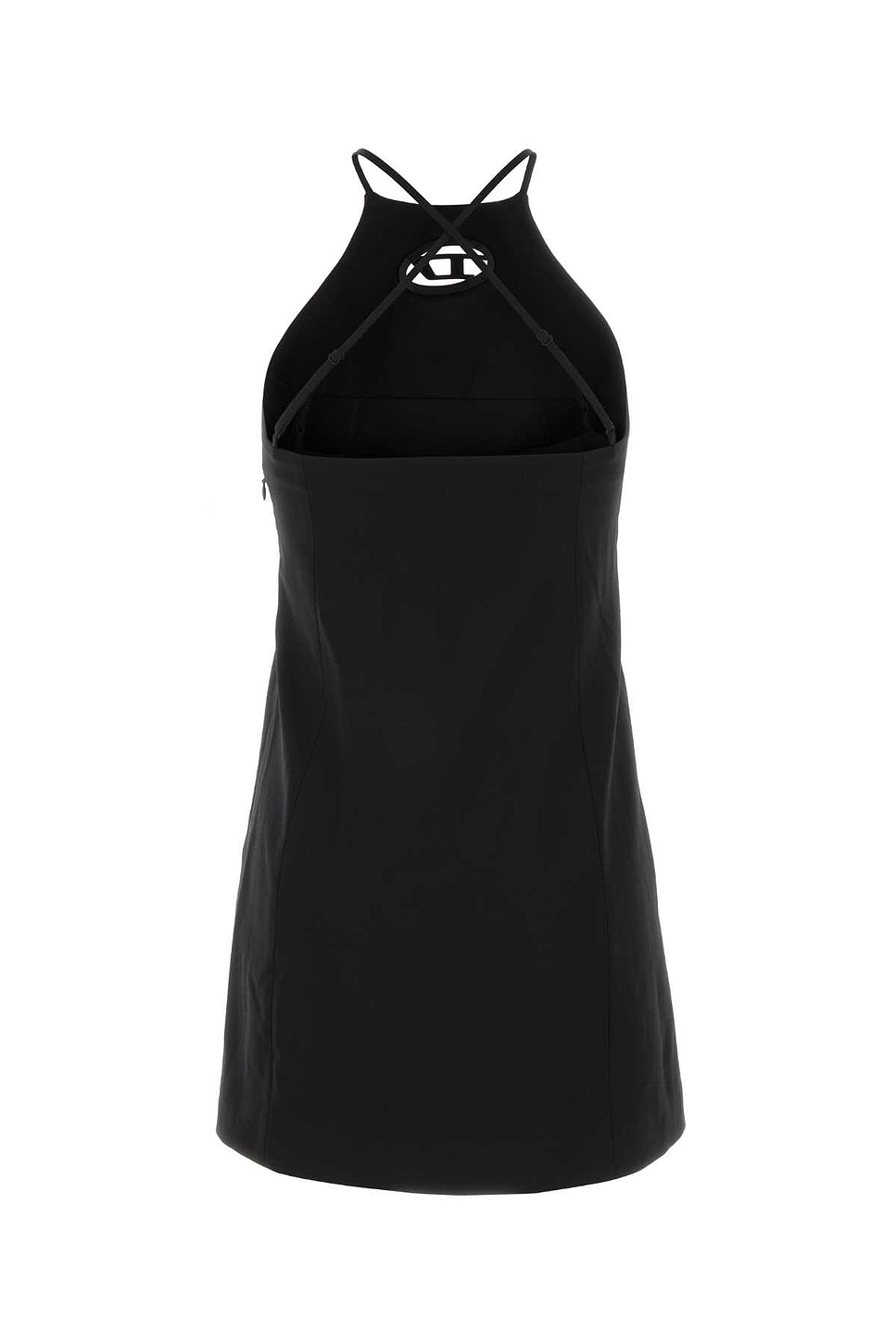
A stretch twill mini dress listed as 53% polyester, 43% wool and 4% elastane for the shell, with a lining of 97% polyester and 3% elastane, made in China, at 340 dollars. There are no reviews, no fit votes and no size chart, and the listing carries two photographs. The product information is four lines: the composition, the country, and two stock numbers. There is no care instruction, no closure and no model. There are no reviews and no fit votes, so there is no score to quote. This garment contains wool in a blend, which raises the question of whether blending removes the problem wool carries, and it pairs that wool with a lining that behaves completely differently in water. The reference is the Diesel Black stretch twill mini dress in Black. Dongguan Bafinasa Garments Co., Ltd. develops comparable wool blend dresses on OEM and ODM terms, from fabric sourcing to retail or FBA ready packing. We publish this as a development reference and build your own version of it, and we do not supply the branded original or reproduce anyone else's label.
Key Features
- Shell: 53% polyester, 43% wool, 4% elastane as stated
- Lining: 97% polyester, 3% elastane as stated
- Stretch twill fabric as stated in the product name
- Made in China as stated
- Three sizes published: 38, 40 and 42
- No care instruction stated on the listing
- No size chart published on the listing
- Two photographs on the listing
Customisable Options
- Fabric: polyester wool elastane stretch twill as the reference, with the ratio and weight set from a tested sample
- Care: we would state dry clean only and test it, since wool felts and no instruction is given. See the note below
- Lining: we would consider matching the fibre, for the reason set out below
- Construction: we would confirm the twill weight and whether the stretch is mechanical or from the elastane
- Length from mini to midi, weight, size set, colour development, private label and care labelling
Specifications
| Style | Stretch twill wool blend mini |
| Reference | Diesel, Black stretch twill mini dress, style FEXN-WD1666, manufacturer style A200990PHAL 9XX, colour Black |
| Shell | 53% polyester, 43% wool, 4% elastane as stated |
| Lining | 97% polyester, 3% elastane as stated |
| Fabric | Stretch twill as stated in the product name |
| Care | None stated on the listing, which is the most serious gap on it. See the note below |
| Closure | None stated on the listing |
| Sizes Published | 38, 40, 42, which are three consecutive sizes |
| Measurements | None published. No size chart and no model measurements on this listing |
| Photographs | Two |
| Production | Made in China as stated |
| Reference Retail | 340 USD, quoted to show the price band this sits in, not as our price |
| Customer Reviews | None on the reference listing, so we quote no score |
| Best Seller Badge | None. The listing carries no rank |
| Categories | Filed by the retailer under mini dresses, with no second category |
| Occasion | City, autumn and winter, work, evening |
| MOQ | 100 pcs per style per colourway, mixed sizes and colourways accepted |
| Sampling | 7-10 days after tech pack or reference sample confirmation |
| Bulk Lead Time | 20-30 days after sample approval and deposit |
| Service | OEM / ODM / private label, wool blend sourcing, twill development, retail or FBA ready packing |
Size Chart
| Size | Bust | Waist | Hips | Length | Source | ||||||||||||
|---|---|---|---|---|---|---|---|---|---|---|---|---|---|---|---|---|---|
| 38 | 31 | in / | 79 | cm | 24 | in / | 61 | cm | 34 | in / | 86 | cm | 86 | cm / | 33.9 | in | Our proposal |
| 40 | 33 | in / | 84 | cm | 26 | in / | 66 | cm | 36 | in / | 91 | cm | 88 | cm / | 34.6 | in | Our proposal |
| 42 | 35 | in / | 89 | cm | 28 | in / | 71 | cm | 38 | in / | 97 | cm | 90 | cm / | 35.4 | in | Our proposal |
This listing publishes no size chart and no model measurements. It offers three consecutive sizes, which is a size range rather than remaining stock, and the elastane content and the twill both bear on how wide that range can be.
Occasions and Styling
Suits city, autumn and winter, work and evening. Wool makes this a cold weather garment rather than a summer one, which is worth stating, since a black mini reads to most customers as a piece for warm weather.
Production and Quality Control
There are no reviews and no fit votes on this listing, so there is no score to quote. There is wool here in a blend, which raises whether the blend removes what wool does, a lining that behaves completely differently in water from the cloth it lines, and no care instruction anywhere on the page.
Blending wool does not remove what wool does, and it is worth being precise about why, and that is the first thing. Wool felt. Its fibres carry scales along their surface, and when the fibre is wet and warm and agitated at the same time those scales lock together and the fibre mats, and the result is permanent: the cloth becomes smaller, denser and stiffer, and there is no way back from it. We set this out on a 100% virgin wool dress and used it to explain why that listing's wording of dry cleanable was wrong, because dry cleanable leaves every other method open on a fibre that cannot survive one of them. The question here is whether 43% wool in a blend still does that, and the answer is yes, because felting is a property of the individual fibre and not of the cloth being entirely wool. Where blending does help is in limiting how far the consequence goes. Polyester does not shrink at all, so the 53% of this cloth that is polyester acts as a physical restraint on the 43% that wants to contract: the garment cannot shrink as much as an all wool one would, because the polyester yarns will not let it. So the blend reduces the severity and does not remove the risk, and it does that by restraint rather than by prevention. That distinction matters for what the label should say. This garment should not be washed, and it is worth adding that the same reasoning applies to the other direction, which is that a minority fibre rarely rescues a majority one. We found this on a viscose and linen blend where linen, which is stronger wet than dry, was contributing support to a viscose majority without making the garment washable, and we said a blend behaves according to the fibre that predominates. Here wool is not the majority, but its failure mode is permanent rather than gradual, and a permanent failure needs the stricter label even at 43%.
The lining and the shell could not behave more differently in water, and that is the second thing. The shell is 53% polyester, 43% wool and 4% elastane. The lining is 97% polyester and 3% elastane, so it contains no wool at all. Polyester does not shrink in water, and wool does. That is the widest difference this series has found between a cloth and its lining, and it is worth setting out what it produces, because the mechanism is one we have described before in its milder forms. A lining is normally cut slightly larger than the shell so that it can sit inside it without pulling. That works while the two layers shrink by the same amount. When they do not, the lining shrinks less than the shell here, since it has no wool in it, and the consequence is that the lining ends up looser inside a shell that has come in, and it bubbles or sits away from the cloth rather than lying against it. The other direction is worse: had the lining been the one that shrank more, it would pull the shell into puckers along every seam. Either fault appears after washing rather than before it, which is why it survives sampling and reaches the customer. The rule this series has settled on is that a lining should be in the same fibre as the cloth it lines, and the reason is shrinkage rather than tidiness. That rule is broken here in the most extreme way we have seen, and whether it matters at all depends entirely on the care instruction, which brings us to the third point. If this garment is dry clean only, none of the above happens, because nothing shrinks. If it is washable, both of the risks above are live at once.
There is no care instruction, and here that gap decides whether two other risks are real, and that is the third thing. This series has found a great many listings with no care instruction, and the argument has been consistent throughout: it is the cheapest item of information a page can carry, because it requires only knowing what the cloth is and what was done to it, both of which are known before the garment is finished, so its absence is not a resource problem. We have also noted that no instruction is worse than a weak one, because a weak instruction at least tells the customer something while silence invites her to decide for herself, and she will usually decide in the direction of washing. This listing is the clearest case yet of why that reasoning is not academic. There are two separate risks on this garment, wool felting and a lining and shell that shrink by different amounts, and both of them are inert under dry cleaning and both of them are live under washing. So the single missing line is not merely an inconvenience, it is the switch that determines whether this garment survives being cared for at home. A black stretch twill mini reads to most customers as an easy garment, and the composition, which contains wool, does not read that way at all. On the sizes, three consecutive sizes is a size range rather than remaining stock, which is the distinction we drew on a knit dress in this batch that published 34 and 38 with the 36 missing. Whether three sizes work here depends on the stretch: 4% elastane is a recovery additive rather than something a fit is designed around, which we said on a button front dress, so the range is more likely carried by the twill's own give and by a generous cut than by the elastane. Every bulk shipment gets a measurement report against your approved chart.
Optional upgrades include dry clean only stated and tested, since wool felts and the lining does not match, a lining fibre matched to the shell, a published size chart and model measurements, the stretch mechanism confirmed as elastane or mechanical, the twill weight specified, alternative wool ratios, alternative lengths, extended sizing, colour development and private label, hangtag and care labelling.
Pre-production sample approval, in-line inspection during cutting and sewing, and a final AQL inspection before packing, with measurement reports and photos shared before shipment.
Send us your tech pack, a photo or a reference garment and we will quote within 24 hours. Contact bafinasa@bafinasa.com or WhatsApp +86 13827222469.