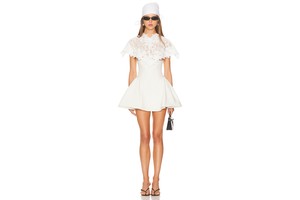
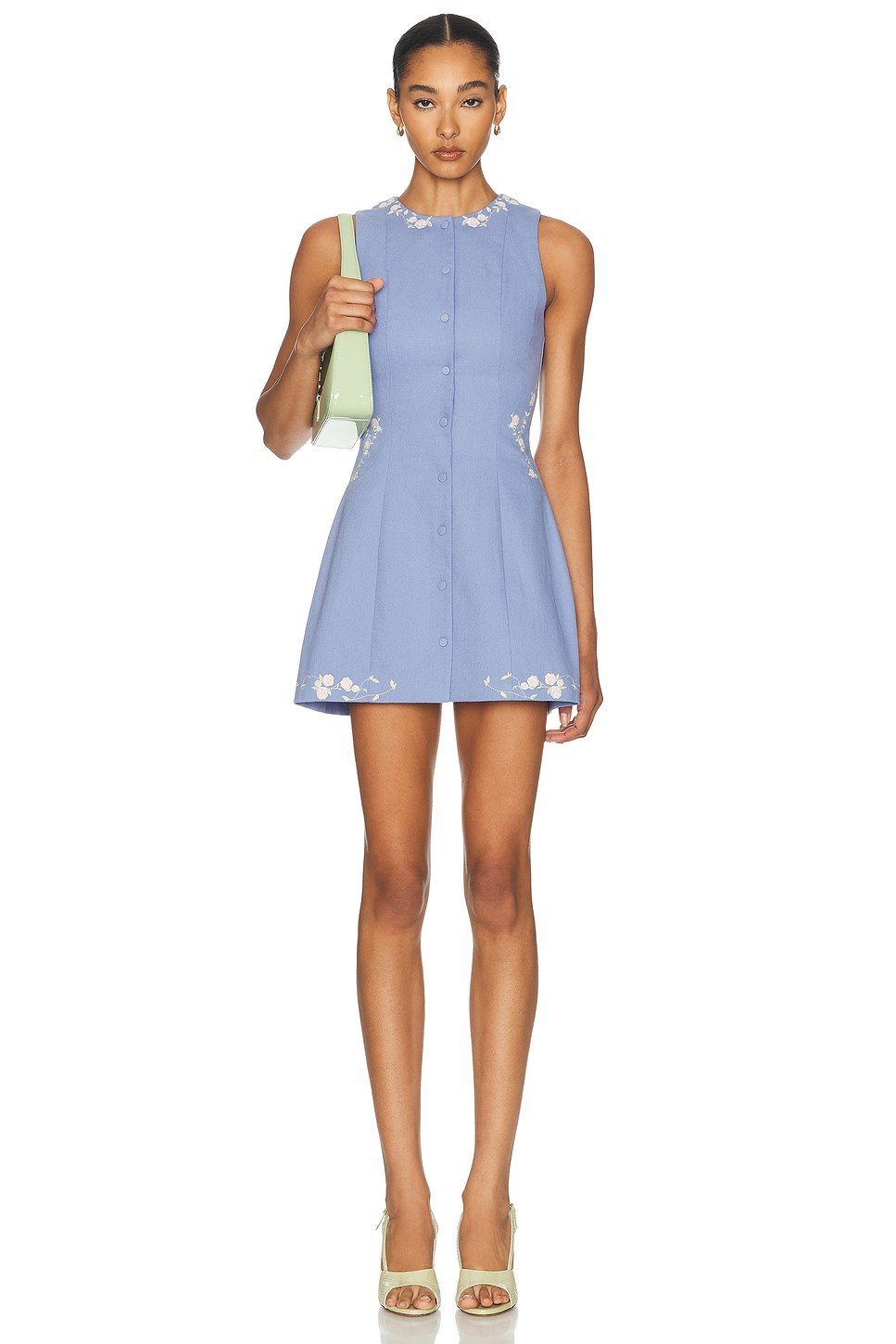
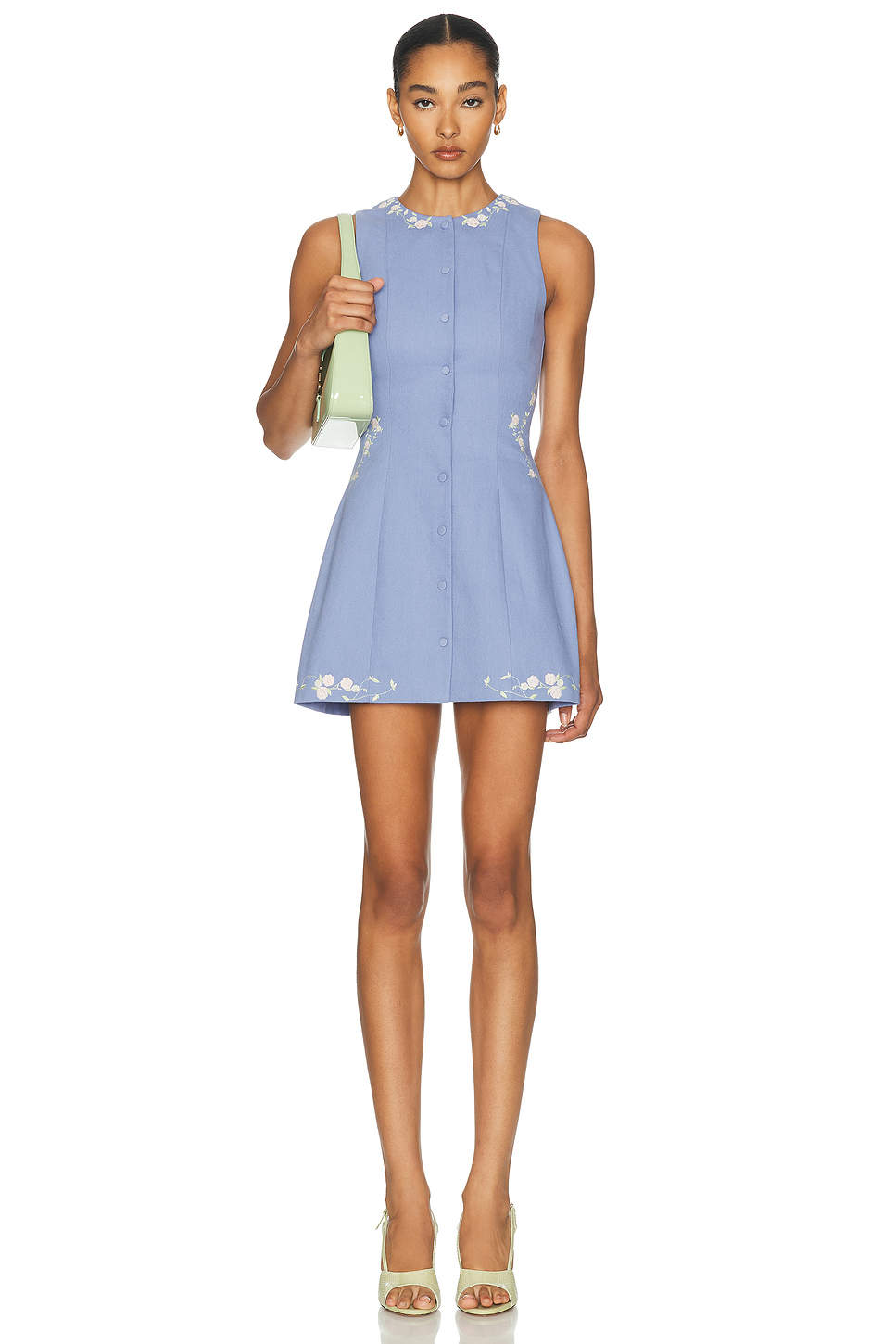
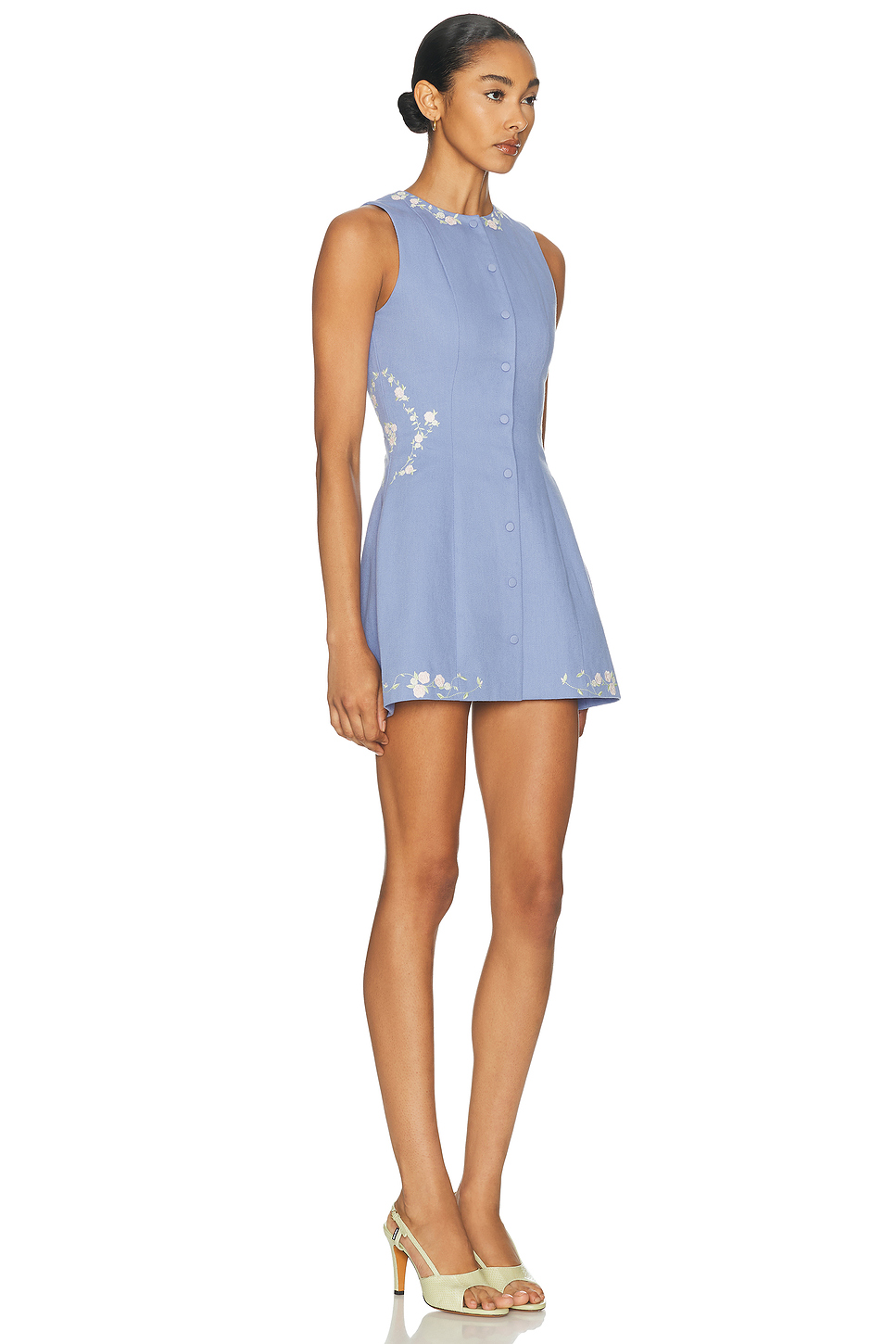
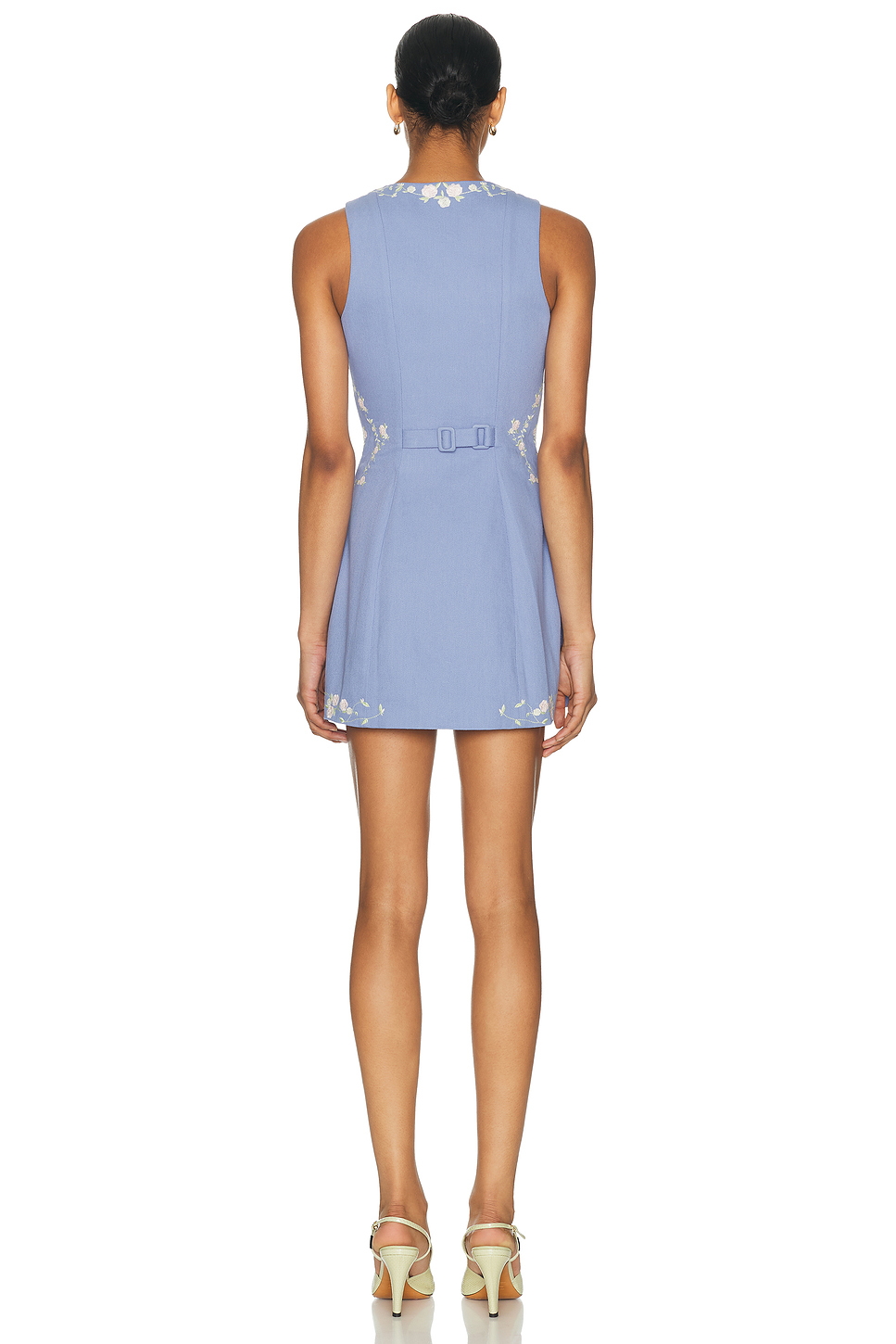
A mini dress listed as 100% cotton for both the shell and the lining, fully lined, closed with buttons down the front, with a tie waist, floral applique decoration, in a midweight twill, dry clean only, made in China, ranked sixty second in the retailer's fit and flare dress list, at 695 dollars. There are no reviews and no fit votes, so there is no score to quote. This is the first garment in this series whose closure is at the front, which resolves a problem we have been documenting for a long stretch of it. There is also an instruction here that looks wrong for the fibre and is right for a different reason, and a waist treatment that does something useful that stretch cannot. The reference is the Pocket Full Of Posies Mini Dress by Mirror Palais in Cornflower Blue. Dongguan Bafinasa Garments Co., Ltd. develops comparable cotton dresses on OEM and ODM terms, from fabric and trim sourcing to retail or FBA ready packing. We publish this as a development reference and build your own version of it, and we do not supply the branded original or reproduce anyone else's label.
Key Features
- Shell and lining both 100% cotton as stated
- Front button closure as stated
- Tie waist as stated
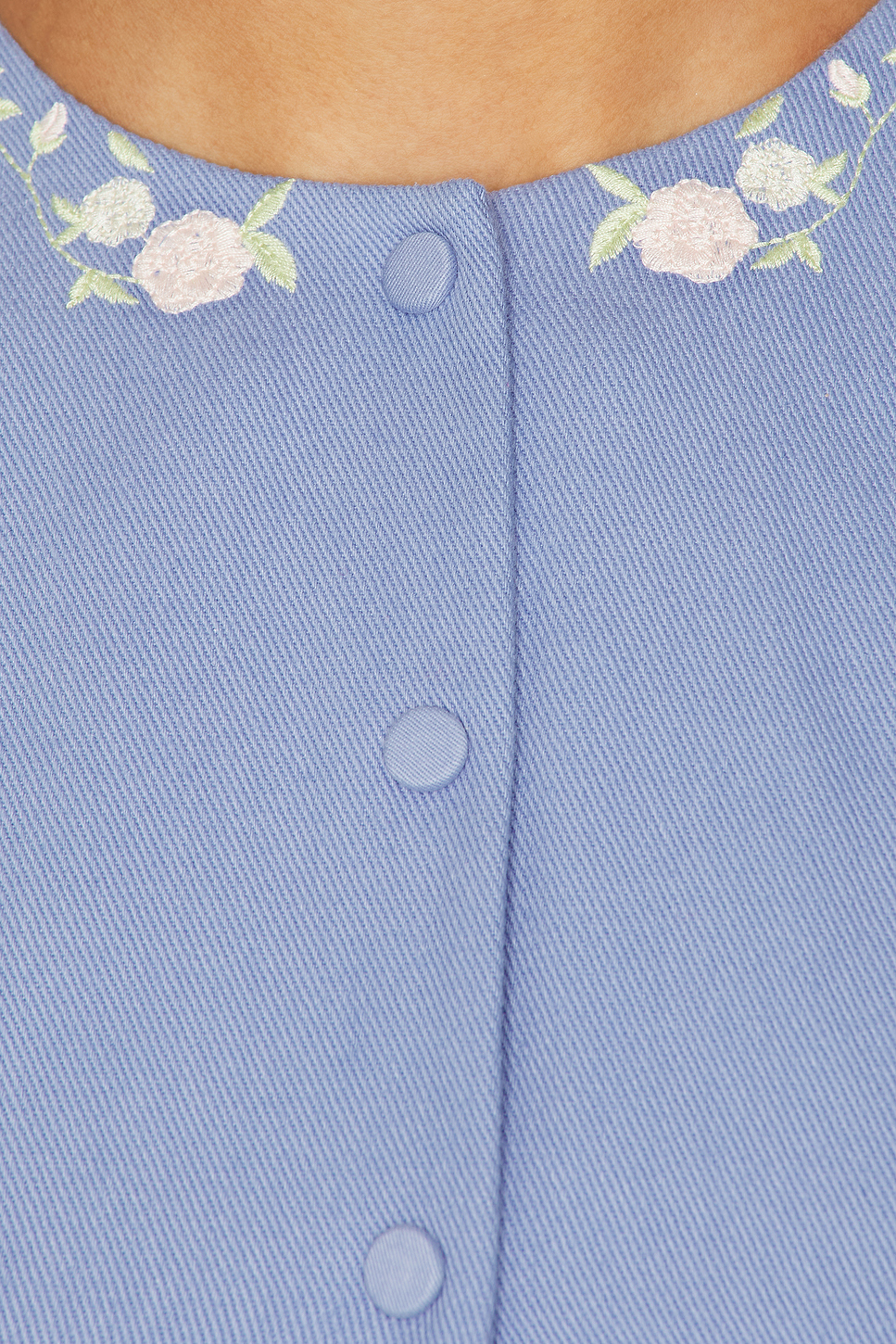
- Floral applique decoration as stated
- Midweight twill fabric as stated
- Fully lined as stated
- Dry clean only as stated
- Made in China as stated
Customisable Options
- Fabric: cotton twill as the reference, with the weight set from a tested sample
- Closure: front buttons as the reference, which is the easiest arrangement to manage unaided
- Waist: a tie as the reference, which adjusts rather than stretches, and needs no elastane
- Applique: we would state why dry clean only is required, for the reason set out below
- Length from mini to midi, button spacing, size set, colour development, private label and care labelling
Specifications
| Style | Pocket Full Of Posies twill mini |
| Reference | Mirror Palais, Pocket Full Of Posies Mini Dress, style MRPF-WD63, manufacturer style MP2107, colour Cornflower Blue |
| Shell | 100% cotton as stated |
| Lining | 100% cotton as stated, which is the same fibre as the shell |
| Fabric | Midweight twill as stated, which resists creasing better than a plain weave |
| Closure | Front button closure as stated, which is unusual and worth noting. See the note below |
| Waist | Tie waist as stated, which adjusts rather than stretches. See the note below |
| Decoration | Floral applique as stated |
| Care | Dry clean only as stated, which looks wrong for cotton and is right for another reason. See the note below |
| Sizes Published | XS, S, M, L |
| Measurements Published | S: bust 32 in, waist 24 in, hips 34 in, length 31 in |
| Chart Note | Bust four inches over the model, waist one over, hip level, which is ordinary woven ease |
| Model | 178 cm, wearing size S, bust 72 cm, waist 58 cm, hips 86 cm |
| Production | Made in China as stated |
| Reference Retail | 695 USD, quoted to show the price band this sits in, not as our price |
| Customer Reviews | None on the reference listing, so we quote no score |
| Best Seller Badge | Rank 62 in the retailer's fit and flare dress list, which is a low position |
| Categories | Filed by the retailer under both mini dresses and sleeveless dresses |
| Occasion | Daytime, spring and summer, occasions, garden events |
| MOQ | 100 pcs per style per colourway, mixed sizes and colourways accepted |
| Sampling | 7-10 days after tech pack or reference sample confirmation |
| Bulk Lead Time | 20-30 days after sample approval and deposit |
| Service | OEM / ODM / private label, cotton sourcing, applique and trim development, retail or FBA ready packing |
Size Chart
| Size | Bust | Waist | Hips | Length | Source | ||||||||||||
|---|---|---|---|---|---|---|---|---|---|---|---|---|---|---|---|---|---|
| S | 32 | in | 24 | in | 34 | in | 31 | in / | 79 | cm | As published | ||||||
| XS | 31 | in / | 79 | cm | 24 | in / | 61 | cm | 34 | in / | 86 | cm | 77 | cm / | 30.3 | in | Our proposal |
| S | 33 | in / | 84 | cm | 26 | in / | 66 | cm | 36 | in / | 91 | cm | 79 | cm / | 31.1 | in | Our proposal |
| M | 35 | in / | 89 | cm | 28 | in / | 71 | cm | 38 | in / | 97 | cm | 81 | cm / | 31.9 | in | Our proposal |
| L | 37 | in / | 94 | cm | 30 | in / | 76 | cm | 40 | in / | 102 | cm | 83 | cm / | 32.7 | in | Our proposal |
The published size S gives a 32 inch bust, a 24 inch waist, a 34 inch hip and a 31 inch length against a model at roughly 28, 23 and 34. The bust is four inches over, the waist one over and the hip level, which is ordinary ease for a woven garment, and the waist figure is explained by the tie rather than by the cut.
Occasions and Styling
Suits daytime, spring and summer, occasions and garden events. A cotton twill mini with applique is a warm weather occasion piece, and 31 inches on a model at 178 cm is short, which is worth stating since it will sit higher on most wearers than it does on her.
Production and Quality Control
There are no reviews and no fit votes on this listing, so there is no score to quote. There is a front closure here, which is rare enough in this series to be worth marking, a care instruction that looks like a mistake and is not, and a waist that works by a different principle from stretch.
The buttons are on the front, and that solves the whole problem we have been tracking, and that is the first thing. We have spent a long stretch of this series on fastenings behind the wearer, and the pattern has been consistent: a zip at the back can be managed alone, a button behind the back is hard because it must be aligned in a place that cannot be seen, a tie that has to be knotted behind the back is harder still because it must then be arranged, and a hook at the back of the neck is hardest of all because the position is both invisible and awkward. We found a wool dress with three fastenings all at the back and said the honest thing about it, which is that it is easier to get into with help, and that this is not a defect. Buttons down the front need none of that. The wearer can see them, reach them, and do them in any order, and the garment can be put on and taken off without assistance and without the contortion that occasion dress usually demands. It is worth naming this as the simplest available answer to a problem this series has returned to perhaps a dozen times, and worth saying that it is available on any garment where the design allows a front opening at all. There is one thing to watch that comes with it. Buttons on a front opening can gape between the buttonholes, because the closure only holds at the buttonholes and the fabric between them is free, and that is worse when the garment is also being pulled tight somewhere else. This dress has a tie waist, and tightening a tie pulls on the front opening, so the two features act on each other. The remedies are small: closer button spacing, a concealed press stud or two between buttons, or a placket stiff enough to lie flat under tension. None of them is difficult, and all of them are easier to build in at sampling than to add afterwards.
Dry clean only on 100% cotton looks wrong, and it is right for a reason the page does not give, and that is the second thing. Cotton is among the most washable fibres in a wardrobe, and we have said so repeatedly in this series, most directly when we set out what a machine washable cotton slip requires, which is pre shrinking before cutting. So a customer reading 100% cotton and dry clean only is entitled to be puzzled, and it is worth being clear that the instruction is almost certainly correct. The reason is the applique. An applique is a separate piece of cloth laid on and stitched down, and it is commonly backed with a fusible interlining so that it lies flat and does not fray while it is being applied. That interlining is the weak point: washing softens and eventually releases the adhesive, and the applique then lifts at its edges or bubbles in its middle. We found the same class of failure from a different direction recently, on a raffia knit whose care instruction advised hand washing when the material itself was dried leaf fibre that breaks in water, and the general principle is worth stating because it explains a lot of otherwise baffling labels. A garment's care instruction is set by its most fragile component and not by its predominant fibre. We have used the same reasoning about stretch: a lined garment cannot extend further than the less extensible of its two layers, so the tighter layer governs. This is that principle applied to care instead of to movement. Here the cotton would happily be washed and the applique would not, so the instruction follows the applique. The only real criticism is that the page does not say so, and a customer who understands why is far more likely to follow it.
A tie waist does what stretch does but by a different means, and that is worth separating, and that is the third thing. Small size ranges have appeared throughout this series, and where they have worked there has been a mechanism: a knit accommodates a range of bodies because its loops can open, and a high elastane jersey compresses to fit. Both are passive, meaning the garment takes the shape of whoever is in it without anybody deciding anything. A tie is the other kind. It is active: the wearer sets it, and the garment then holds what she set. The useful consequence is that it needs no elastane at all, so it works on a woven cotton with none, as here, and it means the waist measurement does not have to be right in the way a fixed waistband has to be right. That is visible in the chart. The bust is four inches over the model and the hip is level with hers, which is normal, and the waist is only one inch over, which is tighter than a woven garment would normally be cut. It can be, because the tie does the rest of the work, and any waist between the two ends of the tie will fit. So a tie is not merely a detail, it is a way of widening the range of bodies a single size covers, and it is worth designing in deliberately rather than treating as decoration. On the fabric, midweight twill is worth a word, because it is a good choice for reasons that connect to something we looked at recently. We compared weaves and noted that a twill lets its yarns shift against one another where a plain weave locks them, and that this makes it more resistant to creasing, which matters on a fibre like cotton that has poor crease recovery on its own. Midweight rather than heavyweight is the right call for a mini, since this garment needs to hold a shape rather than to hang. Every bulk shipment gets a measurement report against your approved chart.
Optional upgrades include the front buttons kept as the primary closure, button spacing set close enough to resist gaping under a tightened tie, a concealed press stud or two between buttons, the reason for dry clean only stated on the page, alternative applique placements and attachment methods tested for washing if washability is wanted, the tie kept as the waist mechanism, alternative twill weights, alternative lengths, extended sizing, colour development and private label, hangtag and care labelling.
Pre-production sample approval, in-line inspection during cutting and sewing, and a final AQL inspection before packing, with measurement reports and photos shared before shipment.
Send us your tech pack, a photo or a reference garment and we will quote within 24 hours. Contact bafinasa@bafinasa.com or WhatsApp +86 13827222469.