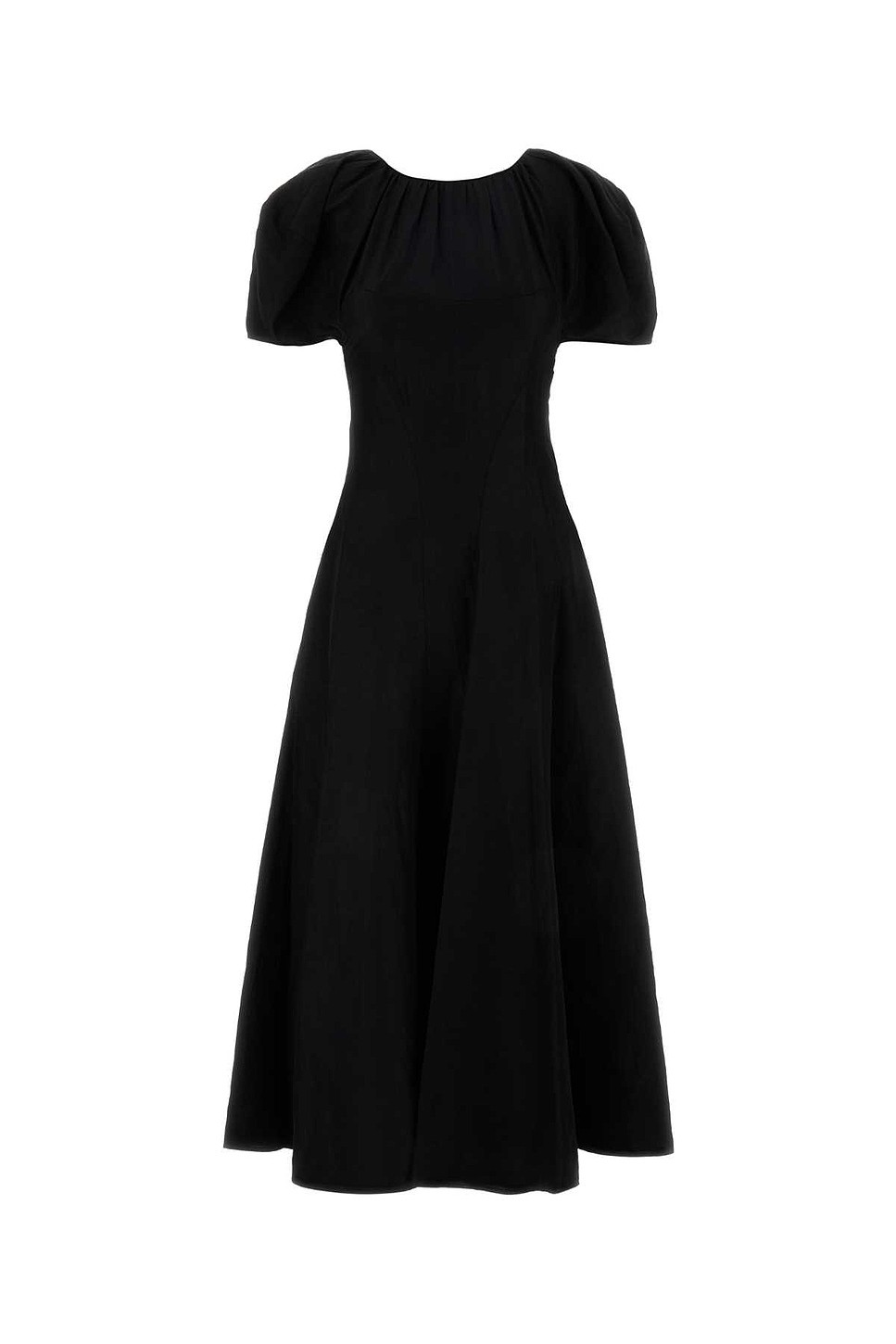
A black mini dress listed as 65% viscose and 35% linen for the shell, made in China, at 917 dollars. There are no reviews, no fit votes and no size chart, and the listing carries two photographs. The whole product information is four lines: the composition, the country, and two stock numbers. There is no care instruction, no closure, no lining and no model. There are no reviews and no fit votes, so there is no score to quote. This is the first linen in this series, and it is worth understanding what the two fibres here do to each other, because one of them is the opposite of the other on the property that matters most. There is also one word on this page that reveals a piece of information the page does not otherwise give. The reference is the Tory Burch Black viscose blend dress in Black. Dongguan Bafinasa Garments Co., Ltd. develops comparable blend dresses on OEM and ODM terms, from fabric sourcing to retail or FBA ready packing. We publish this as a development reference and build your own version of it, and we do not supply the branded original or reproduce anyone else's label.
Key Features
- Shell: 65% viscose, 35% linen as stated
- Made in China as stated
- Two sizes published: 0 and 2
- Filed by the retailer under mini dresses
- No care instruction stated on the listing
- No size chart published on the listing
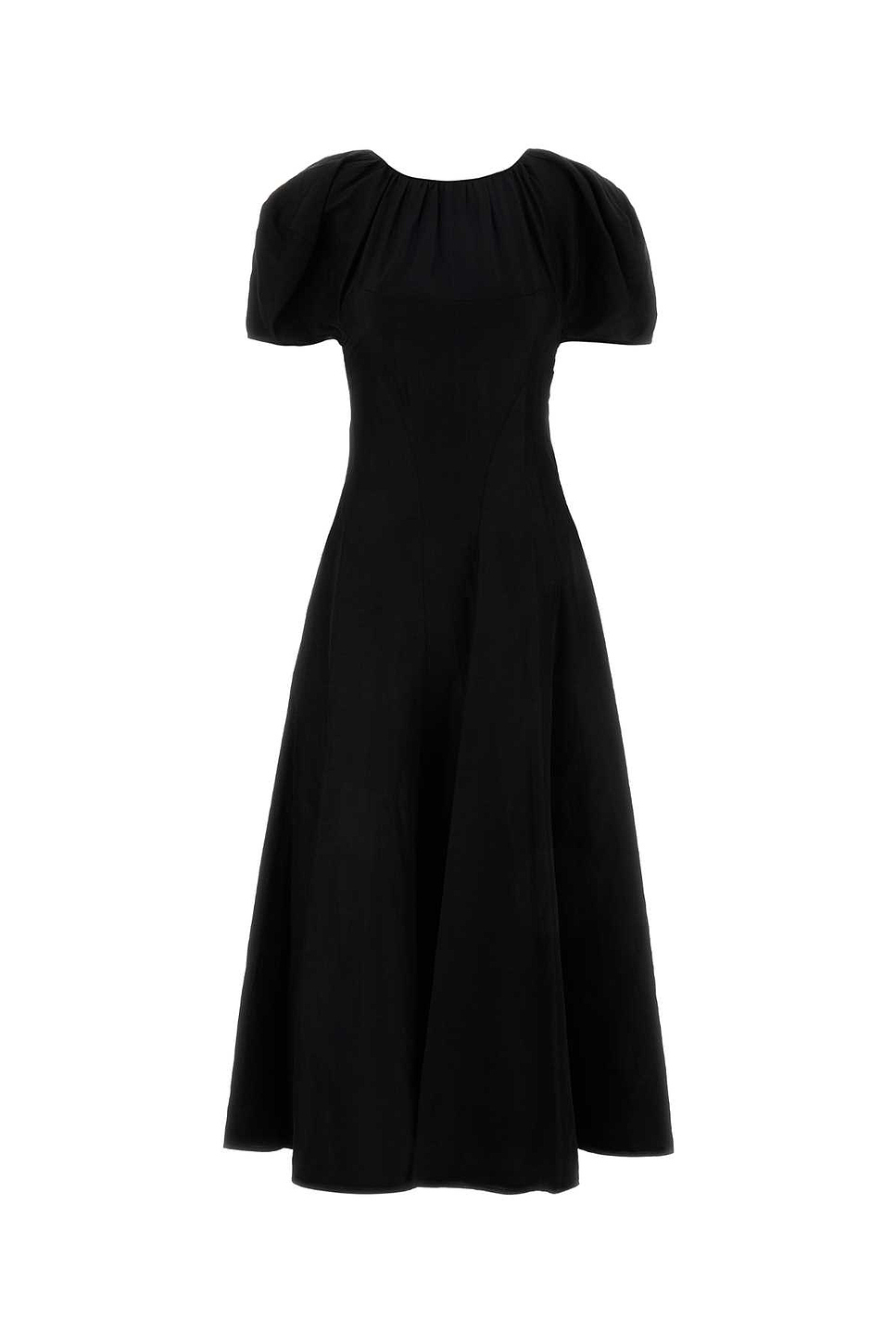
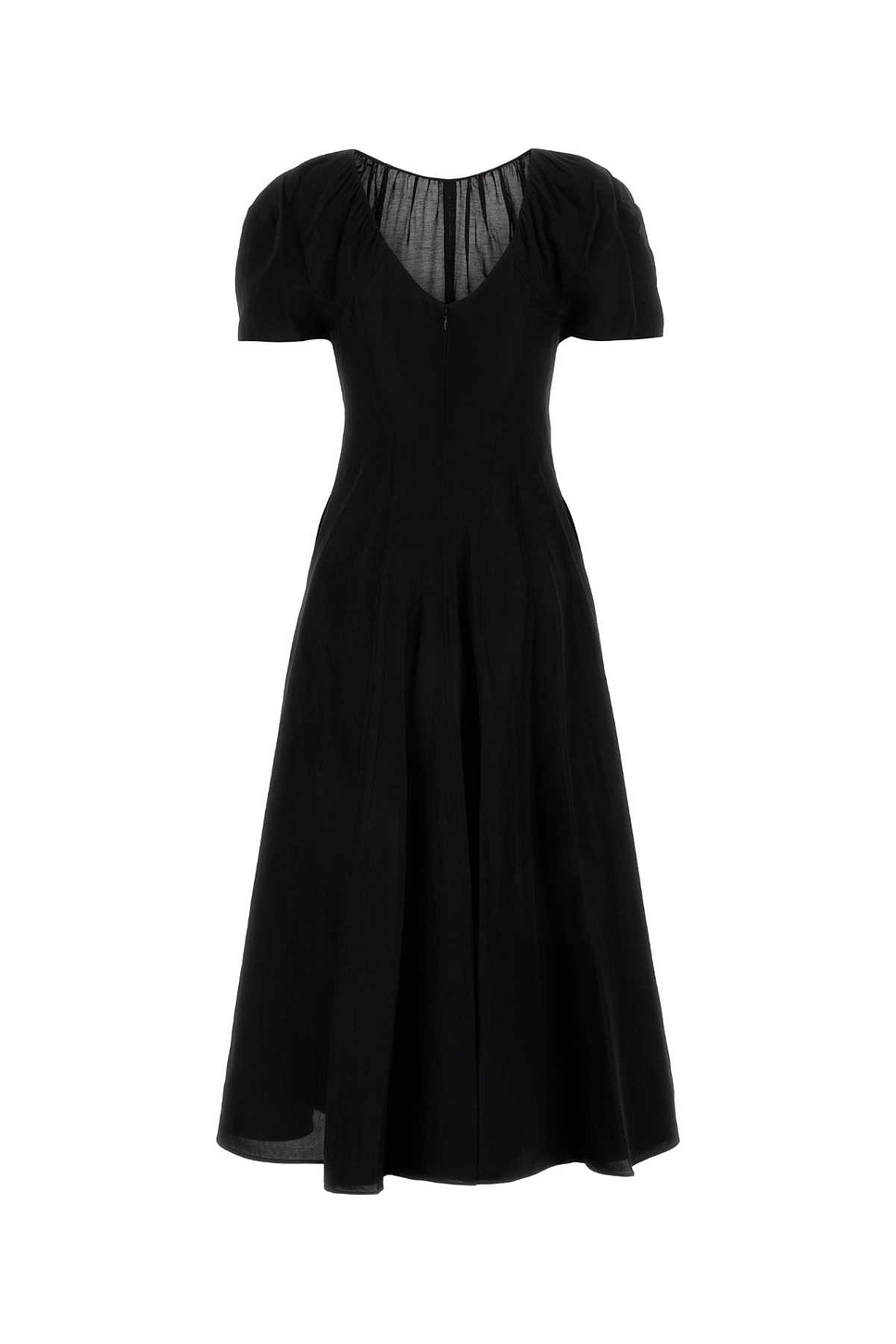
- Two photographs on the listing
- Four lines of product information in total
Customisable Options
- Fabric: viscose linen as the reference, with the blend ratio and weight set from a tested sample
- Care: we would state a single clear instruction, since the listing gives none and the fibre needs one
- Crease: we would consider a construction that resists creasing, for the reason set out below
- Lining: we would establish what the shell wording implies. See the note below
- Length from mini to midi, weight, size set, colour development, private label and care labelling
Specifications
| Style | Viscose linen blend mini |
| Reference | Tory Burch, Black viscose blend dress, style FEXN-WD984, manufacturer style 170760 001, colour Black |
| Shell | 65% viscose, 35% linen as stated |
| Lining | Not stated, though the composition is given as shell, which implies one. See the note below |
| Care | None stated on the listing, which is the most serious gap on it |
| Closure | None stated on the listing |
| Sizes Published | 0, 2, which is two sizes |
| Measurements | None published. No size chart and no model measurements on this listing |
| Photographs | Two |
| Production | Made in China as stated |
| Reference Retail | 917 USD, quoted to show the price band this sits in, not as our price |
| Customer Reviews | None on the reference listing, so we quote no score |
| Best Seller Badge | None. The listing carries no rank |
| Categories | Filed by the retailer under mini dresses, with no second category |
| Occasion | Daytime, summer, warm weather, city |
| MOQ | 100 pcs per style per colourway, mixed sizes and colourways accepted |
| Sampling | 7-10 days after tech pack or reference sample confirmation |
| Bulk Lead Time | 20-30 days after sample approval and deposit |
| Service | OEM / ODM / private label, viscose and linen sourcing, retail or FBA ready packing |
Size Chart
| Size | Bust | Waist | Hips | Length | Source | ||||||||||||
|---|---|---|---|---|---|---|---|---|---|---|---|---|---|---|---|---|---|
| 0 | 31 | in / | 79 | cm | 24 | in / | 61 | cm | 34 | in / | 86 | cm | 86 | cm / | 33.9 | in | Our proposal |
| 2 | 33 | in / | 84 | cm | 26 | in / | 66 | cm | 36 | in / | 91 | cm | 88 | cm / | 34.6 | in | Our proposal |
This listing publishes no size chart and no model measurements, and offers two sizes. There is nothing on the page from which a customer could work out whether it will fit her, which is the largest gap after the missing care instruction.
Occasions and Styling
Suits daytime, summer, warm weather and city wear. Linen is a summer fibre by character and viscose drapes, so the blend reads as a warm weather piece, and it is worth saying so on the page.
Production and Quality Control
There are no reviews and no fit votes on this listing, so there is no score to quote. There is a blend here whose two fibres behave in opposite ways on the property that matters most, and one word on the page that gives away information the rest of it withholds.
These two fibres are opposites when they get wet, and that is the first thing. We have returned to viscose throughout this series and the fact is always the same: it loses about half its strength when wet, which is why every viscose garment we have looked at needed dry clean only rather than a weaker instruction, and why a 63 inch viscose mesh maxi published as dry cleanable was a garment waiting to distort under its own weight at the moment it was handled. Linen is the reverse: it is stronger wet than dry. So in this blend the two components pull in opposite directions, and it is worth asking what that produces. The answer is not an average. A blend behaves according to the fibre that predominates, and here viscose is 65% and linen is 35%, so the garment will behave predominantly like viscose, with the linen contributing some reinforcement and some of its own character. The practical reading is that the linen does not make this washable. It makes it somewhat less fragile in water than a pure viscose would be, and that is a difference of degree rather than of kind. There is a second thing about this pairing worth knowing, and it is less comfortable: both of these fibres crease. Viscose creases because it has poor elastic recovery, and linen creases because its fibres are stiff and have almost no ability to spring back, which is the trade linen has always carried in exchange for being cool and strong. So this is not a case of one fibre covering for the other. It is two fibres that both crease, and a garment made of them will crease. We have collected three ways of dealing with creasing across this series: stiffening the bodice so it cannot collapse into a fold, using pleating so that volume comes from having more cloth than the body needs, and choosing a weave that resists it, since a twill lets its yarns move against each other where a plain weave locks them. None of those is mentioned on this page, and a customer buying a viscose linen dress deserves one of them.
One word on this page tells you something the page does not say, and that is the second thing. The composition is given as 65% viscose and 35% linen for the shell. The word shell is doing work here, because it is a relative term: it only means something if there is something else. A garment made of one layer would be described as the fabric, and the moment a listing says shell there is usually a lining or a second layer underneath. So the word implies a lining whose composition has not been given. This is the second time in this series that a single word has carried information the description withheld. We found it recently on a raffia knit dress where a shipping restriction, stating that the garment could not be sent to Australia, turned out to be the most informative line on the page, because Australia's border rules on plant material are among the strictest in the world and raffia is plant fibre, so the clause revealed that the raffia content was high when the description itself gave no composition at all. Here the mechanism is smaller but the same: the wording was chosen by somebody who knew there were two layers, and the layer underneath was never described. It matters for a specific reason. We have argued repeatedly that a lining should be in the same fibre as the cloth it lines, and the reason is shrinkage rather than tidiness: two layers of the same fibre shrink by the same amount and stay in relation to each other, while two layers of different fibres shrink differently and the lining then either puckers the shell along every seam or bubbles loose inside it, after washing rather than before, which is why the fault survives sampling. Here we cannot know whether that has been attended to, because the second fibre is not stated.
There is no care instruction, and on this blend that is more serious than it was on cotton, and that is the third thing. We have now found several listings in this series with no care instruction at all, and the argument has been consistent: it is the cheapest item of information a listing can carry, since it requires only knowing what the cloth is and what was done to it, both of which are known before the garment is finished, and its absence is therefore not a resource problem. On a cotton poplin mini at 1,470 dollars we called it the most serious gap on the page, and it was serious because cotton is among the most washable fibres there is and the customer could not know that, so she either pays for dry cleaning she does not need or does not buy. Here it is worse rather than better, because this is predominantly viscose. A customer who cannot see an instruction will make her own decision, and the most likely decision for a black mini dress is to wash it, and that is the one thing the fibre does not want. The gap is not neutral: on a fibre that weakens by half when wet, silence pushes the customer toward the wrong answer. Two sizes is the other thing worth naming, and we have now met it repeatedly. Where the sizes run consecutively, a small size range is a design decision, usually supported by stretch or by a body that accommodates a range of bodies. Here the sizes are 0 and 2, consecutive, and the cloth has no stretch, so it is a small range on a woven garment with nothing to make it work, which points the same way as it did on the poplin mini: the fit is either generous or expected to be altered, and neither is stated. Every bulk shipment gets a measurement report against your approved chart.
Optional upgrades include a care instruction stated on the page, and specifically dry clean only given the viscose predominance, a construction chosen against creasing, the lining fibre stated and matched to the shell, a published size chart and model measurements, more than two sizes offered, alternative blend ratios, alternative weights, alternative lengths, extended sizing, colour development and private label, hangtag and care labelling.
Pre-production sample approval, in-line inspection during cutting and sewing, and a final AQL inspection before packing, with measurement reports and photos shared before shipment.
Send us your tech pack, a photo or a reference garment and we will quote within 24 hours. Contact bafinasa@bafinasa.com or WhatsApp +86 13827222469.