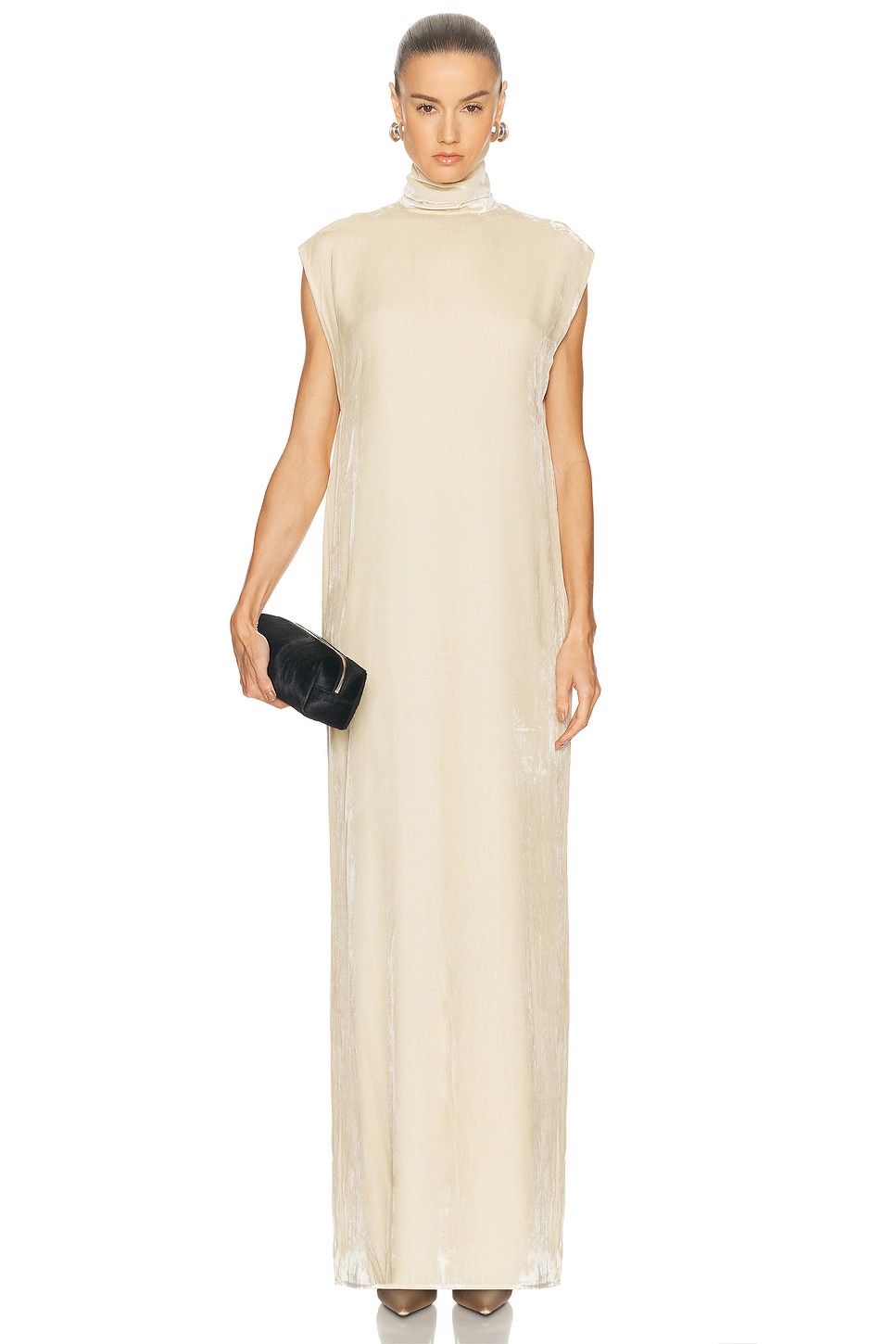
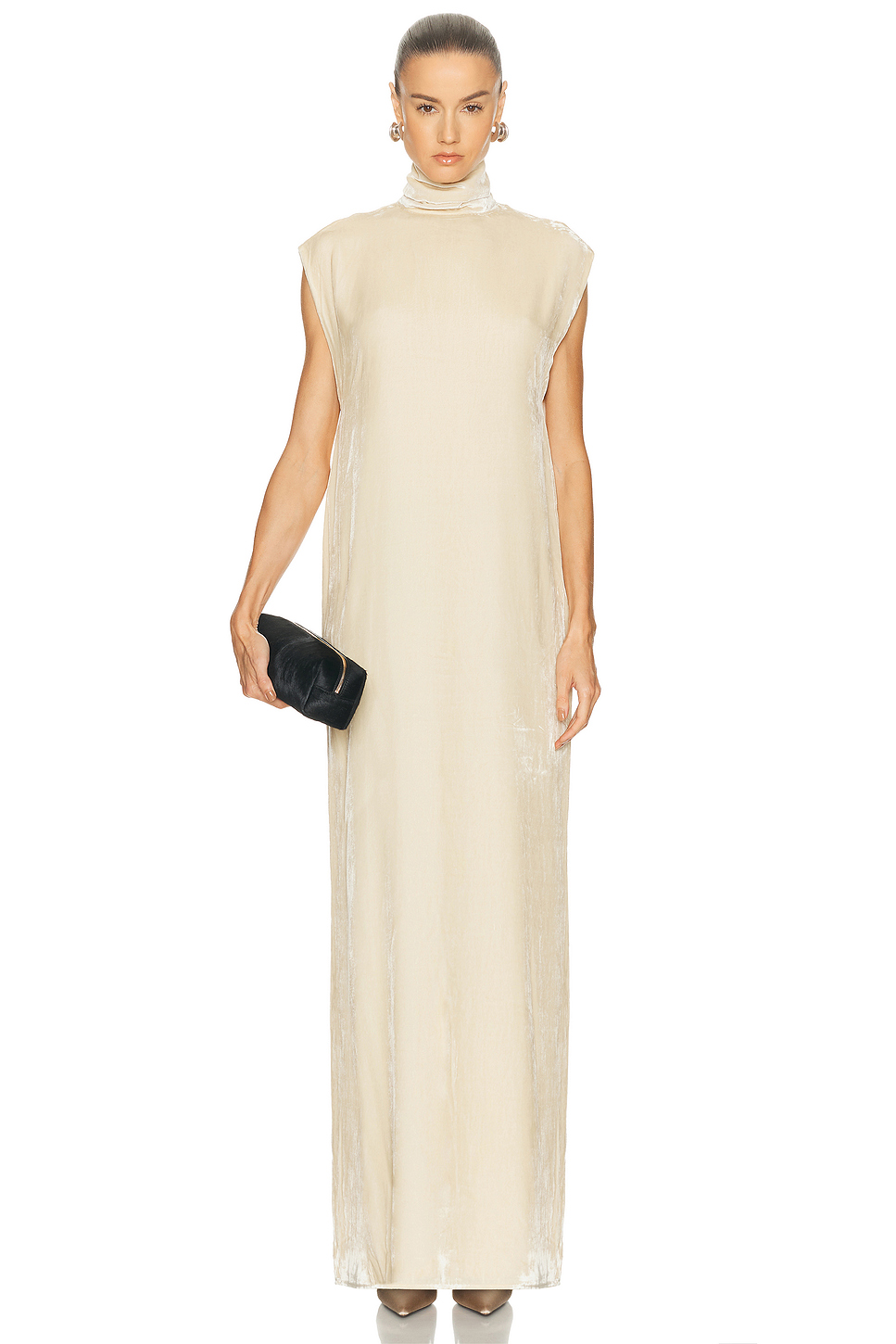
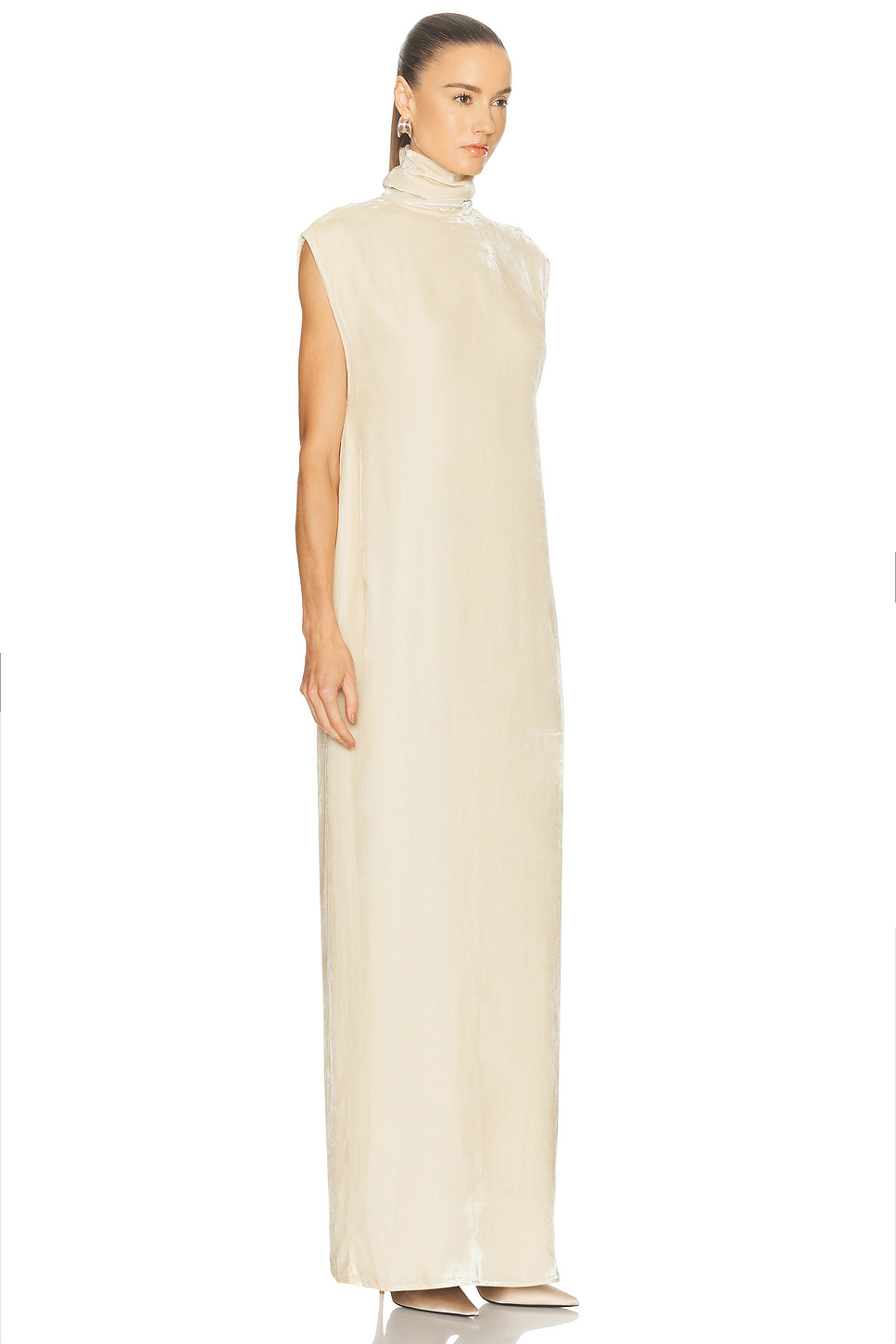
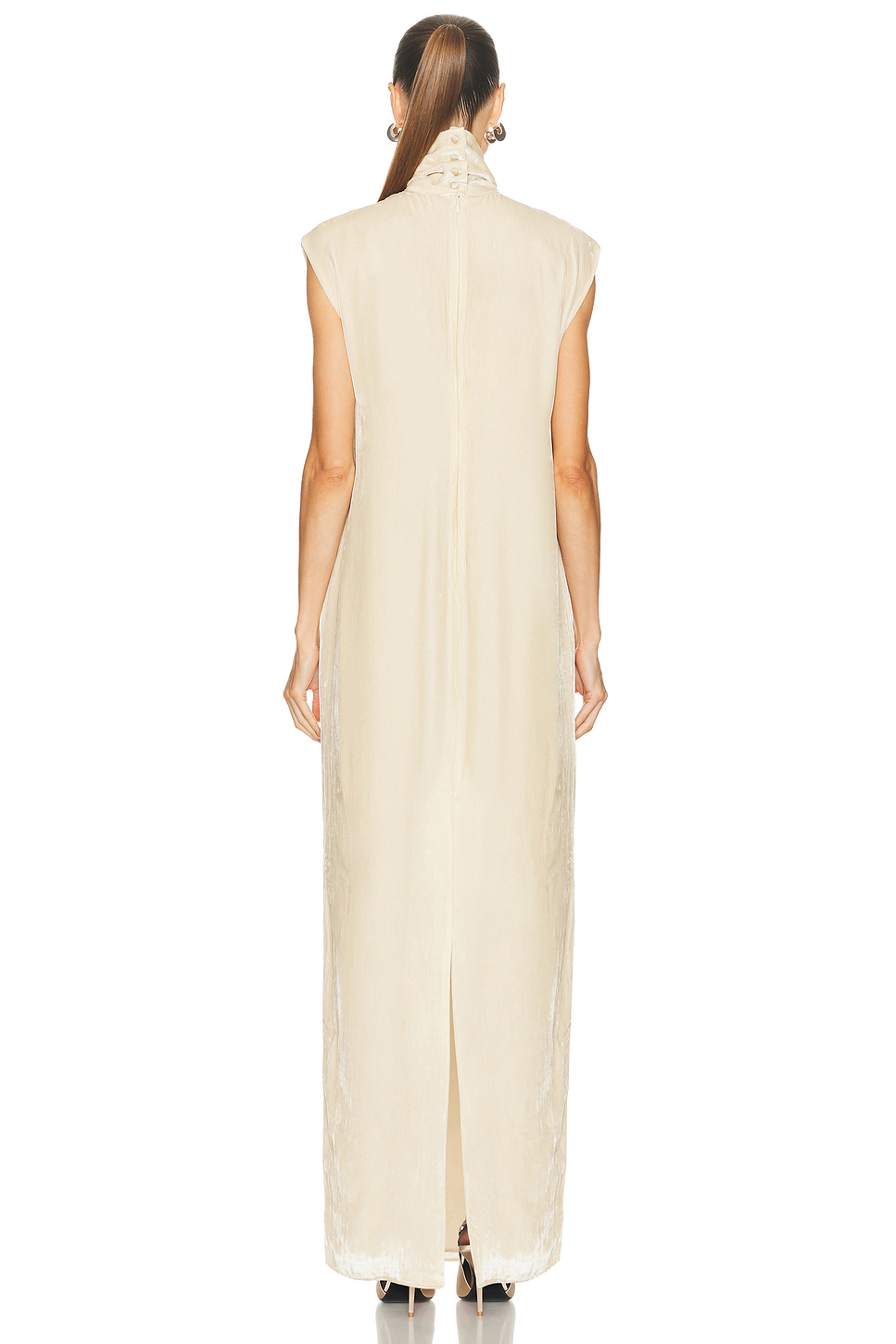
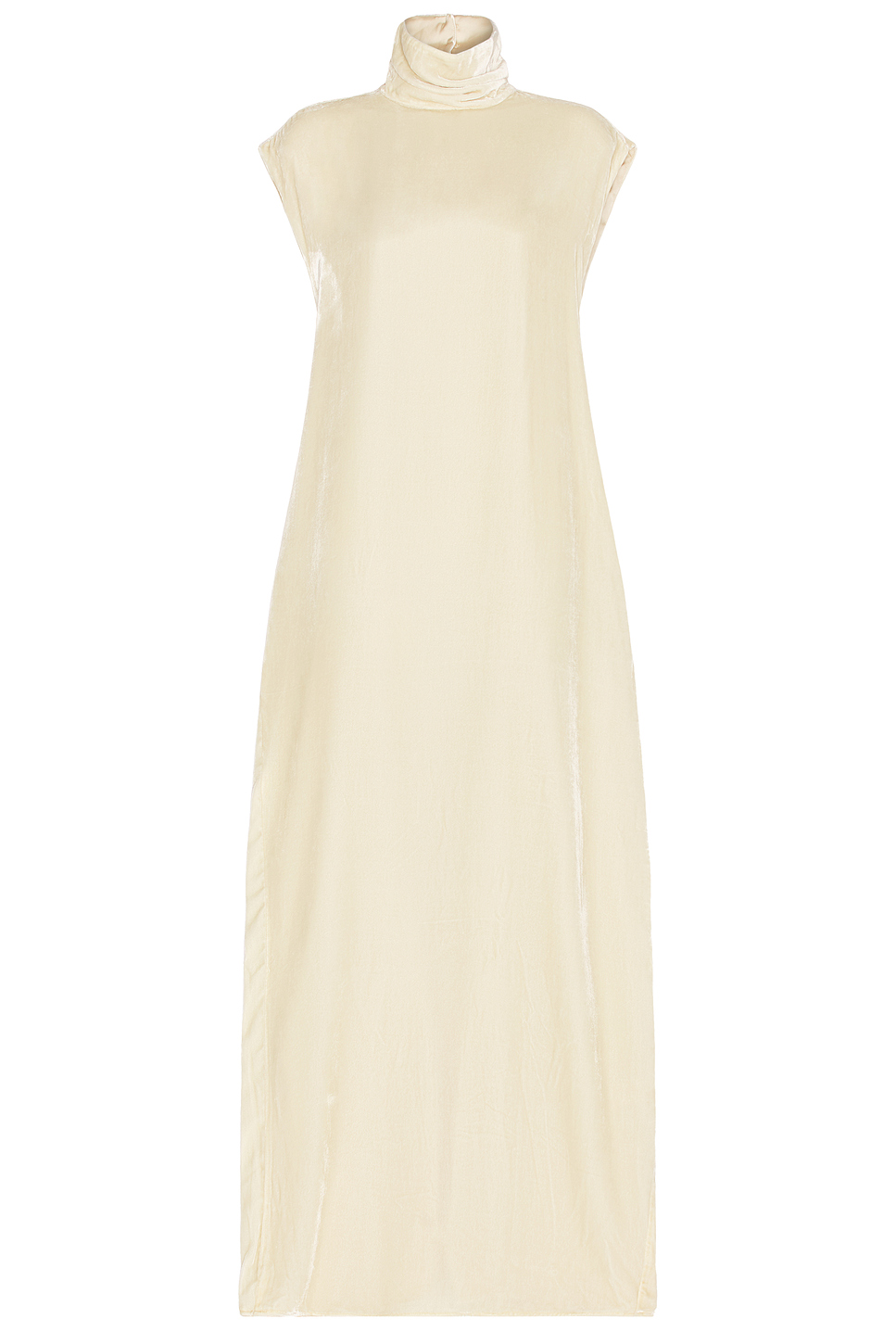
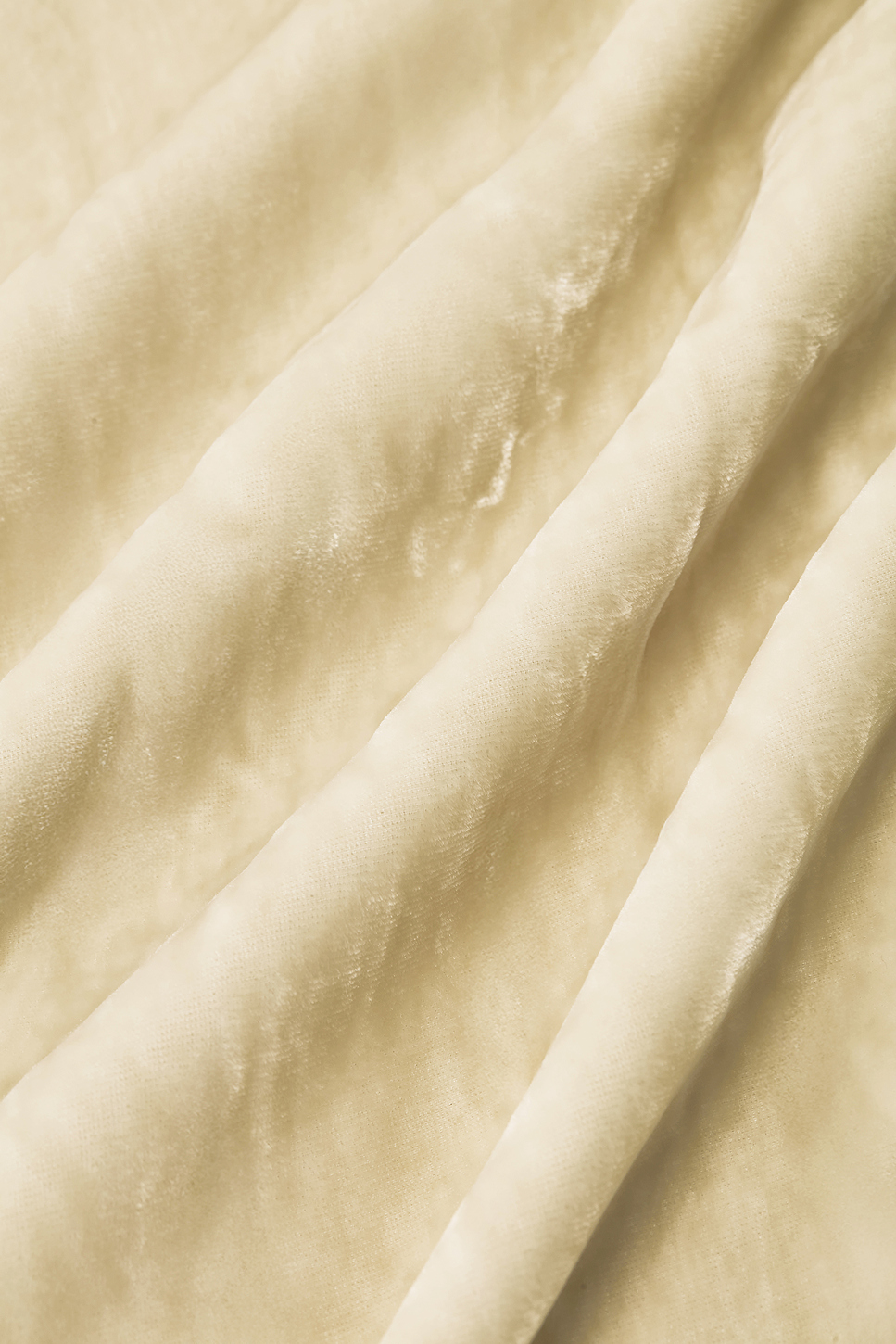
A short sleeve maxi listed as 80% viscose with 20% silk for the shell and 100% polyester for the lining, fully lined, closed with a zip and a button at the back, with a split hem at the back, in a midweight velvet, dry clean only, made in China, at 180 dollars. The listing gives the length as approximately 142 cm from neckline to hem. It shows a 5.0 rating from one review and two fit votes, split evenly. There are no written reviews. This is the first velvet in this series, and velvet has a property that no other fabric we have covered has, which changes how it must be cut and how much cloth it takes. That property is also the reason for two things on this page that look unrelated to each other. There is also a length here that needs a height beside it, and a small construction detail that fails in a predictable place. The reference is the Lily Dress by SRG in Buttercream. Dongguan Bafinasa Garments Co., Ltd. develops comparable velvet dresses on OEM and ODM terms, from fabric sourcing to retail or FBA ready packing. We publish this as a development reference and build your own version of it, and we do not supply the branded original or reproduce anyone else's label.
Key Features
- Shell: 80% viscose, 20% silk as stated
- Lining: 100% polyester as stated
- Midweight velvet as stated
- Fully lined as stated
- Zip and button closure at the back as stated
- Split hem at the back as stated
- Dry clean only as stated
- Length approximately 142 cm from neckline to hem as stated
Customisable Options
- Fabric: viscose silk velvet as the reference, with the pile height and weight set from a tested sample
- Cutting: we would specify a one way layout, for the reason set out below
- Hem: we would reinforce the top of the split, for the reason set out below
- Care: dry clean only as the reference, and we would add steam only, no pressing
- Length from midi to floor, split height, size set, colour development, private label and care labelling
Specifications
| Style | Lily silk viscose velvet maxi |
| Reference | SRG, Lily Dress, style SRGR-WD23, manufacturer style SRD10045 H25, colour Buttercream |
| Shell | 80% viscose, 20% silk as stated |
| Lining | 100% polyester as stated |
| Fabric | Midweight velvet as stated, which is the first velvet in this series |
| Velvet Note | Velvet has a direction, and it changes both the cutting and the amount of cloth needed. See the note below |
| Closure | Zip and button closure at the back as stated |
| Hem | Split hem at the back as stated |
| Length | Approximately 142 cm from neckline to hem as stated |
| Care | Dry clean only as stated |
| Sizes Published | XXS, XS, S, M, L, XL |
| Size Chart | No measurements published on this listing |
| Model | 179 cm, wearing size XS, bust 34 in, waist 24 in, hips 34 in |
| Production | Made in China as stated |
| Reference Retail | 180 USD, quoted to show the price band this sits in, not as our price |
| Customer Reviews | 5.0 from 1 review as stated, which is a rating with no written comment |
| Fit Votes | 2 votes, split evenly between true to size and runs large, which is too small a sample to use |
| Best Seller Badge | None. The listing carries no rank |
| Categories | Filed by the retailer under both maxi dresses and short sleeve dresses |
| Occasion | Winter events, evenings, formal occasions, celebrations |
| MOQ | 100 pcs per style per colourway, mixed sizes and colourways accepted |
| Sampling | 7-10 days after tech pack or reference sample confirmation |
| Bulk Lead Time | 20-30 days after sample approval and deposit |
| Service | OEM / ODM / private label, velvet sourcing, retail or FBA ready packing |
Size Chart
| Size | Bust | Waist | Hips | Length | Source | ||||||||||||
|---|---|---|---|---|---|---|---|---|---|---|---|---|---|---|---|---|---|
| XXS | 31 | in / | 79 | cm | 24 | in / | 61 | cm | 34 | in / | 86 | cm | 140 | cm / | 55.1 | in | Our proposal |
| XS | 33 | in / | 84 | cm | 26 | in / | 66 | cm | 36 | in / | 91 | cm | 142 | cm / | 55.9 | in | Our proposal |
| S | 35 | in / | 89 | cm | 28 | in / | 71 | cm | 38 | in / | 97 | cm | 144 | cm / | 56.7 | in | Our proposal |
| M | 37 | in / | 94 | cm | 30 | in / | 76 | cm | 40 | in / | 102 | cm | 146 | cm / | 57.5 | in | Our proposal |
| L | 39 | in / | 99 | cm | 32 | in / | 81 | cm | 42 | in / | 107 | cm | 148 | cm / | 58.3 | in | Our proposal |
| XL | 41 | in / | 104 | cm | 34 | in / | 86 | cm | 44 | in / | 112 | cm | 150 | cm / | 59.1 | in | Our proposal |
This listing publishes no size chart, so the only dimension given anywhere on the page is the length, stated as approximately 142 cm from the neckline to the hem. On a model at 179 cm that is floor length, and on a shorter wearer it will be too long, which is worth saying plainly.
Occasions and Styling
Suits winter events, evenings, formal occasions and celebrations. Velvet with 20% silk is a cold weather fabric, and it is worth saying so on the page, since a customer buying a velvet dress for a summer event will be uncomfortably warm in it.
Production and Quality Control
There is one review and two fit votes on this listing and none of them carry information. There is a fabric here with a property no other in this series has, and that property explains both the care instruction and the cutting.
Velvet has a direction, and it is the reason for two things on this page, and that is the first thing. Velvet is made by weaving two cloths face to face with yarns connecting them, and then cutting those connecting yarns apart, which leaves a surface of upright fibre ends standing off the cloth. That surface is called the pile, and the pile is not flat, it leans. Because it leans, it has a direction, and that direction is the whole of what is difficult about velvet. Run your hand one way and the pile lies smooth and the colour looks deep. Run it the other way and the pile stands up and the same cloth looks lighter and slightly grey. So two panels cut from the same roll and sewn next to each other will appear to be two different colours if their pile runs in different directions. This has a direct and expensive consequence: every panel of a velvet garment has to be cut with its pile running the same way, which means the pattern pieces cannot be flipped or rotated to fit together efficiently on the cloth the way they can with an ordinary fabric. More cloth is wasted. We have been collecting the waste figures at each end of a range across this series: a leather dress at the expensive end, because hides are irregular and scarred and have to be cut around, and a fully fashioned knit at the other end, where the panels come off the machine already shaped and almost nothing is discarded. Velvet sits toward the leather end of that range, not because the material is rare but because of the direction of its pile. That is worth knowing before quoting, because it is invisible in the finished garment and it shows up entirely in the cost of the cloth. The same property explains the care instruction. Dry clean only is right, and not only because viscose loses half its strength when wet and silk takes badly to water: it is because water flattens the pile, and a flattened pile does not come back. A velvet garment that has been wet has dull patches that no amount of brushing or steaming restores. The same applies to pressing, which is why velvet is steamed rather than ironed, and to folding for storage, which crushes the pile along the fold and leaves a line. Velvet should be hung, and ideally rolled rather than folded for transport.
One hundred and forty two centimetres needs a height next to it, and velvet makes that worse, and that is the second thing. The listing gives the length as approximately 142 cm from the neckline to the hem, and the model is 179 cm tall. On her that is floor length. It is worth being precise about what that means for anyone else, because we have made this point twice and it bears repeating in the specific form that matters here. A length in inches or centimetres tells a customer nothing on her own, because what she wants to know is where the hem will fall on her, and that depends on her height as much as on the garment. We said it about a bias cut gown at 54.5 inches on a model at 182 cm, and again about a smocked mini at 23.5 inches, where we added that the shorter the garment the larger the proportional difference a few inches of height makes. Here there is a second reason to care, which is specific to velvet at this length. A hem that touches the ground abrades, and on velvet abrasion flattens the pile, so the bottom edge of the dress will gradually go dull and then shiny relative to the rest of it, and that cannot be fixed. So on a velvet garment, a hem that is slightly short is a better outcome than one that is slightly long, and a customer who is shorter than the model should know that the dress will need altering and that the alteration is worth doing rather than optional. We would say this on the page, and we would photograph it on someone of average height as well as on a tall model.
The split has a top and that is where it fails, and the back has two closures when one would do, and that is the third thing. A split hem is an opening that stops partway up, and the stress of the garment is concentrated at the point where it stops, because that is where the cloth on either side is being pulled in opposite directions every time the wearer takes a step. It is the same concentration of load that makes a tear in a woven cloth travel, and the remedy is the same one used on a pocket opening or on the end of a zip: reinforce the end of it, so the stress spreads into the surrounding cloth instead of sitting on a point. We noted this on a leather dress with a vent at the back, where the problem was different, because leather is stiff enough to hold the vent open rather than let it fall shut, and we said then that the back is the one place the wearer cannot check on herself. That applies here too. The second point is the closure: a zip and a button, both at the back. We have criticised this before, on a dress with a hook and eye and a zip at the back, where the objection was that there were two actions and neither was in front of her. Here a button is the harder of the two, because a button is a small rigid object that has to be pushed through a hole aligned with it, and doing that behind your own back is genuinely difficult, which is the same objection we raised to a button loop at the back of the neck. The usual reason for the second closure is to take strain off the teeth of the zip at the point where a zip most often fails, and that is a sound idea. But a self locking slider does that job without asking the wearer to do anything, which is what we recommended on the other dress. We would specify that and keep the button as a decorative detail if the look is wanted. Every bulk shipment gets a measurement report against your approved chart.
Optional upgrades include a one way cutting layout specified and costed, the top of the split reinforced, a self locking zip slider so the button does not have to function, steam only and hang to store stated on the care label, the length published against a height with photography on someone of average height, alternative pile heights, alternative lengths, extended sizing, colour development and private label, hangtag and care labelling.
Pre-production sample approval, in-line inspection during cutting and sewing, and a final AQL inspection before packing, with measurement reports and photos shared before shipment.
Send us your tech pack, a photo or a reference garment and we will quote within 24 hours. Contact bafinasa@bafinasa.com or WhatsApp +86 13827222469.