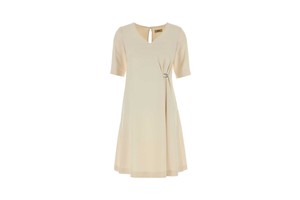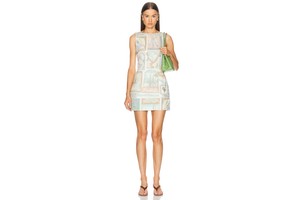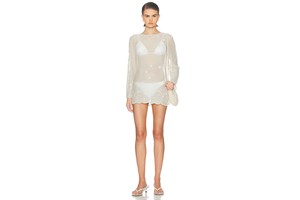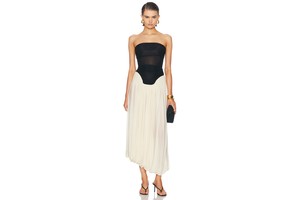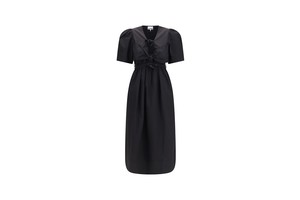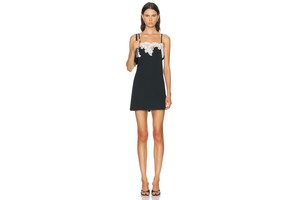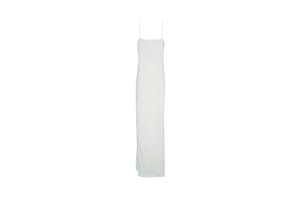
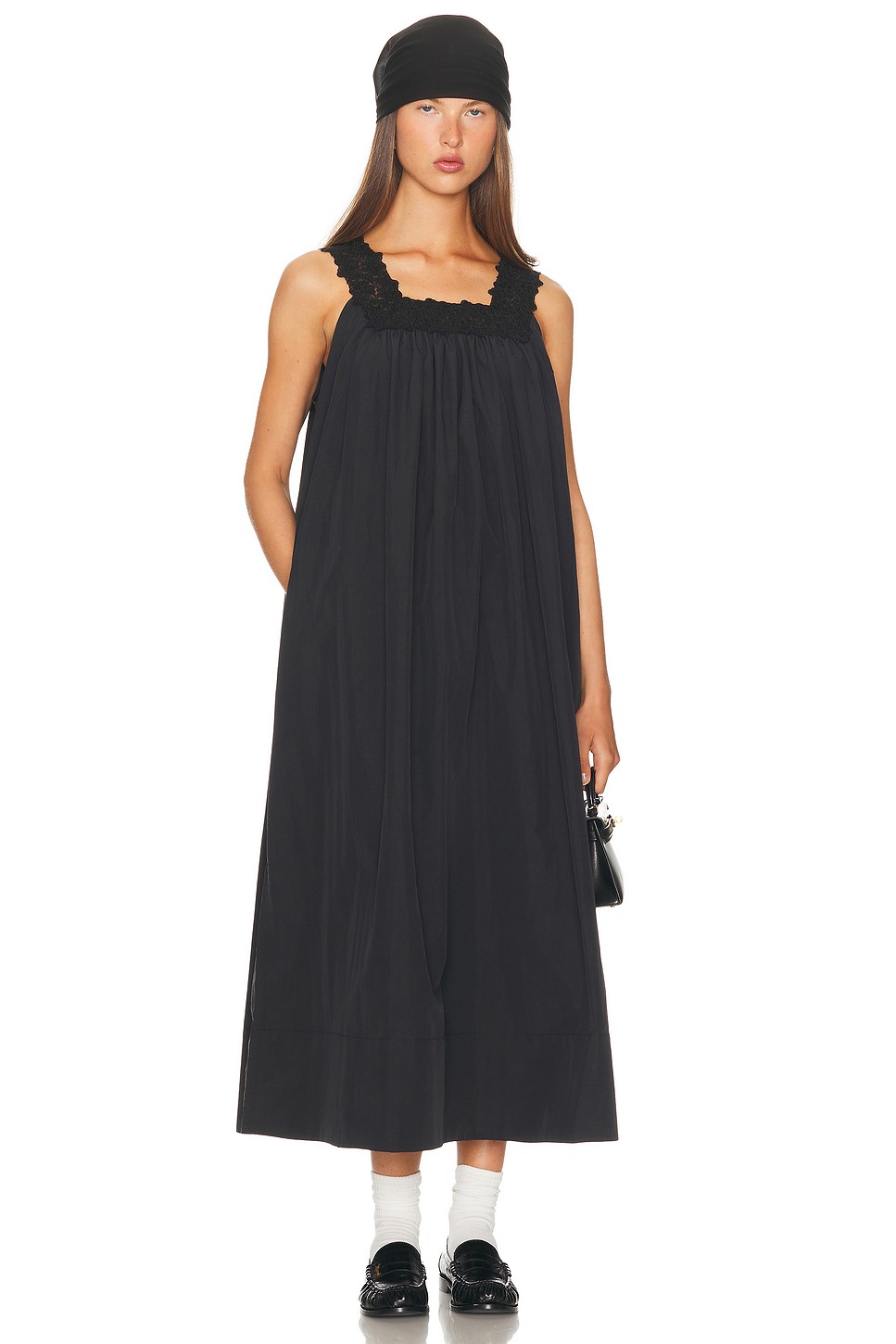
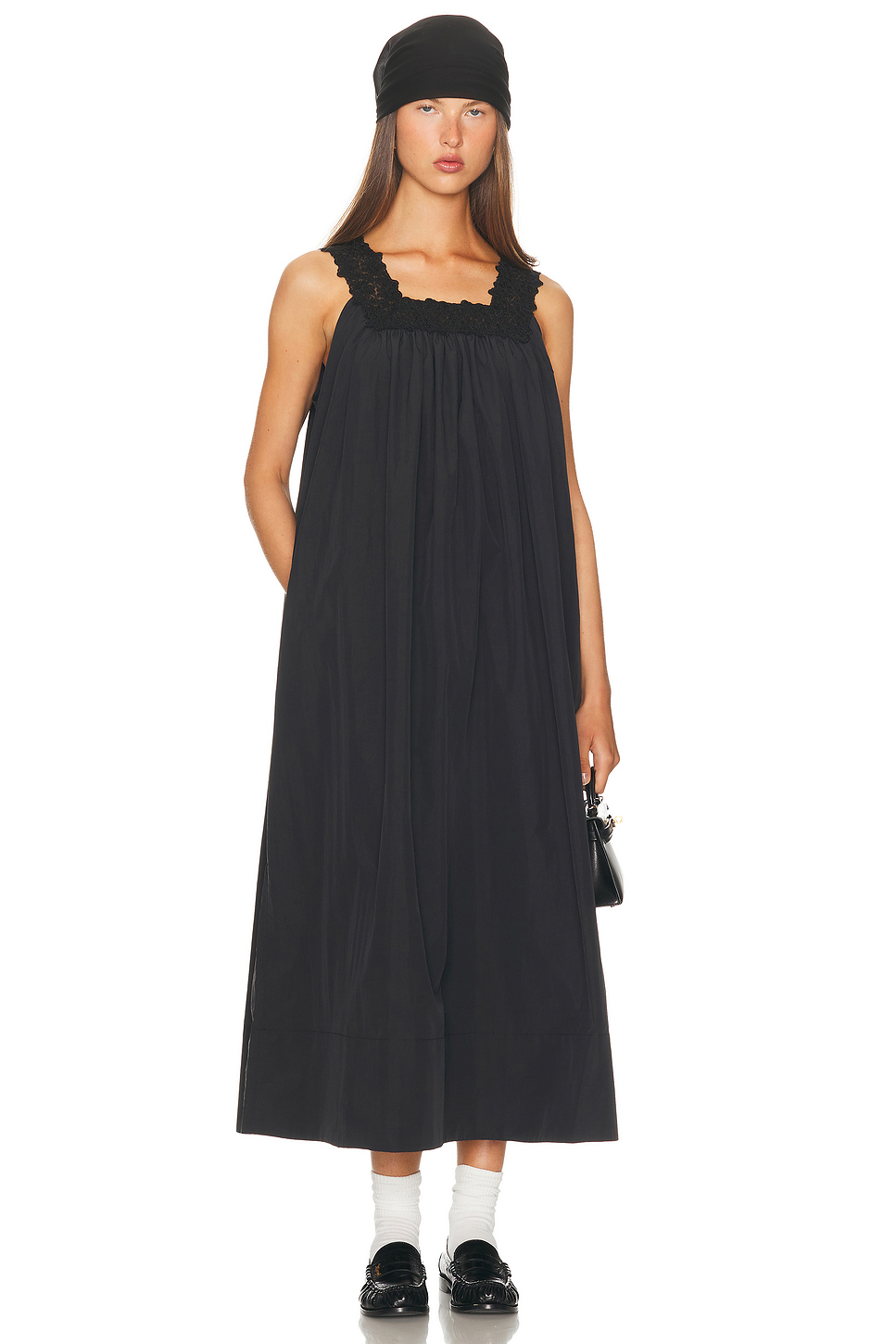
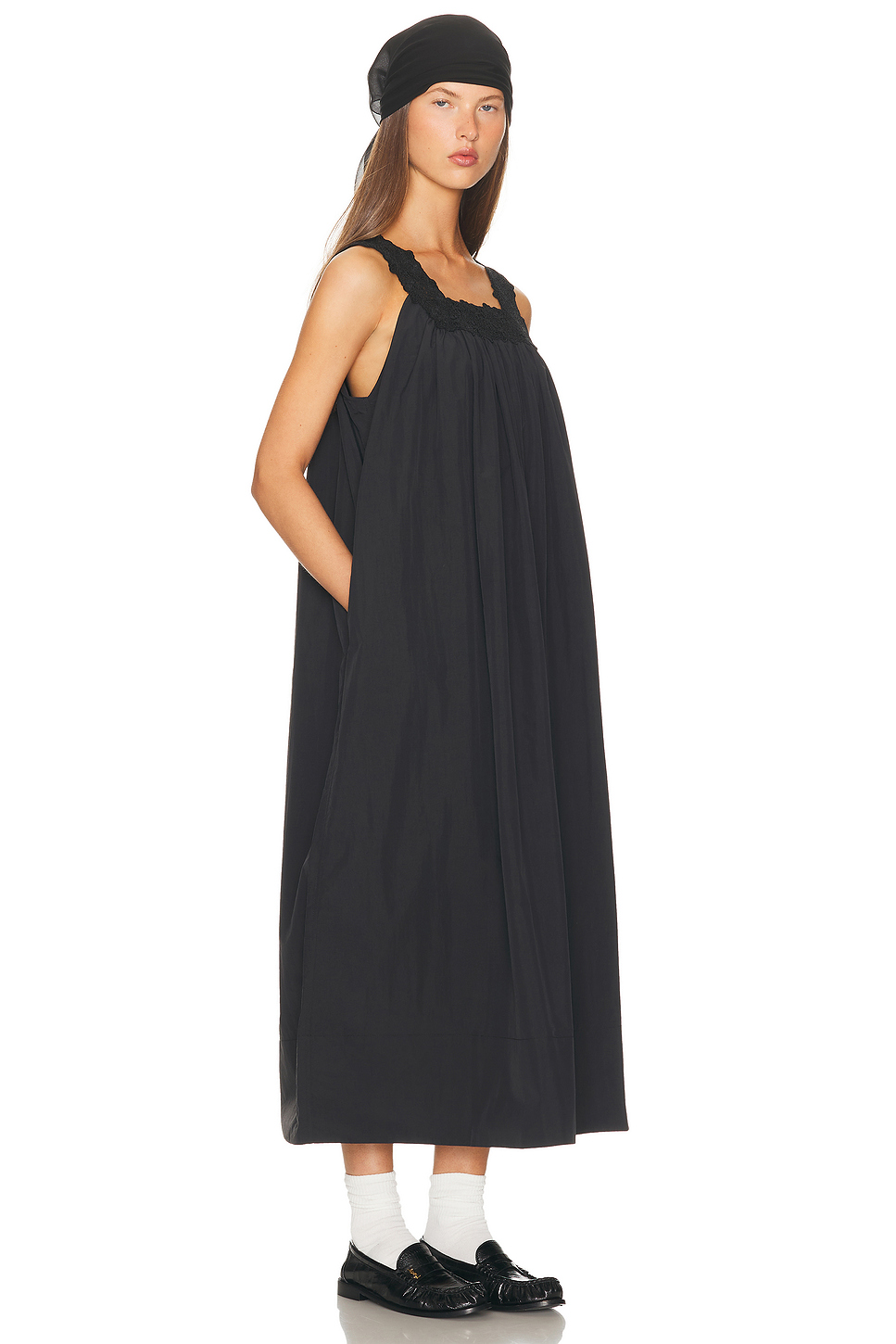
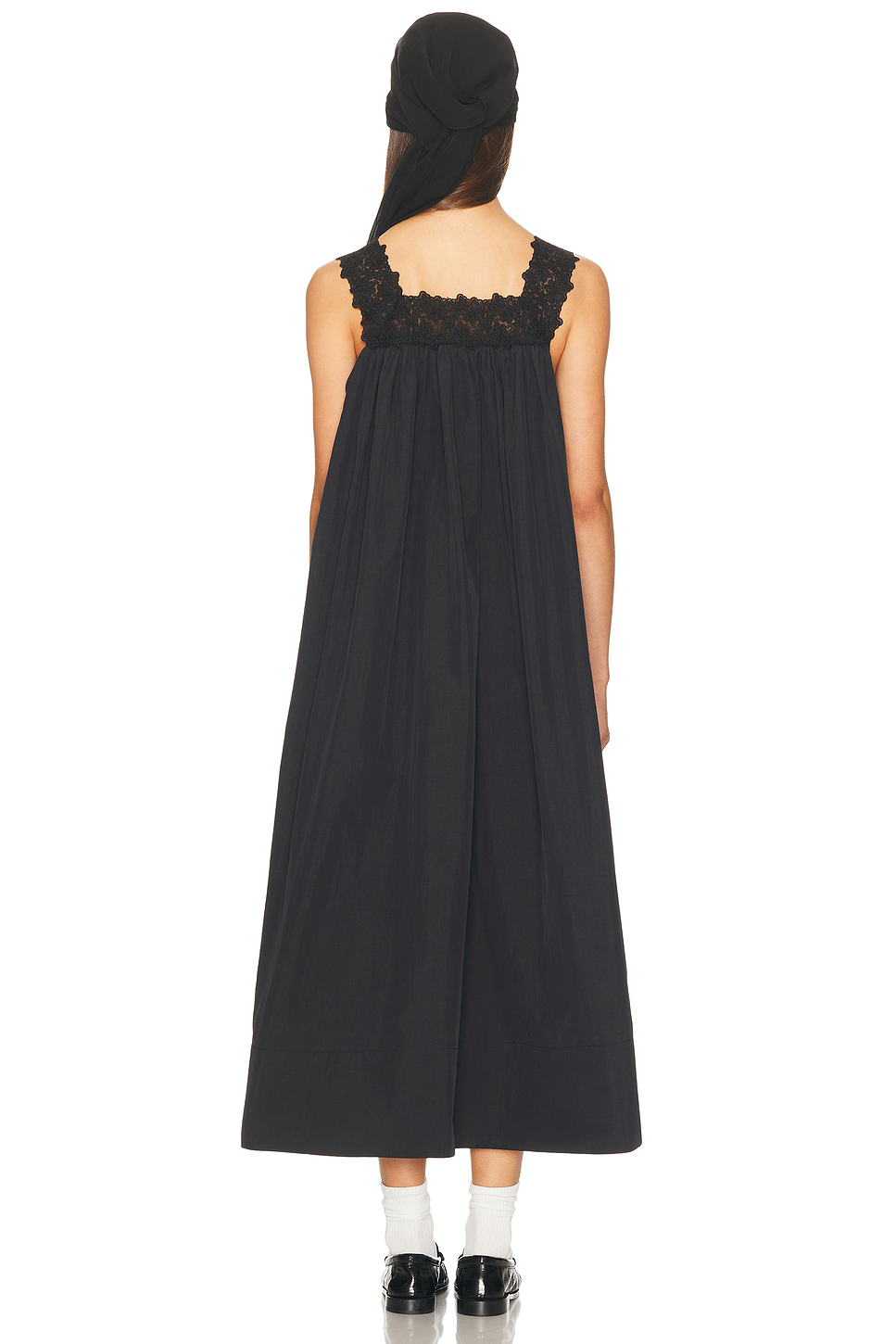
A midi dress listed as 63% nylon with 37% cotton, unlined, pull-on with no zip, with a square neckline at the front and the back, pockets in the side seams and embroidery at the neckline and straps, in a taffeta, dry clean only, made in China, ranked second in the retailer's black dress list, at 224 dollars. The listing shows a 4.8 rating from eight reviews and fifteen fit votes, of which 60% report true to size and 40% large, with nobody reporting it small. There are no written reviews. This is the largest sample of fit votes we have found in this series and it points in a direction, which is more than most of them do, and the direction has a cause we can identify. There is also a contradiction between the name and the description here, and a fabric with a specific failure mode that is worth knowing before anyone cuts it. The reference is the Midi Dress With Lace in Tech Poplin by Helsa in Black. Dongguan Bafinasa Garments Co., Ltd. develops comparable taffeta dresses on OEM and ODM terms, from fabric sourcing to retail or FBA ready packing. We publish this as a development reference and build your own version of it, and we do not supply the branded original or reproduce anyone else's label.
Key Features
- 63% nylon, 37% cotton as stated
- Taffeta as stated, with the style name giving Tech Poplin
- Square neckline at the front and the back as stated
- Embroidery at the neckline and straps as stated
- Pockets in the side seams as stated
- Pullover with no zip as stated
- Unlined as stated
- Dry clean only as stated
Customisable Options
- Fabric: nylon cotton taffeta as the reference, with the weight set from a tested sample and the embroidery yarn specified
- Ease: we would allow room at the stress points, for the reason set out below
- Pockets: we would add a stay at the opening, since taffeta does not fall closed
- Sizing: we would act on the fit votes, since they point clearly in one direction
- Length from mini to maxi, embroidery pattern, size set, colour development, private label and care labelling
Specifications
| Style | Lace trim taffeta midi |
| Reference | Helsa, Midi Dress With Lace in Tech Poplin, style HLSA-WD226, manufacturer style HED10003 U25, colour Black |
| Composition | 63% nylon, 37% cotton as stated |
| Fabric | Taffeta as stated, while the style name gives Tech Poplin, which is a different cloth. See the note below |
| Neckline | Square neckline at the front and the back as stated |
| Detail | Embroidery at the neckline and straps as stated, with pockets in the side seams |
| Closure | Pullover with no zip as stated |
| Lining | Unlined as stated |
| Care | Dry clean only as stated |
| Sizes Published | XXS, XS, S, M, L, XL |
| Size Chart | No measurements published on this listing |
| Model | 179 cm, wearing size XS, bust 34 in, waist 24 in, hips 34 in |
| Production | Made in China as stated |
| Reference Retail | 224 USD, quoted to show the price band this sits in, not as our price |
| Customer Reviews | 4.8 from 8 reviews as stated, all of which are ratings with no written comment |
| Fit Votes | 15 votes: 60% true to size, 40% runs large, 0% runs small as stated |
| Vote Note | Fifteen votes is the largest sample in this series and 0% small points one way. See the note below |
| Best Seller Badge | Rank 2 in the retailer's black dress list, which is a strong position |
| Categories | Filed by the retailer under both black dresses and midi dresses |
| Occasion | Evenings, events, parties, formal occasions |
| MOQ | 100 pcs per style per colourway, mixed sizes and colourways accepted |
| Sampling | 7-10 days after tech pack or reference sample confirmation |
| Bulk Lead Time | 20-30 days after sample approval and deposit |
| Service | OEM / ODM / private label, taffeta sourcing, embroidery development, retail or FBA ready packing |
Size Chart
| Size | Bust | Waist | Hips | Length | Source | ||||||||||||
|---|---|---|---|---|---|---|---|---|---|---|---|---|---|---|---|---|---|
| XXS | 31 | in / | 79 | cm | 24 | in / | 61 | cm | 34 | in / | 86 | cm | 112 | cm / | 44.1 | in | Our proposal |
| XS | 33 | in / | 84 | cm | 26 | in / | 66 | cm | 36 | in / | 91 | cm | 114 | cm / | 44.9 | in | Our proposal |
| S | 35 | in / | 89 | cm | 28 | in / | 71 | cm | 38 | in / | 97 | cm | 116 | cm / | 45.7 | in | Our proposal |
| M | 37 | in / | 94 | cm | 30 | in / | 76 | cm | 40 | in / | 102 | cm | 118 | cm / | 46.5 | in | Our proposal |
| L | 39 | in / | 99 | cm | 32 | in / | 81 | cm | 42 | in / | 107 | cm | 120 | cm / | 47.2 | in | Our proposal |
| XL | 41 | in / | 104 | cm | 34 | in / | 86 | cm | 44 | in / | 112 | cm | 122 | cm / | 48 | in | Our proposal |
This listing publishes no size chart. The fit votes are the largest sample we have found in this series at fifteen responses, with 40% reporting the garment runs large and nobody reporting it small, which is a clear direction and the only sizing evidence on the page worth using.
Occasions and Styling
Suits evenings, events, parties and formal occasions. A taffeta midi with embroidery is an event piece, and it should be photographed in movement as well as standing, because taffeta makes a sound and has a particular way of catching light that a still image does not convey.
Production and Quality Control
There are eight reviews and fifteen fit votes on this listing. The reviews carry no information at all. The votes are the largest sample in this series and they point in one direction, and that direction has an identifiable cause.
Fifteen votes pointing one way is usable evidence and it has a cause, and that is the first thing. We have been sceptical of fit votes throughout this series, and for two distinct reasons. The first is small samples: we said of a dress with two votes that an even split looks like information and is not, and that with two votes pointing opposite ways you have learned nothing about which way a garment runs. The second is samples that disagree: we found one with eleven votes split almost exactly evenly between true to size and large, and argued there that the disagreement was not noise because the sample was big enough to be sure of it, and that what it told us was that the garment has no single answer. This is the opposite of that. Fifteen people responded, nobody said small, and 40% said large, so the disagreement is only in one direction. That is not an absence of consensus, it is a lean, and it is the largest sample we have met, so we would act on it. The cause is also visible on the page: this is a pullover with no zip. We have now found this several times and the mechanism is always the same, that a garment with no opening has to be cut large enough at every circumference to pass over the widest part of the body, so it is generous by necessity rather than by choice. On this garment there is a second cause compounding it, which is taffeta, a cloth with essentially no stretch. So it cannot be cut closer and still go on. That is a complete explanation for 40% saying large, and it means the honest thing is to say so on the page rather than to change the pattern, because the pattern cannot change much without adding an opening. We would publish measurements and a note that the garment runs large, and add a concealed zip if a closer fit is wanted.
The name says poplin and the description says taffeta, and taffeta is the one with a failure mode, and that is the second thing. The style name gives Tech Poplin and the description gives taffeta. Both are plain weaves, so they are related, but they are not the same cloth. Poplin has more warps than wefts, which gives it a faint crosswise rib, and it is comparatively soft and matte. Taffeta has warps and wefts of similar density, which makes it crisp and smooth with a sheen, and the characteristic that anyone who has handled it knows, which is that it rustles. The composition supports taffeta rather than poplin: a nylon and cotton blend at 63 to 37 is a classic taffeta construction, since nylon gives the cloth its crispness and its sheen. So we read the description as the accurate one and the name as a piece of branding, and we note it as the third time in this series that a name and a description have not agreed, which is worth flagging as a habit rather than as a serious problem in itself. What matters about taffeta is its failure mode, and it is specific. Taffeta splits. Because it is crisp and closely woven with little give, the yarns cannot shift to relieve stress, so when the cloth is under tension it tends to tear along the line of the yarns rather than stretch, and the places it happens are the places a garment is stressed: the armscye where the sleeve meets the body, and the side seams, and anywhere the cloth is pulled tight over a hip. The remedy is not a stronger cloth, it is ease: the garment needs room at those points so the cloth is never asked to carry load in tension. We would build that in and test by sitting and reaching rather than by standing still. There is a second property worth knowing, which is that taffeta holds a crease and marks with water, so it cannot be pressed with a hot iron on the right side and it should not be spot treated with water, which is one reason dry clean only is correct here.
Embroidery adds a fibre the label does not mention, and the pockets will gape, and that is the third thing. The composition gives nylon and cotton, which is the ground cloth. But there is embroidery at the neckline and the straps, and embroidery is stitched with a yarn of its own which the label does not account for. We made this point about a broderie cotton dress and said it is worth knowing because the embroidery yarn is often viscose or polyester rather than cotton, since those dye more brightly and have a sheen that reads against a matte ground, and if the embroidery yarn and the ground cloth move by different amounts in water the embroidery puckers, meaning the stitched areas pull into ridges and the cloth around them will not lie flat. That fault appears after washing rather than before, which is why it is missed in sampling. Here it is avoided, because dry clean only means no water and therefore no differential movement at all. So the strict instruction is doing the same job we identified on a three fibre silk dress, where we said dry cleaning was the only thing making an otherwise impossible combination of fibres viable. The pockets are a separate and more ordinary problem. A pocket in a side seam is an opening cut into the seam, and a stiff cloth does not fall closed over an opening, so a slit pocket in taffeta will stand open rather than lying shut, more so than in a softer cloth. We noted the same on a poplin shirt dress and recommended a stay at the opening so it cannot stretch, and a pocket bag deep enough that a phone sits below the hip rather than pulling at the seam. Both apply here. One last point on the neckline: it is square at the front and the back. We have said repeatedly that an open back rules out a normal bra and that this is a decision the customer makes before buying rather than after, and a square neckline at the back is wide enough to show a strap. It is worth one sentence on the page. Every bulk shipment gets a measurement report against your approved chart.
Optional upgrades include ease built into the armscye and side seams since taffeta splits rather than stretches, a stay at the pocket opening and a deeper pocket bag, the embroidery yarn specified and tested against the ground cloth, dry clean only kept, measurements published with a note that the garment runs large, a concealed zip if a closer fit is wanted, alternative embroidery patterns, alternative lengths, extended sizing, colour development and private label, hangtag and care labelling.
Pre-production sample approval, in-line inspection during cutting and sewing, and a final AQL inspection before packing, with measurement reports and photos shared before shipment.
Send us your tech pack, a photo or a reference garment and we will quote within 24 hours. Contact bafinasa@bafinasa.com or WhatsApp +86 13827222469.