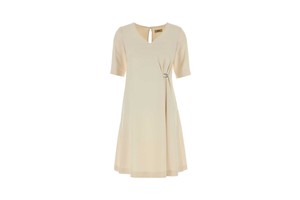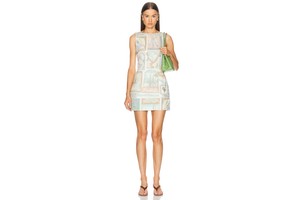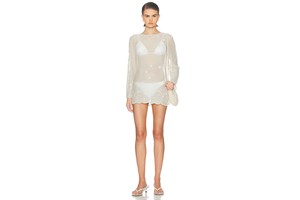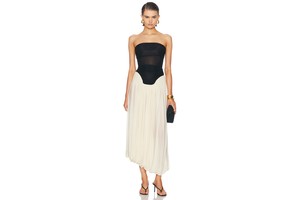
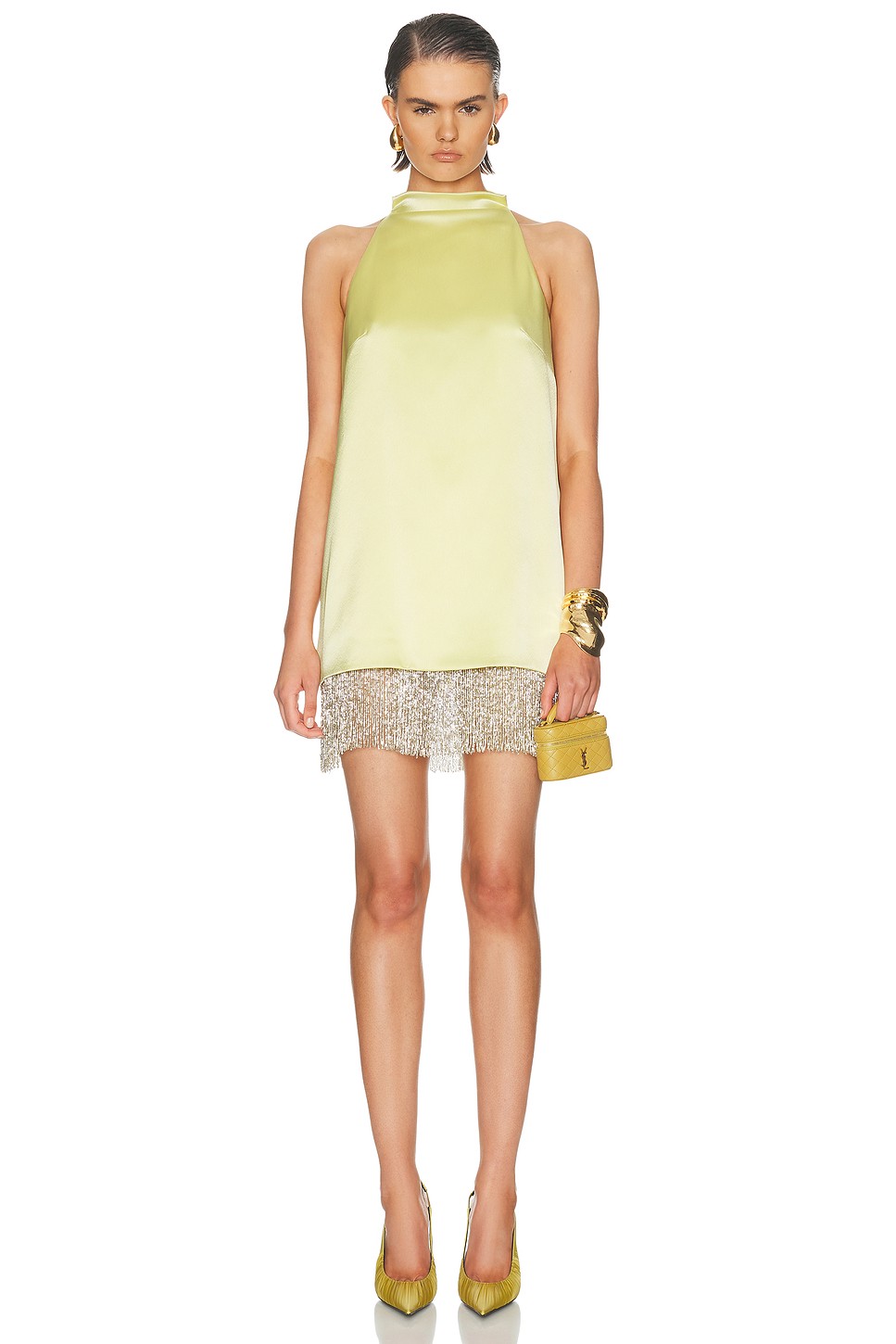
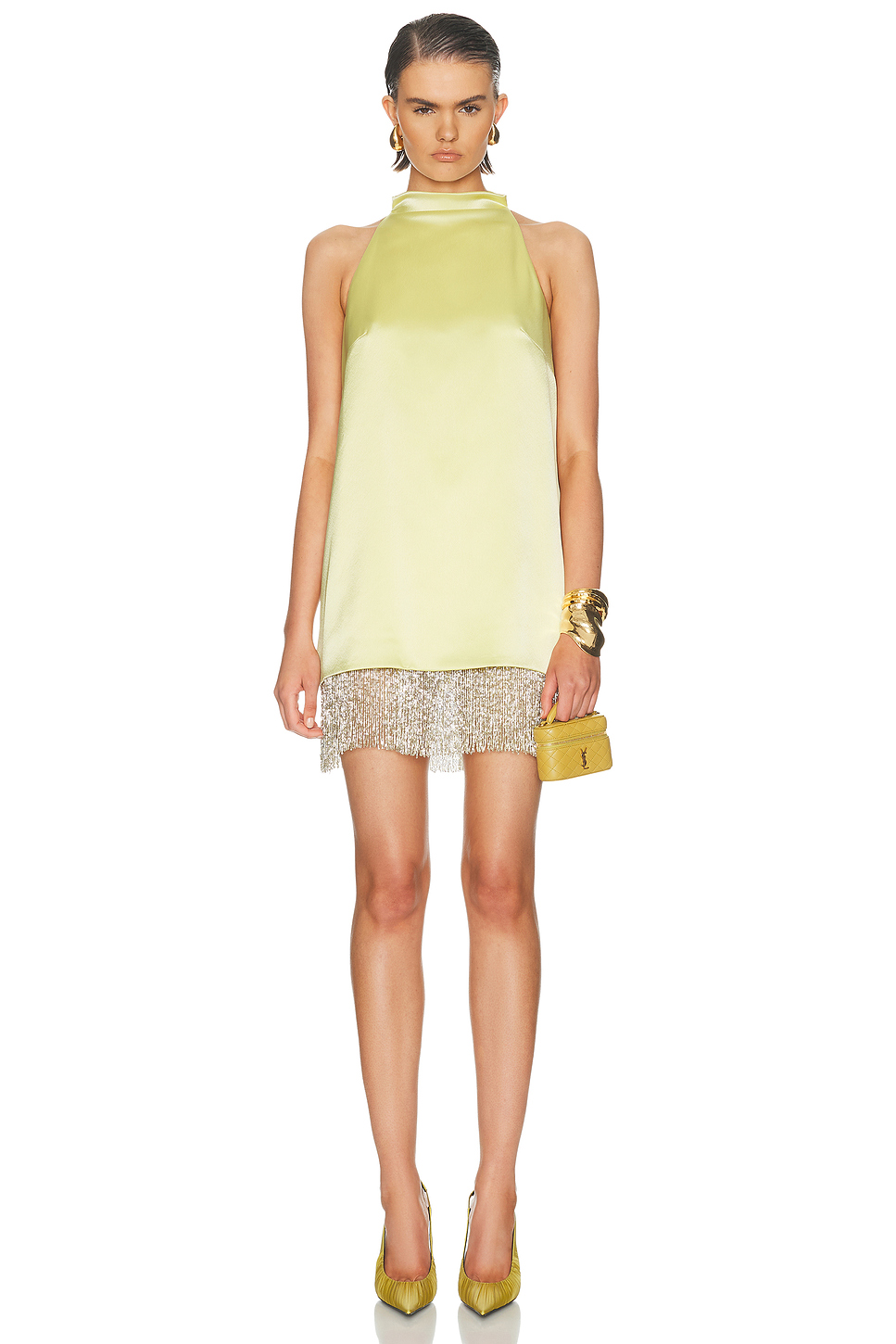
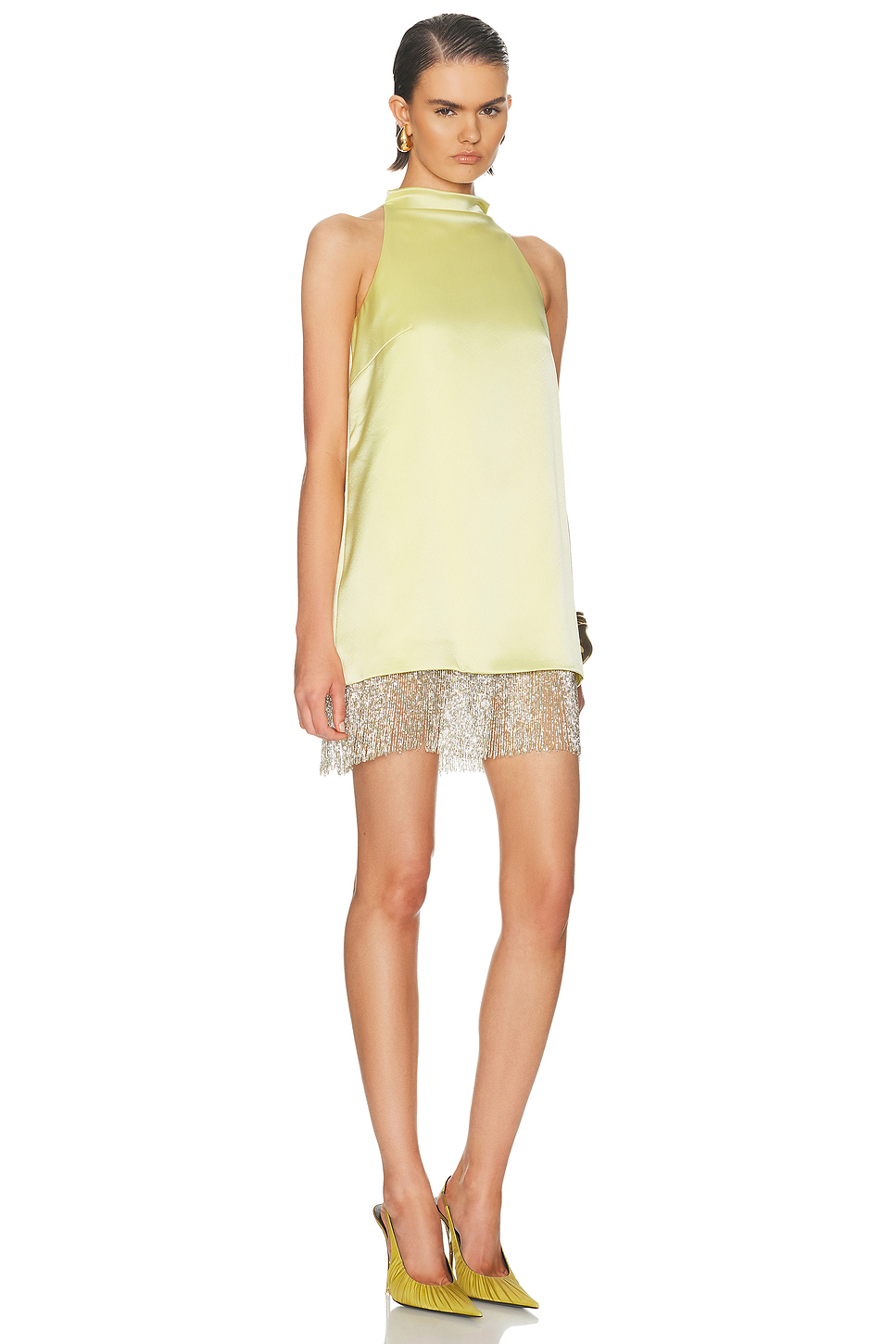
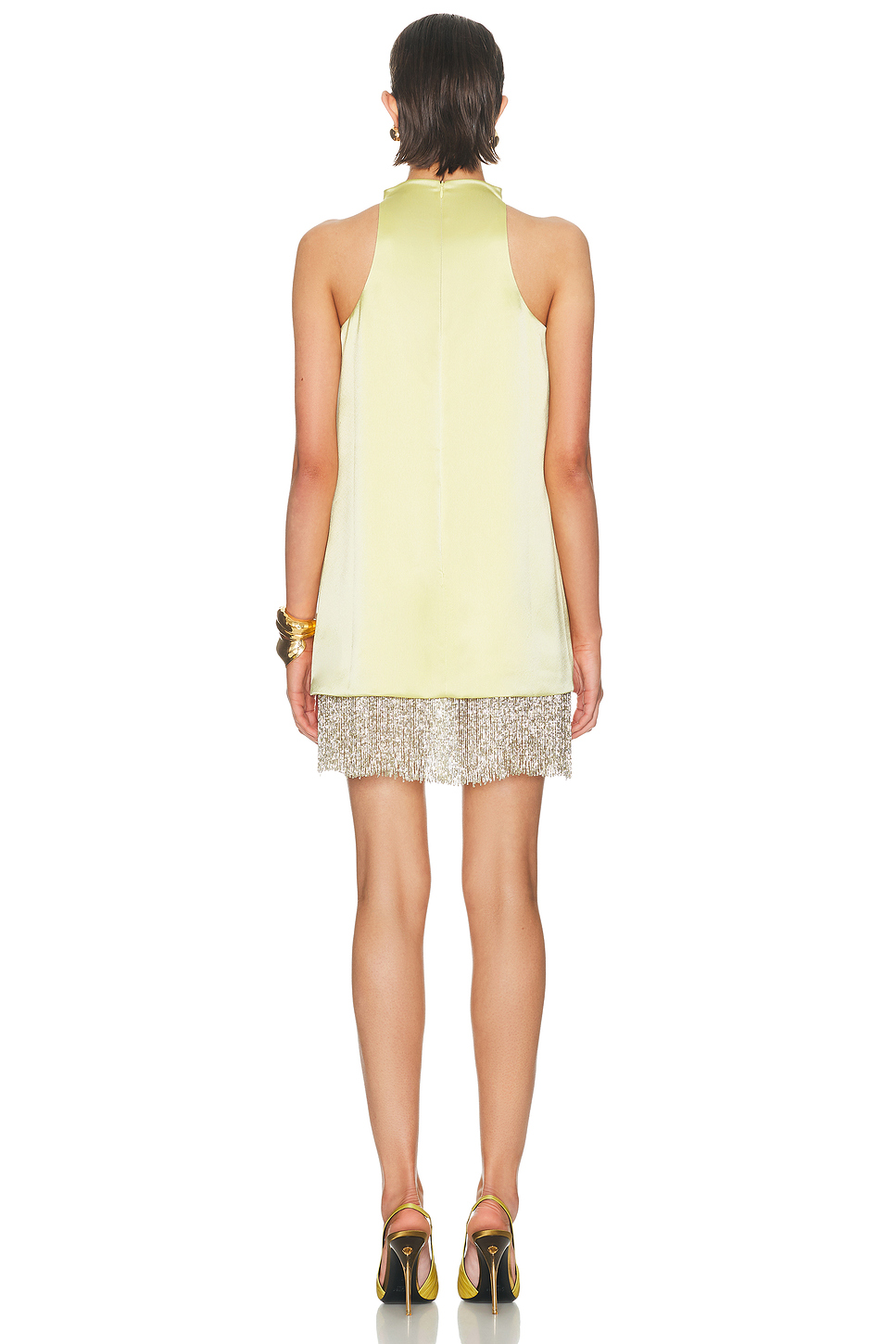
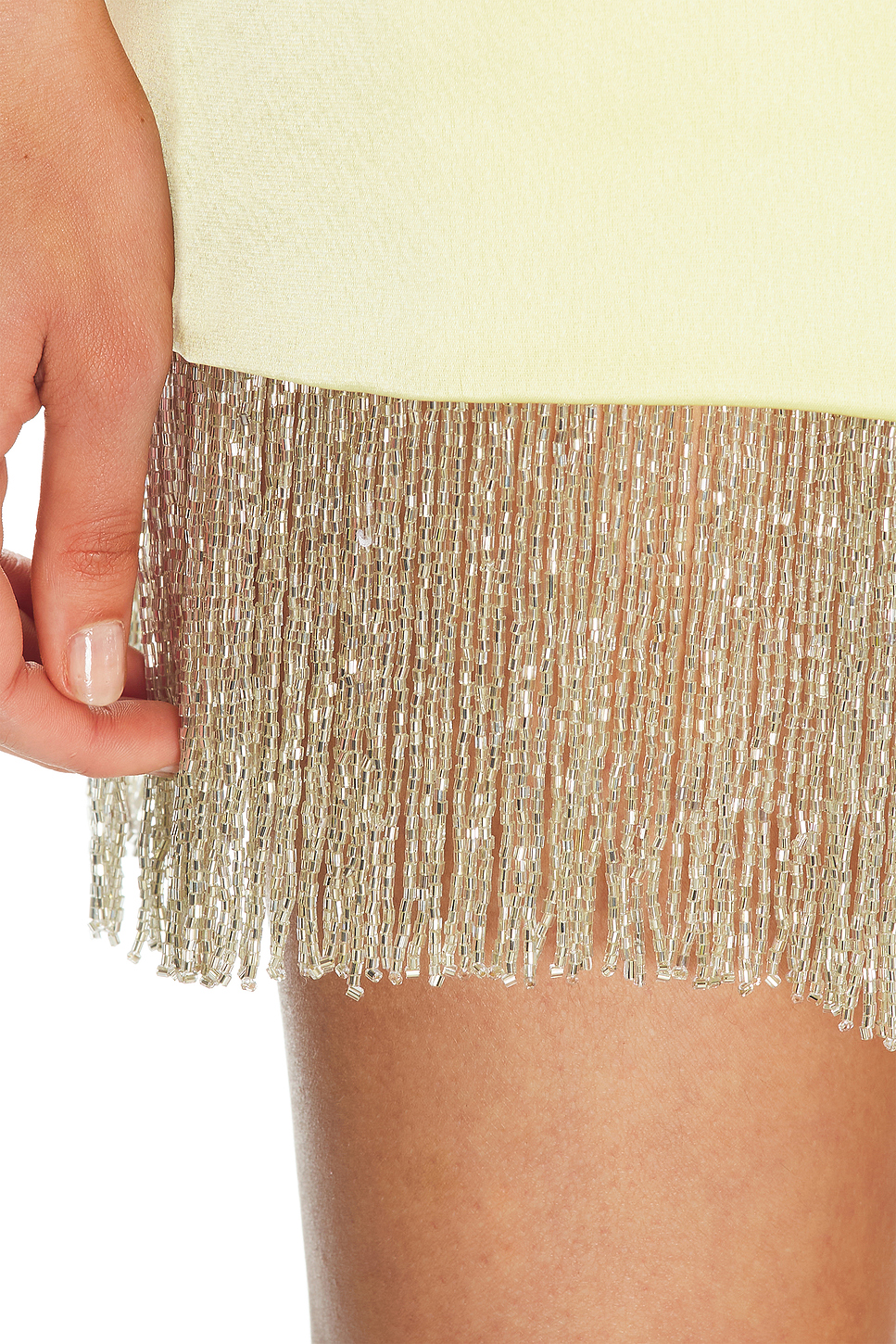
A cocktail dress listed as 100% polyester for the shell with an interior of 80% triacetate and 20% polyester, fully lined, closed with a concealed back zip and a hook and eye, with rhinestone fringe trim, in a midweight satin, dry cleanable, made in Spain, ranked thirteenth in the retailer's embellished list, at 960 dollars. There are no reviews and no fit votes, so there is no score to quote. There are three things here that are each worth a close look, and two of them concern the embellishment, which is the part most likely to go wrong and the part a photograph least prepares you for. There is also a fibre in the lining that is easily confused with a more troublesome relative, and the distinction matters for how the garment is cared for. The reference is the Daniella Dress by SEV in Yellow. Dongguan Bafinasa Garments Co., Ltd. develops comparable embellished dresses on OEM and ODM terms, from fabric and trim sourcing to retail or FBA ready packing. We publish this as a development reference and build your own version of it, and we do not supply the branded original or reproduce anyone else's label.
Key Features
- Shell: 100% polyester as stated
- Interior: 80% triacetate, 20% polyester as stated
- Fully lined as stated
- Rhinestone fringe trim as stated
- Midweight satin as stated
- Concealed back zip with hook and eye as stated
- Dry cleanable as stated, which is not the same instruction as dry clean only
- Made in Spain as stated
Customisable Options
- Fabric: polyester satin as the reference, with the weight set from a tested sample
- Interior: triacetate blend as the reference, which is a good choice and we would keep it
- Trim: we would establish how the stones are attached, for the reason set out below
- Care: we would tighten the instruction, and possibly follow the strictest example in this series, for the reason set out below
- Length from mini to knee, trim placement, size set, colour development, private label and care labelling
Specifications
| Style | Daniella rhinestone fringe cocktail dress |
| Reference | SEV, Daniella Dress, style STVF-WD21, manufacturer style 26SSC-1051, colour Yellow |
| Shell | 100% polyester as stated |
| Interior | 80% triacetate, 20% polyester as stated |
| Triacetate Note | Triacetate is not the same fibre as acetate and is considerably more stable. See the note below |
| Fabric | Midweight satin as stated |
| Trim | Rhinestone fringe trim as stated, with the attachment method not published |
| Closure | Concealed back zip with hook and eye closure as stated |
| Lining | Fully lined as stated |
| Care | Dry cleanable as stated, which is a weaker instruction than dry clean only |
| Sizes Published | 34, 36, 38, 40, 42, which is French sizing and does not map directly onto US or UK sizes |
| Measurements Published | 36: bust 32 in, waist 36 in, hips 40 in, length 32 in |
| Chart Note | Generous at the waist and hip, so this is a relaxed rather than fitted shape |
| Model | 178 cm, wearing size 36, bust 84 cm, waist 62 cm, hips 89 cm |
| Production | Made in Spain as stated |
| Reference Retail | 960 USD, quoted to show the price band this sits in, not as our price |
| Customer Reviews | None on the reference listing, so we quote no score |
| Best Seller Badge | Rank 13 in the retailer's embellished and sequined dress list, which is a strong position |
| Categories | Filed by the retailer under both cocktail dresses and embellished dresses |
| Occasion | Parties, cocktails, celebrations, evenings |
| MOQ | 100 pcs per style per colourway, mixed sizes and colourways accepted |
| Sampling | 7-10 days after tech pack or reference sample confirmation |
| Bulk Lead Time | 20-30 days after sample approval and deposit |
| Service | OEM / ODM / private label, satin and embellishment sourcing, retail or FBA ready packing |
Size Chart
| Size | Bust | Waist | Hips | Length | Source | ||||||||||||
|---|---|---|---|---|---|---|---|---|---|---|---|---|---|---|---|---|---|
| 36 | 32 | in | 36 | in | 40 | in | 32 | in / | 81 | cm | As published | ||||||
| 34 | 31 | in / | 79 | cm | 24 | in / | 61 | cm | 34 | in / | 86 | cm | 79 | cm / | 31.1 | in | Our proposal |
| 36 | 33 | in / | 84 | cm | 26 | in / | 66 | cm | 36 | in / | 91 | cm | 81 | cm / | 31.9 | in | Our proposal |
| 38 | 35 | in / | 89 | cm | 28 | in / | 71 | cm | 38 | in / | 97 | cm | 83 | cm / | 32.7 | in | Our proposal |
| 40 | 37 | in / | 94 | cm | 30 | in / | 76 | cm | 40 | in / | 102 | cm | 85 | cm / | 33.5 | in | Our proposal |
| 42 | 39 | in / | 99 | cm | 32 | in / | 81 | cm | 42 | in / | 107 | cm | 87 | cm / | 34.3 | in | Our proposal |
The published size 36 gives a 32 inch bust, a 36 inch waist, a 40 inch hip and a 32 inch length against a model at roughly 33, 24 and 35. The waist and hip are generous, so this is a relaxed shape rather than a fitted one, and anyone expecting it to be close through the body should know that before buying.
Occasions and Styling
Suits parties, cocktails, celebrations and evenings. A rhinestone fringe dress is a piece for a specific occasion, and it should be photographed in motion, because fringe does nothing at all until it moves.
Production and Quality Control
There are no reviews and no fit votes on this listing, so there is no score to quote. There is a fibre in the lining that is often mistaken for a more difficult relative, and two problems with the embellishment.
Triacetate is not acetate, and the difference matters, and that is the first thing. The interior is given as 80% triacetate with 20% polyester, and triacetate is frequently confused with acetate, which is a fibre we discussed earlier in this series. They are related but not the same, and acetate is the more troublesome of the two. We noted two particular vulnerabilities for acetate: it is sensitive to heat, so it must be washed cool, dried away from heat and ironed at a low setting, because too much heat will shrink or glaze it; and it is attacked by acetone, which is the solvent in nail polish remover and in a good many cosmetics and sprays, so a customer who removes nail polish while wearing an acetate garment will put a permanent mark in it. Triacetate is considerably more stable than that. It tolerates higher temperatures, it holds its dimensions better, and it is more resistant to creasing, which is why it is used where a garment needs to keep a pressed appearance. It shares the solvent sensitivity to a degree, so acetone is still worth avoiding, but the heat problem is much reduced. So this is a good choice for an interior, and it is worth saying why: a lining is the layer against the skin, and a fibre that manages moisture and does not crease is more comfortable than one that does not. We have argued throughout that a lining should match the fibre of its shell so the two layers move together, and this does not match, since the shell is polyester. But there is a reason to deviate here, which is comfort, and it is a considered one. It is also worth noting the general point that a lining better than its shell is unusual and worth remarking on, because the usual economy runs the other way.
Rhinestones are usually glued and glue and dry cleaning solvent do not agree, and that is the second thing, and it is the most important caution on this garment. We have worked through two kinds of embellishment already. On a sequinned dress we noted that sequins are normally sewn, and we said it was worth confirming whether they were sewn or bonded, because bonded sequins rely on an adhesive and some adhesives are attacked by dry cleaning solvent, in which case the garment loses its sequins at the cleaner, which we called about the worst possible failure. On a heavily beaded dress we went further and explained why the instruction there was spot clean only, the strictest in this series: beading is thousands of objects held on by thread, water and agitation break and tangle the thread, and solvent is worse because it can attack the thread finish or any adhesive and because any immersion bath tumbles the garment in a way that beading cannot survive. Rhinestones are different from both. A rhinestone is a moulded glass or acrylic stone with a reflective backing, and the overwhelming majority are attached with adhesive rather than with thread, because there is no convenient way to sew one. So a rhinestone trim is entirely dependent on its glue, and glue is the component most likely to be attacked by solvent. The instruction here is dry cleanable, which we have repeatedly flagged as the weaker of the two wordings, because dry clean only says one method is the only safe one while dry cleanable says this method is safe and leaves the rest open. On a garment whose embellishment is held on by adhesive, that ambiguity is dangerous. We would establish how the stones are attached and what adhesive is used, and then set the instruction accordingly. If they are heat-set stones with a solvent resistant adhesive, dry cleanable is fine. If they are glued with anything less, the honest instruction is spot clean only, which is what the beaded dress carried. That is a big difference in what the customer can do with the garment, and it needs to be right.
Fringe catches on everything, and that is the third thing, and it is the failure a customer will actually experience. Fringe is a trim made of lengths of thread or beads hanging free from an edge, so by construction it has no structure holding it in place and it swings. Everything that follows comes from that. It tangles with itself in wear, and it tangles worse in any kind of bath, which is the mechanical reason a fringed garment cannot be immersed even setting the glue aside. It catches on anything with a projection: a handbag clasp, a bracelet, a chair with a rough edge, a ring. And because each strand is anchored at one end only, a caught strand either pulls out or pulls the anchoring stitches with it, and once several have gone the trim looks sparse and there is no way to restore it. This is not a defect, it is what fringe is, and plenty of customers want it knowing that. But it belongs on the page rather than being discovered, and it is worth saying how to store the garment, which is flat or hanging with the fringe free rather than folded, because a folded fringe takes a set that is difficult to remove. We would also look at where the fringe sits. On a dress worn to a party, the most likely place to catch it is on a bag carried at the side or on a chair arm, so a trim placed high on the body is safer than one at the hem. One last point on the closure: there is a back zip with a hook and eye. We criticised a hook and eye at the back on another garment, but that one had no zip, so the hook was carrying the entire load and its failure would have left nothing holding the garment closed. Here there is a zip, so the hook is doing its proper job of taking strain off the teeth at the point where a zip is most likely to fail, and if it defeats the wearer the zip is still there. That is the acceptable version. Every bulk shipment gets a measurement report against your approved chart.
Optional upgrades include the stone attachment method and adhesive established and the care instruction set from that, a note on the page about fringe catching and how to store the garment, fringe placed away from the hem if possible, the triacetate interior kept, the relaxed shape stated on the page, alternative trims, alternative lengths, extended sizing, colour development and private label, hangtag and care labelling.
Pre-production sample approval, in-line inspection during cutting and sewing, and a final AQL inspection before packing, with measurement reports and photos shared before shipment.
Send us your tech pack, a photo or a reference garment and we will quote within 24 hours. Contact bafinasa@bafinasa.com or WhatsApp +86 13827222469.