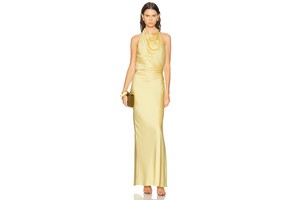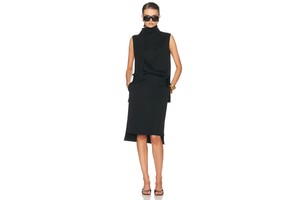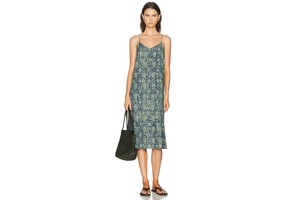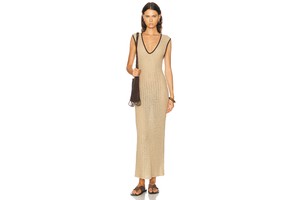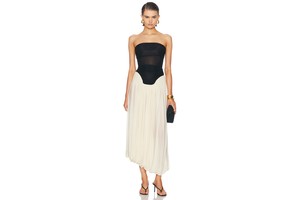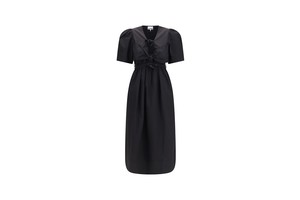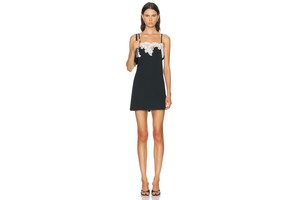
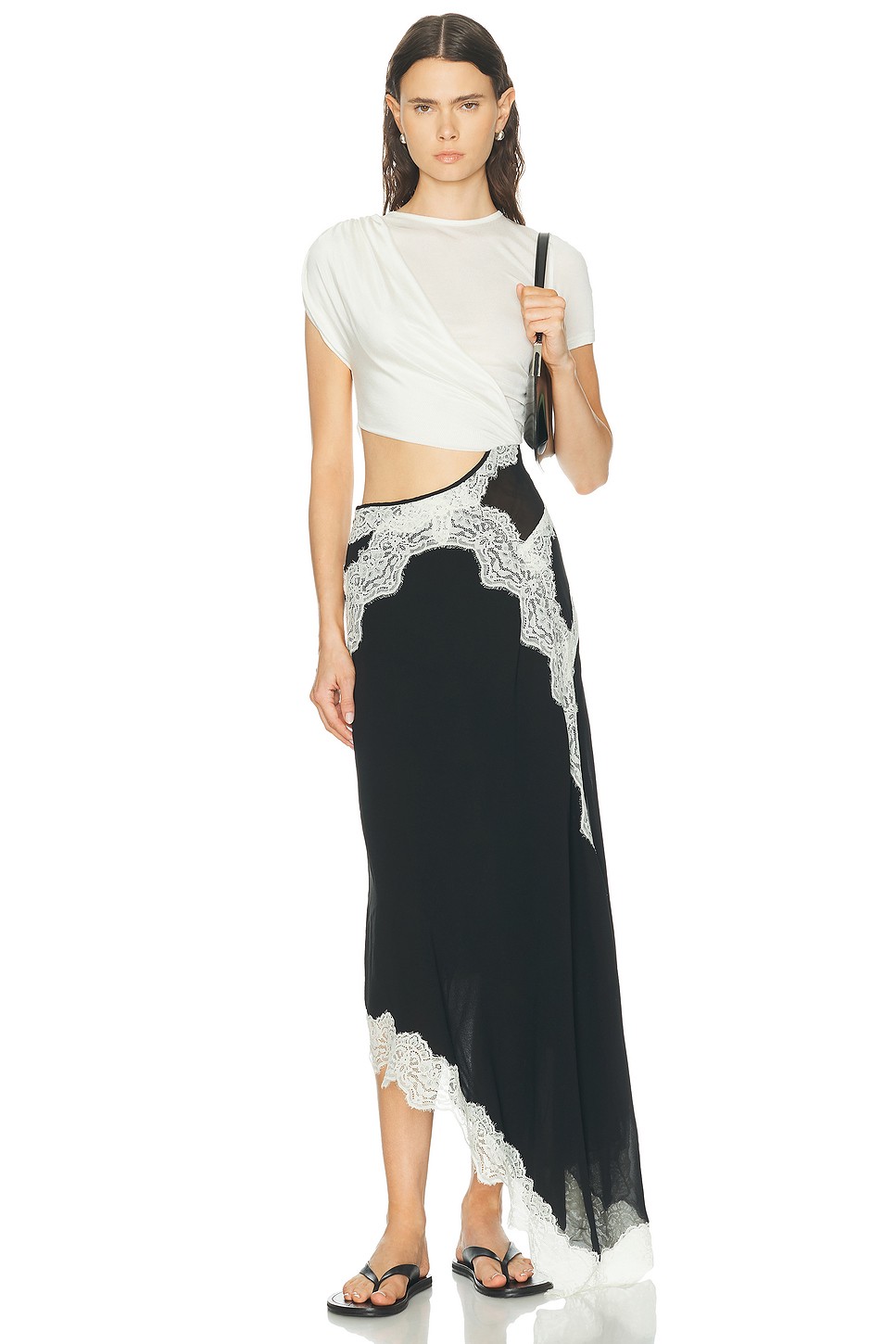
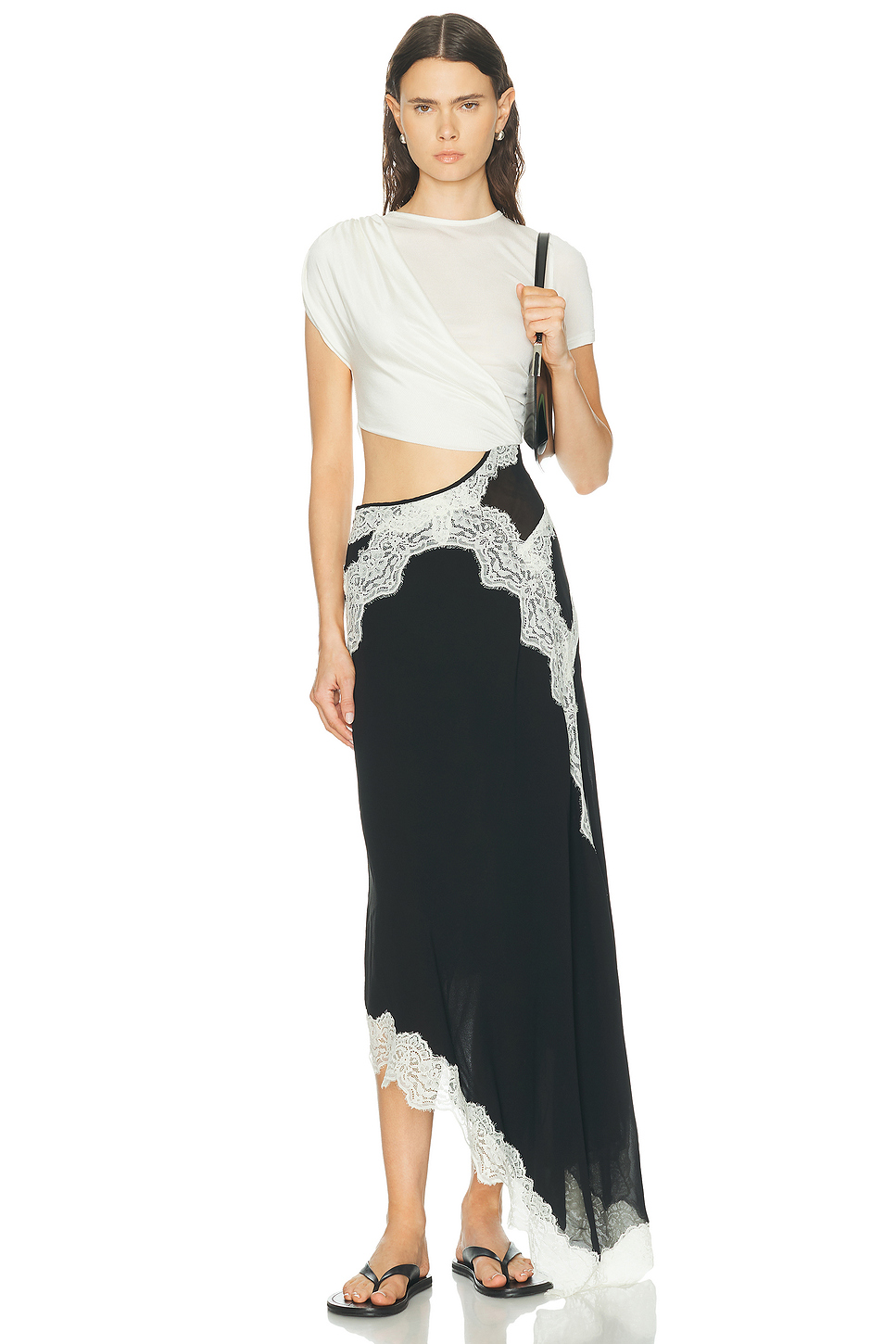
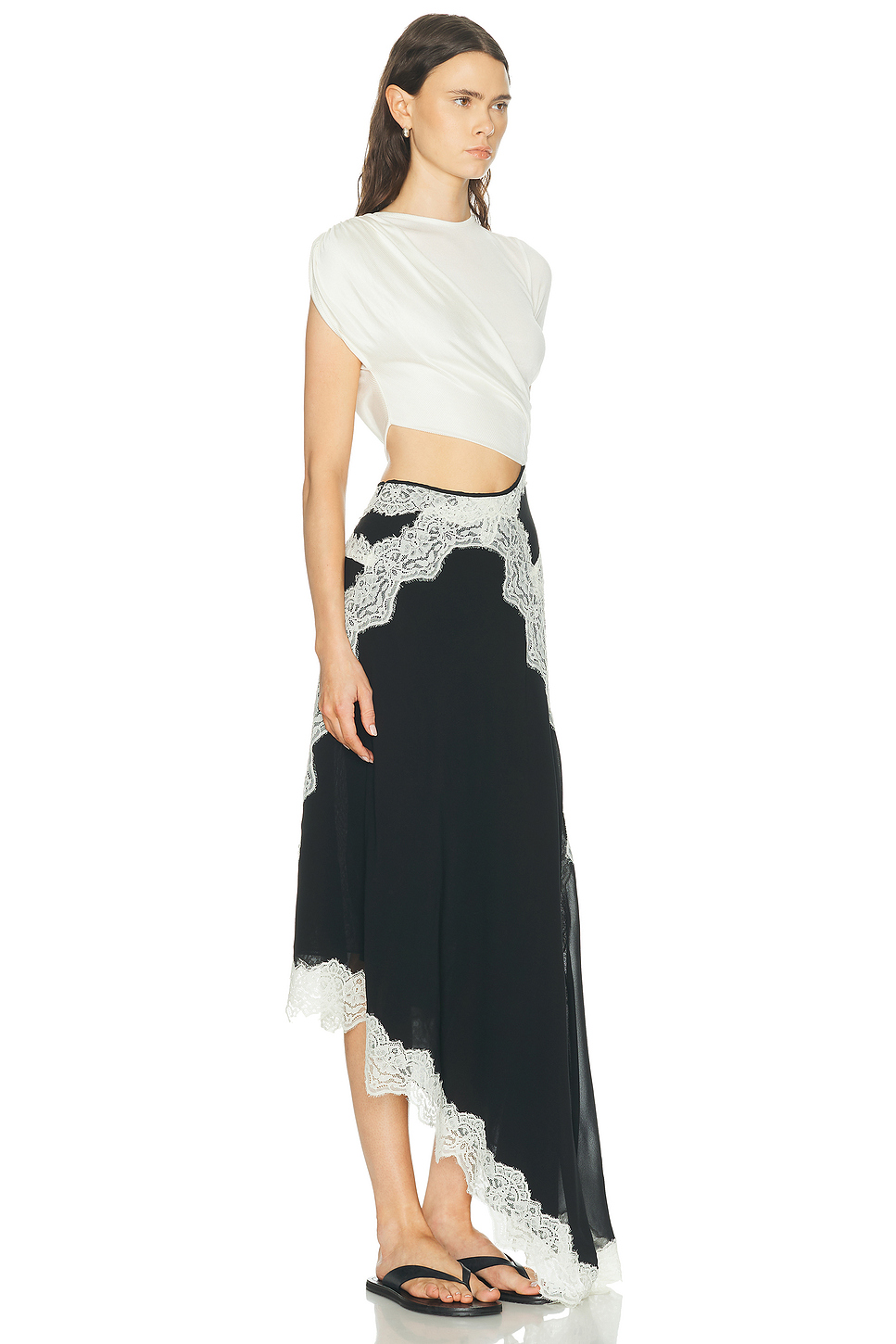
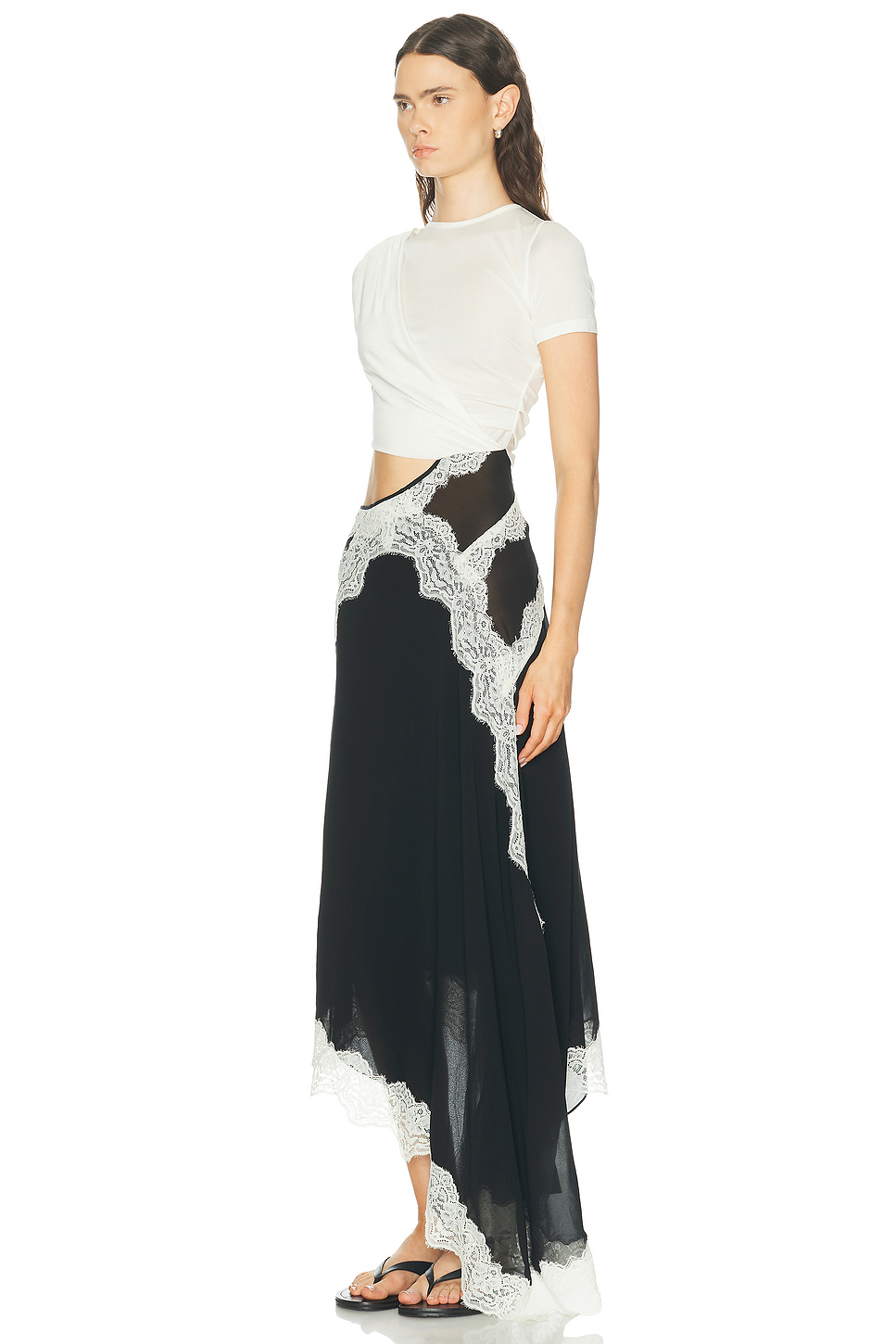
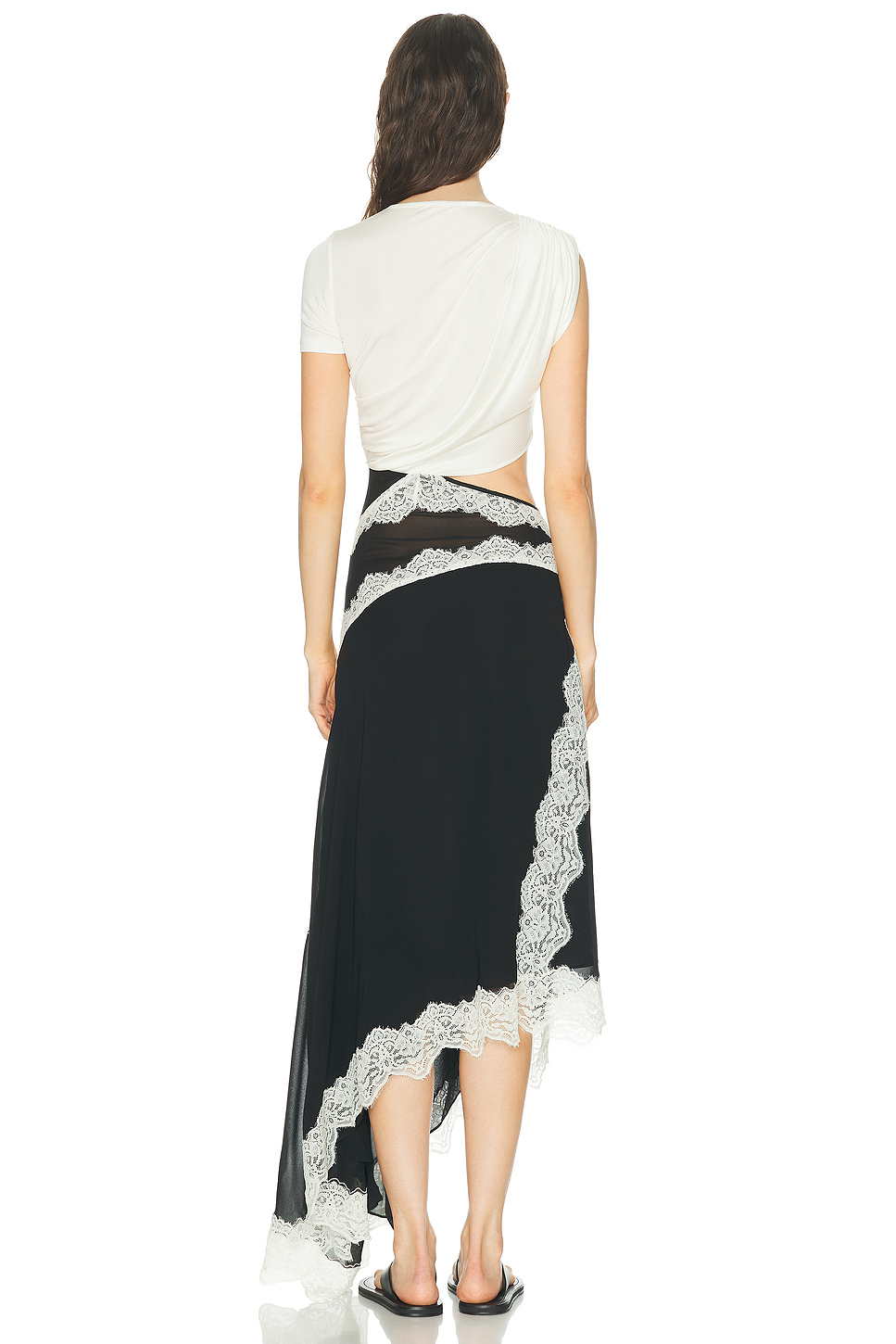
A maxi dress listed as 100% silk for the shell, 100% polyamide for the lining and 95% viscose with 5% elastane for the contrast, part lined, closed with a concealed side zip, with a twisted cut-out, an asymmetric skirt and scalloped lace trim, in a midweight chiffon skirt over a jersey bodice, dry clean only, made in Vietnam, at 1,150 dollars. The listing states plainly that the garment is made of a semi-sheer fabric and that underwear will be visible. There are no reviews and no fit votes, so there is no score to quote. This is the most fibres we have found in one garment in this series, and the interesting thing is not the number but the fact that they can coexist at all, and what makes that possible. There is also a decision here about which fabric goes where that is worth understanding, because it solves a problem that a single fabric cannot. And the measurements contain a drop that looks alarming until you see what causes it. The reference is the Verve Twisted Tee Dress by Christopher Esber in Black and White. Dongguan Bafinasa Garments Co., Ltd. develops comparable mixed media dresses on OEM and ODM terms, from fabric sourcing to retail or FBA ready packing. We publish this as a development reference and build your own version of it, and we do not supply the branded original or reproduce anyone else's label.
Key Features
- Shell: 100% silk as stated
- Lining: 100% polyamide as stated
- Contrast: 95% viscose, 5% elastane as stated
- Midweight chiffon skirt with a jersey bodice as stated
- Twisted cut-out as stated
- Asymmetric skirt with scalloped lace trim as stated
- Part lined as stated
- Concealed side zip as stated
Customisable Options
- Fabric: silk chiffon over a jersey bodice as the reference, with both weights set from tested samples
- Contrast: viscose elastane as the reference, and we would consider matching its fibre to the shell
- Care: dry clean only as the reference, which is what allows the three fibres to coexist
- Hem: we would hang and settle before cutting the hem, since the skirt is asymmetric
- Length from midi to floor, twist placement, size set, colour development, private label and care labelling
Specifications
| Style | Verve twisted tee dress |
| Reference | Christopher Esber, Verve Twisted Tee Dress, style CHRF-WD364, manufacturer style 24023316, colour Black and White |
| Shell | 100% silk as stated |
| Lining | 100% polyamide as stated |
| Contrast | 95% viscose, 5% elastane as stated |
| Three Fibre Note | Three fibres in one garment, combined two different ways. See the note below |
| Fabric | Midweight chiffon skirt with a jersey bodice as stated |
| Detail | Twisted cut-out as stated, with an asymmetric skirt and scalloped lace trim |
| Sheerness | Stated on the listing: made of a semi-sheer fabric, underwear will be visible |
| Closure | Concealed side zip as stated |
| Lining | Part lined as stated |
| Care | Dry clean only as stated |
| Sizes Published | Aus 4 / US 0 through Aus 12 / US 8, with both given on the listing |
| Measurements Published | Aus 6 / US 2: bust 48 in, waist 24 in, hips 36 in, length 59 in, sleeve 7 in |
| Chart Note | A large drop from bust to waist, which the twist produces. See the note below |
| Model | 182 cm, wearing size Aus 6 / US 2, bust 86 cm, waist 58 cm, hips 91 cm |
| Production | Made in Vietnam as stated |
| Reference Retail | 1,150 USD, quoted to show the price band this sits in, not as our price |
| Customer Reviews | None on the reference listing, so we quote no score |
| Best Seller Badge | None. The listing carries no rank |
| Categories | Filed by the retailer under both maxi dresses and short sleeve dresses |
| Occasion | Evenings, events, weddings, formal occasions |
| MOQ | 100 pcs per style per colourway, mixed sizes and colourways accepted |
| Sampling | 7-10 days after tech pack or reference sample confirmation |
| Bulk Lead Time | 20-30 days after sample approval and deposit |
| Service | OEM / ODM / private label, silk and chiffon sourcing, mixed media construction, retail or FBA ready packing |
Size Chart
| Size | Bust | Waist | Hips | Length | Source | ||||||||||||
|---|---|---|---|---|---|---|---|---|---|---|---|---|---|---|---|---|---|
| Aus 6 / US 2 | 48 | in | 24 | in | 36 | in | 59 | in / | 150 | cm | As published | ||||||
| Aus 4 / US 0 | 31 | in / | 79 | cm | 24 | in / | 61 | cm | 34 | in / | 86 | cm | 148 | cm / | 58.3 | in | Our proposal |
| Aus 6 / US 2 | 33 | in / | 84 | cm | 26 | in / | 66 | cm | 36 | in / | 91 | cm | 150 | cm / | 59.1 | in | Our proposal |
| Aus 8 / US 4 | 35 | in / | 89 | cm | 28 | in / | 71 | cm | 38 | in / | 97 | cm | 152 | cm / | 59.8 | in | Our proposal |
| Aus 10 / US 6 | 37 | in / | 94 | cm | 30 | in / | 76 | cm | 40 | in / | 102 | cm | 154 | cm / | 60.6 | in | Our proposal |
| Aus 12 / US 8 | 39 | in / | 99 | cm | 32 | in / | 81 | cm | 42 | in / | 107 | cm | 156 | cm / | 61.4 | in | Our proposal |
The published Aus 6 gives a 48 inch bust, a 24 inch waist, a 36 inch hip, a 59 inch length and a 7 inch sleeve, against a model at roughly 34, 23 and 36. The bust is very generous and the waist is close, which is what the twist at the front produces: the bodice is loose and the twist draws it in. So the bust figure is not the bust the wearer ends up with.
Occasions and Styling
Suits evenings, events, weddings and formal occasions. A chiffon skirt over a jersey bodice is a piece that moves, and it is worth photographing it walking, because the skirt is the point.
Production and Quality Control
There are no reviews and no fit votes on this listing, so there is no score to quote. There are three fibres here combined two different ways, a decision about which fabric goes where, and a drop in the measurements that has a cause.
Three fibres can coexist here for one reason, and that reason is the care instruction, and that is the first thing. The shell is silk, the lining is polyamide, and the contrast is viscose with a little elastane, so there are three fibres in one garment, which is the most we have found in this series. What makes that interesting is not the count but the fact that they are combined in two different ways at once, and those two ways carry different risks. We set out the three possibilities earlier: blended into one yarn, where the fibres cannot separate at all; sewn side by side as panels, where a difference in movement shows as puckering at the seam and is visible on the outside of the garment; and layered as shell and lining, where the difference shifts the garment internally. This garment uses the second and the third simultaneously. The contrast fabric is a panel, so it is visible, and the lining is a layer, so it is hidden. Now, silk, polyamide and viscose all move by different amounts in water. Silk shrinks, viscose shrinks more and is weak when wet, and polyamide barely moves. So both combinations should be problematic here. The reason they are not is the instruction: dry clean only. With no water involved, nothing shrinks, and the three fibres never have to agree. We made the same observation about a beaded dress whose instruction was spot clean only, where we said the strict instruction was what made an otherwise impossible fibre combination viable, and that it was a real trade, meaning the instruction buys freedom in how the garment is put together and the customer pays for it in upkeep. That is exactly the situation here, and it is worth knowing, because if anyone were to soften this instruction to hand wash or to make the garment more convenient, they would break two constructions at once. The alternative, if you want a washable garment, is to make all three from the same fibre.
Chiffon skirt over a jersey bodice solves a problem no single fabric can, and that is the second thing, and it is worth understanding because the reasoning generalises. Think about what a maxi dress has to do at the top and at the bottom, because the two requirements are opposites. At the top it has to fit: it has to hold onto the body, cover it, and stay put, and for that you want a fabric that has some give in it and that returns, so it can be cut close and still be comfortable and still be got into. At the bottom it has to move: a long skirt is bought for how it falls and how it travels with the wearer, and for that you want a fabric that is limber and light and that drapes under its own weight. A jersey is excellent at the first and poor at the second, because it is heavy for its drape and it clings rather than floating. A chiffon is excellent at the second and poor at the first, because it has almost no stretch and no recovery, and it is also sheer. So one fabric cannot do both jobs, and putting a jersey bodice on a chiffon skirt is the standard answer: each half gets the fabric that suits it. We have seen the same logic in other forms, notably on a bias cut gown where the whole garment was cut at forty five degrees specifically to make a woven cloth behave more like a knit, and the reason there was the same as here, which is that a garment often needs two properties that one cloth does not have. The consequence to watch is the join. Two fabrics with different weights and different amounts of stretch meet at the waist, and that seam carries the weight of the skirt, so it needs to be constructed to take the load rather than merely to look neat. We would reinforce it and test it on a body rather than a hanger.
The bust is 48 and the waist is 24, and the twist is what closes that gap, and that is the third thing. A twenty four inch drop from bust to waist in a single garment is not a shaping achievement in the ordinary sense, because no pattern takes in that much through a side seam. It is a twist. A twisted front takes a loose panel of cloth and turns it, and the turning consumes the surplus: the cloth that would have hung loose is wrapped across the body instead, and the point where it crosses is what creates the waist. So the generous bust and the close waist are not in conflict, they are two ends of the same mechanism, and the twist is the thing between them. That is worth stating because the number alone looks like an error, and this series has given us plenty of measurements that were. It is also worth noting that a twist is doing the same job as several other mechanisms we have catalogued for dealing with a surplus of cloth or a range of body sizes: gathering, shirring with elastic thread, bias cutting, a tie, and elastane in the cloth. Those five plus a twist are six approaches to the same problem, and the reason there are so many is that the problem is universal. The caution with a twist is that it has to stay twisted. A twist held at one point will travel, meaning it rotates around the body during wear and the drape collapses, which is a fault we identified on another draped dress where a single review complained about quality and cut and where we said the anchor needed to be at more than one point. We would do the same here and test it over several hours. There is one further point on this garment. The skirt is asymmetric, and we noted on a poplin dress that an asymmetric hem tends to spiral, because cloth cut off the grain stretches unevenly under its own weight, and the remedy is to hang the finished garment and let it settle before the hem is cut. On a chiffon skirt, which is limber and has little stability, that matters more rather than less. Every bulk shipment gets a measurement report against your approved chart.
Optional upgrades include the waist seam reinforced to carry the weight of the skirt, the twist anchored at more than one point and tested over several hours, the garment hung and settled before the hem is cut, the contrast fibre matched to the shell if a washable version is wanted, the sheerness specified by area since the lining is only partial, alternative twist placements, alternative lengths, extended sizing, colour development and private label, hangtag and care labelling.
Pre-production sample approval, in-line inspection during cutting and sewing, and a final AQL inspection before packing, with measurement reports and photos shared before shipment.
Send us your tech pack, a photo or a reference garment and we will quote within 24 hours. Contact bafinasa@bafinasa.com or WhatsApp +86 13827222469.