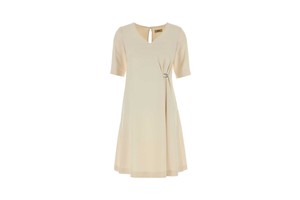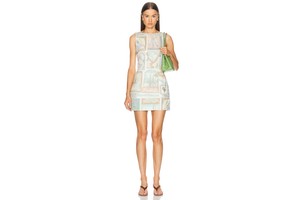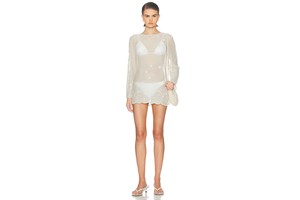
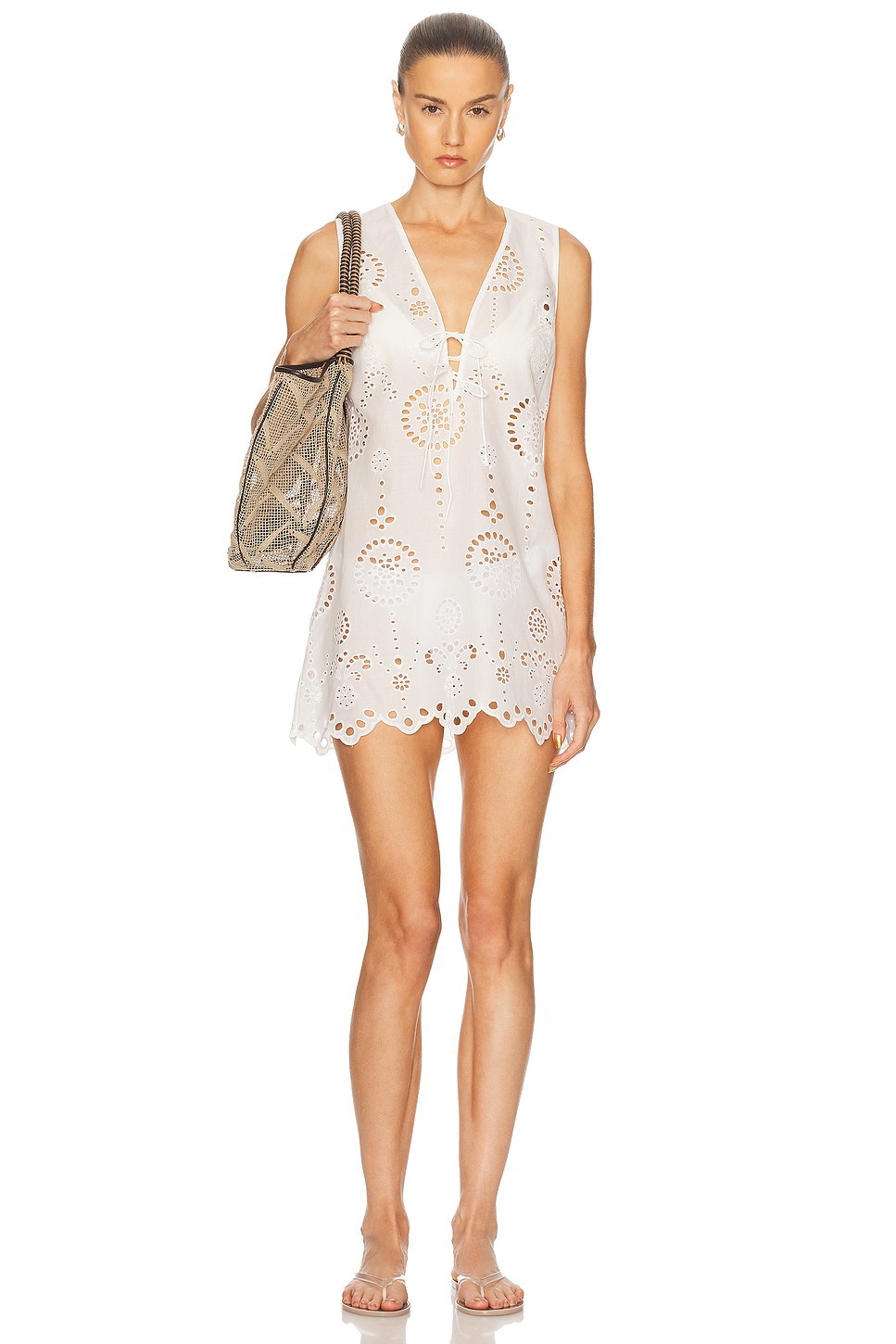
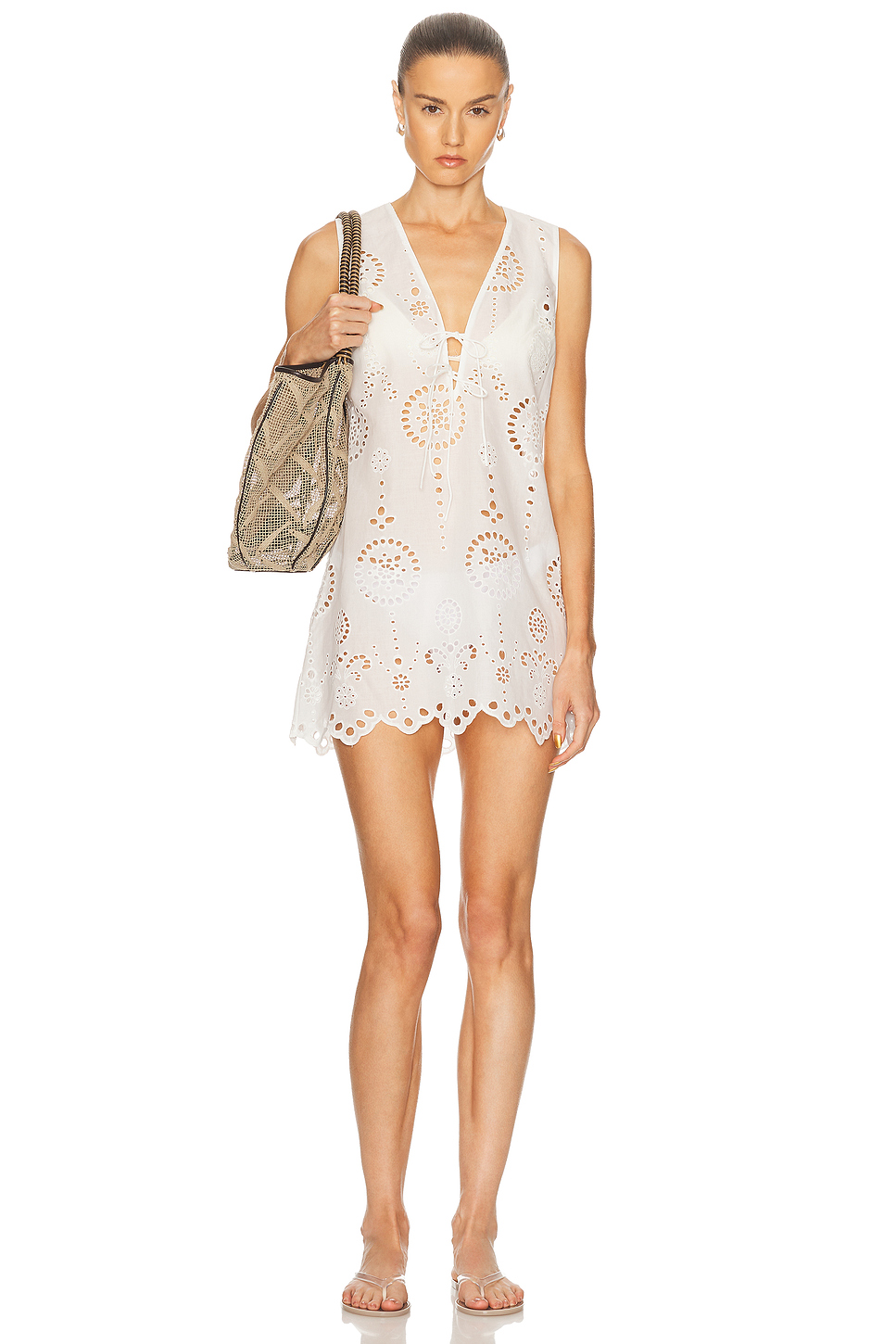
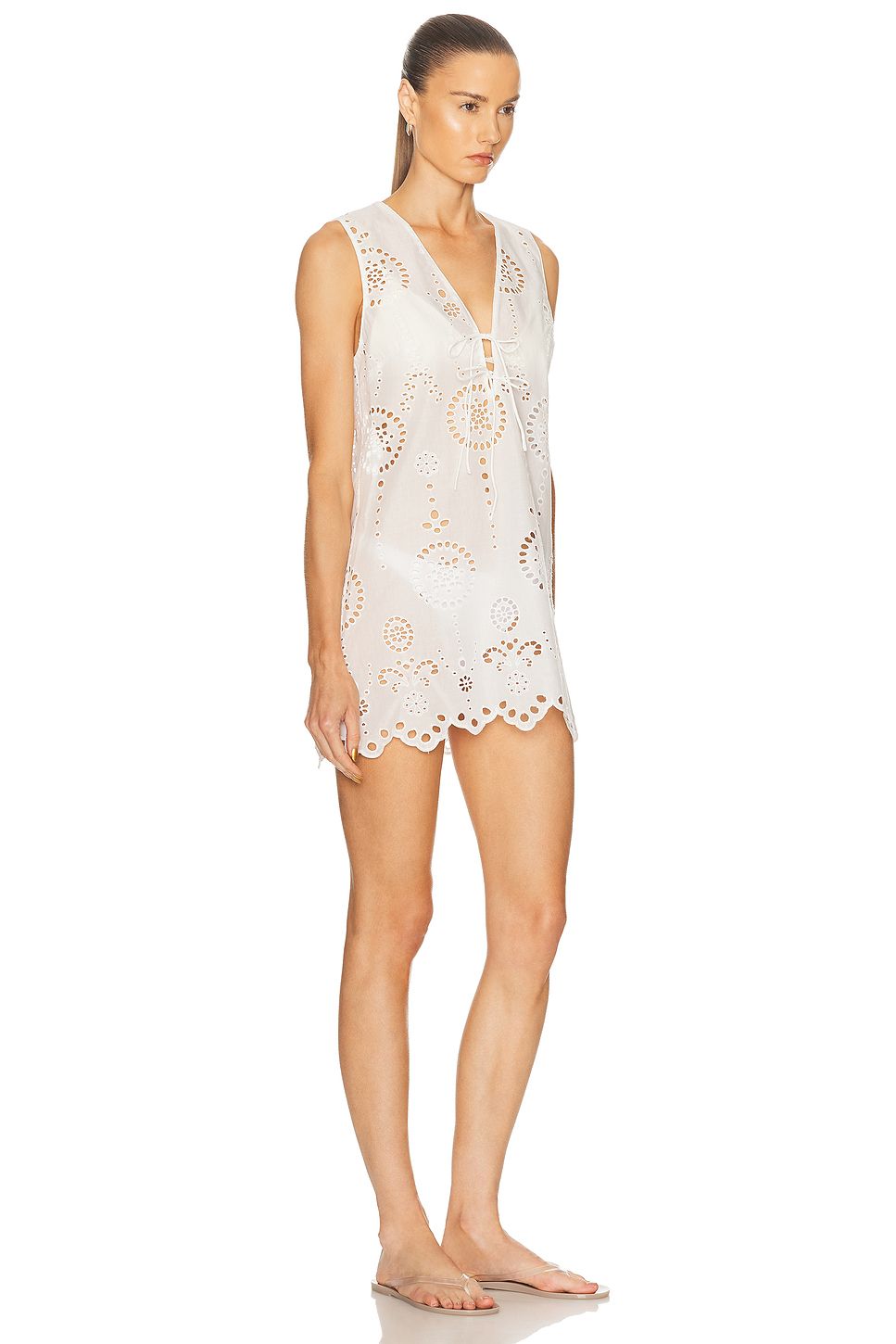
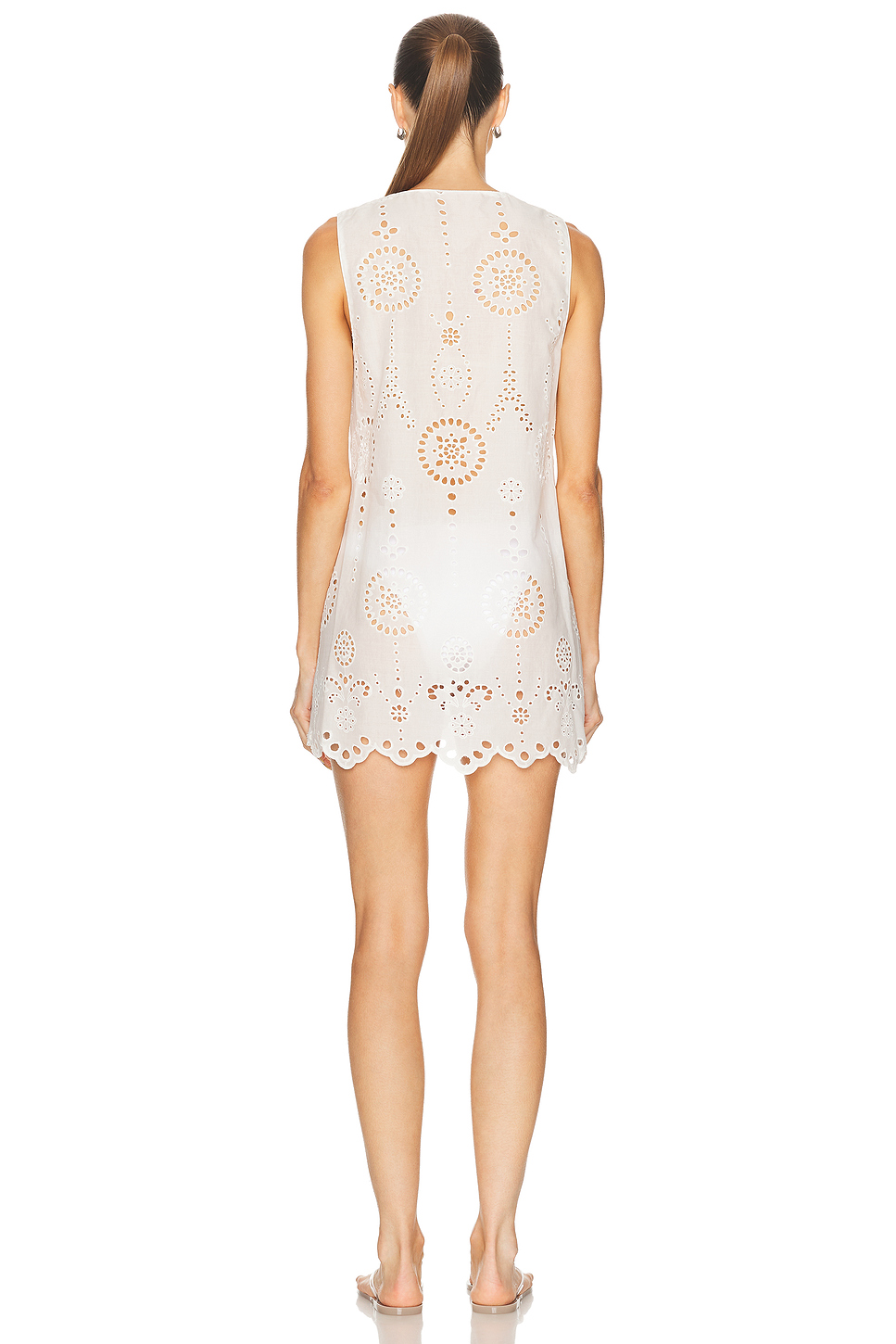
A mini dress listed as 100% cotton, unlined, with a self tie at the front, in a lightweight broderie eyelet, hand wash cold, made in Australia, ranked fourteenth in the retailer's shift list, at 440 dollars. The listing states plainly that the garment is made of a semi-sheer fabric and that underwear will be visible. There are no reviews and no fit votes, so there is no score to quote. This garment puts its tie in the best of the four positions we have now collected, and it puts it there in the best of the fibres, so it is worth setting the whole comparison out because it resolves a caution we have been repeating for some time. There is also a fibre hidden in this garment that the composition does not mention and which causes a specific and common fault, and it is worth knowing about if you develop anything with broderie. And the shape the measurements describe is confirmed by the retailer's own filing, which is the second time that has happened and is a useful way to check a chart. The reference is the Broderie Tie Mini Dress by Matteau in White. Dongguan Bafinasa Garments Co., Ltd. develops comparable cotton dresses on OEM and ODM terms, from fabric and trim sourcing to retail or FBA ready packing. We publish this as a development reference and build your own version of it, and we do not supply the branded original or reproduce anyone else's label.
Key Features
- 100% cotton as stated
- Lightweight broderie eyelet as stated
- Sheerness stated on the listing: made of a semi-sheer fabric, underwear will be visible
- Self tie at the front as stated
- Unlined as stated
- Hand wash cold as stated
- Four sizes from 1 to 4
- Made in Australia as stated
Customisable Options
- Fabric: cotton broderie as the reference, with the weight and the embroidery yarn set from a tested sample
- Embroidery: we would specify the yarn and check it against the ground cloth, for the reason set out below
- Tie: at the front as the reference, which we would keep
- Care: hand wash cold as the reference, and we would add pressing rather than wringing
- Length from mini to midi, embroidery pattern, size set, colour development, private label and care labelling
Specifications
| Style | Broderie tie front mini |
| Reference | Matteau, Broderie Tie Mini Dress, style MTEF-WD124, manufacturer style BTMDR, colour White |
| Composition | 100% cotton as stated |
| Embroidery Note | Broderie is embroidered, and the embroidery yarn is a fibre the composition does not mention. See the note below |
| Fabric | Lightweight broderie eyelet as stated |
| Sheerness | Stated on the listing: made of a semi-sheer fabric, underwear will be visible |
| Closure | Self tie at the front as stated |
| Lining | Unlined as stated |
| Care | Hand wash cold as stated |
| Sizes Published | 1, 2, 3, 4, which is the brand's own sizing and does not map directly onto US or UK sizes |
| Measurements Published | 2: bust 35 in, waist 34 in, hips 37 in, length 32 in |
| Chart Note | Ten inches of ease at the waist, which is the shift shape and which the tie is there to draw in |
| Model | 179 cm, wearing size 2, bust 34 in, waist 24 in, hips 34 in |
| Production | Made in Australia as stated |
| Reference Retail | 440 USD, quoted to show the price band this sits in, not as our price |
| Customer Reviews | None on the reference listing, so we quote no score |
| Best Seller Badge | Rank 14 in the retailer's shift dress list, which is a strong position |
| Categories | Filed by the retailer under both mini dresses and sleeveless dresses |
| Occasion | Daytime, holidays, warm weather, resort |
| MOQ | 100 pcs per style per colourway, mixed sizes and colourways accepted |
| Sampling | 7-10 days after tech pack or reference sample confirmation |
| Bulk Lead Time | 20-30 days after sample approval and deposit |
| Service | OEM / ODM / private label, cotton and broderie sourcing, retail or FBA ready packing |
Size Chart
| Size | Bust | Waist | Hips | Length | Source | ||||||||||||
|---|---|---|---|---|---|---|---|---|---|---|---|---|---|---|---|---|---|
| 2 | 35 | in | 34 | in | 37 | in | 32 | in / | 81 | cm | As published | ||||||
| 1 | 31 | in / | 79 | cm | 24 | in / | 61 | cm | 34 | in / | 86 | cm | 79 | cm / | 31.1 | in | Our proposal |
| 2 | 33 | in / | 84 | cm | 26 | in / | 66 | cm | 36 | in / | 91 | cm | 81 | cm / | 31.9 | in | Our proposal |
| 3 | 35 | in / | 89 | cm | 28 | in / | 71 | cm | 38 | in / | 97 | cm | 83 | cm / | 32.7 | in | Our proposal |
| 4 | 37 | in / | 94 | cm | 30 | in / | 76 | cm | 40 | in / | 102 | cm | 85 | cm / | 33.5 | in | Our proposal |
The published size 2 gives a 35 inch bust, a 34 inch waist, a 37 inch hip and a 32 inch length against a model at 34, 24 and 34. The waist has ten inches of ease, which is consistent with a shift, and the tie at the front is what draws it in. So the waist figure is not the waist the wearer ends up with.
Occasions and Styling
Suits daytime, holidays, warm weather and resort. A white broderie mini is a warm weather piece, and it is worth photographing it against the light, since that is the condition in which a customer will discover how sheer it is.
Production and Quality Control
There are no reviews and no fit votes on this listing, so there is no score to quote. There is the best tie placement we have seen in the best fibre, a hidden fibre in the embroidery, and a shape confirmed from two directions.
This is the best of the four tie positions and the best of the fibres, and putting the two together resolves a caution we have raised repeatedly, and that is the first thing. We have now met ties in four places. At the back of the neck we were hardest, because a fitting there is out of sight and behind the head and catches hair, and on a halter it is worse still because the tie is suspending the garment rather than closing it. At the back of the body it is reachable but invisible, and it has the specific problem of pressing into a chair back. At the side it is both visible and reachable and clear of anything she sits against, and we called that the best of the three at the time. This one is at the front. That is better than all of them: she can see it, she can reach it, nothing presses on it, and she can adjust it during the day without undressing. Now the fibre. We have said throughout that the caution about ties is not about wrap fronts or about halters, it is about smooth cloth, because a knot holds by friction between its two ends and a slippery surface does not hold one. We worked through this in order: silk satin is the worst, silk chiffon somewhat better because its twisted yarns give it a drier hand, and cotton poplin, which we said holds a knot properly because cotton has high friction and poplin has a close surface that grips itself. This is 100% cotton. So a tie at the front, in cotton, is the most reliable version of this closure we have seen, and there is nothing to fix. It is worth adding that the position and the fibre are independent variables, and knowing that lets you choose: if you want a tie at the back of the neck for the look, as several garments in this series do, you can still have it safely by putting a small hook or snap behind it so the closure does not depend on friction at all. That is the general answer, and this garment happens not to need it.
Broderie hides a fibre the label does not mention, and it causes a specific fault, and that is the second thing, and it is the kind of detail that gets missed until a wash test. The composition says 100% cotton. That is the ground cloth, meaning the cloth the garment is made of. But broderie is embroidery: the pattern is stitched onto or into that cloth with a separate yarn, and that yarn is a fibre in its own right which the label does not account for. Embroidery yarn is often cotton, but it is very often viscose or polyester instead, because those take a dye more brightly and have a sheen that reads well against a matte ground. So there are effectively two fibres in this garment, joined not at a seam but over the whole embroidered area. Now recall what we worked out about the ways two fibres can be combined. Blended into one yarn, they cannot separate. Sewn side by side as panels, a difference in movement shows at the seam and is visible. And here, laid one on top of the other over a whole surface, a difference in movement shows everywhere the embroidery is. Cotton shrinks when it is washed, and it keeps shrinking a little over the first several washes. Polyester and viscose shrink differently. So if the embroidery yarn and the ground cloth move by different amounts, the embroidery will pucker, meaning the stitched areas will pull into ridges and the cloth around them will not lie flat. That is a very common fault on broderie and eyelet garments and it appears after washing rather than before, which is why it gets missed in sampling. The answer is simple: specify the embroidery yarn, and wash test the finished cloth rather than the plain ground cloth, because the two are not the same material. We would also add pressing rather than wringing to the care label, because an embroidered open structure distorts easily and the distortion sets.
The measurements and the badge agree, and that is the third thing, and it is worth noting because we have now seen it twice and it is a way of checking a chart. The waist is published at 34 against a model at 24, so ten inches of ease, which on a fitted garment would be a serious warning. But the retailer files this under shift dresses, and a shift hangs from the shoulders without coming in at the waist, so ten inches of ease is the shape rather than a fault. This is the second time in this series that a size chart and a retailer's own category have agreed with each other, the first being a satin gown filed under shift dresses where the waist also carried about nine inches of ease. That is worth using as a check: if the numbers and the stated shape disagree, one of them is wrong, and it is usually the filing. There is a consequence for the customer, and it is the one we noted on the other shift: a garment with this much ease will not look fitted, and anyone expecting a shaped waist will be surprised. Here that is partly answered by the tie, which is what draws the surplus in, and we said something similar about a lyocell slip recently where the same combination of generous measurements plus a tie achieved the same thing, which is that one size then accommodates a range of bodies because the wearer sets how much is taken in. That is a genuinely useful strategy and we would keep it. The one thing we would add is a sentence on the page saying the waist figure is the garment's and not the wearer's, because a customer comparing 34 with her own 28 will conclude the dress is enormous. Every bulk shipment gets a measurement report against your approved chart.
Optional upgrades include the embroidery yarn specified and wash tested with the ground cloth, pressing rather than wringing added to the care label, the waist ease explained on the page since the tie does the fitting, alternative embroidery patterns, alternative tie placements, alternative lengths, extended sizing, colour development and private label, hangtag and care labelling.
Pre-production sample approval, in-line inspection during cutting and sewing, and a final AQL inspection before packing, with measurement reports and photos shared before shipment.
Send us your tech pack, a photo or a reference garment and we will quote within 24 hours. Contact bafinasa@bafinasa.com or WhatsApp +86 13827222469.