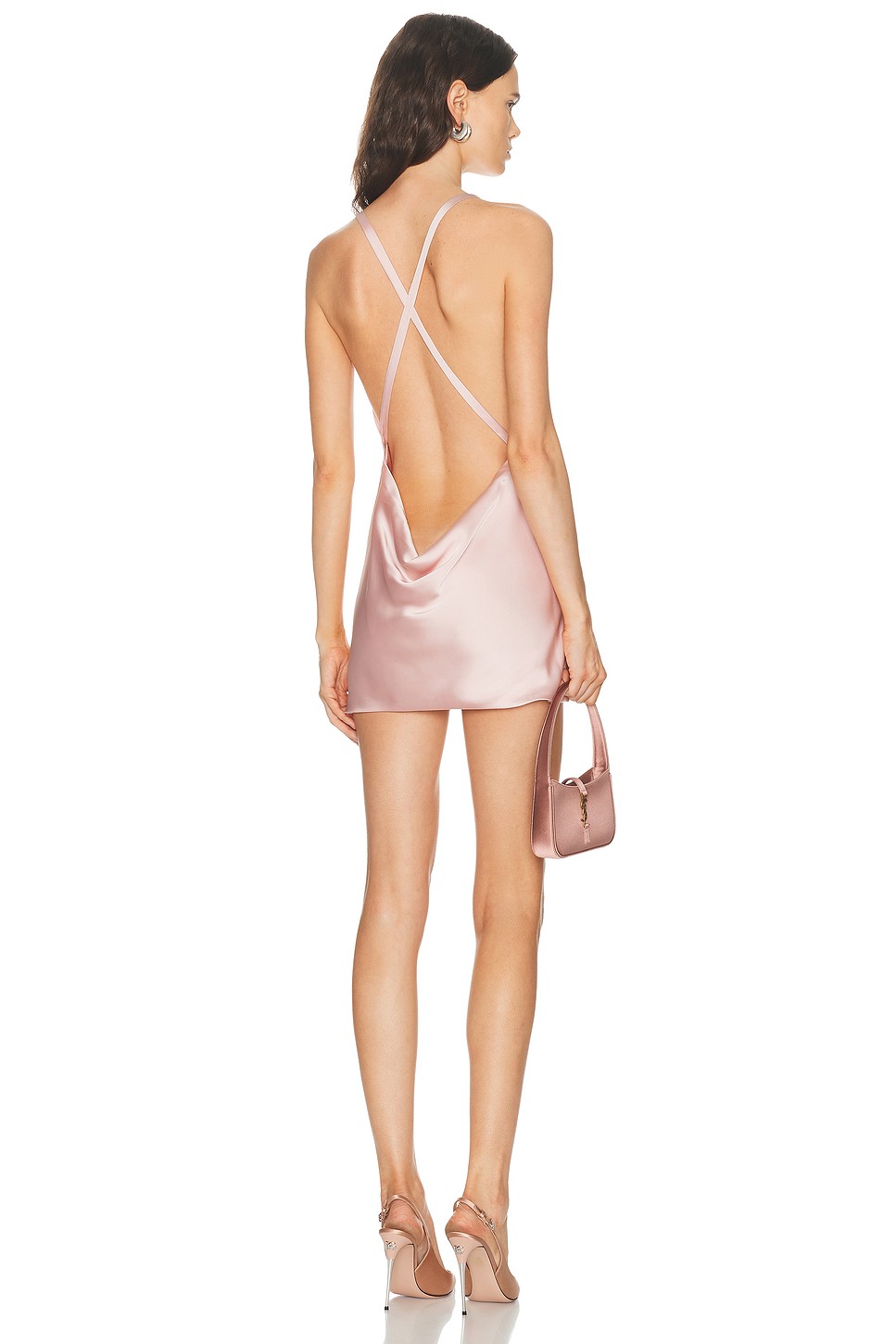
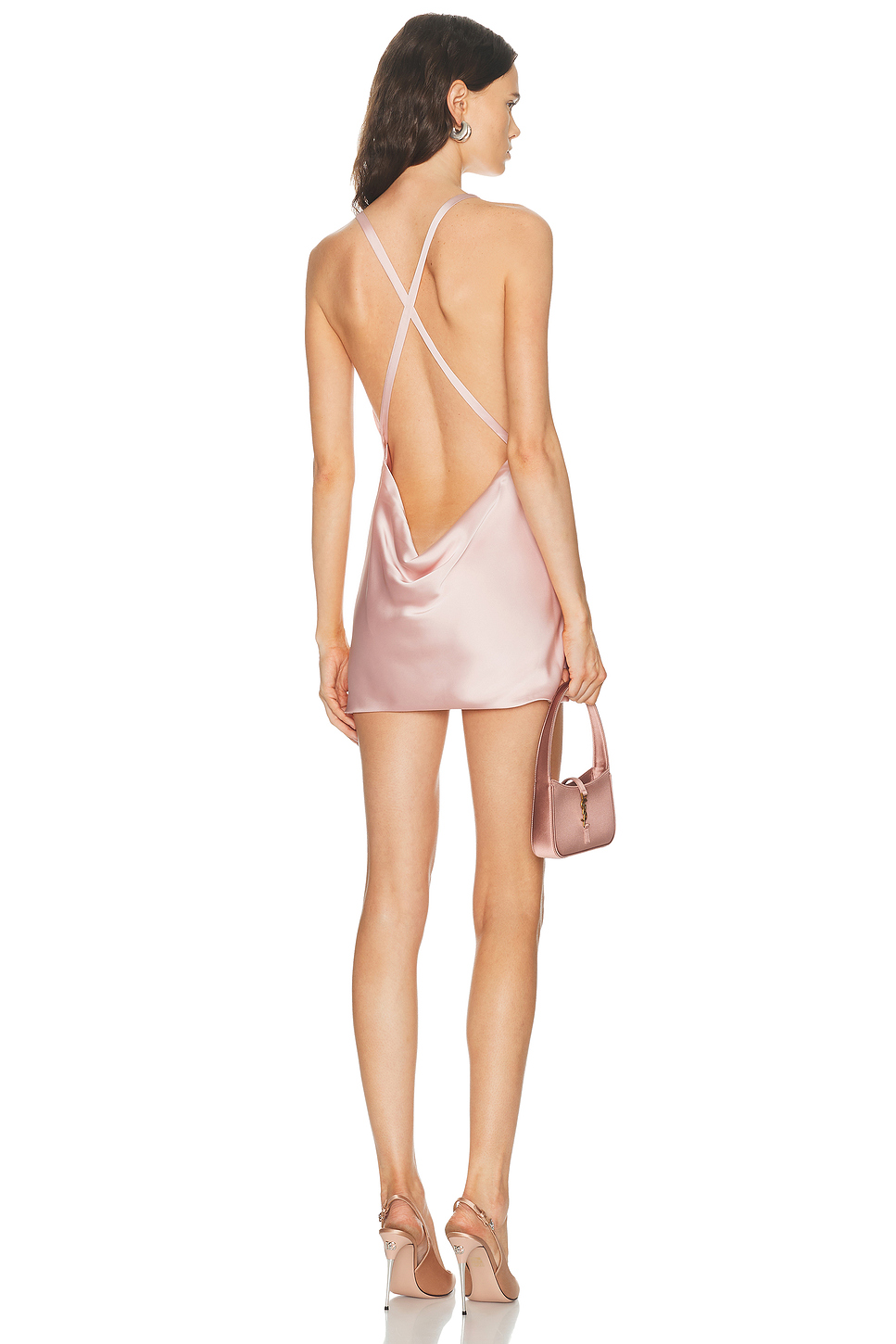
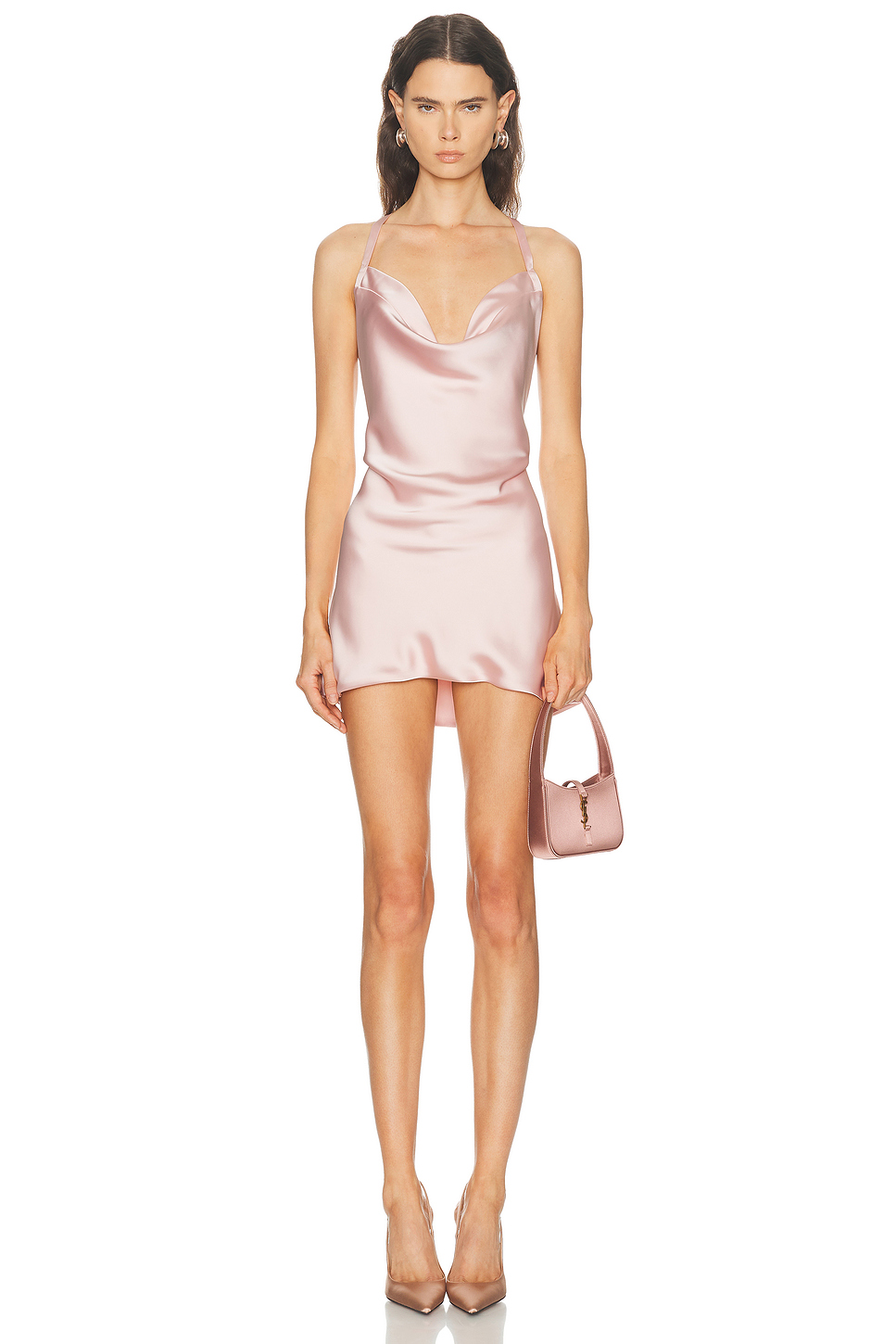
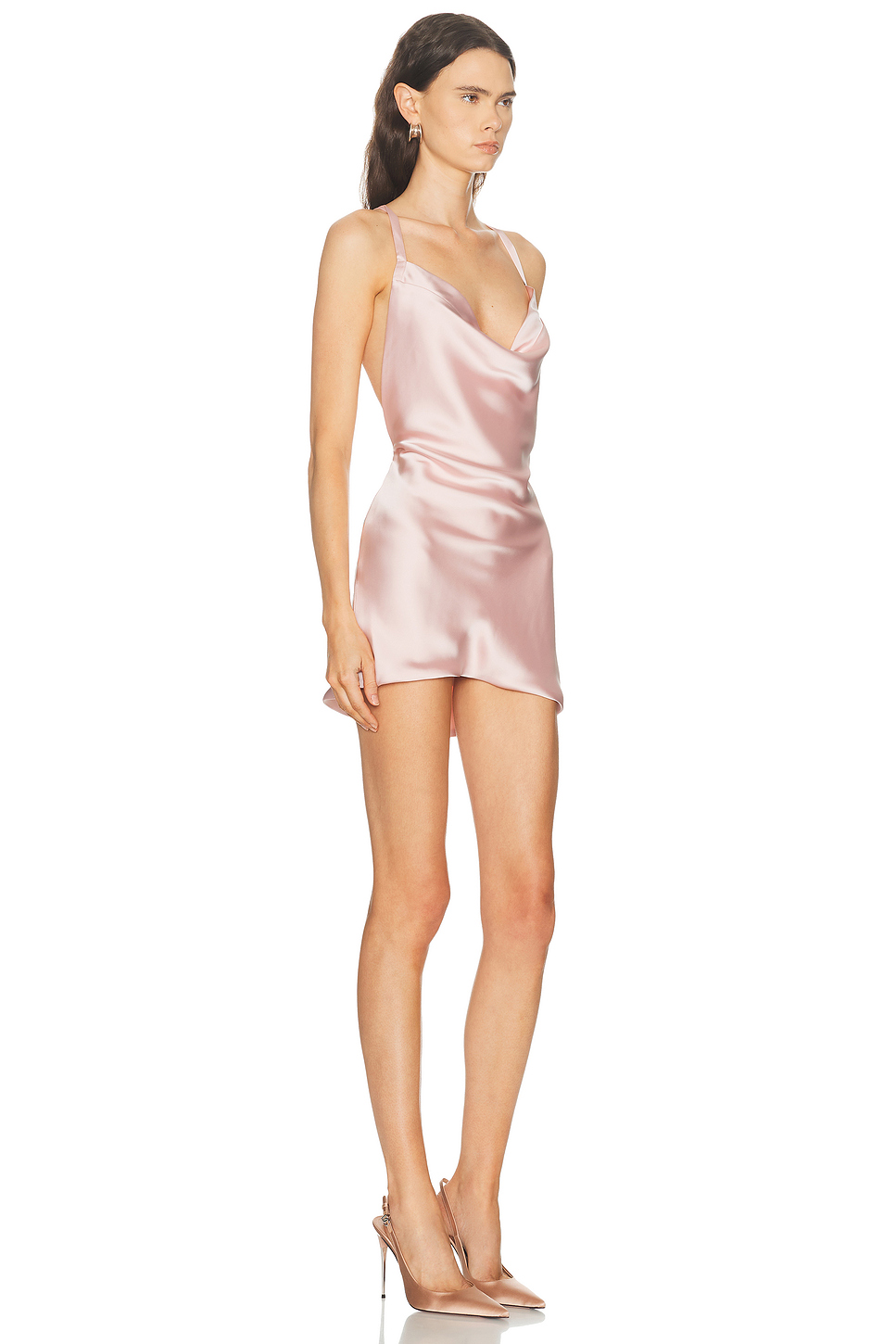
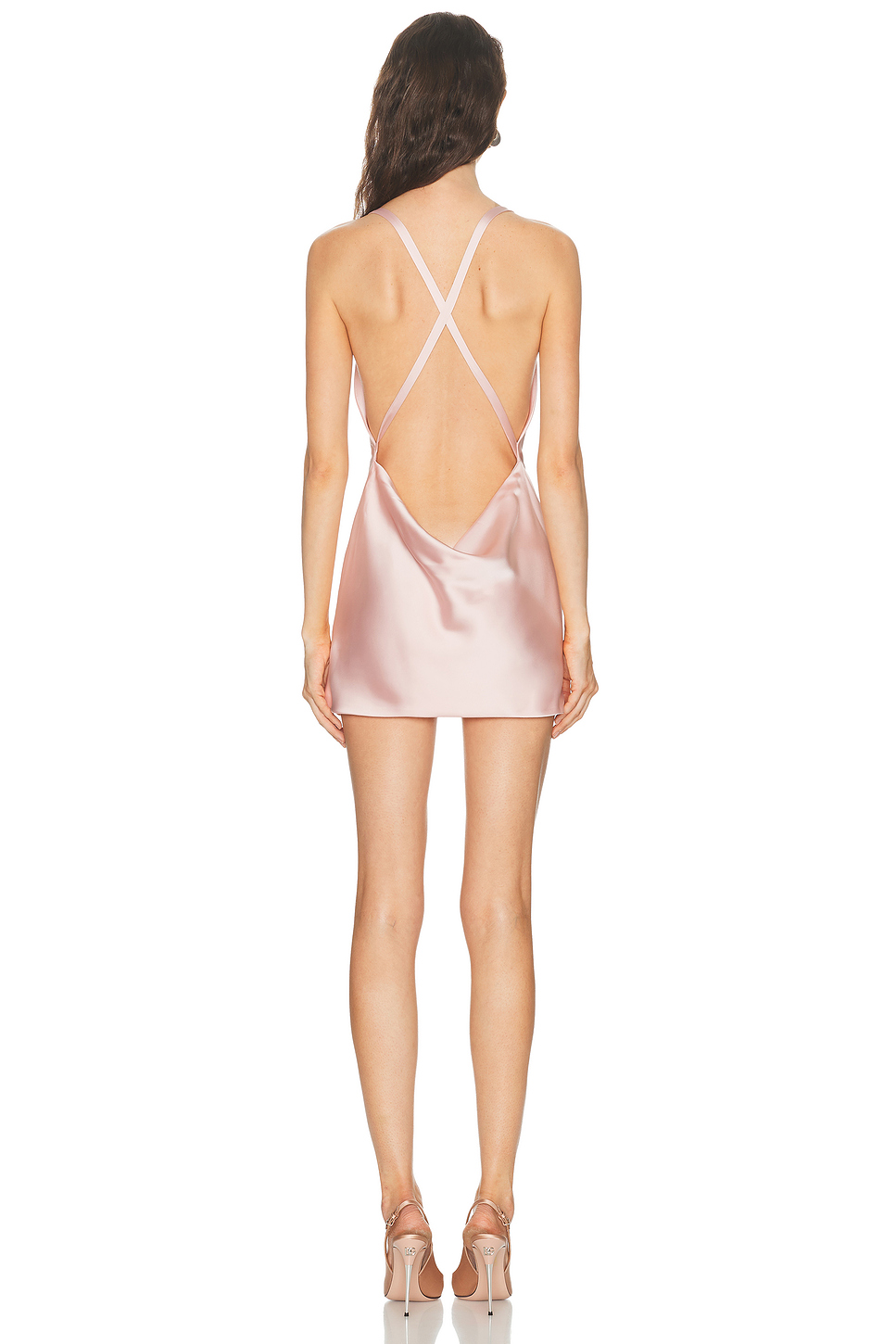
A bias cut mini listed as 100% polyester, fully lined, pull-on with no zip, with a cowl neckline, a low back with draped detail and straps that cross at the back, in a midweight satin, hand wash, made in China, ranked fourth in the retailer's cocktail list, at 350 dollars. There are no reviews and no fit votes, so there is no score to quote. This is the third garment from this brand in three groups to carry exactly the same size advice, and all three have been pull-on and bias cut, and that consistency is worth more than any single recommendation because it tells you the advice was worked out rather than guessed. There is also a connection here between two features on the same garment which is not a coincidence but a requirement, and spotting it explains why both are there. And the back does something clever that we can set against another garment's solution to the same problem. The reference is the Cross Back Bias Mini Dress by Norma Kamali in Ballet Pink. Dongguan Bafinasa Garments Co., Ltd. develops comparable bias cut dresses on OEM and ODM terms, from fabric sourcing to retail or FBA ready packing. We publish this as a development reference and build your own version of it, and we do not supply the branded original or reproduce anyone else's label.
Key Features
- 100% polyester as stated
- Midweight satin as stated
- Cut on the bias as stated in the style name
- Cowl neckline as stated
- Low back with draped detail as stated
- Straps crossing at the back as stated
- Fully lined as stated
- Runs large, sizing down recommended, as stated on the listing
Customisable Options
- Fabric: polyester satin as the reference, with the weight set from a tested sample
- Cut: on the bias as the reference, which the cowl requires, for the reason set out below
- Back: as the reference, and we would state on the page what the low back rules out
- Care: hand wash as the reference, and we would add that it must be dried flat
- Length from mini to midi, back shape, size set, colour development, private label and care labelling
Specifications
| Style | Cross back bias cowl mini |
| Reference | Norma Kamali, Cross Back Bias Mini Dress, style NOMF-WD725, manufacturer style ST1263SAQ89838, colour Ballet Pink |
| Composition | 100% polyester as stated |
| Fabric | Midweight satin as stated |
| Cut | Cut on the bias as stated in the style name |
| Cowl Note | A cowl needs a bias cut to drape as it should. See the note below |
| Neckline | Cowl as stated |
| Back | Low back with draped detail as stated, with straps crossing at the back |
| Closure | Pull-on with no zip as stated |
| Lining | Fully lined as stated |
| Care | Hand wash as stated |
| Sizes Published | XS, S, M, L |
| Measurements Published | S: bust 32 in, waist 29 in, hips 42 in, length 29 in |
| Size Advice | Runs large, sizing down recommended, as stated on the listing |
| Chart Note | Generous at the hip, which is consistent with the advice and with the drape |
| Model | 182 cm, wearing size S, bust 86 cm, waist 58 cm, hips 91 cm |
| Production | Made in China as stated |
| Reference Retail | 350 USD, quoted to show the price band this sits in, not as our price |
| Customer Reviews | None on the reference listing, so we quote no score |
| Best Seller Badge | Rank 4 in the retailer's cocktail dress list, which is a strong position |
| Categories | Filed by the retailer under both mini dresses and sleeveless dresses |
| Occasion | Parties, evenings, cocktails, celebrations |
| MOQ | 100 pcs per style per colourway, mixed sizes and colourways accepted |
| Sampling | 7-10 days after tech pack or reference sample confirmation |
| Bulk Lead Time | 20-30 days after sample approval and deposit |
| Service | OEM / ODM / private label, satin sourcing, bias cutting, retail or FBA ready packing |
Size Chart
| Size | Bust | Waist | Hips | Length | Source | ||||||||||||
|---|---|---|---|---|---|---|---|---|---|---|---|---|---|---|---|---|---|
| S | 32 | in | 29 | in | 42 | in | 29 | in / | 74 | cm | As published | ||||||
| XS | 31 | in / | 79 | cm | 24 | in / | 61 | cm | 34 | in / | 86 | cm | 72 | cm / | 28.3 | in | Our proposal |
| S | 33 | in / | 84 | cm | 26 | in / | 66 | cm | 36 | in / | 91 | cm | 74 | cm / | 29.1 | in | Our proposal |
| M | 35 | in / | 89 | cm | 28 | in / | 71 | cm | 38 | in / | 97 | cm | 76 | cm / | 29.9 | in | Our proposal |
| L | 37 | in / | 94 | cm | 30 | in / | 76 | cm | 40 | in / | 102 | cm | 78 | cm / | 30.7 | in | Our proposal |
The published size S gives a 32 inch bust, a 29 inch waist, a 42 inch hip and a 29 inch length against a model at roughly 34, 23 and 36. The waist and hip are generous, by six inches each, which is consistent with the advice on the page that the garment runs large and with the way a bias cut dress settles when worn.
Occasions and Styling
Suits parties, evenings, cocktails and celebrations. A bias cut satin mini with a cowl neck is a going out piece, and it should be photographed from behind, because the crossing straps and the low back are what distinguish it.
Production and Quality Control
There are no reviews and no fit votes on this listing, so there is no score to quote. There is a consistency in the size advice here that is worth more than the advice itself, a requirement hiding in two features that look unrelated, and a back that solves a problem in a second way.
The same advice three times from the same brand for the same reason, and that is the first thing, and it is the most valuable thing on this page. The listing says the garment runs large and that sizing down is recommended. We have now seen that exact sentence on three garments from this brand across three groups, and on each occasion we worked out why. The first was a shirred shirt dress that was pull-on with no opening, and we explained that a garment with no opening has to be cut large enough to pass over the widest part of the body, so it is generous by necessity rather than by choice. The second was a bias cut gown, also a pullover, and we added a second cause: a bias cut garment grows longer when it is worn, because the cloth settles along its own weight, so a gown that looks right on the hanger hangs lower on the body. This is the third, and it is a pullover and it is bias cut, so both of those causes apply here. Three garments, the same recommendation, the same two reasons, no contradictions. That is what derived advice looks like, and it is worth saying plainly why it matters. Most size advice on retail pages is a guess, or a convention, or something copied from a similar garment, and the way you can tell is that it does not survive being asked why. This one does. We said when we saw the second of these that consistency across garments from one brand is worth more than any single recommendation, and the third confirms it. We would keep the advice and we would publish the measurements alongside it, which is the version we would always prefer.
A cowl requires a bias cut, and the two features on this garment are not a coincidence, and that is the second thing. A cowl neckline is a piece of cloth that falls in soft folds at the front, and the folds are the whole point. Now think about what makes cloth fall in folds rather than standing in a shape: it has to be limber, meaning it has to bend and drape under its own weight rather than resisting. A woven cloth cut on the straight grain is stiff along its length and width, which is exactly why it holds a shape, and a cowl cut on the grain sits in hard angular creases rather than soft folds. Cut the same cloth at forty five degrees and, as we set out on the bias cut gown, the yarns can rotate against each other, so the cloth becomes limber and follows the body. That is the property a cowl needs, and it is why bias and cowl appear together so often that it looks like a convention. It is not a convention, it is a requirement. This means something practical for anyone developing the garment: you cannot make this dress on the straight grain and keep the neckline, and if a factory proposes to do so to save cloth, the neckline will not work. It also means the cowl is the part of the garment most sensitive to how the cloth was handled, since a bias cut panel that was stretched while being sewn will have folds that do not sit evenly. We would cut and hang the front before finishing it, and we would check that the folds fall the same way on every size.
Crossing straps solve the strap problem differently, and that is the third thing, and it is worth setting against the other solution we have seen. The difficulty with any strap is that shoulders vary: the slope from neck to shoulder point is different on different people, and so is where a strap naturally sits, so a strap cut to one length will slide off one wearer and dig into another. We saw one answer to this on a one shoulder silk gown, which had an adjustable strap, and we liked it because it hands the problem to the wearer, who can set it exactly right in a few seconds. This garment uses a different answer: the straps cross at the back. Crossing works structurally rather than by adjustment. A strap that runs diagonally across the back and meets its opposite number cannot slide outward off the shoulder, because the tension in each strap pulls against the other, and the point where they cross anchors them. So the geometry does the work instead of the wearer doing it. Neither answer is better in the abstract: an adjustable strap is more precise, since it can be set for any body, and a crossed strap is simpler and needs no hardware and no adjustment. On a bias cut dress with a low back, crossing is also the more elegant of the two, because an adjuster is a piece of hardware sitting on a satin strap and it will press and wear there. We would keep the crossing. The caution that remains is the one we always raise about a low back: it rules out a normal bra, and the page says nothing about it. We have said this repeatedly and it is always worth repeating, because it is a decision the customer makes before buying rather than after. One sentence. Every bulk shipment gets a measurement report against your approved chart.
Optional upgrades include the front panel cut and hung so the cowl folds evenly, the low back stated on the page with what it rules out, hand wash specified with flat drying since this is bias cut, the measurements published alongside the size advice, alternative back shapes and strap arrangements, alternative lengths, extended sizing, colour development and private label, hangtag and care labelling.
Pre-production sample approval, in-line inspection during cutting and sewing, and a final AQL inspection before packing, with measurement reports and photos shared before shipment.
Send us your tech pack, a photo or a reference garment and we will quote within 24 hours. Contact bafinasa@bafinasa.com or WhatsApp +86 13827222469.