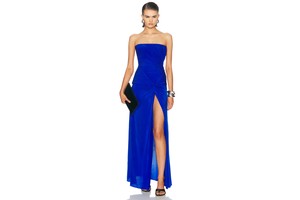
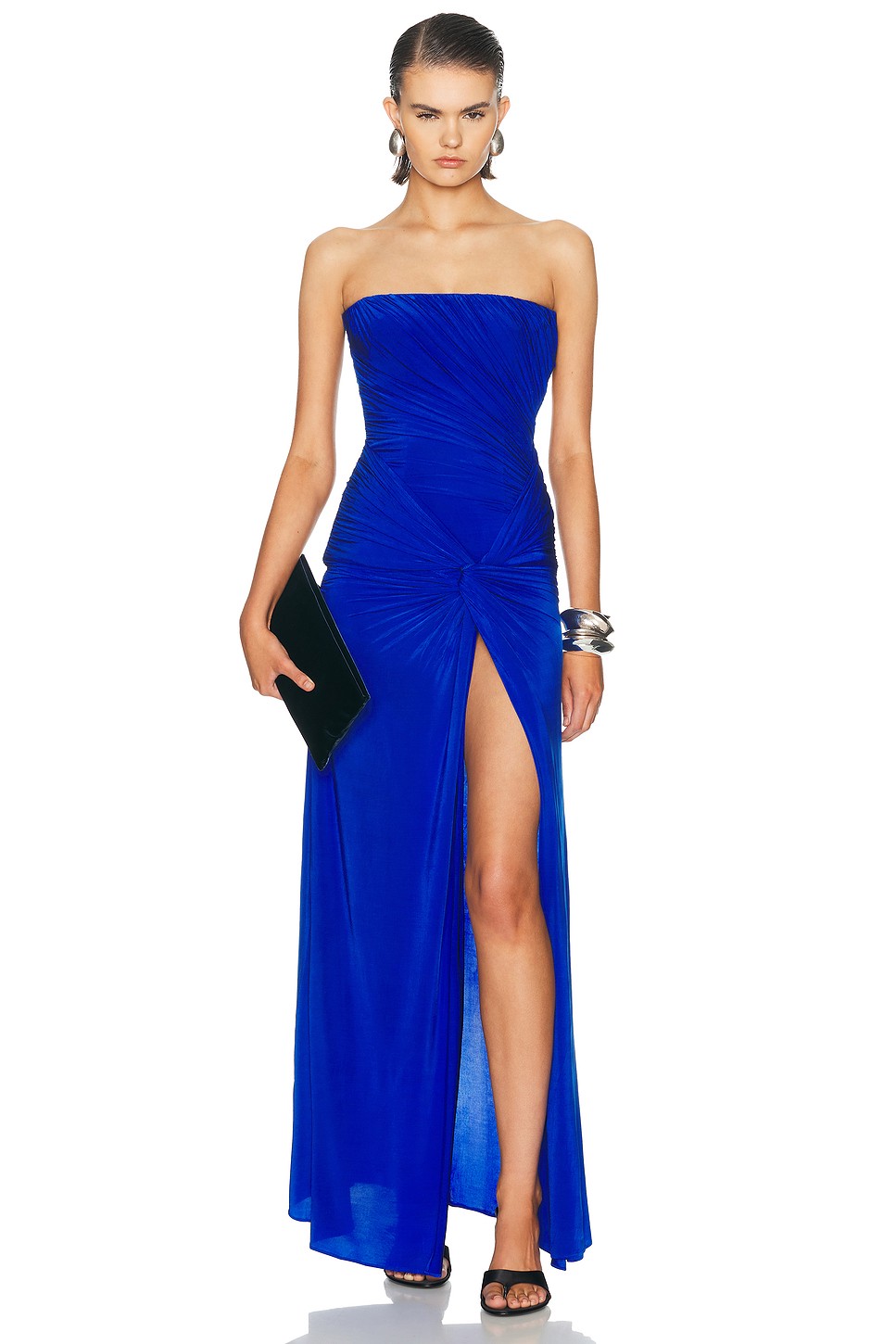
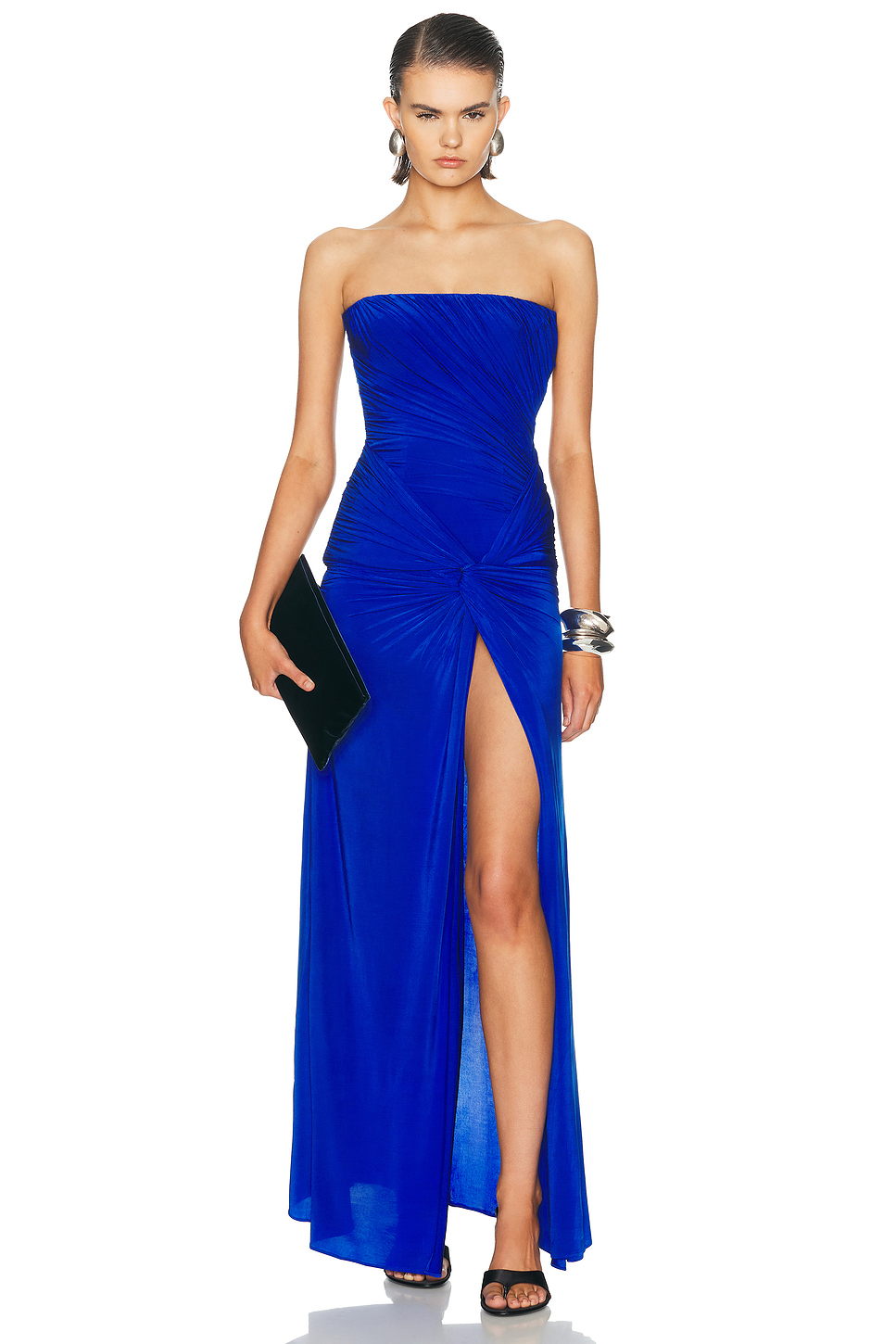
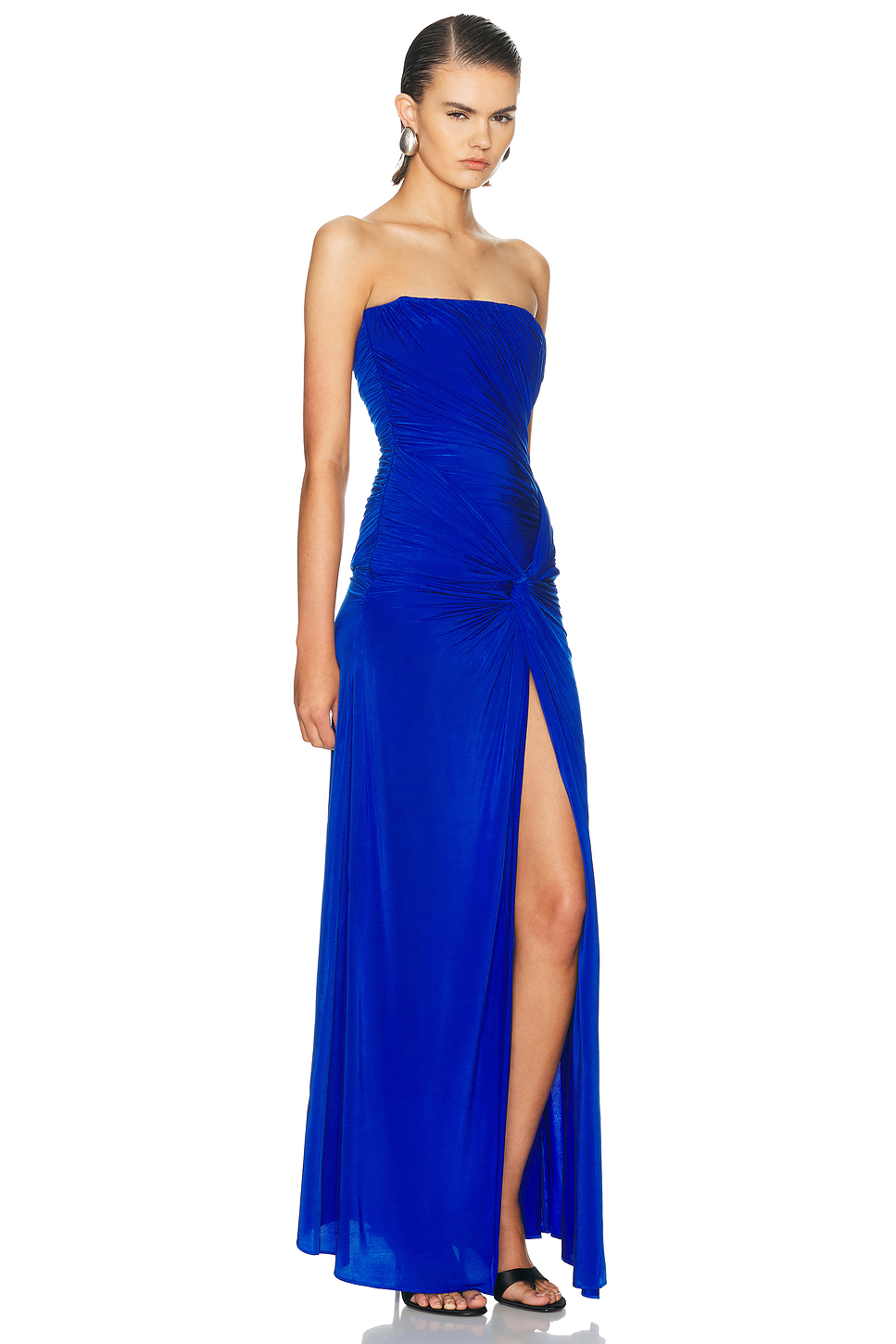
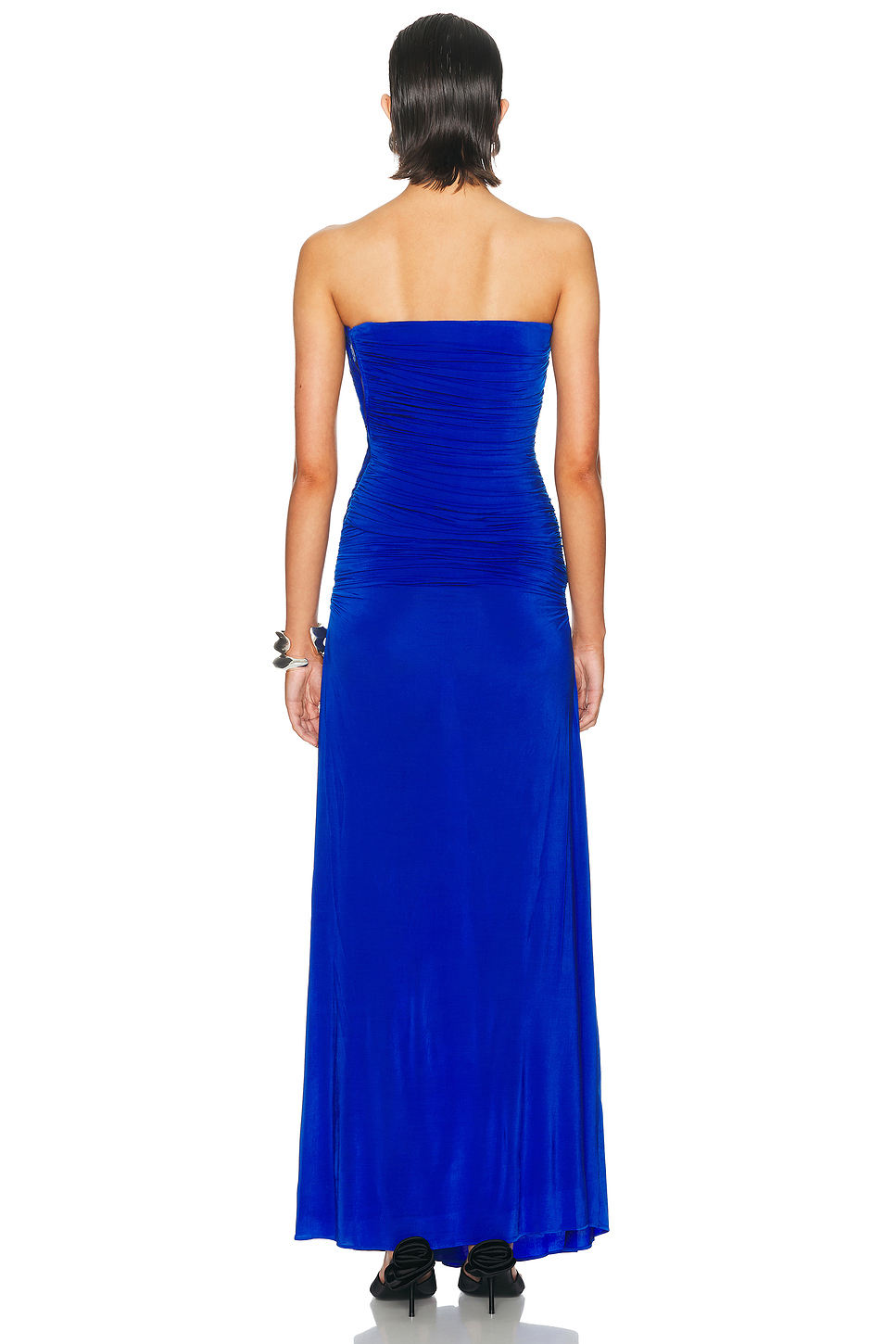
A strapless gown listed as 85% viscose with 15% elastane, part lined, closed with a hidden side zip, with internal boning in the bodice, ruching and a twist at the front over a draped body, in a lightweight smooth knit, dry cleanable, made in Australia, ranked seventy fifth in the retailer's strapless list, at 2,500 dollars. There are no reviews and no fit votes, so there is no score to quote. This is the most expensive garment we have covered and it is also the one that finally answers, completely and with hardware rather than with a property, a question we have been asking since the first strapless garment in this series. It is worth setting that answer out against the other answers we have collected, because the comparison is the useful part. It also forces a correction to something we have been doing with elastane percentages, because the same number in a knit and in a woven cloth does not mean the same thing. And there is a consequence for how a garment like this should be sold which is not obvious and which gets it wrong more often than anything else about it. The reference is the Strapless Ruched Twist Gown by Alex Perry in Cobalt. Dongguan Bafinasa Garments Co., Ltd. develops comparable boned gowns on OEM and ODM terms, from fabric sourcing to retail or FBA ready packing. We publish this as a development reference and build your own version of it, and we do not supply the branded original or reproduce anyone else's label.
Key Features
- 85% viscose, 15% elastane as stated
- Lightweight smooth knit as stated
- Internal boning in the bodice as stated
- Strapless with internal structure as stated
- Ruching and a twist at the front over a draped body as stated
- Hidden side zip as stated
- Part lined as stated
- Made in Australia as stated
Customisable Options
- Fabric: viscose elastane knit as the reference, with the weight and power set from a tested sample
- Structure: internal boning as the reference, which we would keep, with the boning type and placement specified
- Top edge: we would add a silicone band as well, for the reason set out below
- Sizing: we would publish measurements and explain how a compression garment is sized
- Length from midi to floor, twist and ruching placement, size set, colour development, private label and care labelling
Specifications
| Style | Strapless ruched twist gown |
| Reference | Alex Perry, Strapless Ruched Twist Gown, style APEF-WD350, manufacturer style D1779PF26, colour Cobalt |
| Composition | 85% viscose, 15% elastane as stated |
| Fabric | Lightweight smooth knit as stated |
| Elastane Note | 15% in a knit is not the same as 15% in a woven cloth. See the note below |
| Structure | Internal boning in the bodice as stated |
| Neckline | Strapless as stated |
| Detail | Ruching and a twist at the front over a draped body as stated |
| Closure | Hidden side zip as stated |
| Lining | Part lined as stated |
| Care | Dry cleanable as stated, which is a weaker instruction than dry clean only |
| Sizes Published | US 0 / UK 4 through US 8 / UK 12, with both given on the listing |
| Measurements Published | US 2 / UK 6: bust 28 in, waist 18 in, hips 24 in, length 53 in |
| Chart Note | Large negative ease at every point, which a compression knit with boning and a zip is built for |
| Model | 178 cm, wearing size US 2 / UK 6, bust 84 cm, waist 62 cm, hips 89 cm |
| Production | Made in Australia as stated |
| Reference Retail | 2,500 USD, quoted to show the price band this sits in, not as our price |
| Customer Reviews | None on the reference listing, so we quote no score |
| Best Seller Badge | Rank 75 in the retailer's strapless dress list, which is a low position |
| Categories | Filed by the retailer under both gowns and strapless dresses |
| Occasion | Evenings, black tie, formal occasions, events |
| MOQ | 100 pcs per style per colourway, mixed sizes and colourways accepted |
| Sampling | 7-10 days after tech pack or reference sample confirmation |
| Bulk Lead Time | 20-30 days after sample approval and deposit |
| Service | OEM / ODM / private label, knit and boning sourcing, corsetry construction, retail or FBA ready packing |
Size Chart
| Size | Bust | Waist | Hips | Length | Source | ||||||||||||
|---|---|---|---|---|---|---|---|---|---|---|---|---|---|---|---|---|---|
| US 2 / UK 6 | 28 | in | 18 | in | 24 | in | 53 | in / | 135 | cm | As published | ||||||
| US 0 / UK 4 | 31 | in / | 79 | cm | 24 | in / | 61 | cm | 34 | in / | 86 | cm | 133 | cm / | 52.4 | in | Our proposal |
| US 2 / UK 6 | 33 | in / | 84 | cm | 26 | in / | 66 | cm | 36 | in / | 91 | cm | 135 | cm / | 53.1 | in | Our proposal |
| US 4 / UK 8 | 35 | in / | 89 | cm | 28 | in / | 71 | cm | 38 | in / | 97 | cm | 137 | cm / | 53.9 | in | Our proposal |
| US 6 / UK 10 | 37 | in / | 94 | cm | 30 | in / | 76 | cm | 40 | in / | 102 | cm | 139 | cm / | 54.7 | in | Our proposal |
| US 8 / UK 12 | 39 | in / | 99 | cm | 32 | in / | 81 | cm | 42 | in / | 107 | cm | 141 | cm / | 55.5 | in | Our proposal |
The published US 2 gives a 28 inch bust, an 18 inch waist, a 24 inch hip and a 53 inch length against a model at roughly 33, 24 and 35. Every circumference is smaller than she is, the hip by eleven inches. That is not a mistake and it is not a warning either. A compression knit with boning and a zip is built to do exactly this, and the consequence for choosing a size is set out below.
Occasions and Styling
Suits evenings, black tie, formal occasions and events. A structured strapless gown in a strong colour is a formal piece, and it should be photographed from the side as well as the front, because the twist and the drape are what the construction is for.
Production and Quality Control
There are no reviews and no fit votes on this listing, so there is no score to quote. There is an answer here to a question this series has asked four times, an important correction to how elastane figures should be read, and a consequence for sizing that is widely got wrong.
This is the complete answer to the strapless question, and comparing it with the other answers is the useful part, and that is the first thing. The question that governs any strapless garment is what holds it up, since there is nothing over the shoulders and the garment can only grip. We have now collected five answers. A ribbed knit floor length gown relied on the tension of its knit, and we said the grip would relax because the knit had no elastane in it and nothing to restore it. A strapless mini had a little elastane and the advantage of being short, which helped because there was less weight hanging below the grip. A bias cut gown put an elastic in the neckline, and we called that the best answer up to that point because an elastic is a component with a measurable strength rather than a property that degrades. A leather tube dress could use none of them, because leather has no stretch to grip with and does not gather onto an elastic, which left it relying on being cut to an exact circumference, and we said that was the hardest case in the series. This garment uses structure. It has internal boning in the bodice. That is different in kind from all four of the others, because boning does not grip, it holds: a vertical bone is a stiff element running down the bodice that carries the load of the garment downward to the waist rather than letting it slide down the body. It does not depend on friction, on tension, or on the cloth having any particular property, and it does not degrade with wear in the way an elastic or a knit tension does. It is the answer used in corsetry for several centuries and it is the right one at this price. This garment also has a side zip, which takes the strain of getting it on, and a compression knit, which we come to below. So it is the only garment in the series to combine an actual structure with a proper closure. The one thing we would still add is a silicone band along the inside of the top edge, not because the boning needs help holding the garment up but because it stops the top edge from shifting against the skin, which is the thing a wearer notices. Boning holds the dress in place; the band stops the edge from creeping.
Fifteen per cent elastane in a knit is not fifteen per cent in a woven cloth, and this corrects something we have been doing, and that is the second thing. We have spent this series reading elastane figures against each other and building up a range: 28% on a silk dress which we called genuine compression cloth, 19% on two lace garments which comfortably explained their negative ease, 18% on a nylon mesh which accounted for its whole fit, then 5% and 4% which we said were not in the business of providing stretch at all but only of improving recovery. We applied that range as though the percentage alone told you what a garment could do. It does not, and this garment shows why. Fifteen per cent sits between the figures we called mechanism and the figures we called additive, and on its own that would leave it ambiguous. But this is a knit, and a knit already has give before any elastane goes into it, because a knit is made of loops and a loop can open. So the stretch in this cloth is the knit's own structural stretch plus whatever the elastane adds, and the two compound. Fifteen per cent in a knit is therefore considerably more powerful than fifteen per cent in a woven cloth, where the only stretch available is what the elastane provides. The correct way to read these figures is to read the percentage and the construction together, and once you do, 15% in a smooth knit is a compression cloth, which is exactly what the measurements say it is. This matters beyond this garment because it means a woven garment at 19% and a knit at 15% may well behave similarly, and comparing their percentages directly would mislead you.
A compression garment should be sized by the result and not by the body, and that is the third thing, and it is the part that gets got wrong. Look at what these numbers mean. The waist is published at 18 inches and the hip at 24, for a model measuring 24 and 35. So the garment is substantially smaller than the body it goes onto, and it is meant to be: it is a compression knit, it has boning, and the intention is that it brings the body to the garment rather than the garment accommodating the body. That is how corsetry works and there is nothing wrong with it. But it means the size chart is not telling the customer what size of person it fits, it is telling her what size she will be when it is on. Those are different questions and a customer who reads 18 inches at the waist, compares it with her own 28, and concludes the dress is far too small has misunderstood what she is looking at, while a customer who understands compression and orders her usual size may find the dress does not do anything for her because it was not tight enough to compress. So a page selling this needs to say which it is. The honest and useful way to put it is to publish the measurements, as this listing does, and then add one sentence saying the garment is designed to compress and that the published figures are the garment's dimensions rather than the wearer's. Without that sentence, both kinds of customer get it wrong in opposite directions and both return it. There is a related point about the twist at the front. A twist over the middle is not only decorative: it puts folds of cloth across the area where a very tight garment would otherwise show everything, and it is one of the standard ways of making a compression silhouette wearable. We would keep it and we would say so, because a customer who thinks it is styling may not realise it is doing a job. Every bulk shipment gets a measurement report against your approved chart.
Optional upgrades include a silicone band along the top edge, the boning type and placement specified, the compression intent stated on the page with the measurements, the knit power specified rather than just its composition, alternative twist and ruching placements, alternative lengths, extended sizing, colour development and private label, hangtag and care labelling.
Pre-production sample approval, in-line inspection during cutting and sewing, and a final AQL inspection before packing, with measurement reports and photos shared before shipment.
Send us your tech pack, a photo or a reference garment and we will quote within 24 hours. Contact bafinasa@bafinasa.com or WhatsApp +86 13827222469.