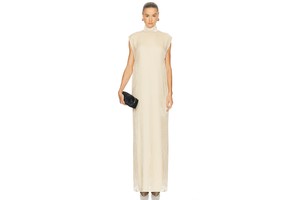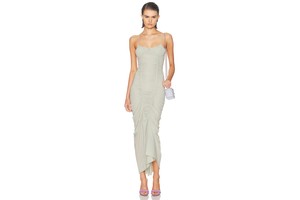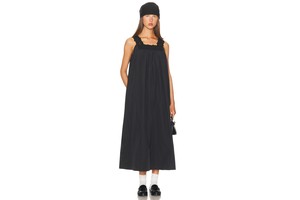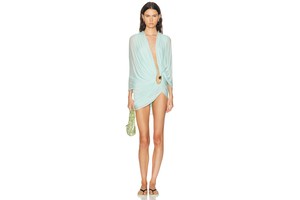
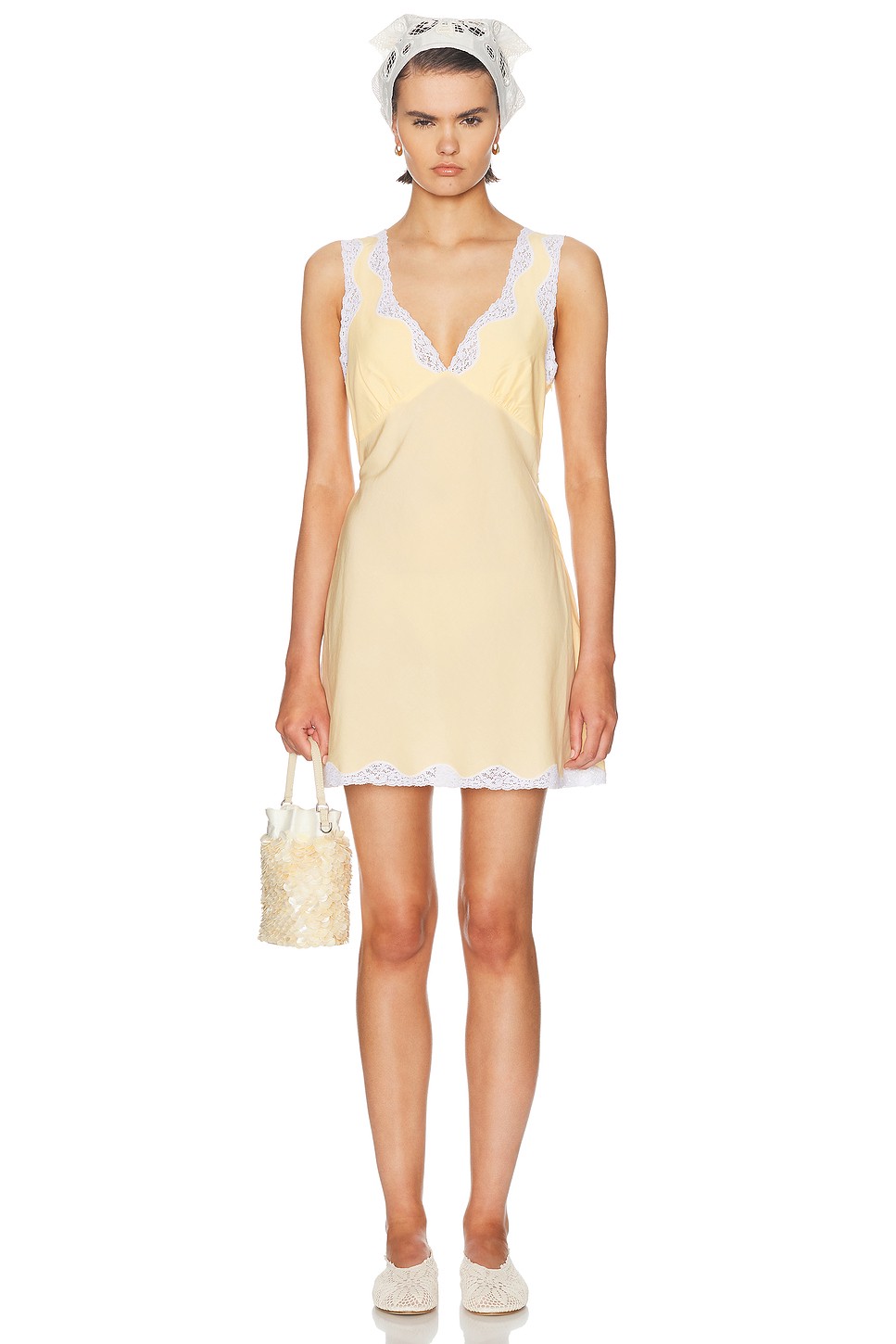
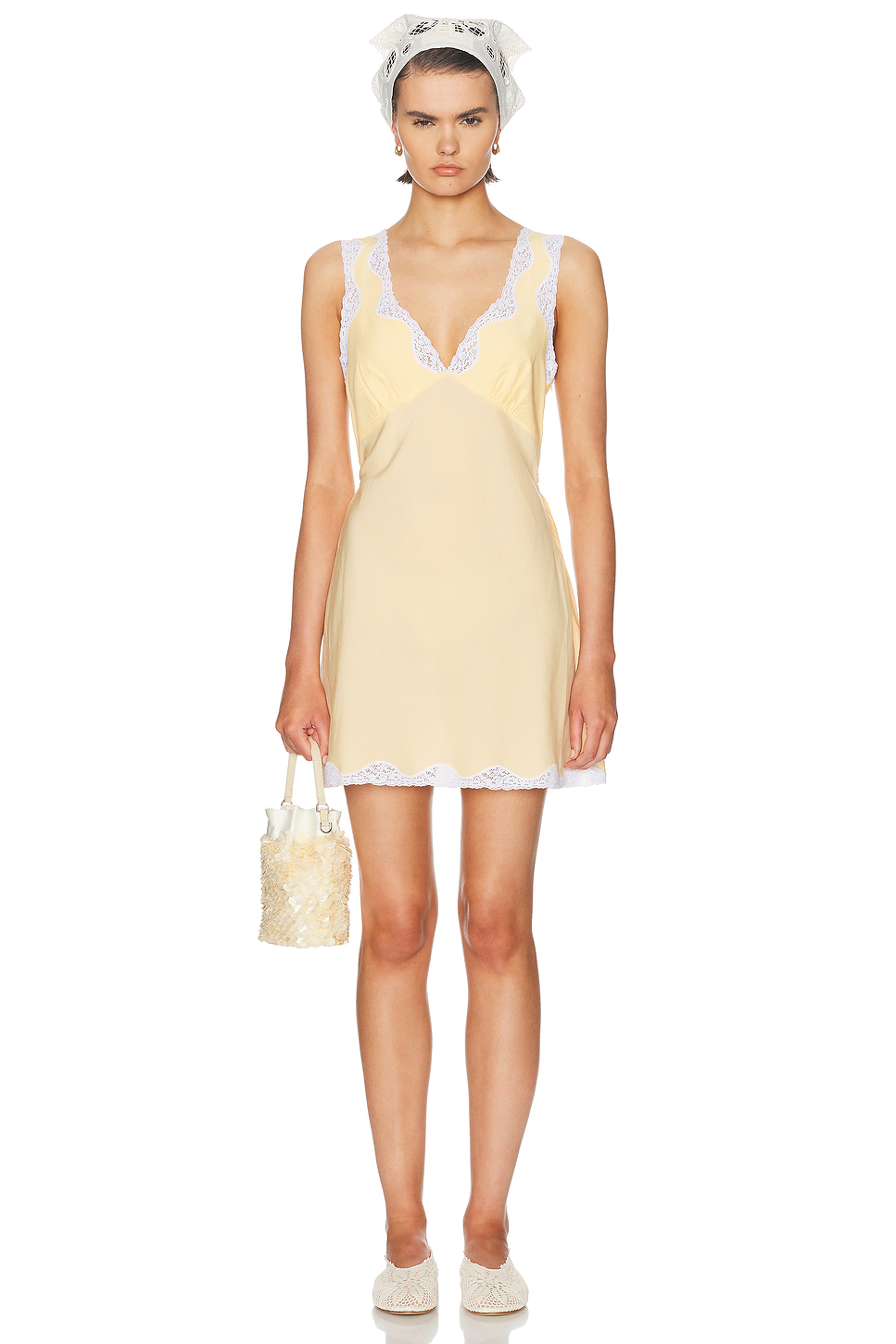
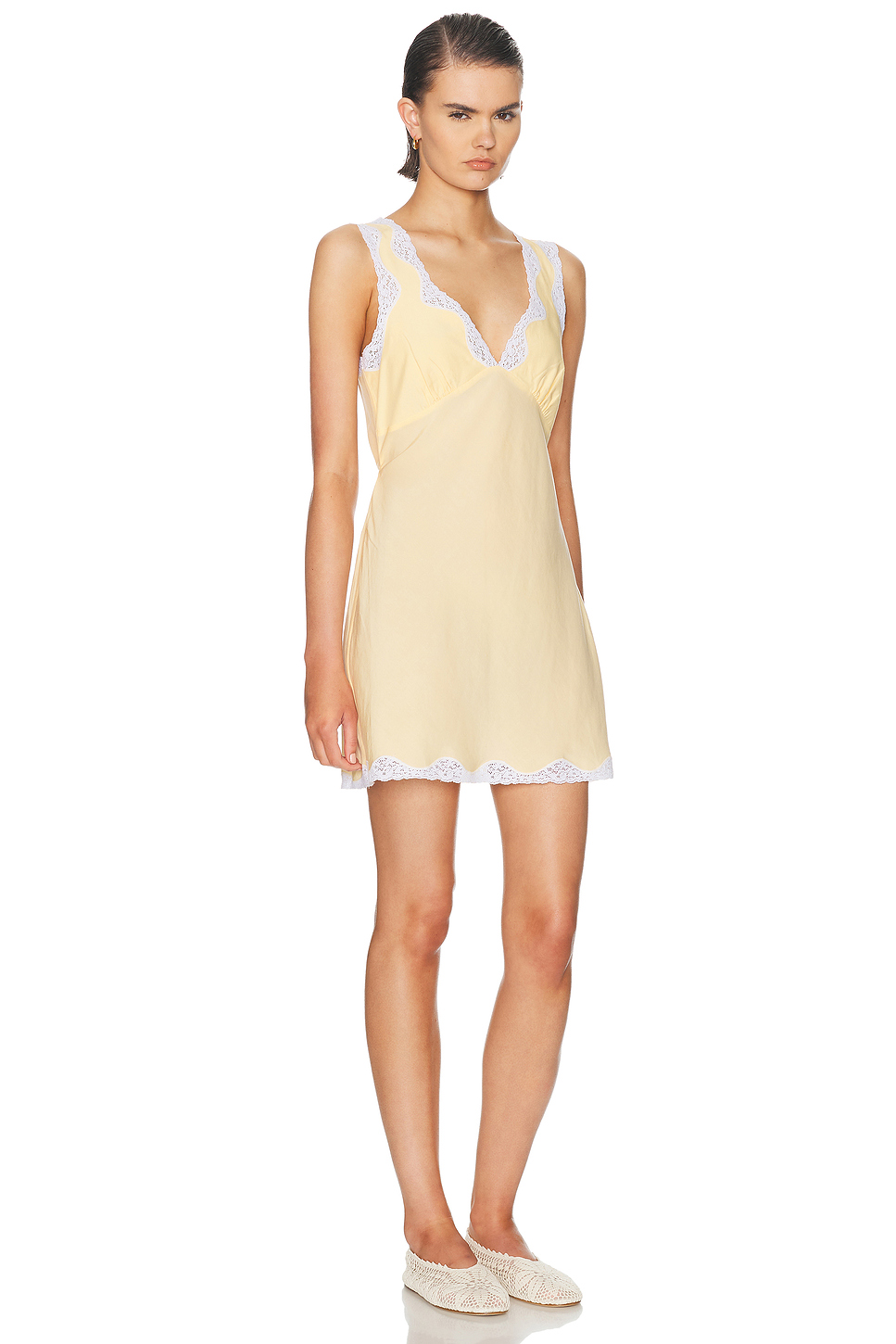
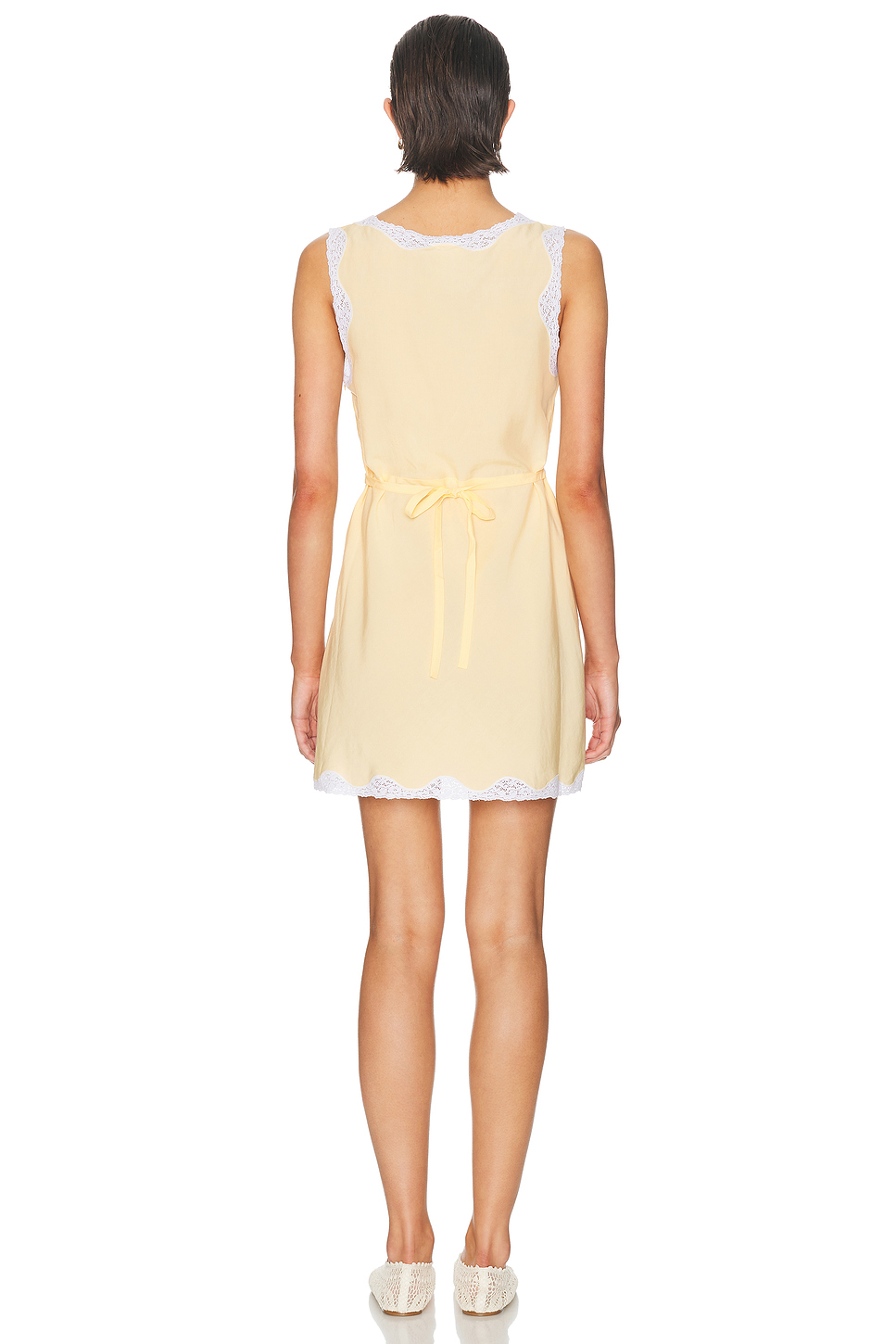
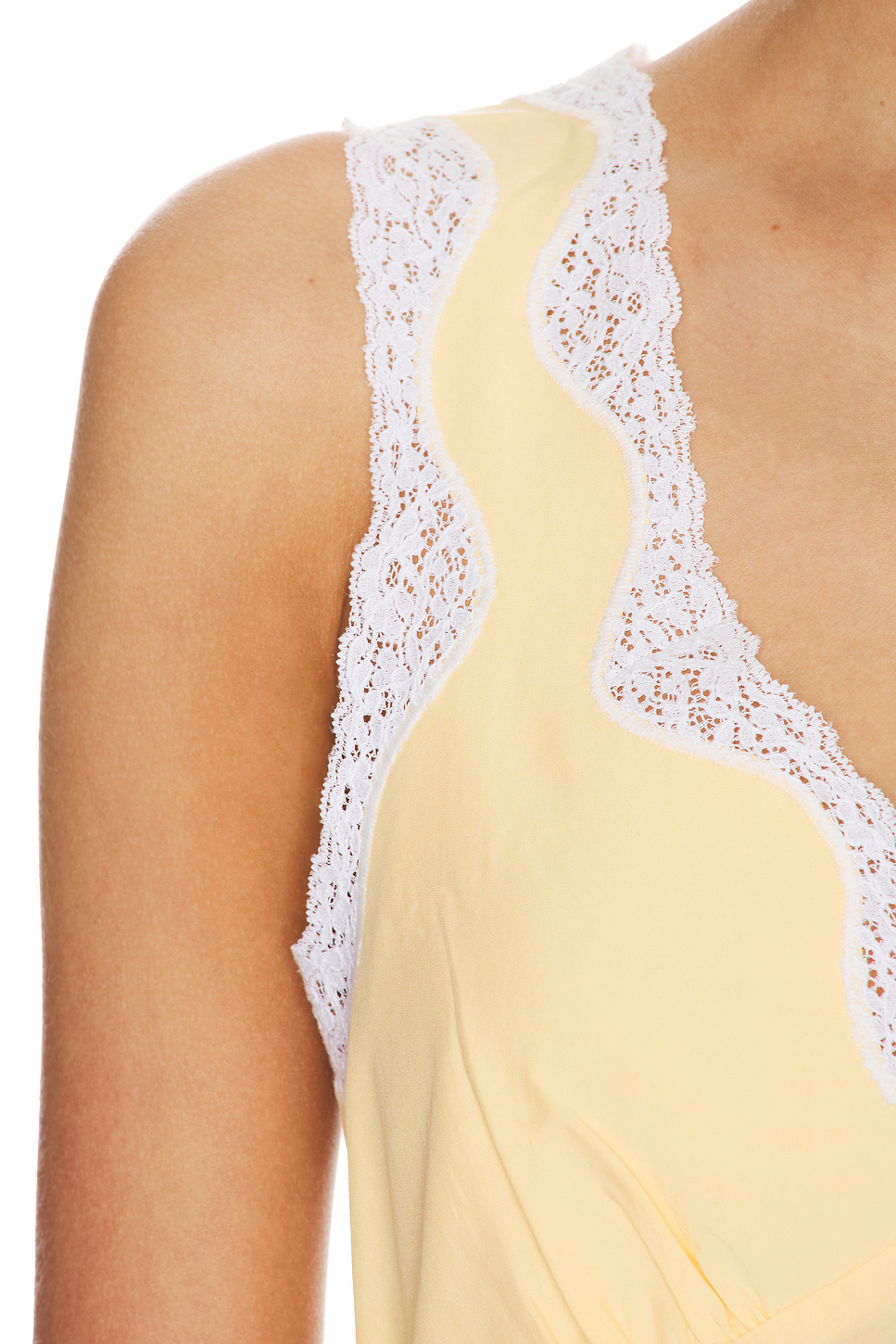
A slip mini listed as 100% lyocell for the shell with a lace trim in 90% cotton and 10% nylon, unlined, closed with a concealed side zip, with a detachable tie at the waist, in a lightweight poplin, dry clean only, made in China, ranked thirteenth in the retailer's tank list, at 390 dollars. There are no reviews and no fit votes, so there is no score to quote. This is the first garment in this series made of lyocell, and the fibre is worth a proper introduction because it sits in the same family as one we have discussed many times and behaves quite differently in the one respect that matters most. There is also a word in the fabric description that could mislead, and clearing it up is useful well beyond this garment. And there is a small design decision here, the detachable tie, that is more interesting than it looks and which we have seen the good version of once before. The reference is the Tabitha Slip Mini Dress by Posse in Buttermilk. Dongguan Bafinasa Garments Co., Ltd. develops comparable lyocell dresses on OEM and ODM terms, from fabric sourcing to retail or FBA ready packing. We publish this as a development reference and build your own version of it, and we do not supply the branded original or reproduce anyone else's label.
Key Features
- Shell: 100% lyocell as stated
- Trim: 90% cotton, 10% nylon lace as stated
- Lightweight poplin as stated
- Detachable tie at the waist as stated
- Concealed side zip as stated
- Unlined as stated
- Dry clean only as stated
- Four sizes from XS to L
Customisable Options
- Fabric: lyocell lightweight poplin as the reference, with the weight set from a tested sample
- Trim: cotton nylon lace as the reference, and we would consider a trim whose fibre is closer to the shell
- Tie: detachable as the reference, and we would add belt loops, for the reason set out below
- Care: dry clean only as the reference, which we would keep, and we would say why
- Length from mini to midi, trim width, size set, colour development, private label and care labelling
Specifications
| Style | Tabitha lyocell slip mini |
| Reference | Posse, Tabitha Slip Mini Dress, style PSSF-WD83, manufacturer style PS2150-BMI, colour Buttermilk |
| Shell | 100% lyocell as stated |
| Lyocell Note | Lyocell is a regenerated cellulose fibre like viscose but behaves very differently when wet. See the note below |
| Trim | 90% cotton, 10% nylon lace as stated |
| Fabric | Lightweight poplin as stated, which is a weave rather than a fibre |
| Detail | Detachable tie at the waist as stated |
| Closure | Concealed side zip as stated |
| Lining | Unlined as stated |
| Care | Dry clean only as stated |
| Sizes Published | XS, S, M, L |
| Measurements Published | S: bust 34 in, waist 32 in, hips 42 in, length 32 in |
| Chart Note | Generous at the waist and hip, which the tie is there to deal with |
| Model | 178 cm, wearing size S, bust 84 cm, waist 62 cm, hips 89 cm |
| Production | Made in China as stated |
| Reference Retail | 390 USD, quoted to show the price band this sits in, not as our price |
| Customer Reviews | None on the reference listing, so we quote no score |
| Best Seller Badge | Rank 13 in the retailer's tank dress list, which is a strong position |
| Categories | Filed by the retailer under both mini dresses and tank dresses |
| Occasion | Daytime, holidays, warm weather, layering |
| MOQ | 100 pcs per style per colourway, mixed sizes and colourways accepted |
| Sampling | 7-10 days after tech pack or reference sample confirmation |
| Bulk Lead Time | 20-30 days after sample approval and deposit |
| Service | OEM / ODM / private label, lyocell sourcing, lace trim sourcing, retail or FBA ready packing |
Size Chart
| Size | Bust | Waist | Hips | Length | Source | ||||||||||||
|---|---|---|---|---|---|---|---|---|---|---|---|---|---|---|---|---|---|
| S | 34 | in | 32 | in | 42 | in | 32 | in / | 81 | cm | As published | ||||||
| XS | 31 | in / | 79 | cm | 24 | in / | 61 | cm | 34 | in / | 86 | cm | 79 | cm / | 31.1 | in | Our proposal |
| S | 33 | in / | 84 | cm | 26 | in / | 66 | cm | 36 | in / | 91 | cm | 81 | cm / | 31.9 | in | Our proposal |
| M | 35 | in / | 89 | cm | 28 | in / | 71 | cm | 38 | in / | 97 | cm | 83 | cm / | 32.7 | in | Our proposal |
| L | 37 | in / | 94 | cm | 30 | in / | 76 | cm | 40 | in / | 102 | cm | 85 | cm / | 33.5 | in | Our proposal |
The published size S gives a 34 inch bust, a 32 inch waist, a 42 inch hip and a 32 inch length against a model at roughly 33, 24 and 35. The waist and hip are generous, by eight and seven inches, and that is what the tie is for: the garment is cut loose and drawn in at the waist. So the waist figure is not the fitted waist the wearer will end up with.
Occasions and Styling
Suits daytime, holidays, warm weather and layering. A lyocell slip mini with a lace trim is a warm weather piece, and it is worth photographing it with the tie on and with it off, because those are two different garments.
Production and Quality Control
There are no reviews and no fit votes on this listing, so there is no score to quote. There is a fibre here that deserves an introduction, a word in the fabric description that could mislead, and a design decision worth examining.
Lyocell is not viscose, and the difference is in the one property that matters most, and that is the first thing. Lyocell and viscose are both regenerated cellulose fibres, meaning both are made by dissolving wood pulp and extruding it, and on a page they look interchangeable. They are not, and the difference is what happens when they get wet. Viscose loses a very large part of its strength in water, on the order of half, and we have come back to that fact many times in this series because it explains so much: it is why viscose garments are hand washed or dry cleaned, why they distort under their own weight while wet, and why a viscose gown must be dried flat rather than hung. Lyocell does not do that. It retains the great majority of its strength when wet, losing something in the order of a tenth rather than a half. So every caution we have raised about viscose and water largely does not apply to lyocell, and a lyocell garment is a considerably more robust thing than the same garment in viscose. It also drapes beautifully and absorbs moisture well, which is why it is used for exactly this kind of soft, fluid dress. What lyocell does have is a fault of its own, and it is a strange one. When it is wet and abraded, its surface fibrillates, meaning the outer layer of the fibre lifts into very fine white hairs, and the cloth develops a frosted or washed out look in the rubbed areas, most visibly on a dark colour and along edges and seams. It is not damage in the structural sense, the cloth is still strong, but it looks like wear. That is the real reason a lyocell garment with a delicate lace trim is specified as dry clean only, and it is a good reason, so we would keep the instruction. What we would add is a line on the label saying why, because a customer who knows that wet abrasion causes the frosting will understand that the instruction is about the surface rather than about the garment falling apart.
Poplin is a weave and not a fibre, and this is worth clearing up because it appears in fabric descriptions constantly and people read it as a material, and that is the second thing. Poplin is a plain weave made with fine yarns at a high thread count, which produces a smooth, dense cloth with a slight rib. That is a description of how the cloth is put together, and it says nothing about what it is made of. The classic poplin is cotton, and we looked at a cotton poplin dress recently where the property doing the work was stiffness, because a dense cotton plain weave holds a crease and holds a shape. This is a poplin made of lyocell. Same weave, different fibre, and therefore a different cloth: it will be softer and more fluid than a cotton poplin, it will drape rather than stand, and it will not hold a crease in the way the cotton one does. So a customer who reads poplin and expects the crisp cotton she knows will be surprised, and a developer who reads poplin and orders cotton will get the wrong cloth. The same word is doing two jobs. This is worth stating generally, because the same confusion arises with satin, which is also a weave, and with chiffon, and with jersey, and we have seen several garments in this series where a weave name was the only description given and the fibre was never stated at all.
The detachable tie is the third thing, and the interesting part is what being loose plus a tie actually achieves. The measurements here are generous: the waist is published eight inches larger than the model's own and the hip seven. On a fitted garment that would be a problem, and on a straight shaped dress we said something similar recently, noting that a garment with that much ease will not look fitted. This garment solves it differently. It is cut loose and then drawn in at the waist with a tie, which means the same size accommodates a considerable range of bodies, because the wearer sets how much is taken in. That is a genuinely different strategy from the two others we have seen for dealing with a range of shapes. One is gathering with elastic thread, which we saw on a shirt dress where the published hip was the gathered dimension and therefore the smallest the panel could be rather than the largest, and which accommodates a range but only within what the elastic allows. The other is elastane in the cloth, where the stretch itself does the accommodating. A tie is different from both because it is adjustable: it has no fixed limit, it can be tied loose or tight, and it can be removed altogether, which literally makes it two garments. That is the appeal of detachable, and it is the same logic we admired on a gown that shipped with a detachable bodysuit, where the detaching removed the single biggest practical objection to the whole category. The caution with anything detachable is that it gets lost. A tie that is not attached to the garment will be left in a changing room or a hotel drawer, and then the customer has a shapeless dress. The cheap answer is belt loops, or a pair of small tacked threads at the side seams, so the tie has a home on the garment when it is not being worn. Every bulk shipment gets a measurement report against your approved chart.
Optional upgrades include belt loops or tacked threads so the tie has a home on the garment, a trim whose fibre is closer to the shell so the seam behaves, a line on the care label explaining the frosting, the waist and hip ease stated on the page since the tie does the fitting, alternative trim widths, alternative lengths, extended sizing, colour development and private label, hangtag and care labelling.
Pre-production sample approval, in-line inspection during cutting and sewing, and a final AQL inspection before packing, with measurement reports and photos shared before shipment.
Send us your tech pack, a photo or a reference garment and we will quote within 24 hours. Contact bafinasa@bafinasa.com or WhatsApp +86 13827222469.