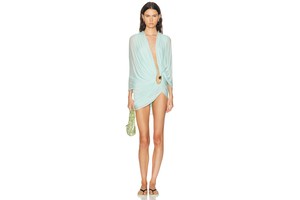
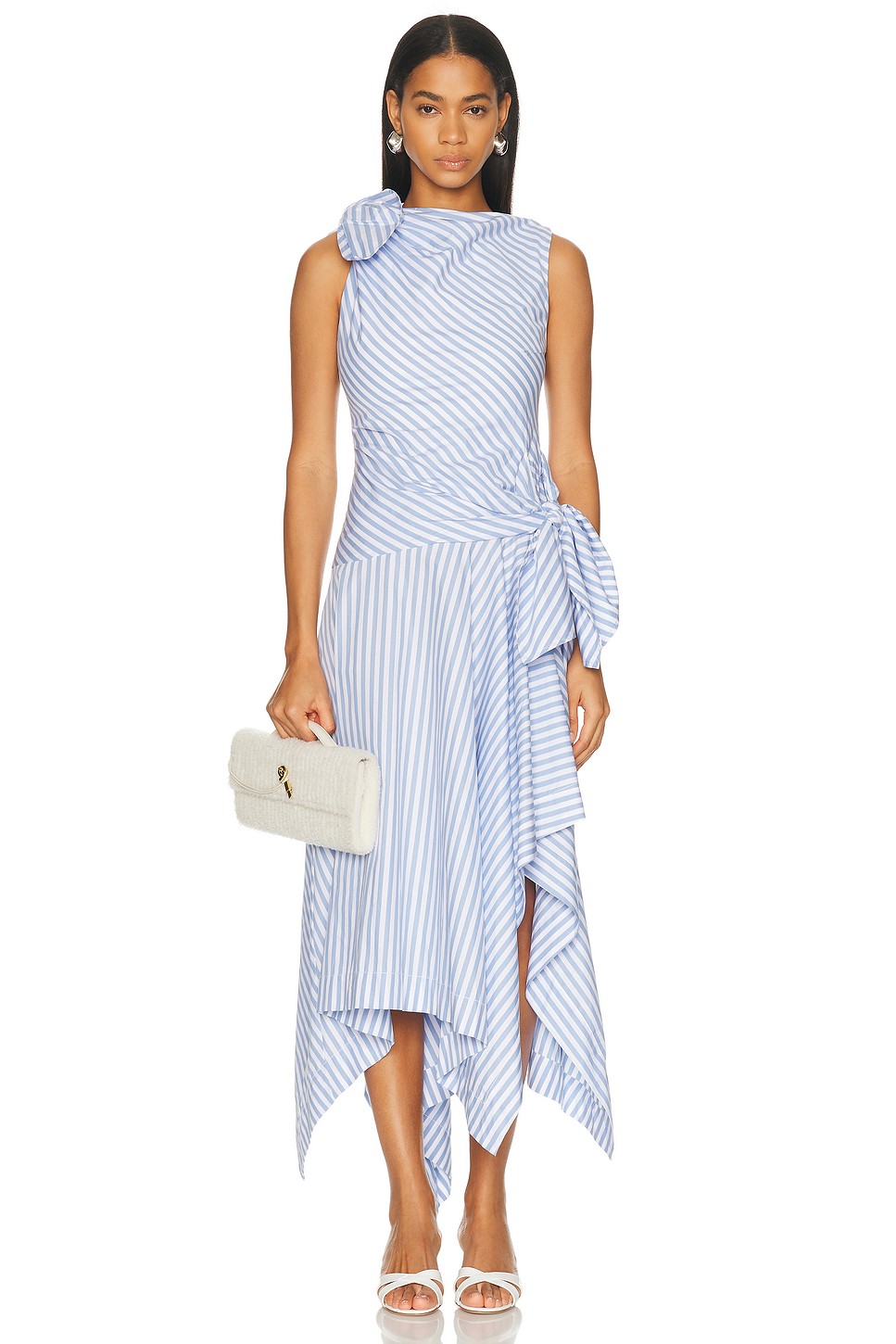
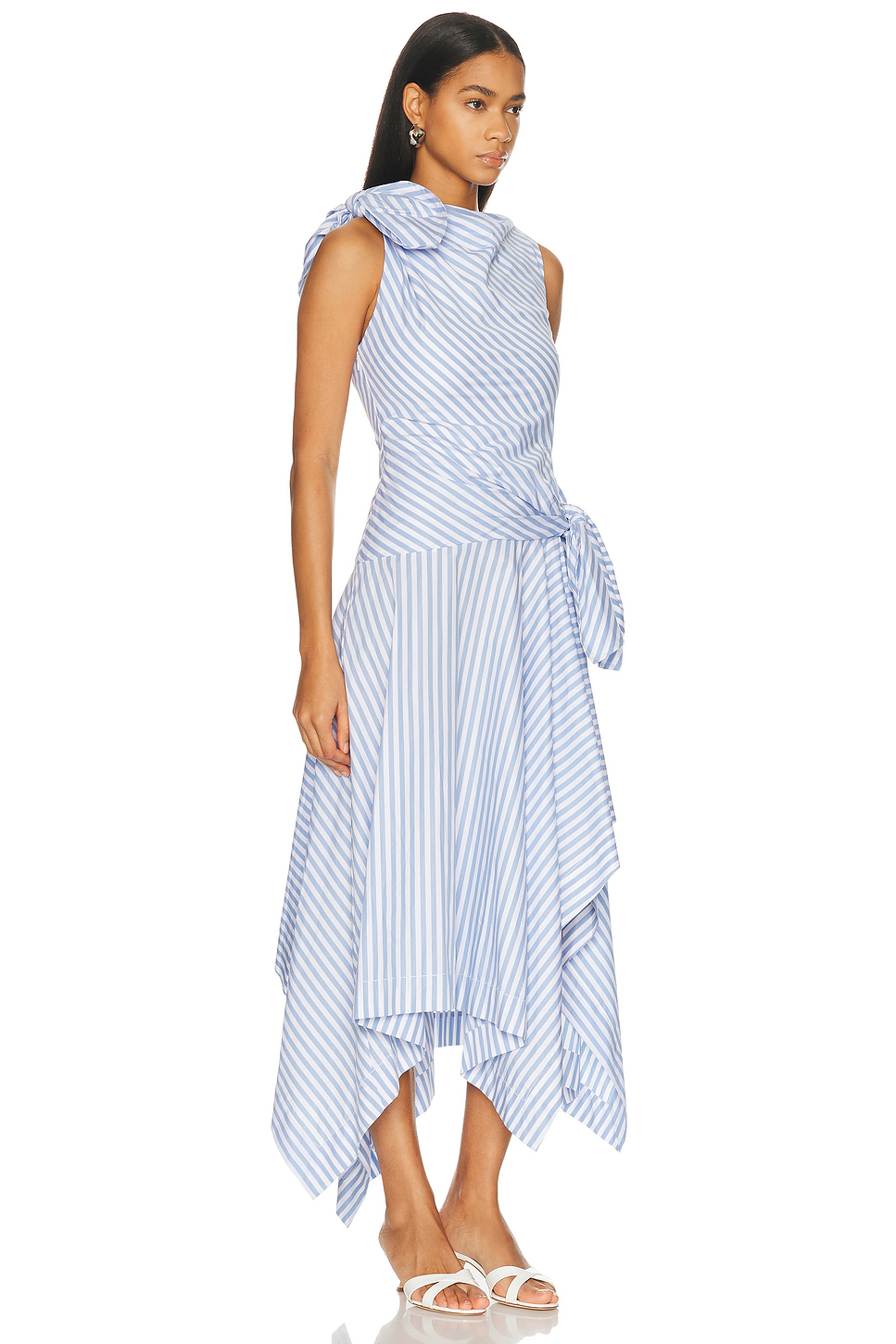
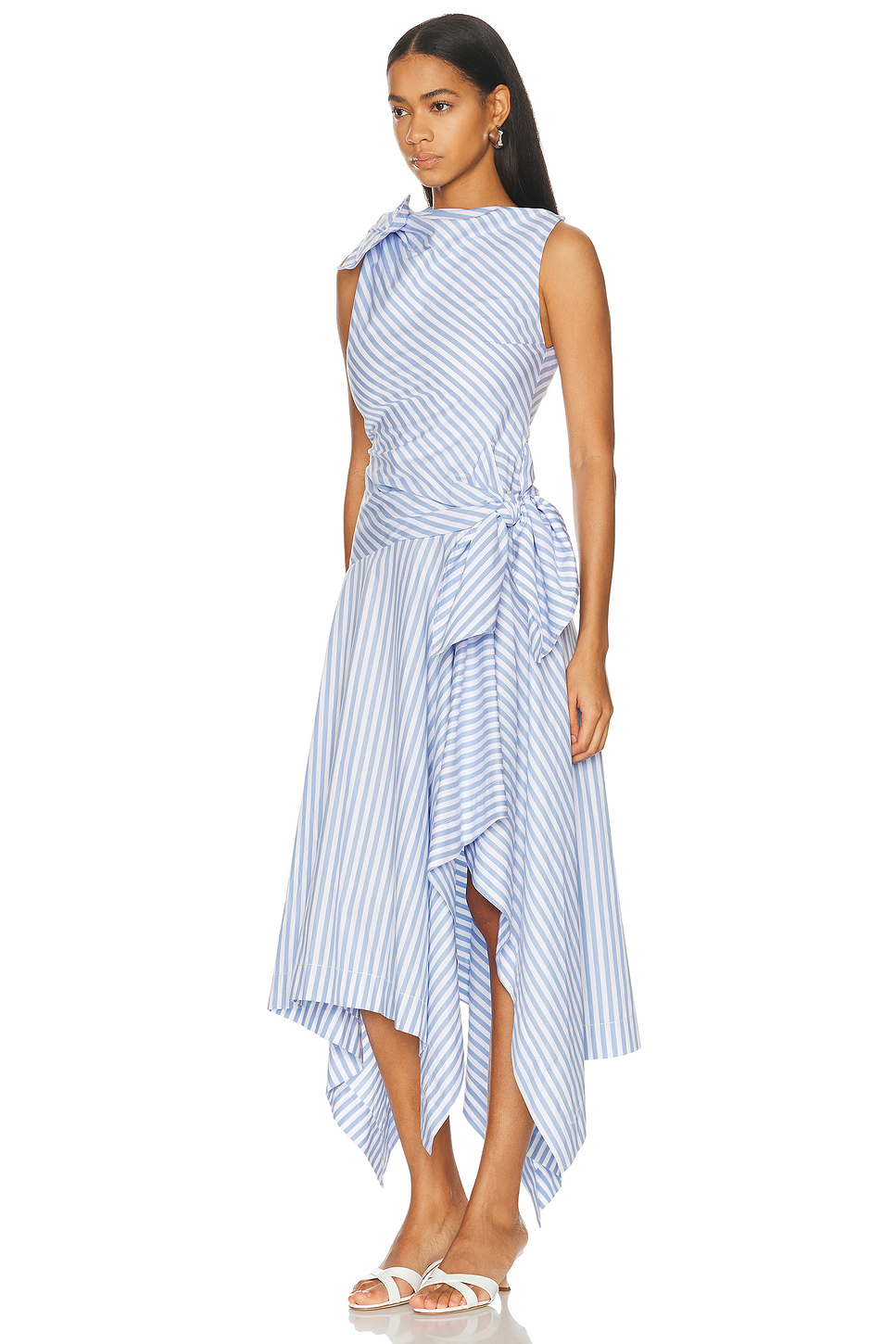
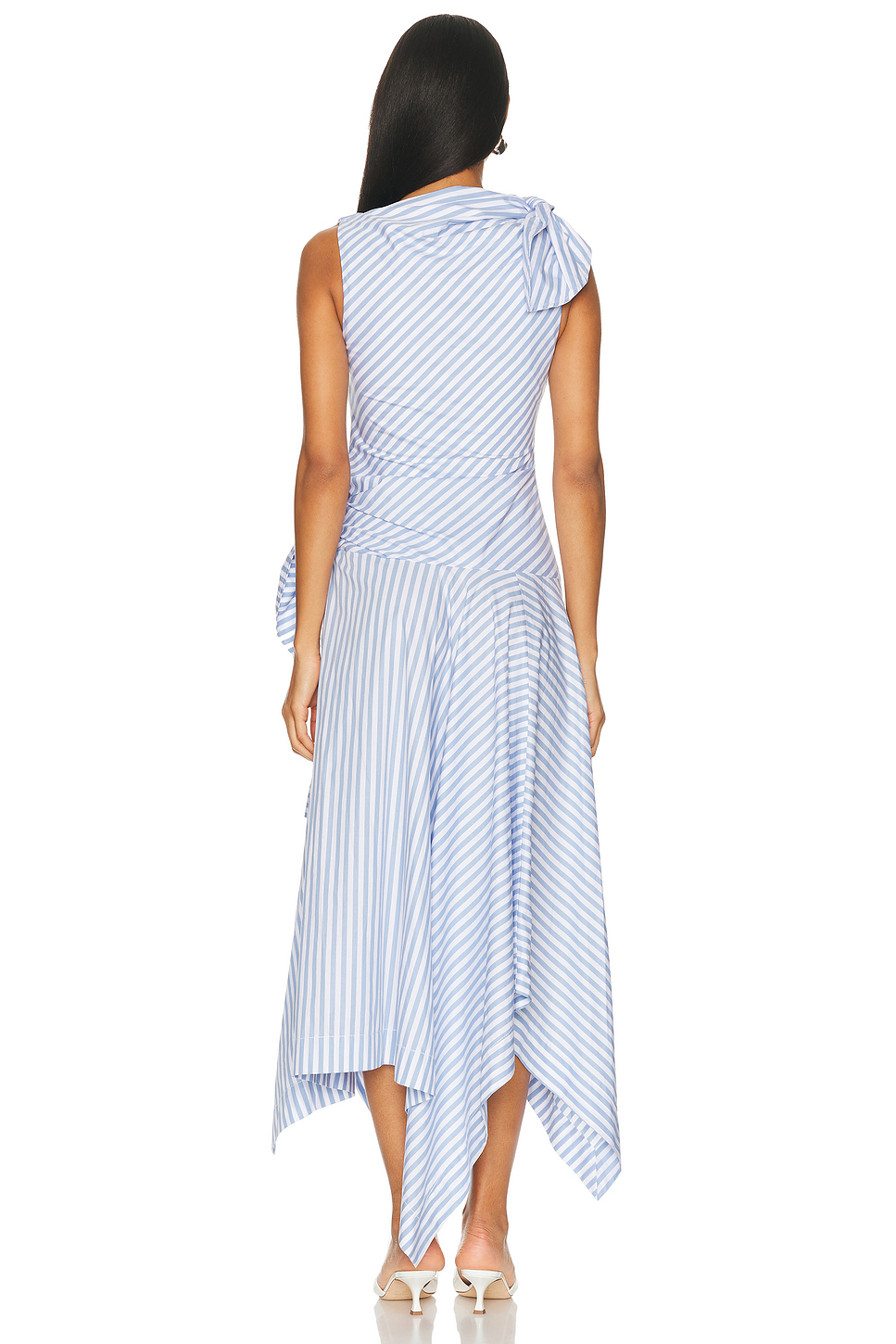
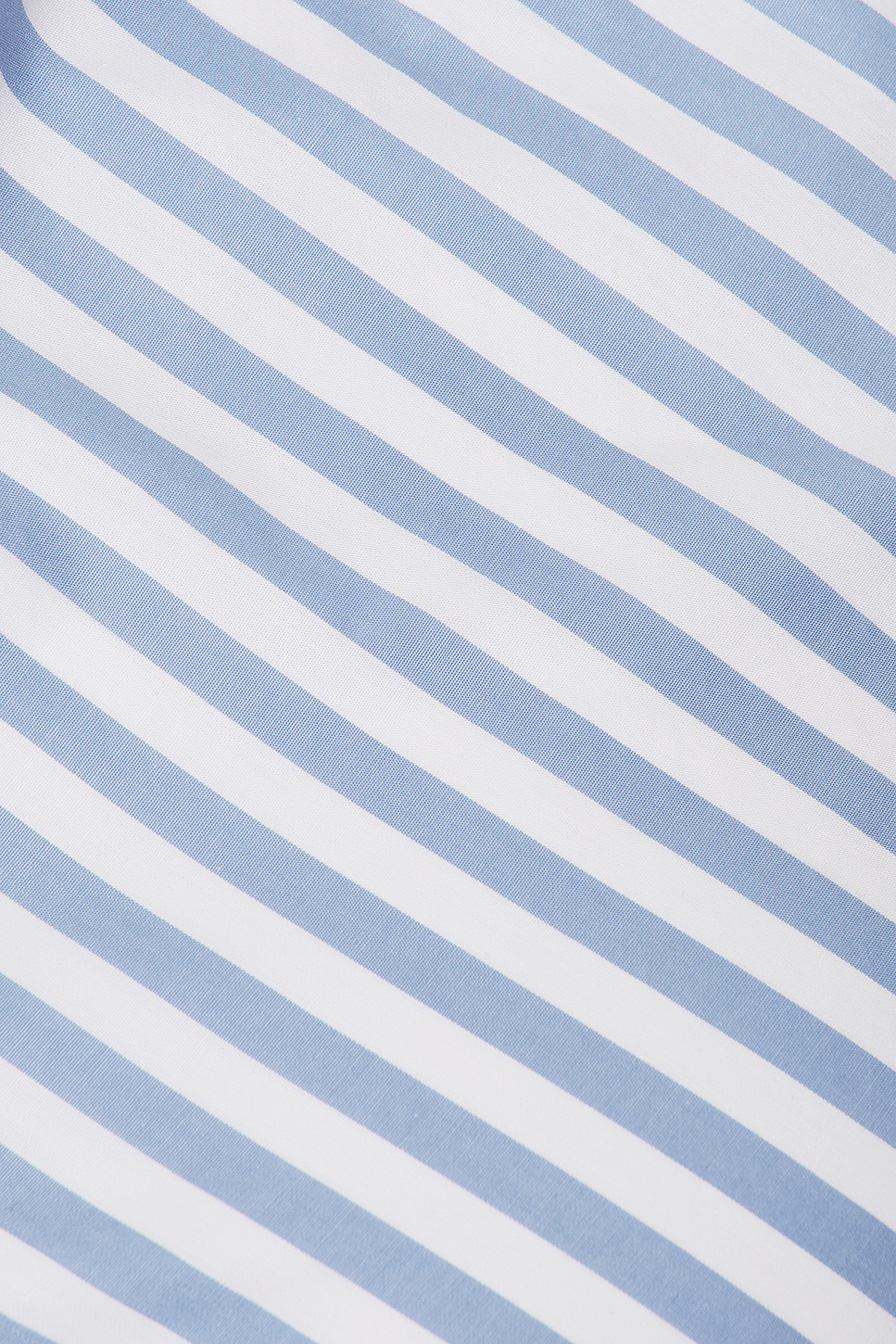
An asymmetric midi listed as 100% cotton for the shell with 100% polyester for the contrast, part lined at the bust, closed with a concealed side zip, with a bow at the shoulder, a wrap front with a tie closure and an asymmetric hem, in a midweight poplin, dry clean only, made in China, ranked thirty ninth in the retailer's cocktail list, at 1,118 dollars. There are no reviews and no fit votes, so there is no score to quote. What makes this garment interesting is that it uses the most ordinary cloth in the wardrobe at one of the highest prices we have covered, and that gap has consequences worth thinking about. It also contains a version of a construction we have flagged as risky twice before, and here it is not risky at all, and the reason is entirely down to what the cloth is, which is a useful thing to be able to show. There is a technical point about the hem and a matching point about the bow, and both come from the same property of poplin. The reference is the Bow Drape Shirting Cascade Dress by Monse in Sky Blue. Dongguan Bafinasa Garments Co., Ltd. develops comparable poplin dresses on OEM and ODM terms, from fabric sourcing to retail or FBA ready packing. We publish this as a development reference and build your own version of it, and we do not supply the branded original or reproduce anyone else's label.
Key Features
- Shell: 100% cotton as stated
- Contrast: 100% polyester as stated
- Midweight poplin as stated
- Wrap front with a tie closure as stated
- Bow at the shoulder as stated
- Asymmetric hem as stated
- Concealed side zip as stated
- Dry clean only as stated
Customisable Options
- Fabric: cotton poplin as the reference, with the weight and finish set from a tested sample
- Contrast: polyester as the reference, and we would consider matching its fibre to the shell, for the reason set out below
- Hem: we would hang and settle before cutting the hem, for the reason set out below
- Bow: as the reference, which suits this cloth
- Length from midi to maxi, wrap depth, bow scale, size set, colour development, private label and care labelling
Specifications
| Style | Bow drape shirting cascade dress |
| Reference | Monse, Bow Drape Shirting Cascade Dress, style MNSF-WD98, manufacturer style MR260218WST, colour Sky Blue |
| Shell | 100% cotton as stated |
| Contrast | 100% polyester as stated |
| Contrast Note | A contrast panel is visible, so any difference in how the two cloths move will show. See the note below |
| Fabric | Midweight poplin as stated |
| Closure | Concealed side zip as stated |
| Front | Wrap front with a tie closure as stated |
| Detail | Bow at the shoulder as stated |
| Hem | Asymmetric hem as stated |
| Lining | Part lined at the bust as stated, with the fibre of the lining not published |
| Care | Dry clean only as stated |
| Sizes Published | 0, 2, 4, 6, 8 |
| Measurements Published | 2: bust 32 in, waist 25 in, hips 33 in, length 47.5 in |
| Chart Note | Close to the model's own measurements, which is comfortable in a cloth with no elastane |
| Model | 178 cm, wearing size 2, bust 84 cm, waist 58 cm, hips 86 cm |
| Production | Made in China as stated |
| Reference Retail | 1,118 USD, quoted to show the price band this sits in, not as our price |
| Customer Reviews | None on the reference listing, so we quote no score |
| Best Seller Badge | Rank 39 in the retailer's cocktail dress list, which is a low position |
| Categories | Filed by the retailer under both midi dresses and sleeveless dresses |
| Occasion | Events, weddings, daytime occasions, work |
| MOQ | 100 pcs per style per colourway, mixed sizes and colourways accepted |
| Sampling | 7-10 days after tech pack or reference sample confirmation |
| Bulk Lead Time | 20-30 days after sample approval and deposit |
| Service | OEM / ODM / private label, poplin sourcing, wrap construction, retail or FBA ready packing |
Size Chart
| Size | Bust | Waist | Hips | Length | Source | ||||||||||||
|---|---|---|---|---|---|---|---|---|---|---|---|---|---|---|---|---|---|
| 2 | 32 | in | 25 | in | 33 | in | 47.5 | in / | 121 | cm | As published | ||||||
| 0 | 31 | in / | 79 | cm | 24 | in / | 61 | cm | 34 | in / | 86 | cm | 119 | cm / | 46.9 | in | Our proposal |
| 2 | 33 | in / | 84 | cm | 26 | in / | 66 | cm | 36 | in / | 91 | cm | 121 | cm / | 47.6 | in | Our proposal |
| 4 | 35 | in / | 89 | cm | 28 | in / | 71 | cm | 38 | in / | 97 | cm | 123 | cm / | 48.4 | in | Our proposal |
| 6 | 37 | in / | 94 | cm | 30 | in / | 76 | cm | 40 | in / | 102 | cm | 125 | cm / | 49.2 | in | Our proposal |
| 8 | 39 | in / | 99 | cm | 32 | in / | 81 | cm | 42 | in / | 107 | cm | 127 | cm / | 50 | in | Our proposal |
The published size 2 gives a 32 inch bust, a 25 inch waist, a 33 inch hip and a 47.5 inch length against a model at roughly 33, 23 and 34. These are close to her own measurements, with an inch or so either way, which is exactly what you would want in a cloth with no elastane in it. There is a side zip, which takes the strain of getting it on.
Occasions and Styling
Suits events, weddings, daytime occasions and work. A poplin midi with a bow sits between formal and everyday, and it is worth photographing the bow and the hem together, since both are details the customer will look at closely.
Production and Quality Control
There are no reviews and no fit votes on this listing, so there is no score to quote. There is a cloth choice here that creates an expectations problem, a construction that is safe in this cloth and unsafe in another, and two technical points that come from the same property of poplin.
A contrast panel is a different problem from a lining, because it is visible, and that is the first thing. We have spent this series examining what happens when a shell and a lining are made of different fibres, and the concern is always the same: the two layers move by different amounts and the garment shifts. But a lining is hidden, and a hidden problem is at least only a problem for the wearer. A contrast panel is on the outside. Here the shell is 100% cotton and the contrast is 100% polyester, and those are about as far apart as two common fibres get in how they behave. Cotton takes up water and shrinks, and it keeps shrinking a little over the first few washes. Polyester takes up almost no water and barely moves at all. Sew those two together and wash the garment and the cotton will pull while the polyester holds, and the seam joining them will pucker, wave, or twist, and that will be visible on the outside of a dress costing over a thousand dollars. The instruction here is dry clean only, and that is what makes the combination workable at all: without water there is no differential shrinkage, so the two cloths behave. So the dry clean instruction is not a formality on this garment, it is the single thing holding the construction together. That is worth knowing if anyone is tempted to soften it. The cleaner answer, if you are developing this, is to make the contrast panel from the same cotton as the shell and get the difference from colour or from weave rather than from fibre, which removes the constraint entirely and lets the garment be washed. And if a polyester contrast is wanted for its weight or its sheen, then dry clean only must stay and should be stated as necessary rather than merely recommended.
Cotton is the right cloth for a tie, and this is the same construction that fails in silk, and that is the second thing, and the contrast is worth drawing because it isolates the variable. We have now looked at three garments closed with a tie. On a silk wrap dress we said the knot would work loose, because a knot holds by friction between its two ends and silk satin is a very smooth, low friction surface. On a viscose chiffon halter we said the same thing and noted that chiffon holds somewhat better than satin because its highly twisted yarns give it a drier hand. This garment has a wrap front with a tie closure and it is made of cotton poplin. Cotton has high friction, and poplin is a plain weave with a fine, close surface that grips itself well. A knot tied in cotton poplin stays tied. So all three garments share the construction and only this one is unconditionally safe, and the difference is entirely the fibre. That is a useful thing to have established, because it means the caution is not about wrap fronts or about ties. It is about smooth cloth, and once you know that you can choose: either use a cloth that holds a knot, or keep the tie and put a small hook behind it so the closure does not depend on friction at all. For this garment nothing is needed. A wrap front is also inherently adjustable, which is worth noting as a benefit: the wearer sets how far the fronts cross, so the same size fits a range of bodies better than a fixed closure would.
Poplin explains both the bow and the hem, and that is the third thing, and it is a nice example of one property doing two jobs. Poplin is a plain weave made with fine yarns and a high thread count, and the result is a cloth that is smooth, dense and, crucially for our purposes, stiff. It holds a crease and it holds a shape. That is why it is the standard cloth for a shirt: it stays sharp. Now look at what this dress asks of it. There is a bow at the shoulder, and a bow is a piece of cloth that has to hold a three dimensional shape against nothing but its own stiffness. Make that bow in a soft cloth and it collapses into a floppy knot within an hour. Make it in poplin and it stands up, which is why this is the right choice. The same stiffness is what makes the asymmetric hem work, and it is also what makes the hem difficult. An asymmetric hem is cut on a curve that falls at different angles around the body, and cloth cut off the grain behaves differently from cloth cut on it: it stretches under its own weight, and it stretches unevenly. The usual result on a garment like this is a hem that spirals, meaning it hangs longer in one place than another in a way that was not designed. The standard remedy is to hang the finished garment for a day or two and let the cloth settle before the hem is cut and levelled, so what gets cut is the shape the cloth wants to be rather than the shape it was. With a stiff, dense cloth like poplin this matters less than it would on a soft drapey one, but on an asymmetric hem it matters enough that we would do it as a matter of course.
One last point, which is about expectations rather than construction. This is a dress made of shirting, the cloth of the everyday office shirt, and it is priced above a thousand dollars. That is a deliberate design choice and there is a long tradition of it, but it creates a specific problem: cotton poplin is the cloth a customer has the most experience of and the least reverence for, and she knows roughly what a shirt costs. We made a related point on a satin gown recently, where the complaint was that the cloth looked cheap next to the price, and we noted that satin invites that comparison because cheap satin photographs beautifully. Poplin invites it for the opposite reason, because the customer has handled this cloth a thousand times and associates it with something ordinary. None of this means the price is wrong; the work is in the cut and the construction. But it does mean the page has to say why, and a photograph is not enough to do it. If the value is in the asymmetric cut, the bow construction or the finishing, that needs to be stated. Every bulk shipment gets a measurement report against your approved chart.
Optional upgrades include a contrast panel in the same cotton as the shell, the garment hung and settled before the hem is cut, the wrap front depth adjustable, the bow construction detailed so it holds its shape, a lining fibre specified, a note on the page about what the price is for, alternative hem shapes, alternative bow placements, alternative lengths, extended sizing, colour development and private label, hangtag and care labelling.
Pre-production sample approval, in-line inspection during cutting and sewing, and a final AQL inspection before packing, with measurement reports and photos shared before shipment.
Send us your tech pack, a photo or a reference garment and we will quote within 24 hours. Contact bafinasa@bafinasa.com or WhatsApp +86 13827222469.