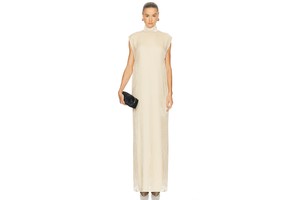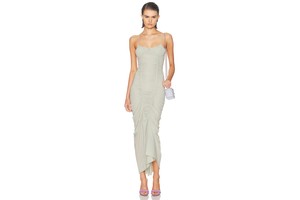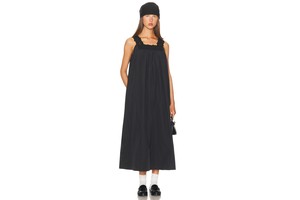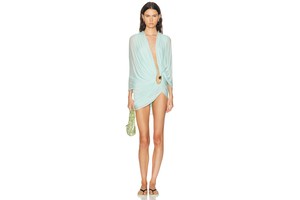
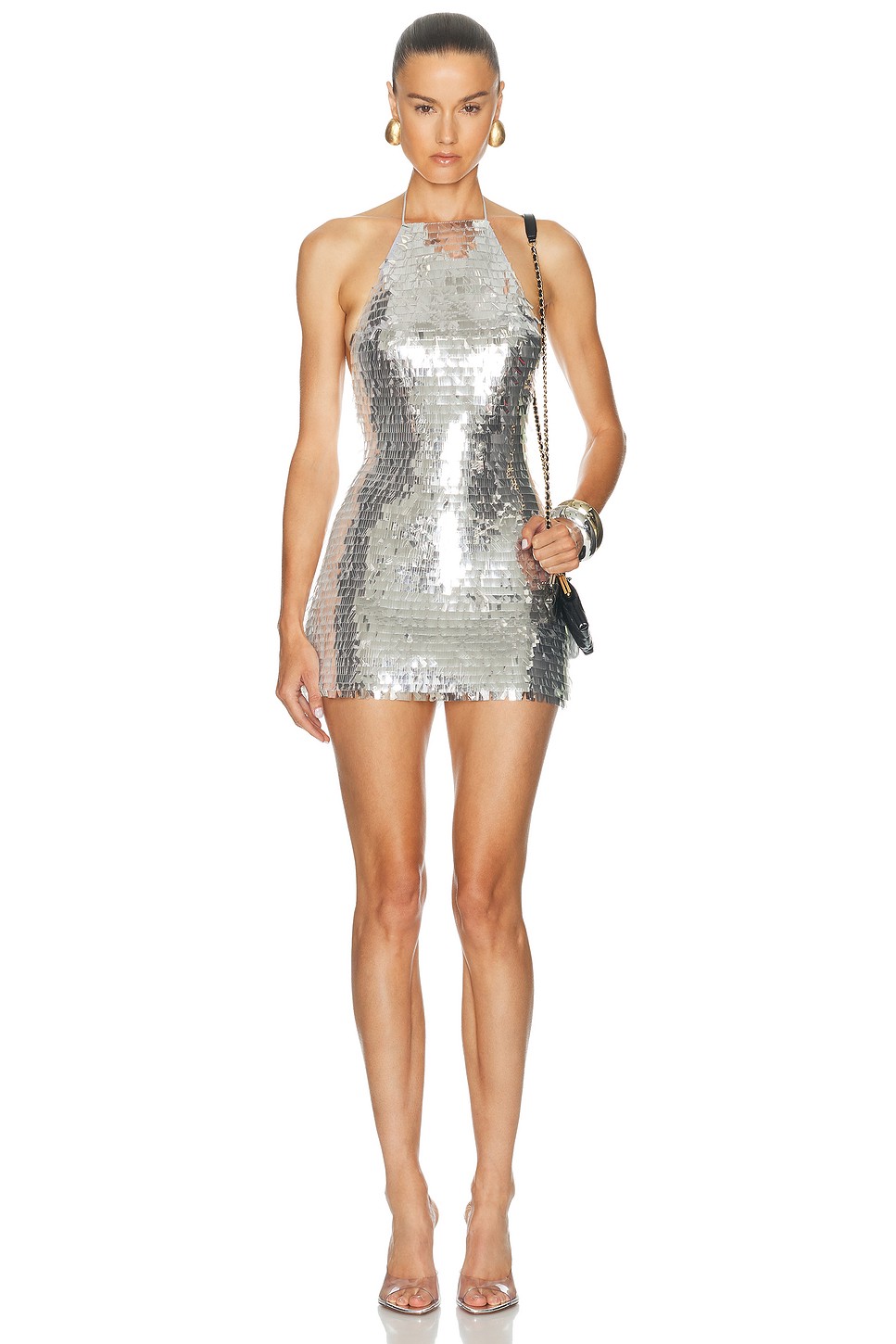
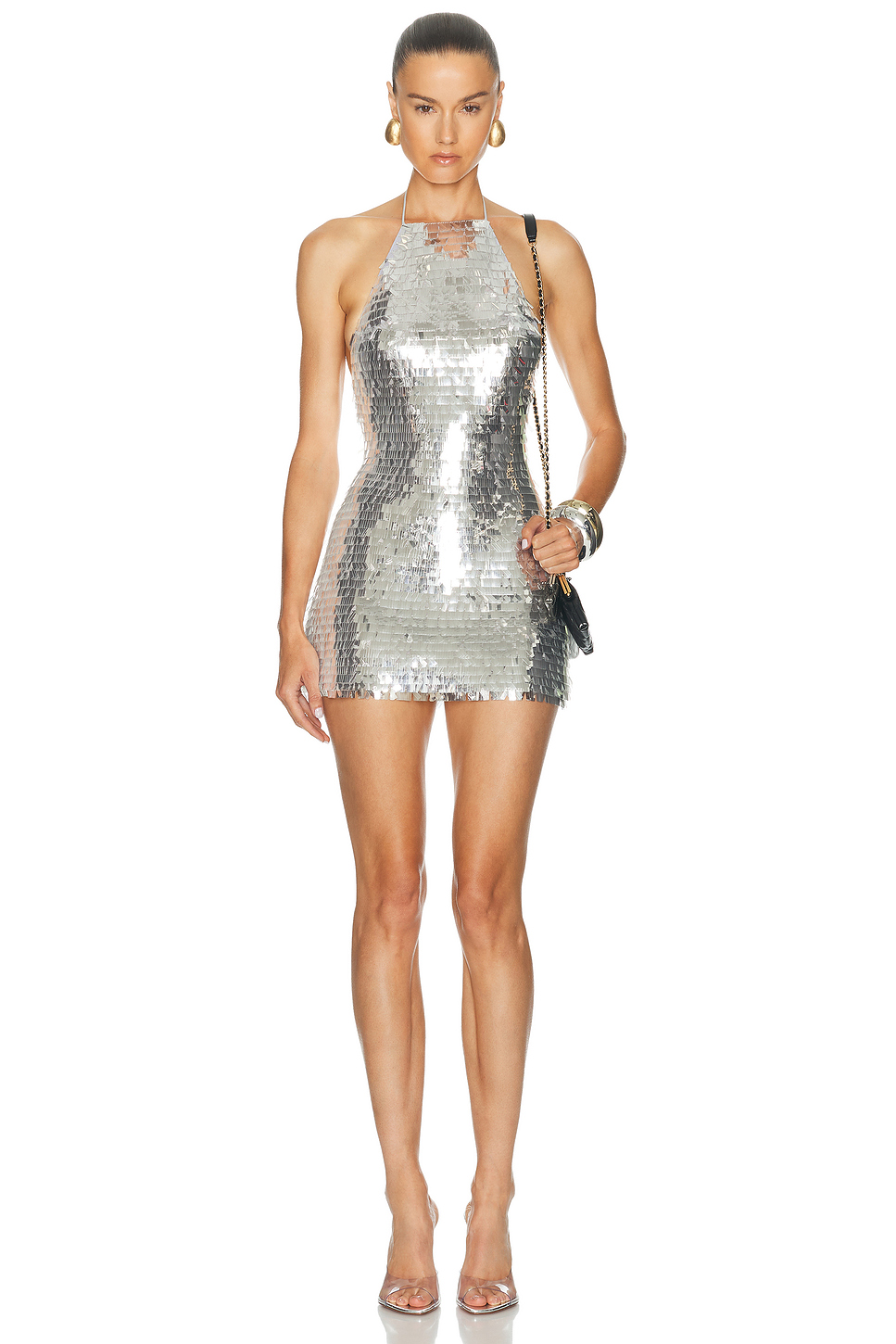
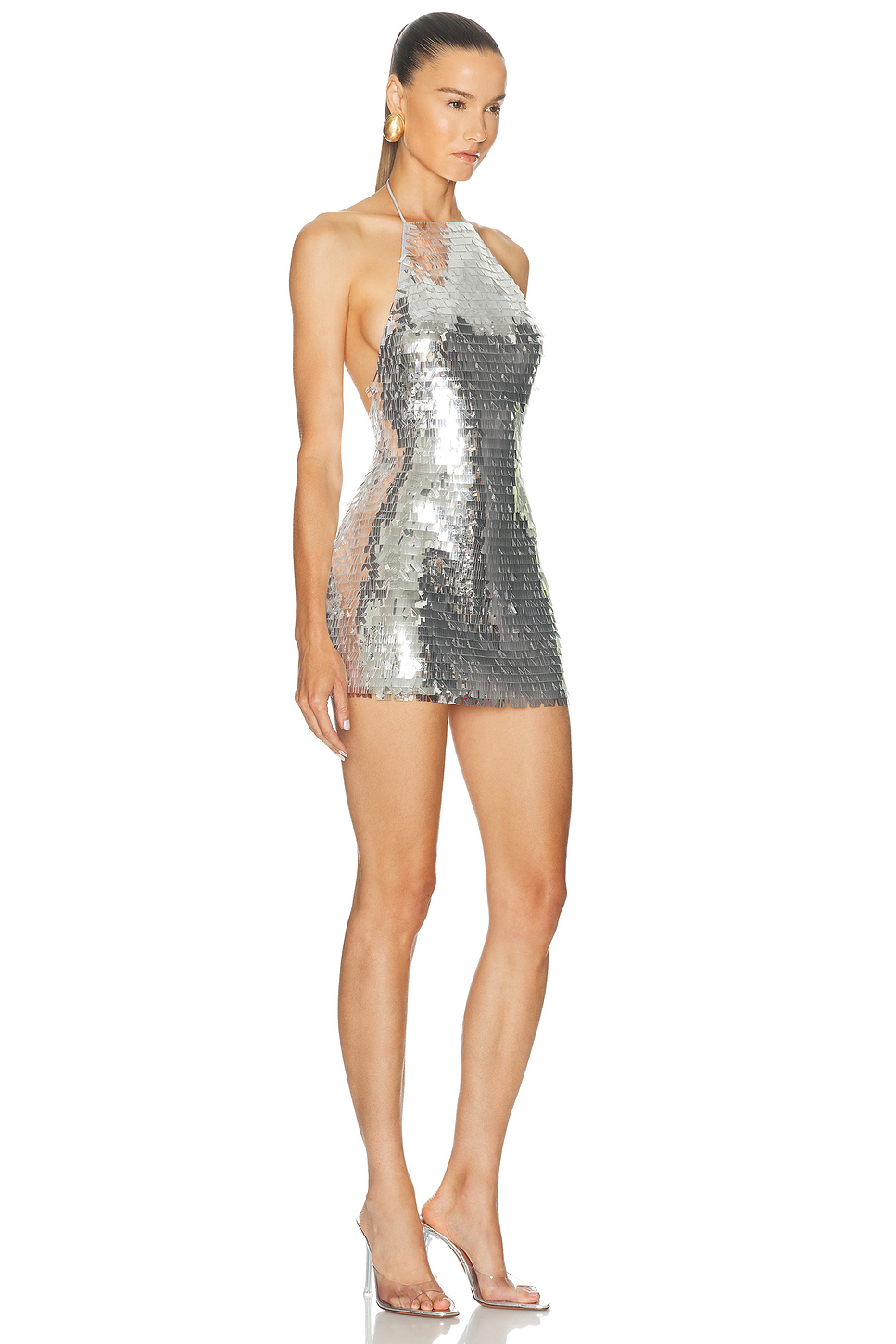
A backless halter mini listed as 95% polyester with 5% elastane for both the shell and the lining, fully lined, closed with an invisible back zip and a halter tie, in a midweight sequin fabric, dry clean only, made in China, ranked thirty sixth in the retailer's backless list, at 698 dollars. There are no reviews and no fit votes, so there is no score to quote. There are two things here that are worth a close look and both of them are unusual in a good way. The first is that the shell and the lining are given the same composition, which is the one version of this pairing we have not yet been able to praise, and it is worth saying why it matters. The second is a fabric we have not covered before, which turns out to change how you should read the elastane figure and why the care instruction on this garment is not a formality. There is also a practical point about getting this dress on that we would want to resolve before sampling, because there are two closures and both of them are behind the wearer. The reference is the Jawa Sequin Dress by retrofete in Greige. Dongguan Bafinasa Garments Co., Ltd. develops comparable sequin dresses on OEM and ODM terms, from fabric and trim sourcing to retail or FBA ready packing. We publish this as a development reference and build your own version of it, and we do not supply the branded original or reproduce anyone else's label.
Key Features
- Shell and lining: 95% polyester, 5% elastane as stated, the same composition for both
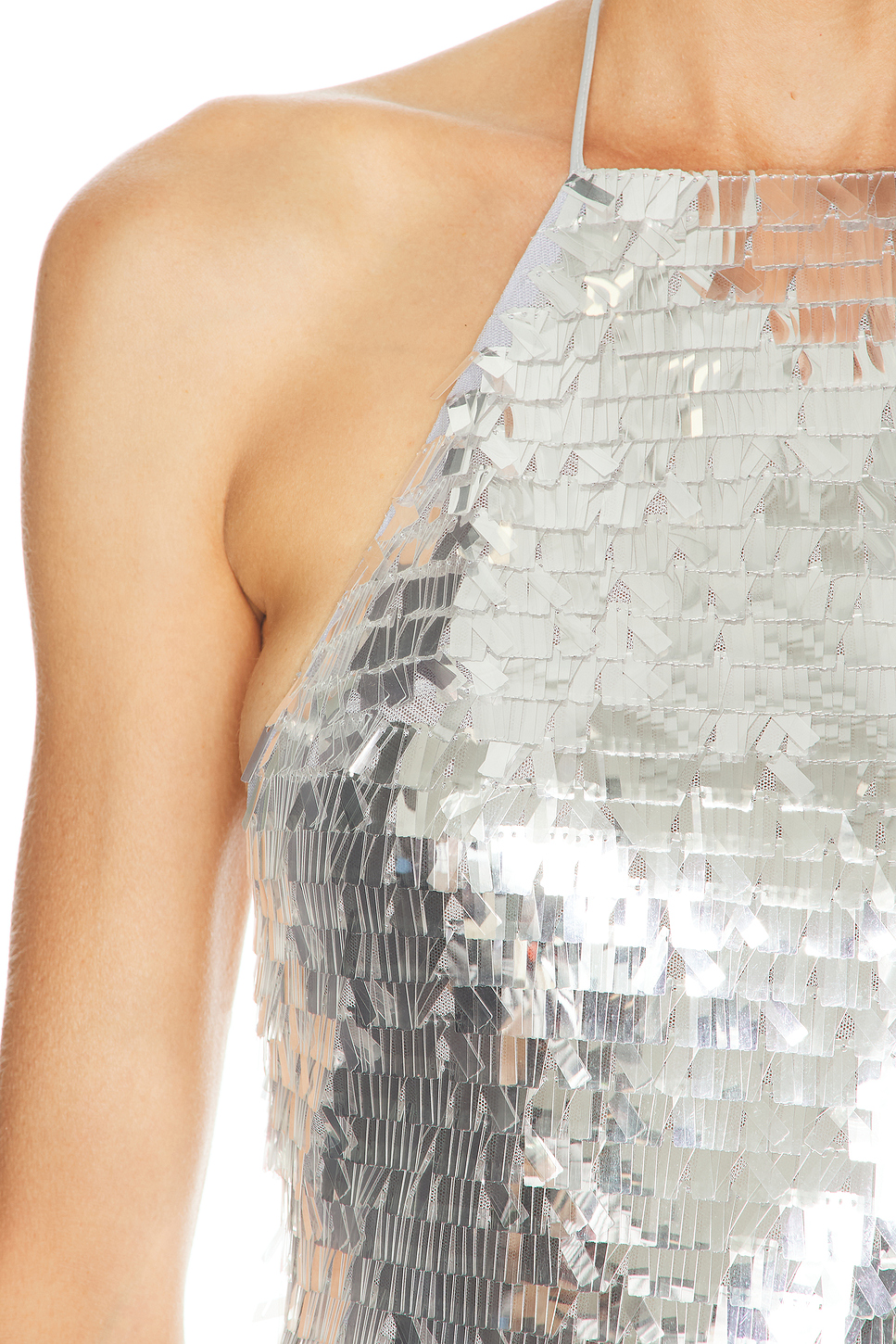
- Midweight sequin fabric as stated
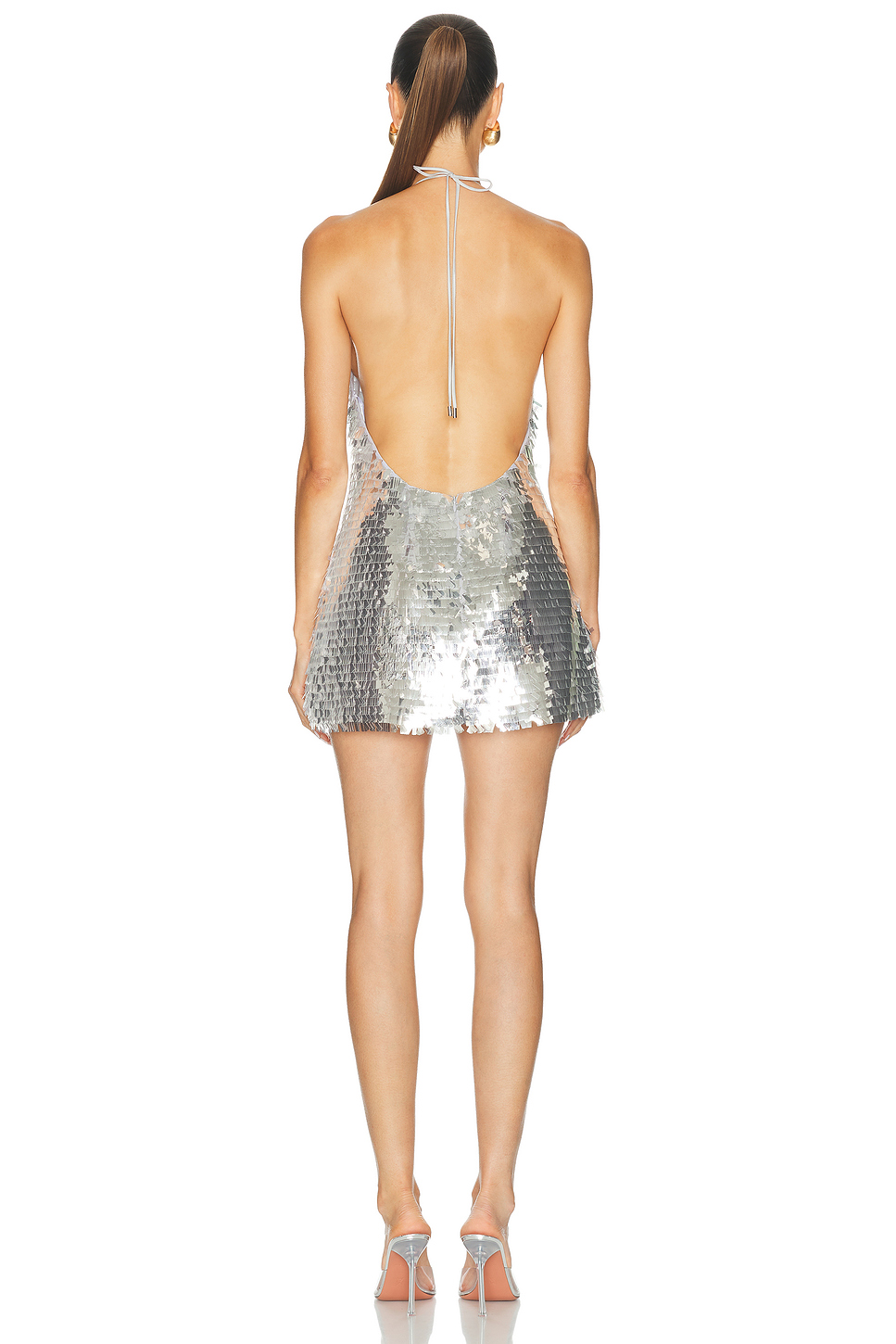
- Backless design as stated
- Halter neck with a tie closure as stated
- Invisible back zip as stated
- Fully lined as stated
- Dry clean only as stated
- Four sizes from XS to L
Customisable Options
- Fabric: polyester elastane sequin as the reference, with the sequin size, spacing and attachment method set from a tested sample
- Lining: the same composition as the shell, as the reference, which we would keep
- Closure: we would move one of the two, for the reason set out below
- Sequins: we would confirm they are sewn rather than bonded, for the reason set out below
- Length from mini to knee, back shape, size set, colour development, private label and care labelling
Specifications
| Style | Jawa sequin halter mini |
| Reference | retrofete, Jawa Sequin Dress, style RTFF-WD795, manufacturer style R-PF26-12836-17, colour Greige |
| Shell and Lining | 95% polyester, 5% elastane as stated, with both layers given the same composition |
| Fabric | Midweight sequin fabric as stated |
| Sequin Note | A sequin layer restricts the stretch of the cloth beneath it, so the elastane figure behaves differently here. See the note below |
| Neckline | Halter with a tie closure as stated |
| Closure | Invisible back zip as stated |
| Back | Backless design as stated |
| Lining | Fully lined as stated |
| Care | Dry clean only as stated |
| Sizes Published | XS, S, M, L |
| Measurements Published | S: bust 26 in, waist 30 in, hips 38 in, length 27 in |
| Chart Note | Eight inches of negative ease at the bust, which we would confirm on a body |
| Model | 179 cm, wearing size S, bust 86 cm, waist 61 cm, hips 86 cm |
| Production | Made in China as stated |
| Reference Retail | 698 USD, quoted to show the price band this sits in, not as our price |
| Customer Reviews | None on the reference listing, so we quote no score |
| Best Seller Badge | Rank 36 in the retailer's backless dress list, which is a mid position |
| Categories | Filed by the retailer under both mini dresses and halter dresses |
| Occasion | Parties, evenings, nights out, celebrations |
| MOQ | 100 pcs per style per colourway, mixed sizes and colourways accepted |
| Sampling | 7-10 days after tech pack or reference sample confirmation |
| Bulk Lead Time | 20-30 days after sample approval and deposit |
| Service | OEM / ODM / private label, sequin sourcing, halter engineering, retail or FBA ready packing |
Size Chart
| Size | Bust | Waist | Hips | Length | Source | ||||||||||||
|---|---|---|---|---|---|---|---|---|---|---|---|---|---|---|---|---|---|
| S | 26 | in | 30 | in | 38 | in | 27 | in / | 69 | cm | As published | ||||||
| XS | 31 | in / | 79 | cm | 24 | in / | 61 | cm | 34 | in / | 86 | cm | 67 | cm / | 26.4 | in | Our proposal |
| S | 33 | in / | 84 | cm | 26 | in / | 66 | cm | 36 | in / | 91 | cm | 69 | cm / | 27.2 | in | Our proposal |
| M | 35 | in / | 89 | cm | 28 | in / | 71 | cm | 38 | in / | 97 | cm | 71 | cm / | 28 | in | Our proposal |
| L | 37 | in / | 94 | cm | 30 | in / | 76 | cm | 40 | in / | 102 | cm | 73 | cm / | 28.7 | in | Our proposal |
The published size S gives a 26 inch bust, a 30 inch waist, a 38 inch hip and a 27 inch length against a model at roughly 34, 24 and 34. The waist and hip have ease and the bust is eight inches under. There is a back zip, which helps, but a sequin layer limits how much the cloth can give, so we would measure the worn bust rather than rely on the figure.
Occasions and Styling
Suits parties, evenings, nights out and celebrations. A sequin mini is a piece for a specific occasion, and it should be photographed in low light as well as bright, because sequins are bought for what they do when the light moves.
Production and Quality Control
There are no reviews and no fit votes on this listing, so there is no score to quote. There is a fabric pairing here that we have not been able to praise before, a fabric that changes how you read the elastane figure, and a practical problem with getting the dress on.
The shell and the lining are the same cloth, and that is the right answer, and that is the first thing. We have made a point throughout this series of checking whether a lining matches the fibre of its shell, and the reason is always the same: two different fibres move by different amounts, so a shell and a lining that disagree will shift against each other over time, and the garment will not sit the way it was designed to. We have flagged that mismatch repeatedly, on a silk dress lined in polyester and on a viscose gown lined in the same way, and on each occasion we noted that a dry clean instruction partly excuses it, since dry cleaning involves no water and so nothing shrinks. Here there is nothing to excuse, because the shell and the lining are both given as 95% polyester with 5% elastane. Two layers of the same cloth will behave identically, which means no differential movement at all, and that is the end of the problem rather than a mitigation of it. There is a second benefit that is easy to overlook. The lining has elastane in it too, so the lining will stretch with the shell rather than limiting it. A lining with no stretch inside a shell that has some is a hidden constraint: the shell can only go as far as the lining lets it, so the elastane in the shell is partly wasted. Here both layers have the same 5%, so the garment moves as one. This is the version of this pairing we would specify, and it is worth noting that it costs no more to do it this way than any other, because it is a choice made when the fabric is ordered rather than a feature that has to be paid for.
Sequins change what the elastane figure means, and dry clean only here is not a formality, and that is the second thing. A sequin fabric is a base cloth with discs stitched onto it, and the base cloth here has 5% elastane, which on an ordinary cloth would give it some stretch and better recovery. But a sequin layer sits on top of that cloth and restricts it. Think of what happens when the cloth tries to stretch: the cloth under each sequin can extend, but the sequins themselves cannot, and the thread holding them has only so much play, so the extension is limited by the spacing of the sequins and by how they are attached. A densely packed sequin fabric will barely stretch at all, and one with the sequins overlapping like scales has more room to move but still far less than the bare cloth. So the practical rule is that you should not read 5% elastane on a sequin fabric the way you would read it on the same cloth without sequins, because the sequins will not let the stretch happen. That matters for the measurement. The bust is published at 26 against a model at 34, so eight inches under, and there is a back zip, which is what makes it possible at all. But we would not rely on the elastane to make up any shortfall, and we would confirm the worn measurement on a body before committing to a pattern. As for the care: dry clean only is correct here and we would not soften it. Sequins are attached by thread, and agitation breaks thread, so a washing machine will shed them. Heat is worse, because most sequins are a plastic film and will soften, curl or discolour under an iron, and there is no way to press a sequin garment from the front. So it cannot be machine washed and it cannot be ironed, which leaves dry cleaning, and that should be said plainly rather than left to be inferred. One thing worth confirming at sampling: whether the sequins are sewn or bonded. Sewn sequins survive dry cleaning well. Bonded ones rely on an adhesive, and some adhesives are attacked by dry cleaning solvent, in which case the garment would lose its sequins at the cleaner, which is about the worst possible failure. It takes a minute to find out and it decides whether the whole garment is viable.
Two closures, both behind her, and that is the third thing, and it is a practical problem rather than a technical one. This dress has a halter tie, which fastens at the back of the neck, and an invisible back zip, which runs down the back of the body. So there are two things to do and neither of them is in front of her. We were hard on a button and loop at the back of the neck on a halter in this series, because a fitting that has to be aligned by feel, out of sight, behind the head, defeats people, and the halter tie here is subject to the same criticism, though a tie is more forgiving than a button because it does not have to be lined up precisely, only knotted. The zip is a separate matter and it raises a question the page does not answer, which is the order of operations. If she ties the halter first and pulls it snug, the back of the dress is now held up and under tension, and she has to close a zip against that tension, one handed, behind her. If she zips first and then ties, she is reaching behind her head to tie a knot in a garment that is already held closed. Neither is comfortable, and on a backless dress there is no slack to work with. There is a clean fix, and it is the one we would make: move the zip to the side. A side zip is reachable, it is visible if she turns, and it separates the two operations entirely, so the tie does the neck and the zip does the body and neither interferes with the other. On a backless design a side zip is also less intrusive visually, since the back is the point of the garment and a zip down its centre interrupts it. We would keep the back clean and put the closure at the side. Every bulk shipment gets a measurement report against your approved chart.
Optional upgrades include a side zip instead of a back zip, confirmation that the sequins are sewn rather than bonded, the worn bust measured on a body and published, a care label stating no machine washing and no ironing, the halter tie specified to be tied double or backed with a hook, a lining that matches the shell as here, alternative sequin sizes and densities, alternative necklines, alternative lengths, extended sizing, colour development and private label, hangtag and care labelling.
Pre-production sample approval, in-line inspection during cutting and sewing, and a final AQL inspection before packing, with measurement reports and photos shared before shipment.
Send us your tech pack, a photo or a reference garment and we will quote within 24 hours. Contact bafinasa@bafinasa.com or WhatsApp +86 13827222469.